The Nissan GTP is a type of race car made by Nissan that was used in professional racing events. It was designed to be very fast and aerodynamic, helping it compete against other high-performance cars.
The Ferrari 512 BB is a famous sports car from Ferrari that has a unique flat-12 engine. It's known for its powerful performance and stylish design, making it a sought-after classic car.
The Ferrari 365 GTB/4, or Daytona, is a famous sports car made by Ferrari a long time ago. It’s known for being very fast and having a beautiful design, making it a favorite among car lovers and collectors. People talk about it because of its impressive racing history and how special it is.
The Datsun Roadster is a small sports car made by Datsun, a brand of Nissan. It was popular in the 1960s for being fun to drive and is now a classic car that many people like to collect.
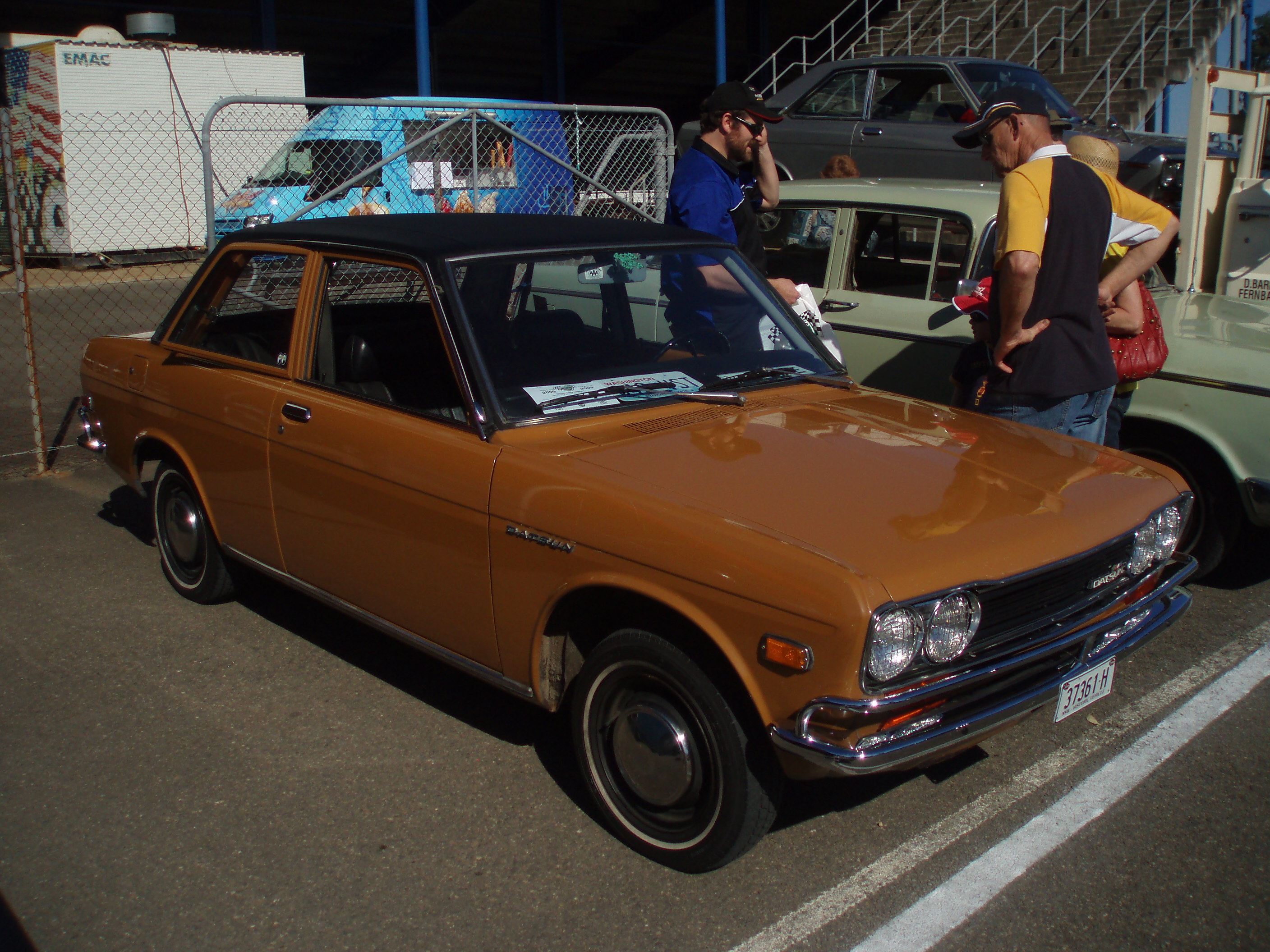
The Datsun 510 is a small car made by Nissan that was popular in the late 1960s and early 1970s. It's known for being fun to drive and often used in racing.
Formula 5000 was a type of car racing that used very powerful cars with big engines. It was popular in the 1970s and helped drivers get noticed by bigger racing leagues like Formula 1.
The Can-Am series was a type of car racing in North America where very fast sports cars competed. It was known for exciting races and attracted many famous drivers and car makers.
The Porsche 917 is a famous race car that was very successful in long-distance races. It had a powerful engine and a unique shape that helped it go really fast.
A race car is a type of car made to compete in races. They are built to be very fast and handle well on the racetrack.
Car
Lola T 400
The Lola T 400 is a type of race car made by Lola Cars. It's known for being light and fast, and it was used in racing competitions in the 1970s.
Car
Lola T332
The Lola T332 is a type of race car that was very successful in a specific racing series called Can-Am. It was designed to be very fast and was known for its unique shape that helped it go quicker.
The Porsche 356 is one of the first cars made by Porsche, built between 1948 and 1965. It’s a sporty car that many people love for its classic look and great performance. It’s often talked about because it helped start Porsche's reputation for making high-quality sports cars.
Car
Porsche 962
The Porsche 962 is another race car made by Porsche, following the 956. It was very successful in races and is known for its speed and engineering.
Indy cars are special racing cars used in a series of races called IndyCar. They are built to go very fast and are used in races on tracks that can be circular or have turns.
The Long Beach Grand Prix is a car race that takes place on the streets of Long Beach, California. It's a popular event where many fast cars compete, and it has beautiful views of the area.
Pocono is a race track in Pennsylvania where cars race in different series, including IndyCar. It has a special shape with three turns, making it different from most tracks.
Laguna Seca is a famous race track in California known for its difficult turns and hills. Many different types of races happen there, making it a popular spot for racing fans.
The Mazda RX-7 is a sporty car that uses a unique type of engine called a rotary engine. It is known for being light and fun to drive.
Car
Ferrari 333
The Ferrari 333 is a race car that was built for racing in events like Le Mans. It's known for being fast and lightweight, which helps it perform well on the track.
LIVE
Welcome to Porsche Pattern with Bracken Helms, the show where we hear Bracken and his distinguished
guests from the Porsche community patter on about Porsches and all things automotive.
Porsche Pattern is sponsored by Circuit 6-4.
Circuit 6-4 creates authentic automotive apparel made for like-minded automotive enthusiasts.
The links for Circuit 6-4 are in the shown notes.
Okay, let's get to it.
John Morton, part two.
All right, and this one we go from his days at Shelby to picking up at Peter Brock
with the BRE team, and we go all the way until he retired in 2002.
I think there's parts in this one that show his dedication to racing.
I mean, he's trying to support his family, and Peter Brock comes to him, and he's going
to pay him twice the amount of money, but like I say in this, I have to figure he's
just trying to play hardball and trying to get that driver position.
So he says, yeah, I'll come work if you let me try out for the driver position.
But he's saying he wouldn't have taken it, basically, because I guess he thought
he wouldn't have as much time to dedicate to racing.
He showed me pictures.
Like he sat there.
He had like 15 pictures of the pictures that I think the guy's name was Gene Rosentowski.
He took the pictures that kind of became famous of that wreck at Lime Rock in the
Nissan GTP.
And yeah, it looks insane.
I mean, there's just a fireball.
Then there's pictures where his helmet's like in front of the car, and he's still
in the car.
It's flippin'.
It was pretty brutal wreck.
In fact, he didn't tell me this, but I learned, and I mean, I'm not 100% sure this is true,
but because of the severity and nature of the crash, Lime Rock officials added a chicane
called the Morton Chicane at the top of the hill that reduces the chance of future
airborne incidents.
But that's pretty crazy.
I mean, they changed it because of his wreck.
There's a point where he's talking to Sylvia.
I mean, you may not know when you're listening, but you can hear him at one point say, what
was that?
And she's saying in the background, oh, it's a boxer Ferrari.
And then he says, yeah, it's a boxer Ferrari.
When we were talking about the 333 and how that felt through it, he was talking about
also driving, you know, previously the boxers.
He wanted to tell me that it's actually called the 512 BB LM, which is the Bern
Letta boxer.
And then the LM stands for Le Mans.
He also said, I think I said 89 when I was talking about my class winning the Daytona
and the 365 GTB4.
And he says, it was really 79, which I have in the notes, it's 79, but he says he thinks
he said 89.
I didn't even catch that.
And then when we were talking about the Hurley Haywood and he didn't want to drive
on the team.
So he kind of took his place.
It was as a substitute driver just to be clear.
So anyway, here is John Morton part two.
And then in 1969, Peter Brock called me.
I had a job working in a company making oil pans because I could weld, learn some stuff
at Shelby's.
I learned how to weld and make things.
So I supported my wife and child making oil pans until Peter Brock called me and asked
if I would be interested in coming to work for him.
And I said, I'll come down and talk to you because he was in El Segundo.
So I drove to El Segundo and he offered me about twice what I was making, which wasn't
a lot.
But I said, I'll take the job if I can have a test when the second Roadster is done.
Dotson Roadster, two liter, 2,000 Roadster.
I was the one that was supposed to be building it or doing a lot of the work on it, which
I did.
And when it was done, I wanted to try out and he said, okay, you can do that.
So then I tried out, I guess, successfully because I drove for him for the next three
years.
So the team ended, honestly, you probably would have taken the job regardless, but you
were kind of trying.
No, I don't think I would have.
I didn't.
I don't think I would have.
Oh, really?
I wanted to be able to do those things, but I didn't want to be, no, I meant it.
I said, I'll take the job under that condition.
Okay.
Cause I was under the impression that you would have taken, but you were kind of
playing hardball like, Hey, I want to do this.
So you got to give me a chance.
Yeah, that's, that's basically it.
But I figured you were going to take the job anyway.
I know I wasn't planning on taking it.
Okay.
For me, I can remember he offered $800 a month and I'd been making $3.20 an
hour.
So yeah, that was a big raise.
But I really was only interested in racing, not work.
I mean, I wasn't lazy.
So how long were you doing the roadster for?
69 and a lot of it in 70.
So we could race it in the same races that the Z car would race in, but the
Z car wasn't finished yet.
When did you race the 510 and when did you race the 240 Z?
The 240 Z got finished before the national championship runoffs in
Rhode Atlanta in 1970.
And I won the race.
I won the national championship.
And then again in 71, same race, one again.
And the dots and five 10 started in the beginning of 71.
That's when we ran that for two years.
71 and 72.
So in 71, we ran the Z in club races and the five 10 and the trans
am thing, which did you prefer the five 10 or the 240?
I liked them both.
I didn't have any preference.
The five 10 is it was, you know, you got paid.
I got paid to drive the Z too, but not very much.
And then I didn't get paid that much to drive the five 10, but
these, they were professional races.
Yeah, which that went on to be pretty dominant, like pole
positions and wins and yeah.
In 71, we had the pole in every race we ran with both of those cars.
We have good cars too.
Yeah.
Then what was your next move when that ended?
Well, Peter bought a Formula 5000 car as I wanted to go to
another level and it got crashed during that season or late in
the season after three races.
And so that ended the whole BRE program had been basically
ended then as a racing team.
And so I ended up buying and now I wasn't married anymore.
I had a girlfriend who I still have.
She helped, she was very diligent in trying to help me race.
And we went in debt to buy a Formula 5000 car.
It's complicated, a bunch of other stuff, but and not long story short,
we ran off our own team in the 5000 series and then the Can-Am
series, because the 5000's morphed into the Can-Am series.
The later Can-Am series, not the terrible 917 Porsches and the
McLarens and the low, you know, not that era, but the era that
started in 77.
We ran that for several years.
So I mean, yeah, there's a lot of what do you want to call
ruts in your career where, you know, lots of ruts.
Yeah, like, you know, it wasn't it wasn't all like ice cream and cake.
No, there were some down times.
And this was like one of them around 75, which I feel like helps your story.
Because I mean, some people just have it easy.
They may either have money or they luck into these things.
Whereas like you were like kind of a true racer.
Like even when you like a lot of people like, Oh, I don't have a ride.
I guess I'll go get a normal job and I'll become a normal person.
You kept with the racing even when you didn't have any money.
You were still spending money on racing.
So like it was in your blood.
So 75, I guess you were kind of like needing money or your friend was like,
Hey, let's go roof a house.
Yeah.
And then from there you con the guy.
Well, maybe not con, but you talk to the guy into buying a race car.
The guy that you're roofing his house.
And that's kind of where you got the F 5000, right?
Correct.
That was the beginning of it.
That car, I just got a text or email from the guy who's racing
that car in England, exactly like it was.
Still got my name on it.
It was a Lola T 400.
And at the same time, a car that car, this is gets really complicated.
I'm not going to go into it.
The replacement for that car was Canem Lola that went to Austria.
This is last year or the year before this car is going there.
And this one's going to England.
One's going to Austria.
I didn't own either one of them hadn't for years.
But it still had was identified as my car, you know, the history of it.
So very strange.
These cars are both going back to Europe and they were cars we struggled
with to try to pay for and try to try to race years and years before.
So the one that you bought from the roofing guy was kind of a lousy car.
You ended up buying it from him, but it was kind of a lousy car.
When did you get the next one?
There was a T 400's, the car we got from the guy whose roof we did
was a T 400, which was a failure.
It was a bad car.
It just didn't work out.
It was the next year's car and it didn't work.
So they backdated it to the last year's car.
And so we did that too.
I ran the first Long Beach Grand Prix with that car.
Oh, yeah, I do remember that.
I do remember hearing that.
Yeah, you could backdate them and then they became better cars.
And then you you turned it into a Can-Am car.
Which is I mean, I don't really everybody did.
I mean, that's kind of how that series was was fed with the old 5000.
They're not old.
They're the they were really the Lola T 3 32 is one of the most
successful race cars ever.
So which Lola did you win the win it on the 84 Le Mans?
T 116, you don't hear much about those.
It was a car, a little very small car sponsored by the Mazda factory.
And we won the C2 class.
And then we had another class win with the Nissan GTS car
10 years later in 94.
And then we were third overall, George Fulmer and I and the guy
named Kemper Miller were third overall in the Porsche 956 in 1986.
That seems a little bit weird.
So you were in the 962, even though the 956 came before the 962,
you were in the 962 in 85.
But then in 86, you were in a 956.
He just had an older car.
Didn't they didn't they have to upgrade it for the safety?
They didn't in Europe, not in Europe.
I'm so outlawed the 956 because they by saying the driver's
feet couldn't behind, could not be in front of the center line of the front axle.
Yeah. I drove for Jim Busby in nine in the 962 for two years
on the BF Goodrich team.
You got any stories about that?
No, for two years, I did the tire testing for Goodrich with those cars.
And then later I drove for Jaguar with Group 44.
And those were my favorite cars, really, as far as prototypes go.
You like those more than the Nissan that came next?
If you take the whole team into consideration,
yes, because it was an underdog team.
It was a good car.
They made a great sound with the V12 engine.
And we won two races.
Hurley Haywood and I won two races with that season.
And that was a kiss off season for Tullius because Wackenshaw
was going to take over the Jaguar program, which he did.
OK, so mid 80s, you were in 962 in a 956.
Then you did the Jaguar, then the 956 for two races.
Silverstone and Le Mans.
OK, then the Nissan.
I know somewhere you said that you wrecked in one of the Nissan's.
I don't know if it was the 300 ZX or the Group C car.
It was the GTP car.
You were a little bit bummed because you were really you were liking the car
and you kind of got replaced for a while, right?
Yeah, after the wreck.
Well, I was not in shape to race for a while.
And then I raced again a little over a month
later, around a month later, it hurt.
I mean, I had I didn't let him know, but I my neck was hurting.
But, you know, I still I raced and we won races.
I was replaced eventually by Derek Daly for a while
and then Chip Robinson.
And they thought I was damaged goods, I think, because it was a bad crash
at Lime Rock.
I mean, if you see it, it's a, you know, it doesn't look survivable.
But I survived it.
Well, I think they thought it had affected me.
How many big wrecks did you get into when you were racing?
Big wrecks.
Well, how do you just find a big wreck?
I mean, I don't care if you just scratched up the side of the car.
No, no, I had I wrecked the Nissan was a total
and burned, among other things.
That was at Lime Rock and that was in 1988.
And then in vintage, I somebody hit me in the scarab
and I tumbled and wrecked that car.
But those are the only two.
And then in the broad BRE car, we get that was this freak
rainstorm and a whole bunch of cars crashed at the end of the five
thousand race at Rotolanta in nineteen seventy two, seventy two.
Which wreck was it that your helmet fell off?
That was the Lime Rock wreck.
OK. It's on there.
You can look at it on the Internet, at least parts of it.
It was not survivable looking wreck, but I survived the car flipped over
because of aerodynamic lift and got an angle of attack at Lime Rock.
And it went upside down, tore off the dry break as it hit the ground.
And then it started tumbling and fire was, you know, like a hand grenade went off.
So how long would the ambulance have waited?
Because from what I hear, you were you don't remember saying it,
but you said we have to wait for Sylvia.
I do remember saying it.
How long were they going to wait before they're like,
oh, we got to go to the hospital.
We can't wait around all day.
Well, I wasn't near death, OK, burned when she came.
She put the water on my face so it would cool down.
And she did the, you know, scoop check to see if I had any teeth, which I did.
And I knew how worried she would be because she was a timer.
She knew what happened.
She saw the smoke and the crew didn't want her to go out
because the crew had told one of the guys, I think Elliot Ford Robinson
said, don't let her go out there because he saw the helmet.
I thought my head was in it.
I think that's basically what happened.
Don't let her go. And she went anyway.
Jeff Brabham lifted her over the fence so she could go to the ambulance.
And then the guy said, are you Sylvia?
And she said, yes, OK, we can leave now.
That's that's what that's exactly what happened. OK.
Why was the nine sixty two painted like a flag?
It was a ghost team, but it was an American paid for the,
you know, whatever it took for Yos to run that car for George Fulmer
and me and Kemper Miller.
We didn't make much money.
I think Fulmer was in charge of the money and I got four hundred dollars for that race.
But the guy who funded it had some daydream that he was going
to run the race as a driver himself.
But he had been given the ambassador ship to Mexico
from Ronald Reagan and wasn't allowed to drive.
He was very much an amateur driver anyway.
And I don't know if you follow history.
Remember when the United States wanted to bomb Gaddafi and kill Gaddafi?
What year was this, like 86? 86.
Yeah, I was like a baby. OK.
So, but you don't read history.
The US bombed Gaddafi, killed his son, actually,
and they wanted to fly over France on the way to Gaddafi.
The guy who is funding the car wanted to do something to the French
for not allowing the Americans to fly over their airspace.
He wanted to avenge.
So he was going to get even with them
by painting the car like an American flag racing in France.
So they put the stripes on.
I rate we raced it a month or so before in France.
I mean, in England at Silverstone,
it was a it was a black and yellow car like Yoast's cars were.
But here it was painted like an American flag to say screw you to the French.
So he was just kind of doing it out of spite, like being kind of pouty.
Yeah, well, he wanted to get he wanted to do Ronald Reagan a favor, I think,
and and say, look, I don't know what transpired between him.
But this is the American flag going down the straight at
two hundred and twenty miles an hour in France with an American flag.
OK, and then also in that race, you were a little bit worried at some time
because you thought your friend Jochen Moss was the one that had died.
But it ended up being.
Yeah, Joe Gardner. Yeah.
So yeah, it was quite a race.
You didn't get paid anything. You thought your friend died.
So your spot with Nissan was originally supposed to be Hurley Haywood.
Brabham was racing an Indy car and he was racing the Nissan.
When he was not racing the Indy car, he raced the Nissan.
And when he, if there was a conflict with the MCA race,
he would drive the Indy car over the Nissan,
because that's the way his contract worked somehow.
And Hurley was the driver that was going to take Jeff's place
when there was a conflict.
And then I was on a motorcycle trip with Jim Buzz
because his team wasn't running anymore.
We stopped at Sears Point to watch the race.
And the Nissan team said,
do you want to drive in place or Hurley doesn't want to drive the car anymore?
He is happy with something.
And I said, well, I feel bad about taking Hurley's ride.
And Hurley said, don't worry about it.
I don't want to be on this team anymore or something to that effect.
And you're welcome to be the driver.
I don't think he cared for that car.
And I don't know that he cared for the team.
I don't know.
I mean, certainly had friends on the people that liked him and respected him.
But so that's how I started with the Nissan team, the prototype, the GTP car.
That was 87. All right.
When did Indy, I know you raced Indy for some time.
Was it just sporadically throughout the eighties?
The first time I raced an Indy car was the Long Beach Grand Prix in 1984.
And then I raced at Pocono in 84, Caesars Palace, Laguna Seca.
And that was on a team called Jet Engineering.
And then I drove again in one race in 86 with another team.
None of them cutting edge teams.
So where was where were these races?
They were by Caesars Palace.
Like, where was this race?
I just I just don't know when they where they used to race in Las Vegas.
I mean, I know now they have Formula One and they have that track on the north side of town.
And they had Can-Am race there.
And I can't remember if it was one or two Indy car or Formula One races.
But it was it was in a Caesars Palace parking lot.
It was right next to, you know, the casino.
And I don't think I think they've done something in it.
I don't know.
Maybe that's where they have.
I don't know the structure of Caesars Palace.
But they had at least two years of racing there.
OK, then you went and started racing the 300 ZX in late 80s or 89, 90.
And so you raced one year with the 300 ZX.
Then for two years, you raced the RX7.
Then you went back to the 300 ZX for two more years.
How did that work out?
Other like 94, 95, 96, 93, I guess.
I'd run the endurance races, Sebring Daytona.
OK, I didn't run all the races, OK, 80s, 89.
And then I'd put Nissan at South America, one of the Cunningham cars,
same cars, but it was sold to a Nissan distributor in Costa Rica.
And I ran in Costa Rica and Puerto Rico, Colombia, Dominican Republic.
So you got a class win at the 300 ZX at Sebring in 93 and 95 and then overall in 94.
Right. You also got a class win at Le Mans in the 300 ZX, right?
Yeah, that was 94.
We're fifth overall, but we lost a cam and then a transmission
while we were running fourth overall.
The car was repaired so quickly that we only lost one overall position.
And still won our class.
That was 94 with Johnny O'Connell and Steve Millen.
OK, then in the 90s, you raced the Ferrari 333 for a small time.
No, I didn't race the 333.
I raced at Le Mans two years.
I drove the Ferrari, what did they call it?
It was the last car on North America, the North American racing team.
What's that?
A box, a boxer, a boxer, but it was a special boxer.
So I was looking at all your racers.
So they must they must have written it wrong because they wrote it as a 333.
I did drive a few laps in a 333.
A guy was supposed to run a second car for Momo
and he always going to come up with the money.
We were at Daytona.
I practiced in the car, never did come up with the money.
So the car was withdrawn.
So I did a few laps in the 333. OK.
We won. We finished second overall and first in our class in a Daytona
three sixty five GTB four Daytona in nineteen eighty nine.
OK, all right.
Moving on, then.
OK, so next you raced a Viper.
For like a year or two.
Two years Viper, yeah, two different teams.
And then from there, then you raced the 993 GT2,
then the 996 GTR or GT3R, then the GT3RS.
I raced at Le Mans in 1998.
The last time I raced there in a Porsche GT2.
So it was a 993.
It was turbocharged.
Yeah, a turbocharged.
It was the GT2 class.
And it wasn't the GT3 was a non turbocharged car.
Then, you know, the class has changed so much.
I don't I don't remember.
I mean, I remember what I did, but I don't know what the nomenclature
is now today for all those cars.
I know there's I raced a GT3 and IMSA.
And I don't remember what year it was.
That one was GT3 and IMSA.
It said you rate you rate like it should on the race results.
It shows you've raced a bunch like from 98 to 2002.
You raced like the 993 Porsche and the 996 like GT2 GT3RS.
Yeah, all the way to 2002.
Uh huh.
That was the last race I ran that was considered an IMSA
professional race was 2002.
And it was Montremblant.
Thanks for joining us for today's episode.
If you enjoyed the show, please subscribe, comment, like and share with your friends.
Feel free to send questions or suggestions to the email in the
description of the show.
Special thanks to our sponsor, Circuit Six Four.
Goodbye for now.
We hope we can get together again for our next episode.
Now get out there and enjoy the cars and the people.
About this episode
John Morton shares captivating stories from his racing career, detailing his transition from Shelby to Peter Brock's BRE team and his experiences in various racing series until his retirement in 2002. He discusses significant moments, including a harrowing crash at Lime Rock that led to safety changes on the track, and his dedication to racing despite financial struggles. The episode also touches on his time with Nissan, Jaguar, and various iconic cars, revealing the challenges and triumphs of a true racing enthusiast.
John Morton is a race car driver. He raced with the Shelby, BRE Datsun, Lola, Porsche, Jaguar and Nissan. Then started vintage racing after 2002.
-1971 & 1972 Trans Am Championship in Datsun 510 -1979 class win at 24 Hours of Daytona in Ferrari 365 GTB/4 -1984 class win at Le Mans in a Lola. -1993 & 1995 class win at 12 Hours of Sebring in Nissan 300ZX -1994 winner of 12 Hours of Sebring and class win at Le Mans.
In this episode we talk about: -His timeline on his racing career after Shelby.