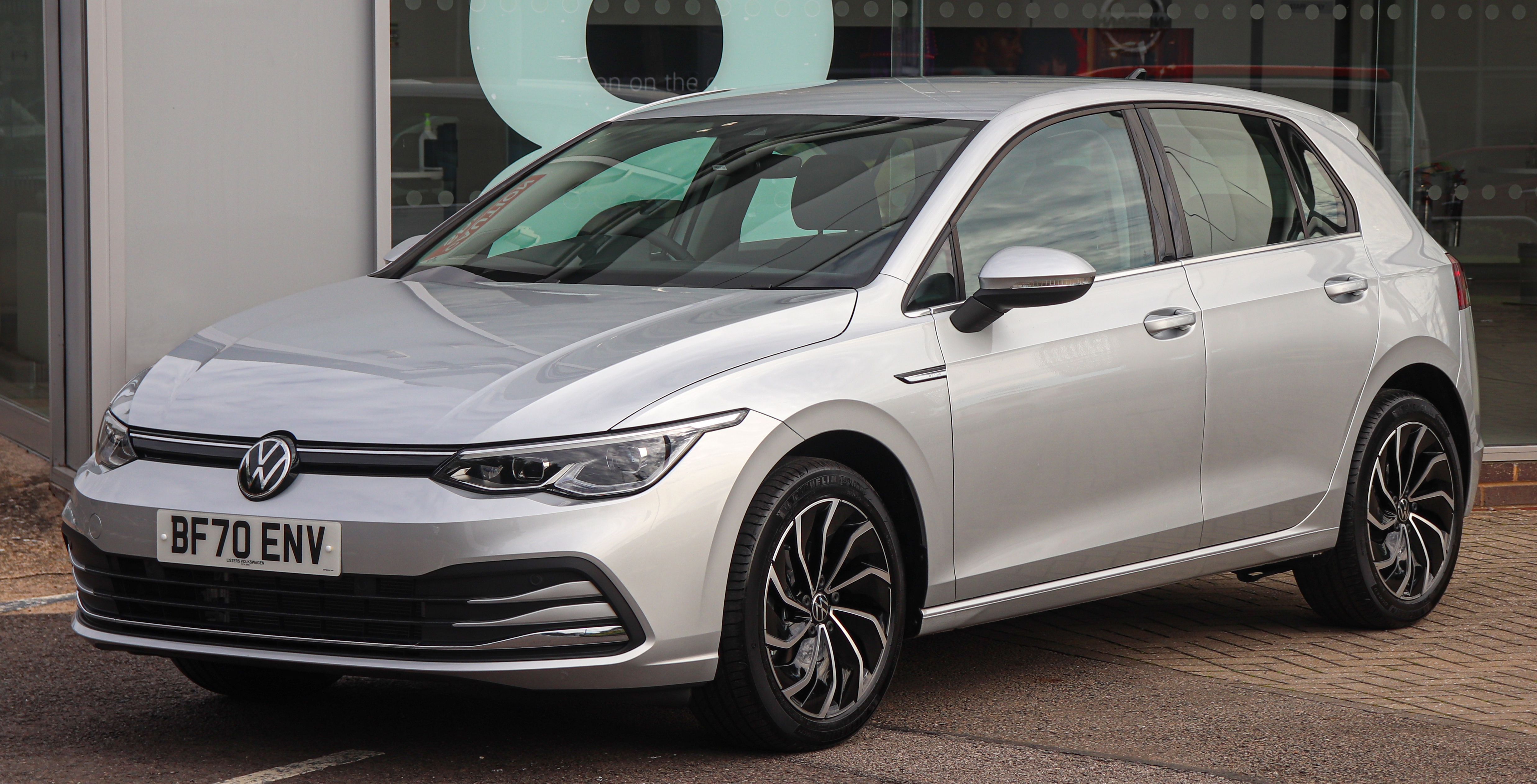
The Volkswagen Golf is a popular small hatchback that’s been around for a long time. Here, they’re talking about Volkswagen stopping the cheapest Golf in the U.S. in 2021, and what it could mean if they start selling it again.
The Volkswagen Beetle is a Volkswagen car with a distinctive, rounded shape. People often recognize it as one of the brand’s most famous models. In the podcast, it’s referenced as a common image people have when they think of Volkswagen.
The Volkswagen Bus is a van made by Volkswagen that’s known for being roomy and having a very recognizable look. People often connect it with Volkswagen’s most famous, classic vehicles. The podcast mentions it as part of the list of models people think of when they hear “Volkswagen.”
The Volkswagen Jetta is a smaller car model (a sedan) sold by VW. They mention it here to show that VW doesn’t have a huge variety of cars available at dealerships.
The Golf GTI is a sportier version of the regular Golf. In this segment, they’re using it to explain that VW’s lineup at dealers is smaller and leans more toward the fun/performance side.
A tariff is basically a tax on products that are brought into a country. If the tariff is high enough, the car can cost more to import, which can make it harder for the automaker to sell it at an affordable price.
They also mention 15% as a smaller tax rate that would be more workable. The idea is that the lower the tax, the easier it is to keep the car’s price reasonable.
The Volkswagen Tiguan is a compact SUV, meaning it’s a larger, higher-riding vehicle than a typical hatchback. It’s meant for everyday driving with extra space. The podcast is pointing out that the Tiguan is a key model when talking about how much money Volkswagen can make and where it’s built.
An abandoned cart strategy means you follow up with people who started to buy something online but didn’t finish. Here, the same idea is applied to car loan payments—helping people who begin the payment process but don’t complete it.
Delinquency rate is how many people with car loans are late paying. If it’s “30 days past due,” it means the payment is at least a month late, which can signal trouble for lenders and borrowers.
Cart abandonment is when someone puts something in an online shopping cart, then leaves before buying. The idea here is that auto lenders should measure similar “started but didn’t finish” behavior during loan payment attempts.
KPI means a “key performance indicator,” basically a number a company watches to see if things are going well. The point is that lenders should track how often people start a payment process but don’t finish it.
LIVE
Dealers, need more used cars? Fast? With Kelly Blue Book Instant Cash Offer, you can connect
directly with local sellers to win more inventory, improve look-to-book, and lower cost to market.
That's the Instant Advantage. Request a demo today at b2b.kbb.com slash ICO.
Welcome to Daily Drive for Friday, June 5th, 2026. I'm Kellen Walker in Las Vegas today on the show.
Canada's largest auto workers union is heading into contract talks with a message for the Detroit
3. Don't even think about concessions. Tesla is on a roll in China, but there's a catch,
and VW could bring more golf variants to the U.S. But one big thing has to happen first. Plus,
auto loan delinquencies are creeping up, and a payments expert says lenders are ignoring
a simple fix that Amazon figured out years ago. Let's run through all the news you need to know
to keep up in the auto industry. Unifor is heading into contract talks with the Detroit 3 with a firm
message. No concessions. The union represents about 18,000 workers at Ford, GM, and Stellantis
plants in Canada. It picked Ford as its opening target when talks begin June 22. Unifor president
Lana Payne says workers are prioritizing wages, retirement security, and getting laid off members
back on the job. That's even as U.S. tariffs freeze investment in two Ontario assembly plants
sit idle. Unifor aims to wrap up Ford talks by July 10. Contracts expire September 20.
Tesla is holding its ground in China. The company's Chinese-made EV sales jumped 39% in May compared
to a year ago. It's seventh straight month of growth. According to the China Passenger Car
Association, Tesla delivered nearly 86,000 vehicles last month, including exports to Europe and other
markets. But Tesla is still waiting on regulatory approval in China to roll out its most advanced
driver assistance features while local rivals like BYD race ahead on smart driving technology.
And Volkswagen could expand its golf lineup in the U.S. as production moves from Germany to
Mexico in 2027. VW Group of America CEO, Cal Gruner, says more variants are on the table,
but whether they arrive depends heavily on where tariffs land.
Here to talk more about it is our own Jack Wallsworth, who covers Volkswagen Group and its
brands for us at Automotive News. Jack, welcome back to daily drive.
Hey, Cal, good to be here.
All right, Jack, so VW dropped the entry-level golf in the U.S. back in 2021. What would
bringing it back mean for the brand's positioning here?
Yeah, I think it would be a good win for the brand for a couple of different reasons. One,
the golf has been around for a very long time. It goes back several decades. It's one of those
name plates that I think when people think of Volkswagen, obviously think of Beetle on the
bus, but then golf is probably right up there too. And I think it's one of those miles that
really speaks to the beauty of Volkswagen, fun practical cars that are affordable,
fun to drive, engaging, but also very usable and whatnot. A hatchback isn't the craziest
product idea, but the golf definitely makes it fun and entertaining. So I think from that
standpoint, it would be a good emotional win for the brand. It would be something that
people might be like, oh, I remember the golf. I'll come into a Volkswagen showroom.
And then also, it would give Volkswagen dealers another vehicle. Their lineup isn't really that
big. All things considered, they've got some crossovers. They've got the Jetta and the Golf GTI
and the Golf R, more as like performance vehicles, but generally speaking, the lineup's kind of small.
So I think giving dealers another entry affordable vehicle would be a big win, especially vehicles
keep getting more expensive. We don't necessarily expect that changing anytime soon. So getting
another affordable model in the lineup that's also fun to drive seems like a win. So it's
one of those things I go to play for a couple of different ways, both on emotions, but also
like just practical reasons. Now, Gruner mentioned tariffs as the deciding factor.
What's the realistic threshold where this actually makes business sense for VW?
Yeah. So I feel like the current tariff wouldn't work. And Gruner did say, you know,
a 25% tariff on an entry golf would be difficult. So I think as things stand right now, it doesn't
seem likely. But if that number through talks gets lowered, you know, maybe Gruner talked about
like 15% being where Volkswagen would like things to be at, and then even lower from there. That's
maybe where it probably starts to make more sense. I would imagine if Volkswagen brought the golf back
to the US, it would be USMC compliant, which would help with the tariff situation. But even then,
I mean, a compact hatchback, the margins are going to be as great as a Tiguan or a Taos,
which are also built in Mexico. So I think it'd have to be obviously lower than what the tariffs
are right now. But I'm thinking maybe like that 15% or lower. But we'll see. I mean,
definitely think Volkswagen can make it work on the GTI and the R at the current rate,
but it would definitely need to be lower for the non-sporty golf. So to be determined.
Perfect. Jack Wallsworth, thank you so much for joining me.
Yep. Anytime. Thanks, Kyle.
Coming up, auto loan delinquencies are on the rise, and a payments expert says lenders are
missing a trick that e-commerce mastered years ago. That's next on Daily Drive.
Dealers, need more used cars? Fast? You're not alone. And waiting for inventory to show up
isn't much of a strategy. That's where Kelly Blue Book's instant cash offer comes in.
Backed by Kelly Blue Book's 100 years of trusted valuation expertise,
instant cash offer connects you directly with local sellers so you can win more inventory
right when you need it. And because the experience is transparent and consistent from the first
click, it helps build trust early before a customer ever walks through your doors.
That trust matters. It sets expectations up front, reducing friction in the appraisal process.
What that means for your team is more control over how inventory comes onto your lot
and more time focused on selling cars, not chasing them. It's a smarter way to source
inventory in today's competitive market, and that's the instant advantage. If you're ready
to connect with local sellers, win more inventory opportunities, and lower cost of market with an
approach dealers rely on, check out Kelly Blue Book Instant Cash Offer. Request a demo today
at B2B.KBB.com slash ICO. Welcome back to Daily Drive. I'm Kellan Walker.
30-day auto loan delinquencies are at some of their highest levels since the pandemic
and ticking up. Paynear Me's Steve Kramer says part of the problem isn't borrowers,
it's lenders who've built clean payment portals for customers who follow the happy path
and ignored everyone else. Kramer is vice president of product at Paynear Me,
a payment technology company that works with auto lenders. He joins our own Dan Shine to
talk about what an abandoned cart strategy looks like for loan servicing and why a
decline payment is actually an opportunity. Steve, thanks so much for joining me on the
F&I Friday edition of Daily Drive. Dan, thanks for having me.
Seems, I guess, since the pandemic, there's been a lot of focus on people who have defaulting on
loans and repossessions and things like that. And it seems to be, again, inching up a little ever
so slightly with the economic factors that we have today. But you kind of talk a little bit
about how people want to make payments, but auto payments are running into friction points.
Can you explain a little bit about that? Yeah, absolutely. And you're right. Delinquency rates
are ticking up 30-day past dues or some of the highest levels we've seen since the pandemic.
And there are many reasons for it. And one of the things you really need to do
is figure out how you can remove that friction, make it easy for the consumer. I'll give you an
example. I don't know if you're an Amazon shopper. My family certainly is. If you shop,
if you go to Amazon, you put something in your cart and then you leave, you know what happens.
You get that email, hey, you put something in your cart, you didn't. Did you forget about that?
There's a reason they and most major e-commerce vendors do that. It's because it works.
It's re-engaging the consumer. It's reminding them of, hey, there's something here. And it's
tracking a key metric, cart abandonment. That's standard in e-commerce. But in loan management
and loan servicing, it's not existed. If you ask most people in the loan service, well,
what's your abandonment rate? They kind of look at you like, huh, I haven't really thought about
that. That's a key KPI, right? Hey, you've got consumers coming in. They're clearly willing to
do something here. They're coming to your site. Most people don't just go to their auto lender
site just for fun. But they dropped off for some reason. Well, why aren't you tracking that metric?
Why aren't you re-engaging that consumer and saying, hey, by the way, we know you came and
you know your bill is still due. And what can you do to help drive that consumer, remind them of
the fact that you still have an obligation here, you still really need to pay and kind of get
them back into that payment cycle. Why is that reason? Is it part of that loan providers,
auto loan providers, feel that people are still mailing in a check or they're just doing a bank
transfer? And this is just not something they think a large segment of their borrowers do?
It's partially that. But it's also that a lot of these folks, they view the happy path, right?
Let me set up a website. Let me let them pay with these methods. Great. I'm in good shape now,
right? I've made it so people can come in. What they don't look at is what happens when that happy
path doesn't happen, right? What happens when the consumer either comes in and doesn't pay you
or comes in and to your point earlier hits some sort of friction. Forgot a password. Their card
didn't work. Their card declined. Something else occurred to them. And that path is often not
looked at by loan servicers to say, wait a minute. Yeah. Okay. I've set up my site. I've got a call
center. I've got a website. I'm good, right? I'm ready for consumers to come and pay me.
If you build them, they will come kind of thing, but not the wait a minute. What happens when
something goes wrong? Maybe I should make sure that if something goes wrong and we kind of look at it
as a willingness ability kind of vision. If the consumer is willing but not able, what can you
do to get them able to or if they're able to but not willing because there's too much friction in
there? Well, what can you do to help them and get them more willing to pay and make it easier for
them? More and more consumers are used to, like you said, the Amazon experience, like the ride app,
the ride share, food delivery. People are becoming more and more comfortable and familiar with that
type of transaction that you would think that auto lenders would also want to get in on. Again,
they always talk about meeting the customer where they are. I think more and more customers are
familiar and comfortable with transacting via mobile or an app or something that makes their
life a little bit easier than going to their bank or writing out a check if anybody even does it
anymore. Again, why is this technology not more common? It's a great question, right? It really is.
As I said, people kind of view that happy path. I'm good. People are set up. They can come in.
The numbers that really should get these auto lenders' attention, right? As you said at the
beginning of this, we're seeing an uptick in 30-day delinquencies and in real delinquency,
right, in terms of what's going on there. When you start using technologies like,
hey, let me just remind the consumer, hey, you came here. You didn't pay me. You really need to and
use the technology that e-commerce has used for years. We've seen a 7% uptick in consumer
payments just from sending those reminders to consumers. That's 7% of those consumers
that might have fallen into delinquency, might have paid late, might have had a bad experience
with your site that you've just recovered and, by the way, recovered in a self-serve fashion.
You didn't have to make outbound calls, which are so expensive, to try and collect those funds.
You recaptured those consumers. Those are the numbers that I don't think have
been published very well that really I think should get those auto lenders' attention of,
wait, are you telling me I can get a 7% uplift in my payments just by simply sending out these
reminders to consumers? That's something that and the KPI of, have I actually looked at my
abandonment rate? Are things really auto lenders need to keep top of mind?
One other thing you note, and you wrote kind enough to write a guest commentary for automotive
news on this kind of topic, is also often when someone tries to make a payment on their auto
loan and it says payment unsuccessful for whatever reason, card decline, and that's kind of the end
of it. And you say auto lenders need to borrow a page from a rideshare or food delivery apps
about how they handle when a payment is declined. Absolutely. Look, one thing we've seen in the data
is when a consumer comes in, they know they have an auto loan they need to pay, and they try and pay,
let's say with the debit card that declines, very, very often we see that consumer try again
and try again and try again. You'll see multiple declines in a row. That's bad for multiple reasons,
right? One, terrible consumer experience, right? Talk about friction, talk about frustrating your
consumer. Two, it's costly, right? And there is a cost to every single one of those. And three,
you're not getting that payment. So what we've seen is if you just take a page out of some of those
other applications, rideshares or whatever, and say, hey, we see your payment declined,
perhaps you should try one of these methods instead and offer up what you think is going
to be the best method for them to pay so they don't keep trying that same card over and over again,
you're going to see an uplift. We've actually seen a 9% lift in payments recovered just by doing that,
just by saying, hey, we're seeing a failure here, perhaps you should try one of these methods instead.
And by the way, if you have a really, really troubled consumer, right, where they simply
can't pay, again, don't let them drop off. You've got them on the line, perhaps that for those
consumers, you put up something that says, hey, look, we see you're having trouble,
do you need to talk to somebody? And that's an indication to you of let's jump them in the queue,
let's get them to talk to someone. They're engaged right now, right? Don't let them drop off.
And perhaps they need a loan modification, a change of due date, a change of terms,
something to keep that consumer from going delinquent at the time, like I said,
while they're engaged in the process. And then something else I found interesting,
because you talked a little bit about enabling borrowers to invite a friend or family member
to cover payment. And I've been out with my kids and whether they were friends,
and someone may buy dinner, may buy them a drink at the bar, and they're automatically
on their phone, been mowing them to cover that their portion of the meal or their drink. And
this again, is something that maybe you suggest that auto lenders should look into is like,
let someone else, if you've got a family member who might cover that monthly payment for one month,
they should, you know, enable that to happen. Yeah, there's, there've been surveys out there
that say, hey, look, if you were in financial distress, would you ask a friend or family member
to help you out? And it was nearly half of consumers said they would. And we also actually
see it in the data. People will say, you know, we'll see a third party, a father, a brother,
whoever, helping out and making that payment. And it's going on today. You know, there's,
there's studies out there showing, you know, literally, you know, billions of dollars in
quote, shadow debt, you know, I borrowed this money from my family member or friend. The struggle
there is, it's already happening for these auto lenders, right? The family member or friend is
paying on behalf of a consumer. But the challenge they've got is twofold, right? One, that family
member may make a mistake and go, oh, yeah, here's my debit card, and accidentally checked that
little box that says save this on file. Well, that's not good, right? Because now, you know,
I now have access to my father's debit card for next month. That's great for me. So that's not
good. But the second and probably even more important thing is some consumer asking a family
member or friend to pay on their behalf is a real indication that there's something up with that
consumer, right? And, and right now, the lender is completely oblivious to that. They don't know
that this occurred. So if you put something in place that says, hey, let's let them invite a
family member or friend, make sure that they can't save their debit card or their bank account on
file. But let's also, if they invite it, let's send a note to the auto lender so they can go,
oh, there's something going on here, I should probably reach out to that consumer before they
go to Linquins and say, do you need help? Is there something we can do to keep you current?
Set up a payment plan, change a due date, change a loan mod of some kind. It gives that, you know,
auto lender a chance to intervene before that consumer hits on Linquins. And that's really
a thing. That's such a leading indicator of a problem with that loan or that consumer that
they're asking somebody else to pay on their behalf. At least they're asking, which is great.
But there's clearly something going on there. So in, in closing, there are big benefits for
auto lenders who can, you know, track abandonment rates and, you know, kind of reengage borrowers
who stalled out and are providing a kind of a safe way for, you know, them to invite a friend
over to make a payment. Yeah, absolutely. You really need to look at it holistically, right?
How do I enable these consumers that want to pay me, remove friction, as you said earlier, right?
Let them invite a friend or family member in to help them pay and let me know about that.
And if they don't pay, let me reengage them. Let me make sure that they're, you know,
borrow a page from that e-commerce has been using for years to try and pull that in.
Anything you can do to find those leading indicators and try to engage that consumer ahead
so that you're getting that payment in before they become 30 days or more delinquent.
Absolutely. There's huge advantages for auto lenders there.
Steve, interesting conversation. Really appreciate your time.
Dan, thanks for inviting me. This is a great conversation.
We know anything about Sean Fane. When he goes on strike, he knows what it takes to hurt the
company. Think back to when he struck the Detroit three. He knew what the choke points were. He knew
what plants would do the most damage the fastest. We'd love to hear from you. Let us know what you
think of the show and the topics we cover today. Send us an email at dailydrive at autonews.com
or leave us a voicemail at 313-444-2774. And if you enjoy the podcast, remember to like,
leave a review and subscribe so you never miss an episode.
About this episode
Tariffs and compliance are at the center of the discussion around whether Volkswagen can bring back the entry-level Golf in the U.S., with hosts weighing how a 25% tariff could strain the business case and why a lower target like 15% matters. The conversation then pivots to PayNearMe’s Steve Kramer, who explains how auto lenders can reduce delinquency by borrowing “abandoned cart” tactics—tracking payment-flow signals, sending reminders, and recovering declined payments with alternative methods.
Auto loan delinquencies are ticking up and PayNearMe’s Steve Kramer says lenders are leaving money on the table by ignoring a strategy that e-commerce has used for years. Volkswagen could expand its Golf lineup in the U.S. if tariffs cooperate. Plus, Canada’s largest auto workers union is heading into contract talks with a message for the Detroit Three: don’t even think about concessions.