A ratcheting style jack is a tool used to lift cars. You slide it under the tire and use a handle to raise the car up, making it easier to work on the vehicle.
Dollies are like carts that help you move cars around easily, especially when you're working on them. They make it simpler to shift a car without having to lift it too much.
A heavy duty jack is a tool used to lift heavy cars or trucks off the ground. It's built to handle a lot of weight, making it safe to work on larger vehicles.
Four wheel drive means that all four wheels of a car can move at the same time. This helps the car grip the road better, especially when driving on rough or slippery surfaces.
Hemi is a type of engine that helps cars produce more power. It's named for its round shape that looks like a half-sphere, which helps the engine work better.
The Dodge Challenger is a popular muscle car that has been around for a long time. It's known for its strong engines and cool design, making it a favorite among car enthusiasts.
A restomod is when someone takes an old car and fixes it up, adding new parts to make it work better and feel more comfortable. It's a mix of old style and new technology.
The Chevrolet El Camino is a car that looks like a pickup truck. The 1959 version is known for being very stylish and is loved by many people who enjoy classic cars.
The Willys Jeep is a classic vehicle that was built for tough terrains and military use. It's known for being durable and is often associated with outdoor activities.
The Chevrolet Corvette is a famous sports car in America. The 1959 version is especially loved for its unique style and speed.
Car
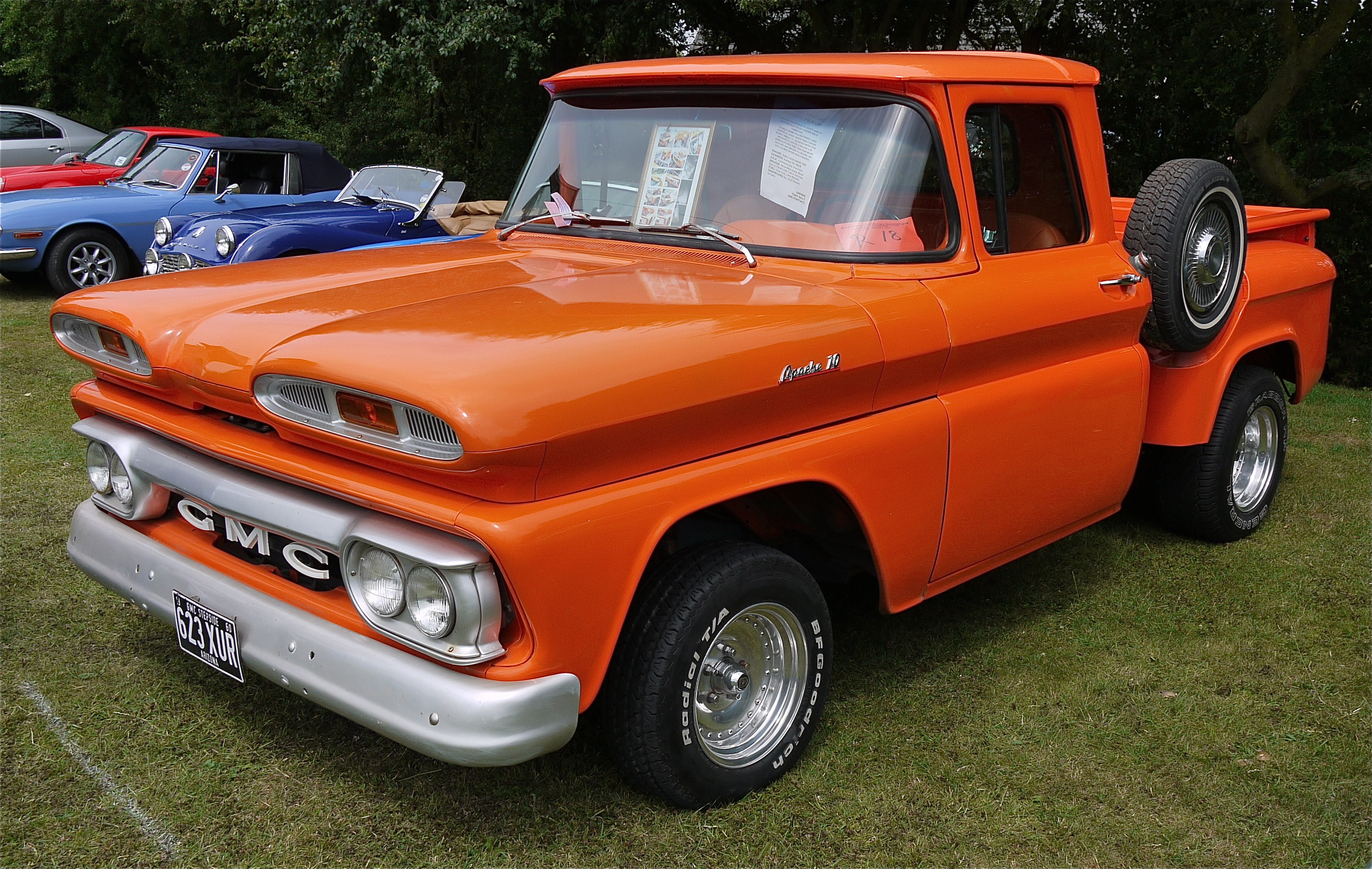
GMC Apache
The GMC Apache is an old pickup truck that many people like because of its unique look and strong build. It's often restored or customized by fans who enjoy working on classic vehicles.
The aftermarket is where you can buy parts and accessories for your car after you've bought it. This can include upgrades or repairs that weren't included when you first purchased the vehicle.
Honda is a Japanese car brand that makes many popular and reliable cars. They're known for models like the Civic and Accord, which many people trust to last a long time.
The Shelby Cobra is a famous sports car from the 1960s that many people love for its speed and unique style. Nowadays, some people build their own versions of this car using kits, which makes it a fun project for car lovers.
The Mazda Miata is a small sports car that's known for being fun to drive. The 1991 version is one of the earlier models and is loved by many car enthusiasts.
A '400 horse motor' means the engine can produce 400 horsepower, which is a lot of power for a small car. It makes the car much faster and more exciting to drive.
Cornwell Tools makes high-quality tools that mechanics and car enthusiasts use to fix and maintain vehicles. They're a trusted brand in the automotive industry.
Original parts are the same parts that were used when the car was first built. They are important for keeping the car true to its original design, especially during restorations.
Custom parts are special pieces made to change or improve a car, often made by companies other than the original manufacturer. They can make a car look or perform differently.
LMC Truck is a business that sells parts for older trucks. If you're fixing up a truck, they probably have the small pieces you need, like screws and nuts.
The Willys Jeep is an old vehicle that was used by the military during World War II. It's known for being tough and able to drive on rough roads, which makes it popular with people who like to go off-roading.
The Nissan 260Z is a classic car that many people love for its sporty look and fun driving experience. It's part of a series of cars from Nissan called the Z series, which are known for being fast and stylish.
The Chevrolet Camaro is a cool sports car that people love for its speed and looks. It's been around for a long time and is known for being fun to drive, especially if you like powerful cars.
The Toyota Supra is a fast and stylish sports car that many people admire. It's known for being really powerful and is popular among car fans who like to modify their vehicles for even better performance.
The Nissan Maxima is a roomy car that's good for families and people who want a comfortable ride. It's known for being reliable and having nice features, making it a popular choice.
The Datsun 240 is an older sports car that many people love for its speed and style. It was made in the 1970s and is part of a popular line of cars called Z-cars.
The Volvo 240 is an older car that many people trust because it's built to last and is very safe. However, since it's been around for a while, you might find that some of them are not in great shape anymore.
The Datsun 240Z is a classic sports car that many people love for its speed and good looks. It's a popular choice for collectors because it's fun to drive and has a cool design.
LIVE
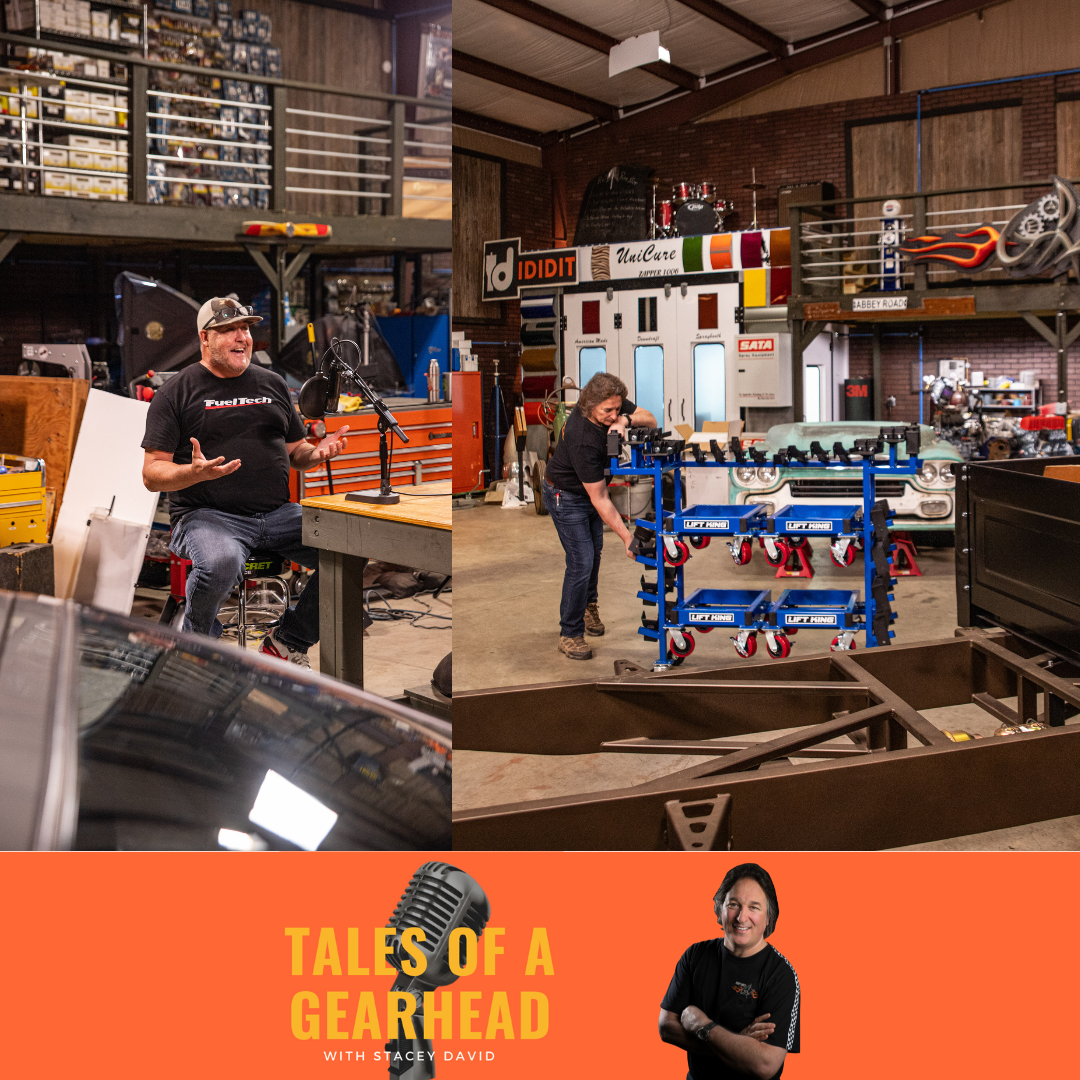
Hey, Stacey David here with the Tales of the Gearhead podcast.
Now this is a podcast about everything automotive, everything mechanical.
You're going to get advice, you're going to get ideas, you're going to hear guests,
you're going to hear people that are just like you.
Everything is going to be wrapped around the automotive lifestyle so we know you're going
to love it.
Today's podcast is brought to you by Cornwell Tools and LMC Truck.
All right, let's get rolling.
All right, we got a great podcast for you guys today.
Got a couple of guests here.
I've got LJ and Munch from Lift King.
And if you're not familiar with Lift King, they build some really incredible shop
tools and some stuff that you're definitely going to want to check out and
hear about.
We're going to go into some of their design work, how they come up with some
products.
But also Munch is a very well known painter.
So we're going to talk about that a little bit as well.
So guys, welcome to the podcast.
Thanks for having us.
I appreciate you.
All right, let's talk about Lift King a little bit.
People have seen me use the products on the show before.
The bed lifters, fantastic.
This allows one person to lift the bed off of a truck.
If you don't have one, if you're working on a truck, you better get one
because it will save your life.
First of all, how do you develop your products?
Well, Stacey, so we, you know, we focus on building things, heavy
duty, you know, and that's our whole focus.
Yeah. And we don't want to build things that is limited to certain size, certain,
you know, so this isn't one or two uses sort of stuff.
No, this is long term.
You know, we build everything to last forever or, you know, a really long time
to be used. Absolutely.
So you've got your body dollies, you've got frame dollies.
You have that rack.
Oh my gosh.
OK, most of you guys know if you've ever worked in a body shop or anything,
you know, the racks that you hang fenders on and this and that.
And they're little spindly things.
Half the time they're tipping over.
You got to be careful how you do.
You brought me in a rack that looks like it looks like it carries aircraft parts,
man. Tell me about the rack.
How'd that come about?
Well, so here's the thing, Stacey.
So a lot of the competitive racks out there, you know, they're typically
referred to as like a parts cart.
Yeah. And they're light duty.
Yeah. Well, we focus in the big truck industry as well as the automotive.
A lot of other groups are focused strictly automotive.
So when we build something, we need to accommodate much heavier things
like the big truck market. Yeah.
And as we're building that particular rack that will you could pull a turbo
off a Peter built or whatever, and you can put it on the shelf
and it's not going to come through. Yeah.
You start putting that in the automotive side and they're blown away.
They're like, wow, I mean, I can put things on here.
I never even thought of because it's also designed for the heavy shot.
So we build it. It'll work both, you know, heavy duty and light duty.
Yeah. Now, most of you guys out there, you're listening to this,
you've probably heard of Gojax or the ratcheting style, Jax,
where you slide them under a tire, you jack the car up.
So you kind of in one fell swoop, you jack up the car and make it
so you can roll it around.
But yours are a little different because these are dollies that actually
you have to jack the car up, but your dollies are so heavy duty.
And then they also have attachments for pinch welds or just a frame saddle
or all kinds of things will bolt to your bolt pattern.
So tell me how that came about.
It's such a better tool for a guy that's doing like a frame off build
or some some sort of thing like that.
Well, over the years, I've had shops that would contact us and, you know,
we'd talk to them about different dollies to move cars around.
And they would complain, you know, they would say, you know,
we can go to such and such company and buy one that works great for
if you want to bolt to the hub or if you want to jack the car up
and just move it around a little bit.
But we need something that will, you know, that will work in multiple scenarios.
So we focused on building a jack that's really heavy duty.
And when I say really heavy duty so that you could put a full,
you know, you could put a full size four wheel drive, you know, truck on it
with no issue. So we're talking eight thousand pounds, you know,
we're putting some, you know, full running truck diesel.
But we wanted to be able to don't try that with a go jack.
I'll just tell you that right now.
It is not going to work. Not going to work.
I've done it. Go ahead.
Well, in our case, you know, we wanted to be able to,
if you just wanted to drop the wheel in, yeah, you could.
If you want to connect to the hub assembly, you can pinch weld.
If you want to set it down on the frame, yeah, but at the same time,
if you set it down in the frame with all the different designs and frames,
you have to have everything independently adjustable.
Yeah. And in some cases, you want to just a minor adjustment
because if you're lower in a vehicle down and say you're missing it
by a sixteenth of an inch or an eighth of an inch, you want to jack the car
back up so that you can get under there and adjust some.
No, with our setup, you can put a wrench down there
and you can independently adjust it upward without relifting the vehicle.
So these are really for somebody that's working on a vehicle,
not something that is sitting in a shop that you want to move to the side
a couple of feet with tires on it, which is what is really cool.
Yeah. This is for a shop that's serious about getting the job done,
whether it's collision, restoration, whatever, have you.
We are covering all aspects of the connection point for the jacking system, for sure.
Yeah, that's awesome.
Now, Munch, did you have anything to do with the design of these?
Not necessarily.
I personally loved what they were coming up with due to the process.
I was there and they asked for a lot of my input.
And when I started seeing and hearing, actually, I should say,
the versatility that was coming from it, I'm going, but like you said,
to the one Jack, I'm not going to mention, like, you know,
there's a point where you you start using it and you go,
there's only so much you can use this for. Yeah. Right.
Yeah. They're designed for what they're meant to do.
But as a guy that loves to play with cars,
yeah, I want the versatility to be able to use it for multiple things.
If I'm going to buy the tool, why not buy it complete?
And that's where that brought my my my brain to a new dimension.
I was like, man, I love the idea of and I've done it myself where I took
the rear and just bolted the rear straight to the axle hold.
Yeah, only because I ain't going to build the rear when I still have to paint.
Yeah, it's a blank and see that's as a painter.
Man, how many times do you actually roll a vehicle in that has tires on it?
Never. Exactly.
It's got to be on some sort of jacks or rollers or something.
And that's where the versatility of these, yes, they're built heavy.
They're built once they're built for life is the way I look at it.
And if I have the flexibility to have either tires on it or not,
or no suspension whatsoever, yeah, that's a home run. Yeah.
That's all right. You guys, both car guys, you grow up with cars?
Oh, absolutely. Love cars my whole life.
So what's your what's your favorite car?
Well, you know, you could have any car.
What would it be? Well, here's the problem.
OK, so the problem is, is I don't focus on cars because of the value or
because of it's a real unique.
I love old Hemi type car.
I love the old challengers, kudos.
OK, things like that.
That's what really turns me on.
Yeah. And is it just the power in them?
It's the styling, the style.
I mean, even the like the late 60s, early 70s, Chevelle's Mustang.
That's a magic era. There's no question.
That to me really, really excites me big time.
Yeah. How about you, Munch?
I'm a fan of all cars.
I don't care if it's a pinto or or or or I'm just an importer.
I could care less what it is.
If it's cool and I can make it look even cooler.
Oh, yeah. I'm low in slow guy and heart.
Yeah. I love low riders.
They're my passion. That's what I love to paint.
Yeah. But there's nothing like getting in a car,
whether it has, whether it's a resto mod,
an old just wham and bang gears and just throwing you back in the seat.
Yeah. That to me, cars, period.
Now, I always wanted a 59, but I got one.
Yeah. So let's talk about this 59.
OK, so I'm just going to ask you guys out there.
What do you think is the best looking year of the El Camino?
And I think probably everybody's going to agree the 59 Elki is magic.
Man, that that wings come into the place.
Yeah. And it worked better on the Elki than it did on the actual car.
Exactly. So you've got one.
You've got a 59 El Camino.
And I'll tell you the first day I saw it, I was like,
all right, how do I get this in my hands?
Right? Yeah. Yeah. I just love the style.
Yeah. I don't need multiple passengers.
It's me and my wife.
Yeah. I need a car that we can cruise and look good in.
Yeah. Yeah.
Does she like it? Oh, at first, she was like, oh, yeah.
It's a car truck.
I'm like, no, it's a floating vessel.
Oh, yeah. Look at this thing.
It just speaks appeal.
It speaks like it's going to take off. Oh, yeah.
You know, and I also got the full in skirts that go the 60.
Oh, the skirt by 12.
That thing's going to look like a space shuttle drive.
Oh, yeah. Yeah.
To me, there's nothing better. Oh, yeah.
I mean, 59 is a beautiful era.
It's a one year only, you know, and honestly, a Camino, man,
if I want to take my kids somewhere, go live in the back bed.
Yeah. Yeah. We used to do it as kids.
Absolutely. And it was fun.
It was fun.
You used to go to grandpa's house just to ride the back of the truck.
It's like sitting on my seat belts, you know, no seat belts.
Yeah. How about the van?
The station wagon is with the rear facing seats.
Yeah.
Well, I used to put my hand down for the truckers to hook at me.
My dad, when I was growing up,
we had a dad always had a Jeep. He had a Willie's Jeep.
We used to sit in the back of the Jeep.
Actually, we would stand on the back bumper and hold on to the tailgate.
And dad would try to throw us off in the field.
He'd pop the clutch and try to throw us off the back of the Jeep.
That's the games that we play.
Yeah. And he would we get up all covered with dirt?
Mom would be like, what are you doing?
See, my favorite was my my my grandpa would be like, no, get in the back
because he had a 70s El Camino back then get in the back.
You guys ain't we don't have room up front.
And then he'd yell out the window, I got pigs for sale.
Yeah. And I'm like, grandpa, for real?
Yeah. Where they're visiting him from the States.
Yeah. Come on, like, and he's just making us look.
OK, so we've got to know how you're going to set up the Elky.
What kind of motor? What kind of transmission?
So I'm going traditional with a three ninety six big block.
Oh, good for you, man. Good choice.
I'm definitely doing the more updated carburetor stick or automatic.
It's going to be automatic.
OK, you're a cruiser. Yeah.
You know, I got a dope, I non delete, you know, deleted.
Oh, yeah. You want your wife to slide over close?
Yeah, I want to be able to go and act like I'm in a movie theater setting
kind of and pull her towards me and still have my space when I want.
Oh, yeah. Right.
But, um, yeah, I'm doing a 700.
Nope. I actually am put.
I went out and found 59 Corvette seats.
Oh, that's going to be awesome because I love movement.
Yeah. And that seat has a little bit of a curved back.
It does. Yeah. And then I built the center console from that waterfall.
Yeah, all the way into the back shelf of the window.
OK, you keep in the fifty nine dash.
I'm keeping the fifty nine dash. That is that is iconic.
I mean, if I did that, I I'd probably be mad at myself.
Yeah, I was going to say, if you're going to get rid of the dash,
I want it from my Apache pickup.
I have to. So if you need one, I got an extra. Really? I do. I do.
I I'm a junkyard guy.
I go places and I go, oh, my God, I found it.
Oh, yeah, I have saws all ready to go in my truck.
Sometimes I'll cut it all out and the same way.
Keep it moving, right?
Because you never know what you're going to find.
Well, it's hard now to find a junkyard that you can actually go through
and people will let you do that just for legalities.
I've got some friends here that have kind of personal junkyards
where I can do that. But the average junkyard, they just don't do that.
I have two left.
And the only reason why I'm allowed at one of them to do it
is because I've known the owner so long.
Yeah, other than that, it's a liability.
Oh, yeah, people get out and get hurt.
Yeah, car drops on or something.
And yeah, I understand it.
But and I wish I could pick more because I love going into junkyards.
You just never know what gold you're going to find.
Yeah, I know it's somebody's trash, but it's another man's treasure.
Absolutely. That is absolutely well put.
Yeah. I mean, I guess call me Sanford and son because I'm going to tell you,
I'm going to go pick that junkyard.
I always love that truck on that show, too, man.
And the theme song is one of the best theme songs of the era.
You can't be crusty harmonica.
No doubt.
So that to me, I wish we still were able to go in and pick.
Yeah, because I know there's one junkyard that I've been trying to get into
in the back of the field.
All you see is old roof lines.
Oh, that's awesome.
And there's a lot. And you're in California, right?
No, I'm in Jersey, by the way.
And really?
Yep. We only have two pools and they're in Pennsylvania.
So do they have a lot of rust in Jersey?
Oh, yeah.
OK, so they're probably rotten in there.
Oh, yeah. But still, you never know that little piece you need, that section.
You can cut it out and take it with you.
The trim.
Yeah, the trim alone.
They don't they're stainless, most of them, you know, or aluminized at some points.
But yeah, I mean, there's so many good parts out there.
It's a shame.
This will be interesting.
I like to get your perspective on this from both of you guys.
Well, you see how the market is going,
you know, as far as just the aftermarket.
What do you see happening?
You know, the electric stuff has kind of fallen off, which we knew was going to happen.
Yes.
Gasoline is back.
We knew that was going to happen because the math wasn't there for electric.
Hydrogen is coming forward.
I see a big rise in, you know, the fast and furious generation.
That's 20 years now since that movie came out.
So a lot of these Asian cars, Toyotas, Hondas, you know, Z cars are really hot.
Yes, they are.
Muscle cars continue to go.
A lot of kit cars.
Guys are building cobras and stuff now.
So what do you guys think?
Where do you think it's going?
Well, you know, it's crazy because everything's been everything's changed.
You know, it's it's been up and down and all over over the last
it's all been done and now it's being done again.
Yeah, yeah.
But and you know, the way, like you said, you know, with the gas and the electric
and just everything's all over the map, you know, it's to me, I really don't know.
But I sure hope that, you know, the gasoline, the hot rods, things like that.
I sure hope they stay stay is a big, big popular item for sure.
How about you, Munch?
You're a painter, so you've seen a lot of changes in paint.
I'm not going to lie.
I'm a gas guy.
Yeah, I love gas.
Let me put that floor to the ground and just roll nothing like it, nothing like it.
But I'm not going to see here and tell you, I told you I love all cars, right?
And I had an import.
I slammed my import.
I did all that stuff.
You know, I love imports.
Listen, my one of my top favorite cars, if I were able to have it back as an RX7,
13B twin turbo first car, I went over a hundred miles an hour.
And it's already unlimited rev.
Yeah, dump that clutch and go.
So to me, I have a son.
Yeah, we just built them a 91 Miata full air ride, full done.
We were putting now in a 400 horse motor.
Yeah, I I kind of love all cars because I do have younger ones.
Yeah, and they keep me in the trends, you know, and as a painter,
yeah, I want to stay relevant in the trends.
Yep. So as he paint changes all the time, man, yeah, it's a it's a constant
evolution. Yeah, I shoot solvent.
I've shot waterborne for many years when it first came out.
Yeah, just to put it into perspective, I am always a diehard of solvent.
Yeah, you know, I know what I can do with it.
I know how I can manipulate it, but there's a place for waterborne.
There's a place for latex.
Yeah, I mean, everything has a place in this era at the end of the day.
Yeah, Gibson still uses that old nitrocellulose lacquer on their guitars.
I mean, it's part of the way the wood works and the way that they're supposed
to crack and sound and this and that, they would dare use anything else.
Oh, God forbid you did, you know, it would change every you'd be you'd be going,
oh, my God, in places you don't want to, right?
But I'm still a fan of the old.
I still have old lacquer for doing old custom tricks.
Yeah. Listen, there's a place for everything.
There's a place for it all. There's no question.
Well, guys, thanks for being on here.
We'll have you back on when you're in town.
I appreciate it.
And you guys have a good day, man.
Thanks for having us, man. I appreciate you.
You know, I got a question for you out there.
If you're working in your shop, what kind of tools are you using?
Now, you're probably going to go, you know, whatever I got.
Gee, man, are you kidding?
Well, and that's the problem because, listen, we all grew up working with cheap tools.
And my first set of tools, my dad got them at Kmart, got them for Christmas.
And I use those things until they just there was nothing left.
But that's all we had at the time.
But as soon as I could, I started investing in good tools.
And the reason it's not because you want to show them off to people, even though that's OK,
it's because they allow you to do quality work.
And there is nothing more frustrating.
I have talked to gear heads all across the nation, around the world, actually.
And one of the biggest frustrations they have is either not having the right tool
or breaking the tool they were using or having something strip or break or something.
And almost every time it's because they don't have the right tool
or they're not using a quality tool.
So if you are into this like I hope you are, you need to get some good tools.
And that's where Cornwell Tools comes in.
They're America's oldest tool manufacturer.
They're still American made.
I think that if you are going to build some stuff, if you invest in a good set of tools
right off the top, you don't have to get everything.
But just get yourself a nice set of hand tools and work from there.
You will never regret it.
And you can pass them down to your grandkids or whatever if you want to.
But most car guys want to hold on to their tools.
As long as they can.
Anyway, if you get a chance, check out Cornwell Tools, you will not be disappointed.
You know, one of the big challenges that faces restorers out there today
is finding good quality original parts.
And there's a lot of places out there that carry custom parts.
But finding those original parts can be very difficult.
And that's one of the reasons you hear me talk about LMC truck all the time.
Because if you're doing a truck project, Ford Chevy Dodge, it doesn't matter what year
they carry everything, they have got the parts, those little screws and those nuts
and those little fasteners that you can't find anywhere.
You can find it LMC.
So if you have a project, even if you're not working on a truck, but you might need
some hardware or something, you know, that is Ford Chevy or Dodge related,
you need to have an LMC catalog because I guarantee you they got something that you can use.
Well, all right, we have a great guest here today, as you know, we have been talking
about Z cars lately because I've got a 240 project that we're doing on the show.
And a lot of you guys are asking questions about it.
It seems that a lot of us grew up with these Z cars.
So I've got Al Allen here from California, Dotson.
We're going to talk Z cars and just cars in general.
So Al, welcome to the podcast, man.
Stacy, thank you for having me.
OK, let's let's get into how did you get into Z cars?
I mean, obviously you're into other stuff, too.
Jeeps, motorcycles, whatever.
Yeah, man. So my dad bought me a Z car as my very first car.
OK, wow. Look at you.
Day, you know, I had the type of parents that taught you to swim
by pushing you in the swimming pool. Yeah.
And sure enough, the same thing happened with my car.
I was working at a local restaurant and just had got my license
and mom and dad come in and dad throws a set of keys on the counter
and says, this is your way home. Oh, my gosh.
And it was a 260 Z that he had picked up for me.
A 260. Thanks, dad. Right.
Right. And I'm ecstatic about this, right?
I here's the thing.
It was also a four speed.
I didn't even know how to drive stick.
All the power to you, son.
This is your way home.
And that was that was the beginning of my love for the Z.
And, you know, the irony is to the day my personal email address
has 260 in it. Yeah.
And I've had it, you know, for as long as I can remember.
I'm a 260 fan.
It's just kind of, you know, yeah, in my in my bloodstream there.
I love that particular year, one year only.
Yeah, they were cool cars, man.
They look like a 240. You know, they hadn't had the ugly bumpers yet to the 280.
Right. Right. Well, they still had some ugly air bumpers.
They just weren't as ugly as those train bumpers from the 280.
But I did do some nice modifications to that car.
And yeah, that's the car that kind of put me on the map.
Yeah, at least he didn't get you a two plus two. No kidding. Right.
Yeah, that would have been the most uncool.
I probably could have used one because it was my car in high school.
And I can't tell you how many, you know, times during lunch break.
I had a couple of buddies in the back of my 260.
Oh, yeah. Right.
Just because you're kids and you know, I was the one with the car.
And sure enough, we made it happen.
So yeah, not a fan of the two plus two.
But, you know, there's some really nice ones out there. Oh, yeah.
Yeah, you can do anything with them. OK.
So you got California Dots and how long have you been in business?
How did how did this come about? Yeah, because, you know, that
most people looked at the at the Z car is kind of a disposable car.
You know, it's not like the Camaro or the Mustang where you have these big
restoration places for a while.
Now that's all changing. Yeah.
So now you got you guys, there's a lot of companies.
So how did you get into that? Right.
So as I told you, my first car was a 260.
And, you know, the the Z car had just been in my veins ever since.
I had been fortunate enough to be sponsored by Motorsport Auto out in Orange,
California. OK.
They had really helped me with a lot of parts, with a lot of
different accessories for the car that made the car into a show car.
Yeah. And it just it just kind of grew from there.
I had started getting extra parts from, you know, just building a car.
Sure. Young man putting a car together.
And now I've got an extra set of wheels and I've got some extra bumpers.
And then before you know it, I'd start selling these things on eBay
or offer up or wherever I could get rid of. That's how it starts.
Yeah. That's how it starts back in those days.
It was, you know, it was the penny saver, right? Yeah.
But anyway, it just I was I was fortunate to be in the right place at the right time.
I wound up working for a company called Enterprise Rent-A-Car,
which is still around today.
And it got me in the automotive industry.
So I got to meet a lot of people in the body shop world on the dealership world.
So I was connected with a lot of folks that I had access to get parts from.
So I was fortunate to be at the right place at the right time.
As far as the business is concerned, well, there's a whole other story there.
Yeah.
I was approached by a gentleman at a car show with that same 260 I told you about.
And he said, you know, we're interested in renting your car
for a movie we have coming out. OK, we'll give you, you know, X amount of dollars.
And we'll have the car for three months. OK.
And the money that he offered me, Stacey, I said, well, hell,
you can keep the car for that amount. Right? No, no, no, we just need it.
Come to find out it was original Fast and Furious movie. What? Yeah.
I guess they did this with dozens of cars.
Yeah. So they would have.
So was it in the Fast and Furious movie? That's the thing.
No, it was never used in any of the scenes.
And the irony is I was telling the same story to a customer recently.
And he says, blue 260 with flames on it.
I said, yeah, how'd you know that?
He goes, I was a film cameraman for the show back in there.
And I remember seeing a Datsun back in the set going, why is that car here?
You know, this is a yeah, this is a car.
This show about Toyotas and Supras and Supras and Acuras and all that kind
of stuff they had in the show. So anyway, it it never got used.
But that's cool, though. That's I got the connections, right?
Oh, yeah, absolutely. I got, you know,
Toyo tires was giving me tires for car shows.
And they wanted their name associated with that brand.
Yeah, yeah. And it allowed me to just flourish, right?
I had this whole new set of connections, this whole new community.
That's awesome. And then, you know, before you knew it,
I was doing that same little side hustle, right, selling these Datsun parts.
And a gentleman had called me down in San Diego and said, hey, listen,
and I see you're, you know, local and you're running this little Datsun business.
And I said, yeah, I says, I have some I got a deal for you, all right.
So Stacy, you remember that show, a storage wars from back in the day?
Oh, yeah, yeah. Well, that's what he had, right?
Like one of those public storage type places. OK, right.
Come to find out the guy used to own a Datsun dealership.
Oh, I hear it coming. Yes.
Yes. Apparently, as the story goes, Nissan would pay these dealership owners
to literally throw these parts away to make room for the new parts, right?
So he says, I wasn't throwing them away.
I was putting them in the story. You're killing me.
Seriously. Oh, my gosh. Yes.
And he had dashboards and, I mean, just truckloads, literally,
of brand new in the box Datsun parts.
Now, with this, was this like first generation Z car stuff? Oh, my gosh.
All Z car stuff. So that kind of got you started.
It did. It really gave me inventory, right?
It gave me which was always a problem with the Datsuns
because they were so fragile. Correct.
You know, especially around here.
I mean, rust anywhere, I guess, except for California.
It's just well, it gets us here, too.
It's just not as bad as everywhere else where there's, you know,
more precipitation and rain and, you know, cars from back in the East Coast
and that kind of thing. Yeah. But, you know, by today's standards,
there's a lot of companies now that are making replacement panels
and floor pans and patch panels and that kind of thing.
So rust is not our biggest enemy anymore.
But, you know, we still fight it just like everybody else. Absolutely.
And the biggest issue that I've seen with the Z car stuff, I mean,
because I do a lot of metalwork and rust replacement and that kind of stuff.
You have to take a different approach with the Z because the metal is so thin
and you have to stress the cars up a whole different way
before you start cutting out floors and stuff.
You almost have to do them like they're all convertibles.
Well said. And properly stress everything up.
I see guys, you know, cutting into rockers and stuff like that.
And it's like, that whole car is going to move on you. Yes.
And they just don't know. And then they get into it and it's like,
well, why don't my doors fit? And they used to, you know, correct, correct.
And so, yeah, there's there's a lot that goes into them,
especially guys putting V8s in them. True.
That's a lot of torque going into a basically a Reynolds wrap car.
And I love them, but they're just that's what they were.
They just weren't they just weren't made for that that heavy stuff.
Correct. The early 240. Yeah.
And there's a lot of reinforcement options that you can do by today's standards
that, you know, weren't available back then.
But even even Scarab, if you're familiar with that company
that was doing those V8 conversions back in the day, they were having to reinforce
a lot of that car just for structural reasons, right? Yeah.
Just they didn't want it bending. They didn't want it flexing.
So they were putting, you know, at least double the horsepower
and those big giant V8s in the car was designed for. Yeah.
So, yeah, it's it's it's true.
These these are thin metal, which, you know,
ironically is what makes the 280 more desirable for a restoration.
Yes. Because just like, you know, Nissan says today
in their advertisements, like our best maxima ever.
Well, no kidding. It's not worse than last year's, right?
It's just that was the same way they got better every year.
And they realized, hey, we need to make the core support stronger.
We need to make the door frame stronger.
We, you know, we need to use thicker gauge metal underneath.
So the structure, the bones of the car
are are much better in the 280 than the 240.
In fact, the the irony is everybody loves the look of the 240.
I was just at the car show at Zekon earlier today.
And I saw, I think, three 280s made to look like a 240.
Oh, that's what I did with all my early ones. Absolutely.
That back when you couldn't find reproduction bumpers,
you actually had to try to find junkyard bumpers.
Good luck with that. Yeah, no kidding. No kidding.
Yeah. So converting tail lights, converting bumpers,
you know, knocking the ugly off of a 280 because it was designed for safety.
Right. Those those big train bumpers weren't designed for cosmetics.
They were designed to keep, you know, a five mile an hour crash from her.
Yeah. Yeah.
But, you know, as far as the look is concerned, the skinny bumpers from a 240,
the tail lights from a 240 really make the car pop.
Yeah. Yeah, they really do.
Say a guy is out there and he's thinking about getting into a Z car project.
Which one would you recommend that a guy get into?
Is there a particular era that you think is a better era like the ZXs or the
300s or whatever for a guy to get into one, have a nice car,
they can do some tweaking on, or do you think that he ought to try to pick up a
first gen?
So I'm going to go back to my original point of saying the 280Z.
And I'll tell you why is a the 75 through 78.
Well, I'm going to say 75 and 76 versus 77 and 78.
And I'll kind of explain that to you in a minute.
But 75 and 76 still have the original spare tire.
Well, like a 240 wood versus 77 and 78.
They have that what they call a false floor in that little space saver tire.
Yeah. They use different type of door latches.
They're just other things in that later model that as a as a Datsun restoration
guy, I don't prefer because not as much as interchangeable with the first gen
stuff, right? Not to mention that you can get that that same 280 Stacey for
half of what you would pay for a restoration project in a 240.
Oh, absolutely.
No, I was looking for a 280 when I found this 240.
OK. That was what I was going to go after because, you know, they're just
easier to find, they last better and stuff.
Made more of them.
Absolutely. I stumbled across this course.
Couldn't pass it up, but I wouldn't have either.
But it altered because I was originally going to do a 280
and probably drop a V8 in it and do all that kind of stuff, flare it out
and do some of that wide body stuff.
Yeah. And it completely changed.
This is a better project because there's a lot more history.
We've been able to tell the story of the 240, how it came into existence.
It's going to be a really good story.
Yeah. But the average person, you just you can still find 240s,
but they're ragged, man, or they're overly expensive, right?
So like I said, if you can get yourself a decent 75, 76
and you've got some money to put into it, you don't have to spend all that
budget just buying the car, right?
You can make some tasteful upgrades and most of them are, you know,
still running and driving roadworthy with a few minor upgrades to them.
And they're like I said, they're way more available.
And even the clients that we do restorations for today,
the vast majority of them have their own car, but the ones that don't,
I ask them, hey, are you OK with me finding you a 280?
But I'll really make it look like a 240.
I'll do the front light conversion.
I'll do the bumper conversion.
I'll do the tail light conversion.
So at the end of the day, cosmetically, it looks like a 240.
That's what you want.
Yeah. But, you know, you don't have to to break your bank for it.
And so what's a guy looking to spend on something like that?
The quality 280 is going to run you about 10 to 15 grand.
Yeah. And you're going to spend double that for the same
condition 240Z. Yeah.
And again, that's, you know, that's not jump change, right?
That's a lot of money. That's $15,000 that you're already in the hole
that you could be putting into to new parts to make your 280.
Yeah. You know, even better.
And so with the 280, say if a guy gets into one, say for 10 grand
and he puts another five into it with a bumpers and maybe does has to do the interior.
Even he puts another 10 grand into it.
He's in a car for 20 grand and it's like new.
Yeah. And he's driving it and he's enjoying it.
And, you know, those cars have air conditioning, right?
Yes. Well, they had it.
Right. That doesn't mean it works, but have you tried that new vintage
error unit that they just came out with?
We have. I got my son right here.
We have. We have.
And the experience we had with it was the earlier generation
where you had to do some modifications behind the dash to make it work.
I know that recently they've come out with a direct kit, a direct bolt-in
that we've just purchased for a client that we're going to be installing this week.
Matter of fact, so we'll try that out.
So yeah, I want to know your feedback on that for sure.
For sure. I'm going to put it in this car and get back with Rick
and give him some feedback. Yeah. Yeah. I think you'll like it.
They they they're known for great products.
Well, that's great, man. Thanks for dropping by.
Listen, any time you're in town, drop by.
We'd love to talk some more stuff with you. Stacey, I love that you had me here.
I love talking Dotson's and yeah, this made my day.
Thanks. Very cool.
All right, that's our show for today, which means you need to get out there
and start working on something, spend some time turning wrenches.
You might be surprised how much you like it.
Now, make sure that you check out our website, StaceyDavid.com,
because we've got all kinds of new products and some other great stuff
that you're just going to love.
I've got a new children's book called Iggy and the Stick Man.
This is a story about a lowly stick that has dreams of greatness
only to be ridiculed by his friends, but then through a series of events,
he learns that it is possible to get up off the ground
and change everything if you're willing to persevere.
You need to check it out.
Also, make sure you check out our social media.
That's Instagram, TikTok, Facebook, YouTube, all at official Stacey David.
Our social media is where you're going to find all of our bonus content.
The giveaways, the contests, the trivia.
We even have extra viewer projects that focus on what you are working on.
Also, the new season of Gears will be on Racer Network
and YouTube will be the place where you can view all of your favorite Gears episodes
as well as the full project builds that follow a project from beginning to end.
So that's really nice.
But remember, the most important thing is you need to get out there
and turn some wrenches yourself.
So get a project and start working on it.
And if you don't have tools, you need to check out Cornwell
because they can help you out there.
And for your truck parts and accessories, if you got a truck project,
you got to check out LMC Truck Man.
They've got everything you can imagine for Ford, Chevy's and Dodgers.
All right, that's all the announcements.
We're all up to date.
We'll see you next time.
About this episode
Stacey David hosts a lively discussion with guests LJ and Munch from Lift King, who share insights about their innovative heavy-duty shop tools designed for automotive enthusiasts. They delve into the development process of their products, including bed lifters and dollies, emphasizing durability and versatility for serious restorers. The conversation shifts to Z cars with Al Allen from California Datsun, who recounts his journey from a 260Z owner to a business owner specializing in Datsun parts. They discuss the evolution of Z cars, restoration tips, and the market dynamics, making for an engaging episode filled with automotive passion.
Stacey has a couple guests in the shop for this episode. First up are L.J. and MUNCH from LIFT KING. They discuss how they design & develop all their products and what they love about the automotive lifestyle, from their favorite rides to MUNCH's passion for painting.
After that, Al Allen from CALIFORNIA DATSUN is in to talk about all things Z-CAR and especially Stacey's newest project, an original 1970 240Z that he recently found in Georgia.