
Lucid Confirms $50k EV, Mercedes-Benz C-Class Electric and PowerCo Unified Cells From VW | 12 Sep 2025
EV News Daily - Technology and Business of EVs
Lucid Confirms $50k EV, Mercedes-Benz C-Class Electric and PowerCo Unified Cells From VW | 12 Sep 2025
EV News Daily - Technology and Business of EVs · Sep 12, 2025
Annotations will appear as you listen
0:00
23:47


LIVE
Five years ago, I was paying $65 a month for my subscriptions.
Today, those same subscriptions cost $111, and I don't even use half of them anymore.
That's why now I use RocketMoney to manage my subscriptions for me.
The app gives you a list of all of your subscriptions and reminds you of upcoming payments,
so you're not hit with any surprise charges.
On top of that, it also sends you alerts when subscription prices go up,
so you always know the price you're paying.
If you decide you no longer want a subscription, you can cancel it right from the app.
No customer service needed.
And the best part is RocketMoney even reaches out
and tries to get you refunded for some of the money you lost.
On average, people that cancel their subscriptions with RocketMoney save $378 a year.
And overall, RocketMoney has saved its members $880 million in canceled subscriptions.
Stop wasting money on things you don't use.
Go to rocketmoney.com slash cancel to get started.
That's rocketmoney.com slash cancel.
If you're the purchasing manager at a manufacturing plant,
you know having a trusted partner makes all the difference.
That's why hands down you count on Granger for auto-reordering.
With on-time restocks, your team will have the cut-resistant gloves they need
at the start of their shift.
And you can end your day knowing they've got safety well in hand.
Call 1-800-GRANGER, click Granger.com or just stop by.
Granger for the ones who get it done.
The number one resolution for people last year was to save more money.
But nearly half gave up by February.
Don't let that be you.
Download RocketMoney to reach your financial goals this year.
Track your spending, cut waste, and automate savings in one simple app.
RocketMoney shows you all your expenses and categorizes them.
So you know exactly where your money is going and where you're overspending.
From there, the app cuts waste by cancelling your unused subscriptions
and lowering your bills.
No customer service needed.
With that money freed up, the app will automatically set some cash aside for your goals.
Whether it's an emergency fund, paying off debt, or saving for vacation,
RocketMoney's got you covered.
Users love the app with over 186,000 five-star ratings.
And on average, users can save up to $740 a year
when using all the app's premium features.
Make saving money a priority this year.
Go to rocketmoney.com slash cancel to get started.
That's rocketmoney.com slash cancel.
Rocketmoney.com slash cancel.
If you're the purchasing manager at a manufacturing plant,
you know having a trusted partner makes all the difference.
That's why hands down, you count on Granger for auto-reordering.
With on-time restocks, your team will have the cut-resistant gloves
they need at the start of their shift.
And you can end your day knowing they've got safety,
well in hand.
Call 1-800-GRANGER, click Granger.com, or just stop by.
Granger for the ones who get it done.
Welcome back to EV News Daily.
Coming up today, Lucid confirms a $50,000 EV.
Mercedes-Benz C-Class electric and PowerCos
unified cells from VW.
Plus, stay tuned.
Later in the show, I'll tell you how many more miles
you can travel on battery power alone in the new Vauxhall Astra.
Well, good morning, good afternoon, good evening.
Wherever you're listening around the world,
this is EV News Daily, your trusted source of EV information.
Friday, 12th of September, I'm Martin Lee,
and I go through every of these stories, so you don't have to.
Patreon supporters, fund the show, get the episodes ad-free,
and as soon as they're ready, be part of the community over there.
I'll click on a link on the show notes.
On today's edition of EV News China,
we're talking about Chang'an in Europe,
corruption crackdowns and small car battles.
And today's Patreon exclusive podcast is a deep dive
into all the EVs announced over the last seven days
of the IAAA show in Munich.
It's live later on tonight for patrons,
and all Patreon exclusives go on to the free feed
after seven days.
If you want the content now,
it's just one of the member benefits.
Now let's kick off with news of Lucid confirming
it will launch a third mid-size electric vehicle
based on the Gravity X concept
with a starting price near $50,000.
The Gravity X concept adds off-road features,
lifted suspension, all-terrain tires, tow hooks,
and a widened stance plus a roof rack system
with built-in LED lighting.
The interior includes leather seats
and a micro suede steering wheel.
Production of the mid-size SUV could begin early 2027
with a mid-size sedan following shortly afterwards.
Lucid said it had secured funding
to support operations through the second half of next year
and plans first to ramp up production
of the standard mid-size SUV
before deploying the full platform.
The company's also considering offering
the mid-size platform for fleet use,
including its Gravity RoboTaxes
for a partnership with Uber.
The mid-size SUV is part of Lucid's effort
to lower costs and make its EVs more accessible.
Yeah, it has to, doesn't it?
It's obviously starting with the Air, sedan,
and Gravity, both gorgeous vehicles.
Oh, highly recommended, by the way,
if you're watching some YouTube content over the weekend,
I check out my friend Kyle Connor from Out of Spec.
He recently took a Lucid Air Sapphire edition
onto the unrestricted German Autobahns
and did 200 miles an hour.
I'll tell you what was fun about watching that video.
It's Kyle, who's an amazing driver, by the way.
He drives on tracks and he's incredibly safe
and you'll watch the video.
He's not hooning it around and being ridiculous.
It was a very safe part of the road.
But he's also doing triple-digit speeds
and being like, wow, look at the German countryside.
It's so beautiful here.
My knuckles would be white.
No one talk to me!
One of the brilliant videos
that he and the team have put out
from the IAAA show while he's over here in Europe.
Now, Mercedes-Benz is launching the electric C-Class next year,
expanding its EV lineup,
with the model built exclusively as a saloon
on the MBEA platform 800-volt architecture C-Class EQ
or C-Class with EQ technology, whatever they call it,
will sit above the combustion model in size,
aligning more with the GLC
in terms of drivetrain technology.
Starting off, rear-wheel drive,
330 brake horsepower,
dual motor, nearly 500 horsepower.
Battery size, 94.5 kilowatt hour,
NMC technology,
and it's knocking on 500 miles.
So, obviously the BMW iX3
took all the headlines last week
for 500 miles of WLTP range.
This one, oh man,
wouldn't you try and eke out three more miles
and get the headline?
The Mercedes-Benz C-Class
obviously a more slippery vehicle
than the iX3, 497 miles.
Now, we're just sort of gonna fall out over three miles.
I don't think so.
This is incredible headline-making.
We knew the Mercedes-Benz CLA was a bit special.
This C-Class EQ looks every bit as special.
Fast charging, 400 kilowatts.
That outperforms the GLC
that I told you about earlier in the week, by the way.
I wonder why.
The distinctive iconic grille is there though,
sets the exterior apart,
estate variants and not planned for now.
An E-Class EQ
will follow in 2027.
That year, the AMG C-Class
will come powered by Yasa's Axial Flux Motors,
expected to exceed the 680 brake horsepower benchmark
set by today's C63 SE performance plug-in hybrid.
Next generation makes a clear case
for premium electric mobility,
but is also highly efficient.
Man, am I excited to see the German car makers
BMW last week, Mercedes-Benz this week,
releasing 500-mile WLTP EVs.
And yeah, I've seen some people saying,
oh, well, you know, real world,
it's probably 400 in the middle of winter.
It's probably 300 if you're towing.
Okay, all right, give me a 300-mile EV.
I'll take it.
Okay, let's move on.
Volkswagen Group and their battery bit called PowerCo
have introduced their new unified cell at Munich's IAA.
That will first power the electric urban family car
from Volkswagen, Skoda, and Coupre
that I told you about earlier in the week.
Production begins at the Saltsgitter factory
by the end of the year,
with additional plants in Valencia and St. Thomas to follow.
Cathode materials are all being sourced from within Europe.
The unified cell delivers an energy density
of 660 watt-hours per litre.
In context, what does it mean?
About 10% better than what they were using
in their vehicles.
They'll combine it with cell-to-pack integration.
The battery supports ranges of up to 450 kilometres in those
kind of vehicles with 25-minute recharge times.
Lower production costs,
further strengthen its appeal for mass-market EVs,
designed to be a flexible platform.
They say the unified cell will be in 80%
of Volkswagen Group's global EV models.
Its compatibility with chemistries such as LFP,
Sodium-Ion, NMC, Solid-State Technology,
means it's entirely adaptable for different vehicles
and different markets.
I'm really looking forward to what they call
the Electric Urban Family Car.
Two models from the Volkswagen brand,
one model from Cooper, one from Scotta as well.
All of them scheduled for a market launch sometime in 2026
using the MEB Plus electric platform as well.
450 kilometres of range for a small car.
That sounds good.
Like I like this from VW.
Economies of scale being leveraged
at manufacturing as well.
Call it the VW Polo Electric or ID Polo.
The ID Cross concept that we saw.
GTI variants of it too.
You know, the Cooper one's gonna be styled a certain way.
The Scotta one will be styled slightly differently
but what a great segment to be in.
And Volkswagen say they wanna capture 20%
of that segment in the medium term.
I'm quietly confident that they can do that as well.
These look like really compelling vehicles
for a lot of family use.
And from a car that I might buy
to a car I almost certainly won't.
Ferrari has revealed a new plug-in hybrid.
Ferrari revealed the 849 Testerosa in Milan this week.
A modern tribute to, yes, the 1980s icon Testerosa.
But this one brought bang up to date 30 years later
with plug-in hybrid technology.
Do you want one?
Well, you can have a Coupe or a Spyder
both with four-wheel drive, four-litre turbo V8,
almost 1,000 horsepower from that
and three electric motors
combined for well over 1,000 horsepower.
205 miles an hour is the top speed
or 330 kilometers an hour.
Prices, well, like I say,
I probably won't be getting one of these next week.
460,000 euros is the entry price.
And that's before you turn up to Ferrari
and start to decide what you'd like yours to be like.
Deliveries beginning Europe next year,
staggered across the second and third quarters.
US arrivals, three months later.
Tariffs will affect the prices.
Alongside the launch, Ferrari's prepping
to preview their first fully electric car,
a staged three-phase rollout.
When you see three-phase, you think,
oh, that's electricity, but not in this case.
It's gonna lead to the global debut sometime next spring.
I think what they mean is they're gonna drip
feed us information until the vehicle finally arrives.
Many of you know that this podcast is sponsored
by Octopus Electroverse.
They're charging products.
My electricity provider is Octopus Electricity.
They're in America now too as well.
And Octopus Energy is introducing their EV product
to Germany now.
We have it in the UK.
It's an all-in-one package
and they're taking that to the European mainland.
Octopus Energy serves more than 800,000 customers
in Germany at the moment.
I think they're barreling towards 10 million customers
here in the UK.
The Octopus EV bundle will combine a lease
for an electric vehicle, your home charger,
the Electroverse Roaming Network,
and the Intelligent Octopus Smart Charging Tariff
all in a single offering.
Now, they say you can save 450 euros a year
by charging when Germany electricity prices are lowest.
Octopus EV was founded in 2018.
It grew in the UK to become the country's leading
fully electric vehicle leasing company.
Over 35,000 UK drivers switched to electric with them.
In the UK, the company's advanced vehicle-to-grid technology
enables cars to export electricity back to the grid
during peak demand.
This summer, Octopus partnered with BYD
to launch the PowerPack,
which the company says lets drivers effectively charge
for free at times.
Users' plug-in set how much they charge,
when they need it, and when.
Octopus will manage the entire charging schedule.
Those same features and technologies
will be introduced in Germany, by the way.
I can't wait for vehicle-to-grid.
I mean, vehicle-to-home is one thing,
but vehicle-to-grid to be properly integrated
with the utility companies, the carmakers,
the hardware makers.
I do suspect it's gonna be a combination
of the biggest carmakers leading it
and the biggest utilities as well.
And probably it will be done first at scale
in places where, I'm not an expert
on the German grid, by the way, but certainly here,
we have one national grid and a bunch of companies
sit on top of it to resell the electricity effectively.
And I think that's probably where vehicle-to-grid,
because it's gonna be a simpler proposition
than thousands of US utility companies
all getting together to do a coordinated V2G attempt.
I just can't wait to see it, though.
BMW and EON, another big energy company,
have introduced Germany's first commercial
vehicle-to-grid system now, though.
They say it enables BMWs to supply power back
to the grid and draw from it.
The service uses BMW's wallbox professional unit
combined with their own management software
and their own EON tariff
that supports two-way energy exchanging.
By offering stored electricity back to the grid,
drivers can earn, they say, 720 euros annually.
EON notes the approach not only improves charging convenience
and provides obviously direct financial kickback
for you, but also lowers the cost of the entire system.
The first model will be BMW's IX3.
So a couple of companies, they're going for bragging rights
in terms of hooking EVs up to the grid,
because that BMW IX3, well, it's not actually out yet,
they say it's Germany's first commercially available system,
but good luck popping down your BMW dealer
and driving home with an IX3 today.
The rollout highlights how EVs can evolve
from being passive consumers to being part
of a more resilient and localized energy grid.
And I'm absolutely here for it, by the way.
A little bit of decentralization
and making things more robust,
more resilient for local areas.
You can get cheaper energy that way as well, it's so cool.
Now, the EU is moving to localize the EV industry.
The European president, Ursula von der Leyen,
said the future of electric vehicles must be in Europe.
She said the European Commission is gonna act
to provide a range of sectors from farmers
to startups and EV makers.
Okay, well, that's nice, but how are they gonna do it?
Well, the Commission says they'll protect EV makers
by making $2.1 billion or 1.8 billion euros
available to companies in the next two years
to invest in battery technology
as long as it offers a made in Europe for Europeans benefit.
Chinese car makers have been expanding aggressively
in Europe, tagging market share from domestic rivals
with relatively cheap and varied EV lineups.
Von der Leyen noting that the European Union
gets 70% of its electricity from low carbon sources
and that Europe outperforms the US
in things like filing patents for new clean energy.
She said, and I quote,
we must stay the course on our climate
and environmental goals, end quote.
So that's good to hear, of course politicians
say a lot of words and it's always good
when they back them up with actions as well.
And it's good that they're making that money available.
I suspect that many of the Chinese car companies
have all got versions of a phrase
of in Europe for Europe, made in Europe,
made with Europe kind of thing.
And so, clearly they know which way
the political wind is blowing.
Yeah, call it protectionism, if you will.
The way the US has closed,
it's kind of closed its borders metaphorically speaking
and wants to make everything in house.
Europe's doing the same China, done it for a very long time.
And so, kind of shifting a little bit away
from globalization, but at the same time,
all car companies want to sell everything everywhere
to an extent.
And so, very interesting how that's all gonna shake out.
The Polestar CEO is next in the news.
The Polestar CEO, Michael Loschler,
has rejected calls from the Germans,
Mercedes-Benz, BMW, and even Stellantis
to delay the 2035 zero emission rule for new cars.
And you might say, well, of course he would.
He's the CEO of an all electric car company.
But the Polestar CEO argues that any postponement
actually really penalizes car makers
who've done the hard yards now by investing in EVs.
It puts the jobs at risk.
And I'd see his point of view as well,
because the rules were set out.
Here's where we're heading.
Here's the long-term vision over 15, 20 years.
And Volvo Polestar then said, right,
right, we'll cut our cloth accordingly
and make those investments.
And the companies that perhaps are starting
to look at 2035 seriously, still blows my mind.
We're 10 years away.
And going, oh, it's just looking a little bit sketchy.
And now saying, well, can you change the rules
to help us?
Polestar saying, but we've been playing by the rules
and so everybody else should do as well.
The Polestar CEO talked with industry experts
on phasing out combustion engines.
He said that Europe would lose momentum
if deadlines are pushed back,
stressing that no sector benefits
from slowing down the move to clean green transport.
On infrastructure, he dismissed the claims
of some of the other car makers
that the charging availability just isn't there yet.
He points out that Polestar drivers
have got access to a million charging points
across Europe, demonstrating our concerns
about charging shortages are being overstated
and he believes that raising doubts about infrastructure
to perhaps politicians that might not be as educated
or perhaps listen to some of the things
that are being said that they should perhaps focus
on what is being done to enable the transition
and not what hasn't been done.
You know, I agree.
It's easy to make a case is that
we need more charging stations.
Yeah, of course we do.
We always need more charging stations in the right places.
We'll take a quick break.
We'll come back.
Rivian CTO over here and battery swapping in Madrid.
Stick around back in a moment.
Let's do the 60 second savings challenge.
Step one, download rocket money.
Step two, link your accounts
and see every subscription you're paying for.
Tap one you don't use and cancel it.
That's money back every month.
Step three, create a financial goal.
$50 every paycheck or let the app automatically move
small amounts of cash when you can afford it.
In a week, you'll forget you set it up.
In a month, you'll see real dollars piling up.
In a year, you'll be shocked at how much money you've saved.
Bonus challenge, upload an internet or phone bill
and let rocket money try to lower it.
You only pay if they find you savings.
On average, rocket money members
can save up to $740 a year
when using all of the app's premium features.
Users love the app with over 186,000 five star ratings.
Make saving money the resolution you actually keep.
Start the 60 second savings challenge
at rocketmoney.com slash cancel.
That's rocketmoney.com slash cancel.
Rocketmoney.com slash cancel.
If you're an HVAC technician and a call comes in,
Granger knows that you need a partner
that helps you find the right product fast and hassle free.
And you know that when the first problem of the day
is a clanking blower motor,
there's no need to break a sweat.
With Grangers easy to use website and product details,
you're confident you'll soon have everything
humming right along.
Call 1-800-GRANGER, click Granger.com or just stop by.
Granger for the ones who get it done.
The holidays are expensive.
You're paying for gifts, travel, decorations, food,
and before you know it,
you've blown way past what you were planning to spend.
Don't start the new year off with bad money vibes.
Download rocket money to stay on top of your finances.
The app pulls your income, expenses
and upcoming charges into one place
so you can get the clearest picture of your money.
It shows how much to set aside for bills
and how much is safe to spend for the month
so you can spend with confidence.
No guesswork needed.
Get alerts before bills hit, track budgets,
and see every subscription you're paying for.
Rocket Money also finds extra ways to save you money
by canceling subscriptions you're not using
and negotiating lower bills for you.
On average, Rocket Money users can save up to $740 a year
when using all of the app's premium features.
Start the year off right
by taking control of your finances.
Go to rocketmoney.com slash cancel to get started.
That's rocketmoney.com slash cancel,
rocketmoney.com slash cancel.
If you're an HVAC technician and a call comes in,
Granger knows that you need a partner
that helps you find the right product,
fast and hassle-free.
And you know that when the first problem of the day
is a clanking blower motor,
there's no need to break a sweat.
With Granger's easy-to-use website and product details,
you're confident you'll soon have everything humming
right along.
Call 1-800-GRANGER, click Granger.com or just stop by.
Granger, for the ones who get it done.
All right, welcome back to the podcast.
Now, the International Council on Clean Transportation,
ICCT, have been analyzing how European truckmakers
are tracking against some of the standards
for heavy-duty vehicles set for CO2 by the European Union.
And this is really interesting, actually.
They found that progress towards the requirement,
which is a 15% cut in the average CO2 emissions
from new trucks and buses,
versus 2019 figures has been driven.
But it's been driven by more efficient diesel engines
rather than what you may assume,
which is, oh, they're buying electric trucks.
The report says that the CO2 targets
of a new heavy-duty vehicles in Europe
using the latest official CO2 data
for internal combustion vehicles
is already being hit ahead of time.
According to the analysis,
Scania and Volvo trucks are gonna meet
the 2025 targets already.
Renault, DAF and MAN can meet the targets,
largely by using some of their credits
and compliance flexibilities.
Eviko and Daimler have not closed
their compliance gap yet,
but they think they will do within the next two years.
The report noting that manufacturers
are meeting their CO2 limits through a mix of measures,
but not necessarily because they're going EV.
Isn't that interesting?
Because you hear that things are being done
to reduce CO2, and you might assume,
oh, the electric trucks are being rolled out,
but at the minute,
and making the old technology just a little bit better.
Okay, come on, let's move to electric trucks
as quick as we can.
Usual plug that I do when I do a trucking story
for the Electro Trucker channel.
Check out his English language version of that.
I find it really fascinating to watch it.
It's a truck driver who's gone electric,
European mainland, and showing that the infrastructure
is just not a barrier anymore.
It's just his vlog, really,
and he tends to make it once a week,
and it's fascinating to watch.
Now, let's talk Rivian's CTO,
Waseem Benzade attending the IAAA show
in Germany this week,
where he's got kind of two hats on, really.
First of all, he's Rivian's CTO.
He's also the co-CEO of the joint venture
with Volkswagen,
and Volkswagen highlighted the partnership
with a dedicated showcase area.
There's big integration between the Volkswagen brands
and Rivian.
Benzade shared images of Audi's
electric two-seat Concept C sports car,
which Audi confirmed will be in production.
It's not the new TT.
It's not the new RS.
It's somewhere between,
and it will feature Rivian's software
when it launches in 2028.
He also went to the Scout Motors stand,
Volkswagen's pickup unit,
which is adopting Rivian's Zonal hardware architecture
and software stack as well.
Scout Motors wants to sell direct to the public
when they go on sale in the US,
currently battling that one through the legal system
in the US with the Dealers Association
saying, no, you're effectively Volkswagen.
You need to operate by the same rules
as we have the contract with VW.
Scouts saying, no, no, we're not VW.
You're very confused.
And then things like this happen at the IAAA show
where Scouts on the VW stand.
I imagine it's a nice extra evidence for the defense,
or the prosecution, I should say,
because the US Dealers Association will say,
you blatantly are just Volkswagen.
They're showing you off on their stand.
We'll see where that one shakes out in court.
Never underestimate the US Dealers Association
for protecting their pretty advantageous system
that they have over there.
Volkswagen committed $5.8 billion
to the partnership last year,
using Rivian's technologies for the next gen EVs.
The new Scouts, Audi's and Volkswagen ID.1
coming in 2027 is the first car
that'll be software-defined.
Now, in Spain, we've got a Madrid.
I'd love to.
It's got cold and wet here in the UK.
Repsol with Stellantis and Free to Move
has launched Madrid's first automated
battery-swapping service.
Cutting recharge times to five minutes.
There's three service stations already active
and two more to you soon.
Ample's modular swap stations
can be deployed in three days,
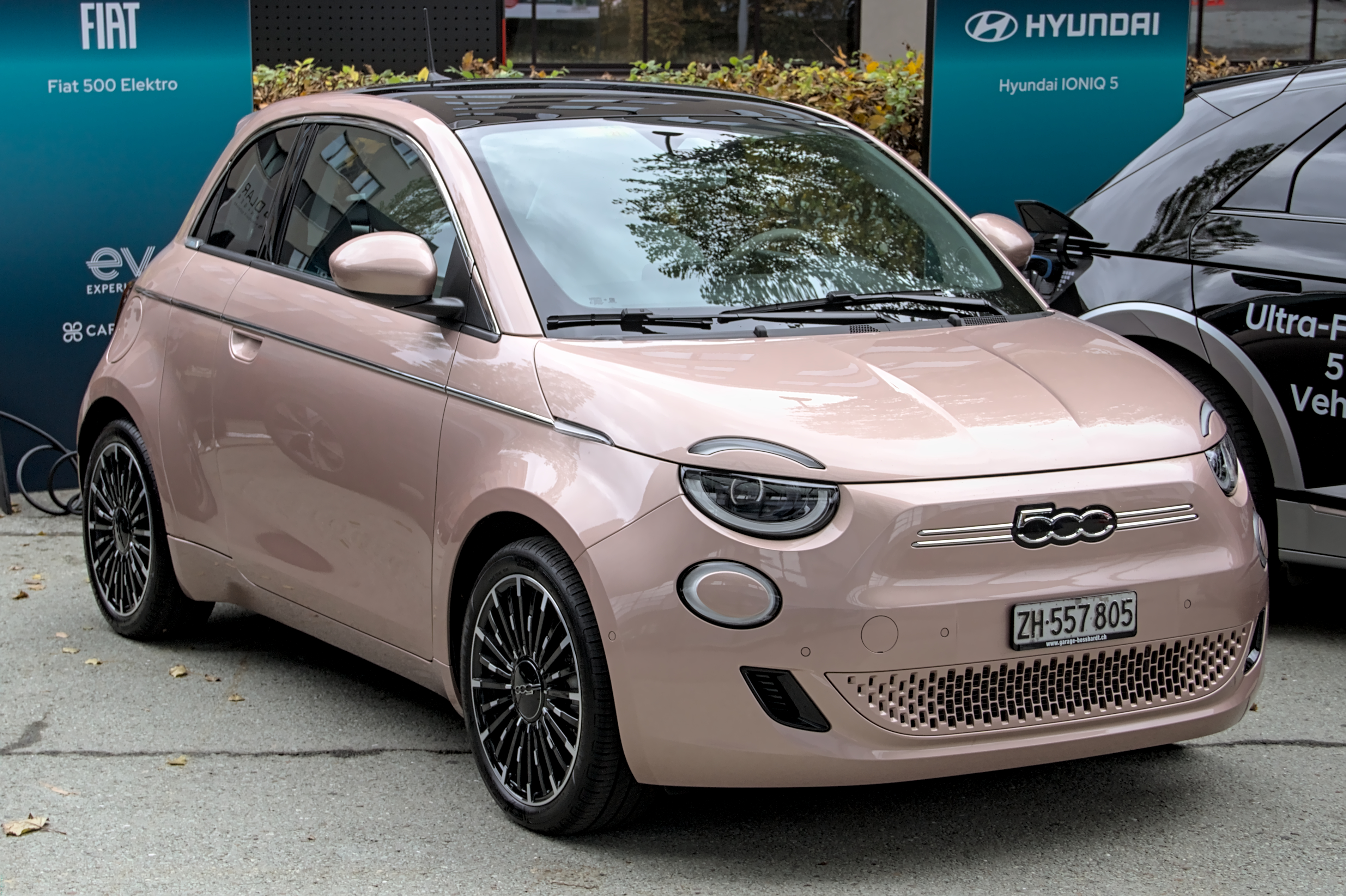
enabling drivers and models like the Fiat 500E.
Obviously, it's an adapted version.
This is not the one that you go and buy today,
but it's an adapted Fiat 500E.
Will change its battery pack,
Free to Move is equipping its car-sharing fleet
with these vehicles to reduce downtime.
Battery-swapping is seen as useful for taxis,
fleets and mobility vehicles
where vehicle availability uptime,
in other words, is crucial.
While the concept has been tested extensively in China,
it's new to Europe, making Madrid a big early adopter.
Repsol complements the initiative
with its existing network of 2,500 public charging points
at over 1,000 filling stations
by adding fast charging and battery-swapping.
They want to broaden their options.
Totally agree, but we've done some stories this week
from IAA about EVs,
that's from Chinese EVs over on EV News China
that are charging in six, eight, 10 minutes,
getting a decent chunk of charge, not 100%.
But actually, some of those vehicles that particularly have China,
that when you DC fast charge them,
they're still taking proper good speeds,
up at 85, 90, 95%, and not ramping down to a crawl.
Man, I mean, battery-swapping works without a doubt in China,
but you've got to build the infrastructure,
and NIO are doing that,
and it is costing them, they're not making money yet.
And I don't know.
I mean, it's working in China.
There's a lot of a lot of doubters over battery-swapping.
I'm not going to be one of those.
It's not an obvious easy path in Europe to do that.
Now, here in the UK, shoppers,
he went along to Sainsbury's on World EV Day.
We're test-driving EVs,
and charging, trying different demonstrators,
and even plugging cars in and trying out
how to charge an EV.
They were doing it at their hubs in Bamba Bridge,
Warren Heath, Corey's Mill, Richmond, and Foss Park.
Customers who charged at smart charge stations
during the event also had themselves
1,000 loyalty points called Nectar over here,
Sainsbury's loyalty card scheme.
Auto trader reporting a rise in interest in EVs
since the government's grant was introduced,
supporting models under 37,000 pounds
at almost 4,000 pounds off.
Sainsbury's launched their smart charging network last year.
Expansion's been really rapid.
The retailer has already installed
more than 650 ultra-rapids
at 75 Sainsbury stores across the UK.
And finally, the Vauxhall Astra, or Opel Astra,
as you may know it, is available in plug-in hybrid form,
and they just made it a lot better for the same money.
The hatchback is 39,000 pounds.
The estate version is 40,700.
New battery is 17.2 kilowatt hours,
and boy, did it need it,
because the outgoing version was a little tiddler,
12.4 kilowatt hours.
So the range is now up to 52 miles of all-electric range.
The entry-level Astra GS is now pushed into
the 9% company car tax bracket down from 13.
Higher trims are at 16%.
Performance also improves,
with output going to 192 hp from 178.
I'll get to 0 to 68 seconds, by the way.
The GSE versions now match the upgrade
with more electric-only driving,
and they'll even go up to 84 miles an hour in EV mode alone.
These changes boost efficiency, performance, range,
and I think they've left the pricing the same,
which is a very welcome upgrade,
if you're gonna buy that family hauler.
Love an estate car, the little sports Torah,
Vauxhall Astra, Opel Astra,
as you may know it, a very, very useful car.
And that's your podcast for today.
Thank you so much for listening and supporting the show
on the Patreon platform,
Porsche of the Village in Cincinnati.
Audi of Cincinnati East, and Volvo cars of Cincinnati East.
National car charging on the U.S. mainland,
and the Loha Charge in Hawaii.
And Octopus Electroverse Global Public Charging
made simple with one app and one map.
Have a good one.
And remember, there's no such thing
as a self-charging hybrid.
Let's do the 60-second savings challenge.
Step one, download rocket money.
Step two, link your accounts
and see every subscription you're paying for.
Tap one you don't use and cancel it.
That's money back every month.
Step three, create a financial goal, $50 every paycheck,
or let the app automatically move
small amounts of cash when you can afford it.
In a week, you'll forget you set it up.
In a month, you'll see real dollars piling up.
In a year, you'll be shocked
at how much money you've saved.
Bonus challenge, upload an internet or phone bill
and let rocket money try to lower it.
You only pay if they find you savings.
On average, rocket money members
can save up to $740 a year
when using all of the app's premium features.
Users love the app with over 186,000 five-star ratings.
Make saving money the resolution you actually keep.
Start the 60-second savings challenge
at rocketmoney.com slash cancel.
That's rocketmoney.com slash cancel.
Rocketmoney.com slash cancel.
If you're an HVAC technician and a call comes in,
Granger knows that you need a partner
that helps you find the right product.
And you know that when the first problem of the day
is a clanking blower motor,
there's no need to break a sweat.
With Granger's easy-to-use website and product details,
you're confident you'll soon have everything humming right along.
Call 1-800-GRANGER, click Granger.com, or just stop by.
Granger, for the ones who get it done.
If you're an HVAC technician and a call comes in,
Granger knows that you need a partner
that helps you find the right product.
Fast and hassle-free.
And you know that when the first problem of the day
is a clanking blower motor,
there's no need to break a sweat.
With Granger's easy-to-use website and product details,
you're confident you'll soon have everything humming right along.
Call 1-800-GRANGER, click Granger.com, or just stop by.
Granger, for the ones who get it done.
For a limited time, save 15% on your custom order,
and choose from an assortment of leathers, fabrics, and features
made to suit your style.
Just visit a local showroom to get started.
Dainier Furniture. We make it simple.
You make it home.
If you're the purchasing manager at a manufacturing plant,
you know having a trusted partner makes all the difference.
That's why hands-down you count on Granger for auto-reordering.
With on-time restocks, your team will have the cut-resistant gloves
they need at the start of their shift.
And you can end your day knowing they've got safety well in hand.
Call 1-800-GRANGER, click Granger.com, or just stop by.
Granger, for the ones who get it done.
About this episode
Lucid Motors announces a new mid-size electric SUV starting at $50,000, aiming to make EVs more accessible. Mercedes-Benz reveals its electric C-Class, boasting nearly 500 miles of range and fast charging capabilities. Volkswagen introduces its unified battery cell technology, set to power a new urban electric vehicle lineup. The episode also discusses Rivian's advancements in battery technology and the launch of Madrid's first automated battery-swapping service. Insights into the EV market's future in Europe and the push for sustainable practices are highlighted throughout.
Original notes
Can you help me make more podcasts? Consider supporting me on Patreon as the service is 100% funded by you: https://EVne.ws/patreon
You can read all the latest news on the blog here: https://EVne.ws/blog
Subscribe for free and listen to the podcast on audio platforms:
➤ Apple: https://EVne.ws/apple
➤ YouTube Music: https://EVne.ws/youtubemusic
➤ Spotify: https://EVne.ws/spotify
➤ TuneIn: https://EVne.ws/tunein
➤ iHeart: https://EVne.ws/iheart
LUCID PLANS $50,000 EV BASED ON GRAVITY X SUV https://evne.ws/46yDvdV
MERCEDES WILL OFFER C‑CLASS EQ ELECTRIC SALOON https://evne.ws/46lVCml
POWERCO UNIFIED CELL DEBUTS FOR VOLKSWAGEN GROUP https://evne.ws/4mei8DA
FERRARI 849 TESTAROSSA: 1,050 HP PHEV https://evne.ws/3HTGDI7
OCTOPUS ELECTRIC VEHICLES LAUNCHES IN GERMANY https://evne.ws/3V9vUMD
GERMANY LAUNCHES V2G FOR PRIVATE EVS https://evne.ws/47FaY7I
EU MOVES TO LOCALIZE EV INDUSTRY https://evne.ws/42tBCwH
POLESTAR CEO BACKS KEEPING EU 2035 RULE https://evne.ws/4nvFOV2
EU TRUCK CO2 REPORT SHOW PROGRESS AND GAPS https://evne.ws/46xeobo
RIVIAN CTO VISITS VOLKSWAGEN GROUP AT IAA https://evne.ws/4poJTw0
RESOL OPENS EV BATTERY SWAPPING IN MADRID https://evne.ws/4pkEjdI
SAINSBURY’S HOLDS WORLD EV DAY CHARGING EVENT https://evne.ws/4n02kpb
VAUXHALL ASTRA PHEV BATTERY AND RANGE GET IMPROVEMENTS https://evne.ws/3I5ek9F
You can read all the latest news on the blog here: https://EVne.ws/blog
Subscribe for free and listen to the podcast on audio platforms:
➤ Apple: https://EVne.ws/apple
➤ YouTube Music: https://EVne.ws/youtubemusic
➤ Spotify: https://EVne.ws/spotify
➤ TuneIn: https://EVne.ws/tunein
➤ iHeart: https://EVne.ws/iheart
LUCID PLANS $50,000 EV BASED ON GRAVITY X SUV https://evne.ws/46yDvdV
MERCEDES WILL OFFER C‑CLASS EQ ELECTRIC SALOON https://evne.ws/46lVCml
POWERCO UNIFIED CELL DEBUTS FOR VOLKSWAGEN GROUP https://evne.ws/4mei8DA
FERRARI 849 TESTAROSSA: 1,050 HP PHEV https://evne.ws/3HTGDI7
OCTOPUS ELECTRIC VEHICLES LAUNCHES IN GERMANY https://evne.ws/3V9vUMD
GERMANY LAUNCHES V2G FOR PRIVATE EVS https://evne.ws/47FaY7I
EU MOVES TO LOCALIZE EV INDUSTRY https://evne.ws/42tBCwH
POLESTAR CEO BACKS KEEPING EU 2035 RULE https://evne.ws/4nvFOV2
EU TRUCK CO2 REPORT SHOW PROGRESS AND GAPS https://evne.ws/46xeobo
RIVIAN CTO VISITS VOLKSWAGEN GROUP AT IAA https://evne.ws/4poJTw0
RESOL OPENS EV BATTERY SWAPPING IN MADRID https://evne.ws/4pkEjdI
SAINSBURY’S HOLDS WORLD EV DAY CHARGING EVENT https://evne.ws/4n02kpb
VAUXHALL ASTRA PHEV BATTERY AND RANGE GET IMPROVEMENTS https://evne.ws/3I5ek9F
0:00
23:47