The Phantom is a super fancy car that costs a lot of money and is made with the best materials. People talk about it because it’s like a symbol of wealth and luxury.
The Wraith is a beautiful and powerful car made by Rolls-Royce, known for its smooth ride and fancy interior. It's a car for people who want to travel in style and comfort.
The Rolls Royce Phantom is one of the most luxurious cars in the world. It's known for being very comfortable and having lots of high-tech features, making it a favorite among wealthy buyers.
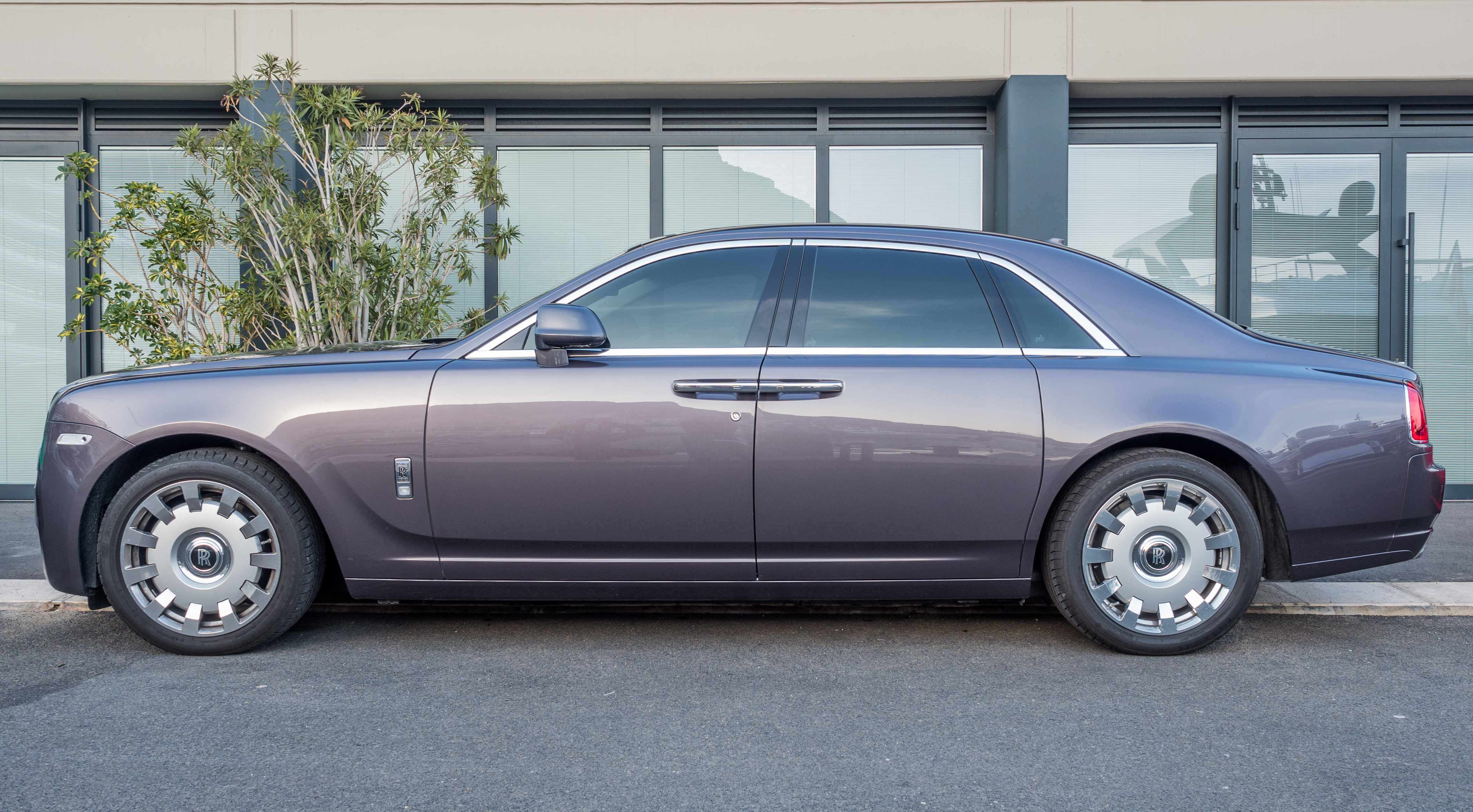
The Rolls Royce Ghost is another very luxurious car from Rolls Royce. It's designed to be comfortable and smooth to drive, and it looks elegant without being too flashy.
Rolls Royce design is all about making cars that look beautiful and feel luxurious. They pay a lot of attention to every little detail to ensure their cars are special and high-quality.
Car
Rolls Royce
Rolls Royce is a famous luxury car brand that makes very expensive and high-quality cars. They are known for their attention to detail and luxury features, setting them apart from other brands like BMW.
The BMW 7 Series is a luxury sedan made by BMW, known for its comfort, technology, and performance. It's one of the most expensive and high-end cars that BMW makes.
A V12 engine has twelve cylinders that help the car run smoothly and powerfully. It's often found in very expensive and fast cars because it provides a lot of power.
The Spirit of Ecstasy is a famous statue that sits on the front of Rolls-Royce cars. It looks like a woman with her arms stretched out and is a symbol of luxury and class.
Car
Rolls Royce 100EX
The Rolls Royce 100EX is a special concept car made to celebrate 100 years of Rolls Royce. It has a unique design and shows what luxury cars could look like in the future.
Wheel size is how big the wheels on a car are. Bigger wheels can make a car look sportier and help it handle better, but they can also make the ride bumpier.
The BMW 3 Series is a car made by BMW that is known for being fun to drive and stylish. It's a compact car that many people like for its performance.
Car
Bentley Dawn
The Bentley Dawn is a fancy convertible car made by Bentley that came out in 2015. It's known for being luxurious and powerful, perfect for a comfortable ride.
The Bentley R-type Continental is a fancy car made by Bentley between 1946 and 1955. It's known for being stylish and fast, and many people love it as a classic car.
The Rolls-Royce Dawn is a fancy convertible car known for its luxury and style. It has a soft roof that you can open to enjoy the fresh air while driving.
The Spectre is a new electric car from Rolls-Royce, which means it runs on batteries instead of gas. It's important because it shows that even luxury brands are going green.
The Ferrari 330 GTC is a famous sports car made by Ferrari in the 1960s. It's loved for its beautiful design and powerful engine, making it a favorite among car enthusiasts.
The Alfa Romeo GTV is a sporty car that looks great and is fun to drive. The 1600 version has a smaller engine, making it a bit less powerful than other models.
The Maserati 5000 GT is a classic sports car from the 1950s. It's famous for its powerful engine and stylish look, and it's quite rare because only a few were made.
The Ghibli is a luxury sports car from Maserati, first introduced in the 1960s. It's famous for its powerful engines and stylish design, making it a popular choice among car lovers.
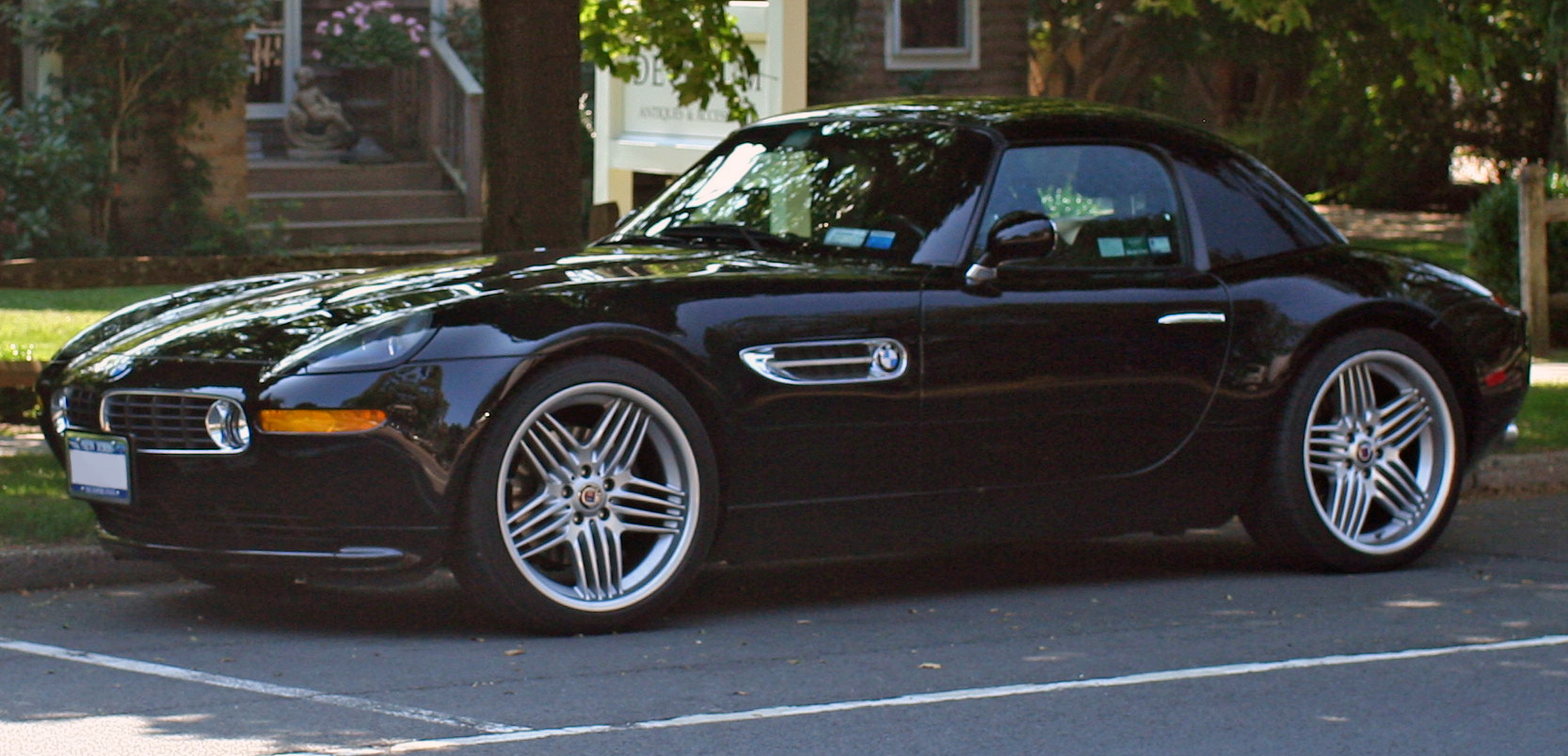
The BMW Z8 is a stylish two-seater sports car that was made by BMW. It's known for its unique design and strong engine, making it a favorite among car enthusiasts.
The Alpina Z8 is a special version of a BMW sports car that is faster and fancier than the regular model. It's a rare car that many enthusiasts admire.
The Range Rover is a fancy, big car that can drive on rough roads and also feels nice inside. People talk about it because it's both tough and stylish.
The Range Rover is a fancy SUV that can handle rough terrain while also looking stylish. It's popular among many different types of people because of its comfort and capability.
Car
Rolls-Royce
Rolls-Royce makes some of the most luxurious cars in the world. They are known for their high quality and comfort, often seen as a status symbol.
The Porsche 928 is a stylish sports car made by Porsche that was produced for many years. It has a unique design and is known for being a comfortable and powerful car.
The Corvette is a fast and sporty car made in America that looks really cool. It's popular because it offers a lot of power for a lower price than other fancy sports cars.
LIVE
We went to an island in a thousand year of monastery and sketched there just with paper
and pen for weeks.
So yeah, it was awesome, it was so much work, Ian kept the team always extremely small,
that meant we all were very busy.
I worked on all the exteriors, the door on the ghost, the race, the new phase of the
Phantom, all in the same time, all in these nine years.
Good heavens.
That was quite an evolution of models too, because you know, convertible, essentially
a convertible ghost, which was the dawn, and of course the Wraith was a very polarizing
design.
Hello and welcome to Cars That Matter.
I'm your host Robert Ross, Rolls Royce, a car that needs no introduction, an icon of
design for over 100 years, a car marked with a storied past.
In this episode we explore the more recent chapters of the Mark's history, speaking
with designers Merit Georgovich and Andreas Turner, responsible for the design of the
Phantom and ghost respectively, among other models.
Stay tuned for insights into the essence of Rolls Royce and the process behind the
evolution of Rolls Royce design.
Welcome to another episode of Cars That Matter.
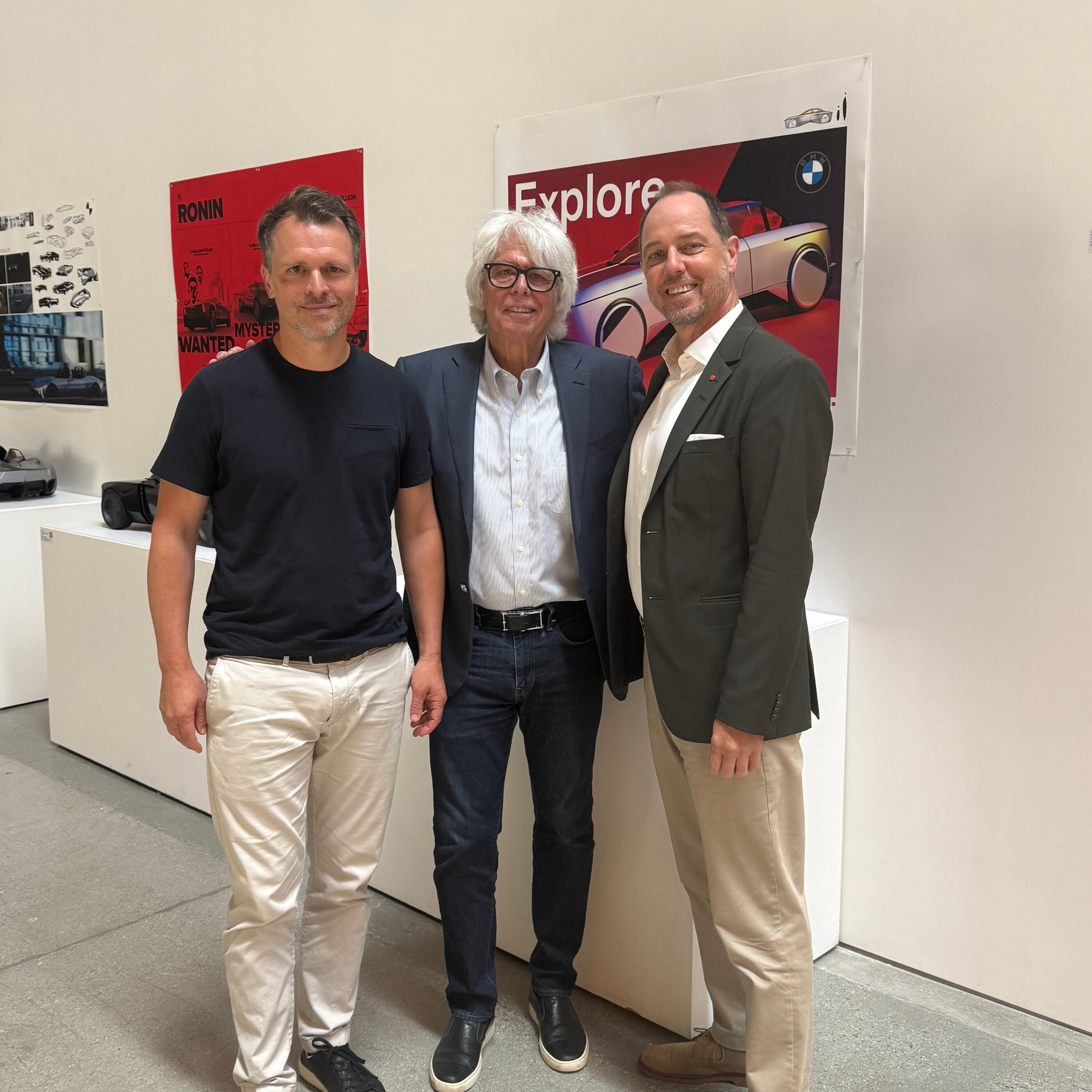
This is Robert Ross and I'm back at Art Center College of Design in Pasadena, California,
with two friends who are two friends of one another.
Merit Georgovich, you've been on our earlier episode and my old friend Andreas Turner.
Welcome to the show.
Thank you for having us, Robert.
And this conversation is about something very specific.
It's about Rolls Royce because Rolls Royce is a history that the both of you intimately
share.
Merit, of course, you started with Rolls Royce when the Phantom was introduced to the public
in 2003 and Andreas, you came to the company just as Merit was leaving.
So I think we're going to have a pretty interesting conversation about what it was like to pass
the torch over that formative first decade and just get some really interesting insights
into what it was like to create an icon.
Merit, tell us about how it all started.
Oh gosh.
You know, it's actually an example in life where you just need to have faith that things
will work out for the best.
Just in 1998, springtime, one of the projects that I was working on, it was meant to be
my first production car for BMW, was canceled, happens all the time in the car industry.
You just have to have the thick skin for that.
Two months later, BMW acquired rights to Rolls Royce.
What was fortuitous in my situation was that I had the time to think about putting together
the process about how to go about designing a Rolls Royce that will be authentic to its
heritage and to its values.
They needed something new.
They did.
But at the same time, we wanted to make sure that the car that we designed not only summarizes
all of the history and the heritage of the brand, but moves it forward into the future
as it was to be the first Rolls Royce in the 31st century.
That's right.
The plan called for setting up a studio in London and pulling the resources from BMW
Group internationally.
So we had three of us competing for the exterior design and two for the interior design of
the car, working very closely with engineering on developing the very package, the architecture
of the vehicle.
Many discussions about the size of the wheels, the length of the wheelbase, dash to axle,
and all of that, the very scale of the car.
Which is fundamental to the ethos of a Rolls Royce.
I mean, it's not a BMW 7 series, it's got to be a Rolls Royce.
Absolutely.
And a lot of people were expecting that that's what we would do, but it was absolutely imperative
that the product was authentic to the values of Rolls Royce.
Well, that's a fascinating project.
Obviously, I remember when the Phantom 7 was introduced in America and I thought that
basically died and gone to heaven.
It was the first Rolls Royce that I'd seen in years that actually really embodied the
ethos of the brand, but was also a thoroughly modern car, a fantastic car, by the way with
a V12 engine.
I mean, it just didn't get any better.
I would say very dear to me was the time when we were preparing to introduce the car to
the market, but because of the agreements that we've had in regards to the ongoing sales
of the previous models, these presentations to potential customers were done covertly.
At the time, this was quite unusual.
So these presentations were done in various locations around the world with our dear friend
Ian Cameron, who was our boss, the design director, doing these presentations in Munich
and London, our chief engineer in the Middle East, and myself in Florida and California,
in Tokyo and in Hong Kong.
That's a real international audience.
And apropos of Ian Cameron, obviously a friend of all of ours, tragically, Ian died in 2024
and it was a great loss to the entire industry.
He'd been the design chief at Rolls Royce for 10 years before he retired in 2012, but
maintained quite an influence and of course had a great influence on both you, Merrick
and you, Andreas.
Tell us about what it was like to sort of leave and come in, respectively, because you left
Rolls Royce shortly after the introduction of the Phantom 7.
Is that right?
In 2005, so actually after the introduction of the Drophead and after the Centenary 100
EX model was celebrated.
That's right.
It was your project.
Let's talk about that.
What was the EX like?
Because I remember the car.
It was a phenomenal thing.
It was just an absolute one-of-one dream project that a designer could ever have, incredible.
The underpinnings were shared with the Phantom.
The interesting thing there was that with Ian's wisdom, we used the project to help
us fund the development of the Drophead, of the convertible, to be able to sell the project
to the board of directors and so on.
So with one exception, the 100 EX had a longer dash to axle because it was to fit not a V12
but a V16.
Yeah.
That car was an EX stood for experimental.
It was a fully developed, fully engineered, fully-feased-out vehicle whose engine was
so smooth that we have a wonderful picture of Ian putting a pound coin on its side while
it's idling and staying up.
So Andreas, you came on board from BMW.
Tell us about your experience, how you met Ian and what the next steps were.
It's actually interesting and in these rooms with these sketches on the wall, it reminds
me so much back to the time because I was sponsored by BMW for an internship six months
and as well for my final degree.
I did a seven-series model searching for the spirit of BMW in the future and presenting
my final thesis seven-series to the design chiefs of the BMW Group, Mini, Rosaros, BMW.
And that was the first time I ever saw Ian Cameron, even though I've been there.
I was there one year basically before.
I never saw anybody of the Rosaros design team ever before.
So they basically were like phantoms and ghosts to me.
They were somewhere.
Literal phantoms and ghosts.
Yes.
And this is how they worked really on their own.
So I never even dreamed or thought about working for them.
I had no relationship with them personally, but I have to say I was a student when the
phantom came out and I surely had a picture of the phantom on my image boards and I just
loved it so much that I couldn't even imagine that a car like this would be possible in
that time and age.
That different, this confident, crowned up, built on a space frame, with real handwork
into it you could tell you could see the spirit of ecstasy, the grill, many other things.
I was just positively shocked about this car and when Ian Cameron after my presentation
introduced himself very charming, very humble as he was and immediately called his team
together.
You might remember this into the penthouse to introduce me to the team.
I was totally in love that first second and shortly after he invited me for an interview
in which he said, you don't have to sell anything to me.
We have to sell us to you.
This is kind of the way he talked.
He's just so humble and so beautiful.
He was that I was sold.
So all of a sudden you're working with Rolls Royce and they had one car.
They had one car.
They had his car.
They had his car.
They needed more cars.
And they had the incredible 100 EX that Merrick mentioned.
Actually as well the 100 EX, a typical Ian in my interview, he just took me and drove
with me to the modeling studio which we called Panzerhalle where the 100 EX was in the making.
It was not even launched at that time and at that time I had no confidentiality agreement
anymore.
Nothing.
He just trusted me.
You were just a guy off the street.
And he would show me this car in the making with all of the single wood pieces that were
actually hand-painted and a true piece of art done by the best craftsmen in the world.
And again I was so amazed that there was any kind of interest for me to put me in with
these best designers in the world.
So I could not describe how much this meant to me.
I was very intimidated as well.
Well, you obviously came up with the plate because your first project was a pretty important
car.
I was hired for the project which was called NGS at the very beginning.
That doesn't sound very exotic.
What does that mean?
New Generation Saloon which at the very beginning, at the strategic phase when I started beginning
of 2004, it wasn't even very exactly clear what kind of car concept this would be.
There were discussions and certainly from us, from the design team, there was the idea
to put forward another real exciting car to strengthen what just had been started.
Give Rolls Royce a real dynamic personality and attract some attention and beat some
pots and pans so that everybody paid attention.
Right now there were two stars out there.
There was a Phantom, there was the 100EX and we thought we'll never do a cheap car.
We do another star.
We have to keep this going.
So there was the discussion to do an open two seater instead.
We'll be right back after this quick break.
And now back to my conversation with Andreas Turner and Marek Georgievich.
So next up was the Ghost.
Tell us about that.
Yeah.
Well, the Ghost was especially at the beginning not an easy project.
Marek, before you left, you participated as well a little bit in it.
At the very beginning, I just mentioned before that we had other ideas and the reason for
that was because the very first package plans were, I would say, like to say more than challenging.
When it was clear that we were going to do another next saloon, another next sedan as
we say here, we were absolutely committed to fight for the proportions and make it a
real Rolls Royce.
So the next one and a half years, I think two years after you left, I was the only extra
designer, the youngster fresh from school.
And this was this challenging project learning so much.
And how Ian approached it was that we were doing three proportion models looking exactly
the same design wise, which is the way you should do it so that you can compare Apple
to Apple.
One with the proposed engineering package, which basically was a seven series with a
high roof.
One which was our ideal package and then one kind of in the middle compromising.
So I was in charge of modeling these with modelers, all three of them.
And I could learn so much in that time, what effect does what have?
Like, for example, wheel size, overall diameter, 7.02 to 7.40 to 7.60 or longer the extra
axle.
Proportion are everything for a brand like Rolls Royce.
We have to be able to understand what you are talking about, even if it's 100 meters
away, even if you do not see the front at all or the grill, you have to be able just
by the stance and the silhouette to be able to understand what it is.
It's like being able to determine whether a cop's following you at night just by the
headlights.
We actually, I found that to be a very particularly important thing in defining the brand and
we call that the very gesture of the mark, right?
And I tried to illustrate that to help people understand from simple silhouettes, just the
simple black silhouette of three different vehicles that help communicate the uniqueness
of a Rolls Royce in its profile.
And the first one was a little doodle of a Volkswagen Beetle, right?
And the gesture was transporting.
Then there was a silhouette of a BMW 3 Series, which had its kind of a nose down, tail up,
kind of a wedge forward toward the road and that was the gesture of driving, right?
Kind of aggressive forward and so on.
And for Rolls Royce, it was high hoods, the sending, sending line towards the rear in
a graceful way.
So with a kind of a nose up, tail down, gliding forwards and up, conveying waff stability
as so famously penned by that.
That's right.
The Rolls Royce verb.
Exactly.
Yeah.
Absolutely.
And the Phantom and the 100X showed us perfectly.
Now, the challenge with the Ghost was that it was meant to be even more of a driver's
car in very agile.
So we had to have pressure on the rear axle, so we had to lift the tail more than in proportion
the Phantom would have done this.
So this was a great challenge.
I think that with the final product, we kind of two or even three inch higher than the
very first proportion models started, but we were able to camouflage it or to balance
it with the entire car and still make a Rolls Royce out of it.
So clearly it was not a BMW 7 series that achieved its own personality.
It was challenged, I guess in some ways, or I would ask whether you were challenged as
a designer to the extent that the Phantom is a very big car and the Phantom 7 always
had to be the kingpin.
There would be a Phantom and then there would be everything else in the scheme of things.
So the Ghost was, as you say, a driver's car, also smaller in size, but it had to have
the same gravitas as the Phantom in its own way.
That was a very personal challenge for me as well as a young designer looking up so much
to Merrick and to the designs you've done to the Phantom.
I just love the Phantom so much.
There was a holy piece for me that I would have loved to do just the exact same car again.
I thought everything done differently would have been a mistake, but of course, being
problem in to do something new as well, something different and had to be a new generation.
So more and more started to see it just as a different personality.
In my mind, the Phantom models were more kind of reflecting the personality of Henry
Royce, who was the older of the two founders, who was the genius engineer, and at one point
I thought, well, the Ghost models probably reflect more the younger founder, Charles
Rolls, which he wasn't very excited.
He was not an engineer.
He was an aristocrat.
I think his family was one of the wealthy families in London.
But he was a very, very fascinating gentleman who informed that different side of the brand
for me as well at one point.
What helped me as well, I mentioned before that Open Two Seater and that Ian would not
be Ian if he would let go easily on things.
So we just kept going as well, even though there was no budget, that meant that I would
do a full-size tape drawing on all four views so that over the Christmas break that we could
do a section model of it and so on and so on.
And we did later a quick two, three week eldest model and a model was done.
But this model, not being a saloon, had me so much to free myself up from phantom.
So the form language of that Open Two Seater really found its way into the Ghost as we know it.
Did that Two Seater ultimately become a Dawn or a Dawn-like thing?
No, no, no.
The surface language, which is, again, very much inspired by drips to P&A wood that we've
done so many times, one of the finest restorers in England who restored these Bentley R-type
Continental shaving them with this beautiful tension and surface.
So that was very much inspired by full surfaces with a natural tension that you would only
do with a hand beating over wood.
This was my dream of doing.
So surface-wise, this project inspired for me the Ghost as well, but as well detail-wise.
For example, the radiator grille that is now not how it should be on the phantom, an
additive piece wood, which really stands up and shows, okay, here we are again.
And the Ghost, it's inward, it's sucking air, it's kind of supporting the engine, which
is the Star, the Ghost as well, the V12 with a lot of torque and an amazing machine.
The challenge was that it should never be a cheaper version of, right?
It had to be a full Rolls Royce from the start, but it had to make money as well.
It had to be pushed the company into the profitable zone.
That was the clear aim.
There was this interesting concept from our marketeers.
You might remember that from Paul Ferriola, we called it a wardrobe.
He called it a wardrobe approach and it really resonated with me.
He said, each Rolls Royce should be like its own suit or a part of a personal wardrobe
that you would pick out for a certain occasion.
So in fact, all of the Rolls Royces should be ownable by one client and he would use
whatever he used, so the Phantom being the tuxedo, the pinnacle, the finest, and the
Ghost being more the open-collar sports suit, if you like.
So that would not make the Ghost a cheaper car, just a different purpose car.
I love that idea.
I wanted to mention as we're talking about Ian, what Ian was so good about and I think
Ian was open to learn and what he learned with the Phantom project or saw as really
successful with the Phantom project is to pull the designers out of the context of Munich,
BMW, the daily pressures and stress of the normal life and putting the designers in London.
So he pushed for that in the years that I was there and in nine years for the Ghost after
those two years of proportion phase, he sent a small group of designers to Southern England
for three months and we were in the 16th century, beautiful house in West Sussex and literally
the same thing, Charles, our mutual friend, had the pleasure of experiencing both the
bank and West Oak house.
This is where a Rolls Royce customer would have lived in 1920 and you actually soaked
in the whole ethos of that lifestyle.
It was just really amazing, almost intimidatingly amazing at the beginning.
We had our own chef who had one mission as a star and later two people came like Rowan
Atkinson and so on for dinners and it was just really amazing because other than with
the Phantom phase, now there was already the Phantom, there were already the first Phantom
clients who as well had friendships with Ian and Ian could invite them in so that they
share their stories and inspire us.
So the Phantom was there to inform us for the future.
West Oak house was one of those aspects.
We went to an island in a thousand year old monastery and sketched there just with paper
and pen for weeks.
So yeah, it was awesome, it was so much work.
Ian kept the team always extremely small, that meant we all were very busy.
I worked on all the exteriors, the dawn, the ghost, the race, the new phase of the Phantom,
all in the same time, all in these nine years.
Good heavens.
That was quite an evolution of models too because you know...
Yeah, these were a lot of models.
Convertible, essentially a convertible ghost which was the dawn and of course the Wraith
was a very polarizing design, kind of love it or hate it profile and I guess thanks to
that or that sort of evolved the new vocabulary for the Spectre and all that.
Yeah, yeah, fascinating and a once in a lifetime chance to work with this team and with Ian,
learn so much from Ian and this time we trust it to do this work.
So I just wanted to say that these experiences of putting designers into environments that
are inspiring is they're not frivolous, they are very, very important because the task
at hand is to bring a designer as close as possible to the environment in which these
cars are used, driven, experienced, to bring them in conversations with customers, allowing
them to get a glimpse into the lifestyle, to the meaning and character and gravitas
behind the product, behind the vehicle.
These are just parts of a very well-lived life and it's important then to put something
like a Rolls-Royce in the context of all that.
So having these experiences shared is I'm imagining really important.
Time for a break but we'll be right back.
Welcome back to my interview with Andreas and Merrick.
It's no secret Rolls-Royce is a German-owned brand now.
I've got a Serbian and a German here and you guys are designing Rolls-Royces.
Where are the English guys?
Does it matter anymore?
And by the way, what about the craftsmen?
I know that Rolls-Royce is in New Factory in Goodwood so there's certainly a heritage there but
are cars cruelly international things now?
Well, I think you bring up a very, very interesting point.
I think that there has recently been a distinct direction towards what we can call international
design.
So there is to some degree a dilution of what used to be some very clear culturally identifiable
characteristics and characters, if you will, of the cars.
What was so beautiful about having a chance to work on a Rolls-Royce is because it was one of
those marks that so clearly embodied such positive British attributes.
And so part of the challenge on the project was not only to make sure that we are aware
of, identify and bring to the fore Britishness in its design, but then also it was very important
to distinguish within British luxury what is Rolls-Royce luxury versus Jaguar or Daimler
or Bentley or Aston Martin and so on.
So again, this is why it was so important to undertake the very design process as an
environment in which you can be immersed in the culture, in the ethos, in the spirit of
what it's meant to represent.
And I think speaking of us not being British, it's definitely important to have a balance
from a view inside and the view outside.
Because by the way, the customers are international.
Exactly.
And sometimes you can't see the forest from the trees and you need to kind of get a view
from outside of the forest to really appreciate what it's doing.
We must mention both of us not only working under Ian, who was such a fantastic leader
and inspiration and a mentor to us, but we both had an incredible privilege and joy of
working together with Charles Coldham who designed the interiors of both Phantom and Ghost.
And what interiors those are, what a place to be.
You talk about intimidating, getting inside my first Rolls-Royce.
I thought I'd died and gone to heaven, but at the same time, such a comfortable, welcoming place.
Well, he captured the interior spirit of Rolls-Royce in ways that are just awe-inspiring for me.
And one thing that I found incredible with Charles is that he was older than us.
He is older than us.
And they often say that designers have a certain span of kind of productive creativity
and then they kind of peter out as they age into their career.
Nothing like that with Charles.
He was putting 20-year-olds to shame with levels of creativity that he had in the 60s.
It was absolutely incredible.
And a kindest, most amazing teammate you can possibly have on board.
Andreas, tell us about how your fine art with horses inspired your work with Rolls-Royce.
Every designer has a very personal approach to get to his designs or to be inspired for me.
Very much of where I was thinking about personalities behind.
I mentioned before Sir Henry Royce or Charles Royce.
But as well, when we were at these excursions in England,
we as well had the chance to visit horse races.
That was for me the first time.
And I was totally inspired by the energy, the pedigree, the beautiful, balanced bodies of the horses.
You could feel the energy before you even could see the horses
because you could feel the vibration on the ground.
All of that captured me totally.
And I did a series of horse paintings, some of pictures that I took,
some out of my imagination from those.
And actually a real part of it, what I particularly pushed during this time at West Oak House,
is the, as a differentiation from Phantom again,
is to lifting the body visually, even more off the ground,
to emphasize on different characters for the driving driver's car,
but as well the feeling of being effortless wherever you go.
Because a horse is airborne, the horse is airborne.
So exactly, some of these paintings show the volume of the horse off the ground,
basically gliding off the ground because the feet you could almost not see of the speed.
So this inspired me so much.
And I wanted visually to lift the car off the ground with more clearance around the wheels.
More ground clearance inspired by the horses.
And I really processed this whole idea of what captured me.
So by painting the horses.
So that was one of the approaches.
That's fantastic.
Many approaches, many ingredients come together,
which are by the way very different for every designer.
Very, very different.
Well, once again, nature inspires art and design.
I always like to get in a designer's head.
Your three favorite cars, Merrick and Andreas.
And go for the first car.
Favorite, favorite Ferrari 330 GTC, Penfarina, I would say.
Very good.
Mine's a Ferrari too, but it's actually a one off chassis 0547.
I think it was based on a GT Europa, but it was made as a one off for a customer in Rome.
By the name of Commendatore Ferrari.
It has one of the cleanest designs that I can ever imagine.
It was beauty that gave it value.
Isn't, doesn't beauty always give cars value?
And Andreas, what do you think?
Next one is the, my first car actually, the car that I paid with my first earned money at Rosaros
was the Batone GT, the Alpha.
Ian actually helped me.
That's a GTV for people who don't.
The GTV, well, I had the 1600, so a slightly smaller engine.
Ian actually helped me.
He test drove the car with me, and he approved it to buy it.
And I love the car so much.
Giugiaro's first or one of his first designs.
It was his first design in 1962, I think.
I think when he was 25 years old, he was exactly the same age as I was when I started to design the
Ghost, which was so meaningful for me working five years on the Ghost.
It's fantastic, fantastic.
And that's a great choice that GTV is truly an all time classic.
Number two.
Hard pressed, Robert, but Maserati, right?
But now you ask me which one, and I'm struggling because, I mean, if it's a 5000 GT,
maybe Alamano body.
Yeah, yeah, Alamano.
That's a fantastic car.
Or a more modest Sebring.
That's an underrated car.
The Series 1 Sebring, what a beautiful thing.
I completely agree.
They're disciplined, but Italian flair, right?
Or a Ghibli, or also a very, very dear car to me.
Hey, make a choice.
Camson.
Yes, all that was one of Ian's favorites.
In fact, he had one.
Yes, exactly.
And I've had the privilege of being driven in it.
He didn't quite let me have the keys, but a very spirited drive on the back roads around his hometown.
He, by the way, was a phenomenal driver.
You got one more car.
Yeah, talking about Ian, I still want to keep him here with us.
All of his cars actually are amazing that he worked on.
Of course, he finished the Z8.
He brought this excellent to the E463 Series, which I own at one point.
But one car that really stands out for me, and at one point I will own one.
I'm not so far, but at one point is the L30 Range Rover,
which he as well as a manager had finalizing and bringing to the quality it had.
And the reason why I love this car so much is that other than any other Range Rover,
it was like a chameleon to make everybody look just perfect in this car.
If it was the Queen, if it was a farmer, if it was anybody, it was just perfect on any occasion.
And I cannot think of any other car which can do that.
So this is one of my all-time favorites.
And the typical Ian, because it's very subtle in his qualities and in his design executions
and sophistication, so that is absolutely his handwriting.
It's easy to see how he was able to translate some of that to the Rolls-Royce sensibility.
I mean, that authenticity and sort of rear-set in both of those designs.
So I'll have to change gears from Italy, because otherwise we'll just keep everything in Italy
for me. But I would say I'll go back to one of my childhood favorites, Porsche 928.
I thought that was one of the most long-lasting in how futuristic it was.
That car looked modern and new and different. Still does.
Still does. It's incredible. It's brilliant design.
Well, thanks for sharing some of your personal favorites. I know that it's
looking back in time, but sometimes looking back in time is one of the most useful exercises in
understanding why we're going where we're going. What inspires people who are doing things for
the future? What inspires engineers and designers to do new things?
Well, thanks so much for joining us today at ArtCenter. Appreciate the hospitality here.
It's a fantastic place to be. Makes me wish I were in school again,
and I really, really enjoyed our conversation, Merrick and Andreas. Thank you.
Thank you so much. Thank you, Robert.
Thank you.
It's been a pleasure.
Are you thinking about building a car collection, but aren't sure where to start?
Here's a car within reach from Hemings that could become your garage gold.
The 1992 to 2007 Dodge Viper. Since its earliest days, the Dodge Viper has been a raucous good time,
a simple, unsophisticated sports car built around a booming all-aluminum V10 engine.
While it has seen refinements over the years that ultimately turned it into a winner at Le Mans,
it never really lost its unique spirit. A Viper will never be confused for a Porsche or a Ferrari
or even a Corvette, even though it might be faster. For that raw, unhinged,
all-American V10 spirit in a two-seat sports car expect to pay anywhere from $30,000 right on up to
$100,000. On my next episode, I'm joined by Fireball Tim Lawrence for a tour of movie cars
at the Peterson Automotive Museum. Cars that matter is a Kurt Go Media production. I'm your
host Robert Ross. The show is produced by Bill Curtis and Stuart Halpern with audio and video
production by Ness Smith Sabadoff and additional support from Melody Larson, Lindsay Davis,
Debra Smith, and AJ Mosley. To listen to more episodes of Cars That Matter,
follow us on Apple Podcasts, Amazon Music, Spotify, or wherever you listen to podcasts.
If you liked this episode, be sure to rate us five stars to help other listeners discover the
show. For exclusive video episodes, visit himmings.com slash cars that matter.
you
About this episode
Marek Djordjević and Andreas Thurner, the designers behind the iconic Rolls-Royce Phantom and Ghost, share their experiences and insights into the creative process of designing these luxury vehicles. They discuss the challenges of merging heritage with modernity, the importance of proportions, and the influence of British culture on their designs. The conversation also touches on their mentor Ian Cameron's impact, the significance of immersive design environments, and the evolution of Rolls-Royce's identity in a global context. Listeners will gain a deeper appreciation for the artistry and thoughtfulness that goes into creating these masterpieces.
Rolls-Royce, a timeless marque that evokes luxury, class, and grace. Robert Ross sits down with Marek Djordjević and Andreas Thurner, former Rolls-Royce designers behind the legendary Phantom and Ghost, in a riveting conversation about the importance of a car's silhouette, maintaining a recognizable identity across models, and the importance of being immersed in a vehicles environment.
A special thank you to our sponsors, Hemmings and MCQ Markets. Visit Hemmings.com to learn more about their online automotive marketplace and claim your seat for Hemmings Motor Club. For MCQ Markets - Before investing, you must review the offering circular available at https://on.mcqmarkets.com/offering-circular. Investing involves risk, including the potential loss of principal. Past performance is not indicative of future results. For important disclosures and additional information, please visit https://www.mcqmarkets.com/disclosure.