The Cadillac ELR is a luxury car that can run using electricity and also uses gas. “ELR” is the model name, and the car is designed to let you drive some distance on electric power before the gas engine helps out. People mention it a lot because the acronym is tied directly to this specific Cadillac model.
Effective labor rate is the hourly money you actually make from labor work. It compares what you charged customers for labor to how many labor hours you billed. It helps you see whether your shop’s pricing and billing match what you think you’re earning.
Labor cells are the shop’s internal buckets for different kinds of labor work. Instead of tracking everything as one pile, you group jobs so you can see how much money you make per hour in each bucket.
Door rate is the shop’s standard hourly labor price—basically the rate they start from when quoting work. The point is to see if the shop actually bills close to that rate once you look at real billed hours and dollars.
It’s the hourly price a repair shop lists for labor. Think of it like the shop’s “sticker price” per hour, not necessarily what they truly collect in the end.
A labor matrix is a chart that tells a shop how many hours to charge for specific repairs. If the chart doesn’t match how long jobs really take, the shop can end up undercharging.
Warranty work is when a repair is paid for under a manufacturer or parts guarantee. Shops can get paid less than their normal rates or for fewer hours than the job actually takes.
Menu pricing means the shop has set prices for typical repairs and labor. If those prices are wrong or outdated, the shop may not make enough money per job.
A comeback is when a car has to come back because the original repair didn’t fix the problem. The shop has to spend extra time redoing it, which can cut into profit.
Term
QC also
QC means quality control—checking that the repair is done right. If the shop has to redo work (a comeback), it costs time and can reduce profit.
This means technicians earn extra pay based on how much work they produce. The goal is to push output, but the segment implies you still need to manage metrics like ELR so the shop stays profitable.
A flat rate technician is paid based on a predetermined labor time allowance for each job (often from a labor guide), rather than an hourly salary. This pay structure can strongly affect behavior—technicians may focus on jobs that pay more per hour under the guide.
Total GP (total gross profit) is the money left over after you subtract the direct costs of doing the work. The segment says advisors get incentives tied to this, and that they should also focus on ELR to help GP go up.
A repair order (RO) is the job document a shop creates for a customer’s vehicle, listing the work to be performed and what will be billed. Auditing repair orders helps ensure technicians are documenting and billing time correctly.
Billable time is the hours your technician works that you can charge the customer for. If you track that time but don’t charge for it, your shop’s effective hourly earnings drop.
Diagnostics is how a mechanic figures out what’s causing a problem—usually by checking systems and running tests. If that work is done but not charged, it can hurt the shop’s effective hourly rate.
This means the shop measures and bills technician work in 15-minute chunks. Because of that time-tracking/billing structure, the hosts say you can’t realistically get to a perfect 100% effective labor rate.
LIVE
This is the Automotive Repair Podcast Network.
Hey, what's up, peoples?
Carm Capriotto, another Town Hall Academy
from Remarkable Results Radio
and the Automotive Repair Podcast Network.
Always remember this, episodic education.
And we've been doing this for 11 years,
bringing you some of the best content
that you could find anywhere in the podcast realm
for the Professional Automotive Service Owner Center.
And it's Carm Capriotto here,
deep into the deep end of the pool
with all the great topics today.
We're gonna talk about effective labor rate.
You're gonna hear us mention the acronym ELR a lot, ELR.
That's what we're talking about.
I have to say this right now.
I just attended a seminar from Repair Ship of Tomorrow,
peoples to the local Buffalo Napa BDG group.
And I saw a lot of starry-eyed peoples in the room saying,
we're not doing this enough.
We're not measuring it yet.
Wow, is this big and important and valuable.
We'll be back with my team here
after a great high five for our sponsors.
Hey, did you know that Napa Tracks
has onsite training plus six days a week support?
It all starts when a local representative meets with you
to learn about your business and how you run it.
After all, it's your shop, so it's your choice.
Let us prove to you that Tracks
is the single best shop management system in the business.
they deliver four times better website conversions,
automated follow up, and real time ROI tracking.
Get industry leading customer support with Kukui.
That's kukui.com.
You're probably tired of chasing new customers
who never return.
We understand.
Pit Crew Loyalty ends the one and done cycle,
turning first visits into lasting reliable revenue.
On the web at pitcrewloyalty.com.
Hey, don't forget everyone,
we have got a podcast app out there
that will rock your socks.
It's for your smartphone.
You can build a category library.
If you love some shows on finance and leadership,
you can save them.
You can share them.
You can download them for listening on an airplane.
So much stuff.
Get it, arpn.app.
Subscribe and have fun.
Let me introduce you to my panel.
Here's who we have today, Andy Adams
from Adams Garage, Terre Haute, Indiana.
Hello, Andy.
Hello.
You're a busy man.
You own five businesses.
And still, you're a full-time coach
for Repairship of Tomorrow.
So let me ask your wife, is she around?
I need to ask her how you do all this.
She's out back enjoying the swimming pool.
Oh, that's great.
Olympic size, I'm sure.
Believe it or not, when they installed it,
it accidentally was oversized.
So it is one of the largest.
All right, guys, I'll keep it.
I'll pay the extra.
I got it.
That was the deal.
Very good.
Adams Garage, Garvin and Lindster in Terre Haute.
Dirks Auto, Adams Auto Car Lot, Vermillion County,
Car Exchange.
You's a busy man, ASC Master Certified and Coach.
Well-rounded.
I know you're gonna bring a lot of great stuff
to this episode, sir.
Thank you.
Rob Spearing is here.
Wow, service director at Grand Rapids Motor Car,
a Napa Auto Care Center.
Join the company in 2007 as a specialist technician,
and now, he's looking to acquire.
Good stuff, bud.
Yes, thanks for having me.
Duff and part of the RSOT Platinum Group
and is a Napa Gold Certified Shop.
Guys, look, effective labor rate.
How do you explain effective labor rate to a shop owner
who's never ever tracked it, Andy?
You're gonna get them to understand
it's literally the amount of hours that they charged
divided into the labor cells that they charged.
And everyone thinks it's 100%.
Right.
A lot of times shop owners will tell us,
well, my labor rate's 180.
When we actively look and see what they're effectively
charging the customers, we might find that that's 110,
or sometimes 120, and there's a lot of gap.
So at the end of the day, it's what did we actually
charge the customer for an hour of labor?
For one hour of labor, and again,
let's jump forward to what the KPI you're looking for.
What's the percentage that you're looking for an ELR to be?
You usually want that to be within 10% of your door rate.
10% of your door rate, or 90%, if you will,
as the formula works its way out.
And so, again, we have a posted labor rate
and effective labor rate.
And why does that distinction of ELR really matter to a shop?
I would have to say that the game has really changed.
If you go back, as I was growing up in the 80s,
maybe early 90s, almost every repair that we had
required parts.
Now, more than ever, you see more time testing
or more time diagnosing a vehicle.
And those charges don't include parts.
So we've got to be very conscious of what we're charging
not only for that hour of labor,
but what we're missing in those parts opportunities as well.
What are the biggest reasons, Rob,
that a shop's effective labor rate falls below the door rate?
Let's dig into the weeds here.
Oh, there's a number of things.
Are they using a labor matrix?
Are they matrixing their labor?
Warranty can take you down for sure.
Is your menu pricing correct?
Those are just a few things.
QC also, I mean quality control comebacks,
if we're investing time and not getting paid for it,
that drops the ELR, right guys?
Correct.
So wouldn't it be nice that every job we brought in
for two hours, we spent an hour and a half,
hour three quarters, or even two hours on that job,
and we have an effective labor rate of either 90 or 100%.
But that's not the case in most shops
that are failing and struggling,
trying to balance the number of tech specialists
that are in the bays and with their labor rate.
Some of the biggest gaps that we end up finding
is through canned jobs.
Or if we have flat rate technicians
and we're actually flagging their time
but not charging the customer.
As you can see, that adds up build hours,
but we're not charging for it.
And we've got to take into account on top of all of this,
that's just what we're putting into our point of sale.
So effective labor rate, while it itself is important,
we've got to make sure that we're tracking our technicians time
and actually billing for it.
If they've got a technician that spends five hours
on a job testing, and I don't have the confidence
in my technician, I only bill the customer in one hour,
our effective labor rate still might look good
or missing out on a lot of labor charges.
Also the DVIs that we do, I think most shops,
at least we do, we don't charge
for the multi-point inspection.
We want to look at every car.
We give the technicians four tenths.
So it's trying to capture every minute
that technician is on that vehicle
when they get the keys and when they turn them in, really.
I don't think we think about that stuff enough.
It's just part of what we are, who we are, what we offer.
And I think when ELR starts becoming an important KPI
to look at, is it the service advisor?
Is it the shops, the specialists back in the shop,
the specialist technicians?
Is it the owner?
Who's got this responsibility here, Andy?
So I like to give both shop owners
and specifically service advisors laser focus.
I don't want them focused on too many different KPIs.
Usually five to seven is what I find a sweet spot.
If we can get those five to seven to land correctly,
the rest of them intentionally fall like dominoes.
Laser focused, let's talk about operational issues.
Can you name some or is operational issues
a big part of ELR?
You know, for us, ELR wasn't something
I knew about it, I know what it is,
but I wasn't really focused on it like I am now.
When I went into the meeting with Repair Shops,
they asked me to present.
I was going in there.
My presentation was gonna be building a culture of production
and it got flipped on me.
I mean, as soon as I started talking,
they quickly figured out that my ELR was way off.
And I have our service advisors really focused on total GP.
That was really kind of where it starts,
but it's amazing how when you get the effective labor rate
right or close, that GP falls right in.
That total GP just falls right in.
It's pretty amazing.
I mean, we have made quite a difference
just in the short time we've been really focused on it.
We have made it mission critical, ELR.
And everything like Andy says,
it just kind of falls into place
if you really focus on that.
I got to ask a question about mission critical, Rob.
So it is that service counter
and our technicians, specialists in the back
that are together on this.
Starts with the advisor.
They're the ones really controlling that.
I guess it depends on how you pay your technician too.
For us, it's salary with incentive based on production.
I think if you had a flat rate tech
that certainly would play into that.
On our end, for the technicians,
it's more production is what we need.
Got it.
So if you incentivize the technician with ELR,
that wouldn't be a healthy thing to look at,
would it, for them?
Even the advisor, we incentivize our advisors
with total GP, but having them really focus on ELR now,
they see that that GP is going up.
So they're gonna not only hit our goal,
but they're gonna also hit their goals as well
by making sure that that effective labor rate is in line.
Okay, Andy, you're my coach and I'm a shop owner
who is just looking for help.
And you start doing some analysis on my ELR.
And I'm saying, what the hell is that, Andy?
Okay, and you explained to me and I get it.
Where do we start trying to fix it?
One of the reasons that I like effective labor rate
is one of the easiest KPIs to show a shop owner
where they could have immediate results.
If you have 200 billable hours in your shop
and I could get your effective labor rate up $10 an hour,
that's $2,000 more profit each week.
So if we're looking to improve profits,
it's a very easy starting point.
It's also very easy to look at labor hours per ticket
and say you've got average repair order of $500.
If you've got two labor hours per ticket,
your average repair order is literally changing
from 500 to 520.
So those conversations with customers are very easy.
We're still spending the time to build the value,
explain our warranties,
and they are not gonna pull that car out of our bays
over $20, but that $20 at the end of the year
is a magnificent difference to you, the owner.
So that's where you would start.
Again, you're talking about warranty issues
and compromising, what else?
With customers, I mean, almost always,
if we're gonna get complaints, it's on the part side.
And that's another big belief that over time
with the rock autos of the world and other places online
that our customers' clients can buy parts,
we believe that the future,
there won't be as much profit on the part side of the business.
So it's important that we start transitioning now
and make certain that we're profitable on labor.
If that transition happens,
there's the possibility in 20 years
we could be selling parts at cost
or making all of our money on the labor side of the business.
I gotta tell you, Andy, I went on a rant a bunch of years ago,
never on the podcast, but to the supplier industry.
And I went to people in the supplier industry
and I said, I had this crazy idea.
I think the challenge for our shop owners today
is going to be getting the margins that they need
to put on their parts.
And when they go into their labor matrix
and I threw some really wild, bad ass ideas out at them
and they looked at me five years ago,
they looked at me like I was absolutely from another planet.
I may have been a little too early in time
to present this, I kind of am a visionary
and I was really looking down the road saying
exactly what you said is going to start happening.
And so I do believe the labor rate
needs to go up to compensate.
We can't make any less money, we have to compensate,
but maybe just maybe the supplier can help.
I don't really wanna discuss right now what my thoughts are,
but maybe after we turn off the recorder,
I'll share with you my thoughts.
I will say there are talks in the industry
which is interesting to me.
We think of car sales.
We see new dealers advertise, they'll sell at invoice.
How are they able to sell at invoice?
It's because of back-in space, back-in rebates.
So there's talks in the industry of maybe the future holds
that we're actually selling our parts at cost to customers,
but we get back-in rebates to make that up.
So I think the whole industry is moving in the same direction.
The other big thought with effective labor rate
is the other side of what we're seeing in the industry.
Technicians are being paid more than they've ever been paid.
We had the Ford CEO make postings,
they've got tons of six-figure jobs they can't fill.
So that's back-flowing into the aftermarket
where we're having to pay more today
than we ever have for technicians.
I've seen some information within the last six months
that they're projecting wages in our industry
will be up significantly over the next three years.
How do we fix this?
It's through the effective labor rate.
We get our effective labor rate where it should be,
now we can afford to compensate and keep technicians.
One of the conversations that I really like as a coach,
many of my conversations every week
is I need help finding technicians.
I like to flip-flop that
because the better conversation is what are we gonna do
to keep them when we get a good one?
Absolutely, retention I think is one of the keys today.
We're gonna do an episode coming up soon here
on the whole retention angle of
what's the benefit programs
that you're providing for your people?
What are you doing?
What do you see where you headed to your point?
Yeah, it's about the money,
but it's also about some of the other stuff
that matters too, you're right.
Let's face it, your shop management system
is the single most important tool in your shop, period.
NapaTracks was built from the ground up
to make your business more profitable and efficient.
We provide an extensive set of tools
to increase and track profitability in real time.
NapaTracks offers the industry's best post-sale support,
hands down, and we train your people on site.
Yep, on site, and we offer remote refresher training
10 times a week, and customer support is open
six days a week.
Give us a call, visit the website,
or join our Facebook community today to learn more.
We'll prove to you that Tracks
is the single best shop management system in the business.
NapaTracks is always customized and tailored for you,
whether you're a one-man shop
or a large multi-bay or multi-location company.
After all, it's your shop, so it's your choice.
Visit us on the web at NapaTracks, that's N-A-P-A-T-R-A-C-S.com.
Hey, why not test your team's knowledge?
Well, today's class quizzes show how much your techs
and advisors really know, so you can train smarter
and build a stronger, more efficient team.
Whether it's the basic quiz, perfect for all techs
to test their foundational knowledge,
the advanced quiz, built for experienced technicians
ready to dive into complex topics,
or the service advisor quiz,
focused on communication and customer service.
Now, each one gives your team a clearer view
of what they know and where they can grow.
Take the quizzes now at todaysclass.com forward slash T-C quiz.
Shop owners, we know you are overwhelmed
with a flood of missed calls, empty bays,
and disconnected marketing tools.
Kukui has spent over a decade building
one integrated platform for auto repair shops,
one login, one dashboard, and mobile-first websites
that convert four times industry average.
Smart, innovative CRM with automated follow-up,
24-7 online booking, and real-time ROI tracking.
With 900-plus years of combined team experience,
we fuel the growth of 2,200-plus shops
and have influenced $3 billion in revenue.
Stop working harder, start working smarter,
get industry-leading customer support,
and book a demo with Kukui, that's kukui.com.
You know, most shop owners feel trapped spending on ads
while half their first-time customers never come back.
It's frustrating, it's exhausting, and it's not your fault.
The industry average is 54%, one and done.
We understand how discouraging that can be.
Well, pit crew loyalty changes the story.
Our clients cut that rate by up to 38%,
raising lifetime value by more than 50%.
Loyalty members visit nearly three times more often,
creating predictable revenue without extra ad spend.
Pit crew loyalty, where customers stay and shops thrive.
On the web at pitcrewloyalty.com.
So, your labor rate is what you say you're worth.
Your effective labor rate is what your customers actually pay
for your expertise.
And sometimes we just don't want to charge
for that expertise, because they don't think we're worth it.
And I think monitoring effective labor rate,
when we see a decline,
it can point towards excessive discounting.
It can point towards poor estimating habits.
It can point towards an advisor that's not following the matrix.
I think bigger than that, if we pull back the curtain,
it could expose an advisor that doesn't trust the technicians.
So, like any KPI, that's just the indicator.
We've got to dig in deeper and see why the numbers
know where it should be.
Those are excellent discovery points, Andy.
And I would like to encourage my listener, do a rewind,
go back 20 some seconds, 30 seconds,
and or if not, look in the show notes,
and hopefully we can include those, Andy.
That's the discovery that we need to have
when we do the math and find out our ELR is, you know,
75% of what our posted labor rate is.
And to your point, just moving it up,
maybe 10 or 15% can throw thousands
into the profit structure of the company.
An interesting one that I had this week, you know,
shout, we're only as good as the numbers we receive, right?
Your point of sale is only as good as the numbers
you put into it. Your cost can be wrong.
And what's nice about this is when you pull back that curtain
and really dig in, so we were showing five technicians,
when we actually got into the point of sale and started digging,
we noticed we were paying 10 technicians.
So tech productivity, the KPI was way off.
But what's nice is we started having that conversation
and we're looking at multiple technicians.
We were talking about the level of these technicians.
We got to the third or the fourth one on the list,
and that shop owner was explaining why
he only billed 19 hours last week.
He's saying he was stuck on a dyag job,
but this guy is the best technician I've ever seen.
You can throw any electrical issue at him
and he will figure it out.
What I like about that curtain coming back
is because then becomes a question,
if this is the best technician you've ever seen,
why are we letting him work on customers' vehicles
for 40 hours and only billing 19?
So the further we dig in,
the more we can measure, manage, and fix.
You know, Rob, it's such an important point.
I mean, if anyone wants to walk away
from this effective labor rate ELR episode,
if you can bill for every hour your technician worked,
you got it knocked.
If you can bill for more,
now your effective labor rate is 110,
whatever the number is, right?
If you do the math, and what we need to do
is we need to put the formula in our show notes
because we're talking,
but you can get an effective labor rate
from any coach you want or any top shop operator,
they'll give you the formula.
And if it's low, then this is where you have to start
asking some really heavy questions.
Now, as an owner, I would reach out to the team
and saying, listen, we have this new KPI
for us up front in the office,
and we're gonna be looking at this heavily, everyone.
Let's look for some areas we can improve in.
Yeah, like Andy said, measure and manage.
That's really what it comes down to.
And when we first started doing this,
I mean, it was conversations on every repair order
that we were working on.
They were coming to me just to make sure
that they were doing it correctly.
For us, we're improving in small increments,
and I think that's important too.
You don't wanna jump too hard or too high
and scare your advisors either.
That's a big change, you're asking for more.
They gotta feel confident in that.
So for us, we're not even at 90%
effective labor rate right now, we're at 84, actually.
But in the last three months,
we've moved that up 10%.
So we're taking strides, we're understanding it,
but it does take measuring and managing.
I audit every repair order every morning.
I'm involved every day, and I'm there for them
with the questions they have for me.
I think that he just said a key, Andy, audit the ROs.
Absolutely.
Thinking back, another big one that we run into
that causes effective labor rate to be down
is a shop owner that pays their technicians for inspections
and doesn't charge the customer.
So any labor, whether it's testing, diagnostics,
inspections that you're tracking billable time
and not charging dollars,
will drive down effective labor rate.
So Robin, your shops, what are you doing?
Or Andy, in your shops, are DVIs or inspections no charge?
For us, it is, yes.
We don't charge the customer for that.
It's just part of our process.
So that's gonna be a gap in ELR that, obviously,
we'll say, hey, listen, we can never get to 100
because of our quarter hour to the tech,
but we know that, we'll live with 90 if we get there.
Is that what you're saying?
With any KPI, you can put in adjustments.
But I think the bigger thought for me behind that is,
it exposes maybe some of the conversation we had offline.
Maybe being the owner, we run our hearts with a big heart
and give more to our staff than we should have to.
Is there anything wrong with that?
If the numbers are there, the culture is there,
the excitement is there, the values are there,
and you got a big heart, God bless you, right?
Right, at the end of the day, that's all we're done.
We're digging into the shop numbers
and listening to the shop owner.
If he's as prompt as he wants to be
and help his staff in that manner, it's golden.
So you're a big heart and you get in front of your people
and you're ready to do this meeting and say,
listen, we're doing so many things right.
We've got this new KPI that we're working on, okay?
I care for you, I value you, but I need your help.
And I want everyone in the back of shop to know
that we've got this new effective labor rate KPI
that we're working on.
Yes, you guys have some skin in the game.
You do, but not as much as me and our service team
on what we're billing per hour.
They need to know that level of concentration
and if you're doing the RO audits like you discussed
and we find something that happened in the last day or two,
it's easier to fix going forward
than looking at something from a month ago
and saying, well, you could have what it should have back then
and now going forward, I think it's quicker to fix.
Agree or disagree with my think here?
Agree?
Yeah, agree with that.
So man with the big heart, Andy.
So around that, for years, I'd walk into my team
and we would talk about something like DVI,
digital vehicle inspections.
And of course the technicians are,
they're saying, I'm gonna bill less hours,
I wanna make less money.
It finally hit me that all of our pay plans are set up
that the perfect conversation was,
guys, I need you to understand,
the only way that I, the owner can make more money
is for you to make more money.
I'm sorry that I'm the only one that gets to go out
to these industry events and talk to shop owner
after shop owner and set through seminar after seminar
and see the results that come
from digital vehicle inspections.
But keep in mind, because the only way I can make more money
as an owner is if you make more money,
I'm never going to try something
that I believe would make you make less money.
So you have to trust me with this.
That's a big heart.
And it's the truth.
That's why they work for you, Andy,
because you always speak the truth to them.
Well, there's more to share.
I mean, that's what it comes down to.
The more there is to share,
that's how we explain to them.
And Andy has showed me that on paper as well.
It's when you can lay out the why and show them,
this is the change we make.
This is the end result and tie that to their pay
and just show them how much more money they're going to make.
It's a really good exercise.
We did that with GP.
We've done that with production.
I have not done that with effective labor rate,
but explaining the why to them and then showing them.
So let's just set this whole thing up.
A shop is struggling.
They're busy, but they're not making enough money.
An owner accepts.
Busy, we throw 8% of our sales into profit.
And he's hearing all those other buddies
in the top shops are doing 20s,
but we're busy or okay and we love to work.
Stop the nonsense, everyone.
The 20 is the perfect goal and the ELR
is a great way to get there.
As a coach, that's the hardest one for me to watch.
When I watch a client that just producing a lot of revenue,
working their absolute tail off, their staff as well,
turn over $2 million in revenue for one or 2% net.
I'm looking at their effective labor rate
and know it's very, very low in this industry.
When you have call after
and they've got a big heart,
they're scared to charge their customers more.
They always believe they can outwork
or work themselves into that 20% net you're referring to.
With one of those clients,
when I pulled up the calculator and showed him
how many more billable hours we would have to produce
to hit 20% net, he's like, wait a minute,
we're already busting at the seams,
there's no way we can do that.
And I start grinning, I said, I know,
that's why I'm showing you this.
And all of a sudden in that moment,
he realized his only path to 20% was through pricing.
He was doing everything else correct.
It was his heart that was keeping his profitability down.
Okay, Coach Andy, I have this wild question or comment.
Everyone complains, who doesn't have a coach.
Well, I know the first thing the coach is gonna tell me
to do is I have to raise my labor rate.
And I can't and he doesn't understand her,
she doesn't understand why.
They don't get where I live in my community, blah, blah, blah.
This is okay, forget your labor rate, don't change it.
Let's look at your effective labor rate.
My point in the strategy, Rob,
from coming from a coach to an owner that says,
okay, you don't wanna raise it, fine.
Well, let's fix the effective labor rate.
And once you start seeing that happening,
and we look at a four or five pronged approach
to greater profitability,
maybe you'll finally start thinking
that the labor rate can be a factor in this level of success.
And my favorite conversation is always after,
whether it be a peer group member or a client,
when you've worked with them for a long time
and finally got them to go up and just, I see it,
I'm bopping at $10 and I'm bopping my labor rate 10 bucks an hour.
When you talk to them a month later and ask them
how many complaints have you had?
Not one customer said a word.
It's a redundant theme on our podcast
for the last 11 years, Andy.
And yet people hear it
and they're still yet afraid to do it.
Now, oh, the people in the shop,
well, the owner, look at, he's putting $10 more an hour
into his pocket.
Part of the problem that I think they're a little afraid
to do it is they think that the people think
that it's all going into his cottage at the lake, right?
Instead of you cannot pay these kind of wages
by this kind of equipment,
grow and scale the company without profits, you just can't.
Obviously they haven't shared financials, numbers, KPIs,
they haven't involved the people in the business
and if they did, boss, go up 20.
That was something Rob and I discussed.
He knows I'm fully transparent with all of my stuff.
I break out the PNLs and all of it.
And some conversations that's come up throughout the years
is your technicians, they look up parts
and have no problem with what you charge for them.
And I really was set back, I'm like, no,
but it's because I have taught all of my staff
to think like a shop owner.
They know even at the prices we charge,
how little slips in that profit.
They understand it.
I don't know why you, Rob,
but that just hit me upside of the head.
Think like a shop owner.
In both of your regards, Rob,
I'd love to hear your take on this
of how you've engaged your people
into your level of mentality
and what you look for and why you manage these things.
For me, it's, I think like a service manager,
when I'm talking to my advisors,
I'm trying to get them to understand
why these KPIs are so important
and why these goals are so important.
And not only that, but keeping them accountable
and accountable to one another.
Instead of me spending more time
going to them and asking them for reports,
I now have them coming to me with work in progress reports,
effective labor rate, where are we at?
How's our GP doing, where are we at?
Now it's noon, how are things going?
They're coming to me and it's just about building.
Really, that's what I need.
I mean, I'm trying to build managers.
I want guys thinking the same way I'm thinking.
So we're all kind of rowing the same way.
I think tying into that,
my goal is to create the opportunities
to where staff not only think like owners.
I want to train them to the point
they could open their own shop
but treat them well enough that they never would.
I want to make opportunities where they can make
as much money without the risk.
And I think that's also why I have so many businesses.
As an owner, if I become complacent
and like now I don't want to grow,
I'm making all the money I want to make,
I'm halting that growth behind me.
By me going and starting a second business,
there's room for one more person to move up.
When we go to three shops,
now there's a position for that person
to become a district manager.
As we keep growing, if I've got a technician
that his dream is to own his own shop one day,
I would create a shop with that plan in place
just so I didn't lose that great technician.
You want them to be a partner.
I mean, I think for a long time,
especially when I was younger,
it was more command and control.
And everything was, I know how to do it, it's my way,
but to try to teach them to do it your way
and to take that on and get that buy-in is so important.
It's really a partnership rather than trying to control it all.
Because like Andy says, I mean, if for a long time,
if I was out of here, vacation or whatever,
things would slow down.
Things weren't operating correctly with me gone.
So the more and more we can pull in and teach these KPIs
and these SOPs, have them really thinking as managers,
as owners, I think is vital.
I mean, for the first time this year,
we're actually going, we're bringing a shop foreman
and a service advisor to the conference
that repair shops that tomorrow is putting on in September.
Because there's so much value there, there's so much learning
and that needs to be spread.
Let's try to wrap this thing up.
I think it was a very, very effective episode
and I think we can hammer this great thought home
is that effective labor rate needs to be critical
in a high and an important KPI in the business.
Not the only one, but it needs to be probably,
what, in the top five or six at least, right?
Okay, let's end with your thought on how can jobs
can really have an impact on that.
So depending on the can job,
a lot of them that we see would be mountain balanced tires.
A lot of independence, let's face it,
we pay our technicians an hour's labor or more
to mountain balance four tires, but we don't charge our door rate.
So if we're paying our technicians one hour
and we're charging, call it $75,
you've got a $75 effective labor rate on that job.
If you've got an oil change, maybe some of us
are bumping up the labor time to a technician.
So if we're charging four tenths and call it $20 labor,
that's a very low effective labor rate.
So that could be across any of our canned jobs.
We just got to be conscious of that.
And many point of sales,
when we go in and change our labor rate,
a lot of the canned jobs doesn't change.
So we've got to be certain to edit those canned jobs
and get them set up while still being
conscious of our price sensitive items.
That's a great point.
You got to pay attention just because you moved it here,
doesn't mean it's going to move over there.
You're right.
And that's what a canned job really is.
That's the price we want to charge.
So you've got to go in and make that adjustment.
Exactly.
And that's where, when I referred to the math,
if I'm the talk of shop owner
and raising his labor rate $10 an hour,
his effective labor rate is not going to move $10.
His canned jobs are going to affect that.
I would say on average, we see it move
50% to 60% of what we remove the labor rate
because we've still got the mountain balance,
the oil change, et cetera.
Still have that going.
It's a great final point.
So Rob, in your final thoughts, labor matrix,
you sent that as a talking point.
We may have talked about it in a high level,
but you got to jump into that thing
and look to see if you've got the right level set.
Yeah, and it's easier today because we use NAP tracks.
There's labor matrixes built already.
There's already templates there.
And RepairShops tomorrow has their own built-in
the tracks as well.
So you can do the basic one or you can jump up a level
and you can start to see those changes.
Honestly, it's fun.
You don't have to raise your door rate.
I mean, even if you just get that matrix right,
that's a good enough start.
And it's really easy to do.
Well, I appreciate that.
And yeah, that's another one of those look at, study it,
find out if all the choices in your case
and tracks can be implemented and pushed into yours.
That doesn't necessarily mean you're going to have a better ELR.
It's one of the components.
Right, guys?
It's a component.
So Rob, take us home.
We're talking good stuff here, right?
For me, really starting to focus on effective labor rate,
I've learned that, I know we call it maybe top five.
It could almost be number one.
Really, if getting that effective labor rate right
close enough anyway to your door rate,
there are shops, Andy and I talk to them all the time.
There's guys who effective labor rate is $20, $25 higher
than their door rate.
I mean, because they've just got it figured out.
I mean, I think Ron Tinner,
he's one of those guys who effective labor rate is amazing what he does.
He does.
He's got a great shop.
His daughter, Jessica.
Anyway, guys, it was great having you.
I appreciate it.
It's always a pleasure to have you on the show.
Effective labor rate.
Hopefully we have done some mental and heartwarming changes
for our audience, for them to sit back here and says,
I got to get off my butt and get some effective labor rate KPIs
and then pull the team together
and let's figure out how to improve that.
We're looking to make a higher net operating income
as a percent of sales.
We're looking to have a higher gross margin,
technician productivity, but ELR right there, guys.
And to your point, Rob, it's your number one KPI to look at.
And good for you.
Obviously, the bank is going to give you all the money in the world
because you are so smart.
Yeah, we'll see.
All right, guys, thanks a ton.
About this episode
The panel breaks down effective labor rate (ELR) as the missing link between posted labor rates and what shops actually bill. They explain ELR as charged labor hours divided by labor hours charged, aiming for roughly within 10% of the door rate. Common ELR killers include warranty write-offs, incorrect menu/matrix pricing, QC comebacks, unbilled “canned job” time, and undercharging diagnostic/inspection work. The discussion emphasizes making ELR mission-critical for advisors and techs, using it to drive total gross profit and quick profit wins.
Thanks to our Partners, NAPA TRACS, Today's Class, KUKUI, and Pit Crew LoyaltyWatch Full Video Episode
Your posted labor rate may not be the labor rate you're actually collecting, and that gap could be costing your shop thousands of dollars every month.
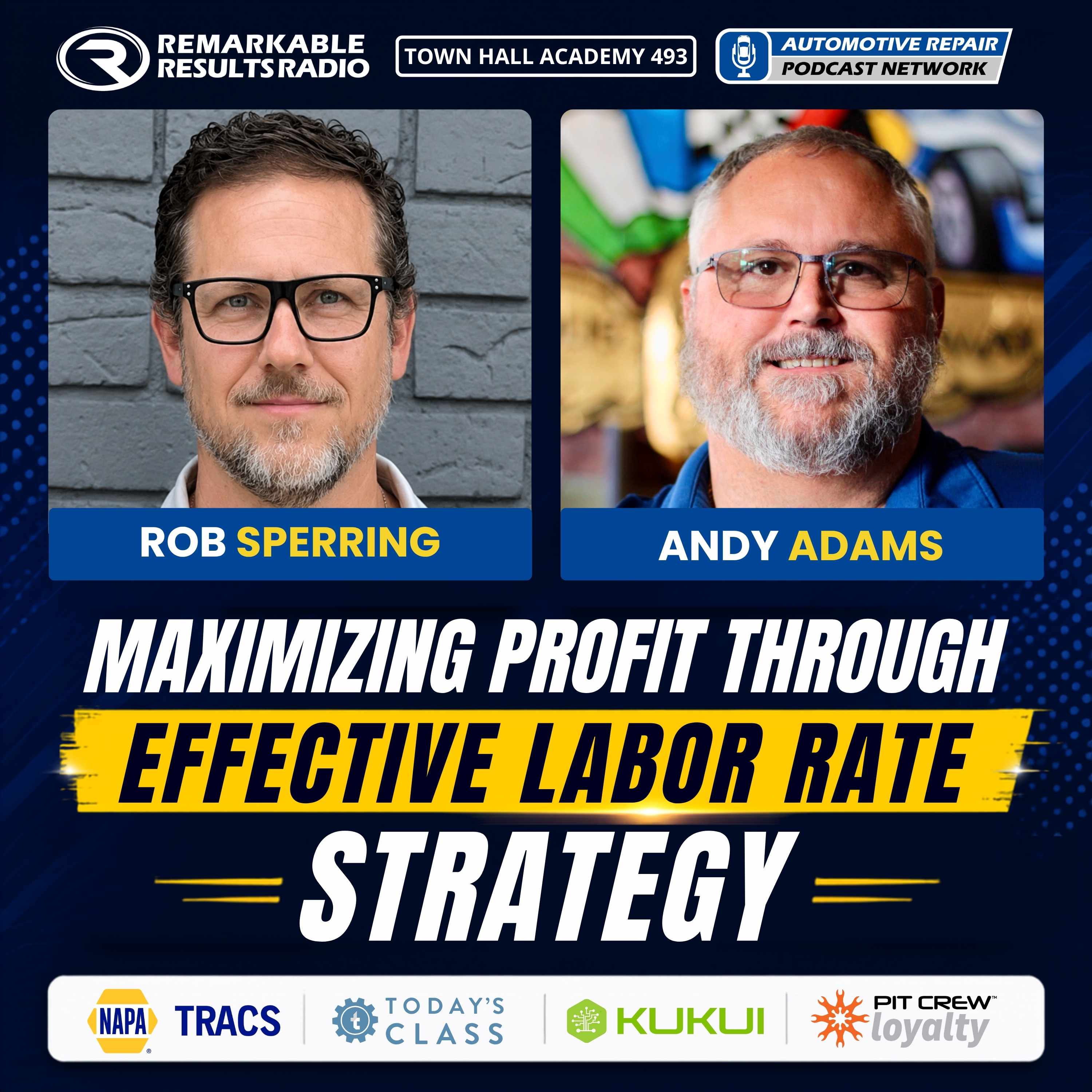
In this episode, Carm Capriotto is joined by Andy Adams, a shop owner and business coach, and Rob Sperring, a service manager, to explain why the Effective Labor Rate (ELR) is one of the most overlooked yet impactful performance metrics in the auto repair industry. They break down why ELR falls short, how it affects profitability, and the practical steps every shop owner can take to close the gap.
What You'll Learn
What Effective Labor Rate (ELR) is and why it matters more than your posted door rate.
Why healthy shops should collect at least 90 percent of their posted labor rate.
How unbilled diagnostic time, underpriced canned jobs, and complimentary inspections reduce profitability.
Why excessive discounting, even with good intentions, can quietly erode your bottom line.
How shifting consumer buying habits make labor profitability more important than ever.
Why improving ELR creates opportunities to increase technician compensation and strengthen your business.
How auditing repair orders can uncover missed labor opportunities and unnecessary discounts.
Why updating your labor matrix and canned jobs can immediately improve financial performance.
How sharing KPI's (key performance indicators) with your team builds ownership and accountability throughout the shop.
Effective Labor Rate is more than a financial matrix; it's a direct measure of how well your shop captures the value of the work it performs. By understanding where labor revenue is being lost and making intentional operational improvements, shop owners can increase profitability, invest in their teams, and build a stronger, more sustainable business.
Rob Sperring, Grand Rapids Motorcar, Grand Rapids, MI
Andy Adams, Adams Garage, Terre Haute, IN. Coach at Repair Shop of TomorrowThanks to our Partner, NAPA TRACS
NAPA TRACS will move your shop into the SMS fast lane with onsite training and six days a week of support and local representation. Find NAPA TRACS on the Web at http://napatracs.com/Thanks to our Partner, Today's Class
Optimize training with Today's Class: In just 5 minutes daily, boost knowledge retention and improve team performance. Find Today's Class on the web at https://www.todaysclass.com/Thanks to our Partner, KUKUI
Stop juggling multiple marketing tools. KUKUI’s integrated platform delivers 4x better website conversions, automated follow-up, and real-time ROI tracking. Get industry-leading customer support with KUKUI at https://www.kukui.com/Thanks to our Partner, Pit Crew Loyalty
You’re probably tired of chasing new customers who never return. We understand. Pit Crew Loyalty ends the one-and-done cycle, turning first visits into lasting, reliable revenue at https://www.pitcrewloyalty.com/Connect with the Podcast: