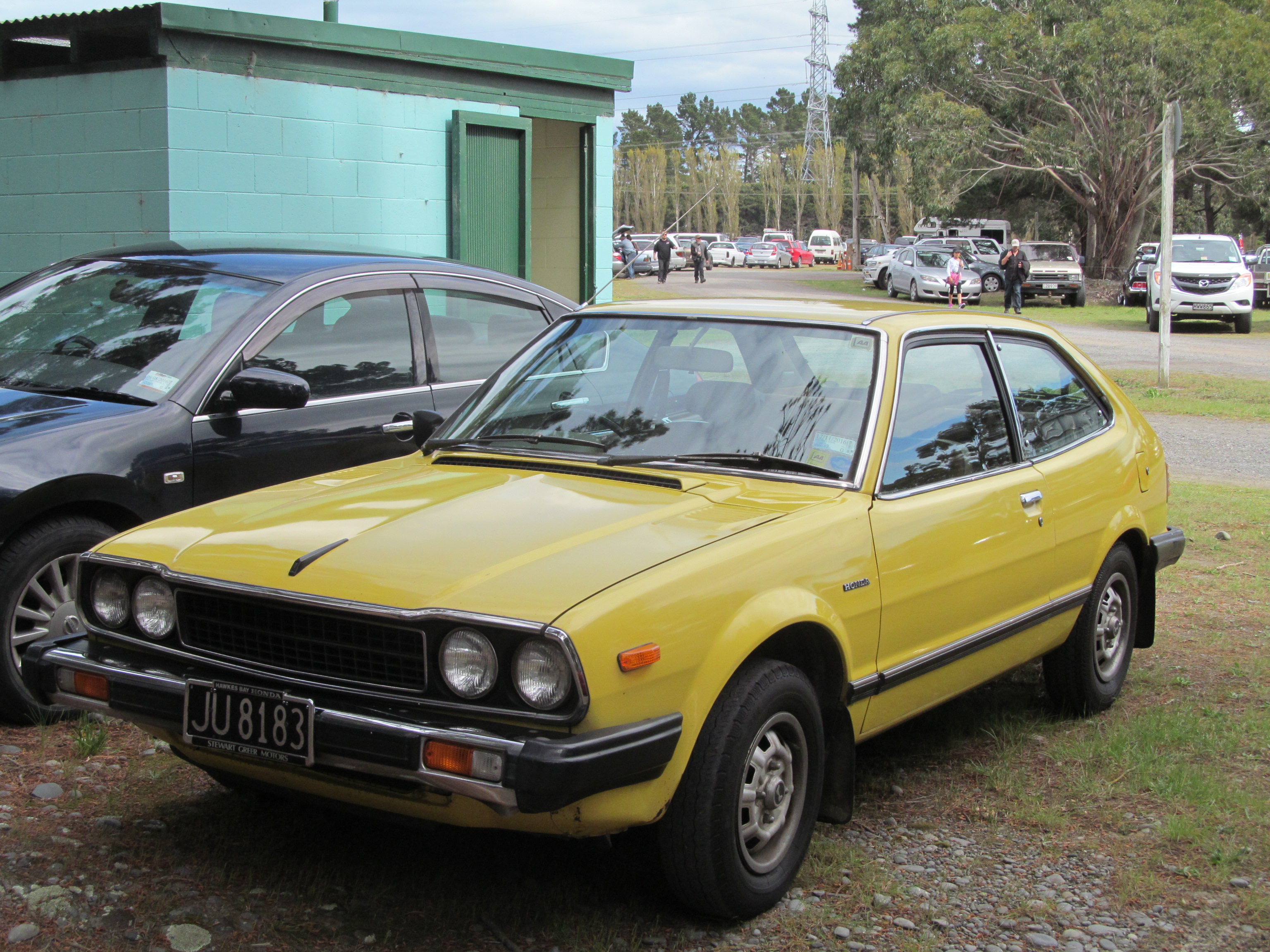
The Honda Prelude is a Honda coupe that’s meant to feel more sporty than a typical daily sedan. It’s the kind of car people associate with driving enjoyment. The podcast mentions it because it’s one of Honda’s notable model names.
The Honda Accord is a larger car than a small commuter model, meant for everyday driving with more space. It’s commonly chosen by people who want a comfortable sedan. The podcast brings it up because it’s one of Honda’s key, recognizable cars.
The Honda Civic is a small, everyday car made for commuting and errands. It’s popular because it’s usually efficient and easy to live with. The podcast mentions it because it’s one of Honda’s major, well-known models.
The Honda CR-V is a compact SUV, which means it’s a taller, more versatile car than a sedan. It’s designed for everyday use like commuting and carrying people or cargo. The podcast mentions it because it’s one of Honda’s important, well-known models.
E-15 is regular gasoline mixed with 15% ethanol (a fuel made from plants). Because it’s a different mix than standard gas, it can change how an engine burns fuel and how well it runs.
Octane rating is basically how resistant the fuel is to “knocking” in the engine. If the fuel resists knocking better, the engine can burn it more smoothly—sometimes helping efficiency.
Energy density means how much “usable energy” is packed into a certain amount of fuel. If ethanol has less energy per gallon than gasoline, you can end up using more fuel to go the same distance.
Synthetic motor oil is a higher-tech type of engine oil designed to protect the engine better, especially in hot or cold conditions. Here, the concern is that there may not be enough of it for routine service.
Group 3 base oil is the raw “ingredient” oil companies use to manufacture synthetic engine oil. If there isn’t enough of it, synthetic oil production can slow down or stop.
The Strait of Hormuz is a narrow shipping route where a lot of the world’s oil passes through. If shipments get blocked, it can cause fuel and oil supply problems downstream.
0W8 is a label for how thick the oil is and how it behaves in cold weather. The right viscosity matters for engine protection, especially when it’s cold.
0W20 is an engine oil type that’s meant to stay fluid when it’s cold and still protect the engine when it’s hot. The number helps describe how thick it is during normal driving.
Here, “warranty” means the manufacturer’s coverage for repairs. The point is that using an approved substitute oil temporarily shouldn’t cancel that coverage.
Group III base oil is the main ingredient inside many modern motor oils. If there isn’t enough of it, companies can’t make as much synthetic or synthetic-blend oil as they normally would.
A synthetic blend is a mix of two kinds of oil: one that’s made synthetically and one that’s more traditional. It’s meant to work better than regular oil, but it still relies on the same oil ingredients being available.
Group II base oil is a more traditional type of oil ingredient. During a shortage, it can be used temporarily, but it may not perform as well as the synthetic ingredients some cars are expecting.
Gas mileage is how far you can drive on a gallon of fuel. The idea here is that the wrong type of oil during a shortage might make the car use a little more fuel.
LIVE
Welcome to Daily Drive.
For Thursday, May 28, 2026, I'm Kellan Walker in Las Vegas.
Today on the show, Honda is leaning hard into hybrids to hold on to its double-digit share.
Concerns about ethanol fuel blends hurting engines are overblown, and a synthetic motor
oil shortage is closer than you might think.
Plus, Flavio Volpe of the Automotive Parts Manufacturers Association talks about the
delayed opening of the Gordy Howe Bridge and what it means for parts makers in North America.
Bridges go two ways.
The American companies are relying on the shipment of goods into Canada, like 29 billion
dollars worth of auto parts that come into Canada every year from the US.
Let's run through all the news you need to know to keep up in the auto industry.
Finally, some good news for Honda.
The Japanese automaker is riding a wave of hybrid momentum and rising gas prices are helping.
American Honda sales chief Lance Wolfer tells us at Automotive News the company hit
10% US market share in April and is targeting that level for years to come.
Hybrids made up nearly a third of Honda brand volume in the first quarter.
When the gas prices increase, consumers look at American Honda products and they consider them,
and it drives additional opportunity for growth.
So that's the biggest change in the marketplace I didn't anticipate that's really benefited us so far.
Honda is responding by ramping up hybrid production and launching targeted marketing
around four key nameplates, Civic Accord, CRV, and Prelude.
Wolfer says the company remains on track for 4% sales growth this year to roughly 1.5 million
vehicles and does not anticipate tariff related price increases in 2026.
Turns out, claims that higher ethanol fuel blends damaged car engines are overblown.
That's according to University of Toronto chemical engineering professor Bradley Saville.
The US EPA temporarily allowed nationwide E-15 sales in March after Middle East tensions
spiked fuel prices. That sparked viral warnings about engine damage and poor fuel economy.
But Saville says E-15 is approved and warranted for vehicles made since 2001.
And while ethanol has lower energy density, its higher octane rating can improve engine combustion
efficiency. And the synthetic motor oil shortage could last more than a year.
That's according to the Independent Lubricant Manufacturers Association.
It says the US will run out of Group 3 base oil, the key ingredient for synthetic motor oil
as soon as next month. The cause, the ongoing US war with Iran, has blocked imports through the
Strait of Hormuz. Cutting off nearly half of US supply, the association doesn't expect
conditions to normalize until mid-2027. Nissan and Toyota have already sent dealerships
bulletins on oil rationing and approved substitutions. Joining me now to talk more about it is Dan
Shine, Senior Retail Editor here at Automotive News. Dan, welcome back to Daily Drive.
All right Dan, so dealerships are being told to ration and substitute oils.
How disruptive is this actually going to be for service departments day to day?
Well, I think right now there's not much of an impact. Dealers, service directors,
fixed-hop directors that I spoke with are not seeing a big impact right now. They say,
oh, my tanks are full. I'm okay. Some of the dealerships like you mentioned Nissan and Toyota
are already kind of, especially Nissan is saying if you got X amount a year ago of a certain,
you know, 0W8 or 0W20, you're going to get half as much as you got last year or 70% of what you
got last year. So there's already some of those dealership groups that are being kind of rationed
and Toyota is starting to make plans. Factory recommends you use this Toyota synthetic blend
and we don't have it or we're not going to have it. Maybe we're enough of it. Okay,
you're okay to use something that's a little bit off-brand for one time use on this vehicle.
We're not going to void a warranty and that kind of thing. So there's already,
they're starting to creep in a little bit the dealership operations and I think as
the weeks go by and the months go by that the impact might become more aware of what's going on.
Now, Dan, what about synthetic oil alternatives? What do service managers need to know about those?
That there's really not alternatives. There's not great alternatives. So,
you know, this goes back to, again, what they call group three base oils that are used to
make synthetic blends. There's just, you know, the supply is completely cut off. You know,
what we have on the shores of the US is what we have and what we're going to get,
what we're going to have for many months. And substitutes like a group two base oil,
which is used more in a convention of motor oils, is a substitute for, you know, kind of a stop gap
for the foreseeable future. Now, those can be used and probably not really, you know,
hurt a car. I mean, you might get a little bit of gas mileage might not be as great.
So, those are possibilities. So, it's just, I think it's, you know, again,
there's not a lot of alternatives out there. There's not a lot of choices. It's, you know,
a lot of these vehicles want and are expected to use a synthetic and there's just,
we're running out of it. And at some point, there is not going to be any left.
Oof. All right. Well, Dan Shine, very insightful. Thank you so much for joining me.
I appreciate it, Cal.
Yesterday on the show, we talked about the delayed opening of the Gordy Howe International Bridge
between Windsor, Ontario and Detroit. The crossing has been decades in the making,
and it's finally complete, but it still hasn't opened. Held up by ongoing testing,
commissioning delays, and political friction after President Trump threatened to block the
crossing over trade disputes with Canada. Flavio Volpe is the president of the Automotive
Parts Manufacturers Association. He sat down with our own Greg Lason of Automotive News Canada
to talk about why this bridge matters so much to the North American auto industry.
Flavio, thanks for joining me once again.
Thanks for having me.
Always a pleasure. Take me back to when the unnamed Gordy Howe Bridge was first discussed.
What was the logistical situation like in automotive transporting parts to and from
Ontario and the United States?
Well, look, if you want to send goods, you've got to go over at the time Matty Maroon's Bridge.
And it's capacity constrained, but it's also constrained by someone who can charge what he
wants, what he wants. It's not just the most important commercial crossing between two G7
economies. It's the only privately held one. And so there was a really good discussion between a
conservative prime minister, the Stephen Harper here up on my wall, and Barack Obama,
and how do we do this? And what do we do? And certainly fought by the owner of the Ambassador
Bridge and the Maroon family now, like any other private business would want to defend its spot
there. And the American side said, look, we really, we understand the value in it, but we don't have
the money to put into it, which is amazing, but we don't have the money to put into it at the moment.
But let's work a tolling agreement so that you guys front the money, and then you make it back on
tolls. And we did that. So the bridge is financed by Canada. Now it's financed by Canada with a
very specific return agreement that worked for Canada, but mostly worked for Canada because
Canada had to find another way in from Windsor to Detroit, because at that time, much like it is
today, but with more volume, the most important things that went from Canada to the US and
in vice versa were manufactured goods. And the center of manufactured goods is Detroit Windsor.
So what were you flagging at that time, you and your members, were you saying this is costing us
time and money? This is a bottleneck? I just wonder what you were flagging or what the parts
industry and auto industries stance was and what their recommendations were to both sides of
government, whether it was US or Canadian government officials.
Look, on the Canadian side, that argument was more about a bottleneck and what that bottleneck
cost versus the toll on the bridge. But the toll on the bridge is look, you got two lanes,
anytime you got an issue, you're stuck getting that cost money. But you got to go through
town to get to that bridge. And if we're going to spend some money on infrastructure going around
town, build the highway to a new bridge and get you right out there, get it off center, and then
see if we can't get the capacity right through town than we did. And so we did a couple of things.
We built capacity to the current bridge, and we've also built that long term capacity
to the new bridge. And you know that the travel and goods is really balanced in either direction.
And so the industry writ large said, yeah, this works for us. This also allows us to grow that
capacity at the time that we'd come to the bridge decision. This cluster, this Detroit
centered cluster was losing investment decisions to the US Southeast. And in a lot of cases,
to Mexico, and some of those US Southeast conversations were, well, access to deep water
ports. And so you're going to make the stuff and you're going to export it out. And then the
Mexican argument was, look, cheap labor, cheap this, cheap that, but also we've got trade agreements
for 45, 46 different countries. So you can use Mexico as a base. And the Detroit cluster
was seen as, well, you're servicing the Midwest and you're servicing American markets, but you're
also, you've got a lot of inertia in the way you move goods. And this bridge was one of the
solutions in moving goods in the air. To put it in context for the listeners who don't know,
there was an old joke around Windsor that went as follows. You could get from Quebec to Miami
and pass 13 stop lights and 12 of them were on a stretch of basically residential roads
leading into Michigan. And then there was one on the other side of the bridge before you hooked
up with the interstate system that could get you all over America and avoiding stop lights.
That is the bottleneck you were talking about, correct? That residential street, essentially.
Yeah, that's right. And now it's free flowing to a brand new eight lane bridge. How does that change
the way auto industry moves goods? And how does that change in terms of monetary savings
just in time delivery? Because we know that's how the industry operates.
Yeah, it's all the obvious changes. Look, you can predict when the shipment's going to arrive.
You can bulk up on shipments and not necessarily worry about whether there's excess capacity.
You know, we're all stuck in the straight of our moves right now. There's a better
calculation on fuel consumption when you're not stuck in Windsor for half an hour when you're
rolling. And the reverse is true. And also, it's a clear signal to the industry that all three
levels of government understand that movement of goods is important because we've built the
monument to it. I remember talking to Eddie Francis, former mayor of Windsor about this
so many times. And, you know, from a municipal point of view, of course, they didn't have the
infrastructure dollars to commission something so expansive. But, you know, he was dealing with
General Motors had closed a transmission plant there. There was a series of closures and slowdowns
on the American side. And the whole issue in Windsor was, look, how much longer is Windsor
going to be in the auto business if we don't fix some of these things? You know, we closed Essex
Engine. We reopened it, you know, with money from the federal and provincial government.
But at that time, a major infrastructure project was good for Windsorites and Ontario companies.
And it was very good long term vision for anybody that knew that you had to go through
Windsor to get to the US. Let's do that in the most painless way possible. And Eddie was a real
champion of it. And he was the mayor. And Eddie's no longer the mayor. It's been a long time since
Eddie's been the mayor. He probably is all his hair grew back. But this bridge couldn't be arriving
at a better time. Politics aside, I think we're going to get peace on the USMCA front. I think
we're going to see volumes pick back up. And the U-turn that the Americans are going to make
on how they view the USMCA region as critical to their competitiveness
with China and the rest of the world may actually cause a real glut of business when this stuff
gets announced. You know, outside my window here, I could see the Ford Oakville plant.
That's going to be online later this year. And better to have a romantic idea that you can
get that stuff across rather quickly, like when you look at pictures of the 401 from the 60s.
You brought up USMCA and you seem to believe a deal is possible and probably likely the other
sort of monkey wrench that's been thrown into this is Donald Trump saying he won't open the
bridge. So even if we get a USMCA deal, do you believe that Donald Trump will indeed approve it?
Does he have any leg to stand on when he says he won't open it? Or is this going to open no matter
what? Well, he's never wasted an opportunity to create negotiating friction. And I think you
could file this into that. That bridge will open. It may not open the minute that we said it's going
to open, but the bridges go two ways. The American companies that are relying on the shipment of
goods into Canada, like $29 billion worth of auto parts that come into Canada every year
from the US, where do they go? They go on many maroons or the maroons family bridge,
you know, some of it sneaks through in other places like in through. Sorry, for example,
Narnia or New York, Ontario bridges, but for the bulk of it goes through there. So
I think he's just pressurizing the situation and making hay of it in the way that he does, but
it's not. There's no way. I want to go back to a couple of things that you mentioned. First,
I want to talk you liken this to the Strait of Hormuzor. At least you showed why one passing
is not enough, right? And we've seen this in auto. If you go back to the COVID-19 crisis and the
blockade at the ambassador bridge, was that really a signal to all parties involved that, hey,
we need a second span in case there is an emergency of any kind at Matty Maroon's bridge or any other
crossing for that matter? Yeah, somewhere on my wall over here that you can't see on your screen,
this is a framed copy of the emergency injunction the APMA got to reopen that bridge. And the way
that we did it was to argue that there was irreparable harm being done on production that
would never be rescheduled. And subsequent reports showed analysis, third party analysis showed
that was about a billion dollar cost to the auto industry. That's in five days. What we argued in
the moment was this thing is so absolutely critical. It has to be cleared. It has to be
cleared today. And you'll remember that everybody bitched and moaned about it. But everybody like,
well, is it Windsor police services? Is it the OPP? CBSA? And we went and got clarity on it.
But I spent like maybe the next six months apologizing for a bunch of idiots with hockey
sticks and Hyundai Tucson wreaked havoc because they understood, I shouldn't call them idiots
because they did understand one thing was the only way in, right? It was owned by a private company
that said, I'm not going to intervene. And by the way, the blockade is at the bottom of the bridge.
You're right. It was on public roadways and public right of ways. It was not on the actual
physical structure of the bridge, which is privately owned, as you mentioned by the murder.
Yeah. So I think it helped to make the case for what was emerging physically as the second bridge
over there to say like, we are not going to have that problem over there. Now, of course,
we made some legislative changes and the provincial government was said, hey, by the way,
you go to jail and we can charge you a hundred, you find you a 100000 dollars is not
a traffic ticket. Don't fool around. But that moment was exactly why that was our straighter
for a moose moment. Exactly why you should have other paths. The other thing I want to
circle back on is you brought it up and I wanted to discuss this. It was a conservative prime minister
and a democratic U.S. president that announced the deal that got together and got this done.
Two parts. One was the political relationship back then better. And two, was there a better
understanding of automotive supply integration between the conservative, the conservatives
under Harper and the Democrats under Barack Obama? What was the relationship politically
better? And was there a better understanding of how tied together North America is in the
auto industry? Well, I'll say all the relationships on either end of the spectrum,
on both sides of the of the 49th parallel have been better than than any relationship that
Donald Trump is the counterparty on, mostly because American presidents, while they always
understood that they had a size and leverage over Canada, always said, okay, well, Canada is our most
important trading relationship. So we're not going to be self-destructive while being mean spirited
to them and cut off our nose to spite our face. They know how exposed they were. And so it made
those relationships easier to manage because there was an expectation of professionalism.
Nixon hated Pierre Trudeau. And there's a famous story where he called him an a-hole and
Trudeau, having heard that said, I've been called the worst things by better people.
And neither one of those two sides of that conversation meant better relations between
the two countries. But the relations and, you know, Nixon put a tariff on Canadian automotive
goods in 1971 to cause a crisis as well. But we don't remember that. We don't get
taught that because it was within the regular spectrum of how these two countries would operate
with each other. So Stephen Harper worked very well with Barack Obama, even if they may not
exactly have liked each other. Now, your question on whether this administration or this Canadian
government really understands and or appreciates the integration of the automotive trade, I would
argue that Donald Trump and his administration probably understands it better than many other
predecessors. And that's why he pushed that button. And that's why he's using it as the wedge. Like,
I know how much pain this is. And by the way, I don't care about you. Here you go.
That makes sense. My last question to you, as we all know, your sports fan,
do you approve of the name, the Gordie Howe International Bridge? It seems like it's
right up your alley. I just wonder your thoughts to get us out of here on something like your
thoughts on the name. You know, we've all kind of spent the better part of the last year cringing
at a phrase that really worked for about a month, which was elbows up. But but Gordie Howe was known
for his elbows. And he was very good. He was not flashy. But he was the best player on the ice and
he was the strongest guy on the ice. And he told the story with his elbows and the curve of his
stick. But he did it for the Detroit Red Wings. He was Captain Canada, when he was the captain
of the team in the industrial heartland of the USA. That bridge could not have been named after
anybody else. And frankly, they should have called it the Gordie Howe Gordie Howe Bridge twice,
because he will stand as a testament to Canada, US culture, family and relationships. Long after
all of us are gone and everybody who poked everybody else's eye, there was only one number
nine. Appreciate it as always, Flavio. Always a pleasure, Greg. That's Daily Drive for today.
I'm Kellen Walker. Thanks to automotive news executive producer, Jake Nier, as well as our own
Dan Shine and Urvash Kakaria for their reporting for today's podcast. You can get the latest news
on North American trade and tariffs, the synthetic motor oil shortage and everything happening in
the auto industry at AutoNews.com. Come back tomorrow for more on the motor oil shortage with
analyst Nate Cineco of Ducker Carlyle. We can't just turn on more oil supply coming into the market.
And even if you could get the base stock, then like the refined capacity is different and it's
really not set up to do that. We'd love to hear from you. Let us know what you think of the show
and the topics we cover today. Send us an email at dailydrive at autonews.com or leave us a voicemail
at 313-444-2774. And if you enjoy the podcast, remember to like, leave a review and subscribe
About this episode
Ethanol and oil supply take center stage as the hosts weigh claims about E-15 and a looming synthetic motor oil shortage. The guest explains why Group 3 base oil supply is “completely cut off,” what “stop gap” Group 2 substitutes could mean for fuel economy, and how dealerships may ration specific viscosity grades. The conversation then pivots to the Gordie Howe Bridge delay—its financing, the Detroit–Windsor logistics impact, and how a free-flowing eight-lane bridge could improve just-in-time delivery.