The GMC Sierra EV is a big truck that runs on electricity instead of gas. It is made by GMC and can carry heavy things while being better for the environment.
MSRP is the price the car maker thinks the car should cost when you buy it from a dealer. Dealers usually start with this price before they offer discounts or deals.
Dealer fees are extra costs that the car dealer adds when you buy a car. They cover paperwork and other things the dealer has to do to sell you the car.
The Chevrolet Tahoe is a big SUV made by Chevrolet. It can carry many people and lots of stuff, and it is good for towing things like trailers. People often buy it for family trips or work.
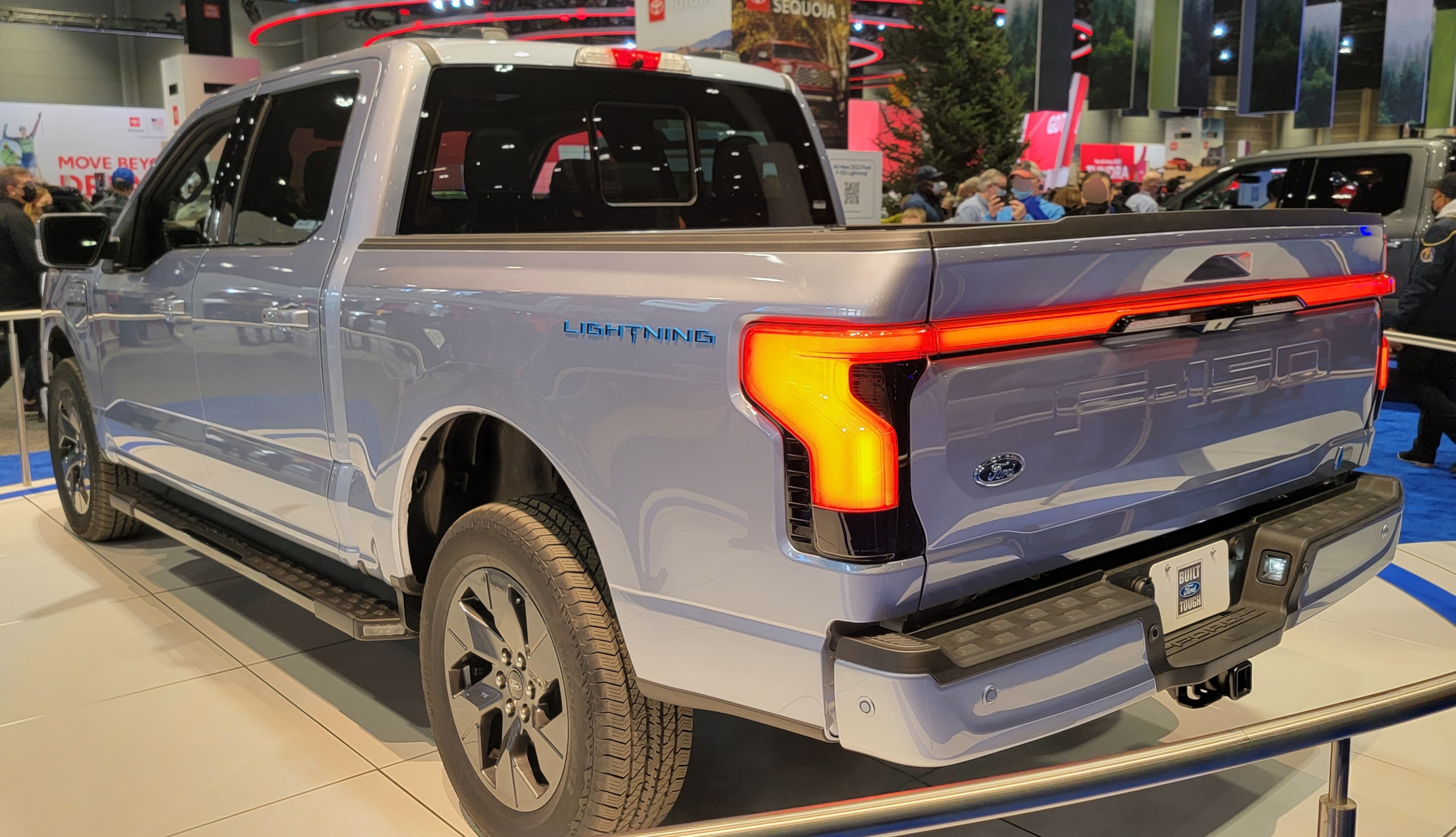
The Ford F-150 is a big truck made by Ford. It is used for carrying heavy things and can be driven on roads or work sites. Many people buy it because it is strong and reliable.
LIVE
We're doing better as a result of social media presence.
It doesn't do those three things then it's on the chopping block.
It's in return on investment discussion.
Hey everybody, welcome back to another episode of The Daily Dealer Live.
I'm your host, Sam Darkin.
Thanks for choosing to be here on this Wednesday, March 11th.
Today, we're diving into three conversations that are heating up
across the industry right now.
First up today, the broker versus dealer debate.
Are brokers hurting the market and driving prices to the bottom?
Or are they actually serving the customer in a way dealers aren't?
We've got a broker joining us today who heard our last show on the subject
a few weeks ago and said, hey, you guys got it completely wrong.
So we're haining the mic over.
We'll hear his perspective.
Then we're looking at fresh service department data from CDK.
What customers really think about service advisors and where dealers
may be leaving serious money on the table in fixed ops.
And finally up today, one dealer operator is going to explain why he cut
a huge portion of his tech stack, fewer tools, fewer dashboards
and surprisingly better performance.
Plus he may challenge the notion that younger GMs equal more AI equals
turning it over to tech.
You may dispute that lot to unpack today.
But first today, let's turn to automotive industry headlines.
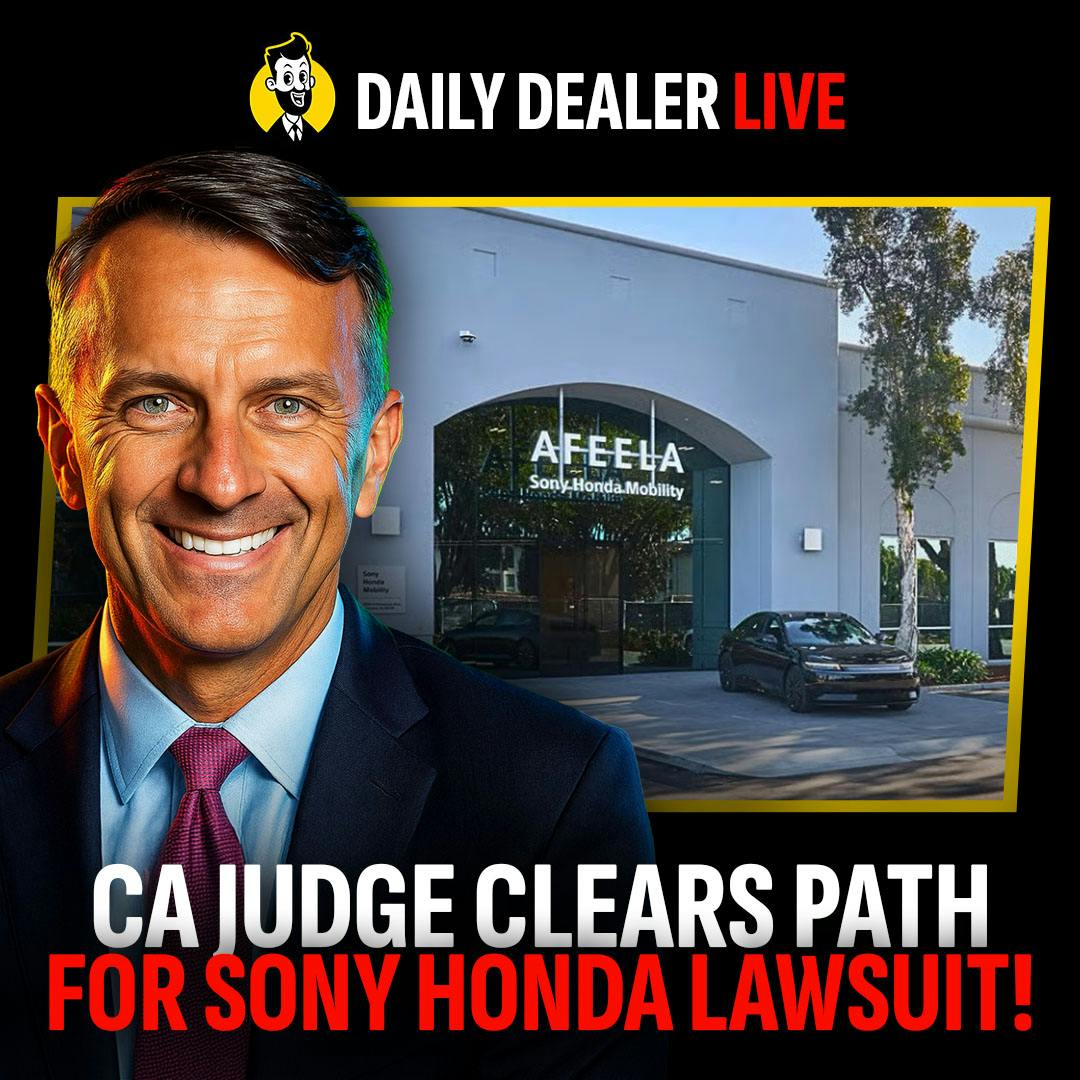
Leading today with a legal development that's adding to a growing pattern
in auto retail, a California judge has allowed the California New
Car Dealers Association's lawsuit against American Honda and Sony Honda
mobility to move forward, overruling the automakers motion to dismiss
for some context here.
C&CD filed the case back in August, alleging the companies are violating
California franchise law by planning to sell a field of brand vehicles
direct to consumers rather than through Honda and Acura dealerships.
Sound familiar Volkswagen scout.
The court also ruled that Sony Honda's $200 reservation agreement represents
a first step towards purchase.
It's a meaningful finding for how these DTC cases get argued going forward.
The C&CD said it wants a resolution before vehicles reach customers later
this year and it's moving with urgency to get there.
Staying in the VW universe or the VW scout universe, the German automaker
reported a more than 50% drop in annual operating profit Tuesday.
With Porsche taking an even harder hit, VW's 2025 operating profit came
in at 8.9 billion euros.
That's well below analyst expectations driven by US tariffs, currency
headwinds and a strategic reset at Porsche.
Porsche's operating profit meanwhile, sink 98% to just 90 million euros
with margins collapsing from 14.5% to a 3 tenths of a percent in a single year.
VW is now targeting a 2026 margin of 4% to five and a half and plans
to cut 50,000 jobs by the end of the decade.
For dealers, the takeaway is that a financially pressured VW is likely
to stay cautious on spending and brand investment, which could
eventually shape model mix incentives and the pace of North American commitment.
So as an aside, it's a fascinating development on the heels of scout
and its attempted launch into the US marketplace as well.
Moving over to a quick recall alert out of General Motors.
GM is recalling just under 12,000 units of certain 25 and 26 Chevrolet
Silverado 3500s and GMC Sierra 3500 trucks over a rear fuel pump
issue that could cause the engine to stall.
The fix is an engine control module update.
It's available for free through a dealer visit or an over the air update.
Owner notices go out April 20th and drivers can check their vins
on the NHTSA website now.
And by the way, I've got a recall number.
I kid you not, I'm not going to read it, but if you want to track it,
I am going to read it in 262544420.
This is a CDG first, we're actually tracking the recall numbers.
That's right.
All right.
And wrapping up, turning to the CDG Bicell Tracker.
Cue the jingle CDG Bicell.com.
Very there we go.
Ross Downing Auto Group made its first move into Alabama,
closing on Encore Chrysler Dodge Jeep Ram in Mobile back on January 12th.
It's the fifth rooftop for the Louisiana based group,
which did over a half a billion in revenue last year.
CEO Ryan Downing told us the deal made geographic sense relative to their
Louisiana stores and the group has its site set on Texas and the broader
Southeast next.
Also in the Bicell world, Generation Auto Group picked up two New Jersey
stores from Nielsen Automotive Group closing January 28th.
Generation acquired Nielsen Nissan, say that 10 times fast, Nielsen Nissan
and Nielsen Infinity of Denville rebranding both under the Rockridge name.
If it brings their New Jersey count to three stores, you can check out more
of these Bicell activities at the full tracker at cdgbicell.com.
We love our CDG Bicell Tracker jingle as well.
Well, that's our app on today's industry headlines.
And as you know, our social comments are already starting to light up in
anticipation for our big topic today.
We are streaming live across all CDG social media platforms.
You can post your comments wherever you're watching today's show.
We'll bring those comments live into the show.
Several comments.
Lift Lane YT.
Hey, let's go.
Glad to be here.
Brittany Minerva coming in with a heart smiley face.
Our guest may know Brittany will ask.
Lift Lane YT says Mike.
So we welcome all the comments as we dive into our first topic today.
Let's turn to Mike Minerva, general manager, partner of Capital Motor Cars.
Mike, welcome to the show.
How you doing today?
Thanks for having me on, Sam.
It's good to see you.
Good to have you here.
So before we dive into our topic, just tell us a little bit about yourself.
Who are you and what do you do?
So I've been in the carbroker business for about 12 years now.
I started when I was just finishing up college.
I didn't really know what I wanted to do.
I started working in the insurance business and kind of was doing some
brokering here or there.
I was younger.
I didn't really have a book of business or anything.
And then here we are about 12 years later now.
All right.
So you sent us a text after our show on broker v dealer.
And you said, always anti broker, never anything positive.
Should have a real broker on one of your shows to set the record straight.
It's not right to constantly drag us through the mud.
It's not it's not right to constantly drag us through the mud.
So let's have at it.
Let's have the conversation.
Why do you think dealers are so hostile towards brokers here in March of 2026?
I think the reason why they're so hostile against brokers is they're not
maybe not dealing with the right brokers and brokering always has kind of
gotten a bad rap, especially when you venture out of the New York City metro area.
When you mention you're a broker and you're calling a random dealer in the
middle of America trying to get a, you know, maybe a one of one car or some
specialty car, half the time they laugh at you.
And that's where brokering has become more popular around here.
And it's it's kind of changed the way the business models have gone on with
the dealers around here.
So you say, hey, there are different types of brokers.
There are different people that are engaged in this business.
Describe for our audience, because by the way, brokering is bigger on the
East Coast and then it varies as you spread across the United States,
depending on laws, whether it's allowed, whether it's not allowed.
And then what the marketplace looks like described to us, what is brokering?
What is this practice of brokering?
So brokering, as far as I'm concerned, in the Northeast market is you
call car broker, leasing company, they're, you know, they're calling brokerages,
leasing companies, everyone kind of markets themselves a little differently.
And you just tell the broker or leasing company what you want.
So call up, say, hey, I'm looking to get a, you know, a GLE 350 Mercedes.
I want it in white with a brown interior or white with red interior.
The broker will then go to their channels and dealers say, hey, I have a
deal on this car, client wants his car, what's my cost on it?
And then work their deal from there.
And then you, and you work that deal direct with the consumer, right?
So you basically negotiate back and forth for on behalf of the consumer.
So traditionally how it works is a dealer, you know, if we're working with a dealer,
that's a, you know, one of our normal dealers we're working with, not, you
know, not a dealer, a new dealer right off the rip, they'll give us our
cost on the vehicle.
So whatever, whatever our off MSRP percentages, they'll say, hey, you
can do this on the car.
These are the incentives.
This is our dock fee.
This is what it costs to do plates in New Jersey or New York, whatever
state the deal is going to be at.
And then from there we build on our deal.
Most of us all kind of use the same software for a long time.
We were all using a product from CDK.
Now we're using a new product that just kind of dropped out the last couple
months, actually like probably like a year and a half ago.
And what was the CDK product called?
And then what's the new product called?
CDK was the webdesk and program from years ago.
The old, oh yeah, they said that.
Yeah, they start, they were supposedly phasing it out or redoing it.
We still have access to it.
We still use it for every now and then, but we, we use a new product.
It's called X desk, actually created by a broker for brokers.
It's amazing how it streamlines the process for us.
So, so you take these data points, you enter it into the system, you get the
customer's information, credit bureau, all that stuff.
And then you send that off to, let's say it's Nissan, you send it off to
NEMAC, right?
The deal.
So brokers are not sending deals directly to the banks at all.
Okay.
They are, you know, we take our deal, we take our deal in.
So it'll start off with customer, we close the deal, we have our deal screen
from X desk or whatever software brokers using.
We'll take that worksheet, we'll get the customer's credit application, whatever
other trailing documents that come with the deal.
If there's, you know, proof of conquest, proof of loyalty, all that stuff,
button it up all in one email and send it off to whatever dealer that the
vehicle is going to be coming from.
And then from there, you know, a day or two later, the customer has the car at
their house, especially if they live, you know, in our general, in the New York
New Jersey area, obviously for shipping the car elsewhere, you know, that lead
time will add into that.
So give us your perspective.
Why do you think, how do you make your money on this deal?
So you get the cost from the dealer, you're giving your consumer a good deal,
I would imagine.
Do you mark up between the price the dealer is willing to pay you and what
you charge the customer, or is there a fee that you charge in between?
Dan C asked that.
He says, does Mike charge a fee to the consumer and also take a cut from the
dealer?
How does that work?
So every, every broker operates differently.
Some brokers charge a flat fee, like, you know, your lease hacker broke.
We had this conversation, like your lease hacker brokers, your, these, these
new style of brokers out there that don't consider themselves brokers.
They're kind of like a car finder service.
They're charging you a flat fee.
We, our profit has worked into whatever the cost of the vehicle is.
So as a broker, the goal is to try to work with dealers that are letting you
buy cars as deep as possible.
So whether it's behind invoice or, or at invoice, whatever the market is on
that vehicle, you want to buy it as deep as you possibly could.
So Mike, I think a lot of franchise dealers watching this would be curious to
know why does a consumer come to you instead of direct to the dealer?
So if, if the consumer could negotiate just as a good deal with the dealer, why
do they come to Mike at a capital motor cars instead of to XYZ Nissan as an example?
So as we all know, dealers, there's a dealers are all over the place, especially
in the Northeast, we're overloaded with every manufacturer in New Jersey, New
York, we're overloaded with every manufacturer.
So as a consumer, I say this all the time.
If you truly want to get a better deal than what you're going to get from a
leasing company, you're going to spend three, four days driving to every one of
these dealers, Hey, I got this offer.
Hey, I got this offer.
Hey, I got this offer versus calling a leasing company up a brokerage up and
working a fair deal out where the car shows up your house two days later, you're
not, you're not wasting three days trying to find that one off deal that you
know, you have, you know, you say you live in New Jersey, that you found out an
Nissan dealer on Long Island.
Okay, so you're, what you're saying is, is you're able to shop all the dealers
and really kind of work them against each other a little bit.
You do what maybe the lead generating websites do and the free market does
online, you just do it in one place, one person, right?
So how do you respond to the dealer who says, look, and we heard a lot of this
on our last show, look, I'm required to spend millions of dollars on my
facilities.
I've got to, I've got to worry about CSI.
I've got to take care of that customer.
If there's a problem after the delivery and you're coming in and you're
pushing me on, on, on, on a program that causes me to lose a lot of money
selling this vehicle.
In fact, I don't know, you know, it was quoted that some dealers will
lose $5,000, $7,000 to sell through a broker.
If you package up 10 deals or 15 deals or 20 deals all together and you
help a dealer hit stair step, what do you say about that?
Like they're required to have a facility and brand standards.
You're not, you can go around, consolidate them and repackage them.
Shouldn't you be required to have a facility standards, maintain CSI,
maintain a great customer relationship?
Yes, of course.
And if you don't do those things for dealers, they'll cut you off.
I've seen brokers get cut off from dealers all the time where, you know,
their customers maybe cause a problem on bad surveys, you know, there might
have been a problem with the vehicle and they're, you know, you know, how
it is in the service department, they're causing a problem at service.
Those, there's times where brokers do get cut off from dealers.
I hear about it all the time.
I see it all the time.
And those are things where you have to be a company that has a footing that
can stand behind and make, make sure the whole deal is being, you know,
taken care of if there's a problem, you know, just throw it to the side and say,
up, it's the dealer's problem now, technically you sold the car.
It's your problem as well.
So the dealer can hold you accountable and then that's their leverage to
make sure that the customer is well taken care of.
Of course.
I mean, there's, you know, I'll give an example.
CDJR stores, if they don't get perfect surveys from our customers, they're
not paying.
Yeah.
How do you get the perfect survey?
By the way, let's give it, give us your secret because you're not the franchise
dealer, right?
And so you're not providing the experience on a lot of the questions that
are asked on the survey.
So for my company, I can't speak for every leasing company brokerage out there.
My delivery team is required, no matter what the vehicle is, to go through
the vehicle with the client.
Uh, if there's an app, you know, phone app for that vehicle, they're required
to set up that phone app for the client with them on their phone.
Um, and, and, you know, continue the delivery process the same way a
dealership would, would, you know, have their, maybe, uh, their genius like
BMW calls it their, whatever the, you know, case may be that goes over the
vehicle with that client, uh, at delivery.
So, so, uh, it's important to hold that line and, and keep that standard.
You mentioned there are dealer, there are brokers that are different, not
every broker is the same.
Should there be standards among brokers who are engaging this type of
behavior activity?
Because, you know, you get somebody that doesn't, uh, defend the line to the same
extent you do on CSI or customer experience, and they just come in and
offer a cheap price, but nothing on the other side.
Ultimately, the dealership and then the OEM is held accountable to, to finalize
that at, at a significant loss.
Should there be better standards?
Of course.
Um, in New York, the state is really kind of clamped down on, uh, on, uh, you
know, making brokers make sure they're licensed, insured, bonded.
Uh, I think that needs to be an industry standard practice.
Unfortunately, it's a, it's a industry where the market to enter the entry, the,
uh, the entry is, is virtually just an office and a cell phone and some
desking software.
So there needs to be some sort of standards in the industry, whether it's
from a state level or something that kind of keeps everybody to even playing
field.
If one brokerage is working out of their house with no overhead and no skin
in the game, and I'm over here.
I have an office.
I have 15 people.
I got to make sure I have, are paid every week and, and, uh, you know, CODs are
paid to dealers and, and money's going back and forth and everything's being done.
FedEx is going out, plates are getting sent out.
You know, there needs to be some sort of industry standard where people have
to abide by Dan C comes into the comments and he asks a great question.
He says, Hey, just for clarity, Dan C, by the way, he's a long time listener,
postal often who actually sold the vehicle to the customer, the dealer or the
broker.
So that's a great question.
A lot of people always ask us this, the dealer that is facilitating the deal is
the dealer that is selling the vehicle.
So someone in the dealer is getting credit for the deal, whether it's a fleet
manager, or they have a round robin where they just throw the fleet deals around,
uh, around the showroom.
And, you know, everybody gets credit for a deal for doing nothing.
Essentially, um, the dealer is selling the vehicle.
There is nowhere on the paperwork or the contract for the lease or contract for
the finance.
Does it mention that ABC brokerage sold this vehicle?
Got it.
But how does it make sense?
How, how do you hold a broker accountable?
If it's not done well, if the brokerage is never listed on any of the paperwork?
I hold the, how do you hold the brokerage account?
Yeah.
How would you hold the brokerage accountable if they are not the seller?
So the, the, the dealer does in a sense, they know who they do.
Got it.
Well, they know in their system, okay.
You know, all right, Mr.
Jones is causing an issue with a survey or service.
Okay.
Look, it's a broker deal.
Oh, it was sold by.
Yeah.
You know, so and so.
So do, do brokers have a relationship with the OEMs like, like Nissan or
Stellanus or Hyundai or lenders, captive lenders that traditional customers don't?
No, we're not dealing with manufacturers at all.
We're dealing with, we're dealing with directly with whatever dealers are
willing to work with brokers at the time.
Yeah.
Do you get the impression though that there's some OEMs that are more supportive
of broker business than others?
And yes, helpful in it.
Yeah.
I mean, for sure.
I mean, some OEMs, they don't, some OEMs don't really understand what we do.
You know, who's most supportive and who's most disruptive in that space?
Would you say?
Land Rover hates brokers.
Yeah.
And they know their cars are getting sold by brokers.
And what do they do to stop it?
Do they do things to stop it?
Or do they?
All allocations from the dealer, if they find out that it's a broker.
Yeah.
And then who are the top two or three that support it?
I would say BMW is a pretty big supporter of it.
They're like really the only ones that kind of police it in a sense.
When you're putting an application and there is a section
you can declare for the FNI, for the FNI director to declare it.
Mazda is doing the same thing now.
They've been doing that for a little bit now, I think almost two years,
but BMW has been doing this for probably longer than I've been in this business.
So, so why is it such a big business on the East Coast and in certain parts of the country
and then almost unheard of elsewhere?
Why are there geographic differences in broker broker business?
There are probably dealers today that are watching the show going,
what on earth are you all talking about, right?
I think it has to do with leasing.
And when I say leasing, 90% of the business that brokers are doing are leases.
I would say post COVID, the finances and the cash purchases,
there's been an uptick in that, certain vehicles just don't make sense to lease anymore.
They make more sense to finance.
So I would say the reason why we exist is because of leasing.
You know, we were talking about this earlier.
We were looking for, I forgot what kind of truck we were looking for.
And I had to call some random Ford dealer.
I'm like, hey, we're going to do a lease on this.
And they're like, we don't do leases.
Ah, and I'm like, what do you mean we don't do, you don't do leases?
They're like, oh, we don't know how to do an out of state lease.
In 2026, you know, I don't care if you have a small, very small dealership.
You should know how to, to bill out of lease or structure out of lease.
For a client, they're looking to lease a vehicle.
So I think the reason why we exist and why it's so big in the Northeast is
because leasing is a major majority of the car sales here,
no matter what the brand is.
And there are some dealers that just flat out won't do it.
So the real issue is it brokers or is it dealer pricing transparency
and willingness to transact certain types of transactions?
Yeah.
Yeah. A lot of great comments coming from online.
I just want to go to a couple of these.
Frank Martin says, you can get just as good a deal or better deal
if you go do the work yourself, so pro dealer standpoint.
LiftlaneYT says, learning a lot from this live.
Thank you.
We see Frank Martin says, dealerships are usually very responsive to customer demands.
And then Motor CityMav says, I buy all my vehicles through Mike.
He is the standard auto find leasing says, Mike Minerva is a legend.
We use CMC all the time.
And then Vedrin says, great info and explanation of how it all works.
And then Robert actually comes in and says, I believe the future is calling
for brokers.
People don't want to spend three to four hours in a dealership.
Do you think the type of experience being offered by franchise dealers
in brick and more contributes to an exit from more traditional models
to yours, a broker or even more online?
Some of those other models, for sure.
And it's funny you spread someone brings this up.
Some dealers in this area specifically, if you mentioned you're working
with a broker, it either goes one of two ways.
Either they tell you, have a nice day, get out of my showroom
or they give the car away and they'll sell the car
pretty much what they're willing to sell us the car for.
So now they're taking a mini deal on the floor, a short deal on the floor
just to keep that customer in house versus having them go back to the broker.
And then maybe that deal ends up at a completely other dealership
versus their dealership.
And we've had instances before where I've had a customer shopping, going around
looking for a Jeep Rancherrikey and I found the car, I send the deal
and it's like this guy spent four hours with
one of my salesmen on Saturday.
Like I can't let you sell this car to them.
Like there's plenty of instances that happens.
Yeah.
So they're and that's not fair to the salesperson either.
And no disrespect to the salesperson.
That's a reflection on maybe poor structure at their store
and the way they're doing things and holding a customer house for four hours.
It shouldn't take more than an hour to buy a car, I'm sorry.
Yeah.
So part of your marketing out there, you and brokers similar to you at Capital Motor Cars,
you advertise leases, you advertise payments, you advertise online.
What is your most successful lead generating activities in the broker
world that brings clients and customers in that you deliver the experience you deliver?
Word of mouth.
There is no there is nothing better than word of mouth.
You could spend $50,000 a month on Instagram, Facebook, Google ads.
There is nothing better than word of mouth, letting someone getting someone in.
It's a warm lead.
They already they already heard the experience that their friend or family member had.
And typically, if they're, you know, referring you, they had a great experience.
There is nothing better than that.
Working with other business owners and just word of mouth.
Those are the two best ways to generate clients.
And that's how I generate a good majority of my clients.
Cut coming from the comments too fast for you all says many times there are language
barriers, etc., or brokers play a massive role in keeping it all smooth.
And then Dan C. comes in and says, does Mike target specific ethnic groups and or religions?
Mike, I'll sell a card to anybody.
It doesn't I have no no barring on any of that stuff.
But, you know, there are broke the brokering world kind of did start from that realm.
And now it's kind of moved away from that where the, you know, everybody's a broke,
you know, every ethnic group has someone in the broker business representing that ethnic group.
Mike, if if if brokers disappeared tomorrow, would the consumer pay more for vehicles today?
Yeah, I think it takes away some of the competition that they have.
You know, there's dealers, you know, if I'm doing deals for a customer in New Jersey,
I'm getting the car from Long Island because they have better pricing.
Now that customer has to now go from New Jersey to Long Island to potentially get that same deal.
Versus trying to get the same deal from a local dealer that doesn't want to do it.
Here's what strikes me is super interesting.
You you bring up some great points, customer experience, speed to acquisition.
You're delivering something that the consumer wants.
So in a free market, you're definitely doing something that people want.
I do think there needs to be controls.
We talked about this outside the show.
I'm going to ask you in a minute what rules should exist.
But it also occurs to me that if there were no dealers that said, hey,
I'm going to make all these Nissan's available to you.
So I hit my bonus or all these BMWs to you.
So I hit my bonus.
It kind of dries up.
You turn back into used cars. Fair.
What what do you think is is the poll for dealers to continue supplying vehicles?
Yet, you know, on one side, they're saying, hey, this this should go away.
On the other side, they're selling you a lot of vehicles.
They're creating a business, a shadow business.
The only way it would stop is if dealers said one day.
I said, no, you pull the pull the plug out and until manufacturers take away
stair steppers and all these things, it's never going to happen.
Even during COVID, when when there was no inventory, there was still plenty of
dealers willing to work with us and it honestly made us stronger and it made us
learn how to find cars elsewhere.
You know, I was I was pulling cars from all over the country.
And I'm talking regular cars.
I'm not saying like a Mercedes G-Wagon where still to this day, you know,
you're going to have to go over the place to find a vehicle like that readily
available, you know, pulling jeeps from Iowa or a Mazda from Georgia.
Just because that dealer had cars, they were willing to work with us.
Their pricing was good and and they they wanted they needed the deals.
Yeah, Karim says 99% of the time customer would not get the same price.
So that's an argument for pricing.
And then too fast for you all says broker deals with all makes and models.
Brokers don't have to sell a Nissan just because of the dealership they're in.
Brokers have no bias.
So what rules should exist for brokers?
Should they go into the future?
And then I'll ask our last question for today.
I think every broker should have a whether it's a brick and mortar location.
Some type of office, brick and mortar location should be some sort of DMV
licensing behind it. Obviously insurance.
You're driving people's vehicles around, bonded, you know, in case something happens
and dealers are bonded, you should be to and kind of held to a standard.
You know, you're you're you're using you have people's information.
So you should be held to a standard of protecting their information.
And you're also dealers information as well.
You're protecting the dealers information and the customers information.
How do you know that you bring up a super interesting question with all the FTC
safeguards, rules and non NPI, non public information and whatnot.
How does a good broker think about data security, data protection when you've got,
you know, you're not the seller, but you are handling.
You are in the custody care control course of control of data and information.
How does that work?
Who has liability if there's a data breach or someone leaves a driver's license
somewhere in process?
You know, that's a good question.
Kind of a little bit above my head with that one.
Yeah, that's OK. I was just. Yeah.
You know, every broker is different.
I mean, there's some brokers that fill their credit apps out on pen and paper still.
Yeah. Yeah.
Those brokers don't have to worry about that.
You know, but yeah.
Did Dan C asked the question, do brokers actually pull credit reports?
I would assume you do.
You've got to be able to pre qualify and understand a customer's capacity to buy
a vehicle. That's a great question.
We have my office.
We use 700 credit.
Any deal that comes in, I'm checking the credit before I'm wasting my time
sending it to a dealer. I want to see what's going on here.
Hey, all right.
You know, customers looking for a Chevy Tahoe and they have a 650 credit score
and they think they're going to get, you know, approved on a lease.
It's not going to happen.
So I'm not going to sit here and send that deal to a dealer.
Excuse me.
Sit here and send that deal to a dealer and waste that dealer's time.
Those are, you know, like I said, there's different types of brokers.
Every broker works differently.
That's something we do here
just so that I don't have my sales guys running around
working with somebody that's not a qualified buyer.
All right. So our last question of our brokers, the travel agents of the auto
industry, or are brokers the Uber of car buying?
A little bit of both.
I mean, a travel agency kind of in this day and age has been kind of phased out.
I feel like depending on the type of, you know, trip you're looking to do,
you know, yeah, really calling travel agent to book a trip.
But, you know, you're looking to go with some exotic trip that, you know,
you really need some help with, yeah, you're going to hire a travel agent to do that.
Well, Mike, say a little bit of both.
A little bit of both. All right.
Mike Minerva, general manager, partner of Capital Motor Car.
I got to tell you, thank you so much for coming on and kind of bringing
greater transparency to this practice of brokering.
Bold step, especially given all the feedback we got from our prior episode.
Hopefully you felt like you were treated fairly on this show
and we appreciate you being as transparent as sharing this.
And we do want to bring you back at the very end of today's show
for a little lightning round with a dealer.
We'll talk a little bit about brokering versus franchise at the very end of today's show.
So hang out for a minute, Mike Minerva.
Thank you so much for being on the show today.
Thanks for having me on.
Fascinating perspective.
Appreciate him answering.
And my gosh, our entire social media is blowing up with comments.
I wasn't able to bring them all in, but you can go look online,
the various platforms and see all the postings.
But let's talk Experian Automotive for a moment.
Today's episode is brought to you by Experian Automotive.
Nearly 90% of dealers say fraud is rising and 75% say
it's already impacting operations.
Stop it fast with Experian Automotive Fraud Protect.
Quickly validate customer identities and documents with zero disruption
to your sales flow or the customer journey.
Learn more by clicking the link in the show notes below.
Or if you're watching the live show, you can scan the QR code off to the left.
We appreciate Experian Automotive for supporting today's content,
including that fascinating conversation we just had with Mike Minerva
about brokering across the country.
But in particular on the East Coast, managing partner capital motorcars.
Thank you again for supporting today's content Experian Automotive.
And let's head straight into our next conversation,
talking all things fixed operations, service and data.
Senior director of product marketing, fixed operations, CDK Kim Saylor.
Welcome to the show.
Thanks, Sam. Thanks for having me.
You know, it's interesting.
We talk about brokering and not everybody in the country knows it.
Not everybody is touched by it.
But a part of it, at least what I learned today
is created by some of the friction points and franchised automotive.
One friction point you shared with me on on a podcast, you and I did,
is the average wait time if I call a service department before I get a response.
Tell us, what is that wait time?
And what does that tell us about automotive service departments
and where we need to put some energy and focus in March of 2026?
Yeah, so the wait time on the latest study we did was over nine minutes.
The average whole time or wait time to get someone on the phone
to schedule a service appointment.
And that's up a little.
It was over eight minutes in the previous study.
So, you know, the dealers, you know,
and surprised me that there are dealers that are still hesitant about,
you know, let's say utilizing a virtual assistant for scheduling appointments
because, you know, they're worried, they're hesitant.
I get it.
They're worried that their customer is not going to like that experience.
But if you're waiting nine minutes, experience is already bad.
And that's the first step into the dealership.
That's a lead to your service department.
By the way, so if I understand that right, average nine minutes,
which means for every one minute wait, there's an 18 minute wait, right?
So and it's astounding.
I don't I wouldn't wait on the phone for nine minutes for anything,
let alone to pay somebody to fix a car.
What do you make of that that trend line getting worse in 2026?
Not getting better. Why is it getting worse, Kim?
You know, I don't know why it's getting worse.
I think one of the things that's happening, you know, at some stores,
and I certainly don't want to, you know, blanket is blanket,
you know, do a blanket statement.
But there's a lot of dealers that aren't adapting to customer expectations,
you know, even, you know, if you think about doing communications
with a customer, you know, as a one size fits all based on, you know, generation.
So, you know, they're worried they're thinking about their customer.
That's let's say my age that they're thinking, OK, this person doesn't want
to have a virtual assistant, but yet 31% the same study,
31% of all the customers said they prefer a virtual assistant.
And when you look at the younger generation that, you know, it just goes up higher.
And in fact, they want to get fast from voice to text, right?
Or some alternate form of communication in some cases, they're OK
going to a virtual assistant as quickly as they can, unless it becomes complicated, right?
Exactly. They don't, the younger generation, they don't want less communication.
They want better communication in their mind.
That is better communication for them.
Yeah. What is your data show about
what are some of the biggest shifts happening in fixed ops right now
that most dealers don't see yet from your perspective in the data?
You know, again, I think it's just not taking in those customer expectations,
you know, being let's say proactive on on communicating with the customers,
you know, not sending out alerts, having the customer still calling
into the dealership to find out the status versus versus proactively
reaching out to the customer.
Yeah. What what is the data show about how customers actually think
about service advisors today, their role, what they rely on a service advisor for?
And how should we be thinking about that role in winning in 2026?
Well, you know, the service advisor is really the face of the service department.
It's the window into the dealership, the service department for the consumer.
And so what did stand out is how consistently positive customers
feel about their service advisor.
So almost 90 percent of the consumers said that their advisors
do communicate clearly.
They explain what's needed.
They treat them with respect.
So that's really huge because, you know, if those things didn't happen
and when they didn't happen, the NPS dropped by almost 40 points.
So the advisor experience really, you know, can make or break
how that customer feels about the dealership and going back to that
service shop or study, the number one reason customers chose to take
their car to a dealership for service is because of the relationship
that they have with that dealership and the relationship is just built
and can and reinforced by that service advisor.
Paul Salisman comes into the comments and makes a great point.
He says, one example, some dealers don't allow booking loaner cars
via their online scheduling system.
So you must call to get a loaner.
He says that's a frustrating friction point when it could be
reasonably automated.
And it's an interesting point Paul makes, Kim.
If you automated that, that then frees up the service advisor to handle
some of that more personal problem solving rather than just
scheduling, which anybody could do, AI could do.
Exactly. Exactly.
I mean, the service advisors have a lot on their plate.
And so anything that you can take off their plate that can be automated
communication, you know, scheduling appointments, you know,
so that they're not answering answering calls, it allows them to
provide the customer that's standing in front of them a better experience.
Did you, as part of your survey, did you look into the split on service
revenue, like how service revenue breaks down between customer pay
warranty and internal?
We looked at recall information, but not so much just straight up
customer pay warranty internal.
Okay. Okay.
What came out in the data as it relates to recalls?
We're definitely seeing a lot of recalls, you know, in this post COVID
era with supply constraints have evened out.
Yeah. So we talked about it, Sam, you and I talked about it before about
recalls and, you know, how, you know, recalls is an area or an opportunity
for dealers to provide more education.
There were a lot, especially the younger shoppers, when they didn't get a
recall done, they weren't getting it done because they thought it was going
to cost them money.
So that's amazing.
Yeah.
How did that show up?
And you said it was a, what Jen was it that was not getting a service call?
Yeah, Gen Z.
But the ones that did come in, the Gen Z that did come in and get that, you
know, that recall work completed, they were also very likely to add additional
services.
So it's not, not necessarily because they're just, you know, carefree with
their money, they were, you know, they were very careful about what they
spent, but when, you know, when they had that trust with the advisor and they
understood what work was needed, they were likely to add additional service as
well to that recall.
So what's the takeaway for a dealer on that?
Is it to be better at outreach on recalls and make sure we explain, you know,
hey, these recalls don't cost you money.
These things are paid for by the OEM, by the dealership, and they're part of
your ownership experience.
Absolutely.
You know, this, you have to think about the Gen Zs.
This is their, likely their first big purchase, right?
And so, you know, they, they don't know, you know, to me, the idea of a recall,
it just seems obvious it's, you know, it's going to be paid by the OEM, but, you
know, I'm the age I am and I've had multiple cars.
This is their first big purchase.
So yes, you know, just educating them that they are not going to, it's not going
to be money out of their pocket, you know, by getting that, you know, getting
that recall work done.
What is your data say about service customer retention in 2026?
Well, it's all, the retention really is going to be about how the dealership
can provide the experience, build the trust, and it keeps those, keeps those
customers coming back, especially when we talk, again, going to that younger,
that younger shopper, they're very loyal.
They are, I think it was, you know, over 90% likely to return to the dealership
for service that they bought their car.
So they're very loyal.
And then on top of that, you know, if they're treated, you know, the way they
expect to be treated, which is basically, you know, a good experience in building
trust, then again, it was over 90% that they would come back to that dealership
and buy that next car.
So, you know, again, I think we talked about the last time, it's a big
opportunity for the dealers to make sure that they are providing the experience
to those younger shoppers that they're expecting so that they come back to
the dealership for service, you know, and of course, buying their car.
Was there any other findings in the dataset that just surprised you as a
takeaway for dealers here in 2026, Kim?
Well, I guess I wouldn't say surprising as much, not, not surprise.
Let me just say what it is, you know, so over, you know, four out of five
customers in the survey said that they were greeted at the car.
So the surprise to me is that not everyone was greeted at the car.
And I think it goes back to what we talked about where, you know, the
advisors have a lot on their plate.
And if there are, you know, solutions, things that could be automated to
take that off their plate, five out of five would be done.
You know, it's, it's likely not happening when the dealers getting busy
and they're answering the phones.
And maybe they are, you know, making outbound calls to let the customer
know about their vehicle instead of utilizing a tool that would do that
automatically.
And the main reason I bring that one up is because the customers that were
not greeted at their car, the NPS dropped by more than 30 points.
And, you know, that, that greeting is the first impression and really sets
the tone for that entire service visit.
How do you define greeted at car, Kim?
So they pull into the lane and they're, they're greeted at the door.
Are they greeted outside as they pull up?
How, how do you define that?
Really it was so that they were greeted and they didn't have to get out
of their car and find a person, you know, someone came up to them versus them
find, you know, walking over to a desk or wherever it might be to find
someone to help them, you know, well, I know what that poor service
advisor is doing.
They're waiting, they're, they're trying to take care of their sick,
those six phone calls at the nine minute wait per call.
Like it really does.
We, we had a dealer that came on last week and said, Hey, I've created
a shirt and it's called 2020 fixed.
And he said, in 2026, we are going to train our fixed ops teams.
Like we've never trained before.
And it really occurs to me between the data on the nine minute wait time to
your data about showing up to Gen Z and their propensity to not understand
recalls are paid by the OEM and or their propensity to actually get additional
work done once they're taken care of on the recalls.
Like training and service is crucial in 2026, I would think so.
It really isn't, you know, whenever you see car sales, you know, get flat
or, or go down, there's a focus on fixed ops, which for me, it's always a
focus on fixed ops.
So yeah, there's, you know, there's training that could be involved.
There's technology to help those advisors all to really improve that
experience for the customer.
That's, you know, going back to one of your first questions, I think one of
the things that, you know, dealers that are really successful have moved
from, you know, the advisors being, you know, a sales person to, to becoming
in the customer's eyes, that trusted advisor.
Yeah.
Yeah.
Which we, we attempted to do that with sales and variable a long time ago.
And it is, what is it about now in 2026 that makes that cycle of training
in fixed ops seem so urgent as compared to other cycles?
You mentioned, Hey, when, when, when, when we hit an economic cycle like this,
this is naturally happening.
It seems more urgent today, Kim, than it has in the past decades.
Well, I think there's just so many options for where I want to take
my car to get service.
Yeah.
And, and in your numbers, you do, you show a lot of defection to
independent repair facilities and it seems to hinge on customer experience.
So any others we wrap up, Kim, any other findings that you found you'd
like to share as we wrap today?
Um, one of the other interesting things I would just say is that, which I
don't know how good of a job advisors are doing or, or, you know, maybe
they just don't have the experience or the, the, the tools to do it is
actually giving, um, estimate a completion times when that's made a
completion time was accurate or even, you know, better than, you know, faster
than what they gave to the customer.
It really helped improve that customer satisfaction rating that NPS score.
By the way, that's an age old, uh, under promise over deliver, right?
So, um, but it's a fine line, right?
Because it needs to be too long.
I'm not going to get the work done.
Yeah.
Well, Kim Saylor, senior director of product marketing, fixed operations at CDK.
Thank you so much for joining the show.
And, you know, I'm going to keep talking the nine minute wait time
because it drives me nuts every time I hear it.
So you're going to hear me talk to CDK stats that all over the place.
So Kim, appreciate you being on the show.
Thanks for joining us.
Thanks for having me, Sam.
All right, action pack show.
Let's go ahead long into our next guest.
And by the way, again, that nine minute, I, I just, it drives me.
I wouldn't wait.
I can't think of anything I'd wait nine minutes for, not an airline ticket,
not anything else.
Ben Saxton, general manager of Inver Grove in a Grove Heights, Minnesota.
Welcome to the show.
We're in Inver Grove Heights, Minnesota.
Oh, Inver Grove.
Sorry, I said it wrong.
Yeah, thank you.
Thanks for being on the show.
Well, thank you for having me.
Tell us for our audience.
You're a first time guest here for the audience that doesn't know you.
Tell us, tell us who you are, where you are, what you told us and what you do.
Yeah.
So I'm in the suburb of St. Paul, Minnesota.
I'm the general manager and one of the owners of the dealership.
We have three stores.
We have two Ford stores and a Hyundai store that's across the street from us here.
We've been in the auto business, the Ford business for 90 years.
And our phone calls and wait times are not nine minutes.
I think it's less.
How long are they?
Maybe 15 seconds.
Okay.
And how did you achieve that?
I want to pull that thread because I'm astonished at nine.
I can't stand it.
I couldn't believe it.
My mouth almost hit the ground.
The thing and stuff we talked about earlier is, though I'm a little bit younger,
I was taught at an early age, people just want to be taken care of.
They want to have a trustworthy advisor, as Kim was saying.
And it just, it has to be easy.
So we have enough people in our BDC answering the phones, call text, email,
chat, social media, whatever.
And our advisors main job here.
I know we weren't going down this path, but we are.
Their job is to work with the customer that's in the service department.
And, uh, you know, I love every part of the dealership, but just taking care of
people and making it easy is important.
And, uh, at the nine minutes just blew me away.
Yeah.
So I, and how do you free up that advisor from, uh, it's the BDC, right?
Yeah.
Are you using any tech, any technology, uh, to enhance or supplement that?
Or is it purely BDC?
So, so all the calls for the dealership, everything goes right through the BDC.
They're both sales and service BDC, which I know is kind of unheard of.
Um, but I have this belief on 34 years old.
If I'm calling someone, I've already done my research.
I've already tried to find the answer.
So just answer the call text or email and, and, and help me out.
Make it easy.
If you make it hard, I'm going somewhere else.
Yeah.
So you talk about that.
You've spent a lot of time looking at the tools and dashboards and you've said,
uh, you said in your intake and other places.
There's just too many data points.
There's too much, uh, dashboards, too many systems.
What was the moment you realized that complexity to your point was hurting
performance at your store and an automotive in general.
So, so actually, I would say it starts with, I'm at a Ford store.
Uh, Ford is a lot of good dashboards.
They have a lot of different data points that they want us to focus on.
And from the dealer and dealer council, um, want to say it was a,
maybe a year ago, maybe a little less than a year, they came out with this dealer
hub, um, which brings all these different data points and things we're supposed
to focus on, um, on one website for us.
We had a general manager of 25 years here who, who retired and I started, you know,
doing my job and looking at things and realizing we're looking at, there's
just too many things we're looking at and we're not, uh, driving what we need to drive.
Yeah.
So you reduced that.
What are the only numbers you, you track now?
So we have, I don't know if Alan Mulally was the person who did this, but we,
we do like business performance review on, uh, twice a week and we track, you know,
units sold, PBR, new and used, F and I, aftermarket, total gross.
And then we look at, um, on the service side, those same, uh, more simple points
at a higher level, um, of gross in the, the different shops, quick lane, repair
shop, parts, recon, PDI, um, and CX and NPS.
So those are probably the highest level things.
Um, and then, you know, service will have certain dashboards or tools they use.
Sales will have theirs.
I'm working to just keep chopping down those, those, those walls so we can just
look at everything together and drive.
So used, so used cars as an area where service and sales collaborate as they
do on many, and you mentioned inventory turn.
What's your target on inventory turn?
Uh, well, we're not where I want to be.
Where, where we have some generational, uh, changeover that's, that's happening
in the coming, in the coming years.
Um, I, I don't have the exact number because I'm poking around to decide
what I think is good enough.
Yeah.
Where do you think most dealers today in 2026 are leaving the most money on the
table and used inventory management?
I think historically people focus only on gross, like, you know, as the, the, the
recon department and used cars are separated.
Um, and we, in our 20 group, this is where a great conversation has been had
about should they be directly connected by pay, you know, do they pay for them?
And how does that work?
But, um, I just think, you know, the difference in beliefs is, is I believe
you, you know, I can go on Google.
I can go on any AI and go find me an F 150 with 50,000 miles with this plan.
You know, so I just want us to be, I want us to be real with what the deals are.
I'd be a vehicle, a vehicle, do the best you can, recon it as, as new as you can.
And let's find a home for it.
Yeah.
So, uh, in, in the green room before you came on, we were talking about, you
know, but AI is the buzzword and all of automotive.
We talked a little bit about that in the very beginning.
I think there was a moment, uh, months ago where, where there were some vets in
the industry that would say, Hey, you know, AI seems to be doing so much.
You know, there's going to be these young guys, gals that come into the industry
and they just turn everything over to AI and you basically have a few people in
the store and AI will just do everything else.
You said, wait, I'm a younger GM.
I'm, I'm getting in, figuring all this stuff out.
And that's just not so talk to us a little bit about your take on technology
and how blocking and tackling an automotive March, 2026 is so crucial.
Even with all the advancements.
So, so I think with the generational turnover, you know, meaning really I have
managers that are 60 plus and they're starting to look at their next phase in life.
And, and I believe based on what Kim said, you know, making things easy.
People I'm 34.
I'm more millennial.
Um, it's not that we don't want to spend money at certain businesses or certain
organizations.
We just, we have to build the trust first because people have been taught a lot
of different things.
Um, but I, I try to take a step back as a newer GM and owner and, and, and look
at just the basics and say, okay, are we doing the basics really, really, really
well, which is not a, you know, sexy thing to talk about or not too exciting.
I look at AI and all of our tools as something that, that just helps everyone.
And so, you know, I think you're 100% right.
The basics are just there.
They're not, they're not easy, but they're simple.
And sometimes you make this business so doggone hard and it results in a nine
minute wait time in service.
Not here.
Same day.
Next day and however you want.
Yeah.
Yeah.
Yeah.
I love.
We'd love to have you actually hang out for just a minute.
I'm going to bring Mike Minerva back in for just a little bit of a lightning
round as we wrap up.
It's become a tradition in the last few minutes of every show.
So thanks for your perspective on all things tech stack and service weight.
And you're thinking as a young GM about how you're going to win in 2026.
Mike, are you there?
Yes, I am.
All right.
So everybody knows kind of this round table.
We just kind of summarize some of the topics we've talked about.
Um, Mike, does the nine minute wait time quoted by CDK?
Is that part of what's causing the need for brokers or at least the interested
brokers?
Yeah, I mean, it's the reason people are interested in working with a broker.
You're dealing with one person from start to finish.
And I led to bring this up a little earlier.
There's really only one auto group that I know of that does something similar to
like brokering sense of doing that customer.
Who's that?
Ray Katina.
Okay.
I don't know who that is.
So let me ask you this though.
You're a big luxury group in New York and New Jersey.
They, they're Mercedes, BMW, uh, they're more, all luxury brands.
No, they don't have any mid-level, low-level brands, all luxury.
You're focused on one element of the business.
So you see somebody like Ben that has to look at service and sales and
BDC and body shop and office.
They've got to focus on all these different areas and you're saying, Hey,
the complexity, you're making one area of it simple in an attempt to get more
customers.
I'm going to come back to you, Ben.
Are brokers helping or hurting the industry?
You're talking about the implications of one price.
Yeah.
So, so in our twin cities area, we have a lot of one price dealers.
So for us, we have no problem working with a broker as long as, you know, we're aligned.
I think with the challenges, at least in our marketplaces, we've had experience
with some brokers that they paint us out to be these evil people.
And we're just trying to follow the rules based on the manufacturer and with the one
price, um, at least in the Ford world and the twin cities, there's some really good
prices out there and really good opportunities.
So, so Mike, does one price kill brokering?
Is there nothing left for you to sell when you can't go to a deal or bundle a bunch of
deals together and get a cheaper price, make your, your cut and still provide a good deal
to a customer?
So I would say there's really not that many one price stores in our area.
I mean, one I know that does the one price thing around here would be like an
auto nation store.
That's really a broker with auto nation.
No.
Yeah.
Yeah.
So that is an interesting point that the negotiating element creates the opportunity.
All right.
Next up, Will, Mike, I'm gonna ask you this.
Will AI eventually replace BDC?
You have BDC, you have a BDC department in your organization, I think, right?
Mike.
Yes.
Will AI eventually replace BDC by automating the elements?
So a lot of dealers are using AI BDC agents now and you don't even realize it that
you're talking to your text, you know, you put a lot of these deals, you know, like,
you know, sell your trade ins and you don't even realize you're talking to a
BDC, sorry, a AI sales agent, which you just talked to a computer.
They're good enough.
Yeah, you don't even know.
All right.
Do you do in the broker world, do you sell used cars as well?
Or is it just new?
No, we don't do.
The only thing we do with used cars is hand them off to either the dealer that wants
it or wholesale it out.
Okay.
Okay.
And you decide to use car to pass it off to you based on who you probably sell
the most new through and who comes to you on that.
Who's going to pay the who's going to pay the most closest MMR?
That's who's getting the car.
Yeah, yeah, yeah, yeah.
So last up question for you, Ben, is used cars the biggest profit opportunity in
the next three to five years or is it fixed stops from your perspective?
I, I think it's fixed stops.
I think our advantage here is we can get people in, you know, same day, next day
for service.
And the main reason is because we've spent a lot of time and money training young
technicians, training the advisors to build that trust and such.
I think with the internet, with AI, right, I think you do the best you can on
new and used vehicles and, and from there, it's just taking care of people.
And so I, I, I think, you know, I built the garage.
We have the voice.
We have the technicians.
And I think being able to take care of people on, on that side of the business is
the most important, but yes, selling vehicles is also very important.
All right, Ben, a comment from online eager case as the sales of sale brokers are
as good as long as they don't buy cars to sell to oversee customers.
Overseas sales, what killing broker dealer relationships and dealers get in trouble
for overseas sales, which I would assume, Mike, you would agree with that as well.
You've got to follow the rules and make sure we don't run astray.
Well, we've had a great show today.
This was a great conversation.
Appreciate both of you.
Mike Minerva, general manager partner of capital motor cars coming on with the broker
perspective, Ben Saxon, general manager of Invergrove Ford coming on to share
perspectives on all things new and used, fixed ops, all the areas of the department.
Thank you both for being on Daily Deal Alive today.
Thank you.
Thanks for having me.
And by the way, the, the, the comments are still all right.
I mean, this New York City brokers do sell new cars to oversee customers,
especially to Russia and Belarus, which I can't.
I mean, that's not legal.
Is it?
You're, you tell me.
And then Kareem says we do not ship to overseas.
So a little bit of a debate there.
We're going to come off of that topic now.
We wanted to provide the counterpoint.
We've done it, and it proved to be a super interesting conversation for today to
our audience on this Wednesday, March 11th.
We say thanks for watching Daily Deal Alive.
We break down the biggest moves in the car business as they happen.
Don't forget we're here live every Monday, Wednesday, and we'll be back this Friday
when PM Eastern with fixed ops Friday.
So if this is your world hit like and subscribe, turn on those notifications
so you never, ever miss a beat and we'll see you next episode.
Thanks for being here.
About this episode
The episode explores the evolving dynamics between car brokers and dealers, featuring Mike Minerva, a seasoned broker who challenges common dealer criticisms. Mike explains how brokers operate, negotiate deals, and serve customers, especially in the Northeast market. The discussion also covers fresh data on service department performance from CDK, revealing where dealers might be missing revenue opportunities. Additionally, a dealer shares insights on cutting back tech tools to improve efficiency, questioning assumptions about younger GMs and AI reliance. Industry news includes legal battles over direct-to-consumer sales, VW's profit drop, and notable dealership acquisitions.
Today's show features:
- Mike Minerva, General Manager/Partner of Capital Motor Cars
- Kim Saylor, Sr. Director of Product Marketing, Fixed Operations at CDK Global
- Ben Saxon, General Manager of Inver Grove Ford
This episode is brought to you by:
Experian Automotive – Nearly 90% of dealers are concerned about rising fraud, with 75% reporting a measurable impact on their operations. In the past year, 85% have suspected or confirmed fraud cases. The fix? Experian Automotive's Fraud Protect. Trust Experian to help protect your dealership. Learn more at https://www.experian.com/automotive/fraud-protect
CDK Global – CDK Global empowers dealers with the tools and technology they need to build deeper relationships with customers and sell and service more cars. Visit https://www.cdkglobal.com
Check out Car Dealership Guy’s stuff:
CDG Circles ➤ https://cdgcircles.com/
CDG News ➤ https://news.dealershipguy.com/
CDG Jobs ➤ https://jobs.dealershipguy.com/
CDG Recruiting ➤ https://www.cdgrecruiting.com/
My Socials:
X ➤ https://www.twitter.com/GuyDealership
Instagram ➤ https://www.instagram.com/cardealershipguy/
TikTok ➤ https://www.tiktok.com/@guydealership
LinkedIn ➤ https://www.linkedin.com/company/cardealershipguy/
Threads ➤ https://www.threads.net/@cardealershipguy
Facebook ➤ https://www.facebook.com/profile.php?id=100077402857683