
Modern Tech Upgrades For A C5 Corvette Without Cutting
About this episode
Hosts settle back in after vacation and talk through what “modern” upgrades look like on a 2001 C5 Corvette without cutting anything. They start with the factory setup—limited display and a 10-disc CD changer—then compare a Bluetooth-to-FM adapter to a more integrated head unit with a real screen, Bluetooth, and Android Auto (around $500). The conversation broadens into used-car shopping and what they want to avoid on older vehicles, plus a few classic-car detours.
Your car doesn’t just get you places, it reveals what you’re willing to put up with. We’re back on the In Wheel Time car talk show and we jump straight into a question every owner of an older performance car eventually faces: do you modernize it, or do you move on? Don’s 2001 C5 Corvette still has that old-school factory setup, so we talk through the real-world appeal of a modern aftermarket display with Bluetooth and Android Auto, and whether a $500 upgrade makes sense if the car only comes out once in a while.
From there, the conversation widens into used car buying decisions that have nothing to do with bragging rights and everything to do with comfort, reliability, and how your body feels getting in and out of the driver’s seat. We also get honest about turbocharged four-cylinder engines and turbo lag, especially when the transmission tuning doesn’t match the way people actually drive in heavy city traffic. If you’ve ever needed the power now to clear an intersection, you’ll know exactly why this matters.
Then we shift gears into pure car culture: Jeff runs through overlooked 1960s cars most people forgot, from sensible compacts to oddball engineering like the Mercury Breezeway rear window and the early-turbo Oldsmobile F-85 Jetfire. Mike takes us underground for a Houston driving destinations segment featuring the Buffalo Bayou Park Cistern and the downtown Houston tunnel system, a hidden way to escape heat and storms without leaving the city core.
Subscribe for more car talk, share this with a friend who’s debating their next ride, and leave us a review if you want more straight answers. What’s the smartest upgrade you’ve ever made to an older car?
Be sure to subscribe for more In Wheel Time Car Talk!
The Lupe' Tortilla RestaurantsLupe Tortilla in Katy, Texas
Gulf Coast Auto Shield
Paint protection, tint, and more!
Disclaimer: This post contains affiliate links. If you make a purchase, I may receive a commission at no extra cost to you.
---- -----
Want more In Wheel Time car talk any time?
In Wheel Time is now available on Audacy!
Just go to Audacy.com/InWheelTime where ever you are.
----- -----
Be sure to subscribe on your favorite podcast provider for the next episode of In Wheel Time Podcast and check out our live multiplatform broadcast every Saturday, 10a - 12nCT simulcasting on Audacy, YouTube, Facebook, Twitter, Twitch and InWheelTime.com.
In Wheel Time Podcast can be heard on you mobile device from providers such as:
Apple Podcasts, Amazon Music Podcast, Spotify, SiriusXM Podcast, iHeartRadio podcast, TuneIn + Alexa, Podcast Addict, Castro, Castbox, YouTube Podcast and more on your mobile device.
Follow InWheelTime.com for the latest updates!
Twitter: https://twitter.com/InWheelTime
Instagram: https://www.instagram.com/inwheeltime/
https://www.youtube.com/inwheeltime
https://www.Facebook.com/InWheelTime
For more information about In Wheel Time Podcast, email us at
[email protected]
10 disc CD player
"It is oldschool, like me. Um, so it's got this little bitty display screen that only shows what radio station you're on. The 10 disc CD player that was back in the back end of the car."
A 10-disc CD player is a car stereo system that can store and play up to 10 CDs. Instead of taking CDs in and out, you can switch between them from the stereo.
A “10 disc CD player” is an in-dash or trunk-mounted multi-disc changer that holds multiple CDs and lets you switch between them without manually swapping discs. In older cars like the C5 Corvette, this was a common factory audio setup before modern streaming and integrated infotainment.
radio station
"Um, so it's got this little bitty display screen that only shows what radio station you're on. The 10 disc CD player that was back in the back end of the car."
A “radio station” is the specific channel/frequency you’re listening to. The host is saying the car’s screen only tells you which station you’re on.
“Radio station” here refers to the specific frequency/program you’re tuned to on the car’s factory radio. The host is pointing out that the C5’s small display only shows the tuned station, not broader infotainment details.
Bluetooth adapter
"[309.6s] Becausewhat I'vedone is that I'vegotalittle Bluetooth adapter. [313.8s] Oh,yeah,thatplugsinthecigarettelighter,"
It’s a little gadget that lets your phone talk to your car stereo using Bluetooth. Then your car radio can play the music from your phone.
A Bluetooth adapter is a small device that lets an older car audio system receive audio from a phone over Bluetooth. In this case, it’s used to feed your phone’s audio into the radio so you can listen without replacing the head unit.
frequency to tune the radio
"[313.8s] ...itshowswhatfrequencytotunetheradioto. [322.6s] SoittakestheBluetoothsignalandpumpsitintotheradioatthatfrequency."
The adapter sends the music over the radio like a radio station. You have to set your car radio to the same station number (frequency) it tells you.
This refers to the FM frequency you set on the car radio so the adapter’s signal is received clearly. The Bluetooth adapter converts your phone’s audio into an FM broadcast, then you tune the radio to that exact frequency.
FM radios
"[313.8s] ...itshowswhatfrequencytotunetheradioto. [322.6s] SoittakestheBluetoothsignalandpumpsitintotheradioatthatfrequency."
FM radio is the normal “radio station” band your car uses. This gadget turns your phone audio into an FM signal your radio can pick up.
FM radio is the frequency band used for most car radio audio. These Bluetooth-to-radio adapters typically transmit on FM, so your phone audio plays through the existing FM tuner.
cigarette lighter
"[313.8s] Oh,yeah,thatplugsinthecigarettelighter, andit'sreallycool becauseitshowswhatfrequencytotunetheradioto. [322.6s] SoittakestheBluetoothsignalandpumpsitintotheradioatthatfrequency."
It’s the old-style power socket in the car (often called the cigarette lighter). People use it to plug in accessories like chargers and small audio gadgets.
The cigarette lighter is a power outlet in many cars that can supply 12V power to accessories. Modern “car” versions are often used to plug in chargers and adapters, including Bluetooth audio transmitters.
coil(s) on it
"[339.3s] ...it'llheatupbecausethecigarettelighterhadcoilsonitthatwerewarmedorheatedelectricallythroughthatplug. [354.2s] Yeah,withyouplugyourphoneadapterinthere,that'snotthesametype,asyouknow."
The old cigarette lighter had a heating part inside it that got hot when you plugged it in. They’re saying the power socket can heat things up because of that built-in heating element.
The original cigarette lighter element uses a heating coil that gets hot when power is applied. The speaker is contrasting that “heated electrically” design with other plugs/adapters, implying the lighter socket can supply enough power to heat the element.
CDs
"[389.5s] IhavesomeCDsthatIboughtwaybackintheday. [393.6s] Headbangandyachtmusic,orwhatnoneofthat,butit'sturnedintoyachtrockradionow,headbang."
CDs are physical discs you put into a car’s CD player to listen to music. They’re talking about music they owned on discs.
CDs (compact discs) are physical audio media that many older cars supported via a CD player. The speaker is describing how their music library shifted from CDs to radio-style playback.
display screen
"Sofor500bucks,youcanbuyanactualdisplayscreen. You don'thavetocutupaccordingto theinstructions,youdon'thavetocutupthestructure behind it,whichwasabigthing."
The display screen is the car’s main touchscreen. Upgrading it is how you get modern menus and phone features in an older car.
A display screen in a car head unit is the infotainment interface where you view media, settings, and phone integration. Upgrading to a modern screen is a key part of making an older car’s tech feel current.
Android Auto
"it's gotBluetooth,andthenyoucanmarryyourphone because it's gotAndroidAutoinit. Youmarryyourphonetoit,andthere'syour there'sacoupleofthingsIseeinthis."
Android Auto is a feature that connects your Android phone to the car. It shows supported apps and navigation on the car screen so you can use them more safely while driving.
Android Auto is a smartphone integration system that mirrors a compatible phone’s apps and navigation onto the car’s infotainment screen. It’s designed to keep you using familiar Google/Android interfaces while driving.
turbocharged four cylinder engines
"Okay,someofthesecarsthatIdriveturbochargedfour-cylinder,oh200,250horsepower."
This means a small four-cylinder engine that uses a turbo to make more power. The turbo helps the engine feel stronger without needing a bigger engine.
A turbocharged four-cylinder engine uses a turbocharger to force more air into the cylinders, allowing more power from a smaller engine. Pairing that with a four-cylinder layout is common in modern “downsized” performance and efficiency strategies.

Chevrolet Corvair
"Well,yes,IIIcantellyourightnowthattheCorvairfrom1964hadtheCorvairSpider,yeah,thathadaturbochargedengineinit."
The Chevrolet Corvair is a classic Chevy from the 1960s with an unusual design. Here, the host is pointing out that turbocharged engines showed up in early cars like the 1964 Corvair Spider.
The Chevrolet Corvair is an early rear-engine American compact that became famous for its unusual layout and for being a tech testbed in the 1960s. In this segment, the host mentions a 1964 Corvair Spider with a turbocharged engine, highlighting how turbo four-cylinders have been around for decades.
turbo lag
"Butatanyrate,Ihavehadsomeabsolutelyhorrible,horribleturbochargedfour-cylinderengines,andit'snottheengine'sfault,it'sturbolagtobeginwith,andthentheymarryittoatransmissionthatdoesn'tunderstandturbolag,"
Turbo lag is the short pause you can feel before a turbo engine really starts making power. It’s like the car doesn’t jump forward immediately when you hit the gas.
Turbo lag is the delay between when you press the accelerator and when the turbocharger produces enough boost to make power. It happens because the turbo needs exhaust gas energy to spool up, so the car can feel slow to respond before it “takes off.”
transmission
"Butatanyrate,Ihavehadsomeabsolutelyhorrible,horribleturbochargedfour-cylinderengines,andit'snottheengine'sfault,it'sturbolagtobeginwith,andthentheymarryittoatransmissionthatdoesn'tunderstandturbolag,"
Here, “transmission” means the car’s gearbox and its shifting behavior. If it’s not tuned to work with a turbo engine, the car can hesitate before it really accelerates.
In this context, the transmission is the gearbox control system that decides when to shift and how much torque to deliver to the wheels. The host’s point is that if the transmission calibration doesn’t account for turbo lag, the car can feel delayed or even unsafe under acceleration.
plug-in hybrid
"It'sanelectriccar. [786.6s] It'suhit'saplug-inhybrid. [790.0s] Plug-inhybrid,okay."
A plug-in hybrid is a car that uses both electricity and gas. You can charge it at home like an EV, but it also has a gas engine if you need it.
A plug-in hybrid is a hybrid car that can run on both electricity and gasoline. It has a battery you can recharge by plugging into an outlet, and it also has a gas engine for longer trips or when the battery is depleted.

80 Lincoln Continental
"Ioughttolookitup. 80LincolnContinental,four-doorsedan. That'sitwasabsolutelygorgeous,anditonlyhad35,000milesonit."
Lincoln Continental is a big, comfortable luxury car made by Lincoln. The host is talking about an early-1980s four-door version and mentioning it had low mileage.
The Lincoln Continental is a full-size luxury sedan from Lincoln (Ford’s luxury brand). The speaker specifies an “80 Lincoln Continental,” which points to an early-1980s model year, and they’re describing it as a four-door sedan with relatively low mileage.
carburetor issues
"Uh,Idon'twanttobebentoverafenderworkingon,youknow,somecarburetorissue. No,II'mI'movertheIboughtthisiswhenIfirstgotIknowIIwhenIIgotintouhtheCorvettething,the1977Corvette."
A carburetor issue means the older fuel system part that mixes gas and air isn’t working right. That can make the car run poorly or be hard to start.
A carburetor is the older-style fuel-mixing device used on many classic cars before widespread fuel injection. A “carburetor issue” typically means problems with fuel metering or airflow that can cause rough running, stalling, or hard starting.

1977 Corvette
"Uh,Idon'twanttobebentoverafenderworkingon,youknow,somecarburetorissue. No,II'mI'movertheIboughtthisiswhenIfirstgotIknowIIwhenIIgotintouhtheCorvettething,the1977Corvette. Itookitofftheroad,spentwaytoomuchmoneyfixingitallup,showit,gotthetrophies,allthat."
A 1977 Corvette is a classic sports car made by Chevrolet. The host is saying they owned one and had to fix it up, which is why they’re cautious about buying older cars that need work.
The 1977 Corvette is a classic C3-generation Corvette from Chevrolet, known for its long-hood/short-deck styling and carbureted-era drivability. In this segment, the host mentions buying and restoring one, which frames why they’re wary of older-car maintenance work.
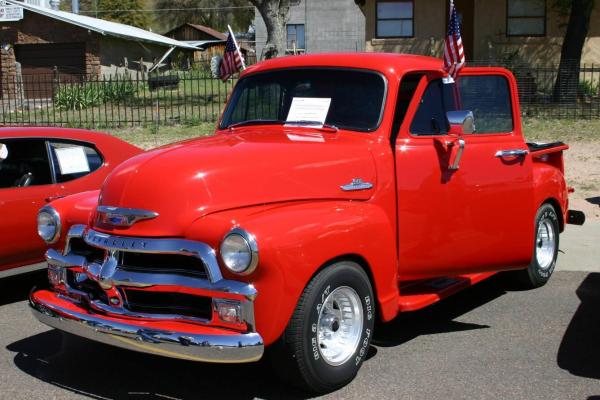
55 Chevrolet half-ton pickup truck
"SoIboughta55Chevrolethalf-tonpickuptruck. Ithadrustholesinthecabthatwereasbigaroundyoucouldputyourheadinthere,butitlookedcool."
This is a 1955-era Chevrolet pickup, and “half-ton” is a way people classify truck capacity. The host says it had major rust holes in the cab, even though it still looked good from the outside.
The speaker’s “55 Chevrolet half-ton pickup truck” refers to a mid-1950s Chevrolet pickup, with “half-ton” describing the truck’s typical payload class (about 1,000 lb in that era’s naming). They’re using it as an example of a vehicle that looked cool but had serious rust damage.
rust holes
"Ithadrustholesinthecabthatwereasbigaroundyoucouldputyourheadinthere,butitlookedcool."
Rust holes mean the metal has corroded so badly it’s worn through. That usually means the damage is more serious than just ugly spots.
“Rust holes” indicates corrosion has progressed to the point where metal has actually been eaten away, creating openings. On older trucks, this often signals deeper rust in structural areas, not just surface damage.
breezeway feature
" [1294.2s] There'sthebreezeway. [1295.4s] Uh,thebreezewayfeaturedoneofthestrangestproductioncarfeatureseveroffered. [1299.9s] Therearwindowrolleddown. [1301.5s] Oh,yeah."
The “breezeway” is a design trick where the rear window is set up to let air move through the car. The host is saying it was a weird-but-smart ventilation idea that people noticed immediately.
The “breezeway” feature refers to a classic car design where the rear window could open or move to create airflow through the cabin. In this segment, the host highlights it as an unusual production-car ventilation idea that later feels similar to modern pickup-truck window/roof airflow setups.

Chevrolet Biscayne
" [1322.3s] Thenextone,Mike,isaChevroletBiscayne. [1325.2s] TheBiscaynewasabudget-mindedfull-sizecar. [1327.8s] Millionswerebuilt,butitlackedtheflashofanimpalaandtheprestigeofacaprice."
The Chevrolet Biscayne was a cheaper, more basic full-size Chevy. The host is basically saying it was everywhere, but it didn’t have the same style or status as the nicer versions.
The Chevrolet Biscayne is a budget-minded full-size Chevrolet from the classic era, positioned below flashier models. The host contrasts it with more prestigious cars, emphasizing how it was common but lacked the “wow” factor.

Mercury Comet Cyclone
" [1340.9s] That'strue. [1340.9s] MercuryCometCyclone. [1343.0s] IhadafriendofminethathadaMercuryCometanditwasacoolcar."
The Mercury Comet Cyclone is an older Mercury model that people remember as a more performance-focused version of the Comet. The host is talking about one because it had cool upgrades that made it look and breathe like a hot rod.
The Mercury Comet Cyclone is a classic American performance variant of the Comet, known for its factory hot-rod styling and enthusiast following. In this segment, it’s brought up as a cool car example, with details about aftermarket-style intake/airflow hardware.
velocity stacks
" [1343.0s] IhadafriendofminethathadaMercuryCometanditwasacoolcar. [1346.2s] Hehadvelocitystacksonitandtwidbowlsonthefront. [1348.8s] Didithavethosegreatbignostrilsonthefrontofit?"
Velocity stacks are intake parts that help the engine pull in air more efficiently. They’re often used on older performance cars and can make the engine sound and respond more “hot-rod” than stock.
Velocity stacks are intake components used to improve airflow into the engine by shaping how air enters the carburetor or throttle body. The host mentions them as part of a friend’s Mercury Comet setup, implying a more performance-oriented intake arrangement.
twin bowls
" [1346.2s] Hehadvelocitystacksonitandtwidbowlsonthefront. [1348.8s] Didithavethosegreatbignostrilsonthefrontofit? [1351.4s] Thehoodwassochoppedupforthevelocitystacks,wedon'tknow."
“Twin bowls” is the host’s way of describing two matching intake/carburetor openings on the front of the engine. It’s basically part of the car’s performance look and airflow setup.
“Twin bowls” here appears to describe a pair of carburetor bowls or intake openings on the front of the engine setup. The host is using it as a visual description of the car’s intake hardware, alongside the velocity stacks.
turbocharger
"And lastly, Don mentioned turbo charges in the first part of the show. Oldsmobile F-85 Jetfire. Look at that, baby. The jet fired deserves farmore attention than history has given it. This thing featured a turbocharger years before turbocharging became cool."
A turbocharger is a device that helps an engine make more power. It uses the car’s exhaust to spin a fan that pushes extra air into the engine.
A turbocharger is a forced-induction device that uses exhaust gas to spin a turbine, which compresses incoming air. That extra air lets the engine make more power without needing a larger engine, but early turbo systems could be harder to make reliable.

Oldsmobile F-85 Jetfire
"Oldsmobile F-85 Jetfire. Look at that, baby. The jet fired deserves farmore attention than history has given it. This thing featured a turbochargeryears before turbocharging became cool."
This Oldsmobile was a performance car that used a turbocharger very early in the game. The idea was cool and powerful, but early turbo tech wasn’t always reliable yet.
The Oldsmobile F-85 Jetfire is a performance-oriented 1960s car known for being an early adopter of turbocharging. The host points out it had a turbocharger years before turbocharging became mainstream in performance cars, but it also suffered from reliability issues early on.
four door sedan
"Umsomehow,someway,Iguesshegotgrandma'scarorsomething. Itwasafour-doorsedan, uh, thisbodystyle."
A four-door sedan is a typical family-style car shape: it has four doors and a separate trunk. The host is just describing the body style.
A four-door sedan is a passenger-car body style with two rows of seats and a separate trunk, with four doors for easier access to the cabin. In the transcript, the host uses it to describe the specific body style of the car they’re discussing.
Request an Explanation
Heard something you'd like explained? We'll add it to this episode.
Sign in to request explanations for terms you heard.
Want to learn more?
Browse our glossary for plain-English explanations of automotive terms, jargon, and concepts.
Help improve this episode
See something that's not quite right? Our annotations are AI-generated and can sometimes miss the mark. Click the flag icon on any annotation to suggest a correction.