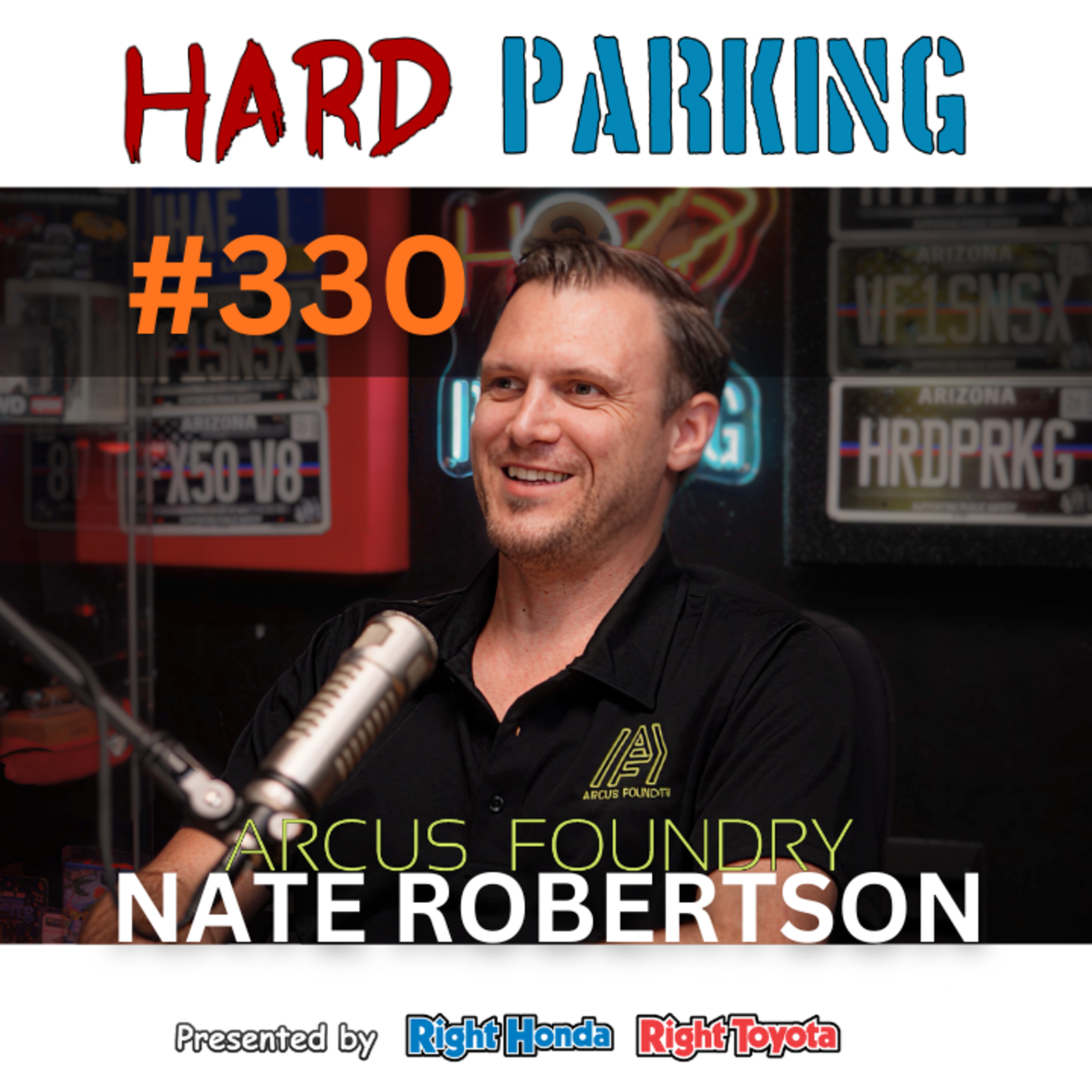
Nate Robertson Arcus Foundry: AI Controversy & Phoenix Car Scene Drama EP330
About this episode
Nate Robertson from Arcus Foundry’s Spark Forge joins Hard Parking to unpack AI controversy in the Phoenix car scene—especially the ethics and legal risk of using AI to create images of local models. The conversation then pivots to practical tech: how Flock roadside cameras work (ALPR, motion-activated, vehicle-focused, not facial recognition) and why they’re not speed cameras. Between the AI talk, they swap real-world car troubleshooting stories, including wiring/harness fire history and headlight module issues, plus NSX and four-wheel-steering chatter.
EP330: Nate Robertson (Arcus Foundry) on AI Controversy, Tech, & Phoenix Car Scene
In this episode, Jhae welcomes Nate Robertson of Arcus Foundry / Spark Forge to the studio. They dive into AI's role in business and content creation, a local Phoenix car scene controversy involving aggressive AI use by a known creator, Flock cameras privacy debates in Arizona, NSX projects, and more laid-back conversation.
Jhae shares Seattle trip stories celebrating friendship across divides. Nate demos tools like Spark Prompt and discusses streamlining business tech. They explore ethics, legality, and real-world AI impacts.
Guest: Nate Robertson – naterobertson.com, @TheN8Robertson
Key Timestamps:
- 00:00 Intro & Seattle Trip Reflections
- 01:40 Coming Up: Nate & AI Controversy
- 02:27 Flock Cameras Deep Dive (Phoenix Privacy vs. Safety)
- 08:05 Nate Robertson Joins – Arcus Foundry & Spark Forge
- 09:14 Studio Chat: NSX Projects & Car Life
- 15:14 Arcus Foundry Overview
- 18:28 Spark Prompt Teleprompter Demo
- 40:00+ AI Tools, Resumes, Ethics & Local Drama
- 01:05:00 Non-Alcoholic Drinks & Wrap-Up
Leave a comment or review – what’s your take on AI in the car scene?
Contact
Email: [email protected]
Website: www.hardparking.com
Patreon: patreon.com/hardparkingpodcast
Instagram: https://www.instagram.com/hardparkingpod/
YouTube: youtube.com/@HardParking
TikTok: https://www.tiktok.com/@hard.parking.jhae
Main Show Sponsors:Right Honda: https://righthonda.com/Right Toyota: https://www.righttoyota.com/Arcus Foundry: https://arcusfoundry.comAutocannon Official Gear: https://shop.autocannon.com/
flock cameras
"I have it, I read it, it's funny, but you know, flock cameras have been kind of a big deal... But for those of you who don't know, flock cameras are a series of surveillance cameras that are put in cities..."
Flock cameras are security cameras installed in public or private areas. People talk about them because they can automatically read license plates, which makes some folks worry about privacy.
Flock cameras are a network of fixed surveillance units used in cities and neighborhoods. They’re commonly discussed because they’re tied to automated license plate reading and raise privacy concerns.
automated license plate readers ALPRs
"this is off of a grok search, flock cameras are automated license plate readers ALPRs systems made by flock safety..."
ALPRs are systems that automatically read car license plates using cameras. Instead of a person typing it in, the computer captures the plate info for tracking or investigation.
Automated license plate readers (ALPRs) are systems that use cameras plus software to detect and read vehicle license plates automatically. In practice, that data can be used to track where vehicles go and to support law-enforcement investigations.
flock safety
"flock cameras are automated license plate readers ALPRs systems made by flock safety, a company founded in 2017."
Flock Safety is the company behind the Flock camera systems. They make the hardware and software used to read license plates automatically.
Flock Safety is the company described here as making Flock’s ALPR-based surveillance camera systems. The episode frames it as a relatively young company that became widely used over the following years.
motion sensors
"How flock cameras work, the cameras use motion sensors to wake up quickly in less than a tenth of a second."
Motion sensors are what trigger the camera when something moves in front of it. That way, the system turns on fast enough to get a clear picture of passing cars.
Motion sensors detect movement so the camera system can activate quickly when a vehicle approaches. The point in this description is fast wake-up time, which helps capture usable images as cars pass.
LTE cellular connectivity
"even at speeds up to 75 miles an hour. They were 24 seven and most weather conditions using solar power and LTE cellular connectivity. No wire infrastructure needed according to Bristol"
LTE is the same kind of cellular network your phone can use to send data. These cameras use it to send information back without running special cables.
LTE is a cellular network standard used to send data over mobile networks. In these camera systems, LTE connectivity helps transmit footage and plate/vehicle data without needing dedicated wired infrastructure.
computer vision
"according to Bristol re data extraction AI computer vision reads the license plate full partial or missing."
Computer vision is a kind of smart software that can “look” at camera images. In this case, it helps read license plates and identify vehicle details.
Computer vision is software that interprets images from cameras. Here, it’s used to read license plates and extract vehicle attributes even when parts of the plate are unclear or missing.
searchable history of vehicle movements
"So I do understand the concern of this. It creates a searchable history of vehicle movements which helps investigators track where the vehicle has been over time."
It means the system can keep a record of where a car was seen over time. Investigators can then look up that timeline to help understand what happened.
A searchable history of vehicle movements means the system logs sightings of a vehicle (typically by license plate) and lets authorized users query when and where it was seen. That creates an evidentiary timeline investigators can use to reconstruct events.
facial recognition
"The cameras focus on vehicles not people and do not use facial recognition."
Facial recognition is technology that tries to identify people from their face in a photo or video. The point here is that the system is meant to track vehicles, not identify people.
Facial recognition is software that identifies or verifies people by analyzing facial features in images. The host notes these cameras focus on vehicles and do not use facial recognition, which is a privacy-related distinction.
speed cameras
"And so I also asked I go well can you use a flock camera for speeding tickets and moving violations. It says yes but rarely and not for speeding tickets in the typical automated sense."
Speed cameras are used to measure how fast a car is going and issue tickets for speeding. The host says Flock’s cameras aren’t meant to do that.
Speed cameras are enforcement cameras intended to measure vehicle speed and trigger citations for speeding. The host explains that Flock Safety cameras are not speed cameras and are not officially marketed for automated traffic enforcement.
LiDAR
"Flot cameras operate still images mainly reviews and vehicle details but lacks radar, [477.5s] LiDAR or other speed measuring technology so not worried about it."
LiDAR is a laser-based sensor that measures distance very precisely. Some traffic systems use it to figure out how fast a car is going.
LiDAR (Light Detection and Ranging) is a sensor technology that uses laser pulses to measure distances and build a 3D map of the environment. In traffic enforcement, LiDAR can be used to measure a vehicle’s speed by tracking how the distance changes over time.
radar
"Flot cameras operate still images mainly reviews and vehicle details but lacks radar, [477.5s] LiDAR or other speed measuring technology so not worried about it."
Radar uses radio waves to detect cars and estimate how fast they’re moving. Some traffic cameras use radar to measure speed directly.
Radar is a sensor system that uses radio waves to detect objects and measure motion. In speed enforcement, radar can estimate a vehicle’s speed by measuring the change in the reflected signal as the car moves.
Flot cameras
"Flot cameras operate still images mainly reviews and vehicle details but lacks radar, [477.5s] LiDAR or other speed measuring technology so not worried about it."
These are traffic cameras that mainly take pictures to document what happened. They’re not the same as systems that use sensors to directly measure how fast a car is.
“Flot cameras” refers to traffic enforcement cameras that capture images (often for reviewing violations) rather than continuously measuring vehicle speed. In this context, the host contrasts them with speed-measuring tech, implying they’re more about image capture than radar/LiDAR-based speed readings.
rodent tape
"Do you have the rodent tape on it? [651.2s] You're not serious. I don't know what rodent tape is... [658.0s] No, no. So it's the... I think Honda might have been one of the manufacturers that made it famous, but it's a special tape that you wrap around the wires of your engine and your harnesses..."
Rodent tape is a tape you put on car wiring to keep mice/rodents from chewing the wires. It’s meant to protect the electrical system by discouraging animals from getting to it.
“Rodent tape” is a specialty deterrent tape people wrap around engine bay wiring/harnesses to discourage rodents from chewing. The tape is often decorated with small mouse-like shapes and is applied specifically to protect exposed wires.
knock sensor
"Yeah, the knock sensor on the J series has that wrap, but that's like the only thing on the J series that is."
A knock sensor is a sensor that listens for bad combustion noises in the engine. If it detects knock, the car can adjust to help prevent damage.
A knock sensor is an engine sensor that detects “knock” (abnormal combustion) so the engine control unit can adjust timing and protect the engine. In this segment, the knock sensor area on a Honda J-series is called out as the place that may have rodent-tape protection.
rolling beta
"It wasn't really a big deal. It was just a small system that was just overloaded, but my point is that everything on the whole car is a rolling beta,"
“Rolling beta” is a metaphor for a car that feels like an ongoing prototype—something that can keep failing or changing as issues show up. Here, it’s used to describe a vehicle with recurring electrical problems, including a harness-related fire.
overheated
"Are you talking about when your car basically overheated? [765.4s] Yeah, we were so close to being there, though."
“Overheated” means the engine got too hot. That’s usually caused by something wrong with the car’s cooling system, like not enough coolant or a leak.
“Overheated” means the engine temperature rises beyond its normal operating range. On road trips, overheating usually points to a cooling-system problem like low coolant, a failing water pump, or a leak.
coolant
"The problem is that, for some reason, there's a consumption issue with the coolant. [785.7s] So I don't even run coolant, I just run straight water."
Coolant is the liquid that keeps the engine from getting too hot. If the car is losing coolant, it can overheat, especially when you drive harder.
Coolant is the liquid that carries heat away from the engine and helps keep temperatures stable. If coolant consumption is high or coolant is lost under load (like revving hard), the engine can overheat quickly.
timing belt
"All we did was give it a new timing belt, water pump, [817.5s] and did a valve adjustment, and we've been sending it full bore for the last eight years."
A timing belt helps coordinate the engine’s moving parts so everything opens and closes at the right time. If it breaks, the engine can get badly damaged.
A timing belt synchronizes the crankshaft and camshaft so the engine’s valves open at the correct times. Replacing it on schedule is critical because a failed timing belt can cause severe engine damage.
water pump
"All we did was give it a new timing belt, water pump, [817.5s] and did a valve adjustment, and we've been sending it full bore for the last eight years."
The water pump moves coolant through the engine so it can stay cool. If it fails, the engine can overheat.
The water pump circulates coolant through the engine and radiator to remove heat. If the pump isn’t moving coolant properly, the engine can overheat, especially when you’re revving or driving at higher load.
valve adjustment
"All we did was give it a new timing belt, water pump, [817.5s] and did a valve adjustment, and we've been sending it full bore for the last eight years."
A valve adjustment sets the small gaps in the engine’s valve mechanism. It helps the engine run correctly and can prevent extra wear.
A valve adjustment sets the correct clearance (or “lash”) between the cam and valve train components. Getting it right helps maintain proper timing of valve opening and can reduce noise and wear.
U-turn
"We're like, all right, cool. We went to the wrong house, and then you were ready to roll by the [841.1s] time we did a U-turn and came back."
A U-turn is when you turn the car around to go back the other way. Here it’s just describing how they corrected their route quickly.
A U-turn is a maneuver where you reverse direction by turning around in a single continuous motion. In this context it’s used to explain how quickly they were able to get back on track after a navigation/route mistake.
headlight issue
"And then you were good, except for your headlight issue, [847.1s] because we got to Lamar's place, and you had some goofy wiring."
A headlight issue means the headlights weren’t working right. Sometimes it’s just a bulb, but it can also be wiring or an electrical problem.
A headlight issue can be caused by more than just a burned bulb—wiring faults, fuses, relays, or control modules can also be responsible. In the segment, the host links it to “goofy wiring,” suggesting an electrical problem rather than a simple replacement.
module
"Yeah, I figured out what it is. There's a module underneath the cover on top of the steering [863.84s]"
A module is a small electronic computer that controls part of the car. The host is saying the problem is coming from a specific module under a cover.
An automotive module is an electronic control unit that manages a specific system (like lighting, sensors, or engine functions). The host says the fix is a module underneath the cover, implying a particular electronics component is the root cause.

NSX
"column on the NSX, and it's a module that controls the headlights. And when I got the car, it didn't have a steering column... So this time around, we've retrofitted every wiring harness on the NSX..."
The Acura NSX is a sports car with a lot of electronics. Here, the speaker is talking about fixing problems in the headlight system and replacing the car’s wiring so the lights and related electronics work reliably again.
The Acura NSX is a mid-engine sports car known for advanced electronics and tightly packaged components. In this segment, the host describes a headlight-control module and then replacing/rewiring parts of the car’s wiring harness because age and prior damage caused intermittent issues.
steering column
"And when I got the car, it didn't have a steering column. So I had to get one from an auto wrecker..."
The steering column is the part that connects your steering wheel to the steering system. If it’s missing or damaged, you can’t steer properly and it can also affect wiring for controls.
The steering column is the structural and mechanical link between the steering wheel and the steering system. It also commonly houses wiring and controls, so missing or damaged columns can create electrical and fitment problems that require sourcing a replacement.
auto wrecker
"So I had to get one from an auto wrecker, and they're not generally nice to these parts. And so when I got it, the covers were all messed up..."
An auto wrecker is a salvage yard that dismantles wrecked vehicles and sells usable parts. For older cars, it’s often where you source discontinued or hard-to-find components like steering columns or electronic modules.
wiring harness
"So this time around, we've retrofitted every wiring harness on the NSX, but there's still a lot of NSX garbage there..."
A wiring harness is the car’s main bundle of wires that connects all the electronics. Replacing or retrofitting it is a big job, but it can fix lots of electrical gremlins caused by old wiring or damaged connectors.
A wiring harness is the bundled set of wires and connectors that routes power and signals to the car’s electronics. Retrofitting every wiring harness on an older car is a major repair because it addresses widespread age-related failures and previous damage from corrosion, broken connectors, or hacked repairs.

Honda Prelude
"...? I really want to love it. Here's the thing, the Prelude pushed a lot of new technologies forward and that..."
The Honda Prelude is a sporty car made by Honda, usually as a two-door coupe. It’s remembered for trying new technology and design ideas for its time. People talk about it because it helped move Honda’s engineering forward, even if some versions weren’t loved by everyone.
The Honda Prelude is a sporty two-door coupe that Honda produced across multiple generations, known for bringing new technology to the mainstream. It’s often discussed because certain model years helped push forward features and engineering ideas that later became more common in everyday cars. That’s why it can come up in conversations about cars that were ambitious and influential, even if not every version felt perfect to every driver.
hybrid system
"So yeah, it's got a hybrid system, but it's heavy."
A hybrid system uses both a gas engine and an electric motor. The host is saying it can make the car heavier, which can make it feel less nimble.
A hybrid system combines an internal-combustion engine with an electric motor to improve efficiency and reduce emissions. The host’s complaint is that the hybrid setup makes the car heavy, which can hurt handling and responsiveness.
four wheel steering
"there's no four wheel steering. The NC1 didn't have four wheels."
Four-wheel steering means the rear wheels can turn too, not just the front wheels. That can help the car turn more easily at low speeds and feel steadier at higher speeds.
Four-wheel steering (4WS) steers both the front and rear wheels, which can improve low-speed maneuverability and high-speed stability. The host is specifically criticizing Honda for not including 4WS on the NC1 they’re discussing, arguing it would be a key “heritage” feature.
super handling drive system
"and now four wheel steering, maybe you could argue that the super handling drive system, but yeah."
Super Handling Drive is an all-wheel-drive system that can send power to the wheels in a smarter way. The host is basically saying it doesn’t fully replace the benefits of four-wheel steering.
Honda/Acura’s Super Handling Drive (SH-AWD) is an all-wheel-drive system that can vary torque between the rear wheels to help the car rotate and track more accurately. The host mentions it as a possible substitute for four-wheel steering, but implies it’s not the same thing.
Request an Explanation
Heard something you'd like explained? We'll add it to this episode.
Sign in to request explanations for terms you heard.
Want to learn more?
Browse our glossary for plain-English explanations of automotive terms, jargon, and concepts.
Help improve this episode
See something that's not quite right? Our annotations are AI-generated and can sometimes miss the mark. Click the flag icon on any annotation to suggest a correction.