The Honda CR-V is a small SUV that is known for being reliable and practical. The 2003 version was one of the first models and is appreciated for its roomy interior and good gas mileage.
Electronic stability control is a system in cars that helps keep them from sliding or losing control, especially in bad weather. It works by applying brakes to specific wheels when needed to help the driver stay safe.
Anti-lock brakes are a safety feature that stops your wheels from locking up when you brake hard. This helps you keep steering control and avoid skidding.
Automatic emergency braking is a system that can stop your car automatically if it senses that you're about to crash into something. It helps keep drivers and pedestrians safe.
The Honda HR-V is a small SUV that is great for city driving. The 2023 version has some new features and a fresh look, making it a good option for people who need a compact vehicle.
Drag races are competitions where cars race in a straight line to see which one can go the fastest over a short distance. It's all about speed and quick acceleration.
The Subaru Crosstrek is a small SUV that can handle different types of weather because it has all-wheel drive. The 2026 version will have a new hybrid engine, which is a combination of gas and electric power.
A hybrid system uses both a gas engine and an electric motor to help the car use less fuel and produce fewer emissions. New versions can sometimes have problems because they are just starting out.
Reliability risk means there might be problems with a new car or its parts, especially if they haven't been tested for long. It's important to think about this when buying a new model.
The powertrain is what makes the car move. It includes the engine and parts that help it drive. When a car gets a new powertrain, it can change how well it works.
Car
Toyota hybrid powertrains
Toyota hybrid powertrains use both a gas engine and an electric motor to save fuel and reduce pollution. They are known for being very reliable and can last a long time, sometimes even reaching 500,000 miles.
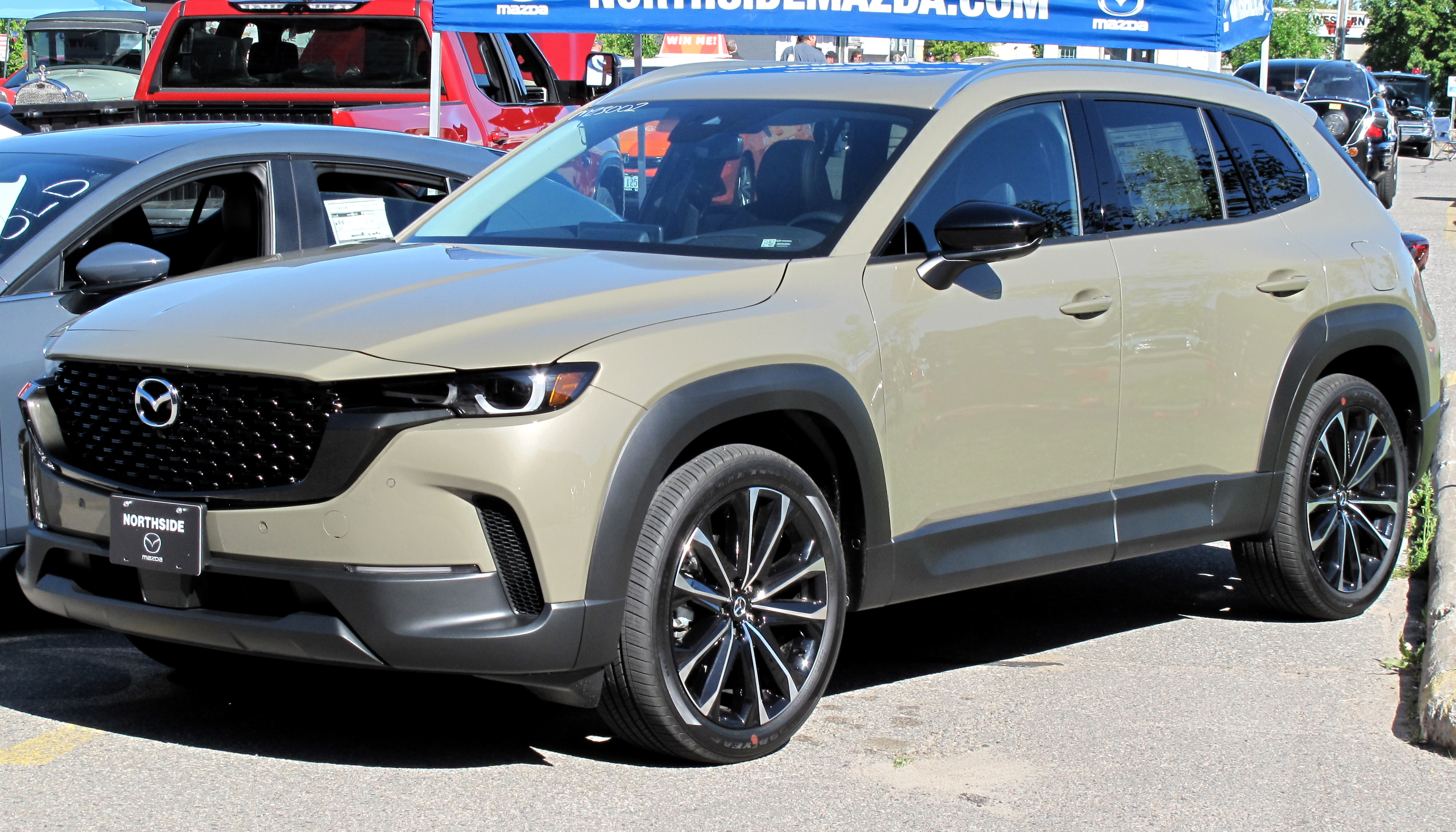
The Mazda CX-50 is a small SUV that comes with a hybrid option, meaning it uses both gas and electric power to save fuel. It's designed to be fun to drive while also being practical for everyday use.
19 inch wheels are the size of the wheels on the car. Bigger wheels can make a car look nicer, but they might make the ride bumpier because there's less rubber to cushion the bumps in the road.
OEM wheels are the original wheels that a car comes with when you buy it. They are made by the same company that makes the car and are usually designed to fit perfectly and perform well.
Aftermarket wheels are wheels you can buy that are not from the car's original maker. People often get them to change the style or improve how the car drives.
The Ford Expedition is a big SUV that can carry many people and is good for towing things. However, because it's so large, it can be hard to drive in cities and may be dangerous for pedestrians.
The Kia Sportage EX Hybrid is a type of SUV that uses a hybrid engine, which means it combines a gasoline engine with an electric motor for better fuel efficiency. It's designed to handle different weather conditions.
Rust is what happens to metal when it gets wet and starts to break down. It's a common problem for cars, especially in places with a lot of snow and salt.
The Toyota Crown is a fancy car that Toyota has been making for a long time, especially in Japan. It's known for being very comfortable and reliable, making it a good choice for people who want a nice ride. Recently, it's come back to the U.S., which is why people are talking about it.
The Lexus ES 350 is a comfortable and stylish car that is great for people who want a nice ride without too much hassle. It has a lot of space inside and is known for being good on gas, especially the hybrid version. Many people like it because it feels luxurious but is still easy to drive.
The Chevrolet Corvette is a famous sports car from America that many people love because it's fast and looks really cool. It's been around for a long time and is known for being a fun car to drive. People often talk about it because it's a symbol of American car culture.
LIVE
Hey, welcome back.
I'm Keith Barry.
I'm Emily Thomas.
I'm Michael Croson.
And we are going to answer your questions today.
Back by popular demand, it's an all-questions episode of Talking Cars.
If you have questions, send them to talkingcarsaticloud.com.
That's the best way to reach us.
We're going to get right into it.
Susan says, I have a 2003 Honda CR-V that was my mother's car before she passed.
It is super basic.
No bells and whistles at all, not even a thaw.
It only has 130,000 miles on it.
I enjoy driving the car, but sometimes I wish I had a few extras.
My mechanic told me to never sell the car, as it was so simple he could fix almost anything
on it.
However, it's 22 years old, and I want a car that's reliable enough to take some
road trips.
Should I just keep repairing it as needed, or should I consider something new?
All right.
What do you think, Michael?
Why don't you start off?
I mean, Susan, your mechanic is not wrong.
This car, you should keep it.
This car could always be fixed unless it's like catastrophic rust, basically.
It is cheap to run, cheap to maintain, cheap to repair.
It's been around a while.
There's no problem that could come up that is unsolvable or that would be like a mystery.
All the different ways this CR-V can fail are known to the world.
So that's really nice.
So I think your mechanic is totally right, but I do get the aspect of the fact
that it is super basic, and you might want some bells and whistles.
I might consider upgrading the radio, something that has car play on a backup
camera that might make it feel a little bit more modern and give you some of those
kind of convenience features that you're lacking in a vehicle such as this.
But then I know Emily is going to comment on the safety aspect of it.
So I think as long as you're comfortable with the current safety
level, both passive and active of the vehicle, I would personally keep it.
Plus, I would have trouble getting rid of my mom's car, too.
So there's that aspect as well.
Yeah, yeah, that is true.
I mean, you don't have to get rid of it to get a new car.
What do you think?
Now you're going to go down the nostalgic route.
Yeah, you can keep it.
You can keep it for the memories, for sure.
I would say if you're not going to replace it, at least get a new car
that you can drive for the very reason the crossing pointed out there.
A lot of safety has changed since 2003.
You kind of want to be able to level the playing field for yourself
when you're out on the road amongst modern day vehicles.
So even things like electronic stability control and anti-lock brakes
were only standard with the 2012 model here in the United States.
Wow.
Backup cameras became standard in 2018.
Now pretty much every new car comes with standard automatic emergency
braking with pedestrian detection.
For collision warning, there's so many new safety features
and crash protection has changed so much since 2003.
So even if you looked at the crash ratings for your 2003 Honda CR-V
and I think you were going to point out an even newer model of the CR-V
significant changes in crash protection ratings.
So I think it's worthwhile to put yourself at par with the vehicles
that are on the road and get yourself the most safety that you can afford.
I mean, I kind of agree with both of those things.
And I love a simple car.
And I absolutely get the point of, you know, they don't make them
like they used to, except they do.
Susan, guess what I found for you?
2023 or newer Honda HR-V.
The HR-V is about an inch longer than the 2020 to the 2003 CR-V that you have.
It has a newer version of the two liter case series engine.
So it still is tried and true, a little more updated.
But it has all of those safety features and crash protection
that Emily was talking about.
And we're not talking about features just for the sake of them.
These aren't bells and whistles.
These are, you know, things like AEB, things like electronic stability control.
These are proven to prevent crashes.
Yeah.
These aren't just things that you get because they're cool or they, you know,
those features are out there. HR-V doesn't have them.
As far as a car as far as it is as a car, it's, you know, it's fine.
It's not going to win any drag races.
But compared to your 2003, it's going to feel like a sports car.
So that's what I say.
Yeah. Yeah.
You can go back and you can buy a brand new 2003 CR-V.
It's just called an HR-V.
Kyle from San Antonio, Texas asks,
I plan to move to the Pacific Northwest next year
and I'm in the market for a hybrid compact with all-wheel drive.
Naturally, the 2026 Subaru Crosstrek appears to check all my boxes.
But with that said, this will be the first year for the hybrid
Crosstrek with a reintroduced hybrid system.
And I am curious about your thoughts and the reliability risk
I might be accepting with going for the 2026 model
and not waiting for a future year.
I see it is still considered to be in year three
of the current Crosstrek generation.
So is this less risk than a typical first year model
not being a full redesign?
Just kind of give a little background there.
CR loves to say, because it's true, that, you know,
cars tend to have bugs in their first year after major redesign.
So wait a year or two.
And also the Crosstrek, like he says,
it's adding a new powertrain to an existing vehicle.
I believe you had some thoughts on this.
Yeah, I mean, generally, we do say avoid that new model, right?
And that's pretty good advice.
I would say if you were going to buy a new model,
this might be the one to do because of the fact
that the Crosstrek has existed.
This new powertrain plus all the hybrid stuff
in this case is from Toyota.
And it's existing Toyota stuff that they've kind of brought in.
So I feel better about that.
There probably still will be some growing pains with it,
you know, because they did have to sort of incorporate
all this new stuff in this chassis.
But I would say it's probably the best case scenario
for, you know, a new model, if you will.
Yeah, I mean, we hear back in our owner satisfaction surveys
and our reliability surveys about Toyota hybrid powertrains
that last 500,000 miles.
And, you know, so I, yeah, I would agree.
Get a Crosstrek?
Go ahead. I mean, we're seeing that happen
with other vehicles too, where I think even our CX-50 hybrid
has the Toyota system in it.
So you'll get, in this case, you'll get all the things
that you love about having a Subaru,
but you'll get to drive a Toyota hybrid,
which typically comes with great reliability.
And, you know, you'll have great fuel economy for sure.
And that all-wheel drive system that's only in the Subaru.
So, Kyle, you've done your homework.
You have our blessing.
Exactly. Michael from Ann Arbor, Michigan says,
I own a 2025 Toyota Camry XSE with all-wheel drive.
I've enjoyed the styling and features both safety
and otherwise, all while having great fuel economy.
But there is one thing that has been bothering me,
and that is the ride quality.
As good as the 19 inch wheels look,
the tires don't absorb the rough roads in Michigan well,
and it can make some drives bumpy and unpleasant.
I'm considering reducing the wheel size
to allow for higher profile tires
that'll have the same ground clearance
but can handle rough roads better.
What are the pros and cons of their beta changing the wheel size
and is it something I should consider?
Well, we do this sometimes.
We're going to send this over to Ryan Pislakowski,
who's over in our tire building live from the tire building.
We're going to hook up to the satellite.
Ryan, can you hear me?
Hi, Michael. Great question.
You're not alone in this.
I've read several comments, complaints, actually,
about the ride quality.
You know, the Camry is not exactly a sports car.
It's a great car,
but it doesn't necessarily need 19 inch wheels on it either.
And I have also driven on the roads in Michigan
and they're kind of rough, right?
So the pros and cons of going to a smaller wheel size
but keeping the same overall diameter, obviously,
mostly pros, really, you're going to get cheaper tires.
The 19 inch tires are expensive, as you probably know.
17 inch tires will be a little cheaper.
I looked at, you know, the General Ultimac RT45, for instance,
it was almost $50 cheaper per tire
from going from the 19 down to the 17.
Now, I did do a quick research, make sure you can do that.
So what happens is sometimes you run into the brakes
getting in the way of the wheels,
which is why they have these bigger wheels
on these cars, because they're trying to clear the brakes.
You should be able to do the 17s,
but definitely confirm that before you spend the money
on those wheels just to confirm.
But they're less prone to damage.
They should ride a little better
because now you have some more rubber,
a little more compliance there in the sidewall.
Other than looks, your steering feel,
you might lose a little bit of that sportiness in the steering,
but even that kind of depends on the tires
you do put on there.
You might not notice anything.
And obviously the tires that came on your car
were V-speed rated, so you want to obviously
keep the same speed rating.
You don't want to go lower than that
and make sure you do the right size
within the 17 would be a 215, 5,517.
But definitely do your research on the wheels,
make sure you get the right wheels
and they do clear the brakes.
Love to know how you make out.
Let us know. Take care.
Good luck.
Thank you, Ryan.
Thank you. Thank you very much.
But I think there's a problem there, right?
Well, I mean, Ryan has really good points
and everything he said is correct.
I did a little bit of research
as far as what Toyota offers in terms of wheels
because I really like OEM wheels.
I feel like they're just of a better quality
in terms of the robustness
and less chance of bending them and things like that.
So for the new Camry, there's a 19-inch choice,
which Michael has.
There's 18-inch wheels and then a 16-inch wheel.
So it's missing a 17,
which I think is like the Goldilocks choice.
It would be just right.
The 16s are going to offer
the best of like sort of the ride comfort stuff,
but their 16-inch wheels are going to look kind of dorky.
So there is that.
So I guess Michael's going to have to kind of decide
what is most important.
And then Michael may want to actually explore
aftermarket wheels as well.
Just make sure that they actually fit properly,
that they're going to clear the brakes
and that the offset and everything is right
for the vehicle.
But I definitely think it's a smart move.
The 19s, while they look cool and it makes a little sporty,
you know, it's not the best for ride quality.
John from Milton, Pennsylvania says,
I am a long, long time CR subscriber.
So I offer this critique with love.
Uh-oh.
That is, those are,
how can CR give a behemoth like the Ford Expedition
or any other lumbering hulk a positive review?
The very size of the beast
and the merits of pickup trucks
that are three times the size they need to be
are posing serious dangers to pedestrians
and other drivers and you yourselves have said as much.
You don't mention EPA figures for gas mileage.
I know I'm butting my head against sacred doors
for gear heads,
but let's stop glorifying oversized motor vehicles
that need not be as big as they are
in order to permit Americans
to carry what they need to carry for a vacation.
My daughter's lived in the UK for 18 years
and she has appalled when she visits
and sees the size of our motor vehicles.
Thanks for listening to my gripe.
I still love you.
Yeah, I mean, a lot of that, John, honestly,
I agree with a lot of that, exactly.
And you know, I know in the UK, it's a little different,
but you know, I lived in Europe for a while
and people are, it's a problem there too.
People are buying the biggest cars that fit.
It's just that things fit a lot.
We can fit a lot more in our roads and our parking lots.
But there are some ways that we are getting
at that issue in our testing, right, Emily?
Yeah, I think it's important to know that, you know,
what his critique is saying that, you know,
we're giving a positive review.
And I would say that we are putting the vehicle
through the same set of tests
that we put every car through.
And we let the data speak for itself.
So if the vehicle performs well in a test,
we're going to say that.
We're not going to be like,
well, it has a good score, but it's bad.
It fits a lot, but it's, yeah.
So every test is different.
It's designed so that, you know,
we can evaluate different aspects of the vehicle.
There are going to be parts of the vehicle that do well
and that's going to be spoken about well.
And there's going to be parts of the vehicle that do poorly.
But it's our job as testers and reviewers
to really let the data speak for itself.
Now, that being said, though,
there are obviously safety implications
for large vehicles, which you've totally pointed out here,
John, and I agree with you, like a hundred percent.
You know, when it comes to crash avoidance and blind zones,
yes, these vehicles are behemoths
and they typically don't do well in our track dynamic testing
that relates to crash avoidance,
like our braking tests or emergency handling, right?
When it comes to being able to see the pedestrian target
in front of the hood, that can often be a challenge
for some of these vehicles.
However, when it comes to crash protection,
they tend to work in your favor just because of physics, right?
You're bigger than only the cars on the road.
So you have to look at safety
and you have to look at the vehicle holistically.
You want something that's not just going to protect you in a crash.
You want something that's going to help you avoid a crash
and finding that right balance will be important.
So I think we are doing a pretty balanced job
of like explaining the test results, whether that's good, bad,
you know, whatever it is, but also giving you kind of like
this holistic view of the vehicle
because for some people, right, they do need that larger vehicle.
They are lugging around a bunch of sports gear.
You have a bunch of kids that all play hockey or you have a boat
or, you know, a couple of horses and, you know, you need a vehicle
that can pull eight, nine, ten thousand pounds.
So and also, I mean, these were on the east coast here,
but that's different than like the west coast of the U.S.
There's a lot more space, really big highways.
People travel really long distances between places.
So sometimes these things can sort of fit that bill
and be nice to drive.
And I think it's all use case, right? Yeah.
But at the same time, if, you know, John, if you are a subscriber,
you can look at our ratings of vehicles
and you might be able to see on our I don't want to give away
too much information for free.
But if you if you look at our ratings of pickup trucks,
if you look at our ratings of SUVs,
you know, the numbers tend to get a little, you know,
go from light green to yellow, the bigger the vehicle gets.
And that is because of those inherent compromises in those vehicles.
So I think, you know, our advice is, you know, yeah,
only buy that vehicle if you if you need it.
Don't buy it because it looks cool.
Buy it because it can tow nine thousand pounds if you need to tow nine
thousand pounds because otherwise, yeah, you're going to have
twenty feet longer stopping distances.
You're going to have kind of lumbering handling.
You're going to have gas mileage in the teens and you're right.
Most folks can get away with something that's smaller than that.
Yeah. So no, it's important stuff to to talk about
and your your fingers in the pulse of a lot of things, John.
So thanks for writing that in.
Isabel from Williston, Vermont, asks,
I am looking to buy a certified pre-owned twenty twenty three
Kia Sportage EX hybrid all-wheel drive with 40,000 miles.
I live in Vermont.
Is the nine hundred and ninety nine dollar extra cost for undercoding worth it
as we head from snow season to mud season in Vermont?
You know something about under undercoding, right?
I know something about rust. OK.
I think we all fortunately know something about rust.
Rust is a battle that I fight all the time.
And, you know, I'm a mechanic.
I'm not like a fabricator or like a body guy.
So I try to buy vehicles that the body is in really good shape.
So I don't have to deal with any of that.
If you live somewhere where it snows and they use salt,
you're going to fight this rust battle, too.
This is a twenty three, so it's not that old.
Forty thousand miles, again, not a ton of miles.
I would want to know a where this vehicle lived its life.
Was it from Vermont or did it come from somewhere else?
Because this is not a new car and there's going to be some level
of dirt and corrosion underneath the body and chassis of this vehicle
and thousand dollars for undercoding.
I mean, no, just no, it's too much money
and you don't want to go with traditional undercoding.
That's the rubberized thick, heavy black goo
that they spray up under the car.
There's better choices out there.
This old school undercoding, especially on a used vehicle,
it basically locks in all that grit and grime and nastiness.
It just covers it up.
It's like putting makeup all over it.
You don't know what's underneath.
And before it's too late, a couple of years later,
it's going to start peeling off
along with chunks of the body of the vehicle.
It just locks in all that grossness
and it kind of makes it worse.
It lets it fester.
There are some products out there called like Woolwax
or Fluid Fill, but it's more like a lanolin base,
kind of like waxy.
Woolwax?
Yeah, Woolwax or Fluid Fill.
Oh, lanolin like a sheep.
Exactly, and Fluid Fill.
So they're a little bit lighter in terms of weight.
They're a little more of a liquid, right?
They're not so gummy.
They can get into all the nooks and crannies.
Some of it will come off over time
as you drive in the rain and stuff.
But the idea is that you have it reapplied every year or two
and it just does generally a better job.
It also doesn't mask it
so you can kind of see what's going on underneath.
It's mostly like opaque.
And that's going to run you about $200 to $300 to apply.
So every couple of years, you do that in the long run.
It might cost a little more.
But that $1,000 for the dealership undercoding,
100% avoid that at all costs.
Well, I really hope that we answered your question
before you bought the car, Isabelle.
So, but yeah, advice for other folks there, too.
But the other good news is that a lot of cars now have newer cars,
especially the factory rust proofing is light years ahead of where it was.
It gets better every year.
You know, they dip the cars, better materials, better seam sealers
and things like that.
So there are improvements and warranties as well on rust, too.
Yeah, for rust perforation, which that means holes.
It doesn't mean surface rust or like corrosion a little bit
on like suspension components.
It's body perforation.
So it's something that you can like put a finger through, basically.
Well, if you have that problem, then, yeah, yeah, it's different.
Yeah, you have another problem there.
Chris from Missouri sent us an email with now we almost didn't look at this
because we thought it was a scam, but it said, help spend my money.
But we opened it and it turned out it was it was a legitimate email.
And Chris says, I'm looking for suggestions to replace my 2017 Mazda
six daily driver, good choice, since it's got over 120,000 miles.
And I'm starting to get concerned about its long term reliability,
looking to buy new or one or two years old and stay 40,000 to 50,000.
I would like a mid-sized sedan or a compact crossover.
Fuel economy, reliability and tech and safety features are top priorities
in having a little more power and keeping some degree of engaging,
driving dynamics would be appreciated.
I drive 60 miles round trip each work day.
All right, let's go around pick a vehicle who wants to go first.
Emily, why don't you go first?
I'll go first.
My choice is going to be as exciting as your guys.
So we'll get mine out of the way.
Oh, you have no idea what I've chosen.
Well, that already makes it more.
I can only guess.
So I picked a twenty twenty five to the Camry, the XLE.
Now, given one of the earlier questions, maybe don't go with those 19 inch tires.
But I do like that it has great fuel economy.
You have that Toyota reliability that you can count on.
It has standard advanced driving assist systems like your A.B.
with pedestrian detection, A.B.
highway speed capable.
You're going to get standard blind spot warning and rear cross traffic
warning on this vehicle as well and adaptive cruise control, which I love to have.
You also get heated front seats, which is really nice of that trim line.
So from our logbook, the guys seem to think that it's engaging enough
to drive and has a little sportiness to it.
So I think it it checks off most of the boxes.
And with your commute only being like 60 miles on trip,
it'll be quite a while before you really have to fill up.
So I think that'll be nice to be able to save some money.
I, you know, it's funny we have our, you know, our cars that we buy
and, you know, every so often, you know, we get to choose them to drive home
and to spend more time with them.
And there's a lot of miles on that Camry and there's a lot of car enthusiasts here.
That car is almost always signed out.
Yeah.
It is not your, you know, it's not your Camry from 10 years ago.
It is a it's a bit of a it's it's peppy and it's a hybrid.
But you don't notice.
What do you think?
Well, I'm glad I didn't pick the Camry, but I did pick another Toyota.
So I went with the Toyota Crown.
However, I have a caveat of the Crown, the regular crown, regular crown.
Only way to get this, though, is the 2.4 turbo hybrid max is what they call it.
Do not get the 2.5.
Our test car had the 2.5 bit of a dog.
Yeah.
The the 2.4 turbo hybrid max, we had borrowed one of those from Toyota
back when the crown was coming out, and it was great.
Tons of power.
And I think that really adds to sort of the driving enjoyment
coming out of a Mazda.
Mazda's generally drive pretty good.
And I think the crown sort of just needs that I don't say larger engine
because it's actually smaller, but the more powerful engine option, I think,
really helps. Yeah.
You know, that was that and the Crown Signia, which is the kind of
wagon-y SUV version of it were were on my list.
But I decided, you know, I saw that one to two years old and 40 to 50
thousand. And I thought about when I'm, you know, when I'm, you know,
I used to have a real long commute and and getting into a nice comfy
car at the end of the day, I say Lexus ES Hybrid.
You get almost the same fuel economy as the Camry.
You get a nicer interior than the Crown.
And I would say go a year or two older used.
Don't go any older because they used to have this horrible
infotainment system.
It was called Lexus Remote Touch.
Oh, yeah. It had this mouse and touchpad.
That was bad. Don't do that.
Don't do that.
But the newer ones just have a traditional screen on them.
Great car, real comfy place to to spend some time.
And we had one here.
It was signed out all the time.
We could never. It was one of the most popular cars we had.
I want to point out that we all basically picked a Camry, though.
Yeah, we did. We picked a we picked a Toyota Hybrid.
My choice wasn't that bad.
Yeah, Emily's right.
It was pretty on par.
Maybe what? Maybe the what?
The CX 50 Hybrid.
Oh, wait. No, that's a Toyota Hybrid, too.
Oh, God.
OK, well, well, Chris, we've told you how to spend your money.
Please tell us what you tell us what you got.
Tell us if you ignored our camera options.
Seriously, and you went and got something.
You got a Corvette, you know, whatever, like the short.
All right, we got a couple more questions.
Trevor says, I have no idea how you all come up with new model year
predicted reliability, a car will have a score
consistently above average reliability for like the last six and six
or more years, but it's 2025 reliability estimate is just average.
Can you explain?
We could, but I think you want Steve Ellick to do that.
Our statistics wizard and expert.
So over to you, Steve.
Hey, Trevor, that is a great question.
And the answer to that is we look at the last three model years that we have.
So to come up with a 2025 rating, we look at the 2022, 23,
24, and if we have early data on the 25, then we apply that to the 2025
new car predicted reliability, unless there is a redesign during that time.
So say there's a redesign in 2024, then we only look at whatever years after
that we have, because we know that redesigns tend to have different
problems than the previous generation.
It really is that we get new survey data every year.
So when we ask people, we ask, what problems have you
experienced in the last 12 months?
So for that reason, our survey data resets every year and the combination
of those two things mean that the data can change.
Now, a good example of what you're saying is the Toyota Camry.
It was redesigned in 2025 and we actually had enough 2025 data
to come up with a prediction because that's when the redesign was for the
Camry and now the Camry was average because of that redesign.
It had issues as we see many redesigns have.
So, you know, even Toyota is an immune to that kind of thing.
They introduce new in car electronics, infotainment system.
Maybe they have some problems with that.
There could be some some problems when new components are introduced.
And that's what happened to the Camry.
It's well above or above average.
The last I don't even know how many years they come up with a redesign
and, you know, they are only average now.
I tend to think because I see this data year after year that the Camry
will probably fix that their growing pains will be over.
They'll learn some lessons and I think they'll probably start to improve,
especially because of the way Toyota is.
So hope that answers your question.
Thank you for it and keep them coming.
I love the reliability questions.
Now, Steve is in an undisclosed location
because we are calculating our reliability scores.
He's in the bunker and secure from any outside influence.
So we'll let him out.
We'll let him out soon.
He's he's in his car shaped bunker right now.
James has a question.
Several people on this podcast have said they don't like one pedal driving
because the the regen, the regenerative braking is too aggressive.
This is crazy.
Just don't let off the accelerator all the way immediately.
The level of regen is determined by how much you lift your right foot.
Lift slowly and you will come to a nice gentle stop with no one getting sick.
That's not really a question, James.
Yeah, I don't see a question mark in there.
Thank you for writing in.
But yeah, I I I got to say I'm not a huge fan of one pedal driving.
My reason why is because I got a little, you know, my my I'm getting older and
having my, you know, that level of control with my foot on a on a long
driver and stop and go traffic, my foot gets tired.
So I don't really like it.
Plus, I'm used to driving gas powered cars and hybrids.
But what do you folks do when you have regen in a car?
If possible, I turn it all the way down to off.
I do like an EV that can coast.
Sometimes regen is nice if you're in stop and go traffic.
It does give you a little bit of flexibility.
But I mean, I do fuel economy testing.
So driving all the gas cars and hybrids out on the highway.
And we don't use cruise control for that.
So we have to maintain 65.
So I mean, I think I have a pretty decently calibrated foot and I still
have trouble with some vehicles on regen.
There's whatever level that they can regen at, you know, a full lift is
simply just too much.
So you kind of have you're working within this zone and it's not so bad as a driver,
but passengers, you can see them rocking back and forth and people in the back
get a little queasy and things like that.
You know, there's there's sort of better ways to handle it, right?
And I think we like the cars that have the paddles would have two or
three levels of regen that you can choose.
You're still working that zone within your foot.
But it kind of changes the scale a little bit.
It makes a little more, I don't know, it makes a little easier,
a little maybe more pleasant.
Yeah, we've been working with regen for several years now at this point.
And so I highly doubt that any one of the testers is just like taking their foot
like just like full off of the gas when driving and testing with these.
Even with the light lift,
you can still have a pretty significant regen.
Now, some of the vehicles, you can adjust it.
Right. Like you said, with the paddle shifters or there's something in God forbid,
the menu that lets you adjust your regen while you're driving while you're driving.
Right. It's so great.
But I like the ones that give me some flexibility where I can kind of choose
what level of regen I'm going to have.
Some of our drivers do like it really high because they like that kind of
like really sporty rock yourself kind of driving.
And I like something that's a little bit more comfortable.
So I will often choose like the mid to low.
If the low is still too aggressive, I will just turn it off.
But I think it really just kind of depends on your driving style.
It has and it has to do with how the manufacturer has tuned it as well.
Like if they're giving you flexibility, then that's great because not everybody
is going to want that experience, even if they are getting an EV.
That doesn't mean that that you want to have that ability.
And maybe not even right off the bat.
Maybe you need to ease into that aspect of EV ownership.
Absolutely. When we first started driving EVs here at the track,
like I absolutely hated one one pedal driving because it was just too much for me.
I needed like a learning curve and some like, you know, lead in time.
I needed to phase it in to like my driving styles to be comfortable with it.
So now that's more I'm more used to it and I can do that.
But I think it really depends on the person and it depends on how
the manufacturer has implemented it.
They're not all created equal by any means to your point.
It's a very different experience for the passenger as well.
And if you're somebody who like already gets kind of motion sick in cars,
like I wouldn't recommend it.
I would just say turn it off.
Like don't play that game.
Yeah. So I get cars sick as a passenger, which is funny for someone who tests
cars, but I'm OK if I'm the driver.
But there was a couple of days where Joe and I actually we sort of did some
investigation as to the G forces of Regen and some cars are up to about
half a G, sometimes even spiking a little bit more.
And I was the unfortunate passenger running sort of the equipment in all of
this and there were a couple of times where I was like, Joe, we need to stop for
a second and I needed a couple of minutes to sort of compose myself.
Yeah. So I mean, it's it's quite a lot that half a G or so is borderline
on an uncomfortable stop in terms of a rate of slowdown and having that be
sort of unexpected because the driver maybe moved or shifted in the seat
or twitched their foot a little bit.
It's one thing if you see brake lights in front of you and you're
expecting a stop, but just that sort of unexpected, heavy slowdown.
I think is a lot for passengers.
Yeah. Well, there's your answer, James.
And next time, you know, we've run out of time now, but we'll we'll take
you on a tour of our foot calibration center where we all have to go in
and get our our feet calibrated.
Thank you so much for sending your questions to TalkingCarsAticloud.com.
Keep in coming.
We'll do more all questions episode soon to get through them.
Thanks for talking cars with us.
About this episode
A lively Q&A session tackles various automotive concerns, starting with a listener's dilemma about keeping a 2003 Honda CR-V versus upgrading for modern safety features. The hosts discuss the reliability of the 2026 Subaru Crosstrek hybrid, weighing the risks of a new powertrain against its established platform. They also explore the pros and cons of changing wheel sizes for improved ride comfort, and debate the merits of undercoating for rust protection. Listeners' critiques on vehicle sizes and regenerative braking preferences add depth to the conversation.
This episode is dedicated to all audience questions! Keith, Emily, and Mike tackle everything from the most reliable new vehicles, whether you should pay extra for rustproofing, why Americans buy and drive large vehicles, and if keeping a 22-year-old vehicle may be better for your wallet despite the inherent repair costs. Plus, we explain how CR determines a vehicle's predicted reliability and whether you can fit your vehicle with smaller wheels and tires to save money and improve ride comfort.