“Hands on the wheels” describes a situation where a human driver is actively controlling the steering, even if the vehicle has autonomous features. The host uses it to indicate the robotaxi still had a driver present and wasn’t fully autonomous in that moment.
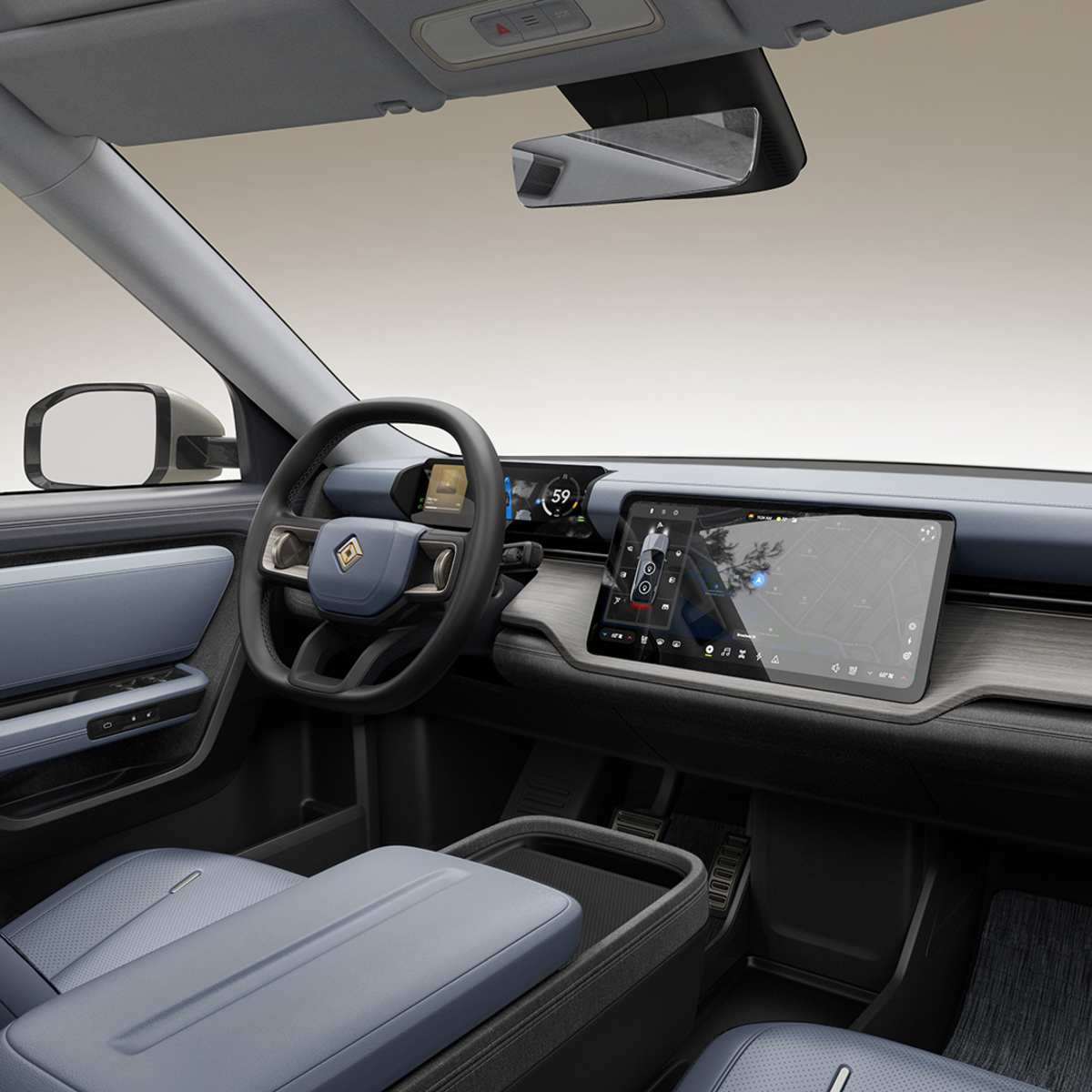
The Rivian R2 is an electric vehicle made by Rivian. The discussion suggests it’s new enough that some people haven’t seen one in person yet, so they’re waiting to check it out directly. “Real life” usually means looking at size, fit, and how it drives compared with what the specs say.
Car
Rivian
Rivian is a company that makes electric trucks and SUVs. The host says they saw a new Rivian while driving and turning.
The Rivian R1S is an electric SUV with room for passengers and a rugged, adventure-oriented design. The host thinks the white vehicle they saw was most likely this model.
Term
big huge like plates on the tires right for aerodynamics
They’re adding parts near the wheels to help the car cut through the air more easily. The host says it looks strange in pictures, but you don’t notice it as much once you’re actually driving.
A three-year pilot program is a trial run for a new rule or project. In this case, it’s how New Jersey plans to test self-driving vehicle operations before deciding what to do next.
“Autonomous vehicle testers” refers to companies running trials of self-driving systems on public roads. In the segment, the New Jersey bill sets up a pilot program specifically to let these testers operate fully autonomous vehicles in the state.
“Full autonomous vehicles” means the car is meant to drive itself. The bill is setting up a trial so companies can test self-driving cars in New Jersey.
A task force is a group of people put together to manage a specific project. Here, it’s the group that oversees the autonomous vehicle pilot and has to report progress regularly.
Quarterly reports are updates every three months. The bill requires regular check-ins so the state can track how the autonomous vehicle trial is going.
A robotaxi is a self-driving car that you can use like a taxi or rideshare. Since it carries passengers, the rules focus on safety and who’s responsible if something goes wrong.
Tesla is a car company that also builds self-driving-related technology. In this discussion, the host suggests Tesla may not fit neatly with the specific robotaxi rules being described.
Manual control here means a human override capability: the supervised operator must be able to take over driving immediately if the automated system can’t handle a situation. This is a common regulatory requirement for early autonomous deployments.
They’re requiring a person to sit in the driver’s seat while the car is running itself. The goal is that the person can watch what’s happening and take over quickly if needed.
Self-insurance means the company is financially backing the risk itself, rather than buying all the coverage from an insurer. Regulators want assurance that money will be available after an accident.
Liability insurance is the coverage that helps pay if someone is hurt or property is damaged and the company is found responsible. Robotaxi operators have to show they have it.
This refers to information a company can legally keep secret because it has business value—like proprietary software, sensor processing methods, or other trade secrets. In robotaxi regulation, it can limit what regulators and the public see, even while companies must share enough data to measure performance and safety.
A redundant safety system means the car has backup safety features. If one system has a problem, another system can take over to help keep the vehicle safe.
Robotaxis need a way for a person to step in. If something goes wrong, the operator (or emergency responders) can take over driving instead of the car handling it by itself.
This is about where self-driving cars get tested. The law calls for both closed test areas (more controlled) and open testing that uses real roads and conditions.
Smart infrastructure means the roads themselves are upgraded to help self-driving cars. That can include sensors and communication systems so cars get better information about what’s happening around them.
These are roads that have their own sensors. They help self-driving cars “see” and understand the environment using information from the roadway, not just the car’s cameras and radar.
Communication systems are how the car and the road share information. For self-driving taxis, that can help the car make safer decisions because it gets updates from outside sources too.
This is technology that updates traffic control based on what’s happening right now. Self-driving cars can use those updates to drive more safely and avoid problems like congestion or sudden changes.
“Fully autonomous” means the car can drive itself without a person steering or controlling it. The segment also mentions that regulators want systems that can be monitored and overridden in emergencies.
Designated highways are specific roadways that regulators allow autonomous or robotaxi operations to use. The idea is to limit deployment to routes that meet defined safety and operational criteria.
Emergency override is a safety feature that lets someone stop or take control of an autonomous vehicle if there’s an emergency. The question here is who gets that power: the state or the company running the service.
Commercial trucks are heavy-duty vehicles used for freight and delivery, typically operating under stricter rules than passenger cars. The segment frames platooning authorization as aimed at autonomous commercial trucking on certain highways.
Platooning is when trucks drive in a tight group, like a train. One truck leads, and the other trucks automatically match its speed and braking so they can follow safely with less human driving.
These are official categories for how “self-driving” a car is. Level 4 means the car can handle driving on its own in certain situations, and Level 5 means it can do it in all situations without needing a human to step in.
This is the organization that created the standard “levels” for self-driving cars. If a law says SAE Level 4 or 5, it’s using that shared definition so everyone is talking about the same kind of self-driving.
“Technology neutral” means the law doesn’t care how the car is built. It mainly cares whether the car can do the required self-driving task safely, regardless of the specific technology used.
Manual override means the driver can step in and control the car if needed. Here, it’s described as using normal controls like the brake, gas, and steering wheel.
The Tesla Model Y is an electric SUV. It’s designed for everyday driving and family use, and people often compare it to other electric SUVs by looking at things like size and EPA range numbers. The “taller” comment is about how the vehicle’s overall height can differ between models.
LFP batteries are a type of EV battery chemistry made with lithium iron phosphate. They’re often chosen because they can be cheaper and tend to be safer/more stable than some other battery types.
Prismatic cells are EV battery cells that come in a rectangular shape. The shape matters because it can change how the battery fits in the car and how it’s built.
Licensing technology means Ford would pay for the rights to use another company’s battery technology and/or manufacturing know-how. In this context, it’s a way to ramp production faster without building every part of the process from scratch.
These are highway lanes that are shut down because of construction. The problem is that the robotaxis might still try to drive into them, and the host notes it could happen at high speed.
An autonomous driving system is the car’s “self-driving” software and sensor setup. The host is saying the recall is tied to a particular version/generation of that self-driving system.
LIVE
Hello everyone and welcome to Kelowata podcast about electric vehicles, renewable energy,
autonomous driving and much much more. My name is Bodhi and I am your host and on our last episode
which feels like I just recorded it yesterday because I did. I covered Tesla's email and their
objection to how the state of New Jersey wants to regulate robotaxies and when I was going through it
yesterday I didn't actually read the bill and as I was talking about it I was like as I was
talking about it on the show I was like I should probably dig it more into this bill. That's not
a thing that I want to do on a regular basis to be honest because it just seems awful to me and it
was awful. The bill was about 20 pages long altogether some of it repeated so it wasn't
like a heavy lift but the thing is I was like well maybe I'm off on my analysis and maybe I'm
being unfair to Tesla so what I did was I read through the bill made my notes and I think what
I'm going to do today and we'll see how much time this takes. If it takes a lot of time this will be
the only thing for this episode. If it doesn't I'll pause the recording as soon as I'm done with this
and I'll get some extra stories in here so that we can actually have a full show.
But I'm going to start with the New Jersey bill and I'm going to read the summary statement,
the introduction section from the bill and then we're going to go over Tesla's claim versus what
it says in the bill and get a little bit of clarification and not just from me but from
what the bill actually says. Now I will say full disclaimer I have read through bills before not
for this show for firefighting stuff just to see what's in there. I've not ever tried to
do any sort of analysis on them so I will fully admit that some of this information I might be
getting wrong but if I get it wrong and somebody points it out then I will be more than happy
to come back and clarify and correct myself but as it stands right now I think I have a good handle
on it. Again I'm fully admit I could make mistakes so treat me as if you were to treat chat GPT
in this situation. You know trust but verify is what I should say oh oh hey guess what I saw in
I was driving on the freeway this is appropriate for this this bill or this segment but I was a
passenger and I wasn't driving I was on on the freeway in the back of a pickup truck and we were
having a nice little drive and the two folks in front one of them's like what is that and I was
working on my laptop and I wasn't paying attention to what they said and they said buddy what is that
and I looked up and I was like what are you talking about like what is that car and I was
like I don't I mean like a Nissan Rogue or whatever was directly in front of us he's like no no over
here and they point off into the left and we're on the I-10 traveling westbound and I was like
oh that's a cyber cab and I'm sitting behind the driver so I unbuckle my seat belt not recommended
I unbuckle my seat belt slide over to the driver's side because I'm sitting behind the passenger
excuse me slide over to the driver's side buckle my belt and I was like pull up next to it I want
to get some video so I got about 10 seconds worth of video because it really I looked like a creep
but anyway got a couple pictures of it from behind and then got a little video of it but first
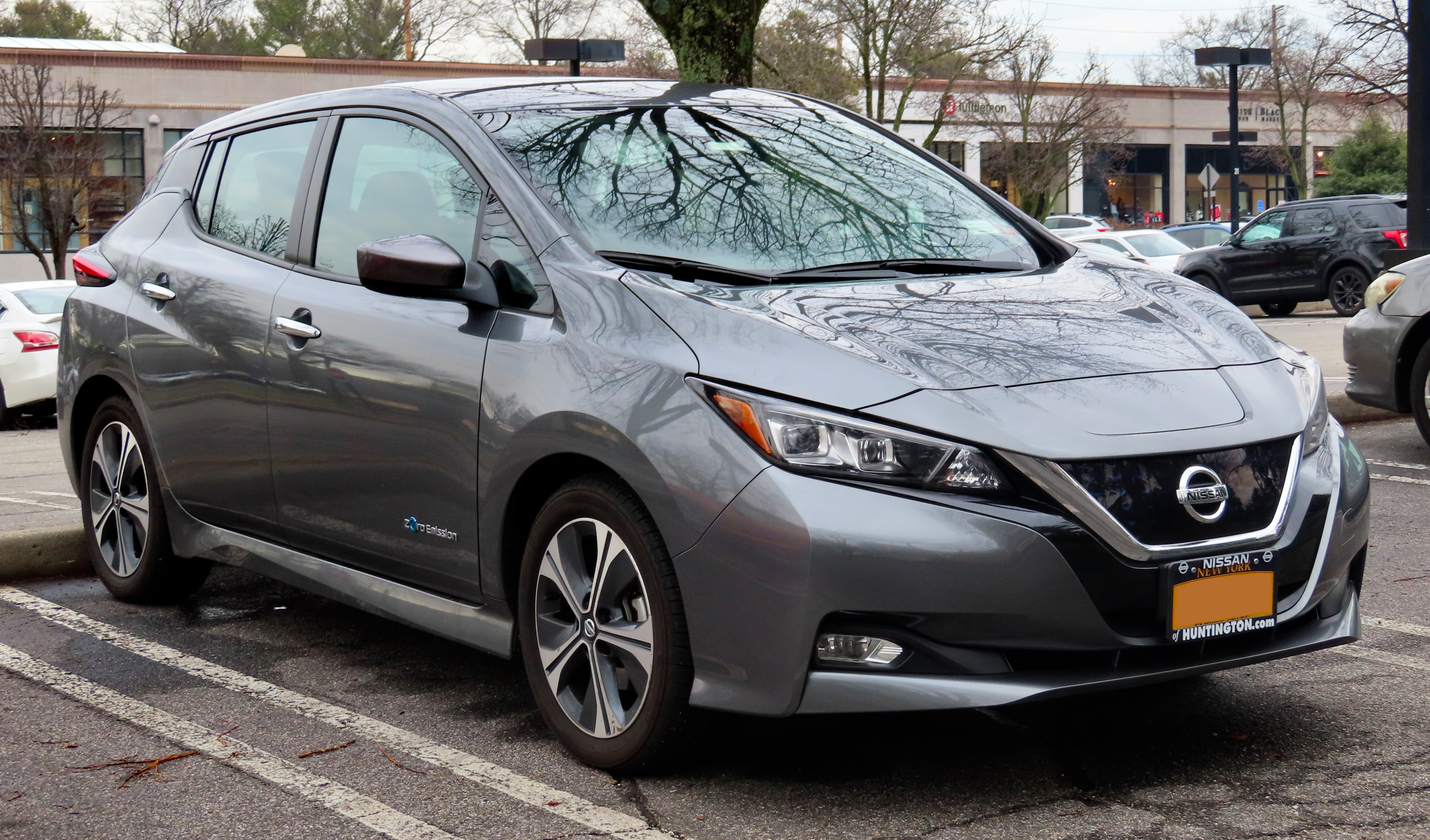
take seeing it in real life small lot smaller than I thought it might be smaller than a Nissan
Leaf I haven't actually looked to see what the distances or what the lengths are but it is small
it is you know this one in particular did have a steering wheel and there was a driver obviously
because it's not approved yet here in Arizona or at least they haven't started if it has been approved
and it's definitely not approved to drive on the freeways but there was a driver in it
and he was actually driving hands on the wheels it looked you know he I don't know if he looked
annoyed when he looked at me filming it or if he just maybe I'm just you know projecting in that
case but I was like I got really I was very excited it is an ugly color cool looking car
I do not like the color so I'm not really sure why Tesla decided to go with that gold
but I'm not a fan it it's not a shiny gold it's like more muted and it definitely stands out but
the car stands out anyway but yeah I thought it looked great in terms of just the overall look
of the car again not not a super big fan of the color it's almost like a vomit yellow almost
but yeah I got super excited to be able to see one in real life so I haven't seen an R2 yet but
I'm planning on doing a lot of things this weekend out and about so I'm hoping to come across an R2
in real life I was driving and making a left turn and I saw a new Rivian or it looked new
it was nice and shiny and white and I was like oh is that an R2 but I had to turn left and they
would have been behind me and I had to get somewhere so I wasn't able to verify that that was a
Rivian R2 or an R1S it was probably an R1S though all right that was my exciting news
please email me a questions oh and you know what in the pictures the they have these big huge like
plates on the tires right for aerodynamics in the pictures I was not a fan of that look
but in reality when you see it I didn't even really notice it until we were driving away that
that was there so you know just goes to prove that things look different in real life
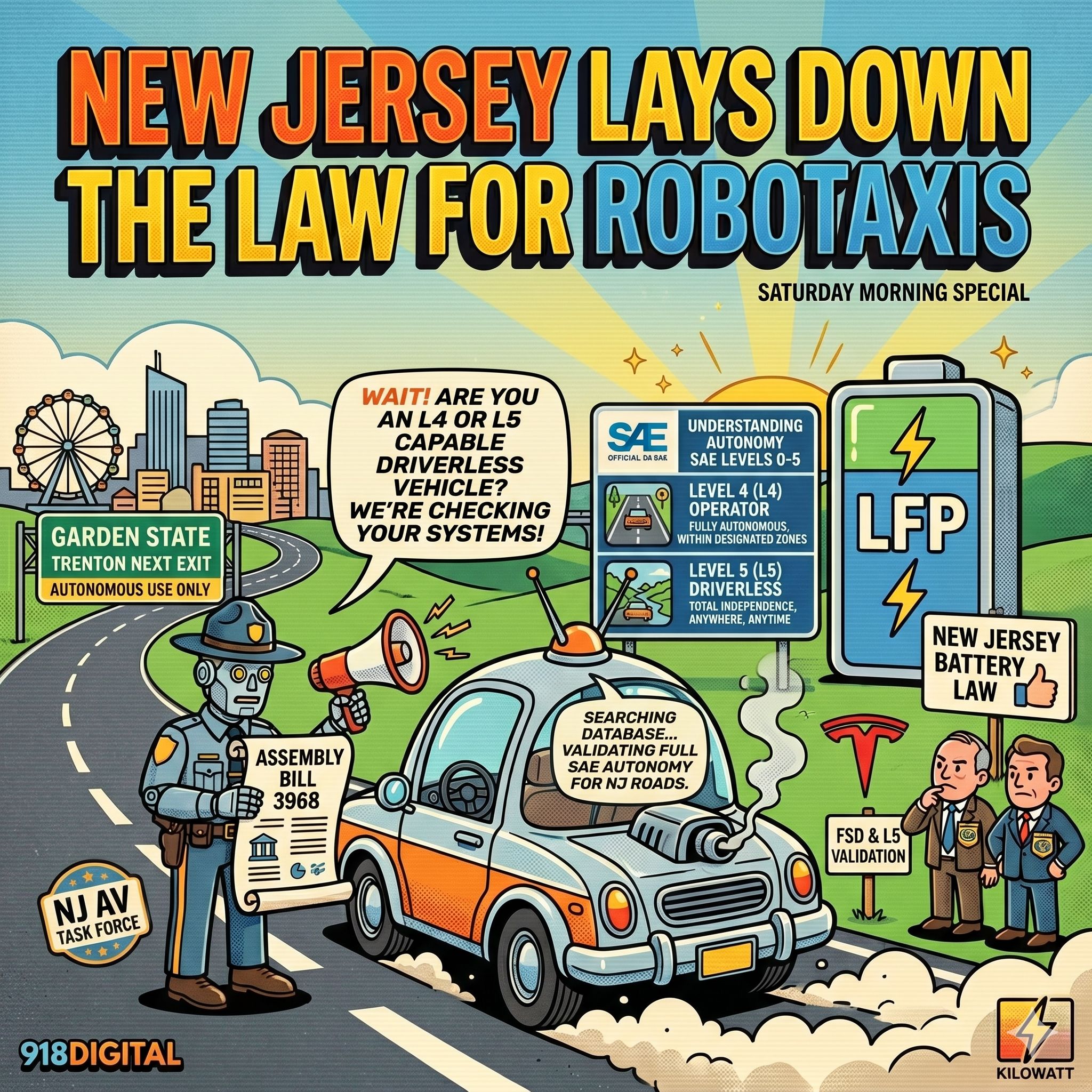
okay that's the cyber cab update let's move on to New Jersey bill a 3968 this is from the
introduction section and this is the statement for the bill starting off this bill requires the
New Jersey Motor Vehicle Commission in consultation with the Department of Transportation to establish
a three-year pilot program to allow autonomous vehicle testers which would be companies like
Zooks Waymo and Tesla this isn't part of the belt this is just me talking that's what the
autonomous vehicle testers would be to operate full autonomous vehicles in the state the pilot
program will be overseen by a task force made up of five members composed of public safety
officials transportation experts and autonomous vehicle industry representatives and consumer
advocates appointed by the commission in consultation with the department of transportation
so for this five members you're going to have basically one public safety official one transportation
expert one autonomous vehicle expert and a customer advocate and then a wild card I guess
that could be from any of those you know four different disciplines I guess and then this
is what the task force is required to do the task force is required to provide quarterly
reports to a commission and to the department of transportation regarding the status of the
pilot program they need to solicit public feedback concerning the pilot program they need to assist
the commission okay to make things easier when I say commission I mean the motor vehicle commission
for New Jersey and when I say department it's department of transportation just to kind of
make this go a little bit easier all right so they're going to assist the commission and department
in establishing responses and protocols to autonomous vehicle collisions cyber attacks against
manufacturers and autonomous vehicles major operation disruption disruptions concerning
autonomous autonomous vehicles and liability in the event of autonomous vehicle collisions
and coordinate with the New Jersey division of state police in the office of the attorney general
to develop guidelines to govern pedestrian and driver's security and safety so basically
what they're saying here is to this point if I'm reading this right we are going to have
you know we're going to take three years we're going to work with not only autonomous vehicle
testers but also you know experts in other fields like public safety and things like that and then
we're going to kind of develop a plan instead of a bunch of lawmakers making rules that may or may
not be good for the community you know I don't see anything wrong with this it's a it's definitely
a slower approach but it's an approach that is probably you're going to hear more voices for sure
from from the community and I don't I don't see anything wrong with it so far so going on and I
promise there's not too much of this Tesla excuse me testers the autonomous vehicle companies themselves
like Waymo, Zooks, Tesla or whoever else is doing this testers are not permitted to operate
autonomous vehicles in the state unless certain conditions are met and this is probably where
Tesla has their problem so continuing on with the summary specifically the operator is required to
be seated in the autonomous vehicle's driver's seat monitor the autonomous vehicle's operation
and be capable of immediate manual control of the autonomous vehicle this person needs to be
I'm paraphrasing now they need to be an employee an independent contractor
or other person designated and trained by the AV tester again Waymo, Zooks, Tesla or whoever's
operating the robotaxi concerning the capabilities and limitations of the autonomous vehicle
not be under the influence of drugs or alcohol that seems like a given I don't think Tesla is
probably arguing that that's unfair to them possess a valid driver's license let's see
or other appropriate license let's see here the robotaxi company is required to register
the autonomous vehicle and submit proof of liability insurance and they need self-insurance
or a surety bond of at least 5000000 dollars to the commission so I if I had to guess Tesla
doesn't want to put somebody in the driver's seat because they they would prefer not to have
anybody in the driver's seat it now is that the only problem they might have no there's probably
other problems down the road here but I think that's maybe an obvious one if I had to guess
now it goes on to say the chief administrator of the commission is permitted to immediately prohibit
an operator or tester from operating an autonomous vehicle if the chief administrator determines
that such operation poses a risk to public safety or that the operator or autonomous vehicle fails
to comply with the with the provisions in the bill now in I don't know that this is any different
from any other state honestly but I could see where a company not going to say which company
but I could see where a company that is used to pushing up against the boundaries of what the
rules are would not want one person within government to be able to just shut them down for
whatever reason and you know I don't know what the parameters would be I don't know who the chief
administrator is in this case but I don't know what their parameters would be outside of you know
the the autonomous vehicle company robo taxi company isn't following the rules but you know
it is they can look at that and say what you're doing isn't safe and we're not going to let you
do it anymore so I can that might be a problem might not be a problem let's see a tester the
robo taxi company participating in the pilot program is required to provide the chief administrator
with certain information appropriate for measuring the performance and pilot program but is permitted
to withhold to withhold commercially viable confidential or proprietary information this
is something that I think Tesla would actually like they seem to prefer not telling people
uh not to say that they're not transparent with the government but they seem to prefer to keep that
information close to the rest whereas some other companies robo taxi companies out there are don't
do that um any autonomous vehicle being operated under the pilot program is required to number one
they need to be equipped with a redundant safety system and technology that ensures
appropriate motor vehicle control teslas are full of redundancies uh so I don't think that's
going to be a problem for the company and they need to allow the operator or emergency responders to
override the autonomous functions and allow operators to take control of the automatic vehicle
I don't think Tesla has an issue in this regard either they need to alert operators when autonomous
vehicle technology has been disengaged and the operator is required to take control of the vehicle
again no big deal they need to retain data recordings beginning 30 seconds before collision
and be able to capture operational data and be capable of capturing operational data
they need to be equipped with certain crash avoidance systems they need to comply with
posted speed limits that might be a problem but they need to comply with posted speed limits
they need to emit an artificial noise for pedestrian safety they need to meet industrial
cyber security standards and ensure that all data is encrypted and then there needs to be
a visible marker that indicates that the vehicle is an autonomous vehicle all of this is reasonable
and I think Tesla meets all of this so I don't see that being the problem with the bill under
the bill all autonomous vehicle collisions are to be reported to the department within 48 hours
additionally the bill requires the department to establish an autonomous vehicle testing
additionally the bill requires the department to establish autonomous vehicle testing environments
which include closed test beds and open utilize existing autonomous vehicle
testing environments so basically they're required the state's saying here that the state is required
to provide funding for a closed test area and an open test area and the money doesn't come from the
robotexy companies that comes from the state that seems reasonable um let's see yeah and it's
interesting in here it says the department is required to identify funding sources to invest
and to coordinate with counties and municipalities to deploy smart infrastructure for autonomous
vehicles which includes uh sensor equipped roads communication systems and real-time traffic
management technology I mean I could imagine that that would be more uh also beneficial for
everybody on the road not just the autonomous vehicle companies but I think that's cool
that they're putting money into that uh autonomous vehicles operating as taxis
are to operate on designated highways be marked as fully autonomous be continuously monitored
through data reporting and have a communication system for emergency overrides by authorities
now I don't know what they mean by authorities here do they mean authorities being the state
or do they mean authorities being somebody within the company that can make overrides
and if I were a company uh if I was operating a robotexy service I would want to know who could
you know if if not my employees for the overriding I wouldn't feel comfortable with other people being
able to to do that overrides uh let's see autonomous vehicle operating at autonomous
vehicles operating as commercial trucks like semizer you know delivery trucks in some way
are to operate on designated highways under specific speed weight and weight restrictions
set by the department and and operators they are required to have appropriate licensing to handle
manual controls if needed and then you know they're they're authorizing platooning which
is really cool like if you have one lead truck that this is the way it's supposed to work I don't
know if this is how it'll work in New Jersey but you have one lead truck that's driven by a human
driver right or maybe monitored by a human driver and then you could have other commercial trucks
behind that that are autonomous vehicles that are operating you know almost like a train right
or a convoy behind that autonomous that that initial first truck that's platooning so finally
platooning is authorized for autonomous vehicles operating as commercial trucks on highways with
a lead vehicle controlled by an operator trucks that employ synchronized braking and acceleration
that follow the lead vehicle may operate as fully autonomous vehicles without a human driver
so as long as they this is not for the this is not for the taxi cabs this is for autonomous vehicles
like semi trucks commercial trucks that are operating on certain highways under certain
conditions under certain speeds but I think that's cool that's a neat technology now do I think
that's cool I want that on the roads I want to be a part of that testing
semi trucks can cause a lot of damage um but ultimately you know eventually I think this
will be a we got to test it somewhere and hopefully nobody gets hurt it's really
kind of where I'm going with that okay one last paragraph the commission is required to
know later than six months after completion of the three-year pilot program to submit
to the governor and legislator legislature a report that evaluates the program and includes
recommendations for safe integration of autonomous vehicles on state highways
so based on this summary they are not saying you cannot operate tesla in our
state with robo taxis they're saying you need to meet these certain guidelines and before you can
operate in our state and we're going to go slow and you know what that's okay I think tesla might
be making a lot of to do about nothing based on their current ramp of robo taxis you know there's
50 other states that they could be testing in well that 50 that's not right because
new jersey is one of the states there are a bunch of other states that they could be testing in
that do not have the same rules that that new jersey has but I think taking time
to develop smart useful legislation for autonomous vehicles and and taxis I think that's
I think this is a really smart way of doing it like I don't have a huge problem necessarily with
what new jersey is doing I don't think they're stifling technology they're definitely slowing
things down though it seems like but if tesla wanted to operate a robo taxi service in new jersey
they could have a driver in the driver's seat and said driver could just be there to take over
whenever they need to whenever there's an emergency and the people who are riding in the robo taxi
can still have all of the things that tesla was talking about like you know elderly people can
still get to where they need to go people with mobility issues can still get to where they need
to go with a driver in the front seat so and I'm curious if I don't think tesla's going to have
a problem with the if there's a collision it needs to be reported within 48 hours I don't think that's
going to be a problem with tesla I really think it might just be the fact that they're requiring
people to be sitting in the seats like everything else it seems like they've already got covered
now I what I did was as I looked at some of tesla's claims and I looked through the bill
and I tried to either prove that what their claim was correct or or not correct so um
so tesla's claim that it's a it's a ban on tesla's robo taxi service
the legislation this is what they say the legislation imposes restrictions so severely
that tesla autonomous vehicles of autonomous vehicle technology could not legally operate it
now the ban does not specifically bill uh the bill excuse me does not specifically ban tesla's
from the new jersey market um so yeah um they do define fully autonomous vehicle in the bill though
and that would be um a system classified as you know the society of automotive engineers
level four or level five autonomy and in texas tesla has self-certified themselves as level
for autonomy but i would imagine in new jersey whatever you know when whatever the um certification
on processes in new jersey they would not pass that uh if i had a guess now the society of automotive
engineers is the same level four level five in new jersey as it is in california as it is in texas
but my guess is uh maybe new jersey uh follows the uh maybe there were a little bit more um
follow the letter of the like they're not gonna let yourself certify they're you're gonna have to
prove that you can hit level four or level five i'm gonna guess if that's the thing so yeah um
yeah because the bill specifically sets out a pilot program for only level four and level five
and their consumer vehicles definitely don't qualify and it kind of maybe seems like their
robo taxis at this point in time wouldn't qualify either find a guess uh the driver physical
requirement you know we already kind of talked about that tesla's not going to love the fact
that they have to have a driver but you know they have a driver in san francisco and they're
you know i don't know if they're doing fine but you know they're operating in that area
let's see um tesla claims or they ask that supporters make the bill a technology neutral
um bill and i don't know from what i can gather the the bill doesn't
really specifically have much to do with like the different technology just needs to hit the level
four level five driving they're arguing that the specific design restrictions um are i guess against
tesla but you know the bill allows the vehicle to be manually overridden uh let's see through the
use of brake accelerator pedal and steering wheel which currently tesla you can do so
i'm not sure what and i would love for somebody that if they know more about this to to chime in
here um you know there's a bill it says that it must emit an artificial noise for pedestrian
safety like tesla cars can do that i don't have an hard time figuring out specifically what the
technology neutral as far as i could tell it didn't have anything that said anything about
lidar or anything like that you know the radar or ultrasonic sensors i don't remember seeing
any of that in the bill yeah and i just stopped the recording to see if there was any mentioned
in the bill about lidar radar ultrasonic sensors and there's not so um i'm not sure what they were
like it just seems like tesla's not at the level four level five or they don't have the ability to
certify in new jersey at the level four level five self-driving because you know they're not
allowing them to self-certify there's there's nothing in here that leads me to believe that
tesla's being um
specifically being written out and said you know you can't be a part of this because of
because you're tesla i don't think that's i just don't think that's happening here
the biggest thing is that it requires a human driver a steering wheel
you know i mean a human person in the in the driver seat a steering wheel pedals
you know actual control of the car if need be if you need to take it over i mean this is this is
all things other than the sae level four level five autonomous system this seems like this should
be a slam dunk for tesla if they actually were able to qualify for four level four level five
autonomous driving so yeah i found that interesting um
should we do a couple of stories i'm gonna write a couple of stories at the end here and uh
just as a thank you for sitting around i don't know if anybody found this interesting i kind of
found it interesting i think bill's you know law writing the law and and all that stuff i think
that's kind of boring myself however going through this um with like a kind of like a critical
eye of like are they being unfair to one specific company not just tesla and i don't see that i i
see this bill as i mean i'm uh all right without getting political i think much of our government
in terms of laws and and the way that it's run is fine most of the time i do think and this isn't
specific to a local level or a federal level or whatever's in between right i do think there is
a very small amount of of government that is theater and that theater is distracting and
takes away from all the other stuff that's working in the government i'm not one of those people that
because i i mean i work in the government it's my job there are plenty of things to be frustrated
about as an employee and as a citizen when it comes to your government but for the most part i
mean i live in the city of tempe and i think the city of tempe's ran pretty well um from a
resident standpoint the city that i work for by and large there's some things that i would like
to see changed but i think it's run pretty well by and large um there's definitely improvement
improvements that could be made but i think the the little bit that's done for theater i think just
kind of distracts or detracts from all the good stuff that's being done and this is an example
of a bill that actually makes a lot of sense i think if i'm wrong here please let me know
because i'm more than happy to retract any of anything that i've said to this point but i
you know they've they've got a closed area that they can test in and then they can move into an
open area and all this seems reasonable so and tesla's got more than enough money to pay somebody
30 an hour to sit in a car as it drives around and for testing they got more than enough money
to do that that's not going to make them poor you know it's not going to break the company
all right everybody um you know let me do a couple news stories so i'm going to go write
some things up and i will come right back to you you won't notice some of you might get an ad break
but not if you go to support kilowatt and support the show you will not get an ad break
that's support kilowatt com
okay let's see did you get an ad break if you didn't congratulations uh let's see here
man my eyes are so bad all right i wrote up a couple quick stories here first of all rivian r2
performance weighs about 500 pounds more and is about 9.6 inches taller than the model y
performance but according to the epa ratings the efficiency is the same as the model y performance
the r2 has 21 inch wheels and gets 32 kilowatt hours or consumes 32 kilowatt hours
for every 100 miles so that's cool uh let's see it's probably not a surprise that ford will be
using lfp batteries for the 30 000 pickup that shouldn't be a shock but ford is going to use
lfp prismatic cells which are rectangles rectangular cells they're not uh cylindrical cells
to power their new uev in a partnership with catl and it looks like ford will be licensing the
technology from the uh for the battery and the manufacturing from catl it but it doesn't look
like catl is going to directly be doing the manufacturing you know uh the best way to make
an affordable vehicle is use affordable parts so this makes sense and we'll see this truck
in 2027 and finally wemo is recalling some robo taxis robo taxis sorry i just woke up from
i i recorded last night and then i woke up this morning i'm tired wemo is recalling some robo
taxis because they might drive into closed highway construction lanes or or just closed highways
all together and the problem is obviously that it's closing it's kind of you know drive into closed
lanes but it's also driving into closed lanes at highway speeds so this recall affects 3871 robo
taxis using the fifth generation uh autonomous driving system that wemo has the recall did
stem from real life events but these events did not cause any injuries it just this is something
they're concerned about but i think you could imagine how uh problematic it is that a you know
if a if a rogue wemo had blasted into a construction zone full of people that would be an issue for
shore just uh as a side note the ohay vans which are the vans made by zika with the cool elevator
doors they're using sixth generation autonomous driving system for wemo so they're not affected
but there's also not very many of them all right everybody that is it for me if this was
interesting to you uh please let me know because you know it's not like i'm going to be doing special
bill episodes but i've never done one before it was kind of
learning how to present it and let me know what you thought you want more never want to do it again
you stopped listening after you heard that i was going to be reading a bill let me know
you can email me bodi bodeie at 908digital.com you can follow me on linkedin it's bodigrim
bodigrim.com thank you all so much for listening i hope you all have a wonderful weekend and i will
talk to you soon
if you liked the show please take a moment to rate review and subscribe it really does help
the show to grow thank you for listening
About this episode
New Jersey’s proposed robotaxi and autonomous-vehicle framework gets a close read, with the host connecting it to what they’ve seen on the road—spotting a Tesla “cyber cab” on I-10 and noting it wasn’t approved for freeway driving. The bill outlines a three-year pilot, operator oversight, redundant safety systems, crash reporting within 48 hours, and smart-infrastructure funding. It also touches platooning for commercial trucks and how Level 4/5 definitions shape eligibility.
In this episode of Kilowatt, we dive into Ford's latest electric vehicle strategy as the automaker begins building low-cost LFP battery cells in the United States. This move is aimed directly at keeping competitors like Rivian at bay while paving the way for a highly anticipated $30,000 EV pickup truck. Meanwhile, autonomous driving hits a bump in the road with Waymo issuing a software recall after robotaxis struggled to navigate closed highway construction lanes. We also examine the growing regulatory pressure on semi-autonomous tech, highlighting a new New Jersey legislative bill and federal lawmakers pushing the NHTSA to investigate Tesla's Full Self-Driving claims. Tune in for an essential breakdown of the rapidly changing EV battery landscape and the safety battles defining the future of autonomy.
Support the Show https://www.supportkilowatt.com/
Other Podcasts:
Beyond the Post YouTube (https://www.youtube.com/@beyondthepostfm)
Beyond the Post Podcast (https://www.beyondthepost.fm/)