The Chrysler New Yorker is a big, fancy car that was made for many years, known for being comfortable and stylish. People often talk about it because it represents a time when cars were built with a lot of attention to luxury and design. It's like a classic piece of American history on wheels.
Aluminum is a type of metal that is lighter than steel. Car manufacturers use it to make cars lighter, which helps them use less energy and go further, especially in electric vehicles.
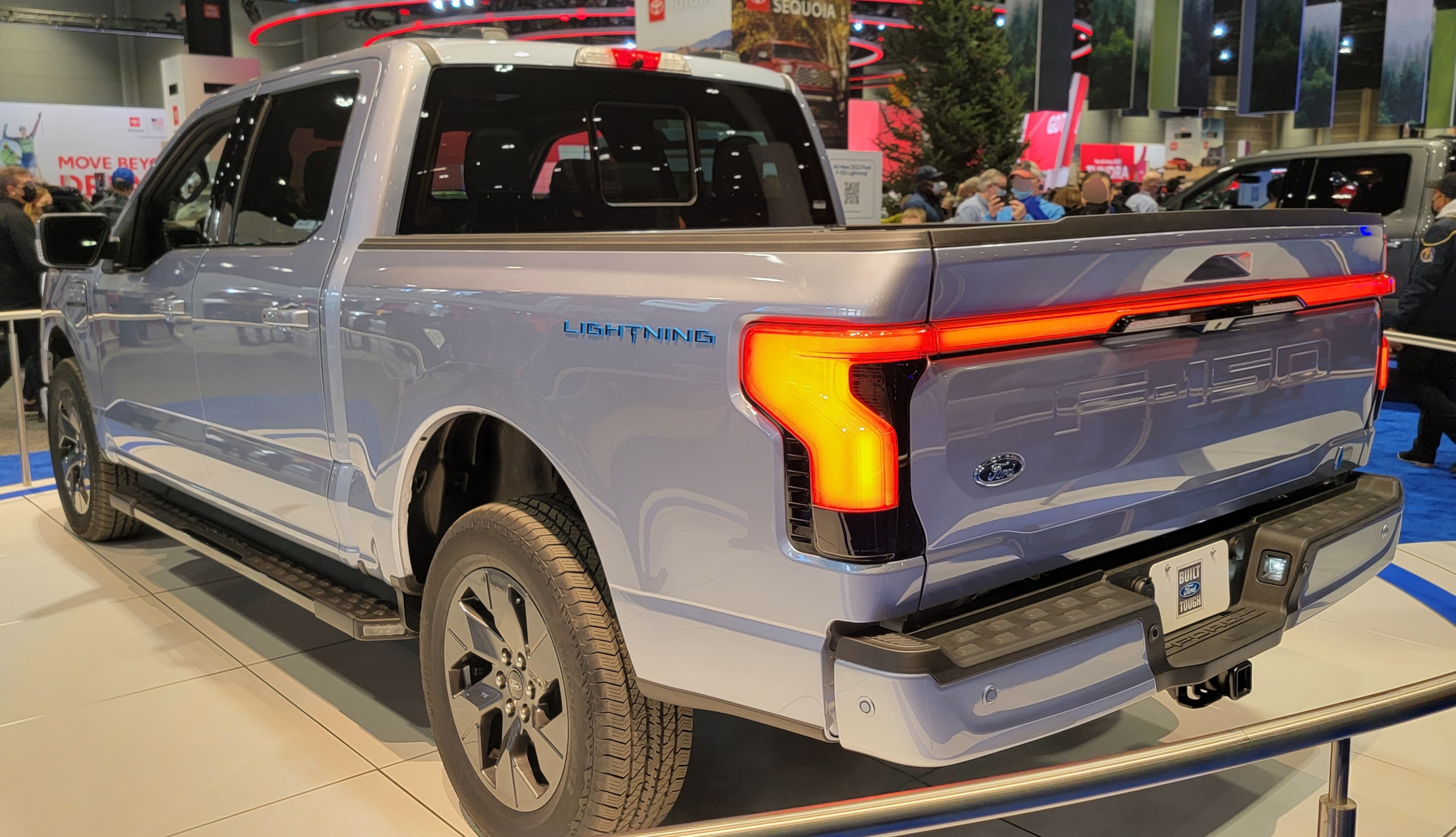
The Ford F-150 Lightning is a fully electric pickup truck from Ford. It's designed to offer the same utility and performance as traditional F-150s but runs on electricity instead of gasoline.
Sourcing is about how car companies get the parts and materials they need to build cars. If there's a problem getting these parts, it can slow down or stop car production.
The F-series pickups are a group of trucks made by Ford, with the F-150 being the most famous. They are known for being tough and are very popular among truck buyers.
A supply chain is like a series of steps that a product goes through to get from the factory to you. If one step has a problem, it can cause delays in getting cars to customers.
EV tax credits are discounts or money back from the government when you buy an electric car. They help lower the price and make it easier for people to buy electric vehicles.
EVs are cars that run on electricity instead of gasoline. They are considered better for the environment, but they can be more expensive to buy.
LIVE
Want to win the inventory game? With Kelly Bluebook Instant Cash offer, you can lock in trade-ins before your competitors even blink. Faster deals, better margins, lock in and load up today at b2b.kbb.com. Welcome to this weekend drive edition of Daily Drive for the second week in October 2025. I'm Kellyn Walker in Nashville, Tennessee. We're breaking down some of the biggest stories in the auto industry from the past week and looking forward to what's in store in the days ahead.
Joining me today, Larry Veliquette, covers Toyota and Subaru for us at Automotive News. Larry Legend, welcome back to Weekend Drive.
Kell, you're in Nashville, so I feel compelled to say salut. That went over my head. It shows how West Coast I am.
It's an old EAR reference. Yeah, that's what it went completely over. And Molly Boygon covers tech and innovation for us. Molly, welcome back.
Howdy, Kell. Here you go, New Yorker. All right. Remember those Opa Conte commercials, Larry. New York City.
New York City. Don't you ever make your sauce in New York City? Okay. This week, we learned that the novellus, aluminum plant, fire in Oswego, New York could cost forward up to $1 billion in earnings and has forced its F-150 Lightning plant near Detroit to go idle.
Now, Larry, have we seen something like this before and how big of a problem is this for Ford and other automakers who source aluminum from the plant?
Well, I tell you, Kell, we have seen big fires and big major suppliers before that have been very disruptive. They've cost a lot of money.
And they've forced sourcing and purchasing automakers to scramble to fill, you know, to keep their lines run because the F-150, I don't know if I want to let you in a little secret there.
That is the franchise at Ford, right? That is the one thing that you keep going at Ford and you stop other production to make sure that you continue to supply of F-series pickups.
To your dealers, it's that important. So aluminum, since 2014, very, very important component of the whole F-series.
So we're talking about a dart right at the heart of Ford here. You can't really overstate how important that is.
And you know, we've seen these key suppliers go down before and then you see the resulting production slowdowns as a result.
So you might see some people laid off for a bit.
And Molly, what do you think this says about the fragility of supply chains?
It is a really potent reminder of the kind of row of dominoes that it takes to actually get these vehicles out to the consumer.
And you know, one, one domino falls and the whole row falls. So it really does highlight that kind of interdependency.
And I would also say this is interesting because of the steel and aluminum tariffs that are being applied on imported steel and aluminum.
So this is a domestic aluminum producer. And it goes down at probably exactly the wrong time as Ford and the other automakers are even more dependent on domestic aluminum and steel.
So with EV tax credits going away, Ford and GM says they were buying up EVs to pass on those credits to customers through lease deals.
But this week GM backtracked and said it would offer its own discount and only through the end of this month.
Stellantis announced a similar plan to give its own discount without gobbling up EVs itself.
What do you guys make of this? Larry, let's start with you.
Well, I think that the key takeaway from this is that EVs are expensive, that they were being subsidized by taxpayers.
And that making that subsidy come from the bottom line of automakers, they don't really have the bottomless pit of money that taxpayers seem to have in this country.
I think it just got to be very expensive, it was going to be very expensive.
And it's also kind of a cost shift because those incentives, they come out of the automaker bottom line.
But the fact that those cars are already sold, right? They've already been wholesale to the dealers who are now floor planning them and hoping to find buyers so that they can stop paying interest on those vehicles.
So I think you're seeing kind of a short-term deceleration, kind of a softer landing with these things.
But it's not surprising to me that they pulled the plug on this pretty ambitious plan to keep up the $1,500 tax credit.
So I actually am surprised that this didn't work out because my understanding is that it was a way of kind of seizing on one of the technicalities and the IRS guidance for the issuance of the tax credit.
So people were still taxpayers, were still eligible to claim the tax credit as long as all the papers were signed before September 30th.
So I thought that this was a plan to kind of purchase those vehicles early and then apply the credit basically as it discounted the consumer.
And my sense is that it's really the kind of political wheeling and dealing that actually created the incentive for the automakers to give this up.
I know Senator Bernie Merino was involved and it also goes to show to me how actually the $7,500 new EB tax credit was quite popular and helpful for the automakers.
And they're basically just trying to extend it as long as possible but ran into some kind of political headwinds.
Yeah, my legs right. I mean, I don't want there to be any misconception here.
That's exactly what happened. I just, I'm kind of shocked at the speed at which they folded.
Yeah.
Right. But I understand it.
I mean, they didn't want to, they didn't want to be on the wrong side of those 75, what I was trying to say is they don't want to be on the wrong side of those $7,500 tax credits.
If suddenly the government says, well, you know what? Yeah, we, it was a technicality that we were going to let people who signed have it.
And you delivered all these vehicles on paper, even though you don't have buyers for them.
So I think they just didn't want to see the on, be on the wrong side of that and have that potential liability on their books if things went south.
Yes.
So agreed.
Good point. Coming up, it looks like the Trump administration is moving toward robotics tariffs. We'll talk about that next on Weekend Drive.
Inventory is tight. Competition is fierce, but Kelly Bluebook instant cash offer gives you the edge with direct access to consumer trade-ins.
You can lock in more of the used inventory you need and load up your lot dealers using instant cash offer cut costs to market by 3.7% and close deals faster with new tools like counter offer.
That means more margin less hassle.
Whether you're looking to boost your use car pipeline or stream on your acquisition strategy, it's time to lock in and load up.
Visit b2b.kbb.com to request your demo and see how Kelly Bluebook can help you win more deals more often.
Automotive news shift podcast brings you the latest on automotive technology trends and transformation. I'm Hannah Lutz.
And I'm Molly Boygon. We're the new co-host of shift and we're excited to bring you new conversations with experts and industry insiders like this one with Larry Dominique, president of LD Management Consultant.
Do you believe the legacy OEMs are falling into a trap? They've got to find a way to, in some ways, build new airplane while they're still in flight.
Cut shift available every Sunday wherever you get your podcasts.
Welcome back to Daily Drive. I'm Kellan Walker with Larry Bellquette and Molly Boygon.
Molly, you wrote a piece about the Trump administration moving toward new tariffs on robotics and industrial machinery.
We heard your interview with Alex Partners Neil Gangouli on Thursday's episode of Daily Drive.
What's going on there and what would that mean for suppliers and automakers?
Yes, the government released a couple of weeks ago a federal register notice that notifies the citizens that the government has commenced a section
232 investigation into the imports of robotics and industrial machinery.
So what that means is that the government is seeking information about how different manufacturing sectors source their robotics and industrial machinery.
And this type of investigation has preceded the section 232 tariffs on other goods.
So they're kind of setting the stage for if the information that they get is what they're expecting to apply tariffs to robotics and industrial machinery.
And this is really interesting because the Trump administration has been applying various levers of pressure to different manufacturing sectors to return manufacturing to the United States.
And now not only are they may they be asked to return manufacturing to the United States, but they may also have to source all of the machinery that they're using to do their manufacturing in the United States from the United States.
Well, Molly, how likely are we to actually see these tariffs go into place?
It's very unclear at this point because it's just the investigation. And so there's a comment period that the government will seek comments from different stakeholders associated with this.
But if the administration's past actions signal anything, it's that there is a focus on reshoring manufacturing, avoiding purchasing goods from countries like China that do do have some role to play in terms of manufacturing robotics and industrial machinery.
So I would say I don't have a crystal ball, but I don't see any huge reason at this point why the administration wouldn't do that.
I will say that one consideration is that the US does get a lot of its robotics and industrial machinery from allies like South Korea, countries in Europe.
So that may give the administration pause, but at this point, it's not clear.
Larry, you look annoyed. What's your thoughts?
Oh, it's not annoyed. I'm certainly not annoyed. I'm just if you have never walked through a for those among our listeners who have never walked through an auto plant, right, to witness what robots do and the jobs that robots do.
I would invite you to go take a tour because robots now do so many jobs and so many really crappy jobs that used to cripple people that they now do automatically they do it really well repeatedly, which is why your vehicle quality is improved.
But I'm sure that this action will do nothing but help, you know, vehicle affordability in the long run.
He's big sarcastic.
Larry, I don't know sarcasm comes across in this in this form.
I just feel like I need to reassure the audience.
Larry, Jim probably gave a speech late last month about the need for skilled trade workers and more training.
You wrote a column this week about his statements and how it relates to immigration. Can you give us a summary?
Yeah, I'll try to be quick. So the summary is Ford CEO Jim Farley said that we don't have enough blue collar workers, right?
And he's right. We don't have enough blue collar workers. There are hundreds of thousands of open blue collar jobs in this country that aren't being filled.
His answer though was, okay, well, maybe companies need to, you know, open their training, expand their training.
And what I left out, what I argue in the column that he left out is that before we need to worry about the private sector training more people, we need more people.
Specifically, the jobs that that historically have those blue collar jobs have been a doorway for immigrants to join the American dream, right, to adopt the American dream.
But when you crack down on immigration, illegal immigration and that discourages immigrants from coming to the US, legal immigrants.
You know, our demographics are not, we're not getting younger as a nation. We are getting older because of the baby boom generation that's retiring at 10 or 12,000 people a day around the clock now.
And our birth rate has not been able to keep up. We're actually seeing a decline in worker working age people. So that was my argument. We need more people if we're going to train more people.
Molly, you have any final thoughts?
Um, just save, save some social security for the rest of us boomers. That's all that.
Now, now I will, I want to point out, I am Gen X, not, not baby boomers.
You tell your boomer friends, like, yeah, tell my boomer friends that all my older brothers and sisters.
Well, Larry, Molly, thank you so much for joining me.
Thanks, Cal.
Thank you, Cal.
That's all for this weekend drive edition of Daily Drive. I'm Kellyn Walker. Thanks to automotive news executive producer Jake Nier for his help on today's podcast.
You can get the latest news on workforce development, supply chains and everything happening in the auto industry at auto news.com.
We'd love to hear from you. Let us know what you think of the show when the topics we covered today.
Send us an email at DailyDrive at auto news.com or leave us a voice mail at 313-444-2774.
If you enjoy the podcast, remember to like, leave a review and subscribe so you never miss an episode.
About this episode
A recent fire at Novelis' aluminum plant in New York could cost Ford up to $1 billion and has halted production at the F-150 Lightning plant, highlighting the fragility of automotive supply chains. The discussion also touches on the implications of EV tax credits as GM and Stellantis shift strategies in response to rising costs. Additionally, the podcast explores the potential for new tariffs on robotics and industrial machinery, and the ongoing need for skilled blue-collar workers in the industry, emphasizing the importance of immigration for workforce sustainability.
Automotive News Staff Reporters Larry P. Vellequette and Molly Boigon talk about the week’s biggest news stories, including an aluminum plant fire that has caused major disruptions for Ford and others, automakers canceling their electric vehicle tax credit extension programs and more.