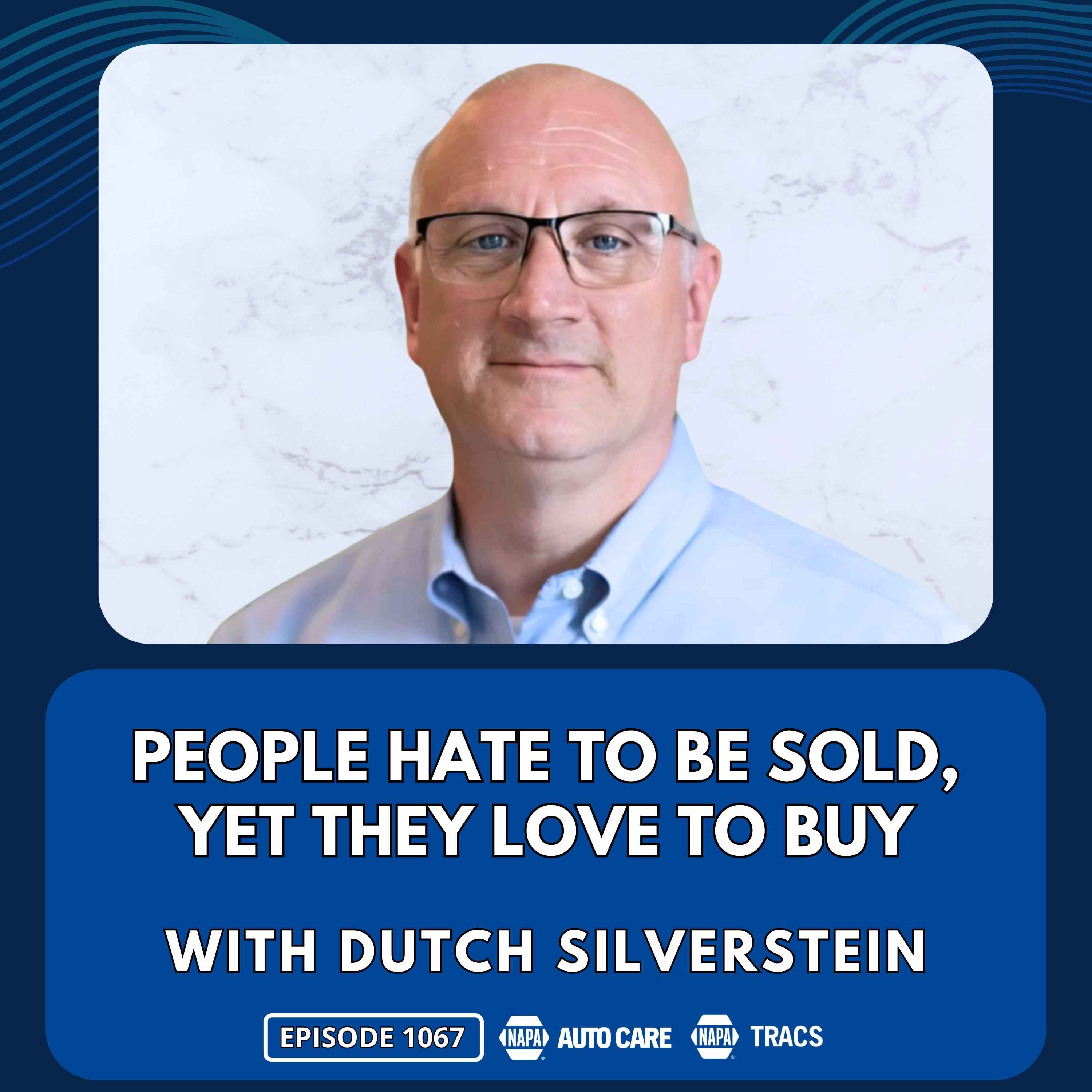
Dutch Silverstein joins the podcast to discuss the dynamics of selling in the automotive industry, emphasizing that while people love to buy, they dislike being sold to. The conversation explores the importance of relationship-based selling versus transactional approaches, the need for better processes and systems in auto repair, and the challenges of licensing and proficiency in the industry. Dutch shares insights from his experience as a shop owner and pilot, advocating for a shift towards consultative selling that prioritizes customer agency and understanding.
Recorded Live at ASTA 2025, Dutch Silverstein delivers a powerful reframing of how the automotive industry can approach customer interaction—shifting from high-pressure sales tactics to a relationship-first model built on the idea that “People hate to be sold, yet they love to buy.
Advocates, Not Salespeople Dutch’s relationship-based shop model stands in stark contrast to transactional sales environments.
No Salespeople:Dutch does not employ “salesmen,” he employs “advocates.”
Role of an Advocate:Advocates collaborate with customers to understand what they want for their vehicle and their long-term plans, then help design solutions that support those goals.
Eliminating Pressure:The shop enforces a strict “no pressure, ever” philosophy. There are no commissions, no sales quotas, no whiteboards, no competitive bonuses—removing any incentive that could create a conflict of interest.
The episode also dives into several controversial but important topics:
The need to revisittechnician licensing, with Dutch arguing current standards are “window dressing.”
Theflat-rate paradox, especially when contrasted with the younger generation’s desire for work-life balance rather than solely financial incentive.
Determining anoptimal labor ratein a way that supports sustainability and talent retention.
The Takeaway The conversation reinforces that effective sales—better yet, advocacy—are rooted in trust. When customers feel supported rather than sold to, they embrace their decisions with confidence. This shift from selling to serving creates a healthier, more sustainable customer experience and business model.
https://astausa.org/pages/asta-expoThanks to our Partners, NAPA Auto Care and NAPA TRACS
Learn more about NAPA Auto Care and the benefits of being part of the NAPA family by visiting https://www.napaonline.com/en/auto-care
NAPA TRACS will move your shop into the SMS fast lane with onsite training and six days a week of support and local representation. Find NAPA TRACS on the Web at http://napatracs.com/Connect with the Podcast:
- Follow on Facebook:
"As an example, I got to stock breaks at rotors because I want to really be the rock"
Brakes are what make a car stop. They use pads that clamp onto metal discs called rotors to slow the wheels.
Brakes are the components that slow or stop a vehicle, typically consisting of pads or shoes that press against rotors (discs) to create friction.
Select text to request an explanation
This is the Automotive Repair Podcast Network.
They've got the same people in the class all the time, every time they all get together and say, I saw Bobby and Joe, they were here last year, but we're not seeing many new faces, but I'm here with Dutch Silverstein and we're going to get back as soon as we thank our great sponsors.
Hey, take your Napa Auto Care Center to the next level with the Napa Auto Care Gold Certified Program, increase Car Count, build trust with customers and stand out as one of the best.
Talk to your local Napa representative today.
Hey, did you know that Napa Tracks has on-site training plus six days a week support?
It all starts when a local representative meets with you to learn about your business and how you run it.
After all, it's your shop, so it's your choice.
Let us prove to you that Tracks is the single best shop management system in the business.
Find Napa Tracks on the web at NAPATRACS.com.
Dutch, how are you buddy?
Peachy, Dutch, you got your AAM from the association.
Yeah, I got it many, many years ago.
AAM Automotive.
AAM Auto Service.
Auto Service in Pineville, North Carolina.
That is no longer your business.
Yep, I sold out.
You sold out 26 years.
Yep, wow.
And of course, I've interviewed you in the past.
I think the whole world knows you were a pilot.
And every time I read an article from you, you write so well for wretch and wrench.
When I get on a plane and I talk about the lack of processes and systems in a business and I think about
if anyone would think about the airline industry and what it takes to get up and get down and stay and maintain that airplane,
why wouldn't we do processes and systems to make minute one and minute 100 experience for the client,
packed with great processes and systems because that's the only way airplanes work.
You think about it on average, it was 10,000 flights a day.
Think about how many of those flights wind up actually having an issue.
And I'm not talking about one where it's 10 minutes late or any of that or even the mechanical that actually crashes
or anything loss of life doesn't have.
Could you take 10,000 driving segments, be driving your car with the same record?
No, it wouldn't happen.
I mean, there's a reason it's deliberate, this system redundancies, training for proficiency,
all of the things that make it head and shoulders above anything else.
We got a vehicle that people depend on that they could get killed in if it's not working right or they're driving wrong.
And I'm not sure we stop to think about the power we have in the safety side of everything.
I think people take it for granted.
And part of that is the good engineering that comes out of the manufacturers.
Let's get credit what credit is doing.
They is some really good engineering.
It's not all encompassing, but there is some good basic engineering that comes out of these vehicles.
Right?
And they're very tolerant of any carelessness in capacity or neglect.
And that's a bad thing because people become at that point very lazy.
And it's routine.
It becomes very routine instead of torquing wheels down.
There you go.
They just hammer them.
It's three agadugas.
I know.
And a real good policy in any shop would be check.
Somebody yells out check in the guy in the next bay or the assigned checker comes in and goes all the way around and checks them on.
Yeah, doing true QC.
Just the airline.
You had a checklist.
Somebody had to sign off on each step.
Each operation had to get checked off.
I mean, there was system redundancy that was there.
And why wouldn't we on luggins?
Because why should I bother?
They've been doing it since, you know, I started in 73, right?
And nobody.
How many times the wheel off that you've ever seen?
Nobody.
It's done because I'm getting paid flat rate.
I got to get this car out of here.
And if I set the torque wrench up and tech tighten them down, lower the car, re-tighten them.
Then I have to tell the people, come back in 50 miles so I can recheck it again.
But I'm not getting paid for that recheck.
That's why it don't happen.
Look, you're writing for ratchet and wrench every month.
Go to the back fold, the back page, right?
The back page.
You've written some really incredible articles.
And if you invest the time to read what Dutch is writing, agree with him or not.
They're very profound.
They've got strong messages.
And sometimes you do.
And I'm not saying political, but you've got a particular stance on a lot of the issues.
I think it helps us stretch our thinking.
Sometimes we get way too focused on stuff.
Some of the articles of just recent.
And I want to mention them because I want to pick his brain on a few of these.
It's time to revisit licensing, the flat rate paradox, the illusion of transparency, which is really cool.
Labor rates, the other side of the coin.
You also did five ways to keep healthy finances and recognizing our customers' agency.
Damn.
And I didn't know where you were going with that till the second paragraph where you described what agency was.
Yeah, that's the reason because it's one of the words people hear.
But nobody says, what is he talking about?
Is he mean by agency?
You know, because that's a word that if you look up in the dictionary and online,
it shows that the usage is very, very low until the last few years.
And then it's become you're seeing it on television, you're hearing it on the radio.
You know, or in podcasts.
And people are saying, okay, what is talking about?
I'm here in the word.
So I thought it necessary to include the definition of what agency was.
And so I read it, a fundamental principle of interpersonal relationships and ethical behavior.
It acknowledges and honors the inherent right of individuals to make decisions about their own lives, bodies and experiences.
Yeah.
We're kind of in charge of that when they come in, giving them, we need to explain to them why and let them decide.
The whole point is for me, and this separates what we did at our shop and what I believe that relationship based shops,
how we differ from based transactional shops, is I don't employ salesmen in the shop.
I employ advocates.
Right.
And an advocate says, let's sit down and talk about what it is that you want for your car.
Tell me about what your plans are.
And based on that, we're going to devise solutions for problems that you have.
And ways that we can help you meet your vehicle goals.
Now, some people say, well, Dutch, what you're doing is you're engaging in consultative selling.
I'm not selling anything as I see it.
Yes, I could see how that readily fit into their description.
But there's no pressure in any of my shop at any time from any individual to sell anything because we didn't have a commission structure.
So there was no inherent conflict of interest.
There was no arbitrary whiteboard with a sales figure on daily sales figure that said today we have to earn this much.
And there was no competition that's saying Joe turned this many hours and Steve turned this many hours.
Fostering the competition and no bonuses, no spifts, none of that crap.
I didn't have it.
You know, you said consultative selling, which is the exact opposite of transactional.
And it really is relationship selling.
I mean, the person came to you because they had a great relationship and they want you.
People love to be sold.
And I think we love to convince people to come our way.
But I still love the idea of relationship selling instead of consultative.
Neil Rockman wrote a book years and years ago on this.
I'm going to guess 27 years ago.
And in our company, we got it.
We all read it.
We brought it to our salespeople because we just needed them to kick it up another level and really care about what they're doing.
And for their clients, you're not arguing about time to revisit licensing.
Can I just say one thing?
It's okay.
Oh, yeah.
Oh, no, I'm sorry.
You can't absolutely.
You can't.
So the point that I'm going to disagree with you on this.
All right.
People love to buy.
They don't like to be sold.
Yeah.
You know, you're right.
You're right.
I take that back.
Thank you.
We love to buy.
People love to buy.
We love to buy.
It comes with a lot of things, but people don't like to feel that they've been sold.
And you know what?
I will stand corrected because every time I would ever have to go buy a car, I couldn't stand being sold it.
Yeah.
That's my decision.
Go see the finance guy.
No.
No, you're going to have to put handcuffs on me and put me in a two-wheeled card.
And you're going to have to push me in there.
And I said, and then my wife is going to go get duct taped for my mouth because I'm not going to say anything.
I hate it to be sold from the financing guy.
Yeah.
F and I.
Yep.
Carb, you don't understand.
I just know I understand.
You're going to try to take my payment up another $300 a month.
No.
Okay.
So there's the definition of being sold.
Yeah.
Very good.
Licensing.
Yeah.
Golly.
You bring up a great point in the article about Canada, Michigan.
Wow.
I got a license tech.
How long ago was that?
Well, 25 years.
Because you do it once in Canada.
You're done.
Yeah.
Almost kind of the same in Michigan.
You know, God bless the Michigan laws.
But it hasn't been looked at.
And I think it's 45 or 48 years.
It's really window dressing.
It's an illusion.
It's like security and airport.
It's the illusion of security.
This is the illusion of competency and the illusion of someone care.
It's not legitimate.
All right.
There's no testing for proficiency that exists.
Stop.
That's it.
Episode over.
Man.
I'll tell you.
The proficiency thing is, I think, the biggest part.
If we can get proficiency testing going.
Sort of viable real legit stuff.
We don't need licensing.
We just need the consumer to look for that certification assessment
and owners to hire people that do that.
As he was started for all this reason.
Because no one wanted the government involved.
The government's not involved.
We're in chaos as tracing talks to her friends all the time
about our industry.
And the consumer's clueless.
Absolutely.
She asks friends.
Do you think the people who work in your car have to be licensed?
She's never gotten.
I know.
Yes.
They all believe.
And then she asks in the question,
do you know that we have technicians working in our shops?
No, they're mechanics.
And that's my big push of changing that language in the industry.
So when we talk about licensing,
where do you think it will ever go?
It has to start with a public relations campaign.
I mean, we have to push this as hard as we've ever pushed for change
in any industry.
It's absolutely necessary because you have to create the demand.
You have to be able to show the features and benefits
in using our terminology of having your car service
by a qualified professional to do them.
So many has to look and say,
that's what I want.
I have a choice.
That's what I want.
And then at this point,
now is a great time because guys that are my age,
dying and relieving the field,
which leaves it since it's going to be fewer.
There's 174,000 repair shops,
not including auto body or dealerships.
And that number is continuing the latest figure as of March 2024,
the Bureau Labor Statistics.
174,000.
Again, not including body shops and dealerships.
Is it including the franchise?
Yes.
It includes the franchise base.
And that number is diminishing because more and more guys
are leaving the field.
So now with them leaving the field,
this now leaves a golden opportunity for techs
who want to start their own business.
And for making changes because there's fewer people
that need to be affected.
Yeah.
Get on the caravan, right?
Yeah.
Food.
So you don't have to test as many because there aren't as many.
That's right.
You don't have to worry about how we're going to fit this in the schedule.
We don't have the auditors necessary to do this.
There's something you have to consider,
but there are less of them.
Right?
Less people that needed to be audited or monitored for proficiency.
Right.
It has to start somewhere.
Do you think our industry wants this?
No.
Absolutely not.
It's scared to death of it.
Absolutely.
Who could control it?
What are the parameters?
It sounds like it could be a 15 year project to try to make it happen.
You know, realistically, I don't think you're wrong.
It's not going to happen overnight.
Anything related to change is not going to happen overnight.
And if you keep the government out, then who does it?
And will this quote-unquote licensing agency have any cloud or meaning
with the people?
Or will...
And again, I love ASC.
I think they're a great organization.
We have to learn from what happened in not making an ASC certification
to have meaning to the public.
And it's almost like today as he be doing this stuff,
I would love to be in a think tank with a bunch of people.
You know, four or five different groups in different rooms,
whiteboard, post-it notes, and you come together with your top five best ideas.
I would love to see something like that, a flow chart or a responsibility chart
or what should...
I'd love to see what it shapes up to be because there's a million different ideas.
Good, bad, ugly.
But wouldn't it be neat to get it with one objective?
Let's figure out licensing and what it means and how it works and how we make it stick.
That would be great.
But, you know, right now there's a better chance that I could become pope
and my rabbi isn't going to go for it.
I know that because ultimately, the problem is too many people in our industry
only care about themselves.
Someone far wiser than I said, we each navigate by the start of a light self interest.
Our vision is limited at times to inches in front of our notes.
And if we can't see the immediate effects of it, we don't want to do it.
So you have to wait for a new generation to come in with whose value system is a little different.
And the generation of people that are coming up now, they can wrap their arms around that type
because they are more cohesive in their vision.
They're more than just money motivated.
They like social causes.
Are you an APA AutoCare Center ready to elevate your shop?
Then it's time to step into the premier tier APA AutoCare Gold Certified Program.
Gold certified centers are recognized as the best of the best,
delivering a consistent trusted customer experience nationwide.
Now that consistency means more repeat business, more referrals and more opportunities to grow your car count.
Now when your gold certified, you unlock advanced resources, maximizing technology,
boosting your local marketing presence, and keeping your team fully trained on the latest trends and tools.
In short, gold certified status separates you from the rest.
So what does it take to be gold?
Qualify, your shop must be a APA AutoCare Center for at least one year,
have been open for two years or more, employ an ASE Master Technician or hold ASE Blue Seal status,
co-brand with the Pro Image Program, maintain a 4-star rating or higher on Google, Yelp or NAPA CSI.
Use digital vehicle inspections, offer NAPA consumer financing, purchase $7,500 or more in NAPA parts monthly,
and participate in a NAPA Business Development Group.
It's a true partnership, and in return, NAPA rewards gold certified shops with premium benefits like free priority placement on the NAPA Online.com locator,
annual marketing funds, enhanced warranties, rebates, training opportunities, and a whole lot more.
Are you ready to take your shop to the gold level?
Will contact your local NAPA sales representative today to see if you qualify and start your journey to gold certified.
Increase car count, build trust with customers and stand out as one of the best.
Talk to your local NAPA representative today.
Hey, let's face it, your shop management system is the single most important tool in your shop, period.
NAPA Tracks has made selecting the right shop management system easy by offering the industry's best most comprehensive SMS.
Now, it all starts when a local representative meets with you to learn about your business and how you need to run it.
After all, it's your shop, so it's your choice, and having local representation is a huge plus.
Customizing tracks to your business, whether you're a one-person shop or a large multi-bay or multi-location company,
are representative consults with you to help optimize your shop's workflow, efficiency, and profitability.
Tracks always has the flexibility to do business how you need to do it, which means it can also grow as your business grows.
And unlike the other guys, we'll be there for you after installation with the best training and support in the business.
Yes, a learning management system tailored to each role in your company.
Simply put, tracks was designed and built for shop owners just like you.
Visit us on the web at NAPA Tracks. That's N-A-P-A-T-R-A-C-S dot com.
The flat rate paradox you talked about Gen Z. I thought it was very astute.
Yeah, there's a reason for why they thought that the American dream for them is beyond their reach.
No longer applies to them. Oh my god, I read that about the American dream. See, I grew up.
I know how well if we're close in age, but you're a boomer, right? Yeah, of course I'm good.
We grew up with, oh, I thought.
Anyway, no, really, that's it. I'm in my 20s. I just looked like crap.
Yeah, all right. I was flatter.
Okay.
I love to do that to people.
You really think you'll, okay?
I'm older than dirt. You look up dirt and addiction area and here's my picture.
We were told that the American dream is out there for you if you want it.
It's exactly right.
And today, again, you got to buy a house. You got to have a family, okay?
You know, one and a half cars, one to two and a half children.
Today, no, there's supplies.
No one's teaching it. No one's emulating it. No one's doing it.
This generation more than any of that we're all seeing.
You know, at this point, despair is a constant component.
Wow.
They lament that their parents are going to live the life that they will never be able to live, right?
And the single largest demographic with money in the country is not spumors.
We maintain over 70% of the wealth.
And they lament the fact that they're never going to be able to achieve that which we achieve.
But in that, they are wrong.
But because they're so discouraged, so disillusioned, so disheartened,
that the way things now exist, they won't even try.
The effort that they're willing to commit is really minuscule.
They've just surrendered to defeatism.
That really bothers me.
You know what I mean?
It's good for my daughter because she's a hustler.
She will go out. She's a worker.
She was raised with my work ethic.
So she goes out and she works.
At this point, she started years old.
She owns her own home, right?
This is what she's been able to achieve the American dream that I achieved in that work.
Anna.
Anna met her yesterday.
My Anna from A&M.
A&M is Anna and Max and 30 years old and she owns me.
Has since she was born.
Well, so does my daughter.
And she's sitting to my left.
Yeah.
Yeah.
There was a point in time where she was working for me and now I'm working for her.
Yes, it.
And every day gets worse.
If Anna had indicated to me, she said,
I want the business.
I would have just given her the business and said,
have at it.
I'll be here to help you in any way I can and make sure you rent payments on time.
But she wasn't interested.
All right.
She's into finance and she works for one of the larger banks in the area in the commercial real estate division.
Oh, nice.
Interesting.
So this whole Gen Z thing is just take some time or I turned around economy or more job opportunities.
I think the scares the crap out of me is everyone's talking about this AI thing and how many jobs it's going to replace.
And again, I don't know if it's going to affect us to the eighth degree unless we let it.
You have to choose with up to 25% of all at right now the latest statistics that I read.
Up to 25% of the information that you receive online by using chat GPT or any of the others is wrong.
Yeah.
It's flat out wrong.
So the fact is the base it's using that for that information doesn't maintain critical thinking because it's not taught.
I'm afraid of the verbatim use of it without applying logic, common sense direction strategy.
Is this me?
I mean, you ask something and it's coming back at you and you're trying to take ownership of that information you bought.
Wow, I never thought of it like that.
Well, maybe you shouldn't and you should ask maybe another AI platform or rephrase the question.
You remember when we were coming up as a kid in the 60s right question us already.
You think I'm that old?
Yeah.
Okay.
Just checking.
What do you want me to lie?
No, you're 29.
Yeah, that's it.
Yeah.
Oh, yeah.
Wait a minute.
You guys got to go listen to the episode with Dutch and Carmen.
They told us 29.
Right question us already.
You remember that?
Yes.
Okay.
Oh my gosh.
So question us.
Don't trust anyone over 30.
Right.
Remember.
Yeah.
Okay.
Now go online to an impersonal machine and he gives information and oh, it's a hundred percent correct.
Right.
What happened to don't question?
That's interesting as hell.
Let me see if I can cross a reference that.
Let me.
Well, nobody wants to do the homework because we're intellectually lazy.
Well, wait.
You don't know what you're talking about.
Yeah.
No, I'm talking about stuff that I feel that I believe that I would do if asked.
And maybe we're arguing philosophy.
We're arguing opinions.
The facts don't care about your opinions.
I'm so mean.
No.
No.
No.
It is an extremely profound statement.
The facts don't care.
The facts don't care about your opinion.
Unless I can prove that my opinion is factual.
Yeah.
So facts don't care about your feelings.
Now, if you have an opinion, what is your opinion based on?
Just because you have an opinion doesn't mean that I have to value it at all.
I may have read five different important facts and I've interpreted them into an opinion.
The wrong conclusion.
According to Dutch, not according to me.
Yeah, but I'm right.
You're wrong.
Oh, I've always known that.
The first time I met you don't ever try to tell me something.
I am listening to you.
I've heard your position.
I'm familiar with position.
You were wrong.
The first time I heard it.
And you were wrong again.
But I'm not biased or anything.
Exactly.
I'm not opinionate.
Is that what people on social media pick fights with you?
I don't think they realize what they're doing is that I enjoy that as sport.
That really for me, I love to argue that I always knew that.
There are some people that don't know.
Let's talk about it.
Let's present this in information so that we can learn for a minute.
You know, 25 paragraphs later.
Yeah.
No.
I don't do that.
There are people that avoid confrontation.
Born and raised in the Bronx.
I don't avoid it.
I welcome it.
Please, when we're all done, let me tell you my Bronx story.
Yeah.
It's two weeks old.
And I have to share it with you.
Arthur Avenue.
Arthur.
Oh, Italian food.
Arthur Avenue.
Oh, my God.
The bread.
Oh, my God.
Ravioli.
The sausage.
The sausage.
Yeah.
Oh, you make a letter.
You make a letter.
You make me homesick.
All right.
What's a good Jewish boy like you hanging out on earth or there?
Because.
All right.
I'm going to tell you the truth.
Yeah.
Growing up in New York.
All right.
Get all the different groups that were around it.
The Irish, the Jews, the Italians, the Jamaicans, the Polish.
All of it.
The two groups that were most similar were the Italians and the Jews.
Yeah.
All right.
Because number one, Jewish grandmothers and Italian grandmothers were both five feet tall.
And they were about three and a half feet wide.
And when you got in front of them in the house, it was on the Emma Manjali.
See something that's not quite right? Our annotations are AI-generated and can sometimes miss the mark.
Click the flag icon on any annotation to suggest a correction.