Hey, everybody, Karm Capriotto, a remarkable results radio, I've got a great, great show
for you.
You know, I've always said your learning curve is episodic when you hang out with our podcast
or maybe it's episodic education, which is what I love to call what we do.
As I said 10 years ago, listen to learn just one thing, but I recently realized
that if you don't say and implement it, I'm not really creating an action based on what
so many people call, Karm, I got a great idea.
This was great.
I learned so much.
Well, what are you going to do about it is my next question to people and some of them
say, you know, you're making a great point.
We really need to do something with all the education that we get from the Aftermarket
Radio Network.
And we have to thank our great partners as we appreciate them in having them get
us to produce this all this great content for you.
More than 16% of light duty vehicles on the road are EV and hybrid.
Is your shop ready to safely and properly service them?
Get your shop trained and equipped to service hybrid and EV vehicles with Napa Autotex
innovative, EV ready, level one high voltage awareness and maintenance training.
Hey, for over 30 years, Napa Trax has made selecting the right shop management system
easy by offering the best, most comprehensive SMS in the industry.
We'll prove to you that Trax is the single best shop management system in the business.
Find Napa Trax on the web at NAPATRACS.com.
Hey, welcome back.
Let's get started.
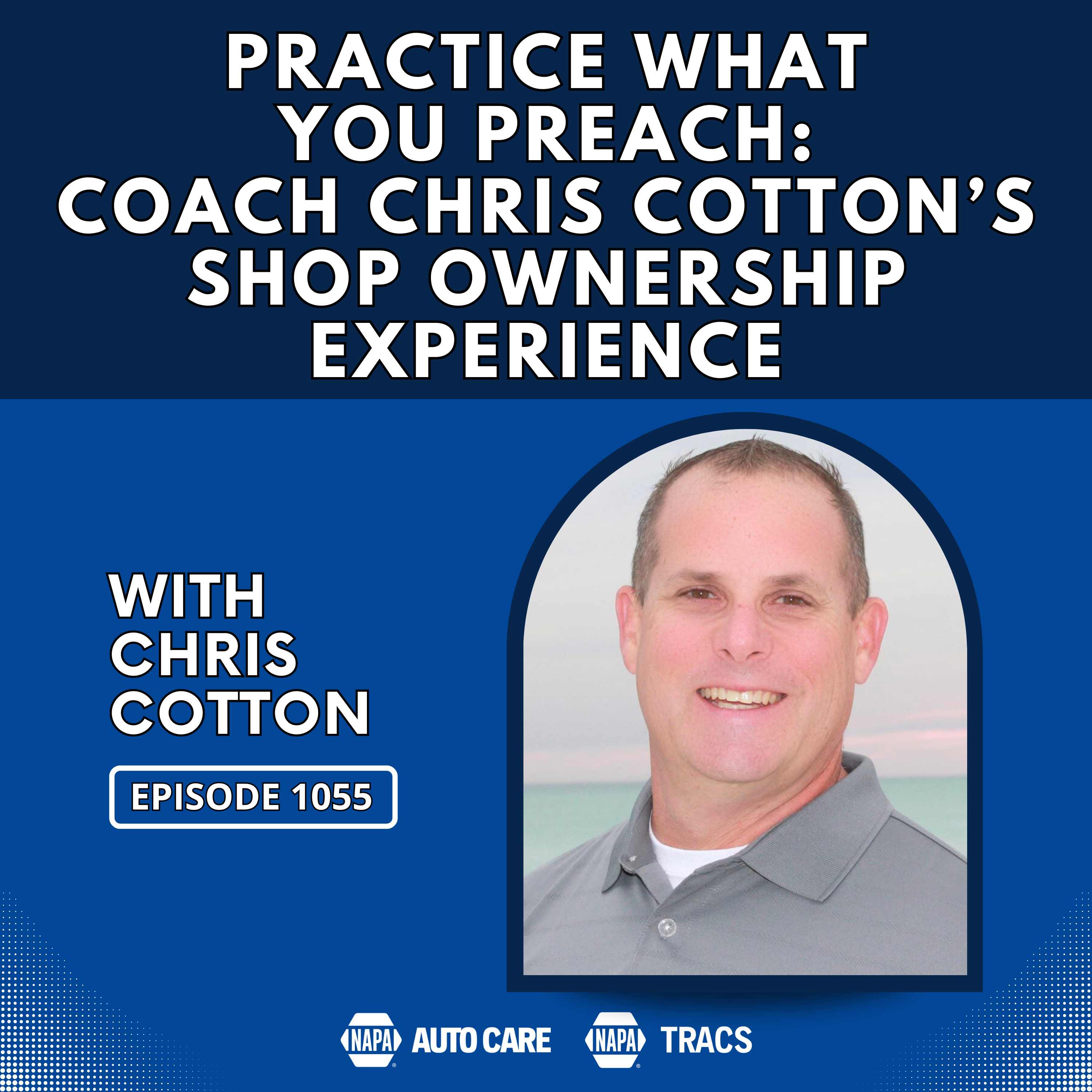
I'm with my friend, Chris Cotton.
Hello, Chris.
Hello, Karm.
I'm all smiles today, mainly because I don't know where we're going to end up.
I know what we're supposed to talk about, but we'll see where we end.
Well, if I know you, and if I know me, we can go into a million different places.
Right.
Coach Chris Cotton from AutoFix AutoShop Coaching has a show that weekly blitz on the aftermarket
radio network.
I've just observed Chris over the years.
We've been doing this together on the network for so, I don't know, a couple hundred
episodes now, which is what, maybe four years.
I've listened to your stuff, I've watched it.
You've got this coolest, neatest, newest series going on.
By the way, it just happened to love them.
They're short.
They're concise.
They're powerful.
I want to talk about that.
And about a year ago, he says, hey, I bought a shop.
Right.
I'm going to school to get my degree.
I bought a shop.
It's like, are you kidding me?
First of all, I want to know, what do you eat and how long do you sleep?
Well, I'm up at 4.30 in the morning, typically.
But I do go to bed early and then I eat when I remember that I need to eat.
But you know, one thing in life falls away and then another thing pops up, right?
So I've truly just kind of let it go to the universe and let it, you know, do its thing.
And here it is.
Plus also, you know, I can't really do the Italian godfather or the last time we were
in Buffalo and we had dinner with you and the girls and this Italian family.
There's a line in Godfather that says, just when I get out, they pull me back in.
It was Michael Corleone in episode three.
Every time I try to get out, they pull me back in.
We'll talk about it.
As far as the business goes is just it was really too good of a deal to pass up and we've
talked about it.
I've done episodes about it, but really, it's done really, really well.
But if we want to back up just to the episode, like I wanted to do like a 10 series episode
of just, and I guess it's all tied in, right?
Like just going back to the basics and doing the things that you know need to be done,
we've proven this hundreds if not thousands of times all across the country, Canada,
Puerto Rico, what we do works.
The people like, oh, well, you're a coach.
You don't know.
You're not in it.
Blah, blah, blah.
I have a unique situation.
So one of the reasons why I bought the shop was like, I want to try all the new stuff
that, you know, we have now in this shop to see how it works.
And man, does that stuff work if you use it and just get in there and get after
it?
It's like making bread.
Yeah.
Because the analogy of making bread is you watch it rise.
You got to put all the ingredients in it right and then you watch it rise.
And that's one of the most miracle things I think of making bread is it takes a little
time to watch it rise.
We'll carry this further because Kimberly makes me watch British Bake Off.
Now, in the beginning, she made me watch it now.
I just kind of watch it because it's kind of interesting.
But if you know British Bake Off, you have the guy, Paul Hollywood, and when they're
baking the bread or the rolls or whatever, he cracks it open.
He's able to look inside and he's like, oh, you didn't let it rise enough.
You didn't put enough yeast in it.
You know, that's what we do.
We look at income statements and we can be like, oh, okay, we'll hear the things that
need to be done.
It's amazing how when I write my blogs each and every week, I almost say at the end
of them, and so if this is happening to you or you feel strong about this, get
a coach.
And so is it, you need an expert, you need an accountability partner, you need
a coach.
But my thoughts are, well, I'm not really sure.
You ever make bread?
What do you mean, Chris?
Do you ever watch bread rise?
Hmm.
If we do all these ingredients right, hopefully within one year, don't tell me
I have two months to prove to you my worth.
But within one year, if our goals for margin and sales and profitability
are what they are, we'll be able to watch it rise.
Yeah.
Sometimes it can just take two months.
Like it can be that just depending on what your situation is.
It's a miracle.
Right.
Hey, what's your role at the shop?
Do you go to it ever?
A couple of days a week, I spent a couple of hours there.
You know, the whole intent when I was talking to Kimberly and got
permission from Kimberly to do this was like, it's not going to be
anything that I am at the counter doing every day.
If that's the case, then we've done something wrong.
And then the other thing is, is if anything ever happens, we can just
walk away from it and just like whatever it's we signed for it on
August 24th, open September 2nd day after Labor Day.
And I made the final payment on it halfway through February.
So it's paid for, it's debt free.
It's doing its thing.
And you gave yourself in the business plan one year to pay for it,
but it did so well.
Yeah.
We did the owner financing and I agreed to pay for it over three years.
I was making like a monthly payment every week.
And then there were a couple of weeks where I made like three
monthly payments and was just able to pay the whole thing in six months.
Beyond your expectations, Chris.
Yeah.
Beyond my expectations, but you know, the things that I know,
the processes we put in place, they work and they worked really, really well.
I have a great staff where they don't need me.
It's like, and usually this is what happens when you go from working in
the business, working on the business, there's comes a time when
you're just in everybody's way.
Like you show up and you do things and you talk to customers and whatever.
And then the guys are the everybody that's in the shop is like, OK,
it's great. We love you.
When are you leaving?
It's happened to me before.
What are you doing here?
Yeah. Why are you here?
Yeah. Why are you here?
Because I love you and I want to talk to you.
Yeah. So now Kimberly and I get to do the fun stuff.
Like I showed up the day before 4th of July and cook,
taught dogs and brats and everything for everybody we went through
and asked everybody what their favorite candy was, which if you thought
that would be an easy task, you are wrong because some of these people
have some really, really interesting candies that they like.
And I had to go on the Internet and find some and have them shipped in
to get what it is.
And so, you know, we did that.
Mine and Kimberly's 26th anniversary was last week.
And the guys said, hey, you need to come to the shop.
And we're like, OK, that's weird.
And he's like, make sure you bring Kimberly.
And so they gave us a card.
They gave us a gift card for dinner and massages and everything else.
And it seems like they love us.
So that's good. They appreciate you.
Congrats on the 26th, by the way.
Yeah, thank you.
I'm going back to an episode I heard you talk about.
Well, you were saying if I get to the shop and they're shorthanded
and I work the counter, one thing you said to me that really resonated
is I stand up.
Yeah, I don't sit in my previous shops.
Nobody sat and now I kind of let them have a stool to rest.
Of course, I'm 52 now.
I got to take a little bit breather every once in a while.
But if I'm there working the counter, I take the stool
and I put it in the closet in the room and I stand the whole time.
That way I'm ready to greet the customer when they walk in.
I'm ready to work.
If I need to run out in the shop, I just boom, turn and go.
And so, yeah, if I have to be at the counter, I'm standing pretty much the whole time.
One of the things I want to cover that Chris did after many, many years
is he got his diploma.
Give us a minute on that great accomplishment.
It's one of those things that I always wanted to go back and do.
And it's probably the most selfish thing I've ever done in my life
because it had nothing to do with anybody else.
I own my own companies.
It's not going to make me a penny more doing anything else.
But it was a box that was left unchecked
that I wanted to check and maybe it makes a whole or better person.
I don't know.
For Piper, I wanted to have her, not that she's even living with us anymore,
but I wanted her to come from a family where both the parents had their diplomas
and Kimberly got hers like way back when like a good person should.
And I will tell you, this thing cost about quadruple what it cost me
the first time, if I had just done it the first time.
But I checked the box, I got it done.
But the other inspiration was Piper was in college.
She graduated the day before me.
So my daughter and I, Piper, we're both class of 2025.
And so we'll always share that and have that too.
I love it.
Let's go back to the business you bought last September.
Are there deals like that out there for shop owners?
There are, but you have to look for them.
You have to find them and you have to be willing to walk away.
Like you can't negotiate with somebody and then come back
and then give a little and then do whatever.
This is the other thing when Kimberly and I were talking about it,
you know, numbers never lie.
The math maths and I was willing to do X and they were not.
And so I'm like, OK, I'm done and walked away for a couple of weeks.
And then they called me back and they're like, well, hey,
we thought about it and we'd like to offer X.
And then I was like, nope, that's not the deal that I asked for.
So no, I'm out.
And then, you know, it helps if you're the only person interested.
And if nobody else is interested, then, you know, you you're in a position of power.
I guess where I'm going with this and I know you are, too,
it has to make financial sense for the buyer.
It has to basically what is listen, whatever I'm going to pay,
you got to pay it off in five years, three years, owner,
financial, however the numbers work.
And the only way you can judge it is on the current P&L's.
Right. And so here's the other thing.
You have to judge it off the current P&L's.
I just talked to a shop owner earlier today.
He was trying, there's, you know, here's the other things like there are so many
people retiring out, they called the Silver Tsunami, the people, whatever
the age are, and they're either like selling out, giving the business away
or just closing the doors and walking away.
I talked to another shop owner this morning that was evaluating a business
here in Colorado. On the books, it only showed that they made $100,000 a year.
But the owner and the wife were like, hey, wink, wink, nudge, nudge.
It really makes $350,000 a year.
We just put all this cash aside.
I told them if they can't prove it, then it didn't happen.
Like, like I've never seen anybody buy one of those businesses
and it turned out in their favor.
It usually always turns out against them.
I think it's great advice to give anyone who is prepping to sell
to legitimize all of your stuff.
Right. Like three to five years before you are ready to sell.
And it's not just putting the cash aside.
It's the kind of expenses you're running through the business too.
And you know, people call that normalizing the P&L, but you're not
going to see every receipt that they flushed.
All right. So the deals are out there, but you've got to be careful.
You just don't be calming.
Don't jump in.
Yeah. And what I tell is if you're not prepared to walk away,
then you shouldn't be buying it.
Like if things go against you and you rush through and still buy it anyway,
it's probably not going to work out well.
Hey, did you ever think you'd be here in this position 10 years ago?
No. If you'd asked me a little over a year ago, I'd still been saying
I would still never own a shop again.
I love coaching so much.
I still do. Buying a shop is not even on my radar.
But again, you know, this kind of just fell in my lap and we just ran with it.
Chris, what's important to you as a coach to a climate?
Is it to become their accountability partner to be an expert or to be a coach?
Or is there a mixture of all?
It's a mixture of all, but really.
So, you know, my football coaching background, like when I was in high school,
my coach never had to yell at me.
Like I could come off the field and look at my coach and I could see
the disappointment in his face, which would almost put me into tears
and be like, holy crap, I messed up.
I need to do better.
The clients that I work with, I want them to be disappointed
if they're not doing what we talk about.
Like I want them to feel some sort of internal pain and be like,
man, I have to talk to Chris in an hour.
And I didn't do a thing that he said, you know, the reason
why we talk about these things is because we know they work.
And the reason why we ask you to do them is because it makes your life
better and makes your employees life better.
That's kind of the way I've always looked at it is I guess
maybe the accountability partner is kind of where that feeds into more.
But I want them to feel the sting of disappointing me.
Any great story that you can tell hide the names to protect the innocent?
Oh, my gosh, for just for like like a coaching session or whatever.
Yeah, just coaching success.
You've turned people's lives around and businesses around like the first
one that pops in my head is with a female shop owner.
We were talking about having tough discussions with employees without
telling her that she was kind of soft and letting people walk over her.
I was kind of pushing her to be a little firmer with the people around her.
And she started doing this and really kind of took control of the business.
And one day she goes, you know, we were talking about it.
And I kind of walked her through the way I did it without her realizing it.
And I think it was something like, I think I felt my spine grow
a little bit this week.
And she goes, she goes, now I think I have a backbone where my wishbone used to be.
Love it. That is a great, I mean, that makes your day, makes your month.
Absolutely. Yeah.
And I love getting texts from clients is like, oh, we just had the best week
we've ever had. We just had the best day we ever had, you know, so and so
I was able to go on vacation for three weeks and not come into the store.
We had a client that like his main goal was I want to be able to take
my kids to school every day.
I want to walk them to school and then come home and then do what I need to do.
And so, you know, we spent about 18 months trying to get everything
in place to where the business could operate without him and, you know,
set up a plan and a schedule so that he could stay home every Wednesday morning
and walk his kids to school. And then before you know it, it's like
every morning, Monday through Friday, he's walking his kids to school
and then he goes into the shop and then works half a day and then comes home.
Wow. And he would have done it.
Had he not hired or gotten a coach accountability partner,
whatever you know, coach is going to help me.
I hear too many negatives.
And then once somebody is decided to stop struggling, digging a deep hole
for themselves after they start seeing the success flow in their business,
then they say, I should have done this earlier.
It takes time for somebody to admit that it seems.
And a lot of time people reach out and they're like, oh, my gosh,
that's a lot of money or this is that.
And then they leave and then they reach back out like a year,
18 months later, and they're like, OK, it's only gotten worse.
It's not gotten better.
I'm in a worse position now.
And then the first thing I say to him, like, that's great.
We can still help you.
But just imagine where you'd be now if we would have started then.
All of the pain would have been over with you to been on doing your things.
But it's fine. We'll start now. We'll start when you're ready.
Are you an APA Auto Care Center who is ready to take your shop to the next level?
Then the Premier Tier Napa Auto Care Gold Certified Program
is exactly what you need.
Gold Certified Auto Care Centers provide customers with a consistent experience
no matter where they are in the US.
Now, this means they are more likely to return and support your shop
or find your Gold Certified Auto Care Center while on the road.
Gold Certified Members can maximize technology,
increase their local marketing opportunities and have a fully trained team
that keeps up with the latest trends.
Simply put, the Gold Certified Napa Auto Care Program
powered by your local brand will set you apart.
A true partnership is a two-way street.
Shops must meet specific criteria to be eligible for the many benefits of gold.
Napa Auto Care rewards its most committed partners,
their Gold Certified Members, with free premium shop referrals
on the Napa Online Locator, annual marketing dollars
and enhanced warranty, training opportunities, program rebates
and so much more.
Are you ready to get started?
Contact your local Napa Sales Representative to discuss your eligibility
and apply today.
More than 16 percent of light duty vehicles on the road are EV and hybrid.
Is your shop ready to safely and properly service them?
Get your shop trained and equipped to service hybrid and EV vehicles
with Napa Auto Tech's innovative, EV-ready Level One High Voltage Awareness
and maintenance training.
Hey, take your Auto Care Center to the next level,
the gold level with the Napa Auto Care Gold Certified Program.
This program is for the best of the best
who can provide a consistent consumer experience
and earn the trust of returning and new customers.
Talk to your Napa Sales Representative about how you can become a gold certified shop.
Let's face it, your shop management system is the single most important tool
in your shop, period.
Napa Tracks was built from the ground up
to make your business more profitable and efficient.
We provide an extensive set of tools to increase and track profitability
in real time.
Napa Tracks offers the industry's best post sale support hands down
and we train your people on site.
Yep, on site and we offer remote refresher training 10 times a week
and customer support is open six days a week.
Give us a call, visit the website or join our Facebook community today to learn more.
We'll prove to you that Tracks is the single best shop management system
in the business.
Napa Tracks is always customized and tailored for you,
whether you're a one man shop or a large multi bay or multi location company.
After all, it's your shop.
So it's your choice.
Visit us on the web at Napa Tracks.
That's N-A-P-A-T-R-A-C-S dot com.
Chris, are you hard on yourself?
Kimberly would be the great person to ask about that.
Like I'm pretty happy, go lucky kind of guy.
And if something happens, it's just kind of like what we would say
water off a duck's back.
But probably if I had a therapist and was talking to therapists,
the therapist would probably say, yeah, he's probably a little hard on himself.
Got it. Wow.
Struggling with anything right now?
Just navigating life.
Like there's all kinds of stuff flying at me
and just trying to get it all figured out, right?
Like how do you be the best person?
I guess the only thing that I struggle with now is we're getting ready
to leave this week and go move Piper home for a month.
And then she's going to move to Germany.
And that's mine and Kimberly's struggle now.
Will she ever move back to the United States again or not?
I don't know, probably not.
So that's the only struggle now that I think that I have.
Good, congrats to her.
And she's an interpreter, right?
Is that what she's going to want to become?
Her major was German and then political science.
I always forget how the languages work.
I think it starts at A and then goes to C when you're fluent.
So she's the highest level B.
And then she just needs to get two levels in the C
to be considered fluent and I guess get a certificate.
And so she's going to do that and then start a master's program in Germany.
But because she'll be doing her master's program in Germany,
she's like, I think I'll need to do a little bit better
at the language before I start this master's program.
So she's going to go do that and then go from there.
So what's next at the shop?
By the way, it's called Firestone of Durango.
Durango, right?
Yep, Durango, Colorado.
Recently, the end of May, first of June,
we had the opportunity to hire two really great employees.
And I didn't want to let them go to any of my competitors.
So I'm like, okay, guys, here's the thing.
We're stacked with people Monday through Friday.
We don't have another place to put anybody.
One of them was service advisor.
One of them was a technician.
And I'm like, the only way we can make this work
is if we move everybody in the shop to four days on, three days off,
and then open up on Saturday and have you guys,
or excuse me, open on Saturday, Sunday,
and have you guys open the weekend.
So both of them were like, we want to work for you.
And if that's what we need to do to get into the company,
then that's what we'll do.
So we started, we've been open seven days a week,
starting in June.
So June's the best month we've ever had.
June is the best month this business has ever had in 40 years.
Our weekends are just as busy as the weeks.
We're billing out as much on Saturday and Sunday
as we would during the week.
But we live in a big travel community or tourist area.
So we have a lot of people from Texas, Arizona, New Mexico,
travel through.
And I was in the shop a little bit on Saturday,
and we sold three walk-in batteries.
Just people like, hey, I'm broke down.
Can't get to the shop.
I need a battery.
Tires, people with diag or pear.
And then we're the only shop in town that's open on Sunday.
Like there's nobody else.
If you break down in our town on Sunday,
you're just stuck unless you can limp out of town some way.
But is it seasonal?
I mean, will this only happen in the summer?
I don't really know.
You know, we're in the mountains.
So we have, our seasonal is pretty much year-round
because we have rafting, hiking, mountain biking
in the summertime.
And then in the wintertime, we have snowmobiling,
snow skiing, all of that.
So my guess is probably going to be less.
But I think it'll probably still be good again
if we're the only people that's open on town on Sunday.
The other thing that I've noticed it lets us do
is it lets us get out work that maybe
didn't get finished on Friday.
If we have time, then we'll pop a car over, get it finished,
call the customer two days early and be like,
Hey, we were able to finish your car on Saturday.
And so we're able to bill it out.
But what that does is it frees up our week again
so that we can take in more work during the week.
So we're, you know, we're a say yes
and figure it out kind of shop.
So when a customer calls, we say yes.
Whereas other places in town,
you call some places and they're like,
Oh, it's three weeks before we can get anything done
for like breaks or anything.
There's so many stories to talk about the three weeks.
You can really look inside the business and
Drives me nuts. I hate it.
And do the math and figure out why they're out three weeks
because their efficiency is probably in the tank.
Anyway, besides from the two that you recently hired,
does the rest of the team come from the previous business?
No. Well, about half of the team we have now
came from the previous business.
And the reason that I asked Chris is I'm trying to
understand you came in, you did your coaching thing
on your own business and brought the processes
and the systems and the marketing and everything to play.
Did anybody leave because they didn't want to
fit into the new way?
No, everybody that left was asked to leave.
So we had a couple of people that they just didn't fit.
We had a technician that had quality issues
and then had honor and integrity issues.
And so that person didn't get to stick around.
But I can honestly say too that everybody that we let go,
we have upgraded at that position.
Like we're in better shape now than what we were.
There were a couple of people that I probably knew
going into it that I was like,
we probably shouldn't carry these people over into the business,
but I also didn't want to skew my thought process
with the manager that I hired.
I wanted him to be able to evaluate those people
and be like, no, I can turn this person around.
Or I think we can make this work,
but it didn't work in either of those situations.
So I'm with Chris Cotton, auto fix auto shop coaching
at auto shop coaching.com.
And also the weekly blitz podcast
on the aftermarket radio network.
What's next in year two for the shop?
Obviously you must want to triple and double your volume.
What's going on?
I mean, our volume as it is is pretty good.
Like just to give you an idea,
we did more labor in June than they did
in total sales the previous June.
So just think about that.
And we raised the labor rate a little bit, not a whole lot,
but we're just way more productive
and we just bill out way more hours.
What was the old shop not doing?
I mean, obviously there was a lot that they weren't doing.
First of all, they were using an older system
and they weren't inspecting any vehicles at all.
It was just like they were just doing burgers and fries
and no preventative maintenance, none of that.
And then the other thing is they were spending zero dollars
on advertising, zero.
And I think it was just because I don't know
if they were trying to make their numbers look better
if they thought because they've been there for 39 years
that they were, yeah, that's spinless.
But I will tell you, we're spending on average
about $10,000 a month just for advertising.
But I also tell my clients like,
you need to advertise for the shop you want to be,
not the shop you are.
So I'm advertising like I'm a $200,000 a month shop.
And last month we did 160 and we're on track to do 190 this month.
And so we're advertising like we're a $200,000 a month shop
and we're getting there.
Chris, that's a hell of a lesson.
Do you ever take that mentality, spend on your marketing
based on the size shop you want to be?
Do you ever give that to a client?
They say, cool, Chris, I'm gonna try it and it works.
It works every time.
I've never seen it not work, never, not, never.
It typically always works, right?
Because you're opening up the possibilities.
But the other thing is you have to make sure
that you're not advertising to be a bigger shop
and then turning everybody away
because you're telling everybody you're so busy.
Our next biggest hurdle now is we've outgrown our shop
because we just have like a small four bay shop, right?
And we're gonna do, I know we're open seven days a week
but we're gonna do almost $200,000 on a shop with four bays.
So we're in the process of getting a building
really near to us so that we can expand into that building
and free up some space in our other shops.
So we can, it'll give us,
I think we'll go from four bays to eight or nine bays.
And you'll just move work over?
Yeah, so what we would do is we would move
kind of like the tire and lube side of the business
over into this other building and keep the main repair.
And then we can still do breaks and other stuff in that building
but it frees up space in our current building
and would make it like the main repair shop, if you will.
A desk calibration, maybe?
Maybe, I don't know.
Like we're, I don't even know where we would put it,
Karm, we'd have to figure that out.
But maybe that's another building down another block
and it's his own building.
It could be.
There's a couple of shops in town that already do it.
What's happened is the shop was busy
and then we've said yes and we've got it so busy
that even now there's been a couple of times
where I've driven up and couldn't find a place to park,
not even for like five minutes.
And then I'm looking at the schedule
and I'm always the one pointing at the guy saying,
bring it in, bring it in, bring it in.
And there were some times in the last week or two
where I was just like,
there's no possible way we can get that done.
And so we've had to turn people away,
which drives me nuts because I don't want to turn anybody away.
So the only way to do that is to find more base to say yes more.
Let's go back to the two people you recently hired.
Where are you finding them?
They just walking off the street.
And you know, this has been something
that I've been telling people all along.
Like I think you've heard me say this,
like I'll fist fight somebody, arm wrestle them.
Like I don't think there's a technician shortage
if you have a great shop.
And one of them had just moved to town.
The service advisor had just moved to town.
He lives in a town just to the east of us.
And so he had started there
and just started coming this way.
And then looked online and saw everything
we're doing on Facebook and everything else.
I was like, hey, there are other shops that are closer,
but I want to work for you guys.
Same thing with the tax.
Like our technicians and our manager
know enough people in town
that they've worked with tons of people.
And the more they talk to other people,
the more other people want to come work for us.
Chris, where are you spending the money?
Google AdWords, Facebook, where are you spending?
We spend a lot of money on all of it,
but really for a general repair shop,
the best bang for your dollar right now
is local service ads.
It's called LSAs.
It's something brand new.
We're still spending money on Google AdWords,
but what we're doing is we're taking
the amount of money in Google AdWords
and we're shifting it over to local service ads.
I did a pretty good episode with Brian Walker
a couple of weeks ago,
and that's all we talked about was local service ads.
But if you're a general repair shop,
that's the place to be in the local service ads.
And then you can also supplement that
with Google AdWords and then Facebook.
Here's the other thing, Carm.
Also, being allowed to beta test,
a lot of this stuff knew that most of these new companies
don't want to try on a regular shop.
And I'm like, hell, yeah, let's just try it.
Like, I don't care.
We're doing another thing now.
I've never been really, really big on postcards,
but I had a company come to me and they're like,
hey, we're not postcards.
It's like a hard or plastic type card.
And we'd like to try some new beta stuff with you.
So we started that.
That went out like five, six weeks ago.
And now we're starting to get all of these cards
from brand new customers.
And the average repair order is pretty high.
Average repair order with the local service ads
has always been high, too.
Almost double what our regular average repair order is.
So I'm a new client.
I pick up the phone.
Chris, I've heard about you.
I really need to do this coaching thing.
What are the first couple of questions
you ask a person like that?
What should they be prepared to tell a code?
Well, first thing I ask them is like,
what's keeping you up at night?
Like, if there are like three,
four things that are just like driving you nuts,
let's talk about those.
You know, one of the other things is
we look at their income statement,
their business summary.
And those are all quick fixes.
And those are all things where us coaches
take a beating because they're like,
well, all you want to do is raise the labor rate
and charge more for parts.
And the quick answer to that is
because we've been screwing it up for however long
and you're not charging correctly,
we got to fix that first.
And then we can do the rest.
So if you truly needed more cars,
I don't want to get you more cars
until the dollars and cents side of the business is fixed.
You know, it reminds me because of the toxicity
that you do see on social media
that says you don't need to coach,
all you need to do is,
all they're going to tell you to do is this,
why spend the money?
And when I hear any coach tell me how
it prevents a lot of people from getting in,
the word that I heard from you was foundational.
There are things that need to be done.
And if you're not doing them,
I guess you can hire me to do them.
But after that, it's like,
ooh, yeast and water and eggs and flour.
You got to watch it rise.
And guess what?
If you don't do the recipe right,
and it doesn't rise, now what?
And the other thing,
before I bought the shop that I bought
when we were negotiating back and forth,
I was like, look,
you're not in a really good position to sell
because you don't have a business that you can sell.
I go, why don't you hire me to coach you?
I'll work with you for two years,
and then you can sell the business and whatever.
I don't even want to buy the business.
If you want coaching, let me coach you.
And I gave him a list of 10 things
that I identified when I was doing my due diligence.
I'm like, here's all the things you need to do
to turn this business around and do it.
Now, I'll also tell you,
this gentleman was in his 70s,
so him personally probably just didn't have much left to give.
But all I've done is do all the things that I told him to do.
And in the first half of this year,
we're up three in a grand over what they did previously.
So we're probably going to do,
well, we'll do more than that.
We'll probably be up another 450 to 500,000.
So we'll probably do 800 grand more this year
in sales than what they did.
And we have the same space.
Like we have the same footprint.
We're just doing things differently.
Chris, if you were sitting down with a client,
we've talked to a lot of age here, 70s.
In my 50s and 60s, the silver,
would you call it the silver connection?
Silver tsunami is what it's called.
The silver tsunami, thank you.
But prepping for a sale.
Don't just hire me to grow and build your profitable business.
We have to do that,
but we also have to prep for the sale,
which means I got to make sure
you're not working in the business.
Right, yeah.
And so the other thing I will say
before we get into this,
so don't let me lose track is,
like our model is always to net our clients 25%
or better net profit.
And we've held that since we opened.
I just did my numbers for last week.
We netted 31% last week.
Good for you.
And in the typical shop,
we continue to hear on an average is,
what, five to eight, Chris?
Five to eight percent, yeah.
You know, we're just doing it because we can.
So your question was,
if we're ready to prep for a sale.
Yeah, prepping them to sell the business,
but they can't be the centerpiece of the business.
No, and that's the other thing.
Like that's one of the things
that I kind of dinged them on the beginning,
because originally I was told
this was a turnkey business
and I had a manager in place
that could run the business
and you don't need to be here.
Well, we started doing our due diligence
and they had let that person go
and the owner had stepped back in.
And so I'm like, okay,
now I have to come up with a number
to replace that person
because I'm not working in the shop.
So that was, you know,
something you got to watch out for.
But a lot of these smaller shops,
you look at them
and the owner is the service advisor
and one of the technicians,
the spouse is the bookkeeper
and handles all the accounting
and they have one technician in the shop.
But the other two want to leave
and so you have a business
that you either have to hire
and put a lot of labor dollars into
or whatever.
So you really have to create a business
that you can leave and go to Hawaii
for a week a year
and not have to be there.
And it runs without you.
You know, you don't get any crazy calls.
And then what we're seeing
on all this crazy money
that people are paying for shops nowadays,
it's one thing to have a shop
that runs profitably.
And then it's another to have a shop
that runs profitably,
has processes and procedures
and the owner isn't there.
But what happens is
if you have a owner
that's not in their business,
you might get your two or three times
Ibida or net profits.
I hate the word Ibida
because most people their eyes glaze over.
But anyway,
so if you're getting three times net profit,
but if you're have great processes
and procedures
and you're not ever there,
then you can take that three
and multiply it times another
two, three, four, five, 10
if you don't have to be there
because the people that have the big money
are other shop owners
that are looking to expand
BMSOs or this big investment money
that people are looking for.
And the way to truly sell your business
and make money
is to have it stand alone
without you having to be there.
Ibida earnings before income tax
and amortization.
Oh, duh.
Anyway, I get that.
But my eyes just glazed over
when you said that.
In a lot of the big kinds of deals,
Ibida is where the factoring happens at.
Anyway, let's talk about your manager
in the closing of the show.
Does your manager see the PNLs
and are they making decisions on marketing too?
Not yet, but that's something
that we're working into.
Like we're already talking about
how do I exit the business
and how do they buy me out
and what that looks like.
So really, again,
we're just ending the first year.
So we've kind of been like,
had so much growth
that we've just,
everybody's just had their hair on fire
just trying to keep afloat.
But there's a couple of conferences
that I've already signed him up for next year.
I saw a class on WorldPak
that just came up
and it's going to be August 6th
with Murray Voth.
I'm going to put him in that.
And I can teach all that stuff,
but I kind of like to let him
learn it from other people first.
And then we can talk about it
and refine it for what we're doing.
That's a brilliant move.
Hear it from someone else.
Come back, tell me,
teach me what you learned.
They learn when they teach
and they explain to you.
And then you can find out
if they're picking it up
and learning it.
And then watch to see
if they're actually doing
what you sent them to school for.
So that's the next step
is kind of moving him forward.
Invest in your people.
I love it.
Yeah.
And I will tell you,
it's funny, I'm 52.
I'm the oldest person in the company.
We've got kind of apprentice level
or younger technicians
that are my daughter's age.
And then the store managers
in his forties.
But he was a long time technician
that was just like,
you know what?
My body's going to be wore out
in another 10 years
and I'm not going to be able
to do anything.
So he wanted to go out
and become a manager,
learn that side of the business
and not wreck his body
in the next 10 to 20 years
and try to retire after that.
I so love this, Chris.
Thank you.
We haven't done a one-on-one
just let the wheels roll
in such a long time.
I'm excited about this series
it's back to basic series.
I know you just recently released
number four.
One was a better communicate
back to basics.
Number two was know your numbers,
the KPIs,
make or break the company.
Number three was talk it out,
fixing broken communications.
And then number four,
recently released,
give you an idea
when we're recording this,
workflow matters more
than you think.
And I loved it
because you said,
got to do this,
this and this.
You gave someone an outline.
It was beautiful.
It was great.
And you're going to do six more
in that series, huh?
Yeah.
I'm getting ready to do a couple more.
And again, it's just
like the basics is what people need.
Like there's so many new people
in the industry,
people that have no experience
with our industry
that are looking for help
and looking for answers.
And so somebody that's been doing
this for 20 years
is probably going to get in there
and be like,
oh my gosh,
can't believe I'm listening to this.
But they should be able
to pull a couple of things
out of there to help them.
And again, you know,
I'm talking about a business
has operated for 39 years
who have a 40 year anniversary this year.
They just need to go back to basics
and go back to what they forgot
if they ever knew it.
That's the other thing,
you know, we talk about
is you don't know what you don't know
until you know it.
Sometimes the basics
really, really help.
And I love what you just said
just a bit ago.
And I think it's worthy of repeating.
I'm sending him
to classes
that I want him to go to.
It's no different
than to take an individual
you see promise.
It doesn't mean
that they could be an owner someday,
but promise to be a better leader
to expand themselves
to give them some self value
self worth
to listen to the aftermarket radio
network and all the great stuff
that we provide
and having someone come back
and saying,
Hey, listen to learn just one thing.
And what was it?
Cool.
Do we need to do this?
Yes.
How can you implement it?
Or will you implement it?
Or can we implement it?
I just love that.
I think that's a big takeaway.
Invest the continuing education
your people
because they want it.
They need it.
I think they'll be loyal because of it.
And you're going to build yourself
a better person.
Right.
We've done this as well.
Like we had another younger technician
that was
I forget how joy was.
He's in his early 20s,
I think or mid 20s, 25.
And his back is just
not any good anymore.
And so he went to the back doctor
went to rehab,
went to PT
and the doctors just like,
look, you need a new career.
And so it was either
us let him go and go do something else
or us find a place to put him.
And so we put him at the service counter
and he's green learning stuff
at the service counter.
He's doing really, really great.
We got to work on his tone
and some other stuff.
But he knows what he's talking about
and he's going to end up
going to classes soon as well.
And so rather than
jettison him out of the industry,
we decided to keep in him
and invest in him
and he'll do an amazing job.
Good.
Thank you for being here.
You're welcome.
I had a blast.
Chris Cotton,
auto fix auto shop coaching
at auto shop coaching.com
and the weekly blitz.
Chris, thanks so much, man.
Thanks for having me.
You guys have a good weekend
and I don't know,
how's the weather up there?
It's warm and rainy actually.
Yeah, we need some rain.
It's warm.
We live in Colorado
in the mountains about 7000 feet
and they didn't use
to put air conditioners
in these houses 50 years ago
when ours was built.
And it's been pretty hot
like in the 90s
with no air conditioning.
It's just been interesting.
All right.
Well, I'll give you a secret too.
I don't have air conditioning.
I only need it like 10 days a year, Chris.
10 days.
Yeah, I baseboard heat.
Anyway, thanks, man.
You bet.
Thank you.
Have a good one.
Thanks for being on board
to listen and learn
from the premier automotive
aftermarket podcast.
Until next time.
About this episode
Chris Cotton shares his journey of shop ownership and coaching in the automotive industry. He discusses the challenges and successes of running his shop, including innovative marketing strategies and the importance of foundational business practices. Cotton emphasizes the need for accountability and continuous education for both himself and his team. He also reflects on his recent accomplishments, such as obtaining his diploma and transforming his shop's operations, while offering insights on preparing a business for sale. The episode is filled with practical advice for current and aspiring shop owners.
Chris Cotton’s latest venture into shop ownership puts his coaching philosophy to the ultimate test, and the results speak volumes.
Episode Highlights:
Shop Acquisition and Rapid Payoff: Despite once saying he’d never own a shop again, Chris purchased Firestone of Durango about a year ago, calling it “too good of a deal to pass up.” Planned as a three-year owner-financed purchase, he paid it off in just six months.
Profitability and Growth: With a 31% net profit (compared to the industry average of 5–8%), the shop’s success reflects the very systems Chris teaches.
Advertising and Expansion: Spending roughly $10K per month, Chris follows his mantra: “Advertise for the shop you want to be, not the shop you are.” He prioritizes Local Service Ads (LSAs).
Operations and Staffing: Chris rejects the idea of a “technician shortage,” noting great shops attract great people.
Coaching in Action: Chris practices what he preaches: action based learning, accountability, and focusing on fundamentals like proper pricing before chasing more customers. For owners eyeing an eventual exit, he advises cleaning up financials 3–5 years in advance and building a business that thrives without daily owner involvement.