
Raptor T1 Meets The Desert
About this episode
Raptor T1 takes center stage as the hosts talk with Matt Martelli about the Ford truck’s debut at the Casey Folks Vegas Torino Run and why rally-raid racing is built around multi-stage desert work. The conversation compares “unlimited” American truck rules to Dakar-style design, with concrete setup details like tire size and wheel travel. They also dig into desert short-course history, suspension tuning, and how Starlink plus a YouTube livestream will bring the Reno-to-Vegas race to viewers in real time.
A Dakar-designed Ford Raptor T1 is about to find out what American desert racing feels like, and we’re here for every gritty detail. We sit down with Matt Martelli, CEO of Unlimited Off-Road Racing, to talk about why Ford chose the Casey Folks Vegas to Reno run for the Raptor T1’s American debut and what makes this run so different from the rough-and-tumble world of Baja-style courses. Think long distance, high speed, and a 550-mile day that stresses cooling, electrical systems, and durability in a way most racing formats never touch.
We also get into the fun rabbit holes only off-road racing can create: what “unlimited” really means when trucks push 1,000-plus horsepower, 40-inch tires, and suspension travel measured in feet, not inches. Matt shares why the sport still leaves room for the garage-built crowd alongside multi-million-dollar teams, and we revisit the roots of short course and stadium racing through the legacy of Mickey Thompson. If you love motorsports history, fabrication culture, and the way racing tech shapes production vehicles like the Raptor and Bronco, this one hits hard.
Then we pivot to the headlines: a Ford worker fired over a $1.95 cookie, and the growing trend of drivers downgrading from premium gas to regular to save money. We break down what modern ECUs and knock sensors actually do, when premium is required versus recommended, and why the real tradeoff is often performance, not instant damage.
Listen now, subscribe so you don’t miss the next drop, and if you enjoyed the show, share it with a fellow car nerd and leave us a quick review. What would you want to watch most: the Raptor T1’s pace or the in-car Starlink view?
Be sure to subscribe for more In Wheel Time Car Talk!
The Lupe' Tortilla RestaurantsLupe Tortilla in Katy, Texas
Gulf Coast Auto Shield
Paint protection, tint, and more!
Disclaimer: This post contains affiliate links. If you make a purchase, I may receive a commission at no extra cost to you.
---- -----
Want more In Wheel Time car talk any time?
In Wheel Time is now available on Audacy!
Just go to Audacy.com/InWheelTime where ever you are.
----- -----
Be sure to subscribe on your favorite podcast provider for the next episode of In Wheel Time Podcast and check out our live multiplatform broadcast every Saturday, 10a - 12nCT simulcasting on Audacy, YouTube, Facebook, Twitter, Twitch and InWheelTime.com.
In Wheel Time Podcast can be heard on you mobile device from providers such as:
Apple Podcasts, Amazon Music Podcast, Spotify, SiriusXM Podcast, iHeartRadio podcast, TuneIn + Alexa, Podcast Addict, Castro, Castbox, YouTube Podcast and more on your mobile device.
Follow InWheelTime.com for the latest updates!
Twitter: https://twitter.com/InWheelTime
Instagram: https://www.instagram.com/inwheeltime/
https://www.youtube.com/inwheeltime
https://www.Facebook.com/InWheelTime
For more information about In Wheel Time Podcast, email us at
[email protected]
American Off-Road Racing Championship
"Uh,weruntheAmericanOff-RoadRacingChampionship,whichisnowthelargestoff-roadracingchampionshipuhintheworld."
This is the off-road racing championship the guest’s organization runs. The conversation is about bringing a rally-raid truck style into this U.S. series.
This is the off-road racing series the guest says they run, positioned as a major championship in the U.S. The episode frames it as a key platform for bringing rally-raid style trucks into American competition.

Raptor T1
"Andyouknow,likeyouwerealludingto,theuhtheuhT1Raptoriscomingtoracewithus,it'smakingitsAmericandebut."
The Raptor T1 is Ford’s special off-road race truck. It’s built for long, bumpy races where the goal is to finish strong, not just go fast for a few minutes.
The “Raptor T1” refers to Ford’s off-road racing truck platform built for rally-raid style events. It’s designed to handle long, rough stages with durability-focused engineering rather than just short-course speed.
rally raid cars
"Well,it'sit'sinterestingbecausethesecarsarewhat'scalledrallyraidcars,sothey'rethey'reusedodoingmulti-stageevents,um,usuallyabout300milesperstage."
Rally-raid cars are race trucks designed for long off-road events broken into stages. They’re built to keep working over days of rough terrain, not just one short race.
Rally-raid cars are purpose-built vehicles for long-distance, stage-based off-road racing. They’re typically set up for repeated “stages” over multiple days, with suspension and durability tuned for sustained travel over rough terrain.
limited travel
"Andyouknow,likeyouwerealludingto,theuhtheuhT1Raptoriscomingtoracewithus,it'smakingitsAmericandebut... Um,andtheyhavelimitedtravel,soitmeansthatmostofthecoursesweweruninNorthAmericaaretooroughforthem."
“Limited travel” means the suspension doesn’t move as far as it could. On very rough tracks, that can make the truck hit the bump stops more often and ride less smoothly.
“Limited travel” refers to how much the suspension can move up and down. In off-road racing, suspension travel affects how well the vehicle absorbs bumps without bottoming out, so limited travel can struggle on especially rough course sections.
multi-stage events
"Well,it'sit'sinterestingbecausethesecarsarewhat'scalledrallyraidcars,sothey'rethey'reusedodoingmulti-stageevents,um,usuallyabout300milesperstage."
Multi-stage events are races split into multiple sections. Each section is like its own mini-race, and the overall event is made up of all those sections.
Multi-stage events are competitions broken into separate timed segments (“stages”), often with long distances between service areas. Rally-raid formats commonly use this structure so teams can manage vehicle wear and navigation across the whole event.
Dakar
"Soitwouldeffectivelybethelongeststagethatanyoneofthesevehicleshaseverrunconsecutivelyinoneday...andandthedisciplinethatthey'reracingatDakarandAmericanoff-roadracing."
Dakar is a legendary off-road race that’s famous for being extremely tough. It’s a rally-raid style event, so it’s a good reference point for the kind of endurance these trucks are designed for.
Dakar is one of the world’s most famous rally-raid races, known for extreme navigation and punishing off-road terrain. When the host mentions Dakar, they’re pointing to the high-durability, long-distance racing discipline that influences how these trucks are built.
Baja
"No,it'sit'sracingoff-road,soit'sjustit'sbuiltformilderconditionsthanwhatwenormallyraceinAmerica,likeBaja."
“Baja” is shorthand for the Baja California desert racing scene in Mexico. It’s known for rough off-road terrain, and the host is using it as a comparison for race difficulty.
“Baja” refers to the Baja California off-road racing region and events in Mexico, commonly associated with very rough desert terrain. The host uses it as a benchmark for milder conditions compared with what they normally race in America.
the Mint 400
"Yeah,likeBajaortheMint400... Um,theMint400inparticularistheroughestracewehaveallyear,andsoourvehicleshavebiggertires,morehorsepower,uh,moresuspension."
The Mint 400 is a famous desert off-road race. The host says it’s especially rough, which is why their trucks are set up with bigger tires and stronger suspension.
The Mint 400 is a well-known off-road desert race, often cited for being especially rough. The host contrasts it with other events to explain why their vehicles run bigger tires, more horsepower, and more suspension.
bigger tires
"Um,theMint400inparticularistheroughestracewehaveallyear,andsoourvehicleshavebiggertires,morehorsepower,uh,moresuspension."
Bigger tires help the truck handle rough desert ground better. They can smooth out bumps and improve grip when the surface is loose or uneven.
Bigger tires increase the tire’s ability to roll over rocks and ruts and can improve traction in loose sand or uneven desert terrain. In off-road racing, tire size is often paired with suspension tuning to keep the vehicle stable over long, rough stages.
more suspension
"Um,theMint400inparticularistheroughestracewehaveallyear,andsoourvehicleshavebiggertires,morehorsepower,uh,moresuspension."
“More suspension” means the truck’s suspension is set up to handle bigger hits. That helps it stay controlled and avoid getting bounced around too much on rough desert roads.
“More suspension” in this context means a suspension setup with greater capability—typically more travel and/or stronger components—so the truck can absorb larger impacts. It’s a common desert-racing upgrade to reduce bottoming out and maintain control over washboard and jumps.
unlimited
"They'rethey'reactuallytheonlyformofracingthatistrulyunlimited... Ifyoucanbuilditanddreamitandbringitandraceit,thenit'son."
“Unlimited” means the rules are less restrictive—teams can build whatever kind of race vehicle they can manage. The host is saying this series is one of the few where you’re not boxed in by strict limits.
“Unlimited” here refers to an open-ended racing category where the rules allow essentially any build approach as long as you can build and race the vehicle. It’s being contrasted with more restricted classes that limit what modifications or vehicle designs are allowed.
four wheel drive
"Ohfour-wheeldrive. Imean,theaccelerationonthesethingsisabsolutelyremarkable."
Four-wheel drive means power goes to all four wheels. That helps the truck grip better on slippery or loose dirt, like in desert racing.
Four-wheel drive (4WD) sends power to both the front and rear axles, improving traction on loose surfaces like sand and gravel. In desert racing, that traction helps the truck accelerate and stay stable when grip is inconsistent.
Coyote
"Um,they'rereallywickedcars. Um,youknow,butwhatkindofmotorsitgotinit? Um,itisrunningaFordengine,theumCoyote,Ibelieve."
The Coyote is Ford’s performance V8 engine. Saying it’s running a Coyote suggests the truck has a strong, race-oriented gas engine.
The Ford Coyote is Ford’s modern V8 engine family used in performance applications, known for making strong power and responding well under load. In a race-truck context, mentioning the Coyote signals a high-output gasoline V8 rather than a small or diesel powerplant.
wheel travel
"So,togiveyouanidea,liketheunlimitedtrucksthatweraceareathousandplushorsepower,theyhave40-inchtiresand36inchesofwheeltravel,right? Sounparalleledsuspension."
Wheel travel is how much the suspension can move the wheels up and down. More wheel travel helps the tires stay on the ground over big bumps and ruts.
Wheel travel is the suspension’s usable movement range—how far the wheels can move up and down over bumps. More wheel travel helps keep tires in contact with uneven terrain, which is crucial for desert racing where the ground changes constantly.
curbstop
"So basically what you're saying is that they wouldn't even know what a curbstop is in the Kroger parking lot. No, noteven you wouldn't even feel it."
A curb stop is the little barrier at the edge of a parking lot. They’re saying these vehicles wouldn’t even notice hitting something like that.
“Curb stop” here refers to the physical curb/parking-stop barrier you’d hit in a parking lot. The point is that these off-road vehicles aren’t designed around scraping or contacting small curb obstacles like a street car would.
stadium racing
"Matt, uh, and I'm not trying to change the subject here, but what happened to what Iconsidered an extremely popular venue, and that was stadium racing for trucks like this, trucks and other off-road type vehicles."
Stadium racing is when off-road vehicles race on a track inside an arena. It’s usually a shorter, more controlled course meant for spectators.
Stadium racing is a form of motorsport staged in arenas or stadiums, typically featuring short, controlled tracks and lots of spectator visibility. For trucks and off-road vehicles, it often emphasizes acceleration, traction, and handling in a compact course rather than long desert runs.
Mickey Thompson
"Yeah, no, it's it's great, it's a great story of uh really a great American, Mickey Thompson. He started um really promoting desert racing and realized he needed to take it to the masses, so he created Mickey Thompson's short course racing..."
Mickey Thompson was a well-known motorsports promoter and off-road racing figure. The hosts are saying he helped popularize desert-style short-course racing, which influenced modern off-road vehicles.
Mickey Thompson was a major figure in American motorsports and off-road racing promotion. In this segment, the host credits him with creating and popularizing short-course desert racing in the 1980s and 1990s, helping shape today’s off-road culture.
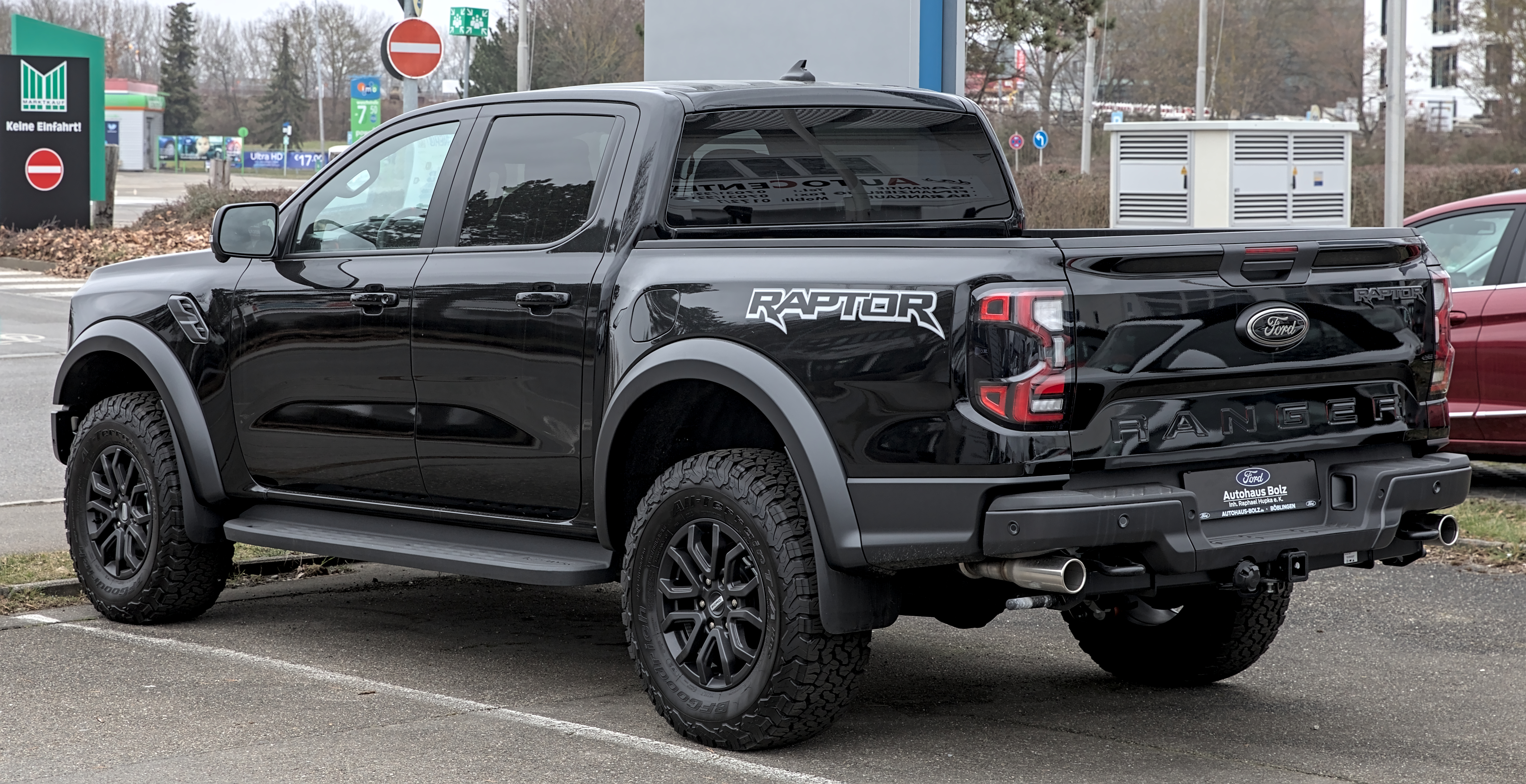
Ford Raptor
"Like I can wholeheartedly tell you that without Mickey Thompson, there'd be no Ford Raptor, right?"
The Ford Raptor is a special off-road version of a pickup truck. It’s built to handle rough terrain, and the host is saying off-road racing helped lead to trucks like this.
The Ford Raptor is a performance off-road pickup built for high-speed desert and trail driving, with suspension and tires tuned for rough terrain. The host is tying its existence to Mickey Thompson’s influence on off-road racing and culture.
Bronco
"Um, there'd be no uh Bronco return, you know, uh on on."
The Bronco is Ford’s off-road SUV. The host is saying that the off-road racing movement helped inspire vehicles like the Bronco.
The Bronco is Ford’s off-road-focused SUV line, known for trail capability and rugged styling. In this segment, it’s mentioned as another modern off-road vehicle that the host credits to the broader off-road racing influence Mickey Thompson helped drive.
Crandon
"Like the biggest track we have is Crandon in northern Wisconsin. Um, they dot woracesthereayear, and I highly recommend if you're a motorsports enthusiast and you have the opportunity to goto Fall Crandon..."
Crandon is a famous dirt-racing location in northern Wisconsin. It’s known for big, intense races where the track surface and corners make things really challenging.
Crandon is a well-known off-road racing venue in northern Wisconsin, famous for high-speed dirt racing. The hosts mention it as their biggest track and highlight how intense the racing gets there, especially in cornering on dirt.
off camber
"Uh, when you have 20 plus vehicles going into one corner off camber on dirt, it's wild."
Off-camber means the track surface is tilted in a way that makes the tires feel like they’re not “flat” on the ground. On dirt, that can make the car harder to control through the turn.
Off-camber describes a corner where the road surface tilts so the outside of the turn is lower than the inside (or vice versa), making grip less predictable. On dirt, off-camber corners can dramatically change traction and increase the chance of sliding.
suspension work
"I mean, and as you said, you know, you could you could put a million horsepower into anything, but when it comes to uh suspension work on these trucks, mainly trucks..."
Suspension work is adjusting the parts that help the truck absorb bumps and stay planted. On rough off-road terrain, the suspension setup can make a huge difference in how controllable the truck feels.
Suspension work refers to tuning and modifying the suspension system—springs, shocks, linkages, and related geometry—to control how a vehicle handles bumps, traction changes, and cornering. In off-road trucks, suspension setup is especially important because the terrain constantly changes the loads on the tires.
UTVs
"Um, so, I have a handful of UTVs, which are remarkable vehicles. If you've never been able to either ride in one or go mud drive one, I highly recommend it."
UTV means “utility off-road vehicle.” It’s a rugged side-by-side you can drive on trails and rough terrain, usually with a roll cage and multiple seats.
UTV stands for Utility Task Vehicle, a side-by-side off-road vehicle designed for work and recreation. They typically have a roll cage, multiple seats, and controls that let you drive off-road more easily than a traditional motorcycle.
Can-Am
"There's a lot of rental places all over the United States where you can go rent a Can Am or a Polaris."
Can-Am is a company that makes off-road vehicles like ATVs and UTVs. Here, they’re mentioning it as one of the brands you can rent.
Can-Am is a brand known for off-road vehicles, especially ATVs and UTVs. In this context, the host is talking about renting Can-Am off-road machines for desert and trail use.
Polaris
"There's a lot of rental places all over the United States where you can go rent a Can Am or a Polaris."
Polaris makes off-road vehicles like UTVs and ATVs. The host is saying you can rent Polaris machines at lots of places.
Polaris is an off-road and powersports brand that makes UTVs and ATVs. The host mentions Polaris alongside Can-Am as a common rental option for off-road riding.
Renoto Vegas
"So we're running Renoto Vegas, which we've never done, um, which is gonna create all sort of additional drama because we're racing from a cooler area at elevation down to a hotter area."
“Reno to Vegas” is an off-road race route across Nevada. The host is saying they’re running it in reverse this year, which changes the heat and elevation the vehicles deal with.
“Reno to Vegas” refers to a point-to-point off-road race route between Reno, Nevada and Las Vegas, Nevada. The host highlights that running it backwards changes the temperature and elevation profile, which affects vehicle stress and cooling needs.
cooling fans
"so it meansthatthe cooling fans and electrical will be running at full clip."
Cooling fans are electric fans that help pull heat away from the engine and other components. When it’s hot outside, they often have to run harder to keep everything from overheating.
Cooling fans are electric fans that move air through the radiator or heat exchangers to keep engine and drivetrain temperatures under control. In hot conditions, they may run continuously at high speed to prevent overheating.
electrical
"so it meansthatthe cooling fans and electrical will be running at full clip."
In this off-road context, “electrical” refers to the vehicle’s electrical load—things like the fan motors, pumps, and other powered systems. When the host says it will run at full clip, they mean the electrical systems will be working continuously under heavy demand.
live stream
"Thisyearalso,thiswillbethefirstyearthatwe'llbelivestreamingit. Soyou'llbeabletogoandwatchtheentireraceforfreeonYouTube. Um,bothwillhaveuhumthefeedsfortheYouTubeumlivestream."
A livestream is video that plays live over the internet. Instead of waiting for a recap, you can watch what’s happening during the race right now.
A livestream is a live video broadcast sent over the internet as events happen. In motorsports coverage, it lets fans watch the race in real time rather than waiting for highlights.
Starlink
"aswellasoneofthecoolestinnovationsthathavehappenedlatelyisthatumwe'vebegunattachingStarlinkstothevehicles. Cool. SonowyoucanseeincarsttheentireraceuhviaStarlink."
Starlink is a satellite-based internet service from SpaceX. If it’s installed on the vehicles, it helps them stay connected so the race can be streamed live to viewers.
Starlink is SpaceX’s satellite internet service. When it’s attached to off-road vehicles, it can provide a live data/connection link so viewers can follow the race in real time via streaming.
premium
"No, but I mean if it did, if I put premium, it takes the regular unleaded, but that would be the difference if it was premium, like a after or a the big TRX or something."
Premium is a higher-octane gasoline. Higher octane helps prevent engine knock, so some cars want it for best (and sometimes safe) operation.
Premium fuel is higher-octane gasoline. Higher octane resists engine knock better, which is why many performance-oriented engines recommend or require it.
knock sensors
"...that it knows and has uh knock sensors in the engine, that if it's not getting enough of the knock reducer uh in the fuel..."
Knock sensors are sensors that listen for signs of the engine burning fuel the wrong way. If they detect a problem, the car’s computer changes settings to prevent damage.
Knock sensors detect engine knock (abnormal combustion) by sensing high-frequency vibrations. When knock is detected, the ECU can adjust timing and other parameters to reduce the risk of engine damage.
ECU
"But most modern cars today have a thing called an ECU called an electronic control unit that it knows and has uh knock sensors in the engine..."
ECU is the car’s main computer. It watches sensors and makes adjustments so the engine runs correctly and doesn’t get damaged.
ECU stands for electronic control unit. It’s the car’s computer that monitors engine sensors and adjusts engine behavior in real time to protect the engine and optimize performance.
engine knock
"...then it backsoff the timing of the engine so you don't get engine knock, which is detrimental to engines."
Engine knock is when the fuel ignites too early or unevenly inside the engine. It can hurt the engine, so premium fuel is sometimes recommended to prevent it.
Engine knock is premature or uncontrolled combustion that creates a harsh “pinging” sound and can damage internal engine components over time. Higher-octane fuel helps resist knock, which is why some engines specify premium.
timing
"...then it backsoff the timing of the engine so you don't get engine knock..."
Timing is when the spark happens in the engine. If the car senses knock, it delays the spark a bit to keep the engine safe.
In this context, timing refers to when the engine’s spark occurs relative to piston position. If knock is detected, the ECU retards (delays) timing to reduce knock and protect the engine.
Request an Explanation
Heard something you'd like explained? We'll add it to this episode.
Sign in to request explanations for terms you heard.
Want to learn more?
Browse our glossary for plain-English explanations of automotive terms, jargon, and concepts.
Help improve this episode
See something that's not quite right? Our annotations are AI-generated and can sometimes miss the mark. Click the flag icon on any annotation to suggest a correction.