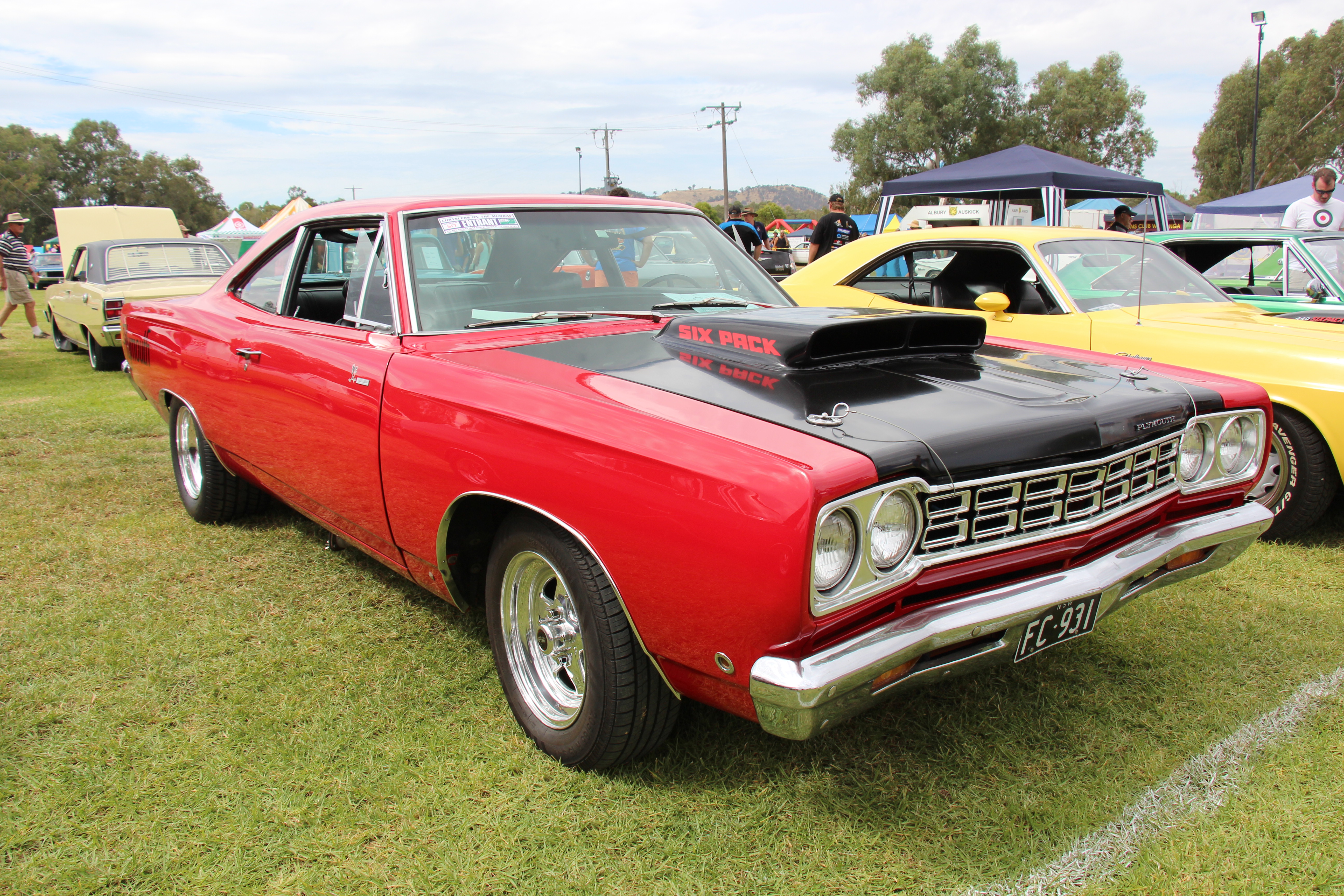
The 1968 Roadrunner is a classic American muscle car that was built for speed and style. It's known for being powerful and affordable, making it a favorite among car lovers.
The Chrysler Pacifica is a family minivan that has lots of room for passengers and cargo. It's designed to be practical and comfortable for families on the go.
Pikes Peak is a mountain in Colorado where a famous car race takes place every year. It's known for being very challenging because of its steep roads and unpredictable weather.
Car
Dodge NASCAR truck
A NASCAR truck chassis is the base frame of a racing truck used in NASCAR events. It is built to be very strong and safe for racing at high speeds.
Car
Mopar R5 P7
The Mopar R5 P7 is a powerful engine used in racing cars. It's built to run really fast and produce a lot of horsepower.
The chassis is the main structure of a car that holds everything together, like the engine and wheels. It's important for how the car drives and handles.
The Dodge Road Runner is a fast car from the late 60s and early 70s that people loved for its speed and cool features. It even has a horn that sounds like a cartoon character! It's talked about a lot because it's a classic muscle car that many car fans admire.
The cage structure is a set of strong bars inside a race car that keeps the driver safe in an accident. It makes the car stronger and helps it handle better.
Wheel spacers are used to make the wheels sit wider on a vehicle. This can make the car look better and sometimes improve how it handles, but it can also put extra stress on some parts of the car.
The Chevrolet C10 is an old pickup truck that many people love because it's tough and can be used for different purposes. It's popular among fans who like to fix up and customize cars, and some even race them in special events. You might hear about it because of its cool history and the fun projects people do with it.
An NA motor is an engine that doesn't use any extra devices to force air in. It just uses the air pressure around it, which can make it less powerful than engines that do use those devices.
A carburetor is an older device that mixes air and fuel so that the engine can run. It's not as common in modern cars, which usually use fuel injection instead.
Jetting is about changing the size of openings in the fuel system to control how much fuel goes into the engine. This helps the engine run better depending on conditions.
Suspension is the part of a car that helps it stay stable and comfortable while driving. It includes things like springs and shock absorbers that help the car handle bumps and turns better.
The Chrysler 300 is a big, fancy car that looks really cool and has a lot of space inside. It became popular because it's comfortable to drive and has strong engines that make it fun. People talk about it because of its unique style and how nice it is to ride in.
Car
Tata Motors Sumo
The Tata Motors Sumo is a big vehicle that's often used by families and businesses because it has a lot of space inside. It's known for being strong and able to drive on rough roads, which is why many people like it. You might hear about it because it's a popular choice in places where tough vehicles are needed.
The Jeep Cherokee is a type of SUV that can handle rough terrain and is popular for both city driving and outdoor adventures. The KL generation refers to the specific version made between 2014 and 2018.
The AMC Matador is a car from the 1970s that has a unique look and a lot of room inside for passengers. It was made for families and came in different styles, like a two-door or four-door version. People talk about it because it's a classic car that stands out from others of its time.
The Dodge Nitro is a medium-sized SUV that looks tough and can handle different kinds of driving, like off-road adventures. It has a lot of space inside for passengers and cargo, making it good for families. People talk about it because it's a strong vehicle that can do a lot of things.
The Chevrolet SSR is a unique vehicle that looks like a mix between a truck and a convertible. It was made in the early 2000s and is known for its eye-catching design.
The Chrysler PT Cruiser is a small car that looks a bit old-fashioned, which makes it stand out. It's known for being practical with plenty of space inside, making it a good choice for families. People discuss it because of its unique look and how different it is from other cars.
LIVE
Welcome to another In-Wheel Time podcast.
Welcome to the In-Wheel Time car talk show coming up from the birthplace of the famous chipmunk, Alvin.
It's Richard Tomlin at Apex Auto Works and his Las Vegas showing of the infamous 68 Roadrunner.
Later in Jeff's car culture, ugly mugs.
You use your imagination.
Mars as a review of the new Chrysler Pacifica.
Howdy.
Along with Mike out of this world, Mars, we always need more Jeff Zeekin.
Chief engineer, David Ainslie.
I'm Don Armstrong.
So glad that you could join us on this Saturday morning.
Well, Mr. Mars, we have our next guest.
Yes, sir.
You've been patiently waiting around.
I'll bet he has.
I hope you enjoyed my introduction.
Wonderful introduction, as always.
Do what?
A wonderful introduction, as always.
Well, thank you.
I didn't know whether you caught the Alvin and the Chipmunk reference,
but I just wanted to throw that out there.
Thought it was fun.
Absolutely.
OK.
What about Dave?
Dave.
Dave.
Oh, hey.
Richard, we were thinking, oh, my God.
So the rain just finished here.
It's headed down toward Alvin.
Are you still?
Clear skies now.
Huh?
Clear skies here now.
Sun's coming out.
It's awesome.
OK.
All right.
Well, good.
Great.
So was it a fun trip to Las Vegas, sir?
Oh, Las Vegas is always fun, right?
It's the getting there is half the fun.
We lost a tow vehicle on the way there.
What?
So we had to call in.
Yeah, the Ram decided it didn't want to go anymore,
had some injector issues.
So we called on friends and family, fellow racers,
off-road racer came in, picked the car up, ran us into Vegas.
We made it there in time for the show at the last check-in.
And they put us in a prime spot right up at front.
I guess it was the only spot left.
And put it in the Hoosier tire booth.
And everybody was happy.
And the car was a huge success and answered a lot of questions
about what we had done and why.
Why we're running a big B-body up Pikes Peak.
There was a lot of learning that happened.
Well, that's good.
Did it make you angry?
No, it's fun to explain things to people
because not everybody agrees with you, right?
And they don't have to when you tell them
that it's a 10,800-mile car that you cut the belly out of.
It's been in the family since 69.
People get a little hurt.
But I wasn't driving.
I wasn't enjoying it doing what I was doing with it.
So now it'll be going to Sonic almost daily
and grab us a Dr. Pepper and chili cheese dog
and come on back home.
I could go for one right now.
Yeah, that's it in the background, right?
That's quite a tease because I'm thinking
we all need to sit around the campfire
with our chili cheese dog from Portillo's.
And hear the whole story.
So I guess I must have missed the part
where you cut the belly out of it.
Yeah, so it's sitting on a 2015 NASCAR truck chassis,
which was still a Dodge vehicle at that time.
But wait a minute, a NASCAR race truck chassis?
Complete.
Got it.
Front to back.
All right.
And I just want to make sure.
Okay.
Yep.
So double-arm front.
It is truck arm rear.
It runs the Mopar R5 P7 engine.
So revs at 9,500 RPMs.
It makes 808 horsepower at the wheels in Colorado.
It's slow.
Dawn is slow.
It's not the quickest thing around, I promise.
We could call him Dr. Frankenstein.
Or Weezer.
I'm not exactly sure.
So, all right.
Did you get it all painted up and looking pretty?
Well, we got painted up.
So as you can tell by the colors
and the hand painted on it is,
it was a throwback to what my father had done
when he was drag racing in the early 80s.
So that's it behind you right there.
That's the orange and white car.
Correct.
That's it.
We built that in 93 days.
It was a mad thrash at the shop.
A lot of customers got pushed off
for us to accomplish what we did.
But yeah, in 93 days,
we took it from a rolling B-body
to swapped onto a rolling NASCAR chassis
with NASCAR engine.
And that was two trips to North Carolina
to buy parts and chassis and get back here as well.
So it was a mad thrash of 90 days
and bad communications with you guys and us.
Well, there was that.
It was crying.
And yeah, and we apologize for that.
But I want to delve into this a little bit more.
Did you have to do anything to the chassis
to get it to fit other than maybe
a couple of tabs or something?
Yeah, welding on some ears and tabs.
No, so what we did is the road runner
is actually a 116-inch wheel base.
The NASCAR truck is a 112.
So we had to add four inches to the NASCAR chassis.
So once we got it here,
we cut all the cage structure off
because that's what we do is we build cages.
We're going to put our own cage in it.
And then we literally cut the NASCAR chassis in half,
added four inches to it,
squared it back up, welded it together.
And then we lowered the road runner body
over the top of it, started welding up,
attaching components.
And it fit.
You make it fit.
We've got grinders.
Okay, we all have grinders, sir.
We're familiar with that.
This is what you do.
I know it is.
I know it is.
So did the actual width of the wheel wells fit this truck?
We actually had to put spacers on it.
So it's running about an inch and a quarter in the front
and one inch spacer in the rear
to fill out the wheel wells.
And those are 18 by 10 steel wheels.
We have our poverty caps or dog dishes,
as people call them.
We can put on it for static display,
which makes me feel better.
And it's setting right now what we call four by four height.
That's the maximum height the car goes right now
to load and unload from the trailer,
but it drops about five and a half inches
from there into race mode.
And how do you do that?
Is it air suspension?
All the NASCAR stuff, they use a half inch,
basically it's one inch all through the half inch impact.
And you basically just run it up and down with the impact.
It is just screw it in and screw it out.
Yeah, very awesome.
I'll say that.
That makes it pretty easy.
Okay.
So does it have what interior wise?
Does it is it street driven?
Can it be street driven?
It will be street driven.
It has not been yet,
but no door panels are all stock dashes stock.
No headliner, of course, because of the cage.
The floor on the inside is 100% NASCAR.
And then we've got our ultra shield racing seats
made here in Texas.
Ultra shield belts to hold driver and passenger in place.
And let's go play.
So how do you how do you plate it?
Does it already have plates and registers, registrations?
It's a road runner.
Same.
Yep.
Okay.
Nothing about it that they are that they would care about
is that's been changed.
So when you pull into W's drive-in on a Friday night,
Halloween night, 1965, everybody's going to go,
it's just another stock car.
Yeah.
Yeah.
This one will not sound so stock.
I promise.
Okay.
9000 RPM.
Yeah. 9500 RPM is what they ran that motor to
and they were supposed to be able to do that for 500 miles.
Like it was built to go race 500 mile NASCAR races.
So then when you go at Pike's Peak or it goes up Pike's Peak
because I'm assuming you're not driving.
No.
Ben Ryan will be driving it for Pike's Peak.
Okay.
There gets kind of thin up there.
It does.
So you started was 8,200 feet and then we raced to 14,000.
So basically you tune it for the 10 to 12.
So we call it the middle section.
So little lean bottom, little fat top and you make the best of it.
But this motor has been up Pike's Peak twice in the C10 truck that it was in
that we worked on in the past.
Oh, okay.
So we know the motor is capable.
We know what it makes in Colorado.
That's where the number is.
When you think about 808 in Colorado a mile high,
we don't know what we're going to make here.
We would say 850, probably 860 wheel is the best guess.
So on the, you said that from 8,000 to 16,000 feet.
Yep.
And the part that you said you tuned for it's thin on the top or thin on the bottom
and fat on the top.
Is that the sweet spot when you're going up after so many thousands of feet?
Is there a sweet spot that you feel all the cars kicking in and we're going for it?
You will feel the change in the car.
People used to say and people still do say you'll be down 30 to 40% on an NA motor.
Our other car is still light.
We never noticed it, but it is also fuel injection.
This one is carb rated.
Rick did notice some drop, but we're looking right now back into some of the old school stuff.
The answers used to actually run what I call a throttle adjuster on an old lawnmower,
but they would actually adjust the jetting, the variable jetting as they were going up the
mountain.
So we're looking into that and working with a guy, Brad Pink,
out of North Carolina to see if he can help us set something like that up.
No relationship to Ed Pink, is it?
He is a son.
So yep.
Sorry, awesome.
It was very nice to meet him and greet him.
And he is the one who actually built the carburetor that's on the car.
And you know, conversations continue because innovations is what makes this stuff fun.
Oh my God.
Dude, I had no clue that your shop was capable of doing this kind of stuff.
It is so unique and so cool for any car guy.
I don't care who you are.
Now, how about are you feeling the hug coming through right now?
I greatly appreciate it, man.
I really do.
Like it's shocking.
We actually ran through a couple of employees in the process too.
And they've come back now and things have calmed down.
So we're getting back to our roots.
Well, congratulations.
I just think it's truly amazing and very cool to say the least.
All right.
So what do you have?
Are you still going to continue to work on this for Pike's Peak in the spring?
Yeah, the goal is to get it into Colorado probably February and we'll leave it up there.
So the local driver is driving it.
We'll have it there on site to drive at every event locally he can.
We'll have test days in MSR.
We've still got some rear brake stuff to fix and fabricate.
And then we will have it on track.
Hopefully before Christmas, we will be doing smoky burnouts in front of my house and around MSR.
Nice.
Right down to Richmond.
Right?
Like as a kid, that's how I learned to do clutch dumps.
That's how I learned to slide a car.
Was in this car.
So it's only proper.
That's what it does again.
Wow.
Well, you know, I'm thinking it needs an appearance in Dell Web.
Yeah.
I come out here to sign the driveway with it.
Exactly.
So obviously you still have to make a living and this probably is sucking everything dry at this point.
So what else have you got going on in the shop?
In the shop right now, we've got a Volvo with big LS7 turbo, which is amazing.
We've got a 69 Roadrunner.
We're doing some upgrades to G-Body twin turbo LS that doing paint and body on that.
And then a couple of Miata's.
If you see this one on my left shoulder, it was a lemon's car.
He crashed it, I guess, two weekends ago in MSR, 17-year-old driving, getting into motorsports.
So we're extremely happy to have someone that young getting into the sport and enjoying it.
We hate that they had a cost of smashing the front end.
So he will be spending his Thanksgiving break here with us.
He's going to be in from Austin, spend a couple nights in the hotel and
he's going to come up here and do the work and we're going to guide him through the process
and start educating this young man on how to work on cars, not just drive them.
Very good.
Typically, when you get a customer into your shop, what's the turnaround time?
And obviously it depends on what they want done to the car suspension or maybe some body work.
Typically, what is the turnaround?
What I tell everybody is we work on toys.
And anything you bring me is nothing that you need back immediately
because I don't like rushing on things.
Like the Roadrunner just kicked my butt.
Why do you ask him?
You should have just asked me.
Well, because he's the professional.
Yeah, you were there.
Well, I know.
Yeah, I've dipped my toe into that down there at Apex and it was fine
because I didn't have to have the car back.
And I guess you had it for a week or so.
Maybe two.
I don't remember exactly, but it wasn't that important.
And we've got cool places to eat at here in Alvin.
Yeah, you do as a matter of fact.
What is the name of that place that we wound up at?
It's been there for decades.
I mean, Gordon Street Tavern is where you guys went.
Yes, that's exactly right.
It's like home cooking with, you know, cornbread and all that good stuff.
It is very good.
Yeah, it is.
And thank you for that, by the way.
No worries.
All right.
Well, Richard, I am thrilled.
And look, he's rubbing elbows now with Ed Pinkson.
Yeah, yeah, yeah.
And anybody that is an engine guy that appreciates all the work that Ed Pink did back in the day,
you got to love that.
Yeah.
It was amazing to get to shake that man's hand, even just being, you know, son too.
But yeah, the trip to North Carolina was so eye-opening on all the NASCAR stuff.
But it's changed my outlook on a lot of the racing that we do.
It may not be 100% the best that's out there, but it's 97, 98% out of the box.
And it's just amazing what they've done.
You know, I was telling somebody the other day, we were talking about race tracks and
guy that I know actually lives in the Charlotte area.
Have you ever been to a NASCAR race at Charlotte?
I've been to one and I've never experienced anything like that in my life.
And you know, Richard, you can't, you can't really convey what that is to actually go
and see it and be there in person.
I've never been to Daytona, been to Indianapolis.
I've been to Talladega.
I've been to some other big tracks.
But, you know, that NASCAR track in Charlotte was the first of its kind back in the day.
And, uh, and look at all of the tracks that have tried to mirror that, that whole thing.
Because it brought racing up to a new level and people that had never been to a car race
before felt comfortable going.
Well, they turned it into the Barnum and Bailey.
You know, made it visible for everybody.
Well, that and the fact that that is a beautiful facility.
I mean, you walk in there, the restrooms are nice.
They're clean, great concessions.
You feel like that you're going to a Bucky's or going to an Alabama football.
Yeah.
Yeah, that kind of thing.
That too.
Yeah.
All right.
Richard, yeah, real quick.
I mean, like real quick.
You just said there was an event down in Victoria.
Yeah.
So, uh, we ran our test event in Victoria last weekend.
It was a private invitation style event.
I think we had 12, 13 cars.
We were testing for our course.
We're going to be doing a spring event in Victoria.
It'll be a three-day motorsports festival.
Think of it as a very small version of the Goodwood.
But we will have approximately 100 cars will show up and we'll run them over two days.
Time attack style, 1.4 mile run in the trees in a city park in Victoria called Riverside Park.
Nice.
As soon as I get dates, I'll get them to you.
Should be April is our hope.
Going to let everything green back up so that the pictures are amazing,
because all the pictures are from the inside the triangle outside,
so you don't have banners and cars, buildings and structures.
It just makes it for a much better car.
Hey, as soon as you get a date, get us the information.
Have you met Bobby and Jeremy down there?
Yeah, Bobby was actually out at this event.
So, uh, and Bobby and I, funny enough, met each other this year,
finally face-to-face in front of the circus circus.
So, you can't make that stuff up.
Well, he was there for, yeah, he was there for SEMA as well.
How appropriate.
Yeah, yeah.
We're staying in the same hotel and I was like, huh, fancy meeting you here.
Richard and Bobby.
Hey, so, good time.
Very good.
Richard, it's always great to talk to you.
Good to see you, my friend.
Have a wonderful Thanksgiving.
And if we don't talk to you, a great holiday season.
Maybe we'll see you tell Bites and Tacos on the 13th.
You betcha.
Hey, bring it.
Come on up and see us.
Bring the car.
We'll chat.
I'll take, you take care.
All right.
All right.
Moving on.
Just ahead, Jeff's car culture.
Ugly mug cars.
You're going to love it.
Plus, Mars Reviews, the Chrysler Pacifica.
After this break on the In-Wheel Time Car Talk Show.
Stay with us.
The Tale Pipes and Tacos Christmas Edition 2025
happens Saturday, December 13th from 8 to 11 a.m.
And you'll want to be a part of it.
Tale Pipes and Tacos is the cruise in everyone wants to attend.
And the Christmas Edition is extra special.
Donate an unwrapped new toy and help yourself to a free
loopy tortilla breakfast taco.
There'll be adult beverages available for purchase too.
And don't forget your ride.
Just cruise in and you're automatically registered
to compete for one of three famous chili pepper trophies.
Best hot rod, best classic, and best modern classic.
Tale Pipes and Tacos Christmas Edition
will be held Saturday, December 13th, 8 to 11 a.m.
at the Loopy Tortilla Tex-Mex,
located at 703 West Grand Parkway,
just south of the Katy Freeway in Katy.
Oh, and don't forget to bring the kids.
There'll be special trophies and goodie bags for them too.
It's the Tale Pipes and Tacos Christmas Edition 25,
Saturday, December 13th, 8 to 11 a.m.
At the Loopy Tortilla Tex-Mex
at 703 West Grand Parkway in Katy.
Bring a toy, get a free breakfast taco,
and enjoy the camaraderie.
In Wheel Time, we'll be there too.
Apple or Android, In Wheel Time podcasts
can be found everywhere, on the stream and through downloads.
Whether you're on the road or at home
and Jones in for a different kind of car talk show,
give In Wheel Time a try.
Honest new car reviews, fun and formative interviews
with real car people, weekly automotive news,
features like Jeff's car culture
and Mike's driving destinations all on In Wheel Time.
Check us out on SiriusXM Podcasts, iHeart Radio,
or while you're shopping on Amazon through Amazon Music.
InwheelTime.com has a list, and we know you love lists.
Talk show, and we thank you for joining us
on our live broadcast here today,
10 to noon central time every Saturday,
as a matter of fact.
And so we invite you to join us for that.
Podcasts available 30 minutes in length.
We invite you to go to your favorite podcast store
and download the little In Wheel Time thingy.
And you can get your podcast there.
Watch your thingy.
Time now for Jeff's car culture.
Cars with the ugliest mugs of all time.
Yeah, friends, it went too far.
Ugly mugs stuck in our memories.
So what's the first thing you see
when a car rolls into a car meet?
No, not the ugly tacky wrap.
It's the grill.
The grill alone can entirely ruin a car, sometimes it can.
But it can certainly shape how people remember it,
often for all the wrong reasons.
Many had solid features, thoughtful engineering,
and even loyal followings somewhere.
But when the front end starts the conversation
on a strange, awkward, or just plain ugly note,
it's like trying to find a perfectly sized wrench
in a messy toolbox.
First one we got is a Chrysler 300 from 2005 to 2010.
Chrysler 300 made an entrance
that shook the sedan segment harder
than an ugly earthquake.
When its wide stance squared off portions, proportions,
and strong shoulder lines,
it looked like a concept car
that actually accidentally went into production.
Or a muscle car dressed for a formal occasion.
It stood out from other sedans,
like a sumo wrestler in a ballet class.
And that was exactly the point.
It quickly became a darling of rappers,
customizers, and anyone who wanted to look
to find a budget.
Shot collar.
There you go.
And then the next one we have
is a Jeep Cherokee from 14 to 18.
This Jeep Cherokee, the KL generation,
brought some genuinely useful updates
to the Jeep lineup.
It offered a smooth ride on pavement,
shocking revelation for Jeep.
Solid fuel economy and better tech than many rivals.
Inside, it felt like a real step up
toward daily drivers.
The front end, however, told a different story.
While Jeep's traditional seven slot design grill
was technically perplexing,
the ultra narrow upper lights,
which were actually the daytime running lights,
and the main headlights were tucked
awkwardly down in the bumper,
left for many buyers scratching their heads.
Imagine that.
The next one is an AMC Matador coupe from 74.
And Kathy and I knew she had a real good friend
that owned one of these.
And it was a cool little car for 74.
For who?
At the time it was.
AMC had a habit of doing things its own way,
often with mixed results.
The 74 Matador coupe was no exception.
The grille pushed the limits,
shaped like a giant pair of aviar sunglasses
on a very surprised face.
It gave the car an expression that bordered on comic,
like a confused alien.
While it certainly helped the Matador stand out
in a crowd,
blame the mid 70s cars,
it didn't win any beauty contests.
The car version of a bad toupee.
The next one is a Lincoln MKT.
Lincoln wanted the MKT to feel luxurious
and forward thinking.
Cross over to redefine their brand.
It offered strong engine,
including the twin turbo EcoBoost V6,
which is a cool motor.
Quiet, comfortable ride,
and available three-row seating,
making it a generally practical full-size crossover.
The grille, however,
went all in on Lincoln's controversial split wing design,
sometimes affectionately or mockingly,
referred to as the butterfly or the mustache grille.
With wide chrome bar sweeping across the front,
it gave the vehicle a wide-eyed,
almost bug-like look
that felt more awkward than refined.
It simply didn't feel aligned
with the elegant upscale interior behind it,
creating a jarring disconnect.
It was like putting a cartoon face
on a serious business executive.
Dodge Nitro, still around.
The Dodge Nitro certainly packed
serious personality into a compact SUV.
Personality that looked like
it spent too much time in the gym.
It squared off-shape, progressively fared fenders,
and a bold styling made it look
like a miniature bruiser or a bulldog on wheels.
The grille leaned heavily on that theme,
which thick vertical bars, often in chrome,
and a massive diagram badge
that took up the prime real estate.
It bordered on theatrical.
Theoretically.
Theoretically, it's theatrical.
Screaming tough guy,
louder than a muscle car convention.
The grille made a strong impression
that left a little room for nuance,
like a brick wall with a giant grin.
It was all attitude, all the time, and very tacky.
Last one, everybody's favorite, the Chevrolet SSR.
One of Chevy's most playful, bizarre,
and utterly committed designs for the 2000s,
it combined a convertible, fun, power retractable hardtop
with a retro pickup body,
creating something no one else offered at the time.
For drivers looking to stand out
and relive their 50s hot rod fantasies
with a modern V8, it absolutely delivered.
It was like a cartoon come to life.
The grille kept the retro theme going,
but the wide, almost goofy smile, and oversized curves
gave it a slightly cartoon-like quality,
like something out of the Cars movie,
even resembled Lightning McQueen a little bit.
The grille certainly fit with the customer's
overwall whimsical theme.
It even made it to the styling feel more eccentric
than generally cool, bordering on character.
So it was a bad, so much unapologetically silly.
Leave that up there for a minute.
So the story with the fenders.
General Motors, he did the automatic bus.
I already hit it, yeah, there.
The fenders, GM had to go back to the 1950s
to take the technology in the actual molds of the fenders
from that generation to create this,
because the curves were so sharp to make them round
that they didn't have that technology anymore,
so they had to go back and look at how they did it.
Yeah, it was truly amazing.
The other interesting thing about that,
and I remember when it came out,
because I was in the press crew at the time,
in driving it, it had no upper structure,
so the whole thing flexed all the time,
kind of like the PT, not the PT Cruiser,
the hot rod looking thing.
Yeah, this is pretty car.
And there was no structure in the upper part of it.
Plus, that one had a V8 in it,
had no horsepower, just like the V6 in the PT Cruiser.
But they were fun to look at.
I'm sure they were fun to drive.
I've never driven one, never been in one,
but they were quite unique with that ugly mud guy.
Yeah, got lots of looks.
I think Harold Gunn has one of those things.
Okay, Mr. Morris.
Yeah, it was a different day, shall we say.
Thank you, Michael.
Are you there?
Yes, sir.
Okay, just joking.
I was just thinking about Harold's car.
I always wondered why somebody didn't hop one of those up
and really make a hot car out of it.
Because the chassis couldn't handle it.
I guess.
You would have to go under and actually spend a lot of money,
more money on the chassis than any kind of motor
that you could put in it.
You just couldn't, huh?
Take it to Richard Tomlin, he'll do it.
Yeah, that's what I was thinking.
You'd have to do something like Richard did and just gut it.
Yeah, pretty much.
I mean, it was a cool thing.
The interior was cool.
It was a three seat, but it really was a two seat
with a little full depth thing in the middle.
And the retractable roof, what a nightmare,
because that retractable roof came in three pieces, I believe.
And it was electrically operated,
but it went behind the seat inside the cab.
And that kind of helped make it look weird.
It was the thing, yeah.
It was a lot of potential there,
but I think they missed the opportunity.
If you see one, you'll know.
Yeah, most definitely.
Every once in a while, you will see one.
I saw one just a couple of weeks ago, as a matter of fact.
Well, anyway, we've got a lot to get to in the next segment.
Our story of the week, I think, is going to interest you,
and we invite you to stay tuned for that
that's coming up in the next half hour.
Okay, we've got a bunch of stuff coming up.
And World Time Car Talk Show continues
right after this.
Quick break.
Join us.
Who doesn't like a social event?
How about one that centers around your love
for all things automotive?
Another Gulf Coast Auto Shield car social is back.
Saturday, December 6th,
9 to noon at 11, 275 South Sam Houston Parkway,
just south of the Southwest Freeway.
It's a morning packed with incredible cars,
some of the finest rides in town,
from classics to modern exotics.
Here's your chance to talk to fellow car lovers,
grab a coffee,
and check out how Gulf Coast Auto Shield
keeps these rides looking perfect.
Meet the team.
Take a look around the shop to see firsthand
how Gulf Coast Auto Shield gets the most
of the look you're trying to create.
In World Time, we'll be there with their live car talk show.
You might just be one of the guests.
Don't miss this free, fun,
and fast-paced car gathering
of fellow car lovers and their rides.
Saturday, December 6th,
at Gulf Coast Auto Shield,
11 to 75 South Sam Houston Parkway.
Bring your car,
bring your friends,
and bring your love for all things automotive.
We'll see you then.
The award-winning In World Time car talk show
now reaches 5.3 million folks each year.
Check us out on InWorldTime.com,
YouTube, Facebook,
and podcasts available
from your favorite go-to source,
including our live broadcast
every Saturday, 10 to noon Central Time.
The In World Time car talk show
has informative automotive guest interviews,
new car reviews,
along with popular features
including driving destinations,
Jeff's car culture,
latest car news,
cruise-ins, and racing dates.
It's all on InWorldTime.com.
Join us.
That's it for this podcast episode
of the In World Time car show.
I'm Don Armstrong,
inviting you to join us for our live show
every Saturday morning,
8 to 11 a.m. Central on Facebook,
YouTube, Twitch,
and our InWorldTime.com website.
Podcasts are available on Apple Podcasts,
Spotify, Stitcher,
iHeart Podcast,
Podcast Addict,
Tune in Pandora and Amazon Music.
Keep listening
and we'll see you soon.
About this episode
Richard Tomlin shares his exciting journey with a 1968 Roadrunner, now mounted on a NASCAR truck chassis, as he prepares for the Pikes Peak race. The discussion covers the challenges of modifying the car, including tuning for altitude and the unique engineering behind the build. The episode also features insights into the automotive culture, including a segment on cars with 'ugly mugs' and upcoming automotive events, making it a rich blend of technical details and car enthusiast camaraderie.
What happens when a family heirloom gets a NASCAR heart and a date with a mountain? We brought Richard Tomlin of Apex Auto Works on to share the full story of transforming a 1968 Plymouth Roadrunner into a Pike’s Peak contender by setting the classic body over a stretched NASCAR truck chassis and dropping in a Mopar R5 P7 that sings to 9,500 RPM. The road to SEMA almost ended on the shoulder after a tow rig failure, but with help from racers and friends the car made a prime debut and drew a crowd that wanted every detail—how it was built, why it matters, and where it’s headed next.
We dig into the engineering: cutting and adding four inches to match the B-body wheelbase, aligning the shell, using NASCAR-style ride height adjusters, and balancing street presence with a proper cage, race seats, and belts. Then we climb into the thin-air problem. Pike’s Peak starts near 8,000 feet and finishes above 14,000, so we talk mid-altitude tuning targets, power loss on NA engines, and a throwback solution—variable jetting on a carb, with insight from Brad Pink, son of legendary engine builder Ed Pink. The motor has already proved itself on the mountain in a C10, and we break down the expectations for power at altitude versus near sea level.
Richard also opens the shop doors: a turbo LS7 Volvo, a refreshed ’69 Roadrunner, a twin-turbo LS G-body in paint, and a batch of Miatas, including a Lemons car that a 17-year-old is repairing while learning to wrench. We talk craft, patience, and why “toys” deserve thoughtful timelines. Along the way, we swap stories about Charlotte’s NASCAR spectacle—how great facilities make new fans—and preview a spring motorsports festival in Victoria’s Riverside Park: a tight, time-attack course through the trees designed for stunning visuals and driver challenge.
If you love bold builds, real-world engineering, and the culture that keeps car life vibrant, this one’s for you. Subscribe, share it with a friend who loves hill climbs or sleepers, and leave a review to tell us what you’d climb the mountain with.
Disclaimer: This post contains affiliate links. If you make a purchase, I may receive a commission at no extra cost to you.
---- ----- Want more In Wheel Time car talk any time?
In Wheel Time is now available on Audacy!
Just go to Audacy.com/InWheelTime where ever you are. ----- ----- Be sure to subscribe on your favorite podcast provider for the next episode of In Wheel Time Podcast and check out our live multiplatform broadcast every Saturday, 10a - 12nCT simulcasting on Audacy, YouTube, Facebook, Twitter, Twitch and InWheelTime.com.
In Wheel Time Podcast can be heard on you mobile device from providers such as:
Apple Podcasts, Amazon Music Podcast, Spotify, SiriusXM Podcast, iHeartRadio podcast, TuneIn + Alexa, Podcast Addict, Castro, Castbox, YouTube Podcast and more on your mobile device.
Follow InWheelTime.com for the latest updates!
Twitter: https://twitter.com/InWheelTime
Instagram: https://www.instagram.com/inwheeltime/
https://www.youtube.com/inwheeltime
https://www.Facebook.com/InWheelTime
For more information about In Wheel Time Podcast, email us at