Napa AutoCare is a big company that fixes cars and helps people keep their vehicles running.
LIVE
This is the Automotive Repair Podcast Network.
Let's face it, your shop management system is the most critical tool in your shop, and
NAPATRAX will move your shop into the SMS fast lane when on-site training six days a week support and local representation. Find NAPATRAX on the web at NAPATRACS.com.
The beauty of you came in a little early, we were able to do this. It's totally honored. I met you back, I'm going to guess about 11 years, and you came in and you did the culture that rocks to this company organization that we were in.
And when I got a chance to email Jim back and forth, he says, I'll remember you, and I remember Gary, and I was tickled pink.
So I brought the book that he signed for me here, everybody, you can see that. Proof, wait one minute, look at that, see that.
So we have some sort of connection, although he did say carms, or maybe he didn't know who the hell I was back then. But Jim, thank you for being here.
I'm excited to have you, I know that you wrote two books after this.
Yeah, well, yeah, and one of them is leadership.
One of them is leadership that rocks, and then I have the one after that is service that rocks. And in January, I will launch the third one in that trilogy, which is engagement that rocks.
Oh, my God.
It's all about engagement. But honestly, those three books are because I deconstructed the book that you're holding right there. That book was my first one.
I probably thought I only had that one book in me, but the reality is it's pretty dense. There's a lot of stuff in there.
There probably is three or four books actually in it that you could have expanded on. That's what I've done.
So I've actually taken the main three elements, leadership, service, and engagement and said, can I not run with that and have smaller, thinner, black and white versions that somebody could afford?
You poured your soul into that book.
I did. Well, I thought it was my only one. And, you know, I worked for one of the greatest cultures in the history of culture.
So I thought if I could just put all that into one sort of Bible, if you will, and let people run with that, that that would probably be enough for me.
But, you know, as with anything else, I always want more. I'm always trying to, you know, push my influence and wherever I can have some impacts.
And I thought, well, now people can hire me for a specific topic and run with that. But, yeah, that's my first and foremost.
That's where I made my first pretty penny there is with that book. And it's at the stage for a lot of other things that I'm doing now.
Let's define the word pretty penny.
Yeah.
I love that. I think I think a lot of us are still out there looking for that pretty penny.
So you're going to talk tonight on leadership.
You leadership that rocks.
Yep.
And oh, by the way, there's Ryan Reagan.
Hi, Ryan.
How you doing, bud?
All right.
So, yeah.
We all pull this thing off together.
Jim is going, I wish you could be here, but you're not, but you're going to get a little taste of what Jim is in this, in this episode that we're doing.
Becoming customer obsessed, Jim.
And I don't know if you're going to talk about that at all tonight.
Yeah.
A little in this industry of ours.
We've got the top tier professionals.
I mean, like I never industry, they're eaten from the cool age jar.
Yeah.
And then we've got some people in the middle that we hope in the podcasts that we do to lift them and get them and get them engaged to find themselves a new world
in a new life and a coach and an accountability partner and go from having turned the wrench.
Yeah.
Without any knowledge of business leadership and culture and to get them to go to that next level.
Yeah.
Nothing better than listening to a person like you come in and talk about that.
Yeah.
Thank you.
Well, you'd like to hope that they're actually showing up with all of those things.
But the reality is, everything boils down to human behavior.
And in fact, learned behavior.
You learn everything.
You learn everything from school, your parents, your friends, the playground, religion, lack of religion.
So by the time somebody comes to me wanting a job, they are the way they are.
And if you start with competence and say, listen, you want to be a technician.
You want to be a service advisor.
I get that and maybe one might be obviously a little bit easier than the other.
But you got to learn those things.
And somebody's got to give them a shot at some point.
So, you know, whether it's through apprenticeship or you're just giving somebody an opportunity
for a summer job to start in one area and move to another, they'll ultimately grow.
That's what you ultimately hope to have happen.
Good stuff, Jim.
Thank you.
Look, I know you're doing a lot of stuff for charity.
Having known you and seeing the passion that you have, you're doing stuff for no kid, hungry,
cannibal cancer kids, tunnel for towers, and hard for the arts.
Yeah, wow.
Yeah.
Well, I mean, I can only do so much, but I just made a decision right at the beginning of my career
that I would take 10% of everything that I make.
We go to some sort of philanthropic charity.
I started with one, but now I'm up to four.
And I don't know how sustainable it is.
I'll take the 10% and I split it up amongst all of those.
You know, I'm a faith-based guy.
And I always felt like, you know, for those people that understand the idea of giving back
and focusing on something that might be near and dear to them or something that influenced them,
that is going to come back to you tenfold.
I've just always believed that.
And so, even in maybe the years that I really struggled financially, and I'm like,
man, right now I'm the charity.
Like, I really need to be holding on to it.
I still gave.
And sure enough, within six months, I would be back on my feet and just in a much better place,
whatever it is, financially, spiritually, physically.
And so I've just maintained that.
And so I really spend a lot of time if I can talking to other people and other businesses going,
what would it hurt to take a certain percentage?
Maybe 10% is too much.
But just take two percent right off the top, not off the bottom, not what's left.
Off the top and donate it somewhere.
And I bet you'd see some massive repercussions, possibly in your business.
I think your consumer, your guests, your customers would actually notice that,
not that you have to, you know, screen at the top of your lungs and pound on your chest
about how awesome you are.
I think people will figure it out.
But certainly, your employees would see it.
And those crew members, those team members would go, wow,
if I've got a choice between this company and this company that are like businesses
and one actually cares about people and the planet or whatever it is,
I'm probably going to want to spend time giving money and working for that particular company.
So that's always been my philosophy.
I think there's an encouragement there for us in the industry.
Well, I don't think we're doing enough in the community.
Probably not.
I don't think we are.
And I'm not saying it would be for selfish reasons to grow your business.
I think it comes from the heart.
Yeah, I think it's a great byproduct.
I think it will absolutely help your business.
I think it's just the right thing to do.
And there's a ton of organizations that need help.
There's tons that are worthy.
You probably have to do some soul searching.
But, you know, I even talk about this in the automotive industry.
I go, what would the most likely organization be?
There's probably a lot of them.
In my mind, the one that comes to my mind, more than anything else,
is like a car's for kids.
You hear the commercial all the time.
I'm like, why wouldn't I, if I'm in the car business,
be figuring out a way to donate that to charity?
But pick whatever works for you.
It doesn't matter to me.
But I think everybody could be doing something
and they could probably be doing something a little bit more.
You're right.
There's a lot of shops that do do something like that locally.
There's a lot of them that will repair a car for a qualified,
and I don't want to say the word needy,
but a person that's challenged financially.
Yeah, they'll give cars away.
I love that.
But they have to have a job.
If you don't have a job, you don't need a car.
So there's a lot of that going on.
And there's not enough of it.
Yeah.
Hey, you know, it's no secret.
The automotive industry is facing a technician shortage.
But Napa AutoCare is stepped up with a powerful solution.
The Napa AutoCare apprentice program.
And the best part, it's completely free for members.
This program was pioneered by shop owners Pete McNeil
and master technician Jake Sorenson at McNeil's AutoCare in Sandy, Utah.
They recognize that waiting for skilled technicians to appear
wasn't an option.
So they built a program to grow their own.
By recruiting motivated individuals
with the right passion and attitude
and providing them with structured training,
they approved that apprentices could become
the next generation of skilled certified technicians.
The program features a comprehensive nine-stage curriculum
with in-depth classroom videos, instructor led Napa AutoTech classes,
web-based courses, and hands-on training with a mentor.
Apprentices move at their own pace,
typically completing the program within two years,
graduates earn four ASC certifications,
the G1, a four, a five, and air conditioning,
and are officially registered with the Department of Labor
as journey workers' automotive technicians.
And here's the business benefit.
As apprentices gain skills, they generate billable hours.
Often boosting shop profits is early as stage five.
Plus, Napa now offers a new apprentice toolkit,
developed with Carlisle tools at an exclusive price,
helping break down one of the biggest barriers
for new technicians, the cost of tools.
Together, Napa AutoCare and your shop can tackle
the technician shortage head on.
Start now, grow your own talent
and build your bench for the future.
Visit member.napaautocare.com or contact
your Napa representative today
and get started with your apprentice program.
Hey, let's face it, your shop management system
is the single most important tool in your shop period.
Napa Tracks has made selecting the right shop management system
easy by offering the industry's best
most comprehensive SMS.
Now it all starts when a local representative meets with you
to learn about your business and how you need to run it.
After all, it's your shop, so it's your choice.
And having local representation is a huge plus.
Customizing tracks to your business,
whether you're a one person shop or a large multi-bay
or multi-location company, a representative consults with you
to help optimize your shop's workflow, efficiency,
and profitability.
Tracks always has the flexibility to do business
how you need to do it, which means it can also grow
as your business grows.
And unlike the other guys will be there for you
after installation with the best training and support
in the business.
Yes, a learning management system tailored
to each role in your company.
Simply put, Tracks was designed and built
for shop owners just like you.
Visit us on the web at NapaTracks.
That's N-A-P-A-T-R-A-C-S dot com.
On your shirt, it says born to rock.
Let's go back to, you know, you wanting to leave the company
and then do this on your own.
It's a cutsy move.
It is.
But this is how all speakers
wind up coming to exist.
Nobody starts going, I'm going to be a professional speaker.
Nobody goes to school for that.
You know, they wind up maybe using their degree,
but they sort of happenstance.
They fall into it.
I was head of training and development
for one of the greatest cultures, hard rock in a national.
So I was opening up cafes, hotels, casinos,
all over the planet,
opened up about 80 different properties.
So I got a lot of my soul searching
around the planet all out of the way.
But even before that, I was a middle school teacher
for six years.
Before that, I'm in a bunch of community theater.
I do have a music degree.
So I always wanted to perform.
So I'm still pulling the levers of music, education,
and hospitality.
I still use all three of those.
And all of those were required to basically do what I do.
And the style that I do.
This edutainment that I like to talk about.
So, you know, I'm always trying to figure out
how can I get it meaning enough that it's sticky
and they go, that was awesome.
That was a great use of my time.
But also, we had some fun.
We had some yuck yucks along the way.
So to your question, I had just gotten to the point
after two decades, a little bit more than that.
All of my people underneath me were promotable.
They were ready to go.
I was probably in the way in a lot of ways.
I was just loving life.
I was getting some of the biggest bonus checks I'd ever seen.
But it wasn't enough car.
I wanted more impact and influence.
I wanted to write that first book.
And honestly, I think my fear was if I do that,
it's going to be a work for hire.
And they might have some ownership in it.
And the second is, I was already speaking on the side.
I was charging people.
But I was given the money to hard rock.
So they led me because I was a revenue generating initiative, basically.
But it fed the beast to me.
And what I found is, I wanted to go vertical.
I didn't want to just do stuff in food and beverage.
And so, now most of my gigs are banking insurance, funeral directors, automotive.
You know, the international packaged ice associate.
We all need to hear this word.
Jim, ever since I saw you speak on stage, and I got your book,
and I devoured this book on culture that rocks, devoured it.
It was just one of those, you could put it down books.
I've always wanted to ask you a very important question.
It was about my hair care products.
Yes, yes, it's perfect.
Let's go there.
It's so long.
When you were at hard rock, was that your hair?
Half the time.
Half the time.
Before it did not go up, it went down.
I had a mullet.
I could sit on my hair two and a half feet, two different times.
You know, you grow it out.
You get it cut.
You send it to locks of love.
And then I just grew it out again.
You know, I didn't start to build your brand.
Then you decided to go up.
Well, you know, I kept the mullet probably longer than it needed to be.
It was very cool.
We all have mullets.
Girls and guys in the 90s.
And then I kept mine a little bit longer.
Everybody else had already cut theirs.
I needed a fresh approach for sure.
But, you know, it was always rock and roll.
It was something that would be a little bit different,
a little bit more unique.
And I just had not seen anybody with huge spiky hair.
And I said, I'm going to go there.
This is before, by the way, the Guy Fieri's of the world,
and Rascal Flat.
I had my spiky hair first.
But yeah, I just decided I wanted to do something a little bit irreverent,
a little bit unpredictable.
But the goal is to get eyeballs on the brand on me.
I love using the music orientation.
I do a lot of band and brand analogies.
All this rock and roll analogy stuff is only to get them to the sweet stuff.
I'm trying to get them to Nirvana.
I'm trying to get them to the meaty stuff to go.
I can make my world better.
The other stuff is just really fun window dressing for me, honestly.
It's a motivator.
I mean, we all know music.
We all get that.
Oh, yeah.
You know, hey, you're having a down day.
Play your favorite song.
You got it.
You got it.
Yeah.
Absolutely.
You're having a down day.
Think of Jim Knight.
And his influence on rock and why, why, you know,
leadership and culture and all that's important.
Oh, my God.
I was motivated.
Why?
I took away an idea.
I learned one thing, but I never implemented it.
Yeah.
Isn't that such a big thing today?
It happens.
I feel like I went away from your conferences that you do.
And you would just hope you've changed one life.
Well, not only one life, I want to change all the lives.
I just want to change one thing about it.
I'm trying to be a catalyst for them, just a small little bit
of a thought leader on something.
So I have been accused of giving too much information.
Like, I am going to be moving at blazing speed tonight
at the keynote.
You know, I have 10 pounds of content, a five pound bag.
I'm one of these speakers who always wants more time.
There are some who are just happy.
who are just happy doing the last, I'll probably try and give eight, nine, ten takeaways.
But I know that everyone's going to be looking at that list going, I already do number two.
I'm awesome at number five.
I rock at number seven, whatever it is.
There's got to be, if they're open-minded enough, there's got to be at least one thing on
there that they're thinking, I don't do that at all, or I could absolutely get better.
You put any metric in front of me and I am on the hot man.
I am trying to crush whatever that number is, dollar about whatever.
You pick anything.
Top line sales, bottom line EBITDA, could be customer satisfaction, team member satisfaction.
I always want to be great at all of that.
So I don't think I'm the only one in the room like that.
I think there are people that are hungry to make their business better.
If we just get one thing in their head and they can push back from that table and go,
awesome use of my time.
We all win.
Are you a full-time speaker?
Are you also consulting and coaching?
Yeah, I don't do any consulting or coaching anymore.
I used to.
I started out of the gate doing that when I first left Hard Rock, really to supplement
the income.
I wasn't sure.
It's one thing to have a full-time job of speaking as a hobby on the side.
Once you do this full-time, I wasn't 100% sure.
So my first two years, I did both.
But I will just tell you, I just discovered I'm not that great as a consultant.
I'm awesome at one thing.
I can hold an audience.
I'm mediocre and all this stuff.
Absolutely.
People come up to you at the end.
You just stick around.
Yeah.
Shake some hands, get some questions.
Yeah.
God.
I can't get this leadership thing.
I just can't get my hands around.
I can't touch it.
Sure.
What's your advice?
So for me, if they want to stay in my orbit, I mean, they certainly have a book that
they keep going grab.
I will spend a little bit of time with them on the phone.
They can sign up on my website.
Have a conversation.
It's for free.
I'm willing to help anybody out that I can as long as I'm not spending hours and hours
on it.
At the end of the day, if there's something that they need from a personal, let's say,
executive coach.
They're struggling from a team standpoint.
I have so many friends that are just part of the spokes that I will just go out there
and go, I got a guy.
I got a girl.
Somebody can help you out.
Somebody comes to me and wants to talk about AI.
That's not me.
You're a catalyst.
You're a catalyst.
I'm a catalyst.
And I don't mind doing that.
And it's not a referral.
I don't make money off of it.
It's just, I got buddies out there who do this and do it extremely well.
I know that I do well.
I mean, I'm a writer and a speaker and that's, you know, I'm super happy with that.
Now I have other investments.
I have other businesses as well, but this is my full-time job.
I make my money off of speaking in front of people.
Yeah.
What's one thing that I could become a better leader?
By far, it is all about hiring the right person.
I can say this all day long.
They're going to focus on the product.
They're going to focus on discounting and couponing and painting the place.
Are you talking visionary to an integrator?
It doesn't matter who it is.
I'm saying, if you, unless you're a standalone entrepreneur, working in a kiosk, I would
guess you're all by yourself.
You have other people.
You have humans that are working for you.
That is by far the most important thing that you could do.
And we don't spend enough time wearing that human resources hat, that recruiting hat
to go, I'm going to go find a rock star.
I've got to find the absolute best top talent that I can.
They're focused on the minutia, on the, you know, the middle of the road type things that
are all important, but they feel like that's how they're focusing on beating their competitors.
When really, it's about the human that's really going to make a difference.
And it's also not enough to just have the experience or just have the competence of doing
the job.
There's a lot of great technicians out there.
It's not enough to just have the person who can do the job.
I know probably from an employee standpoint or from an employer, I might not care that
much whether that person is rude or gruff all day long and maybe we can take off with
each other, but the customer can see it.
And the customer at some point is going to be talking to that person, the more that I can
find that mix of something who can do the job with the right character, they've got the
right culture fit.
Those three C's, competence, character, culture fit, I'm going to win every single time.
And probably the way that I treat them, if I can get them to stay with me a little bit
longer, they're probably going to be taken over my job.
That's the name of the game.
That's how we all get promoted.
I want a circle around me that I can absolutely invest my time, energy, effort, money
and rigor on.
I want to create an army of giants, but you got to go out there and find those rock stars
and they're in the field right now.
Jim, people want to be led, but the leader doesn't necessarily know that.
Yeah, another problem.
So all the stuff that I just said, let's say the leader doesn't get that right.
I'm hoping this is why they come to events like this.
If they can come to an expo, if they can go to a show and not just milling around on
the expo hall, like I get it, so important, what they need to be doing is taking stock
of any of the breakout, seeing the keynote speakers, look for the one or two things that
they can do better.
I'm hoping somebody's actually said something to them and said, listen, this is how you
made me feel.
You're awesome.
Thank you for the money and the benefits.
And yeah, the pool table's cool and the company dog and whatever, right?
But the way you make me feel sucks, I mean, I absolutely feel like you don't care about
me as a human.
You don't listen to me.
I don't feel seen.
I bring up stuff.
You're afraid that I'm challenging the status quo.
If all of these things that they hear and they never do anything about it, well, then
they're going to expect to get the exact same results and probably turning over a lot
of these team members.
But if they can come to an event like this and just open their mind to say, I want to work
on my personal leadership a little bit more, there's always something out there that somebody
can grab.
I'm just, I'm trying to do the same thing.
Like I know I step into these industries that I have no business being in, right?
I don't know anything about a lot of industries, but here's the thing.
I'm trying to figure out what is it that you have that I don't have?
I just want to put that arrow in my quiver so I can be just smart enough to hang in the
conversation.
I want credibility.
But again, all of that is to get to the meatiness that they're never, ever going to forget.
And if it's about hiring the right people, communicating with the right people, loving
on people a little bit more, then again, I've done my job.
I'm just enough of a catalyst to say, just think differently and I think you're going
to be in a better place.
How do we get to a Jim Knight book?
What do we do?
And I would say the best way is go to knightspeaker.com so all roads lead to my website.
That's my last name, knightspeaker.com.
Anything and everything that you want is there.
You'll see all of my books and workbooks.
I put out content every day.
I'm all over social media so all of that stuff is there.
Video, tons of video.
I do something every day.
Well tonight, I can't wait to be in that dinner in that room in the ballroom.
I'm going to have to put something together so that I don't miss a word.
I'm kind of bumper around me because you're just an amazing speaker.
You just, I just love what you did all those years ago.
I consumed your book.
Trust me because of how much I loved culture that rocks.
I think you're going to love whichever book you buy of Jim.
In fact, I just have to recommend this one.
Jim, thanks for being here.
I know you got a hell of a schedule.
We're in the mode of everybody shutting down.
Yes, I saw that.
There's a time thing going on.
I'm honored to have had you on my podcast having known you probably a year before I started.
And who would have thought that I'd have chimed night on my show?
I thought about it.
You know what?
Honestly, we had such a great relationship back then just passing and I know a nice good
friend, Gary, who you know, has passed on.
But you know, that time back then was just me getting my sea legs.
And now, who to thought that this is what I'm doing for living and probably the rest of
my life?
The hard rock stories that you told, I think back then, it so inspired me that you were
able to take the hard rock ambiance culture, pop your hair one mile to the sky and go out
with this.
If you will, rock and roll style delivery, you know, listen to Metallica, listen to Jim
Knight.
Same thing.
Yeah.
Metallica, but like you said earlier, music, it doesn't matter which genre I think everybody
identifies with music.
And so, of course, the palette with which I get to paint is rock and roll is probably
my background because of where I worked.
Back then, I actually spent a lot more time talking about hard rock, obviously, because
this is what happens with musicians.
When you first start off, you're playing nothing but covers.
And then eventually you start writing around, you throw in one of your own songs, the audience
will allow you to do that.
And at some point, you don't want to play anybody else's stuff.
You only want to write original.
So my trajectory has sort of been the same.
I have a mad love affair with hard rock.
My affair with them will go on probably forever because I spent two decades of my life.
But at some point, I thought I need to be talking about other things in just a story.
That story is one of the greatest stories ever.
And somebody should write a book on it, which is crazy, that there really isn't one.
But I said, I probably need to be talking about stuff that can help people out, not just
hearing the good old times of rock and roll and the 70s.
And that's what gravity back then, because you're a hell of a storyteller, just to hear
it.
Even behind the scenes of an institution like hard rock.
Jim Knight, thank you so much for being here.
It's my pleasure, man.
Get to see it again.
You look exactly the same.
I can't believe that.
That's the truth.
Rock on my friend.
Rock on.
Thanks for being on board to listen and learn from the premier automotive repair business
podcast, Remarkable Results Radio.
Check your episodic education on the ARPN Listing App at automotive repairpodcastnetwork.com.
Also enjoy the podcast on our Carm Capriotto YouTube channel.
Carm is all for advancing the professional automotive service industry.
Until next time.
About this episode
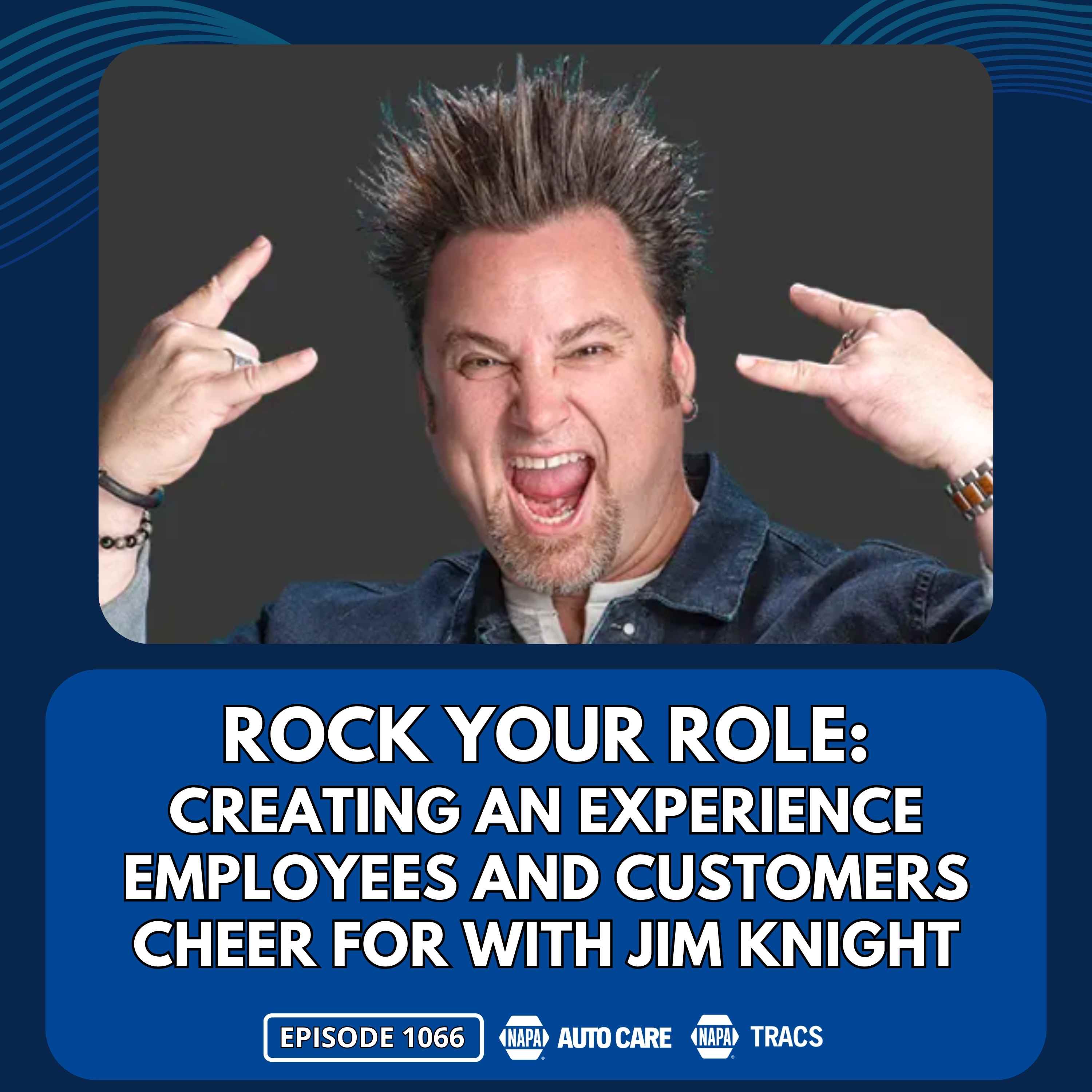
Jim Knight, a renowned speaker and author, shares insights on leadership, culture, and employee engagement in the automotive industry. Drawing from his experience at Hard Rock Cafe, he emphasizes the importance of hiring the right people and fostering a positive work environment. Knight discusses his trilogy of books focused on leadership, service, and engagement, and how giving back to the community can enhance business success. His engaging storytelling and practical advice aim to inspire listeners to improve their leadership skills and create a workplace culture that resonates with both employees and customers.
Recorded Live at ASTA 2025, keynote speaker Jim Knight dives into leadership and organizational culture through his signature “edutainment” style—a high-energy blend of music, education, and hospitality. Knight is a professional speaker, writer, and former Head of Training and Development for over two decades at Hard Rock International, which he calls one of the "greatest cultures in the history of culture."
Jim stresses that the most important responsibility of any leader is hiring the right person. Too often, leaders get distracted by product, pricing, or aesthetics, while the true differentiator is the human element. He recommends evaluating candidates through the Three C’s:
Competence – Can they do the job?
Character – Are they kind, respectful, and easy to work with?
Culture Fit – Do their values align with the organization?
Leaders who fail to make employees feel seen, heard, and appreciated, he warns, will continue to struggle with turnover.
Jim Knight, a renowned keynote speaker, author, and training and development expert, teaches organizations of all sizes how to attain their own “rock star” status. https://www.knightspeaker.com/