All right, we got a great topic to cover this week
and it's basically how to build a TRD Tacoma
for the pores.
Or how to not build a TRD pores Tacoma.
Or how not to do it.
That's also correct, so.
Because we went down the rabbit holes on everything.
We went down the rabbit hole
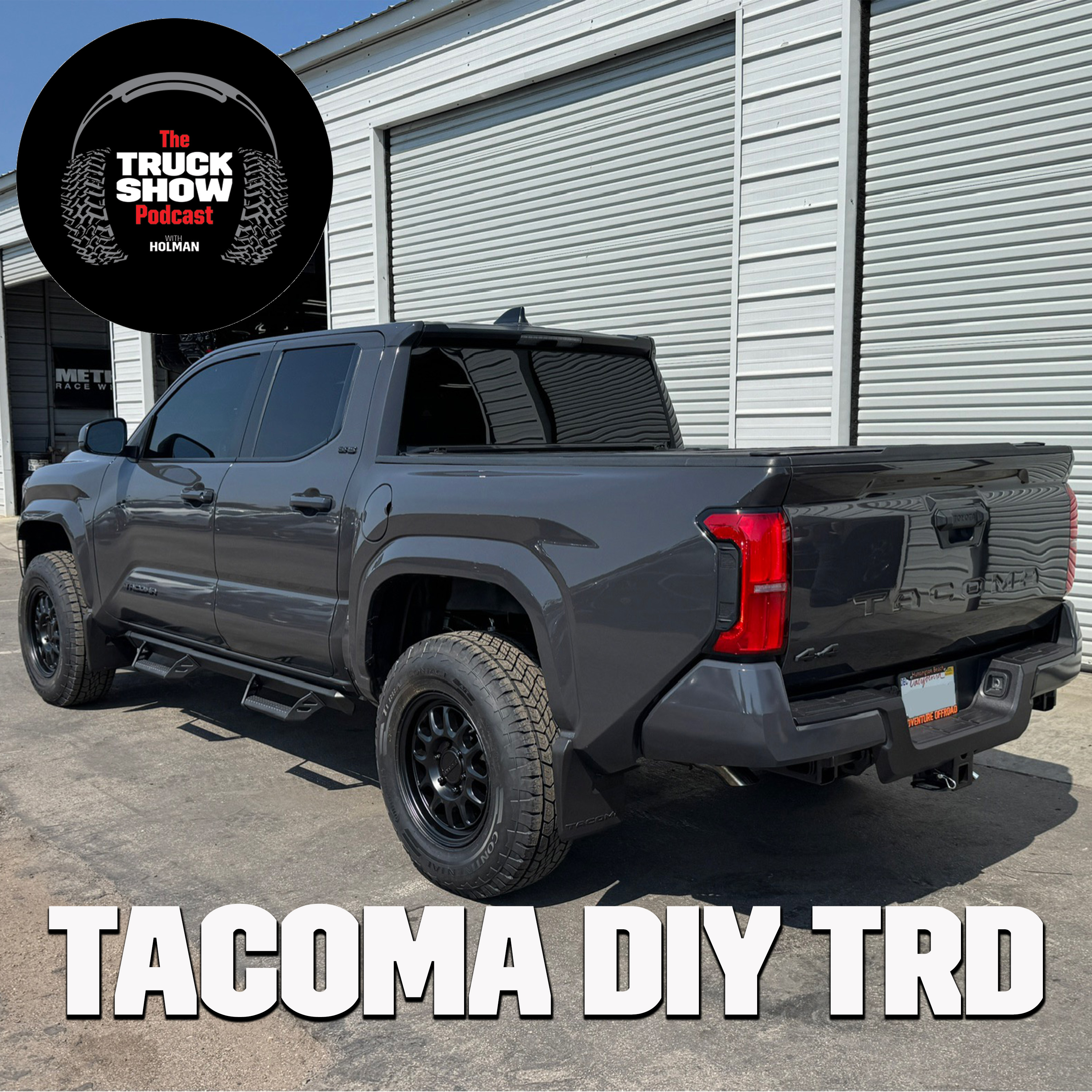
and Mike has a 2024 SR5 Tacoma Double Cab
non-hybrid automatic four by four.
Really super basic, under 45 grand.
You guys have heard me talk about
wanting to do this like $45,000 truck thing.
So you'll hear a little bit of that discussion today
but this is mostly for how to upgrade it
and make it cool because it looked like
something you'd find in the lot at Hertz.
Pretty much.
I mean it was really just like painted aluminum wheels
and a giant air dam, all that stuff.
I could rob a bank because I passed four of them
on my way to work the exact same color
and fitment of everything.
Yeah, because it was the loss leader
at the dealership that week when the paper came out.
So anyway, we're gonna talk about that
and kind of dive down into something we don't do a lot
and that's Tacomas and we'll kind of look at the price
between building up an SR5 versus just going
with a TRD off-road, what the differences are.
So we'll have a little bit of fun with that.
But before we get started,
we have to thank the companies
that make the Truck Show podcast possible.
The Truck Show podcast is brought to you
by the following sponsors.
Amsoil launched the industry's first synthetic motor oil
back in 1972 and Amsoil continues to innovate
with a wide selection of synthetics
that are formulated, blended and packaged right here
in the United States.
These specialized lubricants are engineered
for what you drive and how you drive.
Amsoil's shop by vehicle tool
offers package size recommendations to maximize savings
and includes Amsoil's ultimate oil change kits.
Amsoil offers the protection you demand
and the performance you deserve.
Get yours today at amsoil.com.
The perfect compliment to your truck is a Kershaw knife.
All Kershaw knives come with a limited lifetime warranty
and repair parts are readily available through the website.
Kershaw knives include lifetime sharpening
and the lineup has everything from EDC knives
that can be used and abused for under 50 bucks
all the way up to high-end collectibles.
Things to our generous partnership
with Kershaw knives Truck Show podcast listeners
can get 40% off MSRP and free shipping
over $50 by using code 2TSP 2025.
It can be used more than once
and even includes automatics.
Visit kershaw.kaiusa.com today.
When it comes to amazing vehicle-based adventure content
how-to's and great storytelling
only one brand is doing it right
in the print magazine space
and that's OVR outdoor vehicle recreation.
OVR is about getting out there in our vehicles
to explore and discover the world around us.
Get complimentary access for a year
to the digital library
or a discount on your print subscription today
at ovrmag.com.
Use the promotional code at Truck Show podcast.
The Truck Show podcast survives off of sponsorships
and your reviews.
Please help me to keep it free by supporting our sponsors
in leaving reviews and comments
on Apple podcast and Spotify.
The Truck Show.
We're gonna show you what we know.
We're gonna answer what the truck,
because truck rides with the ****.
The Truck Show.
We have the lifted, we have the lowered
and everything in between.
We'll talk about trucks that run on diesel,
electricity and our gasoline.
The Truck Show.
It's The Truck Show with your host, Holman.
Well, it's not just me today.
We've got Mike Rice in the pod shed.
How you doing?
Good.
We're gonna talk about how to,
basically how we made your truck not suck.
Exactly.
So it's funny because you bought the truck
and you were kind of agonizing over it for a while.
Oh, yeah.
And I think we talk about it in the first interview piece
and I won't do too much of a setup.
But essentially, you kind of went through the process
of I want a truck, I want to keep it for a long time
and I don't want it to be overly tech-heavy,
but I need a four-wheel drive
and so you landed on the Tacoma.
So I'll play this first piece.
But first, we have to, well, we need a jingle.
So I don't even know.
What jingle do I get?
I don't know.
So I was thinking that it could be a project truck.
You've got a project training your wallet.
What's to show for your bad choices?
Do you still have a wife?
Tell us what's in your driveway.
You've got a project training your wallet.
What's to show for your bad choices?
Tell us about that project.
I mean, that one kind of works.
Does that work?
Yeah, but I mean, on the scale of projects,
and you know all the stuff that I've owned,
this one not actually that much wallet draining.
We basically transformed your truck in like a day and a half.
Yeah, pretty much.
And then you've just been driving it ever since.
I mean, there's one that's like, what's new in trucks?
What's new in trucks?
That's like a news junket.
Yeah, that's more news.
Oh, this might be good.
Tell us all about your truck.
Is it great or does it suck?
Yeah, let's do that.
It did suck.
That's a good one.
Let's do that one.
For I buy, I need a clue.
Don't pull punches.
You review.
All right.
That one fits.
I think that one fits.
Yeah, I think that one fits.
Let's do that one.
All right.
You sure you don't want to pull up a stool?
Because you could share your experience.
You could just make an episode of going over sound clips.
That would be an hour.
All right.
Well, whatever Mike is about to do, he's going to,
it doesn't matter the jingle because the content's going to be the same.
It's going to be awesome.
So before you and I kind of have our dialogue,
I want to play this clip.
So while we were driving down there,
I did a little recording and kind of set up what our day was
and what we were going to do.
And do you want to go over the parts really quick
or you want to just hit this first and then we'll talk about it?
Well, I mean, I guess we should lay the groundwork
to let the listeners know what we were doing for the day.
So I guess, yeah, let's go over the parts list.
All right.
So essentially what happened was you got your truck
and then I'm like, your truck's dumb.
And you're like, yeah, it kind of sucks.
And I agree.
Yes, my truck's dumb.
And I said, I kind of want to do the story
that nobody ever does.
And that's like how to build a TRD for the pores.
And if you have an SR5, could you get close
for a reasonable amount of money?
And then you raised your hand and said, oh, me, me, choose me.
Right.
Because you can't swing the proverbial dead cat
without hitting a Tacoma with some sort of an upper control
arm, Fox or King or Bilstein, 2.5s or Bilsteens.
What are they?
60, 70 millimeter?
60 millimeter, yeah.
Yep, 60 millimeters.
Tons of stuff exists for that truck.
I did not want to spend that truck money,
but I wanted something that was better than stock,
better than what I could get with Toyota and functional
and still kind of work on a budget.
So you and I ping-ponged a bunch of ideas off of each other.
In the off-road world, when I was selling stuff to clients,
kind of the go-to was the Bilstein 5100 leveling strut.
Right.
I put them in a ton of trucks and a bunch of satisfied
customers matching rear shocks.
They come with the snap rings and you can set the ride height.
And they don't really have any problems.
No, they're great.
They easily last well over 100,000 miles.
The seals are great.
OE technology.
We'll get into that with an interview here in a little bit.
So that was what we based this build around.
It was like, we need a better monotube shock
to replace the twin tubes, something that would level it
so you can get a bigger tire in there.
And then you sort of went a little bit crazy on wheels
which we'll cover.
And then you actually did like a really reasonable tire choice
and we'll talk about that.
But then you thought to yourself,
well, it still doesn't look good enough.
So I'm gonna do the TRD skid plate,
which is a little bit beyond the scope of the build
of trying to keep it in budget.
Because that's sort of like a, that's a farkel.
Yeah.
Well, I had two items that were kind of not
on the basic edge of the build.
You know, the skid plate, Toyota put a piece of carpet
between the oil pan and anything on the road.
But there's plenty of aftermarket companies.
You didn't need the TRD one, but you did.
Yeah, I got the TRD one.
Yeah, of course.
And it looks great.
And there's, it actually is fine on the non-TRD trucks.
And then you threw me a complete curveball
because you came to my house
because we're going down to Bill Stein,
which is in Northern San Diego County.
So about an hour and a half from here.
It's about 20 minutes from our friends over at Magnaflow.
And you said, oh, we're gonna stop there first
and I'm gonna get an exhaust.
Whoa, hey, you just blew up the budget.
I did blow up the budget.
So we'll talk about that too.
But this first clip is you and me right after Magnaflow
and then talking about the truck heading down to Bill Stein.
So here we go.
All right.
So I am with our good friend, Mike Grice,
driving in his 2024 or 5?
2024.
2024 to coma.
And so we'll talk about two different things.
One is the mission we're on today.
And number two is we're gonna use Mike as a guinea pig
in our $45,000 truck experiment
because the MSRP on this lovely SR5 crew cab,
non-hybrid, was about 44.
Yeah, just under 44.
So that dovetails nicely into our little experiment
of what do you get?
And I will say that I'm enjoying the fact
that you have a push button start in this.
I do like the push buttons.
It's time has moved on.
Technology is great.
I remember first coming out like that's only for race cars
and it's cool in my Honda or something
and it's dumb for everything else.
And then I had the Ranger, which was a turnkey on the XLT.
You have to step up to a layer to get a push button
and I didn't realize how much I rely on it,
especially right now I've got a bad arm.
So coming out of the grocery store,
carrying things and trying to get the key out of my pocket
and then unlock the door with the key button
and then I put it back in my pocket,
sit down after I load up the truck, I get it.
Oh, I got to just fish around my pocket again to turn it in
and I'm like, man, I've gotten soft.
Yeah, I mean, you know, but it's first world problems, right?
These are definitely first world problems.
But when you've had a bunch,
because I've had a bunch of cars with push button starts
and it really does make life easier.
It does.
I don't got to dig in my pocket for keys.
I just walk up to the door and grab the handle and it opens.
Does it still have, well, does the Ranger do that
where you put your hand in the door handle and it unlocks?
You have to pull the fob out.
I got spoiled on the Jeep.
I got spoiled on the Aria.
I got spoiled in my wife's car and it's like,
now I kind of feel like, man, that's sort of a must have.
What's the window sticker on that Ranger?
That one was 47, I believe.
So we'll dig into the Tacoma as a vehicle price point.
But right now we're in the truck on our way to Bilstein
because we're upgrading your suspension.
So in OVR Magazine, we're doing like a poor man TRD build
and Bilstein has their 5100s out now for this generation of Tacoma.
And I will say what's cool about this truck is it's a coil spring truck in the back.
And so the shocks, this thing rides pretty good.
It's a little, it's a little bit, I'm not going to say nervous,
but a little bit busy on some stuff, but overall it's pretty good.
It rides really good.
Yeah.
The rear has a little more squat than I'd like to see from a coil spring truck,
but it's just kind of, it's mushy.
Yeah.
It's soft.
I mean, listen, I'm not going to complain.
It actually feels pretty good going down the road.
But like when you hit transitions, you hit bumps,
you can definitely feel the bottom, bottom out in the back.
Yeah, that's the thing is it's like there's plenty of,
plenty of compliance for around town.
It's when you get over the heaths or the railroad tracks or broken stuff
is where the stock suspension sort of falls apart a little bit.
So what we're going to do with yours is we're putting a 32 inch tire on it.
We're doing the leveling 5,100s.
So we'll bring the front up, give it a little bit better stance,
take this big snow plow digging blade off the front.
Oh God, I hate the plastic air dam.
Oh, it's so bad.
And it's funny because we went to Magnaflow and we updated your exhaust
to the overland exhaust, which you might be able to hear in the background.
So nice and quiet.
No giant tip anymore.
It's tucked up next to the spare tire.
And your air dam actually hit the ramp on it.
It was so close.
You know, it's funny, Mike, is while we were at Magnaflow,
as they were pulling it off the hoist, I heard this.
Dang.
Am I just the butt of all of your Tacoma jokes?
Yes.
Yes, you are.
Fair.
Whoa, that's not right.
That's the thing.
Look, the SR5 is a great truck, right?
You can't complain too much about it.
But soon as you start to take it outside that box
and do what you would traditionally do with the Tacoma 20 years ago,
take it on fire roads, take it camping, load it up and go ahead for the hills.
The new truck, you can kind of start seeing some shortcomings in it.
The air dam, the super soft shocks.
It's almost like they made the base truck less off-road capable
so that they could sell you the off-road package.
So you've got a 4x4 SR5, so what we're going to do is,
in addition to the Bilstein suspension that we're putting on today,
and we'll do an interview on our way home so we can talk about the difference.
The tires, you're also doing TRD skid plates with the Magnaflow exhaust.
And the idea is, for somebody who doesn't have a Toyota off-road package,
could you spend a little bit of money to make it look better,
better performance through wheels and tires and suspension?
It gets like a TRD light, if you will,
or a TRD Sport close with your SR5 in the aftermarket.
So I think that'll be pretty interesting.
So I'm excited to get down there today, learn about the new product,
get them on your truck, and then we've got an hour and a half drive home
from Poway, back up to Orange County,
where we'll be able to feel the difference in the ride and talk about what that's like.
Yeah, that's going to be a great test.
And then we'll have to take it out for first dirt.
Yeah, we're definitely going to need to get some first dirt on it,
but I will tell you, I haven't been super impressed with the Tacoma,
but this truck at Little Under 44, it's actually grown on me,
just spending the day with you and it already.
It's dynamically, it's quiet, it feels good.
There's not a lot of body on frame jiggles.
The dash is nice enough, it doesn't feel cheap,
it doesn't also feel premium, but it's somewhere in the middle,
where it's like, for this price point, I could live with this no problem.
You've got the smaller screen, and it's totally fine.
Yeah, the smaller screen is actually kind of nice,
because I don't have my view out of the windshield block.
Yeah, my giant tablet.
Oh, God.
Yeah, it's just, I don't like the way.
They've gotten so carried away with it.
Yeah, I don't like the way on the Tacoma,
how it just sticks up out of the dash out of nowhere,
like a big sharks fan or something, and it's silly.
It's like, you redesign the whole thing,
why couldn't you do a better job of integrating the screen to the dash,
because it just looks like an afterthought or out of place,
but the seats are comfortable, and yeah.
Gets good mileage, I mean on the way down, it averaged almost 24.
Yeah, so that's good, and it's plenty peppy.
You know, the Turbo 4, like getting non-hybrid, totally fine,
and I know, maybe we should talk about why you chose this truck,
because you had a couple of things in mind,
there's a reason you went this way,
and then you sort of found this particular truck.
What was your thought process of Tacoma SR5?
Well, my thought process was, is,
trucks have gotten so expensive, for one, for two.
I just wanted something basic, reliable, just like a truck, right?
I don't need like heated massaging seats, they're nice,
don't get me wrong, my Megacab had heated seats,
and I loved it, but you know, maybe we've gotten soft,
maybe I don't need all that stuff,
and I just kind of wanted a basic truck
that I knew I could keep for 10, 15 years,
and hopefully not have to do any work to.
Obviously the juries out, Toyota, the 8-speed gearbox early on had some issues.
The 4-cylinder Turbo, it's been truck-proofed according to their engineers,
they added like 50% specific truck parts to the package.
The cooling system is the same size as a 5.7 Tundra of the last generation,
so they tried to truck-proof it, because you know the Tacomas are bread and butter,
but I wanted a truck that I could just throw stuff in,
not worry about basic, just cheap, knock-around,
haul stuff from Home Depot truck, and then put camping gear in the back,
head up to the mountains.
So what are the parts? Obviously,
let's start with the Bilstein shocks that we're on our way to install now.
So, you know, I had this thought, it's like,
you know, buying a TRD off-road or a TRD Pro to gain a little bit bigger tire,
better suspension, and the skid plates.
I mean, it quickly goes from a $45,000 truck to like low 50s,
and I think the top of the line TRD Pro is like 65 grand.
68, I think.
68.
Yeah, it's almost 70.
So, okay, so I don't, and it comes with like the leather.
And you're forced into the hybrid too,
which you didn't necessarily want from a longevity standpoint.
Yeah, from a longevity standpoint, I didn't want the hybrid.
Even though Toyota's been doing the hybrid longer than anybody,
you know, they're pretty good at it.
But I just, it's just not something I wanted.
So I started thinking, it's like, okay, well,
if the SR5 is like 44, 45 grand, that gives me a fair budget to kind of put things in money
where I want it.
So the first thought was like, okay, I got to do something about the suspension.
So, you know, I found out Bilstein was working on 5100 leveling struts,
which I don't know.
I can't even tell you how many trucks I've done those struts in.
Trouble-free, they vastly improved.
Easy to last over 100,000 miles, no problem.
No problem, no issues.
And it, you know, I can adjust the ride height to it,
and it gives a drastic improvement.
On, on-road and off-road performance.
So I was like, okay, Bilstein's coming out with that, Bilstein.
I got to break my-
Like, beerstein.
Beerstein.
Yeah, I got to break my Southern California.
I know.
You know.
Come on, Mike.
Bilstein.
Bilstein.
Bilstein.
Bilstein.
Bilstein.
I'm going to give you a dry erase marker for that board over there.
You're going to write Bilstein, Bilstein, Bilstein over and over again.
Of the proper pronunciation of that.
But it's like, okay, so take care of the suspension.
I didn't want to go down the route with like, you know, Fox or King 2-5s,
upper control arms, rear arms, going way out of scope.
You want to get as much stock stuff as possible,
and a low maintenance or no maintenance up there.
Yeah, I don't want to deal with maintenance.
I don't want to deal with headaches.
Yeah, the race shocks are great,
but you also have to rebuild them every 10, 15, 20,000 miles.
You know, as you know, I already have one crazy four-wheel drive in the garage.
I don't want to have to watch after another, right?
So this is the daily driver.
This is the road trip truck with my wife.
So it's got to be comfortable.
It's got to be reliable.
So basic replacement shocks, keep all the factory suspension intact,
you know, as far as arms, steering, all that other type of stuff.
Pull the nose up a bit.
Now, as far as wheels, I went with race line.
There's a bunch of great wheel, race lines, great, zero issues with race lines.
I put tons of them on trucks for years.
And then the tire, I decided to try something different
out of the realm of what I usually do.
I kept going back and forth with, do I want a traditional all-terrain,
being that it is a daily driver, being that it's going to, you know,
see more commuter miles than it is dirt miles.
And I didn't want to affect the gas mileage too much.
I didn't want to go larger than the factory size TRD tire, which is about a 33.
Sure.
I know, like, I think the Trail Hunter, you get with like 35s.
I don't want to, I don't want to kill the gas mileage.
So, you know, I decided to go with a continental extreme contact.
I think is what, or I can't remember the name of it.
It's like the, it splits the difference between a highway terrain and all-terrain, right?
So, yeah, it's a little more aggressive than your highway tire,
but not quite as aggressive as an all-terrain knowing that this is going to be a daily driver,
weekend warrior, not using this for the trail.
You've got your two-door Jeep for that.
This is going to be, I'm going to take a short dirt road to an established campsite already.
So, you're not worried about rock crawling or, you know, muddy roads.
You're probably not going to be out in that sort of thing,
but you want something with a little bit more traction.
You can go the mountains, you can drive it.
If I see snow somewhere or rain, you know, get decent mileage on the highway to get where I'm going,
but it still has a decent enough tread pattern for stuff like, you know, wet dirt,
you know, a little bit of muddy trail, just something not too crazy.
And I think the continental tire actually looks pretty good.
It has good reviews.
So, we'll see. The only thing I'm kind of leery about
to save weight and to save gas mileage, obviously, sidewall count goes down.
What I would typically do on a Tacoma is like a load range C, right?
So, you still get a decent, you know, six amount of plies in the sidewall.
But this is a standard load, so it actually has pretty thin sidewalls.
I'm trying to figure out the ply count, but it's, I think it's like two to three.
But I was, you know, the research I've done is apply, and correct me if I'm wrong,
like the material used in sidewalls has gotten infinitely better in the last 10 years.
It has.
So, I'm hoping I don't have to deal with any flat tires.
Some people go, oh, you know, it's like rice paper sidewalls.
But I think you'll be fine, especially with how you use this truck.
And again, the nice thing about this sort of premise unit came up with like the poor man
TRD is this is how most people use it.
We really went after, we didn't go after the fancy lift kit or the big knobby tires or whatever.
We, you know, we tried to stay true to that budget price point of what the average person
who could afford this truck could afford to do in upgrades.
And I think we stayed true to that.
And, you know, even a little bit of eye candy and function like the TRD skid plates that
he bought, the only ones that you're going to put on will elevate it even more.
Just give it a nicer, more off-road, tougher stance.
But it's not going to take out a whole lot of efficiency from you.
It's still going to be a great daily.
It's still going to ride great.
So I think we really hit the compromise of that kind of happy spot.
And I guess we'll see if we ruin your truck after we finish all these upgrades.
Right.
To get, well, I mean, you know, the skid plate, that's something we should talk about.
Yeah.
I, you know, look, trucks are trucks.
And I get it.
Like, not everybody takes their truck off-road or even down a dirt road.
But the skid plate that's on it, I mean, and I, you know, for the listeners,
I'm doing air quotes right now.
Yeah.
The skid plate that's on it from the factory is that like carpeted fender liner material
that any stick or anything is just going to go right through like it's not even there.
Not even close.
It's not, it's going to do nothing.
I think it's there essentially to smooth out air flow and maybe some sound deadening.
And that's about it.
So that's pretty much it.
Yeah.
Having a proper skid plate on there.
And then of course TRD, it's OE.
It's going to look nice.
It's going to fit the design aesthetic.
And it'll be, it'll be just enough.
It's the, it's the right amount of a little bit of functional eye candy
or Farkles, as we like to say, function sparkle.
That's going to make the truck look so much better.
Right now it looks like it came out of the enterprise.
We ran a car fleet, let's be honest.
Yeah.
It does.
And you know, you need a higher offset wheel.
You need something that's got, you know, more of the vibe that we like for off-roading.
A little bit better stance, a little bit bigger tire,
a little bit more skid plate instead of air dam.
You know, interesting thing about the offset on the wheels,
I actually picked a more positive offset to keep it under the fender.
Sure.
Because I, you know, doing what I did for a living, you know, when people push,
like you've seen for whatever reason, the Toyota crowd loves negative offset wheels.
And they also have all of the rock chips all over the sides of their trucks and flares.
Well, but your wheels still going to not be a flat face like the stock one.
So it'll still have, again, it's the compromise.
It's more, it's not negative way out of the fender.
Well, but it will be a little bit pushed out.
It's more positive than what you might choose otherwise.
So again, going for that compromise, that stance, we're trying to, you know,
juggle the line or tow the line between reliability and durability with looks and performance.
And I think this truck will be the perfect happy medium there.
Yeah, it should be good.
Like I said, I plan on keeping this thing 10, 15 years.
So, you know, I wanted to do something that is going to bring more utility to the truck,
bring more performance to the truck and not ultimately not break the bank.
All right.
Well, we are pulling up to Bilstein.
So we'll talk to them about the shocks that are going on this particular truck, Mike's Tacoma.
And then afterwards on the ride home, we'll get some feedback on what Mike thinks of it,
what I think about it on ride quality.
I'm sure he'll be happy.
All right.
So that kind of sets you up for the day.
And we spent the day at Bilstein.
And I got a great interview with her good friend, Shane Cassad.
And he kind of walked us through a little bit about what Bilstein's up to and the suspension
that we put on Mike's truck.
So here is Shane Cassad from Bilstein.
So I'm down here in Poway, California at Bilstein.
I'm standing here with my friend Shane Cassad.
So you guys know Shane has been on the podcast before.
And so as part of this OBR project and my search for the perfect mid-sized pickup
truck around $45,000, we took Mike Rice's Tacoma SR5 double cab down here.
And we put your brand new line of 5100 direct replacement shocks.
These are awesome because they have four adjustments on the collar
so that you can just ride high.
You can have it high in the front stock or you have it in between.
I think we've set it at the second setting, which is a 1.4 inch lift.
And then that gives us a basically leveled and still gives you good ride quality
because you haven't moved anything too high up in all your CV axles and all that stuff
are all in the great spot.
You don't need UCAs.
They'll be able to align the car without...
With all the stock stuff, nothing special.
I don't need to buy cams and all that.
It pretty much leveled it out too.
It looked good.
We just thought we'd drive out the door.
Miguel, the tech is taking it on a shakedown run.
So I just wanted to talk to you about the Bilstein 5100 versus the stock shocks.
These, this is a pretty affordable upgrade.
Maybe talk through the product, what's different, what a owner can expect
and what we should expect on the way home driving the truck
with a different set of shocks on there.
Well, the shocks come with a twin tube damper that's very cheap to manufacture.
So the Bilstein's a lot higher quality components.
It's a mono tube shock.
With the mono tube, it has to be higher quality because there's 300 plus PSI in there.
And what the PSI does is it keeps the oil from cavitating.
When you have a twin tube shock, the oil kind of churns up,
foams up a little bit, especially if you go off-road and your suspension fades away,
it gets soft.
So we talk about a mono tube versus a twin tube.
When you touch the shock body on a Bilstein,
that on the other side of that wall is your actual piston.
And on a twin tube shock, you have multiple walls, which is bad for a couple reasons.
One is you don't have a pressurized chamber that's going to keep the oil and gas from mixing
and cavitator making bubbles, but it also traps heat.
So it doesn't shed heat as fast as a mono tube.
So the potential for fade is greater, cavitation is greater.
And as you know, in an oil column with bubbles,
it no longer supports the piston and the piston can blow right through it.
So with the 5100 mono tube shock, you basically have a piston and gas on one side
and oil on the other.
And because it's pressurized, they're kind of kept separate.
Yeah, and the piston is probably 30% larger in a mono tube versus a twin tube.
So that usually translates to better ride quality overall.
And with that, the shocks have a superior damping system
that's called Deflective Disk.
And we use that aggressive piston, which allows you to isolate a lot of the
MVH and make a lot of that better.
A lot of these chassis kind of rattle around.
You get a little bit of a body on frame shape through the structure.
It helps with that.
But it also just gives you overall better ride quality as far as handling goes.
So it's going to handle a lot better.
It's going to be less bouncy.
And be more reactive to those really quick high frequency motions
or like a top out, bottom out situation whoops, things like that.
The other thing that I would point out too is with the bigger piston,
with the digressive versus a linear valving, linear means that it's a straight line.
It changes at a constant rate as you get deeper into it,
where a digressive piston is actually more reactive.
Yeah. It basically gives you the handling without the harshness.
So when I go over, let's say a speed bump in a parking lot or something like that,
it's not going to be harsh going over.
It's going to soak that up and it's going to progressively improve its speed.
It's got some give to it.
Awesome. So I just saw the truck pull back in and we'll put the bigger tires on it tomorrow.
But even with those little stock tires, you can see the body sitting level
and you look at the quality of the shot.
A couple of things to note, you guys build or have tooled up
and include in the package your own spring isolator for your perch.
You're not reusing the factory ones.
And then you have your own bushings that are vulcanized in rubber
on the shocks themselves, so welded in the eye
and then these vulcanized rubber bushings.
So it's very much like OE and they're massive.
They're not these like tiny like, and they're not, you know,
polyurethane or something like that that's going to just like crack over time.
This is an OE quality rubber that's around a metal sleeve.
Yeah, we actually tested the OE bushings
and came up with something that was just good and not better.
Awesome.
And it's a dual vulcanized setup, so it's going to give you a long life,
just like the OE will.
It's not going to fall off your car.
And it's basically an OEM shock in a way, but it's a monotube shock, which is nice.
And it gives you that flexibility to adjust your ride height.
And basically no modifications are needed to the vehicle.
Everything bolts together just as you take it off.
You put these on even the factory springs go over the new shocks on the perch.
You set the C-clip at the position that you want.
All that is perfect.
And then from here, this is sort of like your entry level aftermarket shock.
You get a little bit, I'm assuming probably a little bit more travel out of it
and better ride quality and better resistance to fading, better performance.
But now from here, 5100 goes into the 6100 series and then eventually the 8100 series.
Yeah.
Yeah, that's the next step.
We'll have a 612, which is a kit to 60 millimeter shocks with springs.
That has a 60 millimeter body.
So it's kind of the same thing from a twin tube to a 46 mil.
It's an improvement in ride quality from a 46 millimeter,
which is a two inch to all of this Americans.
Yeah.
And the 60 millimeters are 2.65.
So in the two and a half inch shock class,
but you guys are even a little bit bigger than that.
Yeah.
And those are going to be like OEM fit with OEM bushings,
but it has a different spring.
It uses the OEM upper isolators, which is nice.
Now on the back of that package, we'll have a 60 millimeter rear to go with.
So it'll be 2.65 front, 2.65 rear.
In the previous versions of the platform,
you would usually do a 60, 112, 60 mil front,
matched with a 47 mil rear with a reservoir.
A two inch shock with a reservoir, we call the 50, 160.
The new vehicles have coil springs in the back,
and they have kind of like a lot of dead length in the shock.
Yeah.
So we're able to package not only fit it on there,
but it has enough like room for the internal floaty piston
and everything to absorb the oil expansion.
So basically what you're saying is,
from where the shock mounts from the top to the bottom
is longer than the amount of travel you use up,
and so that dead space allows you to make for a longer body
to package more technology in it.
Yeah, exactly.
Awesome.
The older, and it just fits too.
What else is on the horizon for Tacoma,
that Tacoma fans should be excited about?
Well, we're going to have rear lift coils.
So there'll be two different coils, one's a one inch lift,
and then there's one,
it'll be like an overland setup.
It'll be like a one inch lift with 500 pounds in the back.
Perfect.
So like this vehicle right here is lifted 1.4,
it's pretty level,
but these shocks N or 6112s could go to two and a half.
So when you go up that high,
you're going to want to lift the back up about an inch too.
So you could use,
because of the overall length of these shocks,
you could still package the taller coil
without changing the shock,
so you would have to go to the next step.
We actually, it'll use the same shocks as these,
it'll just be position dire.
Okay, got it, got it.
It's not giving us more travel,
because you have brake lines and other things in the way.
Right. Awesome.
And then from there,
probably the beginning of next year,
February, maybe we'll have the 8112,
JCO, RCO.
The ones I saw over on the prototype bench.
DSA plus,
and then the back will be a new product.
It'll be an 8100 smooth body,
our dream shot.
I know the one we've been talking about forever.
I know.
You get the Toyota's first.
Dang it.
With JCO, RCO and three adjustments.
So that's a jounce cutoff, rebound cutoff.
So those are Bilstein technology
where you're essentially packaging a bump stop
inside the body of the shop,
a hydraulic bump stop on both ends of the travel.
So you no longer have to package on the outside
for an external bump stop.
Exactly.
And all that technology comes inside,
which is awesome.
Aluminum body is huge,
especially for tolerance, heat dissipation,
lightness, performance, all those things.
So that's coming.
And then the DSA is where you have the click adjuster
on the compression side,
where you can dial in how much compression you want.
So depending on your load and whatnot,
you can kind of adjust the shocks to your liking.
Plus the way you want to drive,
if you want to drive really fast,
so you can turn it up.
If you want to drive it slower,
you can turn the DSA down.
It stands for dual speed adjustable,
low speed, high speed.
And that's not how fast you're going.
It's how fast the suspension's moving.
And then it has the JCO adjuster.
And that's the internal hydraulic bump stop adjuster.
So there's three knobs on this thing.
Ning, that's awesome.
And it's going to be called an 8100 DSA plus.
So the plus means it has the RCO JCO on the Wranglers.
There's the 8100 DSA.
So that means it has the click adjusters,
but not the JCO RCO.
Not position sensitive.
Yeah.
So those will probably find their home
on a certain brand new 392.
When I get it down here, something to say about that.
DSA will.
DSA, yep.
And then we need to work on coming out with this for the Gs.
I mean, I'll be the first one banging down your door.
If you need a Jeep to put them on, I'm your Huckleberry, my friend.
Yeah.
All right.
Well, good to see you.
It looks like Miguel's wrapping up.
And Mike and I are going to take this thing back down the freeway.
And I'll give you a call later and tell you how much we like it.
Great.
Thank you.
All right.
So that was Shane and got to thank him for having us on.
We also were on the Bilstein Shock Talk podcast,
which was pretty cool.
So we did all sorts of pod while we were there.
Now, this next piece is Mike and I driving home
with the new suspension on his truck.
Well, it's the end of the day.
And my friend, Mike Rice and I are headed back north to
our places.
Sunny Orange County.
Yep, in Orange County.
And we just left Bilstein a little while ago.
We were able to get the alignment before he left.
Yeah.
What do you think, Mike?
I feel a tremendous difference in the way the shocks make this truck ride.
You know, I noticed a bigger difference than I thought I would.
Yeah.
Definitely firmed it up a lot, but not obnoxiously so.
It doesn't have that like wallowy 1970s Cadillac feeling
when we go through like dips and transitions
and going around curves in the road.
Well, like the rear was kind of squat down really fast.
And I felt like it was really good just in normal daily driving
in a very narrow envelope.
But once you went outside of that, you know,
spirited driving or high frequency or big, you know,
top out, bottom out types.
They fell apart and fell off really fast where
the Bilsteins that we put on the 5100s feel really, really good.
It's very firm, but not uncomfortably firm.
It just feels like well controlled.
There's still compliance.
It's not harsh at all.
It's just a really like competent and stable ride.
Yeah.
The truck definitely feels more planted, feels more stable.
I have more confidence in the truck now,
especially if it's something like I'm driving up the mountain road,
up to Big Bear, something like that,
that I know it's not going to get all like weeble wobbly
going up, going up on the switchbacks.
Yeah.
The stock suspension to me felt a little wallowy,
especially in the transition side to side, a little bit of head toss.
All that's gone.
And I felt like it was tuned to like the lowest common denominator of truck buyer.
It wasn't tuned for the guy that's going to use their truck.
It was tuned for the person who wanted to be a first-time truck owner
and have a really soft ride.
But it was, to me, too soft.
Yeah, agreed.
Which, you know, I do like the comfortable ride.
I kind of grown accustomed to it.
I mean, because I've had this, what, 6,000 miles in eight months.
So I've gotten kind of used to the wallowiness of it.
And maybe that's not a good thing.
So, you know, definitely this is, it's definitely a sharp,
marked increase in performance.
And I'm very happy with it.
So I like to, you know, thank the guys at Bilstein.
Yeah, they really engineered a good shock package.
Yeah, and then just looking at the vulcanized rubber bushings,
the size of everything, the way the shocks were put together,
the four levels.
So we're on level two.
Level one was level.
We're at the second clip, which is 1.4 inches,
which as it turns out, it was supposed to level it.
I think on your truck, it's actually like a quarter inch high in the back.
Like just barely a rig, which is good.
It still feels like it should from a pickup truck standpoint.
We just took this transition from the five freeway to the 405 North.
And in the middle of it, you were doing freeway speeds,
75 miles an hour.
And there was like an undulation or an expansion joint right in the middle of the turn.
And the truck, yeah, handled it whereas before you would have felt that cross,
like front left to right rear kind of a cross.
And this didn't do it at all.
It was very flat going over that, you know, which normally.
Yeah, you get that knock back side to side.
Yeah, it felt like earlier this morning when we were headed down,
that would have had some secondary motions across the vehicle.
And this just handled it completely flat and stable.
Yeah, no, they did a really good job.
The bushings are an interesting thing, though, because it seems like most shock manufacturers
would have just put some random bushing down in the bottom of it.
And, you know, Bilstein is like, no, we're going to tool up and specifically make a Toyota proper.
Like the bushing on that thing is the size of like you'd see in a,
like a mid-sized German sedan.
Yeah, they're huge.
Yeah, so, you know, that's cool.
It's nice to know they kind of put that much work into it.
So I think the retail price, not the street price for these shocks,
which is the leveling shocks in the front, reuse your front springs,
but have four perches for different ride heights to level or be nose high.
Or if you want to lift it to the top part, put a, you know,
longer coil spring in the back, whatever you want to do,
you've got four options in the front.
And then you've got the 5100 smooth bodies in the back is around 750,
a little less than that somewhere in there.
As a truck owner, would you spend the money and do this again on this truck?
100%. It definitely made a giant improvement over how it was when I drove it off,
you know, Toyota's lot back in December.
I mean, it's just, it's really worth the investment.
I think I'm going to get, you know, years and years and miles and miles and miles of happy use out of this thing.
And, you know, what's what we're going to have to do is we're going to have to take it out
and get it on the dirt and see what it really does.
All right, tell me when I'm ready.
Let's do it. Let's probably go home first.
Yeah, it's been a long day.
All right, Mike Rice, so we in fact made it home that evening,
which is good because our families love us and miss us.
But I always tell new truck owners, and I've said it on the podcast,
when people say, what's the first modification I should do to my truck?
And without hesitation, I always say shocks.
So basically the first mod you did to your truck was a brand new set of Bilsteins.
What say you?
Would you do it again?
Absolutely a hundred percent.
All right, now we are, what, three weeks after something like that?
Yeah.
And you've had a chance to drive on the freeway.
Yep.
Commute in it.
Yep.
And I know, so a couple of things changed.
When we were driving home, we were on the stock wheel and tire package,
so not as much sidewall as your aftermarket ones, which we installed the next day.
And basically we got in the truck and hit the freeway in rush hour.
And we had a little bit of 70, 75, but also a lot of stopping go.
So I know leaving there, it was a completely different ride.
And I guess what I'm asking is, so now that you've had some seat time in the truck,
are you used to it?
Do you feel like it rides better than it did before?
Do you feel like you wish it was more compliant or was this a hands down,
100% I would do it and the truck is way better?
100%, Bilstein nailed it.
Yeah.
Like, you know, they nailed it.
And, you know, the interesting thing is, is I put Mrs. Mike in the truck.
That was going to be my next question.
What did your wife say?
Because she's very particular about that sort of thing.
Yes.
And she doesn't care about you modding, but she instantly picks up on whatever you
do that she doesn't like, and she will, it's like a radar.
She'll tell you, she knows.
Yeah, she does.
And the interesting thing is the Megacab obviously rode a lot stiffer.
Yeah.
And, you know, the Wrangler rides like a Rolls-Royce.
And, you know, she got on the Tacoma and even, you know, the 1.4 inch with just a
hair taller on the tire, she picked up on that getting in and out.
She's like, it sits taller.
And I'm like, yes.
And we went for a drive and she's like, I like it.
It's not nice.
I won.
Dude, you did an affordable mod to your truck and your wife said, cool.
Yeah.
She likes it.
She loves that truck.
Awesome.
Yeah.
Now, you know, the next big thing for me is, you know, we're going to do a road trip,
probably to Northern Arizona.
So I'm going to get some time in the dirt with it, rain, snow.
I really want to see what those continental tires will do because,
and that was kind of the thing that was messing with me is like, no,
you got to do an all-terrain.
No, you got to do an all-terrain.
The inner me was like, no, you got to do an actual all-terrain.
And I picked the safe and sane route.
Yeah.
Again, this is your daily.
You've got my rock crawler.
Yeah, it's my daily.
So I, you know, reason one out on this one.
But, you know, I've wheeled on all-terrains for years.
I'm really curious to put this continental in the dirt and see what it can do.
I did speak with someone at Continental Tire, and me being the idiot I am,
I didn't write it down, but he had some terminology for the plies in the sidewall
because I did run that by him after the install.
And he said it is definitely much stronger than a traditional ply.
And he did caution me to not take it rock crawling.
But it's, you know, for everything, for my use case and most people's use cases,
it should be plenty of tire.
So he was not a lying sack of shit.
I guess we'll find out because I'm just glad that we didn't ruin your truck.
Because that was the thing I was worried about because you always do the
money. I wasn't worried about it.
You were super conservative. Obviously, you ran an off-road shop for a long time.
So you've ruined plenty of people's trucks.
Not intentionally, by the way.
Well, I would tell him if you really want to do this.
And your customers would say,
God, you're the worst person I know.
Yeah. The only thing I've never done is the angry eye girl on the Jeep.
I would refuse to install those.
That ain't true. That's not true.
That is true.
So get your facts right.
Come on. There's that one guy and he wanted it real bad.
I offered free removal and dumpster service for anyone with an angry eye girl.
So when he came in, he saw it on his Jeep.
Did he say,
Okay, explain to me exactly what I did wrong.
All right. So let's go a little bit deeper into the specs on what we did.
Build breakdown.
Build breakdown.
Build breakdown.
So I went online. Yours is 24.
So it's not exactly Apple Stapsules, but I went on Toyota's website.
Yep.
We did a 25 Tacoma SR5 short bed double cab,
four by four, and that came out to 42085.
And I spec the exact same thing in a TRD off-road and that was $44,895.
Correct.
So that's about a $2,800 Delta.
Correct.
Now the TRD, you get a few nicer things on it because it's a higher trim level
and you do get the rear locker, which you isn't available on the SR5.
So correct, which is, you know, if we're going to be honest,
that's kind of a nice thing to have.
It is. And you get the crawl control and multi-terrain select on the TRD off-road.
Okay, so with those things being noted, the Bilsteins around 700 or so bucks,
wheels for four of them around 1400, the tires around 1100,
we're looking at right around 3200 over the TRD off-road,
but you don't have a locker.
You can also option the sway bar disconnect on the TRD off-road,
but it's something like a $1,200 option or something like that, right?
I mean, it's like it's still going to flop.
And it's still going to flop.
So I would recommend going to Apex Designs
and I would suggest picking up a set of their air links,
which are the pneumatic sway bar end links that are awesome for Jeeps
and especially Toyotas with the sway bar disconnect.
And essentially you fill them up with air to certain pressure
and you can either make them zero and it's totally loose
or you can make them 300 psi and it acts like a locked out firm sway bar.
But the nice thing about it is you don't have to push any buttons.
You know, you turned me on to that
because I didn't even know that was a thing.
Yeah.
And you know, I obviously know Apex from all the steering coolers
that I have done in jails.
And that thing is a work of art.
Yeah.
Yeah, that guy really...
No, he's unbelievable.
In fact, he's a brain trust.
He's sending me the cooler again for the new Jeep.
He's just sending me a pair of the Jeep air links
because it helps to save your mechanism on the Rubicon sway bar disconnect.
And they work awesome.
And it's a fraction of the cost of
if you were to do the sway bar disconnect from Toyota.
The other thing that you added is the skid plate,
which is about 700 bucks or so.
I did the Toyota TRD Pro.
Which you don't have to do if you're a CBI or...
Yeah, you could do a CBI one.
There's, you know, there's a number of other manufacturers.
But I did like the OEM fitment of it.
Yeah.
So it looks great.
It looks great.
And, you know, funny thing, the OCD me that you and I talked about,
there was like a one inch gap between the SR5 bumper.
We put it on and I went, no, boy, no.
Yeah, and both of us are all...
Because you were going to throw away the plastic trim piece.
Yep.
So tell the kids what you did.
So when we got it down on the ground,
we looked at it and there's a one inch gap
between the TRD Pro skid plate and the SR5 bumper.
So I took the air dam marked it, cut it to an inch tall
and a foot wide and put it back on the bottom of the bumper
to fill the gap out.
So there's like a one inch strip that's like a foot and a half
long that just covers that gap.
Perfectly.
There's no gap.
It looks so good.
So the other thing was the curve ball was the magniflow exhaust.
It was about $1,250.
You went with the Overland exhaust.
Yes.
No big tip.
It's all tucked up high.
Yep.
So basically...
That's an extra.
Everything that you put into it was about $5,150
before labor.
So obviously that's...
That's retail price.
That's retail price.
But it's also more than the $2,800 or so Delta between Tacoma SR5
and a TRD Off-Road.
So it turns out that the TRD Off-Road is a pretty good value.
It is a good value.
Unless you start adding options and it gets really expensive,
really fast.
Yes.
Because it's $1,200 if you want to add the sway bar.
And then if you want...
Like I went with $2,500.
I could have gone with $2,800,
but in order to get $2,800 on the Tacoma,
it's TRD Pro and I think that was what?
$9,000 package?
Yeah.
So...
Yeah, it's way more for that.
So the other thing is you can get the Bilsteins and the tires
which would have put you at around $1,800
if you didn't do the wheels.
If I didn't do the wheels.
Because you could have put a $2,55 on the stock wheels
if you wanted to.
It would have been lame.
I could have gone on Facebook Marketplace
and bought a set of take-offs for $400.
Yeah, there's things you can do.
But the real big takeaway on this
is the shocks kind of...
Transform.
Transform the truck.
So, you know, tires and shocks will get you a lot of places
on a truck without an aura Jeep,
much more so than you would think.
The other thing that you're missing
is the bigger 12.3 inch cluster.
Not a big deal.
Yeah.
And again, I think it's important
because somebody's going to say,
well, why didn't you just do X-Way?
This is supposed to be a cheap low-tech truck
as much as possible for a today's truck.
And the other thing is somebody will say,
well, why didn't you do the TRD Sport?
Why are you going up two trim levels
to a TRD off-road?
And the reason for that is because
you get a tuned twin tube on a TRD Sport.
Correct.
You have to go all the way up to the off-road
to get monotubes,
which is what we did with the Best I Monotube.
And we did a thicker, bigger-bodied monotube
than what you get there.
Plus, the lift in the front gets the nose up,
which gives you a little bit more ground clearance.
So...
You would have to do a leveling kit on a TRD anyway.
Anyway, to do that.
Exactly.
And then you would be forced into the...
Well, I have these like,
pretty decent factory shocks.
Yeah.
Then I'm going to put a $150 Chinese Spacer
in a blow-through through my shocks
and without having bump stops.
So everything has a drawback.
Right.
So we're looking at a compromise here.
We're looking at what the mission is.
Do we blow our wad past the $2,800 Delta?
Yes, but for what you were looking for,
this is a better...
I don't want to say...
It's my approach.
It's your approach.
It works for you.
I can pick my wheels.
I can pick my tires.
And it's just another way to get there.
Is there anything that you've noticed
while driving?
Has your fuel economy gone down?
Have you...
Oh, were you able to calibrate your speedo?
Or is that still not a thing on the new Toyota so far?
I haven't even looked.
Okay.
Yeah.
I mean, I don't know.
I mean, the reality of it is,
is I think my tire size went up an inch.
Yeah.
Is it half a percent?
Sure.
Yeah.
The gas mileage is an interesting thing though.
You commute,
and I was thinking without the big air dam
in the front with the Tier 3 skid plate,
that may be more than the tire issue
as far as helping with fuel economy.
So I was kind of curious about some thoughts on that.
Hurting me with fuel economy?
Yeah.
The reality of it is,
is I got to get it back on the five south
and do a proper mile per gallon thing,
like we did when we were on our way down there,
which was almost 24 miles of the gallon.
That's going to be the real comparison.
My mileage per tank is almost the same,
but I feel like it's going to be a mile or so
per gallon off between the tires and the air dam.
But you know what?
Beauty is paying.
I'll pay the mile per gallon hit
not to have that hideous plastic snow plow
on the front of the truck.
Listen, you're talking to a guy
with a Wrangler 392 that gets 13 miles to the gallon,
so I'm premium, so.
That good, huh?
I actually got 16 on the old one,
and the new one.
It got better than your supercharged V6.
They were within a half a mile
per gallon of each other, and so the new.
But one sounds way better.
Yeah, one sounds way better.
Oh, that one's for sale,
so if you want to buy it, my buddy Todd's selling it.
Todd's selling the Jeep.
Yeah.
So I'm going slick top on the new one,
so no roof rack.
Okay.
Because people have been asking,
like, what are you going to do different?
And I'm going to,
I'm trying to streamline it a little bit,
a little bit less weight,
be a little bit more,
I don't know, thoughtful of what I'm bringing with me,
what I really need to bring.
The roof rack, I love the roof rack look,
but it causes some issues with
wind noise is about a mile per gallon lower.
Maybe on 392, like,
three quarters of a mile per gallon lower.
It blocks the satellite antenna,
depending on which direction that you're looking,
so you have to redo where that sits,
and there's a bracket you can get from Maximus on that.
But the problem is,
the big problem is that it makes me bring more stuff
because I can,
and then of course you have the higher center of gravity,
which after rolling three or four times,
I probably should keep things low.
How much weight did you have up there?
On the trip to Moab, nothing,
I had my start link up there.
But the other thing is,
I can mount the start link internally,
because it won't have to get through the cage.
And it won't have to, yeah, exactly.
So there's a bunch of things that I,
so I bet I'll be able to get 15, 16 on that thing,
and I'm going to all trains instead of mud trains.
Everyone has a dream.
We'll see.
I got close until I put the roof rack on in the mud trains.
That thing will get 16 miles of the gallon
if you're going down the western slope of the Rockies.
All right, I'll make you a bet right now.
Driving, when I drive it home from Michigan.
That's not fair.
No, no, it's got to break in
before you can do a proper mile per gallon test.
I mean, you know, I'm right.
I mean, you're right, yeah.
I'm just thinking at some point,
we'll have to settle this.
Okay, all right.
Well, how about you give me the number?
What do you think I'm going to average
over 2,200 miles driving
from Michigan to home in that thing?
Well, you're going to be driving
into the wind too, most of the way.
I think you'll probably get 15, 16.
No, I think about it.
I think I'm going to do
solid 15.
Okay, yeah.
That sounds about.
I would like to think you would do better than that, but...
If you are going 55 to 60,
that thing will do 25 miles per gallon.
Oh, yeah, because you're doing 55 to 60 on...
But when you're in Utah and the speed limit's 80...
Yeah, it goes backwards.
It's like, you know, it's doing like 11.8 in smiling.
You know, Cummins had some weird
calculation for that.
If you have anybody there,
because of all the fleet service and trucking they do,
they had a calculation of percentage for every mile an hour
over 70 miles an hour.
Okay, that's super interesting,
because basically, if you don't know,
fuel economy is affected by arrow around 55 miles per hour.
That's about where that comes in.
Anything under that, and it's all about
weight and rolling resistance and things that...
Once you get above 55, now it's about wind and drag and stuff like that.
That's kind of interesting.
All right, any last thoughts for listeners on anyone
who's thinking about getting a set of...
Well, let's just say aftermarket shocks,
but specifically Bilsteins.
Jump in.
I have no reservations.
You know, and I sold them for years,
and I don't have a dog in this fight.
Like, I run foxes on the Jeep, and I love my bypasses,
but I wasn't loyal to trends.
I basically offered clients what I knew,
wouldn't cause them issues, and would give them the best performance.
And what would marry you to them for the next five years?
Exactly, right, because if I sell them something that's like
the flavor of the moment, and then I do that for a year,
and then all of a sudden those shocks start leaking oil
all over customers' driveways, which we won't mention the brand of,
then all of a sudden I have a bunch of pissed off customers and warranty claims.
So, I tended to sell what I knew worked and what I knew performed,
and Bilsteins is just one of those brands.
If you guys want to hear Mike come on and talk about his glory days
running the off-road shop, truckshowpodcast.gmail.com,
because I'm sure now that you've had the statute of limitations is behind you,
I bet you could tell us what it's really like to be behind the counter on off-road shop.
I was never forced to sign an NDA, so I can tell you all sorts of stories.
Or we don't even have to say where it was, people can figure it out.
Yeah, they can figure it out.
But, and I don't even necessarily mean the corporate side,
just like customers, products, people, like-
Hemi-conversions, all sorts of fun stuff.
If you're game, I would love to do an episode of Mike Behind the Counter.
Yeah, we can do that.
That would be great.
No hesitation at all.
The other interesting thing is when we were down at Bilstein is there may,
and this is how it starts.
There may be a better shock for the Tacoma.
Oh, there's something coming.
Yeah, this is the entry level Bilstein, and there's some stuff coming.
And I'm just like, damn it.
But again, I got to keep my mind framed in my use case, and this is my use case,
and it works fantastic for my use case.
Until you realize you need a better shock, and then Bilstein comes out with that.
Yeah, you're a horrible influence as a friend, but I love you.
It's funny because Shane and I were talking about the the DSA pluses,
and I'm like, wouldn't it be awesome if this adjustable 8100 also had JCOs and RCOs in it,
and just go down a rabbit hole because they have so much technology down there.
It's great.
Honestly, I was blown away at some of the stuff they had back there.
I don't know if I can talk about it, so I'm not going to.
Seeing some of the stuff that they had in engineering and the cutaways
and some of the stuff they're working on, I was like, holy s***.
Oh, and by the way, while we're on the topic of Toyota shocks,
you had a chance to see a certain old man EMU aluminum body, the 8100 from the
Are you trying to get sued?
From the Tacoma trail hunter, which I have said before.
It looks suspiciously like something else I've seen, but I couldn't put my finger on it.
And it's amazing.
Why would they have all the engineering drawings and the cutaway of that shock
sitting there at Bilstein?
Oh, that's right, because Bilstein makes those for Toyota.
Are you trying to get sued?
You're not wrong.
You just may be less than right.
Nope, I'm right.
All right, moving right along.
Moving right along anyway.
How about those Brooklyn Dodgers?
So I've got this email that I wanted to, I figured, because I used to sell
AEV, so this is kind of a friend email from one of our listeners.
Love AEV.
Let's go check in to the inbox.
That's right.
Everybody email.
Type it up.
You email proofread.
I email standard.
We email click it.
Everybody email.
Still love this.
Oh, so good.
All right.
This one here is from Jason Gainer.
You're right.
Sierra, HD, American Expedition Vehicles.
Sean, take a look at this.
And you don't have to air this email unless you get some positive clarification.
This seems like a great deal for anyone that owns a AT4X without the GM AEV package.
The pricing is about the same, except you get the winch and 37 inch tires for about the same.
I don't want to ruin this for the buyers, but just thinking if you could talk to your
contacts at AEV while outfitting your new 392 and he sends the link to the
CRHD on the website.
I am not in the market, but maybe I could be.
My 2019 L5P is great fighting the P249D code, but I have a lot invested in the truck.
I've got everything that Banks offers on the truck and it makes 450 at the wheels without
even knowing what we were doing at the dinner shop.
Went to a Mustang shop, didn't put it in tow haul mode, kept forcing a jump to fifth, etc.
Questions for AEV.
One, does it have the same stuff as the GM package plus the winch and 37s?
If I order black, I delete the AEV paint changes.
That would be great.
So I could have a smooth black truck without the contrasting black panels.
Three, what is the AEV shock package on the regular AT4X?
Maybe we need an episode with this detail, but given the close pricing to GM, I
understand your voice sounded so awesome on this week's episode.
As others have said, I had to check the date.
My wife and I have been praying for you and marrying the whole time.
And just know we really appreciate the show and all of your work.
I look forward to the show, OVR MAG, and knowing that there's a trusted source for
truck info.
I've listened to all the episodes, maybe not day one, but started about 20 in
time. Keep on keeping on and thank you for what you're doing.
Jason Gaynor.
So I love truck as that.
The heavy duty.
Oh, so it's an HD.
It's the GM 2500 HDs.
So if you look up on the screen, I did a little research.
So I talked to AEV and they have their kit and I kind of detail the differences.
So if you were to buy a ZR2 Bison from the GM dealer, whether it's HD AT4X or
Sierra, it's about 9,200 bucks.
And that includes the front and rear bumpers, the stamp steel front skid plate,
the stamp steel under body skid plate, the transfer case skid plate.
So those are all AV parts, the multi flex tailgate, the 18 inch carbon flash
metallic wheels that have the AV logo, the 18 inch AV aluminum matching spare,
the AV branded floor mats.
And then that's the package that may require some optional equipment.
Now here's what's interesting.
If you were to start with a standard ZR2 and you send it to AV,
you would get for $79.99, $8,000, so it's about $1,100 less.
You get the AV branding package, which is more extensive than the one that I
believe is on the Chevy trucks.
The AV paint appearance package, which is the hood, the roof, and the tailgate,
which for me looks awesome.
I ordered that on every truck I got a chance to.
And it looks great.
So Jason, I think it's a matte black with a red stripe is differentiating.
So it kind of has that cool 18 vibe.
You could pick your color because on some trucks I would do
like the back tailgate with like black and then a red stripe.
If it was a white truck or if it was a black truck, I would do like a granite crystal stripe.
Oh, nice.
Okay.
And then on the multi tailgate, basically they have the inset panel.
The top one that drops is what's black on it.
Okay.
I think that's cool.
You get the AV rear bumper and the AV rear bumper auxiliary lighting kit.
Salta XT wheels, it's a different wheel than the GM trucks.
And of course, an AV windshield banner saying that it's from the factory or built from the AVs
factory, but you don't get the winch.
You don't get the front package.
So moving on up to the AV ZR2 Bison.
So you take your ZR2 to AV and you say, I want the package.
You do get a lot of the stuff from the GM.
You get the AV front and rear bumpers.
Again, this is $11,999.
So this is less than $2,000 in upgrades.
So you get the front and rear bumpers, not just the rear.
You also get the Salta wheel.
So different wheel than GM.
The AV branding package, basically everything I just said on the AV ZR2.
But here's what you also get for that upgrade.
So going from 8,000 to 12,000 from AV ZR2 to AV ZR2 Bison or 9,100 to 12,000 from Chevy to ZR2.
This is what you get with the AV Bison.
37 inch clearance kit, BF Goodridge All-Train KO2-37s.
AV Universal Haas Fairlead.
A come up 12.5 RS winch, which is a great winch.
Tire pressure monitoring system.
And then if you want to spend an extra 410 bucks, you can get the AV rear def cover.
That's a lot of content for 2,000 bucks more.
Did you check with someone to AV?
Is that $12,000?
Is that accurate?
Yeah.
On the website.
I mean, you're going to spend more than that taking...
Like if I was to build that in my shop, it's costing you more than $12,000.
Granted, the labor rate is different in Michigan than it is in Southern California.
Right on the left side.
But I mean, yeah, built 12 grand.
And basically if you go...
And you can just ship your truck to Michigan?
Yeah.
So the other cool thing is like, so basically I want to build the Silverado HD,
aev-convergence.com is the place you would do that.
And they have a configurator.
So you go to build and price, you supply the truck.
You can either ship it yourself or have it shipped from your dealer.
And I love the blacked out roof panel.
That looks so good.
Yeah, so good.
So starting at $11.99, here's the options.
When you do that $12,000 package, because you're looking at it from a shop guy going,
that's a lot of stuff for $12,000.
They give you a solid deal.
Here are the options.
Let's play.
I would do the diff cover.
So diff cover is $4.10.
Yep.
The quad bed rack is actually really cool, $1,700.
Yeah.
GM's AV snorkel with ram air.
I would do the snorkel.
That's $13.29.
And then you can go to the Salta XT spare tire package, which I would do too.
That matches.
Let's talk about the spare tire.
Okay.
How much is the spare tire?
Well, the spare tire package that they sell, which is, I'm sure it's a Salta mounted
balance, but 37 is $951.
Okay.
So I had a customer with a Prospector XL power wagon.
Okay.
And he did not have a spare tire.
And he got a flat tire somewhere in Colorado.
Had to drive out of the mountains.
How much damage did he cause?
It was a $1,400 tow.
And then to a town.
And then it was a three day wait for a 40 inch tire to show up.
Wow.
So I tell everybody.
Get the spare.
Get the spare tire.
Get the spare people.
But it takes up room and get the spare tire.
So it's on this truck.
They also sell the AV vertical spare tire mount as an option is $1,214.
Which is a flex.
Let's be honest.
That and the snorkel and the bed rack.
Yeah, it just, it looks like a badass truck.
Then you can get the AV spare tire tie down,
which I think is the one word lays flat in the bed.
It lays flat and you get like a boss draft for it.
And then you can do different paints and those are the options.
Otherwise it comes fully loaded because.
So basically you spend 12 grand, you get all that stuff on the check sheet.
12 grand, actually 12, four, 10 plus.
Let's say spare tire and diff cover.
12 grand minimum just to get in the door.
Let's call it 13 and a half.
But you get a lot of stuff for your 12 grand.
13 and a half.
13 and a half.
If I was going to spend it to just keep going up because I like all the cool stuff.
What would you, as somebody who is selling this at a shop,
what do you think if you were to piecemeal all that together, where would you be at?
I mean, if I was going to paint your roof, your tailgate and your hood,
I'm going to charge you 4,500 bucks right there,
especially if it's black with a pinstripe.
That immediately whacks you down to 7,500 bucks.
Four tires.
What do we have there?
There's two grand.
So I mean, it starts.
It starts adding up quick, right?
The bumpers alone.
Not cheap.
Yeah.
I mean, bumpers alone, you're probably talking five grand right there,
not counting labor, not counting the winch.
That's why I asked you to check your numbers.
I just did it.
And then I'm like, now you're making me feel like I got it wrong.
I'm just telling you, as someone who handed out estimates for six years for a living,
if you have a ZR2 GM HD, probably go get on that before they look at their websites.
Well, I think on that note, that'll do it for this episode of the Truck Show podcast.
So you can follow us on social at Truck Show podcast or at Sean P. Holman
or leave us a message on the Five Star Hotline 657205615.
Thanks for having me, Holman.
Always a good time.
Oh, we love having you.
You'll be back.
I'll always be back.
I'll be back.
Give us your feedback on this episode on the TRD for the pores
or as we like to call it, Mike's Truck.
The Off-Road Poverty Edition.
That's right, Truck Show podcast at gmail.com.
And we didn't even get into it, but I didn't want this to be a super long episode.
But join the Facebook group, the PodShed Insiders, why not?
There's so much funny stuff that's went in there in post this week.
Make sure you're checking in on that because I think you guys are going to love it.
Send me your events.
Oh, we haven't had any Know Your Notes in a long time.
I still want to do like a Friday night episode where we just record it live.
And it's just all of you and me just hanging out, maybe get Mike in here.
Yeah.
We'll just, like whatever, we'll just wrap for an hour and a half or something like that.
But at some point, we're going to get that done.
And we got to thank our sponsors.
Amsoil.com.
If you love your vehicles like we do, they make the best synthetics.
You get oil change kits, car care products.
You can buy online.
Amsoil.com.
We love them.
And then if you're a truck guy, you've got to have a knife.
So head over to KershawKnives at kershaw.kaiusa.com.
And you can get yours today with a huge discount to TSP 2025 is the code you want to use at checkout.
And of course, OVRMag.
If you go to ovrmag.com and use at TrekShow podcast,
we'll give you a free digital subscription for a year or a discount on your print subscription.
Just wanted to say thanks for listening.
And hey, Mike, let's do this again soon.
Yeah, so let's do it again soon.
Because I still got to talk to you about the Amsoil's a sponsor, right?
Yeah.
So what we really need, the rabbit hole we got to go down next
is the very thin motor oil and new engines.
Oh, yeah, we definitely have to talk about that.
Yeah, definitely.
Put a pin in that one.
Man, this is great bonus content.
All right, you just got to come back.
Yeah, I'll come back.
This is a production of Trucked Famous LLC.
This podcast was created by Sean Holman and Jay Tillis,
hosted by Sean Holman,
and uses production elements by DJ Omar Khan and Jay Tillis.
If you like what you've heard,
please open your Apple podcast or Spotify app
and leave us a five star review.
And if you're a fan,
there's no better way to support the show
than by sharing it and patronizing our sponsors.
Some vehicles may have been harmed during the making of this podcast.
All right, Mike, tell us one story
about your worst customer you ever had.
Really?
This is the bonus content.
Okay.
I think that's it.
So this is like the after hours bonus content?
So I'll add like two minutes of nothing between now and here.
So only the biggest fans listen.
Okay, cool.
So I had a referral from Nick from Peak Suspension.
And I normally don't install customer supplied parts.
It's kind of a thing of mine.
You don't bring your meat to McDonald's to have it cooked.
But, you know, Nick was trying to sell some parts.
And we love Nick.
Yeah, we love Nick.
And, you know, I reluctantly agree.
Wait, before you go on, was Nick your bad customer?
No.
Nick was the source of the bad customer.
So the interesting thing was,
speaking of AEVs,
I basically built this guy,
a Colorado ZR2 Bison clone.
Okay.
And the customer dropped the truck off with all of his parts
and then disappeared in South America for months.
And I could never get ahold of him.
Oh, I remember this.
Yeah.
And the guy showed up out of the blue and basically took his truck,
got in an argument with me.
We did have to install a Lincoln Felter supercharger.
I was going to say this was the supercharger truck.
Yeah.
So this truck in all fairness,
we did have something go wrong on the install
and a bolt got dropped down the intake,
which we covered.
We took care of everything,
sent it over to the actual GM dealer
and had a new head put on it and paid for everything.
Didn't cost the customer a dime nor should it.
That's what you do when you run a shop
is you just take care of the customer.
Sure.
So the guy,
I gave him thousands and thousands of dollars
worth of discounts.
I didn't charge him for stuff
paint matching the panels under the headlights
that you have to do on the filler panels
when you put on the bison bumper.
This was the previous gen Colorado.
Yeah, the previous gen.
And I couldn't get ahold of him
to make decisions on anything.
So I had the truck in my shop,
so I discounted his bill with all this stuff
less than what he signed for the estimate.
As a, hey, sorry, we screwed your...
And here's a bunch of extras.
Here's a bunch of extras.
And he would not leave my shop,
was throwing a fit,
took the keys off my,
took the keys to the truck and drove away,
never to be seen again,
leaving a five figure bill that went unpaid
that got turned over to the legal department
and the police department.
Is that what you thought to yourself
as he was driving away?
Yeah.
So I mean, that's one of the more memorable ones.
And he wasn't an easy person to work with
by any stretch of the imagination.
And this was a number of years ago.
I'm sure there was litigation.
I didn't ask questions.
But whether or not it was resolved,
I can't tell you.
But yeah, that was a nightmare customer.
And sometimes all you can be is a little bit sorry.
Yeah.
Well, I know you have a lot of stories.
So this is going to be your homework assignment
is you have to start jotting down
like maybe your best five stories
or what you want to cover,
because we're going to have you come back
and you got to talk about
what it's like to be the counter guy.
Okay.
Because it's not like you were the counter guy.
Just you were in a shop that did high-end builds.
Yeah.
And so you saw everything from a tire kicker
coming in for leveling kit
all the way up to $20,000, $30,000 built.
And the highest ticket I had was $95,000.
And weird but spoke stuff too.
And also there's a certain company
that does six by six chassis for certain vehicles that...
Well, we're not going to talk about any of those.
No, I mean, I can talk about a number of things
like the Mercedes Unimog.
You saw that thing.
Yeah.
What other good one did I have that I did?
The Porsche Cayenne that I built
that got put in an airplane
and flown to the ice races in Austria.
Yeah, there's the...
The lake didn't freeze and the build was for nothing.
There's the G-Wagon that went down to Baja, right?
It did the 500.
It drove back from...
It got bought from Matt Scott.
And it drove back from Arizona down to the 500 and back
down the 1,000 and back
before anyone realized it actually had a blown head gasket.
That's how reliable Mercedes diesels are.
Yeah, thank you for coming.
Yeah, so there's that story.
There's a bunch of them.
I'll do some homework and do some thinking.
That's funny.
I don't recall asking for a really really really really really
About this episode
Mike Rice joins the Truck Show Podcast to discuss upgrading a 2024 Toyota Tacoma SR5 into a TRD-like truck on a budget. The episode dives into the challenges and considerations of building a capable off-road vehicle without breaking the bank. Highlights include a detailed breakdown of parts, including Bilstein shocks, wheels, tires, and a TRD skid plate, as well as a visit to Bilstein for installation. Listeners will appreciate the practical advice on enhancing truck performance while keeping costs manageable.
Join Holman and listener favorite Mike Rice, as the guys take a '24 Toyota Tacoma SR5 and add capability and looks on a budget. Will it be a TRD for the "poors" or did they blow the budget? Find out the answer to this and more, including all about Bilstein's new direct-replacement monotube Tacoma shocks. The guys also dig into AEV's GM HD truck packages. The Truck Show Podcast is produced in partnership with AMSOIL, Kershaw Knives, and OVR Mag.