What's up, everybody? Welcome back to the Truck Show podcast. This is your host, Holman,
and we've got a pretty interesting show for you today. Our guest on this episode is none other
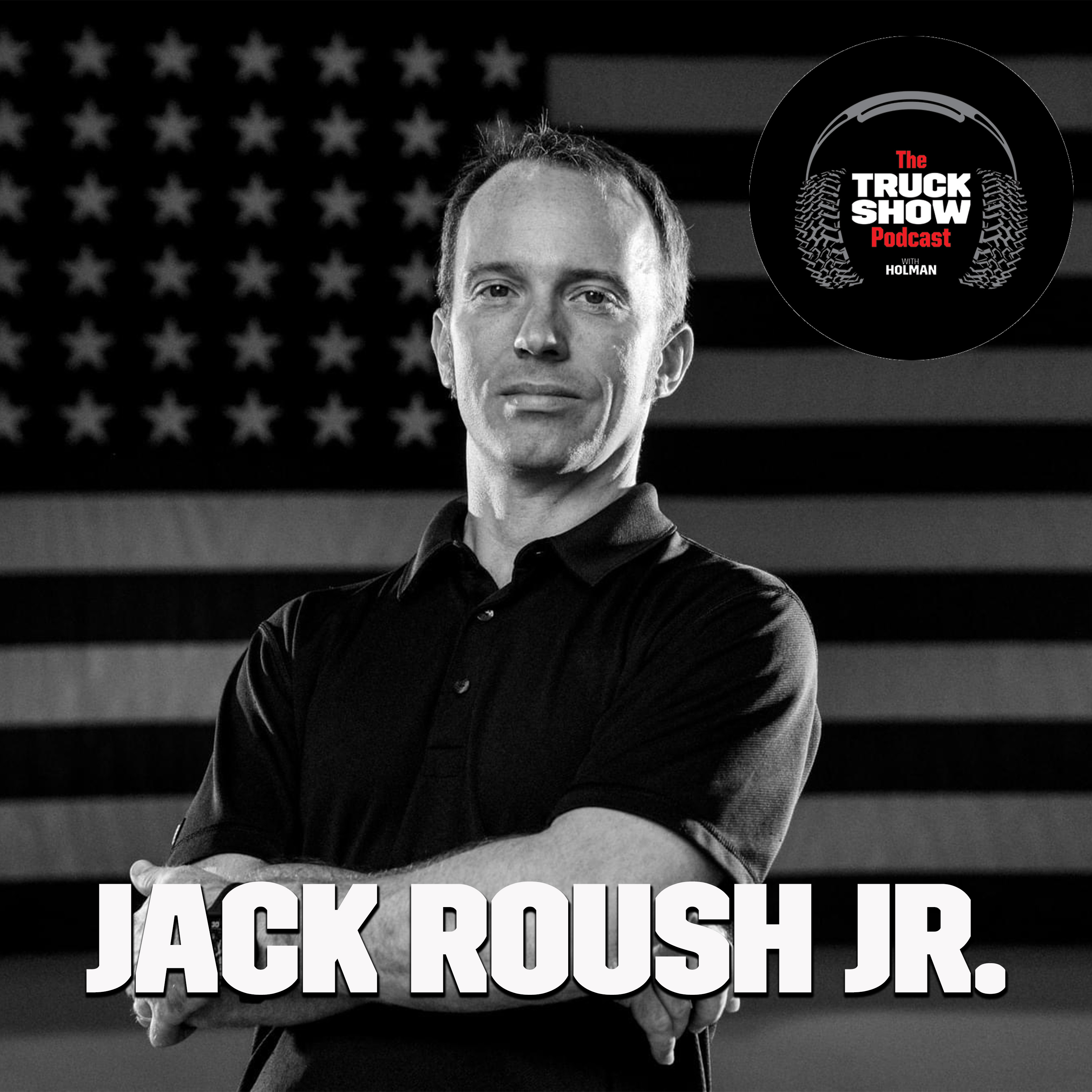
than Jack Roush Jr. Yes, that Roush. And we'll talk about his family business, racing, his famous
father, and of course, digging to some of the latest Roush products. But before we get started,
I have to confess, I might have pulled a fast one on you guys. And I posted a reel this past week on
At Truck Show podcast and at Sean P. Holman of What's in Holman's Driveway with a very close-up
shot of a particular red Jeep. Well, I might have been toying with you all a bit because I never
revealed what it was. However, there's some eagle-eyed followers on socials noted that despite being
red in Rubicon on the non-392 hood, there was a slider visible through the windshield. And it
is true, this Jeep is in fact the 25 Gladiator Rubicon I've been teasing you guys about. And
it just so happens to be the same color of my 392 flame red, which by the way is getting really
close to being completed at AEV. So more on the Gladiator later in this episode. And as far as
picking up my 392, which I'm super stoked on! Woo! I'm going to be flying out on Saturday night to
Michigan and hopefully leaving town by Tuesday so I could head out westbound and down and make it
home by the weekend. And man, I can't tell you how excited I am to finally get back into a Jeep I own.
This one's going to be cool. I know there's been a lot of questions about
what the changes will be from my 23 to this 25. And it'll have all the 25 upgrades. So
power seats, better sound insulation, new TKs, full-float rear axle, all that stuff. Of course,
the new interior and dash that has the nice big screen on it. And you connect five. So excited
for that stuff. But as far as the build goes, it'll look pretty much the same, although it'll
have some different AEV wheels on it going back to the Sevegre IIs, which I absolutely love.
No roof rack and go slick top, different front winch, which we will talk about in an upcoming
episode of the Truck Show Podcast. And a few new AEV goodies, which includes some AEV jail parts
that I don't think have been announced yet. So more to come on that. Man, I've been compiling a
ton of parts for the initial install and I'm going to bring a bunch of it to Michigan like the screen
protector and the 67 designs dash mount for my phone. So I have that coming back and all those
little odds and ends and as much as I really don't want to and didn't want to start over from
scratch on a build because my old one was almost perfect. I'm getting myself in a positive mindset
that it's always fun to tweak the formula and have an opportunity to do it again and refine what I
liked. So it'll be good. And my plan is to do a few shows from the road. Hopefully update you
guys as I'm crossing the country and let you know about my progress. And then of course you can follow
along on social as well. And kind of curious, anything you guys want to see me do to it when
I finally get it home. I've been vacillating whether I want to go exhaust or not on it. And
I'm still torn there. There are any widgets or jail things that you're curious about? Anything
I've missed? Go ahead and shoot me an email at truckshowpodcast.gmail.com and let me know what
you're thinking. All right, well, it's time to get into the show and into our interview with
Jack Rouse Jr. But first, let's take a moment to thank the companies that make this show possible.
The Truck Show Podcast is brought to you by the following sponsors. Amsoil launched the industry's
first synthetic motor oil back in 1972. And Amsoil continues to innovate with a wide selection of
synthetics that are formulated, blended and packaged right here in the United States.
These specialized lubricants are engineered for what you drive and how you drive. Amsoil's
shop-buy vehicle tool offers package size recommendations to maximize savings and includes
Amsoil's ultimate oil change kits. Amsoil offers the protection you demand and the performance
you deserve. Get yours today at amsoil.com. The perfect compliment to your truck is a
Kershaw knife. All Kershaw knives come with a limited lifetime warranty and repair parts are
readily available through the website. Kershaw knives include lifetime sharpening and the lineup
has everything from EDC knives that can be used and abused for under $50 all the way up to high-end
collectibles. Thanks to our generous partnership with Kershaw knives Truck Show Podcast listeners
can get 40% off MSRP and free shipping over $50 by using code 2TSP 2025. It can be used more than
once and even includes automatics. Visit kershaw.kaiusa.com today. When it comes to amazing vehicle-based
adventure content, how-to's and great storytelling, only one brand is doing it right in the print
magazine space and that's OVR Outdoor Vehicle Recreation. OVR is about getting out there in
our vehicles to explore and discover the world around us. Get complimentary access for a year
to the digital library or a discount on your print subscription today at ovrmag.com. Use the
promotional code at Truck Show Podcast. The Truck Show Podcast survives off of sponsorships and
your reviews. Please help me to keep it free by supporting our sponsors and leaving reviews
and comments on Apple Podcasts or Spotify.
All right, who's ready for some awesome podcasting content? Well, if you're listening, I'm guessing
you're waiting for me to give you something good and I'm gonna do that right now by playing for
you the interview with the guest for this show, Jack Roush Jr. Let's get into it. All right, so I'm
excited because today on the Truck Show Podcast, we have Jack Roush Jr. and so we have a mutual friend
Tyler and I was talking to him. In fact, I think he maybe saw the post I posted on the new frontier
that you guys worked on in collaboration with Nissan and he said, well, do you want to get Jack
Jr. on the show? And I'm like, yeah. And he said, well, let me hook it up. So I'm so glad you've
joined us today and the Roush Company is huge, whether it's engineering, whether it's performance
aftermarket, whether it's performance in conjunction with OE racing. I mean, there's just a ton of
stuff that you guys do and I can't wait to get into it, but every guest gets a jingle. So we'll
start you off with that and then we'll get into it.
So we have a bunch of goofy jingles. I thought that would be a good one for you.
That works. So you haven't always been with the family business. You kind of went out on
your own and started a tech company and then came back to the family business and now you're,
if I'm correct, VP of marketing? Actually, I'm the VP of brand strategy.
A little bit different, but we're growing as you were leading to, we're expanding into
new products with this Nissan partnership. But yeah, there's a lot to talk about.
As far as my background, I don't know if you want to go a ways back.
Yeah, totally. I think people are curious about where you came from because I think it's
automatically assumed that when you have sort of a famous family business, that the family
sort of comes up through that, but you really went your own route and then kind of came back
to the business after you had established yourself in other areas. And I always think
that's a really interesting story. Oh, absolutely. Now, growing up, it's funny when I think back at,
you know, really what made me wired for different things. It all comes down to when I was six years
old and man, this is going to age me, but it was around 1979. My dad got me started go-kart racing.
My mom started taking me to computer programming classes and also doing some music stuff. And I'm
still really passionate about all those things and obviously running a business, you know,
and that sort of thing is, I consider that a lot of fun too. You know, zooming ahead many years,
after college, like you said, I didn't immediately work for my family business.
I worked with some friends of mine during the internet boom, just trying to invent new technology.
We did a number of different things, some software for the major search engines at the time,
and some other things as well, but it was a lot of fun. I did that for about 10 years and
also at the same time got involved in road racing. I had grown up go-kart racing,
but RPP, Rosh Performance, was trying to drag me in. I was doing some consulting work for them at
the time and they also were pushing me to get into road racing to represent the brand and
things kind of evolved with that. And, you know, I'm super passionate about the performance side
of our business. That's where I've been ever since I came on to the family company. You know,
it's kind of hard for me to leave this part of it because think of it as the toy factory.
I remember the first time that Rosh was sort of a name was growing up reading all the magazines and
you'd have a car that was testing car and driver and motor trend and they were taking
Mustangs at the time. I think that was kind of the big product and I think I remember the first
time I saw one with a supercharger sitting at the dealer and there was, I don't know if it was
etcher, there was a window cling in the rear window, the quarter window that made it look like
it was your dad's signature in the glass. And I remember walking through the dealership and
being a young car enthusiast who loved magazines and all that, I used to, this is bad, but I used
to go to dealerships for sport and pretend I was in a position to buy a car and then shame the sales
person who knew nothing about the car and then walk out, you know, and just be like, oh, I can't
believe you don't even know about this car. I can't buy this from you. And my friends and I would do
that just because it was something to do and I'm sure we wasted a lot of sales people's times,
but I remember the first time I saw a Fox body Mustang, white supercharger sitting in the,
in the showroom and after all these years of reading about Roush Mustangs in magazines and
seeing them in print or, you know, on TV or whatever, there was one sitting right in front of
me and I thought that was so cool. I walked up on the passenger side of the car. I still remember
running my hand along the side on the passenger door walking by going, man, a real one. This is
so cool. Well, that's awesome. And I know you guys have expanded from there. You've had, got into
trucks and I'm sure trucks are a big part of your business. So probably want to talk about that as
well. But what was the point that you came on full time and then started advancing within the
company and how much of that was working with your dad? You know, he's, he's so busy with
different things, you know, the race teams, he's still super passionate about it. You probably
haven't met him in person, but he's fiercely competitive. You know, he really loves the racing
side of our company and even diving into, you know, the engines and then hands on with that.
When I came on to the company, you know, with my background in tech, I really saw a lot of
opportunity to improve the way that we did things online. So in the early years of my
being on RPP, that was my focus. But, you know, I also had a lot of background in racing.
So getting into the product side of the business, you know, was a natural
outfit as well. And I've, I've really been bouncing around between a lot of different roles.
You know, as you mentioned, more recently, I have been involved with marketing. During COVID,
we had a gap in needing someone to run the marketing department. I didn't really consider
myself a marketing person, but I have actually done a fair amount of that over time. And that
was a lot of fun too. That was, that was a really intense experience, by the way.
What were some of the racing series or racing things that you participated in? Because obviously,
working for a performance company, it kind of gives you the chops or credibility where somebody
said, Oh, what do you know about performance? Well, I've been on the track and that's, that's
where you started. I mean, not you personally, but I guess you did on the cart side, but the
company really started in performance and racing and, and brought that mentality and that brand
to regular everyday customers so that they could kind of experience a better version of their
favorite muscle car or truck and live in that in daily life. So you've had to have some sort of
interaction behind the wheel of a race car to understand what those customers' needs are.
Oh, absolutely. So starting in 2005, I did a little bit of drag racing in NMRA, if you're
familiar with that series, which is, I believe, still defunct right now. But in the next year,
I had the chance to do some road racing in IMSA. And that was just an awesome experience. Growing
up, I go cart race, which is essentially road racing. And in what was it, 1982,
after racing for about five years and, you know, having a good amount of success there. My dad was
being pulled off. He was basically recruited by Ford to run their road racing teams. They were
kind of struggling. And he had a lot of success there. I'm not sure if you're familiar with that
history. But before, you know, before he was in NASCAR, that was really, you know, he got a lot
of success there. And he had teams that raced against the greats. I mean, not that he isn't
one of them, but that class of racer at the time, there are so many great other teams that he
competed with. You talked about your dad being a fierce competitor. He was in the mix at the
very top tier and top echelon of those racing series during, you know, the heyday. I'm sure
looking back on it, you're in the thick of it and you're fighting it through and you're competitive
and you're doing it. But I'm sure looking back, you probably think, wow, that's so cool to have
been a part of that history. I mean, we were there. Oh yeah. Really proud of what he's done,
for sure. You know, one of the things in road racing specifically that was really inspiring
to me growing up is he went to the 24 hour race at Daytona. He brought bringing his teams 10 times
over the years, not consecutively, but 10 times overall. And he won every single time he went.
Wow. No one has ever done. So when he took a year off, the competition was like, oh,
so glad Jack's not here. So when, you know, obviously racing, big part of the business,
that's, you know, I would probably think it's foundational to what you guys do. But
in terms of not monetary outlay, but making money, I'm sure building up these bespoke vehicles that
you can buy from your dealer with a warranty or buy through you guys, when did that really start
and take off? Because if you go back in, I guess what you probably the 80s or something like that,
you're thinking of Roush and Saline and, you know, some of these other brands that were sort of in
that space, McLaren was there for a little bit. And there was a small group of performance companies
that probably haven't had the staying power that Roush has had. But you guys were all there,
sort of when that, I guess you would call it OEM tuner sort of thing kind of took off. Like,
maybe just walk us through the start of that business when it came and what's the secret
been to the staying power for the brand? It's kind of a complicated question to answer. I guess
just to step back, maybe this will help. Back in the early 70s is when my dad started the business.
He started with a business partner, Wayne Gaff. Actually, it was the late 60s, I believe 69.
And their business was in building race engines for drag racing. But in order to, you know,
prove out their engines for their marketing, they would go and they would race and they did extremely
well. He eventually split off and just basically bought Wayne out. And the company was called
Jack Roush Performance Engineering at the time. During the late, I think it was the late 70s,
he had some offerings for street Fox bodies. And he was one of the very few people that
were offering anything for that platform at the time. But, you know, as far as Roush Performance
as a division, that didn't start till 1996. So we have really been more of an engineering company.
You know, you don't really hear about that because we're, we do work in the cities.
You do a lot of stuff for like, if an OE comes with a particular engineering problem that you
might have a better acumen in, or maybe there's a military contract, or I think I read on the
company bio somewhere, even like amusement park operators and things like that. So there's kind
of a wide variety of engineering challenges that you guys tackle as a company. And some of it
may be driving something right now and not realize that you guys had your hand in it.
Absolutely. Yeah. And I can't really talk too much about that because, you know, that is work
that we do for other companies. Yeah, no, totally understand. I just think it's always interesting
when somebody doesn't make the connection of all the broad things that a company does. And
then of course, probably the most prominent part of the business is going to be your trucks and
cars and things like that, the F 150, the Mustang. And started with the Mustang, but
truck came along and all of a sudden trucks been a pretty strong piece of the business for a while
now, right? Oh, absolutely. Yeah. In 2005, the Mustang really blew up, you know, it really got
big, including for rush performance that really made us turn into a more significant part of the
rush company. We did have a truck early on, but that kind of fizzled, you know, after, you know,
the demand, you know, people just weren't really that into trucks at the time. 2017, I believe
it was, we offered an F 150 again, you know, thinking there might be a market and things really
just started to take off for truck in general. And since that time, sports cars overall have
kind of been falling in terms of overall market demand. Sure. And, you know, trucks, you know,
they're huge for us now. My theory on that is I believe that the last bastion of the true American
driving experience, big V eight rear wheel drive. And of course, some of the trucks have gone turbo
V six and things like that. But it really is the pickup truck. And especially when you go in the
off road side of the business, you're not worth, you can't drive a new, let's just say a factory
Mustang at nine or 10, 10 off a track. You just can't do it. The performance is threshold is so high.
And it's just, it's not safe on the street. You can't drive it on the street like it can be driven.
But when you move into off roading, it's kind of the last place you can drive a vehicle at eight
or nine tenths and do it legally, do it safely and really enjoy it being a driving vehicles,
you know, speaking of power slides on a dry lake bed or driving dynamics or again,
big V eight, big vehicle, rear wheel drive, and you know, add a bonus of four wheel drive.
So I really think that that's part of it is like cars outside of the muscle cars. So many
categories are either completely gone now or have been neutered so much for whatever, you know,
field economy standards and regulations that people found trucks and went, Oh, I can still
have a similar experience. And this is kind of a cool new way to have it. Oh, absolutely.
Yes. There's a lot of different offerings out there right now too. And I think one of the ways,
you know, we've really differentiated ourselves is to not try to completely or we don't directly
compete with Raptor. Our strong suit, our focus has really been trying to give vehicles a lot of
utility for the road, you know, still having, you know, really good towing capacity, while also
having a lot of really good off road capability as well. I think one of the cool vehicles you
offer right now is the, the nightmare. And I love that truck. I've got a friend of mine is probably
listening, my buddy Bradley, he loves the fact that you can order a regular cab, short box,
F 150 with a five liter. And then Ford kind of figured out, you know, it was just part of the
configurator, right? Like, oh, it's just a fleet truck. If you don't want to pay up for the V six,
whatever. But then they realized, Oh my gosh, there's this performance component. In fact,
when that truck, the current generation, when it first came out, you couldn't get the bigger
screen and stuff. It was kind of like, I think XLT was the highest trim level. So having the ability
to come do all the chassis mods, the performance mods, and then bring the interior along for the
ride, if you will, to make it so you could have that more luxurious truck, even though it's a
regular cab short box. There are so many people that are in love with the romanticism of a regular
cab short box truck. I mean, you think back to some of the short and wide Chevy C 10s and,
you know, 67 to 72 Ford F 100 bump sides and things like that. And, and the fact that you
can get that in a modern package and you guys offer this really cool lowered performance V eight
powered truck is, you know, to me, I love it. It just, it looks right. It sits right. It's so,
it's so proper the way a sport truck should be done. Oh yeah, it is a lot of fun. I've taken
it on this autocross course that we set up for, you know, just our employees one day and thing
just is incredible, you know, the cornering capability. I've never driven a truck that
can handle like that. In fact, I don't know for sure. I didn't think that there is another
production truck with that, that high of lateral cheese. Yeah, you guys are saying on the website
that you guys are able to get over one G of cornering capability from your chassis tune on it.
And to me, that's incredible. I mean, it's, it's very rare that a truck can out corner sports car.
I know when Toyota came out with the Tacoma X runner years and years ago, one of the things
they benchmarked, I think was the Z or the Supra in cornering capability. And that was a big story
with that truck. We obviously pickups are a little trickier because they're nose heavy and,
you know, leaf sprung in the back. And so there's some challenges, but the fact that you're able
to ring every last bit of performance of somebody can truly enjoy driving, whether it's a freeway
on ramp or a curvy mountain road, whatever it happens to be, I think that is, that is super
cool. And the price is pretty reasonable. It's 20,000 over a regular, you know, F 150 that you
would supply for, for that build. Yeah, it's definitely a lot of truck for the street.
I wouldn't off-road it. You know, it's a little bit of our other offerings, but
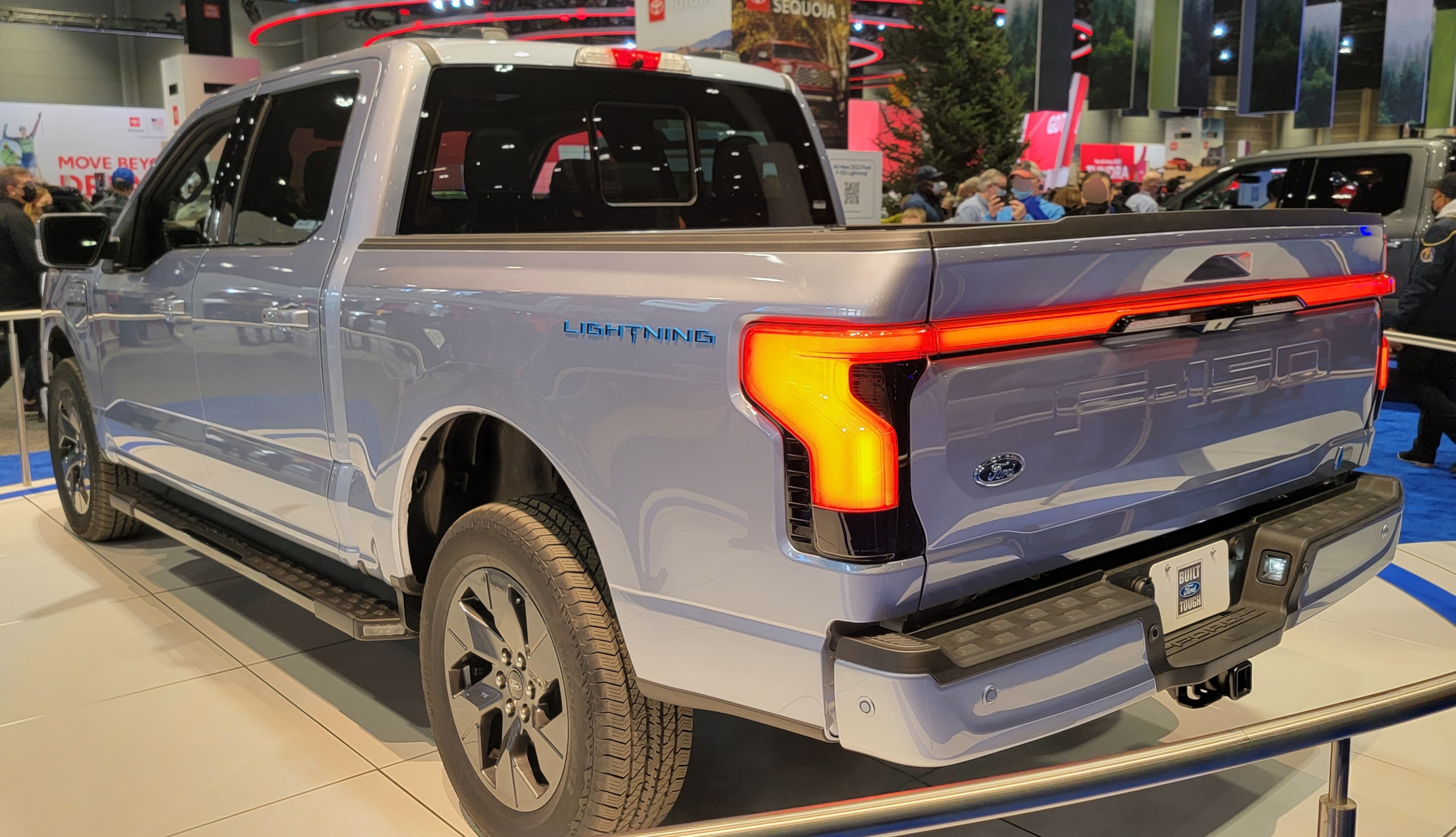
yeah, for sure. You guys have the Roush F 150 and then you also have the Roush RT6. And then
fairly recently is when you added Super Duty to the lineup. Has it been around for a while?
We've had it for quite a while. Okay. What are the differences if you're on Roushperformance.com
and you're looking at the website and you want a truck, what are the differences between the
F 150s? Sure. So the, you know, our Roush F 150 is a little bit elevated, you know,
that one really, as far as the F 150 offerings, that one has a lot of off-road capability,
but it also has the most towing capacity. The nightmare and the RT6 really are not engineered
for towing. You know, those have their own unique characteristics. I guess we went through the
nightmare, you know, lowered really great track performance. The RT6 is brand new. It's raised
six inches where the standard Roush F 150 is not raised. It's a two inch leveling kit on that one,
but what's unique about the RT6 and the bigger market, you know, there are other lifted trucks
out there, but it's thoroughly engineered. It's not like we just put shackles on it to lift it up.
And I think if you had the chance to write in it, you'll notice it's a lot better mannered
than, you know, a truck that's just raised. This is one of the things that caught my eye because
we know ADOS is becoming an issue in the aftermarket, which we've talked about on the podcast
before. That's the Advanced Driver Assistance Systems. And the issue with the more complicated
ADOS systems is the manufacturers haven't really given a margin for a lot of aftermarket opportunity
to recalibrate. Now some of them do, but you get to a certain lift height or certain bumpers where
the sensors don't work or the cameras now aren't in calibrated to the distance in the road for
adaptive cruise and emergency braking, all those things. One of the neat things that you've mentioned
on the website is that you guys have not only validated to FMVSS, which is the handling and
you know, roll over and all that kind of stuff, but you also made it fully compatible
with the Ford ADOS system. And that's a huge thing with a company like Roush being an engineering
company is you can provide those solutions. So when somebody gets into your car or your truck,
it's a fully baked vehicle. There's not, Hey, this is a great vehicle. Yeah,
live with those warning lights that are on the dash or these, you know, beeps or air,
they don't mean anything. No, you guys have engineered a complete package or a complete
application where the customer has a seamless experience. And I think that is so huge in
today's world of much more complicated vehicles. Oh no, you're exactly right. You know, that is a
huge challenge when we start to do these different packages and mess with the height a little bit
or a lot. That is always a major concern and a challenge to get those sensors and those systems
to work correctly. So you have been aligned with Ford as a company for a very long time.
And we have a great relationship with Ford. We have a great relationship with Nissan. And
many months back, having some conversations internally with our friends at Nissan,
it was hinted that there was a more performance oriented version of the Frontier coming out.
And finally they released it and we could talk about it. And I was actually really impressed
with what you guys were able to do. And you know, I've said this on the podcast before,
the Frontier project with Roush wasn't out to be a Tacoma TRD pro fighter or anything like that.
It was designed to show Nissan management that customers were hungry for a performance
version of the truck that was leveled up, that had more off-road capability, that had some more
ground clearance. And it's sort of a dabble into what can we do with this platform. And they
partnered with you guys. So you'll be able to go to the dealer, you buy a 2026 Nissan Frontier Pro 4x,
they call it the R. So it's the R outfit. So basically order from the dealer, everything's
covered under warranty. And it goes to your outfit center before it gets delivered to the customer,
unless of course the dealer has it on the lot is how I understand it. And I was looking through
the changes. By the way, the wheels, whoever designed your wheels on that truck,
those are some of the best looking OE offerings that you can get out there. What a gorgeous wheel
that is. Oh yeah. Yeah. I think it is a great package. It really is a good value too. A really
good value. We looked at it. I don't remember what it is up top of my head. It might be around
$5,000 or something like that. But what you get is, you know, leveled in the front, you get the
Olens and Roush shocks, you know, that you guys tuned. Olens, obviously a massive name
in Europe and on motorcycles. And they've dabbled a little bit in the aftermarket
on this side with, you know, Jeeps and things like that. But they haven't really made a name
in OE. And it's kind of like when Multimatic came to the GM platforms with their spool valve shock
and everybody went, well, that's a racing shock. How's it going to do off road? And that's been a
really good change for them. Because usually you hear about some of the greats in the industry,
the Bilsteins, the Foxes. I've had people ask, well, tell me about these Olens. And
that is a great talking point differentiator because people are going to want to know about
the suspension. And then the other thing you guys did, other than the Roush branding, is an all new
upper control arm so that it can be aligned properly and, you know, OE spec. And you guys have
this really cool powder coated red arm that looks like it's cast. And it's just a little bit of a
hint. Like there's more performance here and we did the lift right. I'm excited about it. Maybe
walk us through how did that happen with Nissan out of all people? And what was the process for
developing that truck? It's been, you know, in development for quite a while. And I haven't been
directly involved in all of the discussions, but Nissan has a long history as well. They produce
great products, including in the USA, the Frontier, Pro4XR is as well. Our facility for
upfitting the Frontier to be a Pro4XR is right next to their plant. And as far as the development,
we work very closely with them. And with Olens, none of the parts have just been thrown out of
vehicle and called good. We have to go through and thoroughly test, thoroughly develop even for
the suspension. We co-develop the system with Olens. It's kind of funny we are in the performance
space, but a pet peeve of mine is, you know, when people call us tuners, no disrespect against the
aftermarket, which we are in by the way, but we really do have high standards for everything
we put out there. So the number of hours and months and money that we put behind each of
these products is pretty significant. Yeah, I want to make sure that people understand that,
again, you guys are an engineering company. And so all the products that come back are
fully baked to basically an OE level through an aftermarket company. And there's a few other
companies out there in the off-road space who do that type of development. AEV comes to mind as
one of those companies that is an OE tier one, but they're at that level for their aftermarket
stuff as well. And I'm always a big proponent of that because you're going to have a durability,
the finish on the parts, salt spray, you know, all that kind of stuff, but you're also going to make
sure that the vehicle works as intended and you're not going to have these goofy things of, oh, well,
it'll handle weird here, don't do this here, or this lights on there. I mean, that's really
important to a buyer who's going to plunk down $50,000 for a vehicle. And the Frontier is a
great platform. It's one of our favorite trucks. And I've always said it just needs a little bit
of a lift, just needs a little bit more. And I've been super impressed. I get to go out on the drive
at SEMA in a couple of months where I'll finally get to get behind the wheel of it.
And it'll probably be a year since I've, you know, by the time that comes up,
since I kind of, it was hinted at. So I've been waiting for this truck and to see that you guys
were involved and the value that you get also, it's really impressive. Oh yeah. I'm excited.
You know, I think it's a really cool time, you know, as we're exploring new things to do.
Yeah. And have you guys had a good response from just consumers once the release went out? I mean,
Roush is a premium brand. And not that this is a budget product, but it's going to be a
lower price point for somebody who wants to get into the Roush family. I could see somebody
with some of your other products going, this might be the perfect vehicle for my kid, or this
might be the perfect daily driver, because I don't want to put a bunch of miles on the
Mustang or something like that. What is the response been from a company? Because
I'm sure a lot of people didn't see this coming.
You know, that's an interesting question. If you look on social media, there has been
some people who then anti-Nissan, pro-Ford only, which by the way, we are pro-Ford and
really value that partnership too. Of course. It's really, like I said, exciting to get into a new
market. The fact that it is lower priced, it's really nice to be able to offer product to people
who don't necessarily have the budget to buy a super duty as an example.
What is your favorite vehicle in the portfolio? Because I'm guessing you probably get to drive
them all, right? Right. You know, that's a good question. It depends on my mood.
Okay, that's fair. You know, I have an F-150, one of our F-150s, and it's awesome. I have it
supercharged. It's actually a 2020 F-150sc. And that thing is just a beast. Talking about, you
know, having too much power on the streets, that thing is ridiculous. I shouldn't say more than
that. But you know, I'm kind of itching to get a super duty to myself. I'm working on my Christmas
list. The new super duties are nice. And I'm a big fan of the 7.3 gas engine. And, you know,
diesels with all the after treatment and things like that. If you don't work them, you know,
a lot of people we call diesel inappropriateness on the show, but you go out and buy a diesel and
you drive five minutes, drop your kids off at school, you're just plugging up the DPF and
you're not using the engine. And I tell people, unless you're towing those massive like over
15,000 pounds, the gas 7.3 is a fantastic engine. And while it may not be as fuel efficient,
it's cheaper to maintain. You can put a supercharger on them. You can also, you don't have DEF,
so there's an extra fluid that you're not worried about. And the difference is what,
$12,000 to upgrade to the diesel. That's a lot of gas you can buy for $12,000 and potentially
have something that, you know, could be a more reliable engine, depending on how you're using it.
I think as a base vehicle, that super duty tremor, I would love to see that truck with
the Roush overlay on it, because I think that would be such a sweet ride.
Oh, for sure. Yeah. And I probably would go with the diesel, but I definitely hear what you say.
Yeah, I mean, if you have the need for the diesel, by all means, it's an amazing engine.
It's just so hard with all of the regulations. And yeah, we get great power, but it comes at the
expense of, you know, dealing with the DPF and extra fluid and all that kind of stuff. But I
don't think you can go wrong either way. But there's just something about the sound of a
gas V8 under the right foot that just makes me happy. Oh, for sure. So you said you have a 2020
F-150. Yeah. Most people are probably surprised to hear that. They probably think, oh, you know,
you probably get a new truck every year. What is it about that truck that you like and
the longevity of it in your stable? You know, it's just lasted. It's lasted really well. I get to
drive, you know, other vehicles in our stable here at RPP as well. Kind of funny story about
that truck specifically. We used it back in 2020 for a lot of different video projects,
including shoot that we did with, not sure if you've seen it with Chris Carracci,
a good friend of mine out in Las Vegas in the desert. And we ran this thing through its paces.
Aaron Kaufman did a review of it anyway. Love Aaron, by the way. Aaron, for those of you,
I mean, he's been on the show. He's a friend of ours, but he is a madman. Once he gets going,
you just, you can't turn him off and his mind is spinning. And I love hanging out with Aaron,
when he's, especially when he's in that mode of trying to come up with something creative to do.
It's so much fun. Oh yeah. So this truck had a hard life in its first, you know,
1,000 miles. And it was pre-title, you know, it was a demo through a dealership. And I was like,
man, you know, we really worked this truck hard, you know, do I feel good about selling this to
a customer? Yeah. I'm just gonna buy this vehicle. And, you know, if it needs some work, I'll deal
with it. And it had a little bit of sand in its shocks and, you know, creaked a little bit more
than normal, but it's just lasted, you know, it's, it does a really great job. And I do a lot of
toying with that thing, probably more than I should, but. So you do need a super duty. Yeah, I do.
How do you balance all this? You've got a wife, four kids, right? And you've got other hobbies
as well. I understand like you're really into music. Yeah, absolutely. Now it's,
we're really busy, you know, just trying to keep up on everything, but it's all good.
How often do you see your dad and is he involved day to day or how involved is he in the company
that has his name on the door? He's super involved. Every day, he's still here. He's 83.
I don't think he could keep him out of the building. Back in here, you couldn't, but yeah,
he's super involved. So moving Roush from where it is now into whatever the next chapter ends up
being, what is the brand promise that Roush gives a customer and where do you see the company going
from where you're at now, at least on your side of the business to where it might need to go in
the future? That's a great question. You know, I guess where my head goes with that is really
since the very beginning for my dad, starting it essentially by himself, but literally just a
very small team of people. It's always been super passionate, people trying to solve hard technical
problems with strong capabilities. And we've really specialized in mobility. You know,
obviously there's the racing, there's the performance side. There's other things behind the
scenes. A lot of it, not all of it, but most of it is focused on mobility. How can we make systems
that are super reliable with very high demands? Kind of where we shine. I'm curious, thinking
about your history and your past growing up. What are some of the people that you were exposed to
growing up that the listener might, oh, he knew that person. Are there any famous racers or people
or friends of the family that you learned a lot from or mentored you or you think back of
how cool I knew or know so and so? Yeah, I mean, probably, you know, no big surprises there.
I think probably the most famous person that I got to meet, I wouldn't say that I knew him very
well was Paul Newman. Oh, yeah. Huge name there. He was a fierce competitor of my dad's dad in the
road racing program for many years, but he also was one of the winners on my dad's team of the 24
hour race that I mentioned. It seems like your dad had a lot of people that he went toe to toe with
and was fiercely competitive with that ended up being friends later in life or coming over to
this side of the business. And it's kind of interesting to read the bio and see like all
these names and people, but you come to find out that the respect was mutual and they're able to
form a friendship or a bond coming out of that kind of being in the fight together, even if it was,
you know, as adversaries. Oh, absolutely. I got a really funny story along those lines,
if you've got a minute. You probably haven't heard this name, but a guy, a dear friend of mine,
unfortunately, he's passed away now. They probably haven't heard of his name was Brad Francis.
He was absolutely brilliant. You know, he was kind of my dad's arch nemesis in drag racing
and road racing and in NASCAR. Like my dad started in drag racing. He had a period in road racing
where he really focused on that. And then NASCAR and Brad ran teams at those same times. And
Brad's team did very well competing against my father. Brad was really kind of a mad scientist
like my dad and really try to innovate technology for the different programs that he was involved
with. He eventually joined my dad's team and headed up his skunk works in NASCAR. Prior to that,
he was behind the scenes with Dale Earnhardt's team. And like I said, I started my road racing
program in 2006. A couple years after I started, my dad was like, well, you know, I got a, I was
road racing, not with the family's team. I was running with another good friend of mine, Dean
Martin. And my dad wanted to make sure, you know, we were as competitive as possible. And he sent
Brad out to kind of recon my team. And he didn't tell me anything about it. Brad just showed up.
I didn't, I didn't even know Brad at that time. I had met him once. It was one of the test days
for the Daytona race in January. I think it was 2008. And Brad and I were just getting to know
each other, had dinner. We were hanging out outside the hotel. And one of the first things that he
said to me when we were hanging out was, I've known your dad for 40 years. And for 30 of those years,
I hated you. I was like, Oh, what? This is starting off well. Yeah. No, but it was awesome.
I won't say that we cheated, but we pushed the limits and had really fast race cars.
And Brad was a huge element of that. If not, you know, the primary.
Does racing and proving out the products have value in your street products as far as development
and durability and things like that? Absolutely. You know, I think we don't always have the
opportunity as far as testing parts that we have on our street vehicles. You know, that's
kind of challenging with the homologated series. Now with IMSA as an example, each part is very
specific. You know, you don't have any freedom to do anything else. However, the theory to be
involved with racing, the theory in performance tuning, all of that is super applicable. And
being involved with road racing has really given me a lot of experience and being able to do that.
So what happens in the development of a new product, let's say four drops, a new truck
tomorrow, and you guys say, Oh, we have to give this the Roush treatment. What does it look like
from the day you start to the day that you debut it? What's the process like? What are you going
through to decide what it needs to be, to decide what you need to do to it to meet those goals,
to price it, to make sure that it's something that the consumer that's desirable. I would imagine
that's a pretty involved thing to decide, Oh, we're going to make a new product and bring it to market.
Oh, absolutely. You're right. It is a super complex process. You know, I think I'm just
speaking, speaking loosely here, one of our program managers would give you a much better
answer for this. But we really start with the concept, basically a discussion of, you know,
what we want to do, different for carryover vehicles and parts. But if it's brand new, like,
you know, the RT-6 as an example, you know, that's very new, we just launched that.
It was a concept, you know, we thought, Okay, you know, we'd like to do a lifted truck.
But, you know, what does that mean? Well, you know, let's explore that a little bit. It'll be a
little bit different for each different product that we come out with. But eventually, we'll
need to have, you know, beyond the idea, we'll have to have, you know, a proposal written out for
what we'd like to do, some loose budget pricing, you know, kind of a loose concept. And do we want
to proceed further? Eventually, we'll get what we call a PBL, the product description letter,
which is a lot more formal. And if that is approved, then we will kick off the project.
As we develop the product in more detail, you know, we may be surprised by cost,
or maybe there's a limitation on different things that we find, and we'll have to adjust for that.
Maybe the performance goal is X, but the chassis only allows for Y or something like that.
Right. Or maybe the OE changed something, you know, in their production.
Which happens all the time, by the way. I mean, and you working with Ford knows they're notorious
for, oh, let's do some metrics, some standards and torques all together in one vehicle. And you
know that they love mid-year changes. And then you're like, oh, man, what serial number did that
start at? And then you have to figure it out and do the adjustments. But I mean, I would imagine
doing these types of aftermarket upfits, that's a big deal is to try and, you know,
suss out anything that is going to limit your own production and your own sales goals.
Yeah, you're right. You know, even if things go right, we have very little time to really
engineer it all. We usually come out a little bit later than we'd like to because we hit some
type of snag or, you know, we want to make sure everything is perfect, which is you can't ever
be perfect, but, you know, we try to. Yeah, it is challenging, but if it wasn't, then why would we
be doing it? Yeah, absolutely. So you guys have a new line of products for Bronco as well. And
you have a huge catalog of Roush performance parts, whether it's superchargers or exhaust or
suspension upgrades across the catalog. So you can either buy a vehicle that's completely built,
done, but you can also go to the Roush catalog. What's the best way to purchase? Is it from the
Roush performance website or is it through a Roush dealer? You know, it's really,
depending on what the customer wants to do through DIY. We have a lot of great dealers
throughout the country. You know, you can buy through us, but dealers are great option as well.
You know, not just car dealerships, but there's online retailers as well. For things like a
supercharger, I would strongly recommend, you know, someone who would install that as well
to make sure it's done properly. This has been awesome. Appreciate the small peek inside Roush
performance. And if anybody's listening and you're interested in knowing more, you can go to
the Roushperformance.com website. And then you guys are all over social. So it's Roush performance
on Facebook. It's Roush Perf on X. It's Roush performance on Instagram, Roush performance
on YouTube. And then of course, Roush performance on TikTok as well. So you guys have the full
social gamut. And if you're interested in being more involved, you can head over to LinkedIn
because you guys also have a company page on there as well. Yep, absolutely. Thank you,
Jack Jr. Really appreciate your time today. And can't wait to see what you come out with next.
It's fun to see some of the new products like the Nissan that are a little bit surprising. And I
can't wait for that to hit the market because I think that's going to do really well for you.
And it's exactly the vehicle that Nissan needs in that space. So it's neat to see you be a part of
it. Awesome. Well, thanks, Sean. Well, awesome. Appreciate your time. And hopefully we'll talk
soon. Thank you, Jack Roush Jr. for joining the TrekShow podcast and giving us a little insight
into Roush. Very cool. That was one of those really special brands growing up that was always
part of the car magazine world. And you always were mesmerized when you saw one in person and
to see that longevity at their company and have them come on the show is a real treat for me.
So again, thank you to Jack Roush Jr. All right, let's get into our next segment.
What's in Holman's driveway?
Well, it might be a mystery to you guys, but it's never a mystery to me. There's a service that
comes in, drops keys off and vehicles. And then I have to give them back after a set amount of
time. Sometimes it's a few days, sometimes it's a week, or in the case of what's in my driveway
right now, maybe if you want. So this is the Gladiator. And this particular Gladiator came
to me from Jeep. And it's a vehicle sporting the Jeep performance parts, two inch lift. And
when that lift first came out, they had foxes on there that now features billstones. And I got
to tell you, the ride is really good on it. And it's got a set of 35 inch, actually the
LT 315 BF Goodridge KO twos mounted on the Mopar accessory wheels. And it's flame red,
it's super bright red, painted top painted fenders, the way a Gladiator should be because
I think a black top looks better on a Wrangler because it says the top comes off, but it looks
weird on a Gladiator. The Gladiator looks more like a traditional truck when everything's painted.
I just think it looks better that way. And so this thing's been sitting in front of my house for a
few days now, and I can see it from my office window and I look at it and I'm like, man, that
thing is cool looking. So needs the tires. I think 35 is how they should come from the factory.
Anyway, I'm going to have this thing for a while and I'm going to be evaluating it for
off road and ride comfort. I'm going to probably put it through its paces up at the property,
things like that. But JPP wants to work with me on some upgrades that they offer. And we'll talk
about those. So there's anything in the JPP catalog that you guys are curious about or you want to
see on this thing, shoot me an email. And if I can show the powers that be a Jeep like, hey,
the audience is interested in knowing about this product or I can do a review on this or we can
do an install or whatever, I think they'll be happy to send it out. And we'll talk about this
Jeep a little bit more, but really happy to have the Gladiator and it's going to be staying for
a little bit. So you'll hear a lot of Gladiator content. And so far I've put probably half a tank
through it. And I like it a lot. It came to me with just about 1800 miles on it. And again,
rides great, feels really tight. Love the new interior, the screen, the power seats,
all the stuff I'm going to have in my 392. So I'm getting my fix, I'm getting my fix. But
shoot me an email, truckshowpodcast at gmail.com if there's any questions that you have or things
you want to see done to it. And I'll be more than happy to answer your questions or give you some
insight or whatever. I'm looking forward to it because I haven't been in a Gladiator in a while.
And I certainly haven't been in a lifted Gladiator. I don't think I've ever had a
tester that was lifted. So that's pretty cool. Superstoke, thank you Jeep for the loan. Thank you
JPP and the crew over there for outfitting it and can't wait to get some seat time in it and
put it through its paces. More to come on the Gladiator. But for now, that's going to do it for
this episode of the Truckshow Podcast. Don't forget to follow us on social at Truckshow Podcasts
or at Sean P. Holman. And we want to hear from you. Be a part of the show. Leave a message.
Five Star Hotline 657205 60105
And give me your feedback. Truckshow Podcast at gmail.com could be about a topic, could be about
a show, could be about a guest, could be about the 392 that's inbound. Ah, yes!
Or it could be about the Gladiator that's currently in my driveway.
Whatever it is, Truckshow Podcast at gmail.com. We love reading your emails.
And think about it. Join the Facebook group The Podshed Insiders. We're having a lot of fun in
there. Why not? It's about 450 of like-minded, fun, loving, knowledgeable podcast listeners.
All in there. They all hang out. We got some everything from memes to discussion on problems,
parts, vehicles, whatever. We have a good time. So head over to Facebook and once you join The
Podshed Insiders, don't forget to send in events, even if there's stuff that's a year out.
I'll put them on the calendar. Know your notes. I'm still looking for those.
And I want to thank our sponsors. Of course, if you love your vehicles like we do,
then you want to use the same products we do. And those are the best synthetics,
whether they're oils or car care products or oil change kits with filters and a funnel and
everything you need. Amazon.com, you can get everything you need right there. And of course,
Kershaw knives. If you have a truck, you also need a pocket knife to go with it.
Get yours today at kershaw.kaiusa.com. You can use the discount code to TSP2025 and get yourself
a really fat discount on any of Kershaw's knives, including automatics. And of course,
ovrmag.com, if you are looking for the best adventure content out there in a old school
print magazine, that is old school in the sense that it's big, it's heavy and it's full of pages
and not like one of those recycled, thin page mags. No, if you want ovrmag, you can find us
nationwide at Barnes and Noble, Books and Million, but you don't even have to. Go to ovrmag.com,
put in our discount code, and guess what? We'll give you a free digital subscription
or a discount on a year's subscription, which covers you for 12 months and six issues.
Anyway, thanks for supporting our sponsors. Thank you for supporting the Truck Show podcast.
And thanks for listening. Let's do it again soon.
The Truck Show podcast is a production of Truckfamous LLC. This podcast was created by
Sean Holman and Jay Tillis, hosted by Sean Holman and uses production elements by DJ Omar Khan
and Jay Tillis. If you like what you've heard, please open your Apple podcast or Spotify app
and leave us a five-star review. And if you're a fan, there's no better way to support the show
than by sharing it and patronizing our sponsors. Some vehicles may have been harmed during the
making of this podcast. Dude, I'm getting my 392 back. My new one. I can't wait.
I should just play all the jingles that have to do with excitement.
And then as I'm going through it right now, I'm realizing we don't have a lot of positive ones.
That one. And yeah, you know what? Maybe I need to have more happy jingles because all of our
drops are like this. This is the worst show we've ever done. All negative. Man, I guess we're
still self-deprecating. All I know is I get to head out in less than a week and then pick up a
brand new Jeep and drive across country home. I'm so stoked. So anyway, I know you guys probably
don't care and you're sick of hearing about it, but I don't care because after everything I went
through in the last six months, it's going to feel like normal again to get my Jeep. So anyway,
thanks for hanging with me. Thanks for putting up with me and thanks for indulging me in all my
392 talk, but I'm going to get some audio clips going for you guys and that'll be some happy,
happy music. And if you forgot what it sounded like, it sounded like this.
All right. See you later in the week for Happy Heard. And then I'm out of here.
About this episode
Jack Roush Jr. joins the Truck Show Podcast to discuss his journey from tech entrepreneur to VP of brand strategy at Roush Performance. He shares insights about the family business, the evolution of Roush products, and the exciting new partnership with Nissan for the Frontier R. The episode dives into the history of Roush, the significance of racing in product development, and the growing demand for performance trucks. Holman also updates listeners on his new Jeep Gladiator build and invites feedback from the audience.
Jack Roush Jr. joins the show to talk about all things Roush, including his famous father, chasing down his own roads outside of the family business, racing, insights into Roush, and of course the latest Roush products. Holman also reveals what's in his driveway. The Truck Show Podcast is produced in partnership with AMSOIL, Kershaw Knives, and OVR Mag.