LIVE
I joked, but actually, I think it's true.
And I said, Dad, this must be how it felt like when the internet came out.
It's a good analogy.
And I was like, you guys didn't know what was going on,
and you thought it wasn't going to last.
I said, that's kind of us right now.
We're all scrambling.
Everybody's coming out with AI this and AI that.
So really just trying to keep up.
Welcome to the Walkaround Podcast, powered by JM&A Group.
I am your co-host, Mark Spoto, joined by Heather Wilkinson.
And here we are again.
Here we are at SiriusXM Studios at the Wynn Las Vegas.
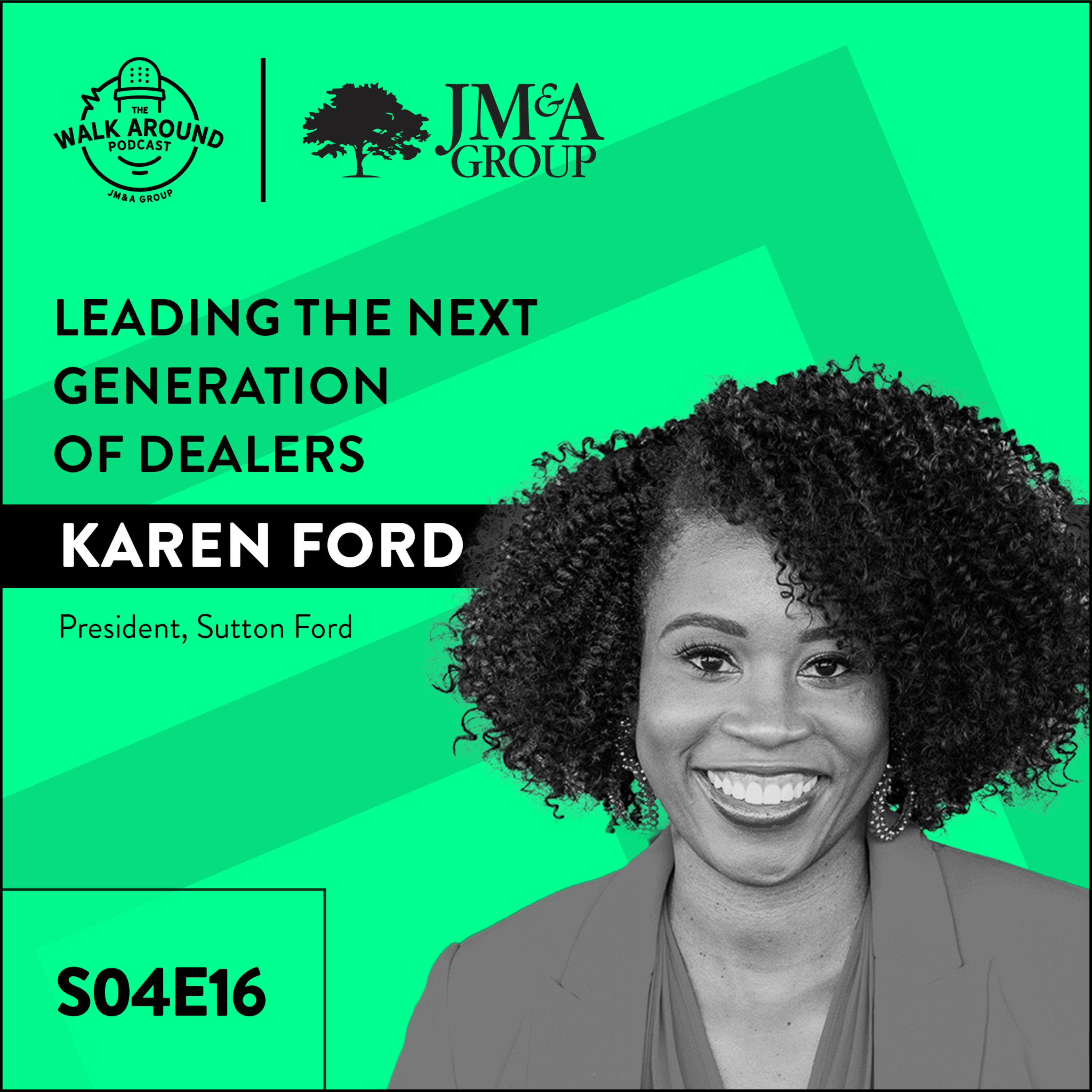
And we are joined by a very special guest, Karen Sutton-Ford.
Karen, you are president at Sutton-Ford, vice president
at Cocoa-Ford, and the incoming president
of the Next Gen Committee as part of NAMAD.
Yes.
Welcome.
Thank you.
Thank you for having me.
Of course.
So I got to ask this right out of the gate.
Mark and I were talking about this.
Mark even asked me.
Was this?
Best bet, or gamble?
Marrying someone with the name Ford.
Was that a requirement that you had, or how did that work out?
I wish.
I wish.
I had to joke.
I had to go all the way to Georgia to find him.
I was in grad school.
I was only there for a year.
And we actually made it a protest.
So he just stopped me to ask me a question.
And then somehow we exchanged numbers.
It was like there was somebody else.
We all exchanged numbers.
And then the next day, we went to church.
And just kind of started communicating.
And now I was like, I just said, I'm from Chicago.
And I'm leaving.
I literally have eight more months here in Atlanta.
And he's just like, OK.
And that's how.
And then he didn't understand.
So everybody would meet him.
And he would introduce himself.
And they would kind of laugh.
And he'd be like, what's so funny?
And I would try to tell him I kind of grew up around Ford.
We have a dealership.
It's called Sutton Ford.
And he was just like, it's not that funny.
So then once he finally saw it, it was like, I
can understand the irony.
When you're not in the automotive industry,
it's hard to make that connection.
But I'm sure the Ford corporate people love it.
Love it.
I'm sure.
Karen Ford.
So my dad's like, you can't name it like,
what if you go buy another brand someday?
And I'm like, dad, I can't think that far, dad.
And when we had kids, they're like, you should name your child
Lincoln.
So we often talk with our guests on the walk around
about their journey into this business.
And sometimes people are bored into it.
Sometimes people fall into it.
But ultimately, they love it.
And in your case, it's kind of both.
You were born and you fell into it.
So take us back and tell us how you got to where you are today.
What was that experience?
So in my parents bought the dealership in 1989.
So at the time, I was maybe walking, maybe not.
And basically growing up, apparently around like 11,
I used to say, I want to take over.
This is what I want to do.
Wow.
And they're like, she's a kid, you know, whatever.
And the rule at home was always after college,
you have to hopefully you go to college, right?
And after college, you have to go get a job.
You cannot come back and work at the dealership.
Now you can go get a job at another dealership
if you so desire.
But they preferred us to go to corporate America.
And why is that?
What was that?
My dad would always say, you need to get beat up.
You need to get beat up.
You need to understand when it's like the politic.
You need to really understand corporate America.
They have a lot more money and structure in corporate America.
So that's what I did.
And I still followed his footsteps
because he worked at IBM before he came into the dealership
world.
So my first job was with IBM in New York.
Then I really wanted to get into the,
I was looking to go to the automotive sector within IBM.
And I said, hey, dad, can you help me get a job in automotive?
And he was like, no.
I'm like, what?
So I said, oh, how about this?
I was like, you're going to NADA.
Can I come with you?
I said, well, you passed my resume around.
He said, no.
So then I invited myself to his NADA trip.
And we were down here.
I think we stayed at the Paris or something.
And I brought my resume.
And so then I worked at Toyota for a couple of years.
Really?
Yeah, Toyota corporate.
And then I got the call.
So I was in the San Francisco region at the time.
And I got the call, you know, hey, it's time to come home.
I was like, what?
I'm having, I'm just having a blast.
You know, the weather out there.
So I said, but because I lived in San Francisco, a lot of friends,
they were interested in graduate school.
So they might come stay with me and then go visit, you know,
UCLA, Berkeley or Stanford, whatever the schools were
that they were going to see.
So I said, you know, dad, I heard that there's this thing.
There's a one year MBA.
And he was like, oh, what?
I said, yeah, yeah, there's one one year MBA program.
So can you just give me like one more year?
And he said, you got one year.
That's it.
And so I applied.
Thankfully I got in that they have one at Northwestern.
I didn't really wasn't ready to come home yet.
And that's how it ended up in Atlanta.
So one year MBA, I graduated.
I started at the dealership in our commercial and fleet
department.
So we're really big in fleet, top five in the nation.
And we have that set up as individual business units.
So it's not easy to pass along because, you know,
all are in there like, you know, they kind of hoard it.
So we had some, some turnover and so we lost some accounts.
And my dad was like, well, they have to train her.
So that's where I started.
I started in the fleet department and we,
at the time we had three, three managers,
three fleet managers, four, four.
And now we have eight.
Wow, you've really grown.
So having worked for the OEM,
that's a very unique experience now to be running dealerships.
What lessons did you learn early in your career
having that OEM experience,
even there may be things that lessons learned
you learned in corporate America,
but specifically OEM to being a dealer.
Yeah, really a lot of it was around the relationship
that, you know, you have to work with that franchise
and just being in their shoes now,
like calling on dealers and it's like,
okay, I have this program I want you to do,
but you really wanna be a good partner with them
and you have to find a way to make that partnership work.
So even though you're individually owned and operated,
that is still your partner.
Like we're their number one customer
and they help us out a lot.
So really just a lot of it was around the relationship building.
And it sounds like it's from your perspective,
two way street, definitely the dealer and the OEM
critically important to the success.
Yeah, so you are now a second generation dealer owner
in the business.
How and legacy is important for the store?
How are you continuing that legacy
that has been established by your father
and others in the business?
What does that mean to you to carry on that legacy?
I mean, it's really a true blessing, right?
Because I wanna say it's 50% of second generation businesses
make it and then it's like 20 or 30% make it
through the third generation.
And so just to have the opportunity to be here
is something that I actually enjoy doing.
Cause like I said, my parents are,
you can do whatever you want.
You do not, there was no pressure whatsoever
to come into the business.
And so just to have the opportunity to do it
and then do it alongside my sister,
you know, it's our vice president.
He always calls us unicorns because he said, you know,
where in the automotive business can you find
black woman dealers who are sisters?
It's like, not one, but two kind of in the same channel.
So it's just really a blessing because legacy is important.
You know, everybody fought really hard to get here
and just really looking forward to it.
You talked about, you know, fought hard to get here,
the legacy that you're building around.
We have some fans on the outside.
And your fans, we've got some fans outside,
waving to Karen.
What have been some of the most rewarding moments
in your journey to becoming a dealer?
Rewarding moments.
We always talk about the challenges,
but what's been rewarding about it?
A lot of it is one, being able to sit here
and even just be able to say that you're a dealer.
Every time you hear that, it's like,
this is actually really real.
Do you ever go back or are you still
that 10 year old little girl inside?
Sometimes, yeah.
Yeah, it's always good to have that, right?
And then just humility.
But just every day, you know, just being able
to see smiles on people's faces,
you know that you're making a difference.
So yeah, we're a for-profit business,
but I have a lot of team members who count on me.
And then just to hear them sometimes say thank you.
Or just to see them excel.
You know, we have our core values as Pruitt
and the P.M. Pruitt is personal growth.
So to really see them, even if they leave our organization
and go pursue what it is they want to do,
it's just to know that you had to stop here
and we had something to do with your progression
and your future.
So that's really what makes me smile a lot.
And actually what our tagline of dealership is,
we'll give you Sutton to smile about.
I like it.
I like that.
So when you think about Pruitt and those values, you know,
it feels like you are trying to carry on
and cultivate a culture in the store, right?
In the store.
So what does that culture feel like from your perspective?
If you're someone that,
if you are hiring someone into the business,
what could they expect in terms of that culture?
Well, the rest of it and Pruitt, right?
Personal growth, respect, urgency, integrity and teamwork.
And integrity is the eye is like, is really, really big
because, you know, people who say,
you're a car dealership, you can't have integrity.
I'm like, what do you mean you can't?
You shouldn't exist if you don't.
And there's no gray area is, you know,
there's a lens that we look at all of our decisions
through and we have to hold one another accountable.
So that's the culture that we try to build
is that our team knows that we're gonna be there
for them, but they also represent us.
And so we wanna be in the community,
we want people to know that there's something different
about us and they say, what is that difference?
And it's that we have morals and we have values
and we're going to try our best to provide
a 100% completely satisfied experience
to not only our guests, but also our team members.
And that's the type of culture that we want.
We want people to enjoy coming to work.
You know, we spend more time with one another at work
than we do our own families.
So you might as well have some fun while you're doing it.
As NAMAD's board member on next gen
and incoming president, how do those culture philosophies
and what you see for the business,
how does those initiatives flow through to what you see
as being important for next gen and NAMAD?
Especially again on that personal growth piece
because the next gen, the goal is for us to build
the next generation of dealers.
And everybody in there, you know,
you're not necessarily a daughter or a son of a dealer.
You literally are the next generation.
So anybody, you know, salesperson,
maybe somebody started off washing cars,
you just never know.
But that's our goal is to help everybody hit those goals.
And it's the most rewarding thing to see in next gen
because so I've been in the back in the dealership
about 10 years and I've seen some people
get their first points, get their first points.
They've seen me finally take over.
And it's just to be able to see that,
that is, you know, part of our core values within next gen
and just really supporting one another,
being there for one another and being a listening ear,
helping hand.
That's what we do.
So as you think about the operations side
of the business now, what are you paying
closest attention to?
Are you focusing your energy on your people,
on technology, the customer experience?
What's your focus going forward and heading into next year?
A lot of it most is economics, economics
and just everything that's rapidly changing
around regulations, AI, right?
That's such a big thing.
And I joked, but actually I think it's true.
And I said, dad, this must be how it felt
like when the internet came out.
It's a good analogy.
I was like, you guys didn't know what was going on
and you thought it wasn't gonna last.
I said, that's kind of us right now.
We're all scrambling.
Everybody's coming out with AI this and AI that.
So really just trying to keep up.
So when we talk about technology,
that's important as well.
It's really hard.
One thing in the business that is really hard for me
is that we have all this awesome technology.
But I'd say 30% of it gets used.
Maybe some of your programs,
maybe 70% of it gets used.
So why am I adding all this technology?
Can I just get one piece of technology that we can master?
That's a thing.
We've heard that from some of our other dealers recently.
And it is, there's so much coming at you.
How do you prioritize it?
It's hard.
It's hard.
And there's probably some things
that we probably should cut
that we're not utilizing enough of.
But a lot of times I really just take the main ones
that we're using and I really call on the representatives
on that whatever organization, whatever third party
and I say, I need a weekly meeting out of you.
I need you to make sure that my team is trained
and they're ready.
And then I talk to the team and say team,
all this stuff costs a lot of money.
And you're just dabbling a little bit of everything.
I need somebody to be a master
and own this particular thing.
You have to see an ROI.
Definitely, most definitely.
So we've talked a lot also on the podcast
about establishing connections with local communities.
And I'm curious what you guys have found successful
in making that connection with customers in the community
and creating that relationship.
Because I think a lot of dealers
are trying to figure that out all the time.
So what are some things that have really worked
for you guys?
So we've been at our location now 25 years.
So we've been in that community for a while.
And we keep in touch with the mayor.
My dad served on the Economic Development Committee
for our village of Madsen.
And we also recently hired,
she's been there about a year now.
So we actually have a corporate social responsibility lead.
And she came from,
she used to work at the Obama Foundation.
So it's like, we know, she knows what she would ask me.
She said, you know,
are you giving money to this organization?
I'm like, I don't know.
She's like, so you didn't like, what did you do last year?
I was like, I don't know.
So many people asking for money all the time.
I just kind of do it how I feel, depends on how I feel.
Or have they done business with me?
And so she's like, no, no, no.
You need a strategy.
You need a strategy.
And we need to line this out.
And we need to let people know
everything that you're doing in the community.
She's like, Karen, you guys spend a lot of money.
But it's also not just about the money.
It's about serving, right?
So we want to actually put some time.
We actually want to put some time into the community.
So I actually recently got to do, it was so cool.
It's an organization and they have a lot of young ladies.
And so it was like a shark tank.
So I got to be a shark.
Oh wow.
I thought that was really cool.
What a great idea.
So stuff like that to serve the community.
We open our doors to a couple of organizations
that come and do a tour of the building.
And then we give them, you know,
a speech about saving and expenses
and how to, you know, the trajectory of your future.
So we do, I mean, again,
but we just have to do a better job of recapping it
and making sure that that community that we're serving
knows how much we're doing to give back to the community.
Corporate social responsibility.
Yes.
Something that you have to be thinking about.
As you're thinking about the vision
as the dealer owner operator of Sutton Ford
and vice president of Cocoa Ford,
what's your vision for your dealership
over your dealership organization
over the next five years?
Yeah.
So right now, the first word that comes to mind is growth.
Growth.
But that's just growth internally.
So we have, my goal is to get back
to selling 150 retail units a month at Sutton Ford.
Right now we're 100, 110, but we have a lot of opportunity.
So I want to focus internally on that.
Cocoa Ford, we just been open two years.
So we really need to focus on getting that to 150 to 200 units
and making sure that we're sales effective
and we're successful.
And then at Cocoa, we've actually started
a upfitting division.
So because we're big in fleet,
now we do the upfitting on police cars.
So lights, metal, gun racks, you name it,
we put it all in the car, the vehicle.
And so that's actually a startup.
And I've never done a startup before.
So I've, you know, I'm looking at the financial statement,
I'm freaking out.
And they're like, it's a, what do you expect?
So that to me is going to take two to three years, right?
I really want to see all of that flourish
and, you know, get president's awards, keep our CSI up.
And then after those three years,
preferably it only takes about two or three years.
And those are flowing.
Then we can go look at some other opportunities
and just whatever opportunity may present itself.
And then we can expand.
I'm curious, I want to go back to the first goal
you mentioned about the volume growth.
And, you know, clearly that is probably
a universal theme among our dealers is, is increasing sales.
So when you think about the opportunity
to grow that number, is it process?
Is it people?
Is it the technology?
Is it all the above?
What are some of the inventory?
Yeah, inventory challenges.
There's a lot in the process and the people for us.
So I, in my mind is you have the right team,
you can do anything.
And so I really feel that we're on the right track now.
We just have a lot of new team members
in the last couple of months and the energy is way higher.
So that was the first step, right?
To get the right people,
you want to get the right people on the bus
and make sure they're in the right seat on that bus.
And then it comes processes.
We, I mean, you look back and, you know,
things that just seem so simple to you
fell by the wayside at some point.
And I don't know if it wasn't caught or what,
because accountability can be a little bit difficult.
But some things that you just think are so simple
of making sure you have the test drive,
you know, the salesperson goes in the test drive with them,
wasn't being done.
So what that's the process is.
If you have really good processes
and you follow those processes,
you should have a recipe for success.
I think it's time.
I think it's time.
Yes.
So the best part of our segment,
and we know you're not a gambler,
but we're gonna go a little, but Mark is.
I got the alligator arms.
We're going to indulge Mark's bedding, that's here.
So thank you, Heather.
Here's how it's gonna work.
We're gonna throw out some ideas
or maybe a trend that's happening in automotive.
And we wanna hear from you.
Are you gonna bet it or are you gonna forget it?
Okay.
Okay.
Here's the first one.
Community based, community first dealerships
will outperform national chains over the next 10 years.
Bet it or forget it.
I can bet on that one.
I can bet on that.
Why do you think that is?
Because I really, a lot of people to me,
they wanna do business with people
that they feel that they can connect with.
And I get it, there's internet game,
you have Carvana, you have all these
where there really is not that personal interaction,
but that's a really expensive purchase.
And even in your service,
you wanna know who you're doing business with.
So I really believe that if you're serving the community,
those same individuals will take care of you.
Okay.
That's pretty solid.
Yeah, it is, very solid.
I'd love to know, I know, I'd love to know
Karen's bet it or forget it on digital retail
and it's an impact on the blind process.
Let's go for it, Heather.
You do it.
So bet it or forget it, Karen.
By 2030, how much of the digital retail experience,
the car buying experience will be impacted by TikTok,
by social media as far as buying the vehicle,
going through the process.
How much will that be impacted?
By 2030, bet it or forget it,
it's going to impact the business significantly.
I can bet it.
Okay.
Because social media, it can make or break you.
Something goes viral and now you're the coolest thing
on the block or it can be a negative thing.
And so we're really trying to get into it.
I see it more of a branding right now
where it's not like somebody just sees your ad
and buys a car, right?
But at the end of the day,
it still influences people's decisions.
Do you think the expectation though
is moving toward being able to buy the car
through social media?
I'm not sure.
That one I'm really not sure.
Being here, I talked to Amazon.
Right.
And they have the car buying on Amazon.
And I'm like, oh, I don't know if this one's
really going to take up.
I said, so can you buy a car on Amazon Prime?
And was it going to be delivered the next day?
And, you know, of course it's evolving,
but wouldn't that be crazy?
That would be insane.
That would be, you literally buy the car.
I mean, I guess that kind of is what Carvana does,
right, where you buy the car
and then it shipped to you the next day.
But just the fact that it's Amazon,
you're supposed to be there for,
I guess it's a consumer good.
Okay, so here, this next one,
I think you're going to like
and you might have a strong opinion on it.
Culture matters more than compensation
when it comes to retaining top talent.
Bet it?
Or forget it.
Culture matters more than compensation.
That one's a tough one because it has a lot to do with it.
I've heard, have you heard the quote,
culture eats strategy for breakfast?
Yes.
Yep, and I personally, I would say bet it,
but I think overall, if I'm looking at people,
I'd probably say forget it.
Forget it.
People want that.
So their pay plan still matters.
Oh, definitely.
Oh, definitely.
Some people put up with a lot more
than what they should just because of the pay.
And that's why I say to me, it's a bad culture, but...
It could also get to the point where they're of equal weighting
where I want the culture,
but I also want to be compensated for it.
But if you're compensating them appropriately
with the right culture,
people will work harder for you and be more committed to you.
And I'm sure you've seen that
having been in business for so long with your dad
and I'm sure you have associates
that have been with you all for quite some time,
for a reason.
It's been a long time.
Well, I did want to ask one final question.
It's not a best bet,
but as you're coming into this role
as president of NextGen,
what is some advice you want to leave
for that NextGen dealer that is up and coming now?
They're not, maybe they're not ready to go into that role,
but you want to start planning some seeds
and some advice of how they can get ready.
So what is that advice?
Own it.
Own what you want to do
and be a sponge.
So if you put, set your mind to something
and you notice what you want to do,
the resources, we're here, right?
Namely, the resources are here,
but you really have to set your mind to it,
stick with it and make sure
that you're just laser focused on it.
And like I said, be a sponge
because there's so much to learn.
There's so much to learn to just be open
and just soak it all in.
But there's a lot of opportunity out there.
And of course we want to see everybody hit their goals.
Well, with leaders like you,
the Namad NextGen group is set for success.
They're in good hands.
Thank you, they are.
Feels like they're in good hands.
Thank you, that's for sure.
That's your hope, so.
Karen, can't thank you enough
for your time with us today.
It's been awesome to talk to you and get your advice
and you did well on the bets.
Exactly.
Thank you.
You're ready for the tables.
I'm a betting person now.
You want to go with me to the tables now?
No.
I'll go enjoy happy hour.
I think it's time for the Ford happy hour.
That's right.
That's right.
Thank you, Karen.
We certainly appreciate you being here
and wish you continued success.
Thank you so much.
I really appreciate you all.
All right, thank you.
We really appreciate you joining us today
on The Walkaround
and we hope you enjoyed the episode.
Please be sure to like, share, subscribe and follow us.
We look forward to seeing you next time
on The Walkaround.

0:00
25:28