LIVE
Hello, welcome to the Walkaround Podcast, powered by JM&A Group.
I'm Heather Wilkinson, joined by my co-host today.
Jonathan Jordan.
Heather, I think this is the first time we have done this together.
I know we both hosted, but it's the first time that Mark has allowed us to do it on our
own.
I know.
We had to show up well for Mark's photo today, right?
Yeah.
I hope he approves.
I think we did.
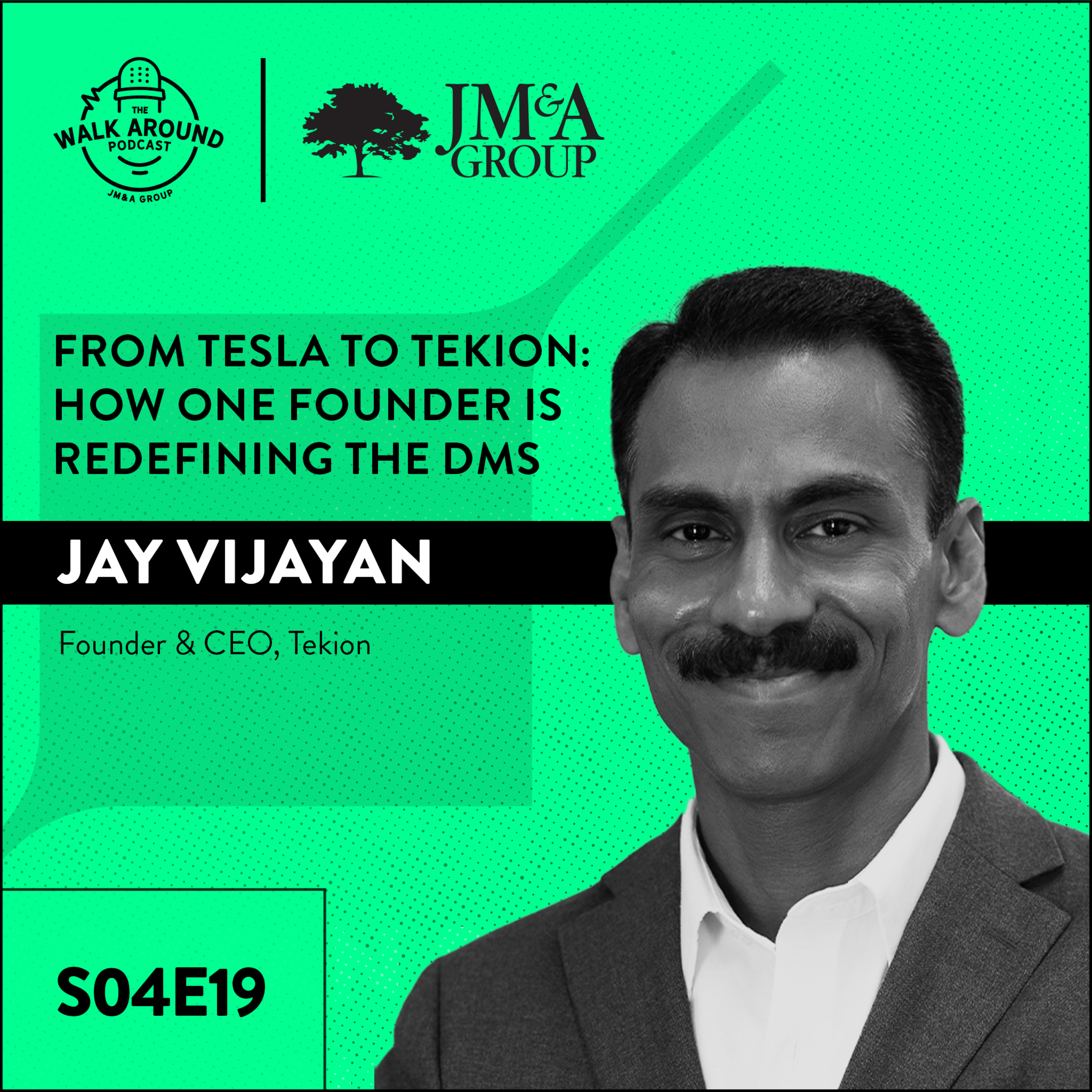
I mean, incredible conversation with Jay Vijayan, the CEO of Techian.
He founded Techian in 2016, and really Jay has focused on revolutionizing the automotive
retail industry with a cloud-native platform designed to streamline and enhance the
car buying process, just to make things easier.
Yeah.
It was a great conversation, and he is really committed to solving some problems, some
decades-long problems, and the commitment that they have so far as to buy a dealership
was really interesting to hear about.
That's right.
Let's take a walk on the Walkaround Podcast with Jay Vijayan.
Jay, we are so happy to have you here.
Thank you for the opportunity to hear your perspective on the automotive industry
and the technology and learn more about Techian.
I just want to dive in.
As we were talking, we wanted to talk a little bit about your career and your journey.
In 2016, you left Tesla as the second in command to Elon Musk at the time to go out
and leave Tesla and start your own company, I guess waited about six months.
The company that you were starting was a service technology company to be integrated
into a DMS.
Walk us through how you go from Tesla to looking at building technology to integrate with one
of the DMS that were out there.
Hey there.
First of all, nice to see you.
Good to speak with you.
Thanks for the opportunity.
You and Jonathan, we are looking forward to our detailed conversation.
So yes, let me do my best to quickly walk through that journey.
So it was a lot of fun.
I had a lot of fun working at Tesla, building the platform, working with Elon.
Definitely grateful for the opportunity because I learned a lot about, I came from the technology
world, high-tech companies, I used to work for Oracle, then VMware, and then Tesla was
my first job in the automotive industry directly.
So I had to learn so much and I had a lot of fun learning.
So I feel it gave me a unique advantage of seeing the problems without, I would say,
attaching to them too much.
So coming outside into automotive.
Okay, now it's been a long time, it's been almost, say, 15 years, close to 15 years
in the automotive industry.
But at that time, it gave me a very unique advantage of seeing the problems and an opportunity
to build what we had to build for Tesla as a brand.
And then when I looked at it, the problems were so visible when what I was fascinated is
first is automotive industry is massive, everyone knows it now.
Even people knew at that time, it's just that I don't think anyone grasped the magnitude
of automotive 15 years ago.
Yes, a lot of things were happening, incrementally things would happen, but if you think about
in the last 15 years, everything has exponentially grown, the investments in automotive, in different
automotive technology, everything from EV to AV, there are so many things that I feel for
all the good reasons investments have happened.
So for me, it was a very good view of how massive this industry is, how much it touched
everyone's lives, basically, you all know this automotive buying a car as many times
the second biggest purchase many people would make in their lifetime.
It's a big one.
And every day, one way or the other, we are connected to an automotive drive or we rent
or we lease, there are so many ways, but it does touch our lives.
So that said, for me, the bigger picture was while we solved many problems at Tesla,
I felt the industry is so big, massive percent at that time, 99 plus percent of the industry
has been underserved from a customer experience perspective, how a consumer would go through
buying anything else, like buying, of course, Apple is always an example of people give
how easy and simple is to shop and buy a product.
And of course, we all know the e-commerce Amazon brought in, but automotive has always
been quite complicated from a customer experience and delivering the customer experience
perspective.
It's not that people didn't spend enough money or time and there are a lot of smart people
experienced people trying it, but I don't think people have brought it together.
There are so much fragmentation and friction in customer buying process.
I truly believed a technology platform to serve that will bring a lot of value
to the automotive industry.
So that was the premise of starting in the idea, even the idea behind Techian.
I felt delivering a technology platform to bring manufacturing brands, dealers and consumers
and of course, all the industry ecosystem partners connecting together in a technology
platform, securely delivering what consumers are looking for in an experience.
I would say enabling the dealers and manufacturers to deliver what the consumers are looking for
is pretty much the bigger picture for Techian.
So I was so convinced that this is such an important thing, decided to leave Tesla and
start Techian in 2016.
And you mentioned that, well, I think indicated, while after a few years, 2018, we delivered
the service app and honestly, the bigger picture was always to build an end-to-end platform.
It was more a test product for us to go to market and see where do we start, like how
do we check.
See, few things we did, I feel any product you develop, sitting in an office and developing
a product without connecting to the customer, it's very hard to develop a great product.
So my thought was, okay, how do we make sure we connect with our customers sooner rather
than later.
So that's why many decisions we made, including testing the product with the service after
sales platform first.
And then also, we may know already, we used to own two dealerships.
These were all part of the conscious decision we made.
I thought that was extremely interesting to really understand the dynamics of what a dealer
process looks like internally.
You actually acquired dealerships for a period of time, and were those your incubation spaces
where you were going in and testing different technology and software to ease the process?
Very much so.
Thanks for that.
Great question.
Absolutely, yes.
It was not an easy decision.
We bought those dealerships when we were fairly small company, we were not a billion
dollar or a four billion dollar plus company, we were a fairly small company, we didn't
have a lot of capital.
It was a big risk to take, but I felt it was worth the risk to take.
Because like you said, it was definitely very much so an incubation, because even
though we had incredible support even in early days, because that kind of indicated even the
need in the industry from dealers and manufacturers, I felt my team needs to integrally know a dealership
process and unfit access to real operations, right, being there.
So in those two dealerships, you will see my product and engineering team, they spend
tons of time and like you said, yes, it's an incubation, every new feature release would
go to that dealership first before we launched to our other other dealers.
And one great example is we launched, this is right in the middle, actually, I would
say peak COVID time frame.
The product, what we call it as a Techion concierge feature, where you can remotely
sell a car from a DMS was first time introduced from that dealership, it was just literally
born in that dealership, because I told my team, guys, why do we need of course, as you
know, well, digital retailing was popular, a lot of people are trying digital retailing,
but digital retailing inherently had a gap because it's not totally connected to a DMS
and it's not a DMS.
So eventually there was a disconnect and digital retailing to most part even today
is more like a lead, or you can even call it as a super lead, it never can close a deal.
Basically, that means a customer cannot finish their purchase.
So then my thought was like, okay, if the DMS is the system of record to do that, why can't
you just do the same thing from a DMS?
Why can't a dealer sell a car remotely at that time there was a need and now you
can even bridge that gap, you could do either way as an hybrid.
So that's how it was born.
So that's a good example.
Yeah, I feel really, really good.
That was a tough but the right decision to make at that time.
What were the major pain points you identified when you owned the dealership that you knew
Techion, a DMS like Techion could solve for dealers?
Great question.
So one is started with that one like, you know, connecting the customer journey seamlessly
without having lots of tool attached and every tool, even if you're attached, it has to really
support that seamless customer journey.
So that's why we ended up developing the concierge feature so that you could still work with
the digital retailing.
But if it doesn't give you the seamless experience, then how do you connect the
customer journey?
What do I mean by that?
So a customer comes in, does a test drive, which is very important part of the buying
process.
They come in, they get all the information of the car, but at the same time, they want
to go back to their home and consult with their family, their loved ones and then still do
the deal without having a lot of pressure.
Now, until the concierge feature, you can't do that.
So now things like the pain point where you connect the customer journey doesn't
matter where they start the journey, where they end.
So they could start the journey on the website of a dealer.
They could end it at the dealership or they could start it at the dealership
to look at the car, look at the product, do the test drive, but go home and close the
deal from sitting at their couch or maybe from their work, whatever it is.
The dealer should still be able to walk through the whole thing, present the
deal sheet, present FNI menu options.
Many things can be done and we call it as a virtual walkthrough with the customer.
So that's kind of what we deliver.
So pain point number one and for what you asked, pretty much solve the fragmentation
in a customer journey.
Even you have to work with other tools, but not for just adding tool, how those tools
can truly help seamlessly connect the customer journey.
If you have a tool that just adds more friction to the customer journey,
honestly, you shouldn't be using that.
So that's the idea.
So first pain point is reducing the friction in the customer journey.
By that, reducing the time that the customer goes through in a car buying process
or an after sales process.
And then finally, more transparent, simple experience.
So as you may know, on the service side, all surveys would show very clearly
customers value the most is their time, not really the money, right?
In a grand scheme of things, we all know Apple has shown the example.
There are many products out there, which are common where people wouldn't,
if you give them a great experience, people would pay more for that experience
and transparency.
So that's the second big problem.
And that also addresses not only from the end consumer, but dealers.
Time is very important to dealers.
Exactly, efficiency.
That's exactly my third point I was going to spot on.
So it's very important, right?
For dealers, time is money.
And of course, they do spend a lot of money to run the operations.
So efficiency is very important.
So what happened, another thing we noticed was there was this inefficiencies
because of disconnect between departments.
There were a lot of things that were done quite manually between departments.
But people are used to it.
So they'll take a paper and walk from service advisor booth to all the way
to the shop floor.
OK, so I'll tell you, when I walk through Longo Toyota, right?
So largest dealership in the country and arguably in the world.
And man, that dealership is so big.
You can think about every day a service advisor or partner walking
from their main area, wherever they work from to all the way.
The shop floor is massive.
Getting on golf carts.
Exactly, golf carts, sometimes walking.
And honestly, it was so gratifying for me once we went live a month after,
maybe month, month and a half, I walked through the floors
and I went to the shop floor and spoke to the technicians.
Honestly, I asked them like, OK, as you know, it's hard.
Technicians, for all good reasons, they're all busy on their work
and they have to be busy.
And I asked them, OK, what do you like about the platform?
How has it been?
The first thing they brought up is, yes.
We honestly didn't have to walk or take a cart for miles a day.
So they said that was a big operational efficiency for us.
Everything is digital now.
Now we have a wish list, Jay, for your team,
what we can ask next to make things easier and better.
And that was very gratifying for me to see
because truly, it's time is money for them and for the dealer.
So in the bigger picture, like you said,
operational efficiency is another one I feel
was so important that we solved.
And we keep fine-tuning more and more today.
Absolutely.
In the, Jay, it's interesting because on our side,
we're thinking about a lot of the same things around,
obviously, we're very focused on F&I.
And when you dig into F&I and the consumer experience,
on the surface, you can make a lot of assumptions
about what the problem is, but it almost always
goes back to time with the consumer.
And with the dealer and with the F&I manager or salesperson
or whoever's facilitating that process as well.
I'm interested, though, on the dealer side.
And kudos to you to go out and buy a franchise dealership.
What a commitment to say, hey, I really
want to understand this space.
What surprised you the most?
What did you learn after you did that to say, hey,
this is different than what I thought it was?
Well, the first thing is, I understood
you got a grasp of the risks of the business itself, right?
How regulated the industry is and then how much risks
it carried around.
And definitely my respect for dealers only went up,
like how they're navigating all of these,
still want to do the right thing for consumers,
any business, you have to still be profitable.
So you have to be profitable.
That doesn't mean you have to compromise anything else,
of course, not compromising the customer experience.
So there were quite a few things.
So one is how complex the business is.
And the second is risks involved.
The third is over a period of time,
and I felt people have added so many processes,
all with good intention,
but I don't think people ever went back and looked at,
okay, this was probably relevant like five,
10 years ago, do I still need to do this step?
And they've built so many processes around there,
like whatever legacy systems and our systems,
probably 20 different systems they've used,
built around it.
And I felt it was a very, it is still a difficult journey
because if someone is used to doing something
for 20, 20 years, 30 years,
it's just written to their muscle memory,
however complex it is.
So the change management part is still quite difficult,
but honestly, it's worth it.
And people who have, thousands of dealers
who have gone through that,
see the value, incredible value
on how you can still do things simple.
It just takes that initial effort
to go through that change, have a paradigm shift,
making things simple.
Like for example, we talked about,
you mentioned about the FNI and sales,
how you can present deals remotely,
how you can have a very simple deal jacket
where everything is in one place,
everything about customer information about the deal.
You can still make it very simple and compliant
for going and looking at it.
On the service side,
having one thing I thought about
and which was working phenomenally well
because before that, I know there were people
who tried doing like iPads in the service lane.
And anywhere I went to most part, it didn't work.
And I would say almost like 99.9% didn't work.
People just tried to make it work.
And there are people I've seen service advisors
used to have their iPads as,
coffee holders, they'll just keep their coffee mug on iPads.
I was like, okay, what's, what happened?
Oh, no, it never worked.
So we just replaced some use for it.
So I just keep my coffee mug on it.
Sounds like value in the technology
that's available to them that they actually use it
is a fundamental key aspect that I've seen
and I've heard about Techian.
Is that?
Thank you.
See, the thing is making it easy in day-to-day life
and because you don't want to give,
so we don't, that's why things that fundamentally
we shifted as we don't do, you know,
proprietary hardware devices
because making it easy for dealers is very important.
Like we don't sell printers.
They could go buy any printer.
We have a recommended list of printers
so that it's easy for dealers to operate.
It's cost-efficient and effective.
And then the mobile phone.
So a service advisor can just use their iPhone
or a dealer can buy an iPhone or an iPad.
It doesn't matter which it is, but phones are so easy
because if you walk into an Apple store,
many times they use their phones to check you in
or sell you a product.
If you think about it, it's so easy.
So sometimes it's just the mind shift of when you,
because phone is something we all know how to use
in our sleep that we can open our eyes
and we know how to just operate in one hand
and within our fingers.
The point is, you have a lot more now left
to interact with the consumer now.
So if you use your day-to-day devices,
be it an iPad or an iPhone,
whatever you're comfortable with,
then your time slot, if the tool works
as it's supposed to and making it simple,
then your time to connect with your consumer,
customer, get to know what they really need
and then sell the right products,
I feel is a huge value for dealers.
Jay, this is an exciting conversation for me
because I think you're talking about problems
that have existed in our industry for sometimes decades.
And in some cases what I think we get frustrated
is the industry talks about these problems
like it's just the way it is sometimes
as opposed to like let's go out and solve them.
And so that's just exciting for me
to hear somebody else who's thinking that way.
But like what makes you guys different?
Like why are you guys like uniquely prepared
or qualified to solve these problems
that others may have been trying to solve for a long time
and just for whatever reason,
just haven't been able to get it across the finish line.
Oh, and a great question, thank you.
So there are a few things fundamentally.
I feel we have that unique combination
and I'll come to the platform, it's more result,
it starts with people, everything starts with people.
So as you know, being an automotive,
I'm sure you would agree as well.
It's a like many industry, but a lot more true
with automotive industry, it's still a people business.
So the thing is convergence of very strong
technology minds.
I've been fortunate to be in Silicon Valley
working with some of the best tech companies.
And kind of converging into automotive,
my experience, converging into automotive via Tesla
and then now pretty much the entire industry.
And we have a phenomenal team that we have hired
from the industry from very early days.
I always felt it's a hybrid,
even reason for acquiring the dealerships is that
like we need to know the industry deeply.
We need to know the problems deeply for solving.
If you don't know the problem deeply,
then your solution is not going to be the best solution
or the ideal solution.
So I think that convergence really helped
and then understanding the problem deeply
and then coming up with the true comprehensive solution.
I'll tell you early days, not even early days
for many years, first four, five years,
people heavily discouraged us not to build
an end-to-end platform.
And all with good intentions, some people very nicely said,
you're trying to boil the ocean.
There's so many companies that failed creating a DMS.
And there are some companies did it,
but they just couldn't make it.
They're like still scraping the surface,
small DMSs here and there.
And you're trying to do too much.
You just don't understand how big this is.
Just building a DMS is big.
And then on top of it, of course,
we wanted to do an end-to-end platform
with DMS and CRM and payroll and all.
Because the idea is how do we deliver?
It's still a fair game.
We integrate with all of our partners,
other CRMs and other payrolls.
It doesn't matter.
So over when dealer feels this is the best platform,
they should be in a position to use it
and deliver the best experience for the consumer.
So what does uniquely position for us
that convergence of the best technology mindset
and automotive mindset, right?
The right people coming together
and comprehensively understanding the problem
and having a very strong will and capability to solve it.
So that's how we came up with the whole automotive,
retail cloud for dealers, enterprise cloud
for our manufacturing partners
and then partner cloud for the ecosystem partners
and how everything connects seamlessly
to deliver what the industry needs.
And then the other big piece I would say
is truly ground up.
We had this opportunity to build
in the best technology stack.
I feel it's technology is a differentiator
and it should be differentiator done right
because there is multiple dealers
and one big dealer I still remember him saying,
how Jay, as dealers, we have pretty much everything.
We have the capital, we have the inventory,
we have phenomenal facilities to host the inventory
and show the customers, do the test drives
and we have great people who are doing it.
But one thing that is where our hands are tied
behind our back is technology.
They feel that's the one thing that keeps us behind
in competing with all of the newer companies
that are coming in beat in the new car
or use car space for us to compete with.
And if we have the technology that delivers
the same experience that the consumers are looking for
is that we can absolutely win
doesn't matter who the competition is.
That resonated so well with me
that what we are doing is worth doing.
So Jay, mentioning that,
this is something Jonathan and I were talking about
prior to getting on today
and we talked about change.
When you're talking to dealers, large groups,
if they are apprehensive or nervous
about changing technology
and going under an undertaking of changing a DMS,
it is very difficult.
It's a lot of pain.
There's a lot of effort that goes behind it.
How do you handle that?
What's your message to those dealers
if they are apprehensive or nervous
about changing technology?
Yeah, I would say a few things.
So first is change, you're absolutely right.
Change is very difficult.
Dealers, I've heard from dealers,
I'm sure you have as well,
changing a DMS is going through a heart surgery
for their business, right?
And there's a dealer when he said like
heart surgery and himself,
like one of our early dealers
is still a big supporter on our platform.
Yeah, I had a dealer tell me a couple of weeks ago
it was worse than that.
Yeah, exactly.
So immediately they'll stop and say,
oh, you know what?
It's not even worse.
Is that like it's heart surgery
and lung transplant done together?
It's like that big.
So it is difficult to go through the change.
And we have a full spectrum
and we've learned a lot.
And there are also dealers who said like,
yes, it's very difficult Jay,
but going through a tech yarn change
is feels like ripping off a band-aid
or a couple of band-aids,
which is a really nice thing to hear.
We do our best.
We continue to fine tune dealer onboarding.
We don't take it easy.
Early days, it's not that we did take it easy,
but we kind of underestimated the complexity of the change
because of the platform is so easy.
That's still the case.
Today, the best thing with tech yarn is
I'll tell you kind of the pros and cons
and what do I tell dealers normally?
First is the value and the worth
of going through the change
and coming the other side is very compelling.
It is big.
So because the future is changing,
whether they like it or not,
consumer expectations have been changing
and it's even more significantly today
because there's companies which are delivering cars online,
both used cars, new cars,
and after sales, simple, easy, transparent.
If dealers don't make the change,
they will continue to keep losing business.
It's more than to put it the other way.
Consumers are going to gravitate
where they're getting the experience
and to going back to this point.
Where it's easy for them.
Exactly.
It's easy and simple for them.
Exactly right.
And going back to this point,
as I mentioned that this large dealer
that mentioned how their hands
are tied behind their back in technology,
but he was so confident.
If he get the technology,
the dealer was saying clearly,
or absolutely no doubt,
we will win against anyone.
I'm not worried about the competition at all.
So that for me is a big one.
So I would mention this to dealers saying that
going through this change for the future,
of course, for the next few decades,
you're going to have the latest
and greatest technology platform.
Yeah, I built into it
because everything around them is evolving
so that they can cater to the consumer experience,
go through the operational efficiency.
And then another important one,
we built the platform is very simple.
This is one of the things
that we kind of underestimated in early days
because the platform is so easy.
Like you said, a service advisor
can check in a customer in mobile app.
There's really most of our users at the dealership
get up and running literally within a matter of hours.
It doesn't need months of training.
But that said,
the reason I said we are underestimated is
dealership business is quite complex.
So everything from setups, configuration,
your legacy data that you're bringing
from your prior systems and DMS is not good.
It's very, very complex.
It's fragmented.
It's sometimes even huge amount of duplicates.
So going through that change,
fine tuning the setups and best practices
to make things easier.
That is the change management
that we handhold dealers very closely.
And we are also building a good partner network
in the industry,
partners that dealers are already working with,
like in their accounting office.
So we are training and onboarding more and more partners
so that it's not only just Techian,
dealers have other partners to access, right?
Like for example,
thanks to JMNA and we are partnering with JMNA
on the FNI and integrations as well.
So we're building more and more partner network
across different areas
so that dealers have access to many,
not only just Techian, but many partners.
So change management is difficult,
but what we tell dealers,
it's worth it when you come the other side
and we do everything to make the change
as easy as possible.
It's not going to be walk in the park,
but do easiest.
Second is onboarding, as I mentioned,
training a new staff is easy.
And I'll tell you a very simple example.
One of our very large dealer groups,
this was two and a half, three years ago
and they're phenomenal customers,
30 plus dealerships.
And the dealer principal called me and he said,
J, I've been in this business for almost 30 years.
First 15 years, I ran one DMS
and then I first, first changed
that was almost close to 30 years ago.
And he said, it felt like I had to,
my team has to learn a completely different language
outside of English.
So the key codes and key combination
and shortcuts they have to learn was massive.
It took almost a year, year and a half
for them to get through that change
before even being more effective and efficient.
Fast forward, after that 15 years after
I went through another DMS change
and I had to go through,
that's the right thing for my business.
But now my staff had to learn
a completely different language,
not again English, but not the previous language,
completely different language.
So for example, it was from learning from
unlearning Russian and learning Chinese.
That's how difficult it was.
That's exactly how he said.
And it went through another one year
of one and a half years for us them to get used to.
And he said, J, we went through Techian change.
It's been like six months
and I want to definitely call you and give kudos.
First time in 30 years, he said,
my staff knew how to speak English
and the software was written in English.
So it was so easy from a transition perspective.
Now I can hire people and train them very quickly.
Who are the right people for my business?
Wow, makes all the sense in the world.
Do you want to touch on one thing?
And I know the listeners
and Jonathan and I want to know more about AI.
So we know in April of this year,
you launched the AI service operations through Techian.
Can you kind of walk us through what that looks like
and what's realistic for us to expect in the future?
In the next two to three years from Techian
as it relates to AI.
Yeah, that's an exciting topic, Heather.
Always quite excites me.
AI is something we've doubled down our investments.
I'm sure many, many, many companies are doing.
But the good great thing with Techian
is from very early days,
we have the latest and greatest tech stack.
We started with embedded machine learning from early days
that evolved into AI, now into generative AI.
There are things that we took our time
for very valid reasons.
So one is we built a security layer very strong.
As you may already know, I just wanted to state this.
I would say Techian is the most secure DMS out there.
We have the SOC one, SOC two certifications.
We have the ISO certification for data security,
data privacy.
We are in the process of going through a certification,
a rigorous certification for responsible AI.
There is an ISO certification for,
how do you build a responsible AI?
So that's what we've been doing.
And the idea is we built our own Techian intelligence layer
because DMS data is so, if you'd call it as precious,
context aware for dealers and the industry.
So we wanted to build our own intelligence securely
for dealers so that you're not pushing your data
through some API to public domain.
When it gets to public domain, it's available for everyone.
I mean, all the large language models and learn from it.
So we built a very secure layer
and we have a very strong, like you mentioned,
we launched our AI agent for service.
We have a very big roadmap of AI agents.
So the way I see the future is a dealership staff
should be able to eventually start working
with AI for every function.
So basically they should be able to give a command
to an AI agent to do their job most efficiently,
to run checks and balances and everything.
So in a bigger picture of the way we see it is,
you have heard this term or the data point
that people talk about how a sales agent
at a dealership was selling 10 cars a month
and on average 50 years ago
and they still sell 10 cars a month, right?
And spied off how many other tools
that we've brought in, right?
So many tools.
I feel first time in that,
whatever number of years, 50 years,
AI has the potential to truly increase productivity
for a dealer staff in all functions,
specifically sales and service.
I feel first time in many decades,
AI can increase, not only productivity,
increase sales, grow the business
without increasing the expense for a dealer.
I'm sure you know how big of a deal it is.
We ran two dealerships.
So I know it's a big deal.
Dealers always try to grow their business,
but expense also grows linearly with that.
So AI has the first time in the industry
because our science, the AI agent for service
is phenomenal.
The data is huge.
Our early dealers are showing,
hundreds of thousands a month additional revenue
from AI on the service itself.
And we'll be publishing data
as we launch more and more dealers.
And we will be coming up with more and more AI agents
across all functions.
As you know, as a system of record,
we run pretty much all functions of a dealership.
And I strongly feel we will have to deliver AI agents
pretty much for every function.
Of course, the first goal is to how to sell cars
and how to service cars more efficiently
and increase profitability for the dealer.
But at the same time, increase the transparency
and experience for the consumer.
And I feel that's a win-win.
And honestly, first time, another thing
I'm quite excited with AI is,
my team genuinely when they present the data,
Jay, this is the first time we've seen everyone wins.
The technician makes more money,
a service advisor makes more money,
the dealer makes more money,
and the consumer is very happy
because they're very transparent.
They get all the data from the AI.
I feel it's the first time
there's so much opportunity ahead.
We are just scratching the surface.
Yeah.
That's exciting.
I've got to ask you one question
before we wrap up though.
And Heather's got a fun little game
we're going to play at the end here.
Sure.
I want to talk just a couple minutes about F&I
and kind of how you guys are thinking
about the F&I process in general,
F&I products in the deal,
and what are you hearing from dealers
in that space as well?
Yeah.
See, F&I, like I said,
it's a very important one for dealers,
important one for the consumers as well
because for them it's more,
of course it's an insurance
and it's a piece of mind for them
getting the right product
when they buy the car.
For dealers so far, what's been is,
you know, there is a full spectrum.
I feel we could make it.
What I mean by that is,
dealers religiously go through the F&I process
with the consumer.
There are also, as you know, dealers feel
like you don't need a separate person
to go through F&I and F&I is still needed
but you don't have to,
so you can make it much more efficient.
I feel this is where the technology can bridge
and give that option for the dealer
to still give a seamless experience,
a full transparent in terms of offering.
It has to be embedded in the selling process.
So if you make it more frictionful
then it becomes a problem either today or tomorrow.
Consumer may buy and they may still feel like,
okay, I was forced to buy something which I didn't want to.
So it's better for us to make that process simple,
smooth and transparent from a consumer perspective,
from a dealer perspective embedded in the flow.
That way it's very simple.
And then of course the last piece you all know,
well compliance is a very important part of the F&I itself
and we have built all that way
you have a very good audit trail and compliance records
for the compliance reasons as necessary.
Makes a lot of sense.
Well, Jay, we have a ton more questions
we would love to talk to you about
and take the rest of the afternoon discussing with you
but I think it's time for us to take on Mark Spoto,
our host, main piece that we like to get into
and it's called Bet It and Forget It.
So Jay, I don't know if you're a gambling man or not.
Do you, you must be a gambling man
if you just take off from Tesla in 2016
and go start a new technology.
So I think you're a risk taker, are you?
All right, so we want to just ask you
a couple of questions here and ask
if you would bet it or forget it
as we look to the future of where technology
and the automotive industry is going.
So you ready, Jonathan?
I'm ready, let's go.
All right, so Jonathan, you wanna ask the first one?
Sure, dealers will adopt cloud platforms more quickly
than EV sales will grow.
Bet it or forget it?
Bet it.
Bet it, okay.
All right.
And so cloud platforms are the way to go,
obviously. Absolutely, absolutely.
Tell us a little bit more about that.
Yes, so you make things, so today
it's highly secure, easy, less risky for dealers
so they don't have to manage, maintain infrastructure,
the risk profile increases, so yes, I would say it is.
It's like the difference between using an iPhone
or an Android phone versus using a flip phone
or a dial phone, right?
I would say that's the difference.
It should be a no-brainer for them to adopt and move quick.
All right, all right, our next bet it or forget it.
Do you wanna give the next one, Jonathan?
Sure.
The next Tesla, you might be a little familiar with that,
the next Tesla level disruption in auto retail
won't come from an OEM, it will come from software.
Bet it or forget it?
In entire automotive or in automotive?
Entire automotive.
I don't say the question is entire automotive.
Entire automotive.
Yeah, I would bet on software and hardware.
It's a combination but I agree, in principle, yes,
I would bet it.
Software is pretty much driving everything,
technology and software is driving everything, yes.
All right, and our last one for bet it or forget it.
Legal pressure and public scrutiny
will force major DMS vendors to open APIs
or lose significant dealer business, bet it or forget it?
Bet it, yeah, we've launching tons of APIs
and we continue to deliver absolutely, yes.
So we need to keep it transparent, easy, secure and simple.
Hey, Jay, one other question I did wanna ask you
and we should have asked it earlier.
What was a lesson that you learned
working with Elon Musk that you've taken into your career now
in the automotive industry?
One or two lessons?
Yeah, then we'll wrap it up, we promise.
Quite a few, quite a few.
So let me keep it simple.
The first is, focus on your consumer.
Focus on your customer and be relentless
in delivering the best product you could deliver.
So I would say that's pretty much number one.
Second is delivering value and efficiency.
Going back to the fundamentals and delivering value.
And this is, I wouldn't say very specific to Elon
but also with Elon, but overall,
that's been my fundamental philosophy always.
And I tell everyone, my team and I tell my kids as well,
always strive to deliver more value than expected.
So indeed your product, it should be a no-brainer
for someone to say, what I'm paying for
is more than worth it for this.
And be it a job, that's how I used to conduct myself
and I work like, okay, if I'm getting paid for something,
I always need to deliver more value
than what I'm getting paid for.
The ideal side effect of it is I get paid more.
People will realize that and say, okay,
and now this guy need to get paid more.
Well, you heard it here.
Be relentless, always think about the customer
and drive value.
Well, thank you, Jay.
We certainly appreciate you being a guest today
on the Walkaround podcast and we wish you continued success.
Thank you so much, Jay.
Thanks a lot, Heather and Jared.
Then it was fun, it was fun.
Thank you, it was a pleasure.
Take care.
We really appreciate you joining us today
on the Walkaround and we hope you enjoyed the episode.
Please be sure to like, share, subscribe and follow us.
We look forward to seeing you next time
on the Walkaround.

0:00
44:35