The Toyota Prius is a car that uses both a gasoline engine and an electric motor to save fuel and reduce pollution. It was one of the first cars to be designed specifically to be environmentally friendly, and many people talk about it because it helps save money on gas and is better for the planet.
A battery electric vehicle is a car that runs only on electricity, not gas. It uses batteries to power the motor, which makes it better for the environment.
All-wheel drive means that all four wheels of the car get power from the engine at the same time. This helps the car grip the road better, especially when it's slippery or when driving off-road.
Instant torque means that electric cars can give you power right away, making them quick to accelerate, which is really helpful when driving on rough terrain.
X-Mode is a special driving mode in some Subaru cars that helps the car handle better on rough or slippery roads. It makes it easier to drive in conditions like snow or mud.
Traction control is a feature in cars that helps the wheels grip the road better, especially when it's slippery. It can slow down the wheels if they start to spin too much.
Off-roading is when you drive a vehicle on rough surfaces like dirt or sand instead of regular roads. Some cars are built specifically for this kind of driving.
A custom setting in a car lets you change how the car behaves based on what you like or need. You can make it feel different for driving in various conditions.
All-terrain tires are special tires that work well on different types of roads, like highways and dirt paths. They have a rougher surface to help cars grip better when driving off-road.
Range reduction means the car can go fewer miles before it needs to be charged or refueled. This can happen if you change things like the tires or add extra weight.
The Tesla Supercharger network is a series of charging stations where Tesla owners can quickly recharge their cars. It makes it easier for Tesla drivers to travel long distances without worrying about running out of battery.
Level two charging is a way to charge electric cars faster than regular home outlets. It uses a special plug that gives more power, so you can charge your car overnight.
MSRP is the price that the car maker suggests the dealer should sell the car for. It's like a guideline for how much you should expect to pay for a new car.
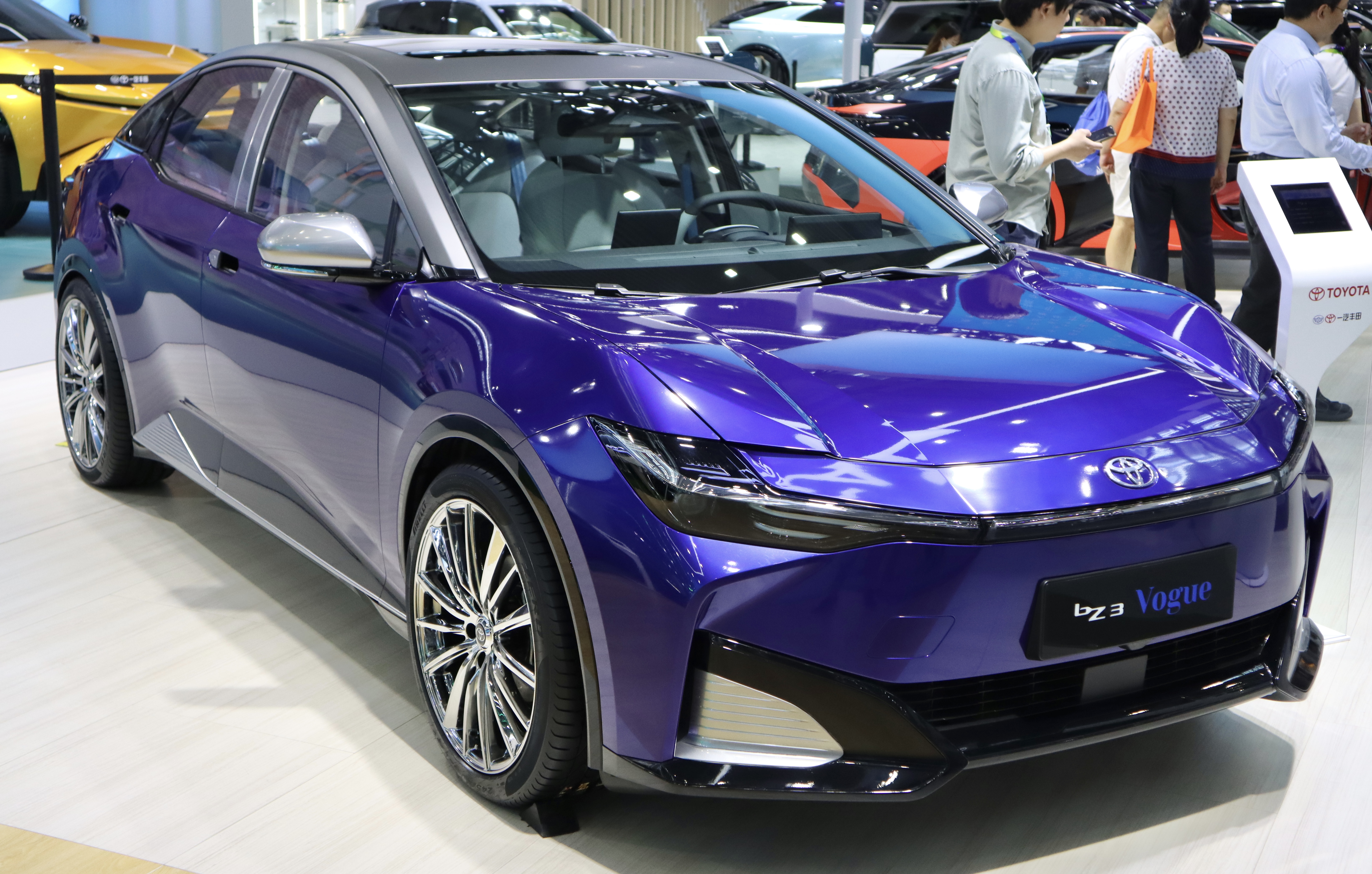
The Toyota BZ Limited is an electric car from Toyota. It's designed to be eco-friendly and is part of a series of electric vehicles that Toyota is producing.
The Toyota C-HR is a small SUV that has a unique and modern look, making it stand out on the road. It's designed to be easy to drive and offers a lot of space for passengers and cargo, making it a good choice for people who need a versatile vehicle.
Instant acceleration means that when you press the gas pedal, the car speeds up right away. Electric cars are especially good at this because they can provide power immediately.
Level three charging is a very fast way to charge electric cars. It uses a special type of power that can fill up the car's battery much quicker than regular home charging.
Level one charging means using a regular home plug to charge your electric car, but it's very slow and can take a long time to fully charge the battery.
An on-board charger is a part of electric cars that helps convert electricity from charging stations into a form that the car's battery can use. It affects how fast the car can be charged.
A hybrid car uses both a gasoline engine and an electric motor. This helps it save fuel and produce less pollution compared to regular cars that only use gasoline.
LIVE
Welcome to the AI Auto podcast with Javier Moda, your front row seat to where artificial
intelligence meets horse power.
Well today we're here in Ohio, California, beautiful place this time of the year, I mean
the weather couldn't be better, everybody's freezing out there in the east coast but here
we're having like 80 degrees, no humidity, well anyway enough of that, we're here for
another reason, we're here with Toyota to drive the 2026CHR which is coming back to
the U.S. market and that Toyota BC Woodland, so we have Chad Morse, let me get your official
title because I want to mess it up, marketing manager for BC, BC Woodland CHR, yeah.
And Thomas?
Thomas Sunday, I am a product education planner for Toyota's marketing group, this is what
it was used to be called at Toyota University or something like that, years ago?
There's on the Lexus side, they do the college, but not on the Toyota side, so yeah we're
just product sales and education is what we are.
Okay, I didn't even finish high school so it doesn't matter to me.
But anyway let's talk a little bit about, I mean there's not a lot of history about
these two cars, but there's some because let's start with the BC because this car used to
be called BC4X, right, and a lot of people were like oh what's that and then I couldn't
memorize it, I didn't know what it was meant but like tell us about it please.
With the 2026 model year, the BC4X changed from BC4X to BC, right, and we launched that
in late 2025 with a lot of improvements to range, the range topping out at 314, one of
the models, as well as upgrades to charging, performance and some interior enhancements
of the way the dash and IP are laid out.
And for the educational part, a lot of people for years have been saying oh Toyota doesn't
have any EVs and they're not investing in that, they're not producing cars, but here
they are.
I mean obviously Toyota is known for the hybrid technologies since 1997 I think in Japan first
with the Prius, but I mean these cars, I mean you've been producing for a few years already,
tell us more about how Toyota has been working on this EV strategy.
We believe in a multi-pathway approach at Toyota, so we believe in meeting the customer
where they're at and providing them the opportunity to embrace and move into the powertrain that
best suits their lifestyle and their needs and you know as we bring the three battery
electric vehicles to the market we also believe in that same multi-pathway approach on that
and that the consumer can lean into the vehicle that best suits their needs, their lifestyle
outside that and that's the reason all three vehicles have a different kind of personality
that they lean into.
I'm glad that you mentioned that because from the distance, if you take a quick glance
they look more or less the same, but they're not.
No, they're not.
Okay, tell us about the differences.
They definitely have some differences, you know, there's kind of, you know, each one
so Busy Woodland, that's our sporty adventure that it leans into, that type of person on
that side.
That's 300 and what's the 75 horsepower?
The 175 horsepower, I'm going to chat, I forget the, I'm not the planner for the Busy Woodland
but it's got what, 4.060 time chat?
4.460 has a, you know, just in general has additional cargo capacity, it's six inches
longer than the Busy, it has 3500 pound towing capacity, really the Woodland represents a
model that has, you know, ultimate ability to take you out on adventures for the weekend,
right?
So it's our battery electric vehicle that, you know, with the additional cargo, more
robust roof racks, towing, you know, as well as the additional power and then standard all-wheel
drive with what we call X mode, which is really helpful in traction control situations, just
provides the additional capability and versatility for someone looking, you know, maybe to get
out of town and adventure, you know.
We took a little bit of an off-road and we trust, I would say, always when I go on these
programs, not only we Toyota but any other manufacturers, you guys put it really to the
test.
I think, I don't know, either you can talk about what consumers' background is, but I
don't think many people do what we did today.
No, the car is capable, but the car is very capable and what you did today is not going
to be the normal situation for most customers, but I can tell you that I actually recently
drove through Snowstorm in Dallas, which is very rare in Dallas, with the BC Woodland
and I just had the utmost confidence with the all-wheel drive system, the available
all-terrain tires, you know, so there's a lot of different situations that would be
maybe more realistic than the hill, the mountain that you drove up, but at the end of the day,
it really maximizes the ability of electric motors, you know, to provide a lot of extra
traction control to all four wheels.
Can you tell us more about it because obviously there's an advantage having an EV powertrain
while off-roading because, as you said, like the instant torque and all that, like, tell
us about it, there's specific technology also in this car.
Well, you know, with the BC Woodland and the X-Mode, there's different settings in there
that are going to control the braking and torque to the wheels, which helps you better
with that traction side, and that's ultimately what it's about when you're off-roading is
going to be the traction, and you do.
You have the two different settings that are going to specialize, whether you're dealing
with like an icy snow or muddy or sandies, that you can make that different adjusting
with that.
There's even a little custom setting that you can adjust if there's certain aspects
that you want to do a little bit different.
A little interesting item, I guess, on the pricing, the tires have an option, but it's
for $0, so tell us why it's that and why it's so unique in this case.
And Chad, being the marketing manager, he's actually got this answer all ready for you.
What comes to Woodland?
Well, the all-terrain tire is actually a $0 option, so it's standard with all-season
tires, but the additional traction is a nice feature if you'll use it, but with the construction
of the tire being more traction-oriented versus, you know, low resistance of all season, there
is additional hit to the range.
So it's about 20, around 20 miles of range reduction by opting into the all-terrain
tire.
And so it goes from $281 to $260 more or less, and depending on your driving style, you're
driving like a maniac, so people like me maybe, you get less, but that's true in any car,
any powertrain, right?
Yes, so we want to take the price out of it because it does get offset with range and
really just allow the customer to choose the tire that best fits their needs.
I have to admit, like, we were driving both on-road and off-road, and usually with off-road
tires, you hear more noise in the cabin, but I didn't hear any difference.
Did you test many different models or manufacturers to...
Why didn't you?
The engineers did.
Someone did.
You to your diamond.
You know, very specifically picked this tire to have good traction, but as a battery electric
vehicle, you know, people expect quiet, you know, smooth ride, and we had to get a tire
that would be able to deliver on those aspects as well.
So tell us a little bit more about what you get with this BC Woodland, and then we'll
talk about the regular BC because it's also very, I mean, very successful, as I understand
from the sales this last month, right?
Yeah, we're off to a great start with the regular BC, great sales in December and January as
this new model gets spread throughout all the dealers in North America.
We're really excited for more customers to be able to take a look at it.
The BC Woodland, which will be coming out in March to dealers, you know, just as we talked
about, has additional power, up to 375 horsepower, improved charging just like the BC.
Which is like the North American charging standard, right?
Or Tesla, like most people know it, but like that.
Gives you access to the Tesla Supercharger network, as well as others, you know,
stuff out there.
So just so much more different access to public charging.
But at the end of the day, you can still do, as most people do,
mostly recharging at home.
If you have a level two, you can charge overnight pretty much from, you know, zero to 100%.
This vehicle also, it's well equipped in two different grades.
The BC Woodland and the BC Woodland Premium.
They both come with soft-text trims, seats, 14-inch touch screen,
full power seats, heated front seats, available ventilated front seats.
You can get a big glass panoramic.
Oh, nice. Yeah, I like it.
Which which is fairly large.
It looks really, really cool from the inside.
What price are we talking about, more or less?
The BC Woodland starts at $45,300.
That's the same price as the BZ Limited all-wheel drive.
So it is kind of at the top of our BEV family lineup.
And the success on the sales this past January was despite that no longer
having the fair credit, right?
So people want these cars.
I mean, that's what's showing in sales, I guess.
Yeah, we're very excited with the performance of the sales.
I think, you know, just with the improvements to BZ, the way it looks,
the improvements to the powertrain, the charging.
We've seen a lot of demand and a lot of interest from customers.
And we hope that adding in both the CHR and the BZ Woodland
will appeal to even wider audience and bring more people in to look at battery
electric vehicles.
So Thomas, from the educational part, they're still even though today.
I mean, let's put aside all politics and all that, that doesn't matter really.
A lot of people still are kind of hesitant about electric.
Tell us about the advantages that not these cars, but in general.
Yeah, I mean, let's most people's reservation about battery electric
vehicles is going to be range of anxiety.
Correct. So, you know, one thing you got to look at when you experience
and you live with the BEV is your how you fuel and you're feeling
or refueling or recharging options is different.
You know, with the ability of having home charging and you can do on a level
to charger on our vehicles.
It's about a seven hour recharge time to go from 10% all the way back to 40.
More than a level to 40.
Yeah, level to charger installed to 40.
But you have the option of waking up every morning with over a 200 plus
mile range that most people won't drive every day.
Yeah, people. Yeah, really.
So, you know, when you're leaning into it and you yourself, you need to ask yourself,
how often do I refuel? How long do I do that?
Am I ever do I have that anxiety when I get in my car and I have a 300 mile
range because it's different.
You don't have to stop at the gas station every day or you don't have to stop.
So this is once again, where we kind of lean into that side.
And then once you actually drive them, and I'm going to use my own personal
experience is, is, you know, I've been driving around in a CHR for a week.
And when I went back into my hybrid vehicle, I missed that instant acceleration.
So, you know, an electric vehicle, even though it less horsepower,
but that power is immediate.
Yeah, it's there. It's instant.
You jump on the electric and you give the power and you take off.
And it's not only coming off of light, but when you're on the expressway
and you need the pass kids, sometimes you need it. Yeah. Yeah.
So, but like in the charging aspect of it, I mean,
I'm going to give my own opinion, I think, but people don't even know how to charge
the phone much less the car yesterday on my flight from Miami.
I saw this lady charge the phone the whole way.
I did not say anything, but like she didn't really need it.
Yeah. They're like the anxiety.
People see a plug and boom, they go, right?
Don't you see that?
You flopping. Maybe it doesn't.
Do you do that on the plane?
Yeah. Just see a charger and plug it in, right?
So, I mean, when it comes to charging ABC, always be charging.
That's kind of a, you know, internal thing.
Oh, I didn't hear that one, but I like it with people with battery electric vehicles.
But, you know, the one thing that we're doing for Toyota to help everybody with that,
anybody that has that is we're spending a tremendous amount of effort in educating
our dealers, sales associates and our dealers on education.
We're making publicly available on YouTube.
We have videos, a whole video series on the Toyota channel.
Yeah. It's self help that you can go there, watch some videos.
This is done by my group in product education on how to charge.
And once you do it a couple of times.
So, what's it? Yeah, go ahead.
Yeah, well, you learn, right?
You learn and you're comfortable with it.
But what's the general recommendation?
Well, I mean, when we look at it from the backside of it,
where people are charging their vehicles, the data shows they're charging at home.
So, the vast majority of people doing the vast majority of charging at home.
And that's where you just get to look at your charging situation at your house.
Can I install a level to some of the systems?
And I'm sure this one has it too, like even you can charge it only to 80 percent
because that helps with the health of the battery and all that.
That's a level three.
So, one of the things we're really excited about here is that we're now
compatible with a much wider network of public chargers with our North American
charging system or NACS, that's kind of the acronym that's widely used on that.
So, that opens us up.
So, with that, there's three different levels of charging.
There's a level one, which is your standard home plug.
Which will take days.
It'll take days, but honestly, I don't have a level two at home.
Every morning I woke up with a full charge.
So, my daily driving needs on level one.
It was sufficient because, you know, I didn't drive
the midnight at night and do the recharge.
I get home five, six o'clock, seven o'clock, I'm plugged in.
So, you get more than 12 hours?
Yeah, I get more than 12 hours charging.
And I woke up every single day to a full charge.
But, on the public charging network or at home, you have 240 level two.
We have an 11 kilowatt on-board charger and you can do that in seven hours.
You can go there or public.
You know, nobody has a public level or at home level three.
Level three is what's called fast charge.
This is a DC direct current charge.
And you can go from 10% to 80% in about 30 minutes.
Which is a little longer than a regular gas stop, but I mean, you still want to
rest if you're taking that long of a trip anyway, right?
Yeah, yeah.
And you can do it multiple times in a trip and you can get that range and
utilize it, you know, from that perspective.
So, let's talk a little bit about the CHR, which is coming back.
It went away for a couple of years.
I don't remember exactly when.
Yeah, it went away in 2022.
So, we had the first generation here in the United States, 2018 to 2022.
Second generation remained very alive and well in other markets around the European market.
It's made in Turkey, I think, right?
That one was made in Turkey.
I'm not sure where that one stole.
They still have that CHR in other markets as well.
But here in the United States, we're excited the CHR is returning as the
sporty option of the three-battery electric vehicle.
So, it sits on the same platform as the vehicles.
It shares the same powertrain as the vehicles.
However, it's got a shorter wheelbase.
So, it's for its shorter wheelbase, which translates into better maneuverability,
the more sporty feel.
Also, CHR has always been about an emotional connection to its styling.
So, when you take a look at that coupe, higher rider, and you look at the styling,
we have really exciting color, new color called Tenduri that you saw this morning as well.
That really makes that emotional connection with the styling of the vehicle.
20-inch alloy wheels on the XSE.
We have 18 alloy, black alloy wheels on the 18.
And it's really well-equipped vehicle.
You said it really, really quickly, but that's what the CHR stands for, right?
Coupe, higher rider.
Yeah, yeah, high rider.
Yeah.
So, Chad, again, people need to know that Toyota is making the beast, right?
Like, a lot of people might be surprised, but that's what it's new now for 2026, right?
Yeah, I think that's the biggest takeaway is we have multiple models now of battery-electric vehicles.
And there's a lot of people out there that may have been considering this as their next car, the powertrain.
Maybe you have a hybrid now.
Yeah.
And maybe you're looking at a battery-electric vehicle and you're worried about some of the range things
that Thomas talked about, but at the end of the day, come learn more about it.
Toyota has multiple of them, different ones that fit your needs, different front-wheel drive,
all-wheel drive, different range amounts, different price points.
So, there's more options there, and I think that's the biggest takeaway is there's more options and
more to choose from, and really, hopefully, the customers can come find what they're looking for.
And as many podcast video stories that we all do, I think the real learning experience is
go and drive it, right?
Like, live with it for like a week, mate.
What's your estimate?
Like, when people learn or start learning to feel more comfortable doing a week to it?
The more time you can spend, the better.
But let's be realistic.
Maybe that's not always what you can do.
So, yeah, the dealership will let you do a two-week test drive.
Yeah, at a minimum.
Go to a dealership, take one for a touch drive, speak with the sales consultant.
We're spending a lot of time educating our dealers and our sales consultants
to not only be there at the beginning of the sale, but be there for you after the sale
to help you be comfortable stepping into this new technology.
And once you drive them for a while in time, you really, really drive it and charge them.
Okay, thank you very much.
I'm gonna actually go now and drive the CHR and finish our test drives here today.
Thank you.
Thank you.
All right, thank you.
That's it for today's AI Auto Podcast with Javier Moda.
Hope you enjoyed the ride as much as we did.
Tune in next time for more on how AI steering the wheel of tomorrow's autos.
Drive safe, stay curious and catch you later.
About this episode
Toyota is ramping up its electric vehicle (EV) strategy with the introduction of the 2026 BZ Woodland and CHR models. Guests Chad Morse and Thomas Sunday discuss the advancements in range, performance, and charging capabilities, emphasizing Toyota's multi-pathway approach to meet diverse consumer needs. The BZ Woodland is designed for adventure with enhanced towing capacity and off-road capabilities. The episode also addresses common consumer concerns about EVs, such as range anxiety and charging options, highlighting the benefits of electric powertrains.
In this episode, we’re on location in Ojai, where Toyota unveiled its expanding electric vehicle roadmap. We get a first look at the upcoming 2027 Highlander EV, then hit the road to test-drive two key models shaping Toyota’s EV push: the 2026 bZ Woodland, an off-road–focused evolution of the original bZ, and the 2026 C-HR, which returns to the U.S. market as a fully electric compact SUV.
Hosted by Simplecast, an AdsWizz company. See pcm.adswizz.com for information about our collection and use of personal data for advertising.