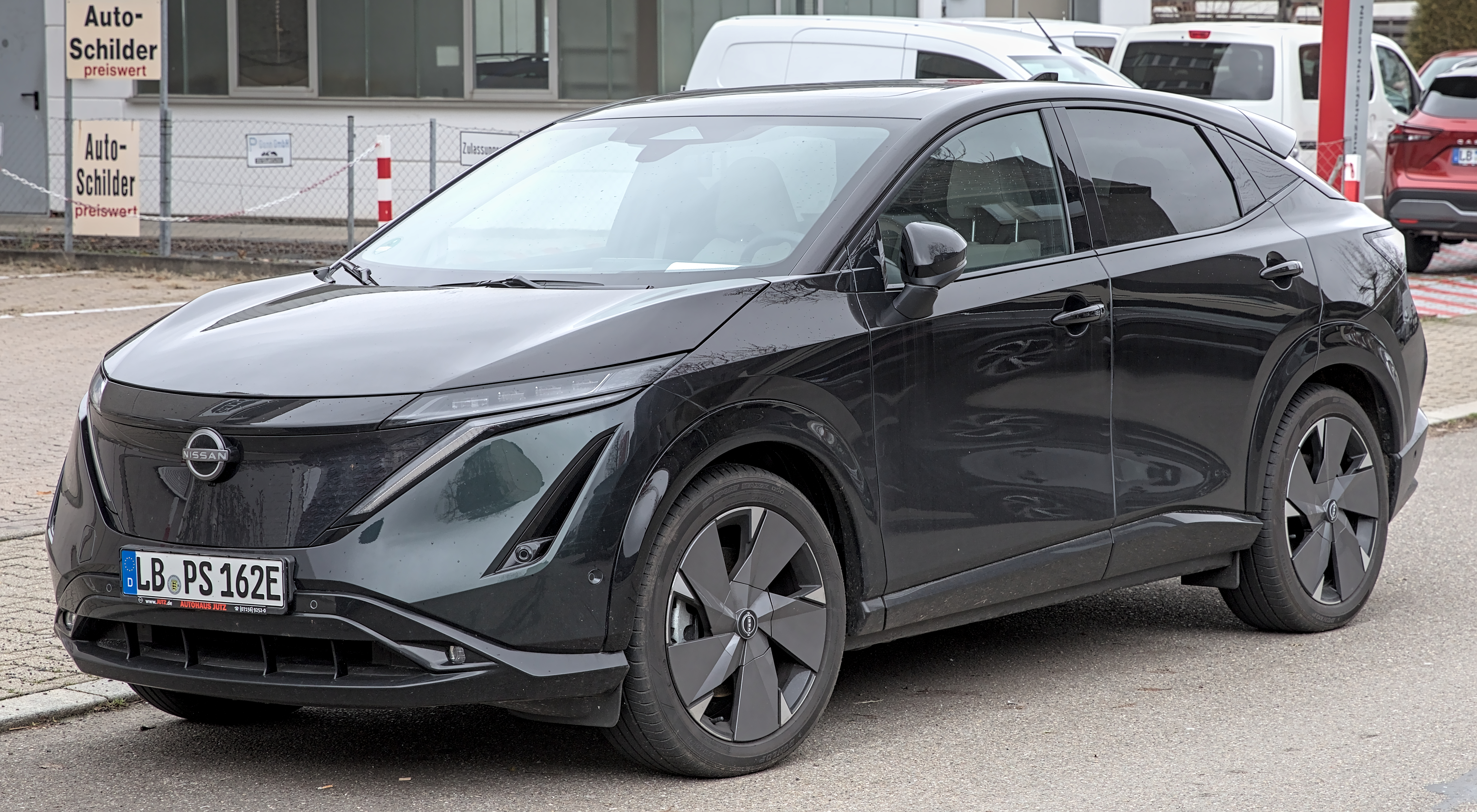
The Nissan Leaf is a fully electric car that doesn't use gasoline. It's known for being affordable and environmentally friendly, making it a popular choice for people looking to reduce their carbon footprint.
The World Car of the Year is an award given to the best new cars each year, judged by a group of car experts from around the world. It helps consumers know which cars are considered the best in different categories.
An EV portfolio is the collection of electric cars that a company makes. It shows what options are available for people who want to drive electric vehicles.
Aerodynamic means how well a car can move through the air. A car designed to be aerodynamic will use less energy and can go farther on a charge because it faces less wind resistance.
Range is how far a car can go before it needs to be recharged. For electric cars like the Nissan Leaf, a longer range means you can drive further without stopping to charge.
Vehicle to load means that an electric car can provide electricity to other devices, like charging your phone or powering a small appliance. It's like using your car as a portable battery.
V2X means that a car can talk to other cars and traffic signals to help improve safety and traffic flow. It's like your car being able to communicate with the world around it.
Charging speed is how fast you can refill the battery of an electric car. A faster charging speed means you spend less time waiting for your car to be ready to drive again.
The coefficient of drag is a measure of how easily a car can move through the air. A lower number means the car is more aerodynamic, which helps it use less energy and go farther on a charge, especially for electric cars.
An electric vehicle, or EV, is a car that runs on electricity instead of gasoline. This means it produces no exhaust fumes and can be cheaper to operate because you charge it with electricity.
A hybrid powertrain is a system that uses both a regular engine and an electric motor. This helps the car use less fuel and produce fewer emissions, making it better for the environment.
ICE means Internal Combustion Engine, which is the type of engine that runs on gasoline or diesel. Most cars on the road today use this kind of engine instead of electric power.
EV means Electric Vehicle, which is a car that runs on electricity instead of gas. These cars are better for the environment and are becoming more common.
Packaging in cars means how well the space inside is used. It includes how the seats and other parts are arranged to make the car comfortable and functional.
A hybrid system uses both a gasoline engine and an electric motor to make a car run. This helps save fuel and can make the car more environmentally friendly.
The Nissan Z is a sporty car made by Nissan, known for being fast and stylish. It's part of a long history of Nissan sports cars that fans really love.
The Nissan 300 ZX is an older sports car from Nissan that many people admire for its design and speed. It's part of the same family as the newer Nissan Z and has a lot of fans.
A full EV is a car that runs only on electricity, meaning it doesn't use any gas. This makes it cleaner for the environment because it doesn't produce any exhaust fumes.
The Nissan Ariya is a new electric SUV from Nissan. It's designed to be stylish and packed with technology, making it a great option for people looking for an electric vehicle with more space.
The Tata Motors Aria is a family-friendly vehicle that can carry more people and cargo, kind of like a van. It was made by an Indian company and was designed to be strong yet light, which helps with driving. People mention it because it shows how the company is trying to improve and make better cars.
The Nissan Pathfinder is a type of vehicle called an SUV, which is designed for families and outdoor activities. It used to be built like a truck, making it very tough, but now it’s more like a car, which makes it easier to drive. People are talking about it possibly going back to its tougher design, which could be interesting for those who like adventure.
LIVE
Comcast Business helps retailers become seamlessly restocking, frictionless paying favorite shopping destinations.
It's how nationwide restaurants become touchscreen ordering, quick-serving eateries,
and how hospitals become the patient-scanning, data-managing healthcare facilities that we all depend on.
With leading networking and connectivity, advanced cybersecurity and expert partnership,
Comcast Business is powering the engine of modern business, powering possibilities, restrictions apply.
At Capella University, learning online doesn't mean learning alone.
You'll get support from people who care about your success,
like your enrollment specialist who gets to know you and the goals you'd like to achieve.
You'll also get a designated academic coach who's with you throughout your entire program.
Plus, career coaches are available to help you navigate your professional goals.
A different future is closer than you think with Capella University.
Learn more at capella.edu.
Well, this is a special episode of this podcast because we're going to talk to CEO Ivan Espinoza
from Nissan who is leading the charge to get the company back on track financially
and also with new products like the Nissan Leaf which is running for World Car of the Year,
of which I'm a member of the jury panel.
So let's listen to what he has to say.
Good morning, good afternoon, good evening to you, wherever you are.
It's a pleasure for me to be with you today and have the chance to speak with the World Car Awards jury.
We're honored that the Leaf has been shortlisted in two categories for the World Car of the Year
and we are very happy to have the time to do today.
So I will keep it short, just speak a few things to give context and then we will have a Q&A.
So as you know Nissan continues to be committed to electrification and to a sustainable future
and we will continue to evolve our EV portfolio and scaling up technologies for the future.
We will continue transforming EV into mobile energy sources and our commitment is to create a fully integrated ecosystem in the future.
We are pioneers on the electric vehicle history.
We are just now launching our third generation Leaf but we have long history on this.
Over 700,000 global sales and 28 billion kilometers driven on Nissan Leaf.
And just two years after the launch of our first generation Leaf,
we started displaying the capability of the energy management and energy ecosystem
by showing the first system allowing energy sharing between the home and the car.
And since then we have been piloting in multiple parts of the world with new key energy players
and we will continue investing in the energy ecosystem space.
Now talking about the Leaf itself, the wonderful car is built into Chigi and Sunderland in the UK.
You can see the design is sleek and aerodynamic but there's a reason for this.
The Aero is a class leading, non-point 25 cd, allowing the best range in its class,
over 300 miles of range in the US standard,
over 600 kilometers of range in the European standard and over 700 kilometers of range in the Japan standard.
The goal is to create a non-compromised EV allowing ICE customers to shift their lives into an EV world without any regrets.
The car is very confident and responsive as you could expect from an EV drive
and we have a seamless onboard and off-board experience with a lot of technology
such as the intelligent around the monitor, intelligent route planner,
which will help the customers have no anxiety when they're planning the routes
as the system gives them the stops they need to recharge the car without the need to worry about it.
It has a dual 14.3 inch screens inside, dual automotive services and a bunch of other things.
Then regarding to the ecosystem, apart from the wonderful range that the car has,
the vehicle is able of providing what we call vehicle to load
to utilize the energy of the car to charge appliances inside and outside the car.
We have also V2X capability and the charging speed of a car is impressive.
So we can get 80% of the battery during a quick charge in just 35 minutes
and also get a quick recharge of 250 kilometers in just 15 minutes.
So the car is very capable.
As we said, the goal is to have a non-compromised EV, a car that is accessible,
a car that allows customers to shift from their ICE cars to an EV world without any regrets and any compromise.
So this is the all new Nissan Leaf.
Thank you again for spending your time with us today and I will open up for questions.
Thank you.
The Leaf is one of the vehicles you were directly involved with in your previous role.
How meaningful would Gualcar of the ER recognition be both personally and for the company?
As you know, I was previously the chief planning officer of Nissan
and this is one of the cars that I had the privilege of working directly on.
Actually, I continue to manage the product directly myself.
It's one of those things that I couldn't let go.
It's the area in which I grew within the company and it's the area where I believe I can provide value to the company as well.
But that aside, it will be very meaningful not only for me, but for the thousands of people behind the development of a car.
It's a car that means a lot to the company because it's an icon of the innovation that exists inside Nissan.
It's a proof of what Nissan can deliver.
And as I was saying, we are expecting this car to be a non compromised EV.
This was the goal from the beginning and we put very, I would say, rigid measures around.
One was the range and actually, you know, in the normal car development, design has a very strong say.
Here, what we did was we set the guidelines of range and this drove the CD, the coefficient of drag, in order to enable this range.
And this was the frame that we gave Alfonso and his team in design and it showed us a completely new way of making cars
because then we are designing around the CD and balancing the beauty and the CD and the range at the same time.
It brought this new shape of car, a car that is a crossover, but it's a bit of a bean shaped car.
It's a very, very interesting design that the restrictions of range and the EV world is giving us.
And it's just one of the examples of how engineers and designers have to cope with the challenge that we give them
in order to bring what the customers are expecting, which is an EV without compromise.
And for us, winning this award will be a recognition to this, a recognition to the fact that we kept the customer at the center
and we balance all the elements of car development to achieve a great product.
And as I said, a product that is well, well at the center, accessible to all
and that will hopefully make many customers happy in their transition to the EV world.
Thank you. Thank you for the question.
How is the lead doing in Latin America, a region you know pretty well?
Do you plan to launch the lead?
And he also would like to understand your comment on electrification in the region.
Thank you.
So electrification pace is moving almost by the hour in a way because there's many elements
behind beyond customer attractiveness or customer appeal.
There's a lot of things playing around in the world of taxation, in the world of some infrastructure and requirements and so on.
So specific to Latin America, what we see is that it might take a little bit more time to get the full EV market to grow quick,
but there will be a transition phase, a transition in which we will be capitalizing on other elements of our electrification strategy,
such as our hybrid signature e-power product and probably some other variants of this powertrain may come to the market,
depending on the conditions that we see.
Regarding to the lead, the lead is a car that was engineered with a global approach in mind.
So it's a car that eventually could go to any market around the Nissan world because it's a car that is a global car,
but it's tailored to achieve and reach every single market in which Nissan is currently present.
So eventually, depending on the market conditions and in the situation that we are seeing customers attractiveness to EV,
we might bring the cars in different markets.
I think Nissan is a company of innovation, is a company that creates accessible and confident innovation.
This is the approach that we have, not only for the electrification, but for everything we do.
We provide accessible products that bring innovation with a sense of purpose to the customer,
innovation that brings value to them.
As I said, in the case of leaf, I think it's very concrete.
It's a car that, if you are an ICE owner, will allow you to move into the EV world without any compromise.
Many elements inside this, like the range is one very important one.
I think also the packaging that we managed to achieve with the car,
the fact that it's around 120mm shorter in overall and luminous as a previous generation car is another proof.
So it's a very functional interior that you get.
You can put the child seat, you know, facing backwards in the rear seat.
There's a bunch of things that the car was developed to deliver to bring this accessible innovation.
And in this case, without compromise, EV to the ICV consumer.
So we will continue doing this.
The e-power row will be aiming in the same space.
A product that will be affordable, a product that will be accessible,
bringing cutting-edge technology to the users of the product in the form of e-power.
E-power, for those of you that have tested it, it's a very unique hybrid system.
It's a series hybrid system that brings the beauty of a direct EV drive feel.
You don't have a gearbox in the middle.
So you don't have transitions in between the ICE and electric motor.
It's very smooth, very silent.
And it's going to show to the world the beauty of electric drive motor driven cars.
And this is the role of the rogue e-power in North America and in the end of the e-power technology that we have in our portfolio as a unit.
The leaf is more affordable than many other North American EVs,
but considerably more expensive than many Chinese EVs.
Do you intend to produce a cheaper, stripped-back leaf if Chinese EVs are sold in Canada or in the US?
Thank you.
Thank you for the question.
As for Chinese affordable cars, we do have a joint venture company in China
with which we are leveraging on the beauties of China, which is not only costs.
It's cost, of course, is one of them, but you have speed, you have technology, and this is what we're doing.
So many of you maybe have seen the products that we are putting out in China, the famous N7 now,
and we have just released a plug-in hybrid car called N6.
And we will continue developing this technology in China, or China, but also potentially the export.
And we will be exporting some products to some markets around the world.
I don't have anything specific to share today, but this is something that we are going to do.
And we will also continue learning of what's going on in China to export the know-how outside of China.
It means we can benefit from our learnings in China to apply this know-how into our newer and future developments outside.
So the beauty of Nissan is we have this world footprint and we can learn from not only customers,
but also from the engineering development that are happening in the different centers that we have around the world.
And I'm guessing I'm the only one here on the call that has a 1990 ZX in my garage,
and I had the leaf in my garage next to it, and I could note the distinct design characteristics that the two cars share.
And I know you are background, so I know you are also a Z guy and love those cars.
I'm curious if you could speak a little too. Obviously, the characteristics that two cars share both inside and out.
Does the Z, since it's such a forward-thinking car for you guys as far as being electrified and futuristic in design,
indicate we'll get more retro throwback design cues in future products, or is this just like a one and done kind of thing?
Yeah, I understand. And there's always a lot of love and affection for our previous nameplates, as you said.
And this is one good example. I'm happy that you picked it up.
You know, the cues that we have on the rear tail lamps and a few other elements of the 300 ZX that we put in.
And I think it's just a way of paying homage to our history, and you know, many fans around the world can discover this.
And one of the things that we have, I mean, just building up on the question on the Chinese,
one of the things that we have as a company is history.
And this is something that not every company around the world has.
And this is something that I want to continue leveraging on.
It doesn't mean that we will be doing retro designs all the time,
but it's a fact that we can celebrate and we can connect our older customers with the younger generations.
And this is a smart way of doing so.
You can imagine myself being a 48 year old dad and I'm familiar with the 300 ZX and I have a son at home
that might be driving a leaf in the future, right?
So we can connect.
I can tell stories about 300 ZX and how wonderful this car was,
how I was impressed by the simplicity of its design,
that it was a very forward looking car.
You open the car, it was like a fighter jet cockpit inside.
And this is what we would like or I would like us to transmit across generations
by having this Easter egg elements on the design.
You see, this is a bit what we've been talking about
and you will see more of these elements coming across.
Yeah, I'm glad that you picked it up.
Say that thinking behind is just what I just explained to you.
How do we connect and present?
How do we use our history to connect with younger generations by owners and lovers of Nissan cars
that can show the younger generations how great our company is?
That's the thinking.
Can we expect the leaf in Mexico again, Ivan?
Yeah, as I was saying, eventually, yes.
The car, as I was explaining earlier, the car was designed to go to any country in the world of Nissan.
It's really a matter of market readiness.
It's really a matter of customer appeal and it's really a matter of priorities
and how do we go around the deployment of electrification.
As we were saying, there are some markets that are cooling now EVs
because customers require them or because the regulation is, in a way,
pushing the market to adopt EVs in a faster rate.
But there are markets that are more appealing or customers are appealing more
to different kinds of powertrain systems being those hybrids or plug-in hybrids
or range-extended EVs in this case.
The good thing is we have the technology in Nissan to cater to all those customer requirements
and we are observing very carefully what should get the cars first,
what kind of technology and which kind of markets should go first with what technology.
The other element is what was mentioned earlier.
How do we, I would say, defend ourselves from the Chinese offensive that is happening around the world?
Because I also have products that are very competitive producing China
and potentially we could use those as tools to defend ourselves in some markets around the world.
So the answer is yes, it might come, but yes, maybe other products might also come,
not only necessarily believe.
We are more like a power country right now.
For the moment, I would say yes, but that doesn't mean we shouldn't have EVs.
I think maybe the mass of the volume for the moment might be more on the e-power systems,
but we need to show the technology and what Nissan is capable of doing in the EV space as well.
So we could have a combination.
We could imagine having a combination of products.
The lower segment, urban A and B segment, seem to be flourishing among Chinese manufacturers
and enjoying success in recent years.
Would it be feasible to see a more affordable Nissan leave in more markets through the alliance with Dongfeng?
As mentioned, we have a partner, but we can also create products by ourselves,
by leveraging what we have learned in China and also in other parts of the world.
As I said, the beauty of Nissan is we have engineering centers in so many places
that we can develop many things and understand well how successful
and how appealing are these technologies or not to customers
and select what's the best depending on the circumstances.
So yes, we could do something with a partner or we could do something by ourselves.
We're always looking at the market and seeing what are the opportunities that we could capture.
In the end, it's all about the balance, particularly A and B segments
or segments that are very sensitive to price.
Probably electrification in a way might not be a priority for every customer yet.
So we might have to think carefully whether we do more of a hybrid e-power option
or we go with a full EV or we do some other technology.
As I said, the beauty of Nissan is we have all these technologies available
and we can play and cater with customers by utilizing that.
Is the Nissan leave a key model on the work?
You are underway to move Nissan ahead of its current financial challenges
and do you have a defined timeline for achieving results?
Yeah, the beef is I would say a key model in the wave of products that we are launching.
We started to change the narrative around the Japan Mobility Show.
We started to display our future product.
We showed the brand, we showed several products including the leaf,
we showed the minor change of Aria and a few other key cars that are
beginning of the offensive of the product and technology wave of the plant.
So leaf plays a key role in this because it's our flagship EV now.
It's the EV that is bringing the precious technology.
As I mentioned earlier, it's a car that has a clear purpose
which is providing customers the no compromise option of an EV if they are owning an ICE car.
So this is the role of a car.
This is what we are intending to do with the leaf
and we will continue pushing the leaf as we said.
We are starting in some markets, gradually the car might come into other markets
because it's one of the symbols of what we are aiming to achieve as a company.
As for the financials, you will listen later on.
I cannot talk about financials, we are in blackout period
but you will listen more about our financial results in a few days actually.
We will have a Q3 announcement quite soon.
You will see where the company is headed and we can talk later about the details
but we are making a lot of progress.
The plant is moving in the right direction and you will hear the news soon.
Thank you for the question.
The leaf pioneered the electric market in 2010 and the 2026 model represents a radical shift.
Do you think Nissan is reclaiming its role as an innovative brand
or is it now focusing on e-power technology?
Yeah, I think we've never left the space.
I think we are, if you look at the history, it's just a time to renew the product
and we decided to make it meaningful.
Why meaningful?
As I said, because the electrification space deserves enough attention from us.
There's many customers that we have, it's not only about the customers that have not changed
it's also providing an option to those thousands of customers that have bought a leaf before.
With this combination, understanding the history of our customers
and understanding the requirements of customers that have not yet converted to an EV
is how we designed this car.
It brings the best for the current owners of leaf
in the ways of exploiting the same values that the previous leaves had.
Accessibility, super smooth drive, a very functional product that has no limits
and we just magnified that with the last generation or latest generation of leaf.
This is for me why it's very meaningful not only for Nissan
but I think for the electrification space in the industry.
It's a clear statement that when you focus yourself in learning
and capturing all the learnings from the usage of hundreds of thousands of customers
around the world and billions of kilometers driven
you can come with the perfect solution for them.
Policy in the shape of a product, as I said, that satisfies the current users
plus opening the door to new customers that have never tried EV
because they were hesitant about it.
This car removes all those limitations and all those questions
and that's why I believe it's really meaningful in the automotive space of Soviet.
Are you planning to visit New York Auto Show and if you win, how do you plan to celebrate?
I don't know if I'm planning to go to New York yet.
We are discussing the schedule is moving all the time and I had seen my team saying like,
yeah, we're checking, so we don't know yet.
The celebration should be with the team.
As I said, there's thousands of people behind this
and it should be a recognition to their hard work.
It's a lot of work behind, a lot of understanding from the product planners,
the marketers, then the designers, then the engineers, the testing teams,
the manufacturing teams.
It's a huge, huge amount of people that is behind these wonderful cars that we do.
And as I always say, we should be proud about what we do.
And this should be, I think the best celebration will be just showing how capable
and strong Nissan is to deliver products when we focus our energy in the customer
and we align everybody together to deliver what we do, which is great cars that make people smile.
So this is how I plan to celebrate sharing it with the teams.
I just wanted to actually circle back to what we were talking about earlier
and actually what you just talked about with the customers
and you were mentioning how the, I'm sorry, the relief
and then you designed the ties back to some of the heritage that Zee really connects
and speaks and purges that generational gap
and you guys are actually enthusiast brand
or at least you definitely were right with the 240SX
and all the other cars we used to have, the Silvia.
We have the XTERRA coming back.
There's rumors about Pathfinder going back to body on frame.
What would you tell enthusiasts that are watching where Nissan is today
and now that there's an enthusiast in charge,
how we can connect today's product and tomorrow's product
for the enthusiast to bring you back to where you are about exciting product?
Well, I will tell them that Nissan is back.
This is the phrase that we're using.
Maybe you have heard also in the region.
It's in the US, it's a phrase that is being used a lot
and the reason is simple.
Nissan is back because we're back to our customers.
We're back to who we are as a company.
We're back to reuse and refresh our identity.
We're going to use some of, as I was saying,
some of the products that we had in the past,
the product that resonated with older generations
but bridged them into younger generation
in the way of fresh technology, pressure design,
but having the roots of Nissan,
the DNA of Nissan, the history of Nissan.
And this is something that, as I was saying,
only a few companies can be proud to have.
And this is one way of defending ourselves
in front of the newcomers that have no history.
We have a lot of history and we need to be proud of that history.
So we're going to keep hammering on it
and you will see a lot of products that will make you smile
because you're probably in the same generation
that understands the older cars
and also expect to have fresher technology
and a fresher interpretation of these old cars
but coming back to life in a modern shape.
And this is what exactly we are going to do.
So the phrase is simple, Nissan is back.
Thank you. I think that's a perfect closing.
Thank you for joining us today.
Thank you everyone for your time
and as I said, it's a privilege to spend some time with you today
and talk about this wonderful car.
Thank you very much. Have a good evening
and a good rest of the day depending on where you are.
Thank you very much.
How hospitals become the patient scanning data managing
healthcare facilities that we all depend on.
With leading networking and connectivity,
advanced cybersecurity and expert partnership,
Comcast Business is powering the engine of modern business.
Powering possibilities. Restricts in supply.
You'll also get a designated academic coach
who's with you throughout your entire program.
Plus, career coaches are available to help you navigate
your professional goals.
A different future is closer than you think
with Capella University.
Learn more at capella.edu.
About this episode
Nissan CEO Ivan Espinosa discusses the company's strategy to compete against Chinese EV manufacturers and the future of the Nissan Leaf, which is shortlisted for World Car of the Year. He highlights Nissan's commitment to electrification, the Leaf's impressive range, and innovative features like vehicle-to-load capability. Espinosa emphasizes the importance of creating a non-compromised EV experience for customers transitioning from internal combustion engines. He also touches on the challenges of expanding EV markets in regions like Latin America and the potential for new affordable models in response to competition.
This episode features a roundtable with Nissan CEO Ivan Espinosa and World Car of the Year jury members. We explore Nissan’s response to intensifying Chinese EV competition and examine the strategic importance of the 2026 Nissan Leaf as a key model in the brand’s roadmap toward renewed profitability and global relevance.
Hosted by Simplecast, an AdsWizz company. See pcm.adswizz.com for information about our collection and use of personal data for advertising.