This episode is about drag racing tires—special tires made for short races where the car accelerates extremely hard. Their job is to grip the track as hard as possible so the car can launch and keep accelerating.
Hot rodders are car enthusiasts who tinker and modify cars to go faster. They try ideas in practice, then engineers use the results to improve the design.
Funny cars and top fuel dragsters are the fastest, most extreme types of drag racing cars. The tires have to handle huge forces and still grip the track so the car can accelerate safely and quickly.
Drag slicks are special race tires made to grip hard when you’re accelerating in a straight line. They’re usually smooth (or nearly smooth) so they can stick better than normal tires.
Here, “stock car” means a race car based on a regular production car. It’s relevant because the tires weren’t always purpose-built for drag racing yet.
Roger Huntington was a well-known car writer. Here, he’s important because he tried to predict drag-racing results using engineering math, but one key assumption turned out to be wrong.
When a car accelerates, some of its weight shifts toward the tires that are doing the driving. More weight on the rear tires usually means more grip for launching.
SoCal Speed Shop was a well-known drag-racing shop in Southern California. Here, they’re credited with being early to market with special drag-racing tires called “SoCal Slicks.”
Alex Zidious is the person running SoCal Speed Shop in this story. The hosts mention him because he’s tied to the early ads for drag-racing slick tires.
“Drag racing purposes” means the tire was made for drag races—hard launches in a straight line. The story treats it as a big deal because it was the first time someone advertised tires specifically for that use.
Recapping means taking an old tire and putting a fresh rubber tread on it. Here, they used that process to turn passenger tires into wide, flat drag-racing slicks.
Motor Life is another automotive magazine. The hosts mention it because it published a 1954 story about getting faster by stripping weight off a car.
Car
1942 Mercury Club Coupe
The 1942 Mercury Club Coupe is the car they used for a speed test. They keep the engine the same (a flathead V8) and focus on what happens when you remove weight and then add drag slick tires.
A flathead V8 is an older type of V8 engine. The key point here is that the test keeps the engine unchanged, so the speed changes come from weight and tire grip, not from modifying the motor.
In drag racing, “elapsed time” is how long the car takes to run the track distance. Faster ET usually means better acceleration and traction, not just a high top speed.
Wheel spin happens when the tires spin faster than the car can move. It means the tires aren’t gripping well, so the car can’t accelerate as effectively.
The story says scientists once believed tire grip couldn’t be “bigger than 1.” Drag racers proved that wrong because the tires could grip the track in a way the simple rule didn’t account for.
An open differential is a drivetrain setup where the two wheels can spin at different speeds. If one wheel loses grip, the car may not send enough power to the wheel that still has traction.
A wheel stand is when the car’s front wheels lift up during a hard launch. It can be dangerous because it can make the car harder to control and can happen too quickly to correct.
“Head of the throttle” means the moment you really stomp on the gas at the start. That’s when the car is trying to accelerate as hard as possible.
Term
g
“g” is a way to measure how hard the car accelerates compared to gravity. Saying the car pulls “0.9g” means it’s accelerating almost as strongly as gravity would push you.
Inertial transfer is weight shifting because the car is accelerating hard. When you launch, more weight moves to the back tires, which can help them grip better.
A drag strip is a track made for straight-line racing. “Santa Ana drag strip” is the specific place mentioned where people were stopped for doing wheelies.
Tire pressure is how much air is in the tire. Changing it changes how the tire “squishes” on the track—lower pressure can help you hook up at the start, while higher pressure can feel better farther down the track.
Retreading means rebuilding a worn tire instead of throwing it away. They keep the tire’s main body and add new rubber on the outside so it can keep working.
A bias ply tire is an older tire design where the reinforcing layers are angled. That older design was easier to rebuild with new tread compared with some newer tire constructions.
Chemical construction is basically the recipe of the rubber compound. Different recipes make rubber harder or softer, and that affects how the tire grips and wears.
The sidewall is the part of the tire on the side. On race tires, how strong that sidewall is can affect how well the tire holds its shape when you’re cornering hard.
Recap slicks are race tires that get rebuilt. Instead of throwing the whole tire away, they keep the old inner tire body and add new rubber on top so it can be used again for racing.
Those bars on the side of the tire act like extra support. They help the tire stay strong and stable, especially when the tire is rebuilt and the tread is wider than the original.
Cord angle is how the tire’s internal “reinforcement threads” are laid out. More upright threads make the tire feel stiffer; more swept-back threads make it flex more and feel smoother.
A bias ply tire is an older tire construction where the internal layers cross each other. That crossing pattern changes how the tire bends and how it feels on the road.
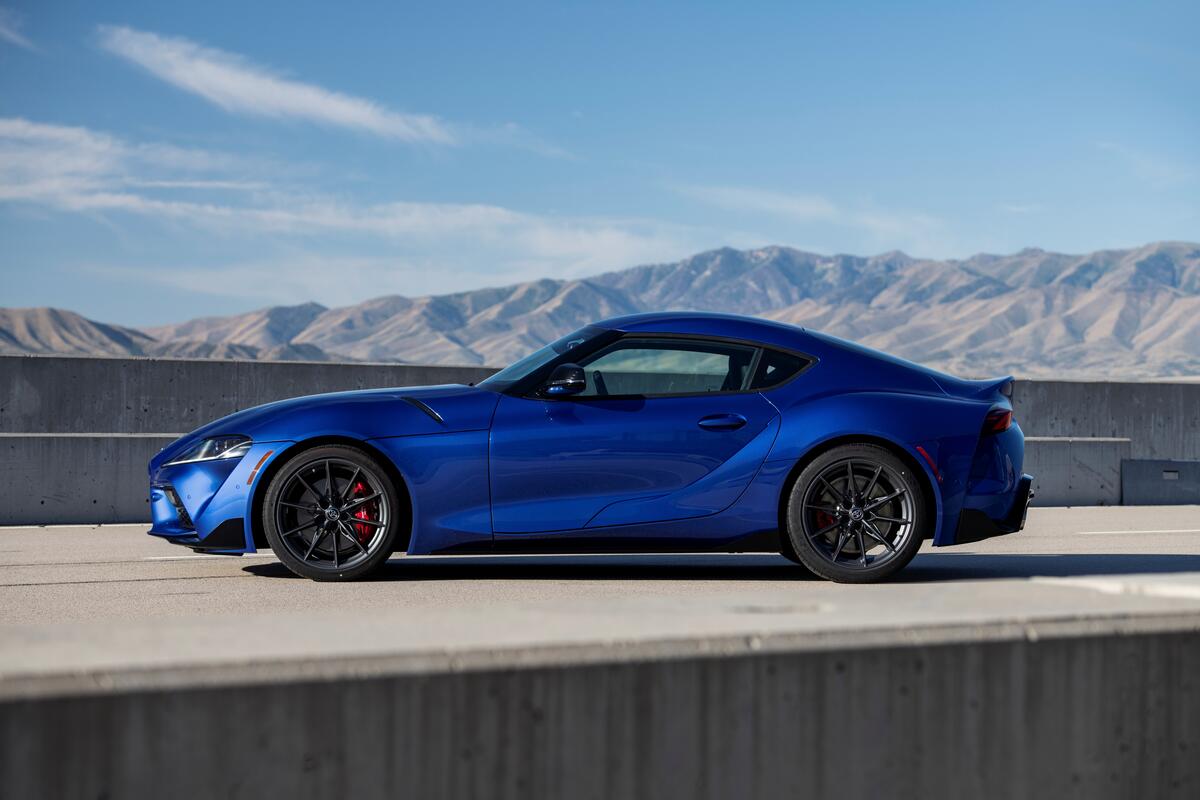
The Toyota Supra is a sports car built for fast driving and handling. In the podcast, it’s mentioned because how its tires are built—especially around the bead area—can affect how well the tire stays seated and grips the road. That’s why details like cord angles matter for performance tires.
Recappers are people who rebuild tires by reusing the tire’s main body and putting new rubber on it. In this story, they helped create early drag slicks using used racing tire casings.
The 1955 NHA Nationals are mentioned as an early drag racing event. It’s part of the story of when people started making drag slick tires and learning what worked.
Firestone is a tire company that was already making racing tires for different motorsports. Here, it matters because drag racers started using Firestone racing tire casings as a base for slicks.
Goodyear is a tire company that started getting into stock-car racing around the mid-1950s. The hosts mention it to explain how Firestone was ahead in racing tires at that moment.
Drag racing is racing in a straight line, where cars accelerate as hard as possible. Tires can behave differently than in other kinds of racing because the stresses build quickly and high speed can expose weaknesses.
Darlington is a famous race track in the U.S. The hosts mention it to show how speeds and tire demands differ between stock-car racing and drag racing.
Centrifugal force is the outward effect you feel when something spins. At high tire speeds, it tries to push the tire’s parts outward, which can make the tread and sidewall deform and lose contact with the road.
Lateral stability is how well the car stays controlled when you’re being pushed sideways. If the tires aren’t gripping properly, the car can feel like it’s about to slide or spin.
The valve stem is the little part that lets you put air into the tire and keeps it sealed. In this failure scenario, it can get torn off, and the tire can lose air very quickly at speed.
Bakersfield is where the episode says an early 1956 drag event happened. It’s used as a real-world example of how fast dragsters were getting back then.
Car
Lakewood Auto Dragster
A Lakewood Auto Dragster is a type of race car built for drag racing—mostly straight-line speed and acceleration. In this segment, it’s mentioned as having the best top speed for that year.
A “slide rule” is a mechanical analog calculator used before electronic computers. In the transcript, “broke the slide rule” means the team achieved results that the era’s calculations predicted were not possible—so their performance exceeded what math models said.
Lion’s Dragstrip is the specific drag strip where the record attempt happened. Different tracks can change how well cars hook up and how consistent the times are.
“Bruce Slicks” are drag-racing slick tires made by Bruce Alexander. Slicks are special tires with a smooth tread meant to grip hard for straight-line acceleration.
The Dacia SuperNova is a car model name mentioned in the podcast. The part you provided mainly talks about a “supernova” happening in 1957, so it’s not clear how the car relates to that story. More context from the episode would be needed to explain the car itself.
They’re mentioning a group that organizes and times racing events. That matters because records only count if the timing is done in a consistent, credible way.
This is the city in South Carolina where the next big race meet was planned. The hosts mention it because the story is about where these record-setting events happened.
Marvin Riftian is the person credited here with creating early drag-racing tires made specifically for racing. The hosts say his idea helped change how the sport worked.
The episode describes how the war affected what tire parts were available right after it ended. Because certain materials weren’t being made, racers had to improvise and tire makers had to find new ways to build tires.
During the war, rubber was limited and controlled. The episode says that meant certain tire parts weren’t being made, so racers had trouble getting the tubes they needed.
An inner tube is the air-holding part inside a tire. The episode says Marvin solved a shortage by modifying a larger inner tube to fit the smaller midget tires.
This is the rubber supplier the episode says M&H worked with. They collaborated on special rubber mixtures for racing tires that were being rebuilt (recapped).
Harry Webster is mentioned as the leader of the rubber company M&H worked with. The episode credits him with helping set up the rubber supply and blend agreement for racing tires.
Rubber blends are different rubber recipes mixed together. The episode says they worked out special recipes for racing tires so the rebuilt tires would perform better.
These are special race tires made for oval tracks. The goal is to give the car strong grip while it’s constantly turning in the same direction and building up heat.
Private label is when one company makes a product, but it’s sold under another company’s name. The host is saying Denman often built tires for other brands.
M&H Cruiser is a well-known tire line from M&H. In this story, it’s important because it was made specifically for race cars that go fast in circles on asphalt, not just modified from something else.
Midget and sprint cars race on short tracks, and their tires are built for that kind of racing. The host is saying M&H’s tires were top-level in those categories.
Indianapolis Motor Speedway is a legendary race track in the U.S. The host brings it up to show that some tire companies were already doing serious racing work there in the 1950s.
Bobo Sicki was a racer and tinkerer who helped build and improve race cars and parts. The host also says he promoted drag racing through an organization called the ITA.
Marv Riftian is the guy in this story who designed a new drag-racing slick tire. He looked at what drag racers needed and then worked with a factory to make a tire meant to handle that kind of racing.
The Denman factory is where the new tire design got made. It’s important because the way a tire is built affects how it grips and how it survives hard racing.
Blistering is when a tire gets overheated and the rubber starts to bubble or separate. It’s a sign the tire isn’t handling the heat and stress of the run.
M&H is a tire brand known for making drag-racing slicks. The story here is basically: the right M&H tire helped a racer go faster, which made the brand famous in drag racing.
The casing is the tough inner structure of the tire. “Recapping” means putting new outer rubber on an older tire base, and the story says that this process limited how wide the tires could be back then.
Magnesium wheels are lighter wheels made from magnesium metal. The hosts say they helped keep the tire seated better than steel wheels, but they still needed the right tire and wheel sizes.
Stock casings are the tire’s inner structure that gets reused when making a recapped tire. The hosts say those casings limited how wide the finished slick could be.
Bruce Alexander is the tire specialist the hosts are quoting. He helped supply and advise racers on the right slick tires and wheels, and he built a big business around tire recapping.
This is the idea that the tire and wheel widths should be matched. If the wheel is too narrow or too wide for the slick, the tire can behave unpredictably at speed.
LIVE
The modern drag racing tire is one of the most fascinating products of automotive engineering
that exists in the world. It does things that no other tire on the planet does,
it's doing multiple jobs at the same time, it's enduring forces placed upon it that no other tire
sees, and somehow it keeps going faster and faster. This is the story of how those tires came to be,
a very detailed look back into the roots of their fascinating history which I truly believe
is unparalleled in any specific race car part, in any form of motorsports.
This is the story of a decades long collaborative push-pull effort between hot rodders and engineers.
Hot rodders would experiment and push things forward, engineers would take their learnings,
apply sound principles and pull them beyond what they thought they could do,
and then the hot rodders would push the engineers again by riffing on their sound
foundations to go even faster. It's fascinating in every aspect. It is a story of people,
of small companies in large, of a famous prediction in 1952, and of the literal rewriting of the
textbooks about things like traction and how tires actually work in a serious drag racing car.
I will say candidly as a guy who's been in drag racing for about 30 years now,
I learned more about drag slicks in researching this video than I could have ever imagined.
I was shamefully ignorant on the most awesome details of how these tires and their technology
evolved and how they all actually function. I suspect many of you will find yourselves in
the same boat while watching and frankly that's the fun of it. I'm going to tell this story in
a chronological format. I'm also going to tell it in the level of detail that I've seldom been
able to achieve in many of my videos because I have been able to gather roughly 100 period magazine
stories, locate and study many SAE reports, physics papers, along with other academic work,
I dove into dozens of books and more, and conducted conversations with people who are
involved in the business of making drag slicks better, faster, and safer over the years.
This is the sticky history of slicks, the fastest racing tires in the world.
To truly understand the 340 mile per hour tires on today's funny cars and top fuel dragsters,
along with those that run about 150 miles an hour on the back of stock eliminator and
super stock cars, we have to head back to a decade where the sport truly came into itself,
the 1950s. In this time frame drag racing was a truly one-dimensional problem,
how to come up with the best solution to take a car from a standing start through the
quarter mile finish line in the quickest time possible. There were such a dearth of rules
and regulations at this point governing the top classes of competition that any idea was
effectively permissible. Engine location, the number of engines, the type of engine,
length of the wheel base, where the driver sat, all of that was up for consideration.
But then like now, drag racers were on an eternal search for grip. The good news for them in 1950,
despite what they thought at the time, even the strongest of their engines had not started to
truly plumb the depths of the horsepower ocean that would be explored in the coming decades.
This said, they were still on the hunt for the drag racer's most elusive friend, traction.
When we look at the early cars racing at places like Santa Ana,
we can see some interesting things going on with tires. Most of them are wearing some sort of tread
and rubber. Some cars are wearing dual tires on either side. There are also a scant few photos
from the 1950 time frame that appear to show cars wearing what seem to be drag slicks and they are.
Kind of. Tire recapping was a massive industry at this time and as the case was, there were
companies across the country performing this service not just for passenger car tires but
for modified and jalopy race cars. When we see some of the early drag cars with slicks on them,
they are most certainly stock car or at the time so-called track racing tires as they were
referred to in the 1950s, especially in the early part of the decade. Despite the fact that they
were not dedicated drag slicks, those racers seemed to be onto something and the logic made sense.
These things were somewhere between 6-7 inches wide whereas a normal passenger car tire was
typically much more narrow and they could use different rubber compounds when they were recapping
the tires, which even if not for drag racing had to be better than some Montgomery wards or Sears
tires, right? The answer? No one really knew. In fact, no one really knew a whole lot about
a whole lot at this time as it was a sport of rebellious kids that people either saw as a
national scourge or a fad. Not everyone saw it that way though. Roger Huntington was one of the
most prolific and respected automotive journalists of the 1950s and 60s and for decades beyond that.
He was renowned for his ability to take an engineer's approach to high-performance stories,
presenting complicated information in a very down-to-earth way that people could understand
and digest to the common gearhead. He was also paralyzed from the chest down. The man's story
is amazing. He authored more than a half dozen books, wrote with insane volumes and prolific
nature for virtually every car magazine you've ever heard of and Huntington was rabid in his pursuit
of the story of drag racing tires as you will learn through this video. And there was a very good
reason for this. The most interesting, innocent and scientifically backed gaffe of his storied career.
It was without malice. In fact, it was well-intentioned. Huntington in 1952 while writing for Rodden
Custom Magazine wrote a story that stated, with the mathematics to back it up, that the quickest
a car would ever traverse the quarter mile was at 9.1 seconds at 166 miles per hour. And yes,
it sounds ridiculous like he pulled the number out of a hat, but Roger Huntington's math equations
spit out these numbers and they made sense at the time. Was the equation broken? Not the equation,
but Roger Huntington's crystal ball certainly was. Part of the equation that Huntington used
involves something called a traction coefficient. This was the simple calculation of the car's
weight versus how much of it could be transferred to the rear tires and how much grip that would
create. We're going to go much deeper down this rabbit hole a little bit later on in this video,
but that's really the basics. Huntington used the coefficient of 1.0 in his equation, which
engineers truthfully believed could never be improved upon. 1.0 would be perfect traction.
As I do not have access to the actual story from 1952, we have to go off of these quotes from
Roger Huntington himself as he admits here it was the most famous blunder, but one that was
absolutely based on the engineering knowledge or theories of the day and he doesn't regret it.
But he did hear about it for the rest of his life. In July of 1953, something momentous happened,
but like so many things in the course of a story, they didn't seem like a whole lot at the time.
The pioneering SoCal Speed Shop, operated by the incomparable Alex Zidious,
published an ad for something called SoCal Slicks, which were special drag racing tires.
What made this momentous was the fact that it was the first time in history anyone
had advertised a special tire for drag racing purposes. These were recap passenger tires,
but they were recapped as to give 7 inches of flat surface for traction, which the ad claims
means 4 times more traction as a regular tire. The ad also states that every major record at
California drag strips were set with cars which used slicks. This ad would appear just one more
time in Hot Rod Magazine, shown shortly into the May 1954 issue, which just so happened to have
the SoCal Speed Shop cars on the cover. It's incredibly interesting that SoCal being the
first to market drag racing tires is little more than a footnote in this story. There is no major
record of business success with their tires, they likely won some races, but the simple fact is that
for a company and its ultra iconic status in the aftermarket, their drag racing tire business
really didn't crack the code and there's really not much more to their story and our story about
this. They were first, but they certainly weren't best. Next up is a great story in the July 1954
issue of Motor Life called Striptease for Speed. It's likely the first time this story was executed
in magazines. This style of story would be done many more times through the years. Famously Hot Rod
had Caddy Hack and Pony Hack over the years as well as the Vet Hack and more modern times.
The premise is brutally simple. Take a slow car and start cutting stuff off of it,
not messing with the engine and just see how fast you can go. The victim here is a 1942 Mercury
Club Coupe with a flathead V8. The car goes quicker and quicker with weight removed as we'd all
expect, but run number 8 out of 10 is the one we're interested in. No weight was removed on this run,
but a set of 7 inch would appear to be recapped slicks was bolted on the back.
These could have been Moxley's, Inglewood's, Bruce's or a near anonymous local tire shop's
version as so many people were producing in them at the time, but with those slicks added,
the car picked up 4 tenths of a second with no other weight removed. Of course, for those of us
in modern times, it seems rudimentary that the tires would seem to have lots of magic lurking
in them, but no one seemed to care or know anything but wider and less tread pad and were better
back in the early 50s. One guy who knew more about drag racing by the sheer volume of observation
he had done by the April 1955 timeframe was CJ Hart. He was the operator of the drag strip at
Santa Ana Airport. He was operating the first commercial drag strip in the country when he
opened in 1950 and by 1955 one of the busiest in the world. Hart talks about many interesting things
in this story, among them house stockers and so called semi-stockers were the backbone of the sport
as the cost of dragsters continued to jump. The interesting disparity between speed and
elapsed time where cars that should run huge speed could not make a decent elapsed time because of
how they launched and had to manage traction. He also makes an interesting prediction in that he
believed the car that would break 150 miles per hour in the quarter mile would not necessarily
have killer elapsed times. He was more right than you may believe. While Lloyd Scott and his twin
engine bustle bomb did it first and had a car that actually could eat tea pretty well, the green
monster of Art Arfons with its massive airplane engine did it next and would continue to shatter
speed records with lumbering elapsed times that couldn't hang with smaller lighter dragsters
simply because of the early run power application the monster engine struggled with.
Not much was made about tires in this heart story outside of a few mentions but
Arpal Roger Huntington was set to fix that in the December 1955 issue of Hot Rod Magazine.
A story called Getting a Bite serves as what can only be described as a landmark piece of
drag racing technical journalism. Huntington in his signature fashion goes deep into the
theory's practice and engineering behind traction and drag cars. Huntington begins with the point
that CJ made in the last story. Cars with big, hairy engines are losing drag races to lighter,
smaller, less powerful cars because of wheel spin. Everyone is building more horsepower by the day
but they have no way to use it. Traction, he surmised, was the most overlooked part of the
drag racing world in late 1955 and he aimed to fix it. He explains that traction is friction
and the maximum horizontal thrust a car can make depends on the friction between a tire and the
road. The amount of torque your hairy engine is making is meaningless if it all goes up in smoke.
There is static friction and kinetic friction with of course static being what's necessary
to overcome to break the tire loose from the pavement and kinetic to traction that is generated
as a rolling thing. The law of physics that drag racers had been making mincemeat out of already
in 1955 was one that stated that friction between two bodies in sliding contact will depend only
on the surface conditions of the two objects and the load pressing them together. Surface area
should not play into this at all according to the physics equations. The existing theories and
equations basically said that a large tire and a small tire with the same road conditions and load
should produce the same grip. Not being a totally versed physicist, this is at least how Roger
decides to tell it in print. Now we have to talk about traction coefficient. As defined by Huntington,
this is the horizontal or friction force as a fraction of the total weight pressing the two
surfaces together. Cars had a traction coefficient of 0.75 to 0.95. In simple terms, if there is a
1000 pound load on the tire, the math that Roger referenced said that the maximum of 750 to 950
pounds of forward driving thrust could be produced. The most important quote of the whole story comes
next and will define the decades to come for drag slicks. Quote, scientists are quite certain that
this coefficient of sliding friction could never be above 1.0. End quote. Let's just say that those
scientists hadn't met the drag racers yet. The reality is that by 1955 racers were already seeing
more than 1.0 traction coefficient and it was happening for a reason the scientists
that were very sure it never could be never considered. The slicks were kind of attaching
themselves to the track like a self-conforming gear. Instead of riding over the low spots in the
pavement and riding only on the high spots for each revolution, the drag slick was accepting
the high spots and deforming to actually grab the low spots as well, taking the effect of
kind of gearing the car to the pavement. The slicks of the day run at ever lower pressures
were producing more traction than engineers deemed possible on their slide rules. The drag
racers had cracked a code that no one knew existed. Beyond that, this was only the beginning
of the beginning, technologically speaking. Huntington made brief mention of the tire
options for racers, how some use natural rubber, some only synthetic, some softer compounds,
some harder. He did say that hard spinning tires were anathema to the best acceleration
and that drivers who showed the most skill, lightly smoking the tires for a few yards at
the head of the throttle, were by far and away the most successful. Huntington surmised that the
most successful design of a drag racing car would be comprised of the elements of lightweight
with as much of it positioned to the rear axle utilizing a system to cancel out engine torque
which unloaded the right rear tire and caused a lot of smoke and an error dominated by open
differentials. Huntington then explained that in frequent and odd happening curiosity at the drag
strip, known then as the wheel stand. If we take a 1,500 pound dragster with 1,050 pounds of its
static weight on the back tires and launch it with the driver hitting the gas, we'd achieve
.9g on the head of the throttle which is awesome. So now we've taken another 210 pounds of front
to weight and moved it to the back via inertial transfer and then another 180 pounds of longitudinal
front to back rear transfer and we're running out of weight on the front end very quickly.
By this math we have moved all but 60 pounds off of the front end and that will be a problem
because the wheels of the front will be coming up more quickly than the driver could ever react.
CJ Hart actually threw people out of Santa Ana drag strip for pulling wheelies. Fans loved them
but they were ultra rare and they were highly discouraged at this point and seen as reckless
and very dangerous. Huntington Tocks tire pressure as well and what the early racers were learning
by experimenting and the findings were interesting. Low pressure gave massive grip on the launch pad
but had bad handling at the top end which seemed kind of weird. Pumped up the tires gave little
early bite but they were way better down course in terms of handling. Now clearly there was a
correlation between inflation pressure and performance but these guys were kind of wondering
what it was. More importantly what the heck were these guys even running for tires? In so many ways
they were running other people's old tires. Drag racers didn't have a ton of options for tires
back in their day in 1955 but they had a few and all of them came from the same process.
Recapping or otherwise known as retreading. The beauty of a bias ply style tire was the fact
that it was basically a reusable item. The idea of retreading tires was introduced in the early
1900s and by 1950 was a legitimate industry across the United States. Gas stations and tire
stores represented the largest group of retreaders nationally and among them were guys who not only
did passenger car tires but had developed a process for racing as well. This most typically for
stock cars, midgets, modifies and others. Bill Moxley was one of those guys who haven't gone
into business in 1950. Bill Cretchen is Englewood tire company which had been producing a recap
line called Positraction Racing Tires since the 1940s as well as Bruce Alexander of Bruce's tires
who like Kretsch got into the business of retreading tires just after the conclusion of World War
II and Alexander saw racing as a massive market beyond the normal passenger car stuff which was
the foundation of his company. So what is a recap tire? It's a brutally simple concept. These
companies would purchase worn out passenger car tires. Step one was to inspect the side walls
and general carcass or casing of the tire from the inside to make sure there was no significant
damage or flaws and then next the tread of the tire would be removed by a machine called the
buffer which is really kind of underselling it. This was really kind of a massive medieval looking
grinder with a tooth wheel that would grind off all the rubber all the way down to the carcass of
the tire. Next up the casing of the tire would be wrapped in a new layer of rubber. Now this
rubber would be chosen from one of the vendors that the recapper worked with. They would choose
the rubber for its chemical construction meaning its hardness its softness thickness and more.
Lastly the tire would be placed in a mold and then inside the tire would be a device that was used
to hold its shape and structure in the mold as heat and pressure were applied to bond the new
rubber to the casing and form it into the tread shape and design that was desired. Now here's
where I need to explain just a couple of basic things so we're all kind of on the same page here.
Firstly this process had plenty of nuance in it as simplified as I've made it seem. The selection
of the proper casings for use in racing was important not all tires were made the same with
sidewall strength section height and width and more. There are also loads of options to choose
from when it came to which rubber to cook onto the casing. There was rubber suppliers like Voight
and dozens of others who had their own catalogs numerous levels of softness and compounds layer
thickness and more. This process could be reasonably well tailored to the end user.
Now this is also where the famed pie crust look came from as well.
In modern times we call these pie crust slicks because of the unique look of their sidewalls
like the edge of a pie whose top was sealed to the bottom with the traditional method of pressing
a fork against the top to lock it in with the bottom layer of the crust. In the case of recap
slicks this was done not for looks but for strength. Each one of the bars you see in the
sidewall is a buttress like reinforcement and that's helping to support the wider than stock
tread on the reused casing. They do look really cool and retro now but again those things were
there to support the square shoulders of the tire and maintain their integrity as they tended to
extend well past the area kind of where the factory tread was on the factory casing kind of a
rubber gusset I guess you'd call it. And oh by the way nobody called them pie crust slicks back
in the era when they were actually made. New I should say is not a retro item. Now there are
many pluses and minuses to recap slicks. The minuses were pretty negligible in the 1950s but they
would grow over time. So what are they? For starters you're basically building a house on an old
foundation. You can build a really pretty house on top of it but you're stuck with whatever is under
it and in the case of a recap especially at this time in history we're talking about a worn out
passenger car tire in most cases. This also means you're stuck with the structure of that passenger
car carcass. Before we go too far down this road we have to talk about the basics of tire construction
to make a lot of this stuff we're going to talk about really makes sense. Some terms like the
bead. The bead of the tire is the part that's effectively going to attach it to the rim it's
stiff and in this era was largely made out of piano wire. Now we need to talk about the cord angle
which is an interesting area and one with drastic effect on the topic of this video. To make a bias
ply tire there are plies in the tire that have cords in them that gives the tire structure and
really kind of define how it works. Now imagine we're looking at a tire that is standing up in
front of us and if we had x-ray vision we could see the cords and they were running straight up and
over the top of the tire from one bead to the other. We would have called that a steep cord angle
we'd actually call it a 90 degree angle because it was running straight up from one bead into the
next. Now if the cords were instead swept back at an angle coming off the bead kind of headed
through the radius of the tire we'd call that a shallow cord angle. The steeper the angle the more
strong and rigid the tire is but the worse the ride quality is. The more swept back the cords are
the more flexible and forgiving the tire is. Manipulating this angle and the construction of
the tire will become a huge part of this whole story and the evolution of the drag slick.
So now that we're clear on that stuff let's go back in the time machine. By the time the 1955
NHA Nationals rolled around the Recappers were making lots and lots of drag racing tires and
as the culture of hot rotting kind of encouraged they were learning as they went with the racers.
For starters they figured out that the best product they could hand to a drag racer was
the slick they had built off the casing of a used Firestone racing tire. Firestone was about
the only brand that had been with racing for a long time now and they had developed and tested
racing tires for multiple different disciplines. Now none of them were drag racing but they were
still a racing carcass or casing to use. Goodyear had quietly gotten into NASCAR in 1954 but Firestone
was the most well-known racing tire manufacturer in the country at this point. For the majority of
people who had no connections to buy used Firestone racing tires the Recappers had learned a few other
things in a short amount of time. The most important was that it seemed like the more used up and
softened the sidewalls were on a casing the better it worked for the drag racers. Secondly and along
the same point tires of fewer sidewall layers or ply seemed to also be performing better but like
with all things there's kind of a catch. If the boys ran those tires with too little pressure they
could barely avoid wrecking at the top end at more than 100 miles per hour. The stock car recaps didn't
do this or suffer this issue and it was to some degree confusing to everybody. Part of it may have
been related to raw speed and wear. For instance when Fireball Roberts grabbed the pole position
at Darlington in 1955 his average speed for his qualifying laps was 110 miles an hour so that might
have met 130 in the straights and far less in the corners. This and a heavy stock car that would have
the tires changed during the race. The drag racers and lighter equipment were exceeding these speeds
and doing it with truly violent acceleration. The Recappers figured it was the inexperienced drag
racers lacking in chassis engineering and the drag racers figured it was something to do with
tires but they weren't sure what. The reality is that the recap slicks that use old passenger car
casings or carcasses were suffering the effects of centrifugal force on the tire at these higher
speeds. The sidewalls were too weak to hold what was a heavier tread section flat so as the center
of the tread was pulling outward harder and harder as the car accelerated and went faster and faster
the sidewalls are supposed to hold it in place. Instead as we can see here the tread would pull
outward the sidewalls would stretch and the car had virtually no contact patch or lateral stability.
This was the root cause of the handling issues with cars that ran these recap tires especially
when speeds kept going well over 100 miles per hour. They did know that in rare occurrences the
top performing cars could actually grab the track hard enough that the wheel would spin in the tire
ripping the valve stem into the wheel shearing it smooth off and causing the tire to rapidly
lose pressure. When that happened at the top end guys got hurt. It was a rare but it was a scary
issue. By 1956 dragsters were starting to get some attention beyond the realm of the youthful sport
they were the stars of. In fact in February of 1956 at Bakersfield the Hashimba Plogle Dragster
ran 912 at 153 miles per hour this within a hundredth of the theoretical limit that Roger
Huntington had proposed in 1952. The top speed of the year came from the Lakewood Auto Dragster at
159 miles per hour creeping in on the proposed maximum speed as well. Whether it was these numbers
or something else Roger Huntington published a story in 1956 that did something no one else had
dared to do to this point in history. Place dragsters on the same plane as the almighty Indy
Roadsters of the day and the world-class Grand Prix racing cars burning corners at this time as
well. Not only did he put the lowly drag racers in the same chat he clearly laid out how what they
were doing was more impressive than a lot of stuff anybody else was doing at the time. Using his
trusty math he produced a chart of an acceleration race between a dragster and Indy car and an auto
union Grand Prix car as well as a Mercedes Grand Prix car. The dragster destroyed them all through
the quarter mile it was a moment where drag racing gained some legitimacy in many circles and was
viewed as an uninvited guest and others. 1957 though would be the year that our story truly takes
off and it didn't take long. On February 3rd of 1957 at Lion's Dragstrip the famed team of Emery
Cook and Cliff Bedwell did the seemingly impossible. They ran 166.97 miles per hour in the quarter
mile and they officially broke the slide rule and did it on eight inch wide Bruce Slicks.
Two months later in April at Bakersfield the pair would take their carved,
nitro burning, heavy dragster into the 8 second bracket to be the first in history to do so at
889. They had single handedly proven that hot rodders could beat the math and do so in a manner
that let the world know they were just getting started. The numbers triggered headlines in magazines,
panic in the control rooms of drag strips who had operators fearful of the danger,
the cost escalation and potential wreckage hurting their sport and the phone melted off the wall
at Bruce Alexander's tire business. Everybody wanted his Slicks. Why? He had the fastest
drag racing tires in the world right now and that was very good for business.
Later that summer a young upstart from Florida would save his money and gain the courage to
attend the 1957 AATA World Series of Drag Racing in Illinois. His name was Don Garlets.
With his own fuel dragster along with his wife he planned to take on and fight the teams of Cook
and Bedwell and all the others. It wasn't going well when he got there. His car was horribly slow.
Emory Cook actually felt so bad he came over and helped Garlets get his fuel system squared away
and in doing so he launched the most incredible career in drag racing history.
Garlets would go on to beat the Cook and Emory car at the track before losing in the top
eliminator final to settle Pistoyan but a star was born that weekend. That star would turn into
a supernova that November. On the 10th of November 1957 at Brooksville, Florida, Don Garlets went
through the quarter mile at 879, some say 876 but in his own book he says 879 so I'm going with that
at a never before considered speed of 176.4 miles per hour. These were two records by a mile and
because of these two runs Don Garlets would get a call from a man named Bob Ossicki to attend a
high paying high profile meet that Ossicki was putting on with his International Timing Association
in Chester, South Carolina. There would be media, there would be competition and most importantly
if he kept his act together there would be money. Someone else was heading to that race as well,
a tall relatively quiet guy from a small berg outside of Boston, Massachusetts named Watertown.
His name was Marvin Riftian and he was not completely empty handed as he headed to the race.
Marvin had tires, in fact he had the very first scratch made purpose built drag racing tires
anybody on the planet had ever created. Marvin Riftian had an idea that these tires could change
the sport of drag racing and like so many other times in his life, Marvin Riftian was right.
A lot of men had been in the tire business in this world but a few of them have loved it,
obsessed over it and helped advance it like Marvin Riftian and to say that he's an unlikely hero
is being real about it. Born in 1915, by all accounts, Marvin was a bright kid,
good at school and he loved cars, especially race cars. By the time he was graduating high school,
Marvin's father who operated a gas station and tire recapping business in Watertown,
Massachusetts on Main Street needed some help. That was nothing special, it was a small typical
auto shop at the time and there are two things I don't know for sure about Marvin.
The first is whether he actually attended college or whether his innate understanding of
engineering and how tires worked was simply learned on the job or if he's learned in the books.
The second thing I don't know is about his war service. It's rarely mentioned in some
recountings of its life and I have found at least one instance of him being referred to
as an Army Intelligence Officer. Now I want to be clear about these two things. I don't want to
commit Marvin to a college education he didn't have or say he didn't have it if he did and I
certainly do not want to claim he had military service if he didn't or detract from that if he
did. Because I can't verify these two things I just wanted to be upfront with both of you.
Now they may be immaterial to the entirety of the story but I want you to understand this
guy's life and that's why I'm coming clean on this front. But one thing we can say for certain
is this. In 1942 Marvin and his father Harry got together and started the M&H Tire Company.
Like other recappers out there the business was rooted in passenger car tires but
it really didn't take long for M&H to get in the racing business. Now when racing got fired up
after the close of World War II, New England midget racers had a major issue. The 12 inch
tubes they needed for their little midget tires were all but nonexistent because of the rubber
rationing and needs during the war. People simply stopped making them to make stuff other people
actually needed in day to day life. Marvin was appealed to and he developed a process where he'd
take a 16 inch car inner tube and cut it down and then rebond it for the midget tires that needed
12 inch tubes. These things worked flawlessly and M&H's entree into the racing business,
humble as it was, was made. Marvin and his father got their recapping rubber from the
Denman Rubber Company in Ohio and after some communication back and forth between Marvin
and Denman's president Harry Webster, they came to a working agreement that Denman would supply
M&H with some special rubber blends developed jointly by his people at Marvin for use on
racing recap tires. Now this agreement was made in the 1940s, the late 40s after the war of course
and it worked well. So well that M&H was becoming more of a racing tire recapper than a passenger
tire recapper. These guys experimented in every way possible. They even tried using
truck and bus tire carcasses to base racing tires off of because of the toughness and innate
strength of their construction. It was a good idea but didn't quite pan out. There was a better way.
In 1952 M&H and Denman entered into an even more extensive partnership to produce full-on
circle track tires from scratch. Because Marvin and his dad didn't have the capital or resources to
build their own tire factory, teaming up with Denman made all the sense in the world and Denman
was a unique company. Over the course of their entire existence, they did a lot of let's call it
private label or side jobs for people. They would manufacture what people wanted, didn't really
care if their name was on it so long as they were getting paid for making it and that is exactly how
it went with Denman and M&H Tire in 1952. So because the fact they went into this partnership,
tires started getting made and born was the famed M&H Cruiser which is a scratch built,
not recapped race tire for stock cars, modifies and really anything else that went fast in circles
on asphalt. The Cruiser line of tires was a huge hit. Their midget and sprint car tires were also
considered the class of the field and while Firestone had done some racing tire work at the
highest levels of competition in the 50s at places like the Indianapolis Motor Speedway, M&H was
really the first kind of meat and potatoes home spun race tire builder because of their
partnership with Denman. As Marvin traveled the country peddling tires and building a dealer
network he met so many people in racing and one of them was named Bobo Sicki.
Bobo Sicki was a Mickey Thompson-esque figure and if he had lived past his early 40s he would be much
better known today. He was a racer in every discipline you can think of from NASCAR to dirt
and drag racing, a brilliant mechanical mind that developed parts and hopped up engines. He built the
insane mad dog racer that Art Malone set a speed record with at Daytona and he was even a promoter
like Thompson with his ITA, the International Timing Association which was a drag racing
sanctioning body. By 1957 Bobo Sicki knew a few things. Firstly he knew that Marv Riftian was
whip smart. Secondly that drag racing was taking off like a bottle rocket and thirdly there was a
massive market for somebody, anybody who could actually make a real tire from the ground up for
all these guys to use. Oh Sicki knew that Riftian was probably the guy to fill the gap that was
needed in the industry just kind of had to talk him into showing up but it didn't take much because
Marv was interested to take on this challenge. The one wrinkle in this whole plan was that Marv had
never actually ever been to a drag race before but what he did was study the equipment and understand
the needs of the competitors before sending a new design to the Denman factory to produce.
It was a slight take off on his cruiser circle track slicks, nothing radical but he understood
that the passenger sidewalls on recaps were not really ideal for any kind of racing tires so
what he did was he made these sidewalls just a little less robust than the stock car tires.
Understanding weight was a concern he made the slick treaded layer a little thinner than the
cruisers and knowing the contact patch was likely the biggest concern he had them molded with a
slight crown in the tread. Now this crown would flatten out when the car's weight was placed
upon the tire and they weren't quite as wide as the seven inch bruce slicks at six and a half inches
as they came out of the molds but frankly Marv didn't see that as a disadvantage. The question is
would he be able to convince racers that to try them? With six pair of tires made he hopped into
his truck to see what drag racing was all about and if his basic ideas rooted in experience outside
of this sport and his intrinsic knowledge of how tires work could actually help drag racers.
His ride to Chester South Carolina was seemingly uneventful. Don Garlett's rides at Chester South
Carolina however were anything but. Garlett's had run 166 miles per hour and then lost the
brakes in his car completely and in an era before parachutes he was a hopeless passenger as his car
shot off the end of the drag strip which was actually a runway which thankfully ended with a muddy
swamp. Garlett's was fine the car looked like it had been pulled out of the La Brea tar pits and
the last thing on Garlett's mind was tires and then he ran into Marv Riftian. As it turns out
when Garlett's ran the insane 176.4 mile per hour speed earlier that month at Brooksville Florida
he had bruises licks on the car and like all top runners across the country they were the ones that
everybody chose but those tires had spun really hard on that run and had blistered and been
roughed up to the point that Garlett's didn't want to use them until he got fresh tires from Eddick
and Darien who promised to send them from California as part of a sponsorship deal.
In the meantime before those tires arrived he wanted to make some test runs and
he had located a pair of M&H Cruiser stock car slicks and installed them
with the idea that perhaps their harder rubber surface may be less apt to blister or come apart
than the softer bruises. It was pure happenstance then that he had those tires on when Marv walked
up. Marv was blown away to see his M&H tires in the back of a dragster and because of that
he offered this young Garlett's man a pair of his new tires. The keen eyed Garlett's had
immediately noticed that the M&H slicks were more narrow than the bruises that were apparently
stuck in the mail so this caused Garlett's to pepper Marv with questions about the tires.
As he was doing so Settle Pistoean ran 10 miles per hour faster than he had ever run before
on one of the other sets that Marv had brought to the property. As you can imagine the questions
stopped and the winning started. Garlett's would run 895 at 170.71 as his best numbers at this race
he would capture the top 118er title and put M&H on the drag racing map immediately.
He would also become an M&H devotee for a long time to come. Marv Riftian had found his new
professional obsession walking around the pits. Now Marv quickly realized that drag racers knew
little to nothing about tires and he didn't think that in a negative way he thought that in an
objective way. The stuff they were using wasn't great and he knew with time thought and experimentation
he could almost single-handedly revolutionize the sport of drag racing and he did. Profiles of cars
often highlighted the massive slicks of the era like on this dragster which of course are quaint by
standards. These are 8 inch wide jobs. It's interesting to consider that from 1953 the
introduction of those SoCal 7 inch drag slicks we were still talking about the same size tires
all these years later. How did they not figure out that wider was better? Racers knew it but there
was two massive limiting factors in this time frame. For starters the casings being recapped
were only so wide. Secondly it was actually rare to find a passenger car wheel that was 7 inches wide
in the junkyard. Sure if you had big money you could spring for a set of trick magnesium wheels
that were wider and could handle wider tires but ironically when you did that they were still only
an 8 inch wide recap to buy because that's as large as these guys could go on stock casings.
But there's more to it and that's why in Hot Rod Magazine of February 1958 a story named answers
to your racing problems ran. This story used none other than Bruce Alexander himself or Bruce's
slicks for its information. Bruce's were still by far the largest most used tire in the sport
and he opened his business in 1946. By 1958 he claimed he had recapped more than 10,000 tires for
passenger car and racing use combined. His racing tire line included midget tires,
tires for stock cars, sports cars, roadsters and drag racing. He also claimed that he was
shipping tires to racers across the world. So what does this story teach us about period drag racing
tires in the late 50s? It sets into stone a rule that companies have been preaching since the
SoCal days and would continue to preach a decade into the future. Racers needed a 1 inch to 1
inch ratio wheel to tire. A 7 inch slick needed to be on a 7 inch wheel ideally. Sure you could
vary up to 1 inch of wheel width but absolutely no more than that so a 6 and a half inch wheel with
a 7 and a half inch tread would work but no more differential than that much. The fear at the time
was that using too wide a wheel and too low an air pressure would allow the wheel to rotate in the
tire as we previously discussed with catastrophic results. In this story Alexander mentions what
recently happened to Emory Cook and Honolulu Dragstrip in Hawaii where both rear tires were thrown at
some 150 miles per hour and the car skated for a long while totally out of control. It was the
bleed off of air pressure that caused the tires to lose their integrity and fly off the wheels of
the top end. It would not be the first or last time a racer would suffer this but Cook was among
the lucky ones to walk away. Magnesium wheels held the tires better than steel but the ratio was
still recommended to be 1 inch wheel 1 inch tire match it up meaning again 8 inch width slick find an
8 inch width wheel 6 and a half inch width slick find a 6 and a half inch width wheel. Alexander
cautioned in the story about killing performance with too much diameter of a slick on a car basically
causing the final drive ratio to suffer. He also talked about the importance of running an actual
tire designed to do what you wanted to do meaning on a drag racing car you should not run a circle
track or sprint car slick because the rubber compounds and casing selections were different.
Also the drag slick was designed with a slightly concave tread that had sharp block shaped shoulders
on the tire this tire would then flatten out when it was inflated and pressed to the ground giving a
good contact patch. Circle track slicks had one sharp and one rounded shoulder for cornering
purposes and more. Incredibly it was recommended that if a tubeless style casing was being run with
an inner tube or a liner the outer tire should be punctured on purpose a couple of times to prevent
an air build up layer between the tire and the tube and this seems like really bad advice. Clearly
it was done a lot but it just seems like really bad advice for something you're going to drive at
150 plus miles per hour. A chart of inflation pressures was published and these show us something
pretty interesting so-called track slicks had a wild variation between asphalt and dirt well
drag racing slicks all came in between 20 and 30 psi this is of course way high when we consider
slicks today as we'll learn in a few minutes but these numbers were all taken with a grain of salt
they do what they please in terms of the racers decision making no matter what the experts said
they already proven the engineer is wrong in the first place so why did they have to listen to
everything these guys told them now prices slicks were mentioned at the 200 to 300 per pair mark which
is way higher than what i have seen in research as i'm putting this thing together so it seems
like a bit of propaganda for a guy like bruce's slicks to be able to say that they were so
astronomically high when the recaps for about a hundred bucks a pair so i think the two to
300 dollar name is really more of a marketing ploy or a discouragement to potential
customers than actual fact because as we're going to learn they never got that high even later in
the decade or in the 1960s but really even this early the guys like bruce understood what the
introduction of the mnh race master meant for the sport of drag racing he understood what it meant
for the advent and advancement of recaps and he understood what his place would be in this sport
if not sooner then maybe a little later and it would be certainly different than where he was
right now 1958 would also give us a very clear indicator and how tires and specifically the
mnh race master were starting to evolve the actual equipment of the sport of drag racing
the racers had gotten themselves far along and now the engineers like riftian self-taught as he
might have been had taken what they knew applied their technical knowledge and the result was
improvement don garlets had a front row seat to this action marv sent him a pair of experimental
slicks which he bolted on for a match race in montgomery new york on october of 1958
there were eight inch wide pieces on 15 inch wheels garlets set a new world record of 836 and
only went 160 miles per hour lifting early he knew the car and maybe more importantly the tires
were magic together back at home he set a new record for asphalt paved drag strips in 174.15
on the same tires he then took the same car and tires to texas and ran 890 at 180 miles per hour
at an nha event that was certified on the clocks by nha officials and it was the engineer and the
racer making history together also as the magazines are freaking out about the performance of the
dragsters and unlimited type cars in drag racing there were massive strides being made with the
stock style car and modified full body production cars in the sport they too had a new tire option
that began to bubble up it was called the cheater slick and it too would have a massive impact on
the sport but just not quite yet this 1959 rod builder feature on the hasham hilton crossley
dragster tells us a lot firstly this is considered the first car in drag racing history to use a
wheelie bar or some sort of wheelie suppression device which they call the fifth wheel at the time
running m&h race masters they quickly discovered what so many other racers did
when their stubby little dragster actually got some traction with these new tires the front end
wanted to leap off the ground and the thing wanted to flip over backward these tires not
only ushered in the wheel stand era they ushered in the beginning of the wheelbase growth that
over time would bring us to 300 inch top fuel dragsters note the track width of this car as well
wheelies and modern drag racing cars are cool and celebrated wheelies in the late 50s were
considered reckless a sign of bad driving and actually got you thrown out of drag strips no
matter who you were isn't that right mr ivo read this from his own book to understand what i mean
the springloader wheel on the back of a hasham car and its little eight inch diameter rubber tire
stopped the multi-foot wheel stands the driver bill crossley was trying to prevent
incidentally ernie hasham would go on to be a huge part of the m&h story as the west coast
distributor of the tires and perhaps the closest personal confidant to marv riftian in drag racing
through his career guys like seto pastoian who was at chester in 1957 they continued to preach the
m&h gospel running eight inch slicks on his blown fueler but the advent of the eight and a half inch
and promised nine inch slicks meant that more grip and speed were ahead the good news for racers
and everyone else frankly is that the story was going far deeper than simple increases in width
and we're going to learn more about that shortly the fact remained though as good as m&h was doing
the recappers still really owned the game firestone had stuck their toes in the drag racing
sand for a short amount of time in this period but it was done so quietly that while they may have
had success it wasn't touted like other companies touted theirs as i previously mentioned englewood
tire in california was one of the first true race tire recappers in the country to gain prominence
and they still had it in 1959 i can say that because they were featured in this november 14
1959 issue of drag news which was at its time the largest circulating drag racing newspaper in the
country the story written by scottie fen is really built around bill crutch the owner of the company
and crutch is lauded for being a lifetime racer in the mind behind the highly successful pause
attraction racing tire line these guys made recaps for every form of racing you could think of
crutch himself was a dedicated racer of midgets the story talks about the process of sorting the
casings they get to recap and how only about 10 percent of them are even considered good enough
for drag racing tires the story talks about how they use void rubber how their quality control
is top-notch and most interestingly how their best drag racing recaps are made off casings of
firestone sportsman tires from the stock car world it was a dirty and kind of nasty business
recapping tires but englewood was still at its forefront in racing and selling tires as fast
as they could cap them moxley is another brand that was about a decade into its racing life at this
point in 1959 and it was as diversified as the others bill moxley made recaps for every form
of racing customers demanded and of course that included drag racing his 1959 catalog is an awesome
window into this era there's some funny stuff in here including the first line the reason for these
articles to sell my slicks people from the period say that moxley was a friendly but relentless
salesman and sure kind of seems like it would that opener in this catalog moxley of course
goes through his products and he does talk about some of the different things he employs in his
recaps and retreads to try to stop high speed distortion and more this illustration of the
high speed distortion that we spoke about earlier is again worth looking at note on the bottom image
he has a patent pending reinforced area in the center designed to keep the tires integrity at
high speeds the whole catalog shows a nice level of sophistication that many people forget existed
in this early stage of the sports growth this is a professionally made piece of literature and yes
it is a sales tool but it also looks like something that's corporately made out of some small recapping
outfit moxley like so many others in this recap slick game was in a good position in 1959 in fact
i'd have to guess that if he and the rest of them in this genre could have frozen time and
performance they likely would have but others sure didn't feel the same way in progress especially
in auto racing as plotting as it may be sometimes is unstoppable so where was good year in all this
yes they had been back in stock car racing for about five years or so at this time but the
company wasn't really interested in doing a lot more if you consider the state of drag racing in
1959 you may better understand why this was still a sport that was trying to shake the stigma of
being a fad a big dominated by scoff laws and hoodlums and it was also a sport that seemingly
ran okay on recap tires and all of those things didn't exactly light up the boardrooms in Ohio at
good year headquarters but something else and actually someone else sure did that guy's name
was mickey thompson thompson as he so often was was desperate to find a company to build them tires
capable of exceeding 400 miles per hour for his 1960 challenger one assault on the world's land
speed record thompson had been rejected by everyone else and the conservative good year tire and
rubber company was his last hope and because of that things weren't looking real good on the face
of this but the men sitting in that room listening to thompson pitches brains out for a special tire
project knew damn well that they were going to agree to do the project they just wanted to make
thompson was worth the investment and it didn't take long to figure out that he was
so how did a room full of executives immediately know they would do a high speed tire project
that a company that was barely involved in racing and had never done anything like this before
in fact they were already basically doing it before thompson showed up good year had provided
tires to supersonic planes already and understanding that there was a massive potential investment
from the government in these types of technologies had invested in a 1000000 dollar scratch
design and built extreme high speed tire testing dyno in fact their advanced engineering department
was already moving along nicely with tires for ever faster jets that the government was speccing
for the future the challenge in this design was using minimal diameter and cross section to make
the tire fit the body of mickey thompson's car and be happy at 400 miles per hour a lot of the
other elements not to say they were in hand but people were a little bit down the road on them
ted hallibrand designed the special wheels for the car 28 pounds a piece made of magnesium
they were a half inch thick at the center and 9 16th thick at the beads the wheels had big ribs
in them for strength and they were run up to a speed of about 300 miles per hour which they
were strong enough to handle but they began to literally sound like an air raid siren and they
churned up so much air that they were immediately covered with moon disks from dean moon for aerodynamic
efficiency gene mcmanus was the lead engineer in the project jim lulin was responsible for
compounding the tire natural rubber was used loads of carbon black and a painstaking process of
trial and error mixing was gone through constructed to resist growth at all costs this was a tire
built to the exact opposite end of the engineering scale than drag slick hot rod magazine called it
the most radically different automotive tire of all time a low oval cross section gave a broad flat
tread the lowest chord angle of any tire ever produced by good year was also employed in the
construction of these for thompson chord angle is something we're going to talk about a lot in
their upcoming discussion but in the case of this moment think of the cords of this tire
basically running bead to bead like a tire chain straight across the tread the design worked as
the tire grew less than one inch at 400 miles per hour amazingly they were tubeless and that saved
two pounds per tire porous magnesium wheels had to be coated and painted to properly seal and hold
air pressure the process was not without its moments in one dino session with the tire the
tire actually threw chunks of itself out at hundreds of miles per hour on the test rig
and one piece of it made it halfway through a concrete block wall in the test cell how would
that happen well they determined at 420 miles per hour centrifugal force overcame the ability of
the spring and the valve stem to remain its seal the pressure actually started to bleed out of the
tire as it was spinning that fast the tire lost its ability to hold shape and the result was a
wave that went through the tire causing it to basically come apart and nearly throw pieces of
itself through a concrete block wall tested by mickey tobson in his own kind of violent ways
they pass their flying colors even after the abuse of a 300 to zero manual braking emergency test
they did keep mickey safe the story contains this line quote good year is already conducting field
tests on drag racing slicks that incorporate the same carcass restriction principles as lsr tires
end quote but would these slicks ever see the light of day as it would seem
not for more than half a decade by the end of 1959 the top fuel record now stood at 823 on the
elapsed time side and the speed number of 186.72 which was held by ted sear as our story heads
in 1960 we enter the truly rapid evolution part of the drag slick in this 1960 speed mechanics
feature roger huntington once again talking tires writes about how high performance tires
are varying types are different the illustration of the michelin x tire shows us a great visual of
chord angle note the area where the number two is this shows us a perfect 90 degree chord angle
like was used on the good year land speed tires this makes for an insanely strong tire but it
doesn't give great ride quality which is why this style of construction wasn't typically used on
passenger car tires of the day now as those chords are leaned back to move more in the circular
pattern of the tire it does provide better ride quality allows for more sidewall give and more
distortion which was a few things that drag racing tires need a lot of and land speed tires needed
none of this illustration of the difference in contact patch on the same tire at 25 psi or 15 psi
is telling drag racers had long figured out that lower pressure didn't mean a wider contact patch
but rather a longer one and those longer patches work great but came with a price like everything
else in racing if you're going to gain something you're going to lose something else of all the
images we've seen so far this one is the best way to illustrate the way a high speed high performance
tire worked at this time in history versus a normal passenger car tire so this is a firestone
racing tire at 100 miles per hour as you can see it is perfectly around from where it is contacting
the roller in that moment and then giving up that contact and maintaining its perfectly round shape
now this is a firestone passenger tire the non-high performance variety and there's plenty
to look at here even if you think there isn't look at this as if the tire is rotating clockwise
look directly ahead of the contact area and directly after it the tire is no longer concentric
and this is creating a so-called traction wave this illustrates one of the base flaws in the
recap passenger slick versus one that is scratch built and it would only get worse as cars got
faster as we'll soon see roger huntington talks about the cheap nature of recaps at being 20 to
30 a piece but he recommends m&h race masters still the only scratch built slick on the market
three years after coming out and to those with very fast cars he thinks that's the best option
especially if you had the money to spend on him even he admits he doesn't know why those tires
are so good but he credits them with record-smashing drag racing performances over the last few seasons
one of those record-smashing drag racing performances happened to be the most controversial
run in the sports history chris caramacinus's 204 mile an hour shot at alton illinois 1960
was made on m&h race masters they were all just a part of the magic if you believe the biggest
numbers of 1960 red greth was clocked at 803 in the speed sport special and chris caramacinus a 204
to lead all racers that year which was a year of kind of suspicious numbers 1960 was also the year
that nha took the nationals to detroit this brought it in front of executives from the car
companies and they saw an event that looked like gear head wood stock well a decade before actual
wood stock but it was that whole type of environment that event helped to not only spark the muscle car
era but the drastic increase in attention giving to racing passenger cars mickey thompson also went
after fia acceleration records in 1960 remember those good year drag slicks that were casually
mentioned in a land speed racing story well they were called blue dragon slicks and mickey thompson
had them on this car but i've never heard of them otherwise even a lot of research and a
lot of poking around nobody's talking about blue dragons but if you look up enough about this mickey
thompson record attempt you will see the blue dragon slick name mentioned but then they went off
into the wilderness a major breakthrough for drag racing tires on full-sized and full-bodied cars
came in 1960 as well the nha allowed stockers to run so-called cheater slicks for the first
time they had to be the same width as the factory tire but these cheater slicks helped to produce
a lot of the big named big elapsed times of the moment they were basically recapped passenger
car tires with much softer stickier rubber and they helped the heavy stockers get off the line
better than they ever had before one of the best drag slick stories of the early 1960s can be found
in this issue of speed mechanics called know your tires it breaks down a lot of the trends
technology and advancements that were happening in that moment and it brought slicks to where they
were then starting with cheater slicks they're explained as recapped tires with wider and
softer rubber tread using minimal grooves to appear like a normal street tire stockers picked up a
half second the moment they were allowed to use them they appeared in 1958 and by this writing in
1961 that they were insanely popular but again as recaps in 1960 butyl rubber tires came out
now butyl rubber is much less prone to stretching and bouncing so when these things were forced
into the racetrack by weight transfer they stuck like glue the issue is that they were very expensive
they wore very quickly and they did tend to have kind of a lazy flexing to them on the starting
line which helped with bite this is also likely because they were under inflated atlas buckrun
was famous as a brand of butyl tires at the time that racers used firestone had a line of butyl
air tires good year got in on the action and even a boutique tire company called vogue vogue tires
offered the largest tread patch of any car tire on sale at that time and racers used them a lot
but they were brutally expensive and they were kind of short lived in terms of their useful life
the company itself is still in business recap tires were still half the price of the butyls
especially if you went to the high level vogue's now the highest level stock eliminator and doorcar
racers of this time that were traveling the country traveled with all three styles of the
tires mentioned here recap slicks grooved and recap cheater slicks and butyl passenger tires
using each as the surface the conditions and the rules allowed going back to the full on drag
slick front things were getting pretty exciting as well after m&h took the market by storm in 1958
with their seven and eight inch slicks they released one with nine and a quarter inch tread width
which went bananas on the top cars in 1961 they made their first significant design change rift
changed the design to add a soft middle layer of rubber between the tires casing in the actual
tread layer this allowed the tire to lay flatter on the ground now we also changed the rubber
blend slightly to provide more wear life for the racers giving them a little bit more bang for the
buck these tires use six ply nylon construction meaning they were not recapped they were made
from scratch using a relatively heavy duty process that resisted deformation at speed
firestone was in the game but again in a weird kind of quiet just to be their form
firestone tires were $35 a piece they were sold for 15 inch wheels only and they were made in width
from six and a half inches to eight inches of tread bruce's slicks weren't going anywhere
without a fight they came out with a white dot line of tires which had a new tread formulation
using natural and butyl rubber as a blend these perform roughly as good as the previous generation
of m&h race masters in terms of racer reviews and performance at the time the bruce slicks were
selling between 36 and 42 dollars per tire back then with m&h going for 45 to 68 per tire now
that's 390 a piece for the bruce's on the low end today and almost 500 a piece on the low end for
the m&h's in today's money and over 700 on the high end for their biggest size prices if you wanted
mag wheels at this time you were looking at 50 to 60 bucks a pop which is about 650 bucks a wheel
in today's money m&h wanted their tires at 30 to 40 psi bruce wanted theirs at 20 to 30 psi and
both companies said that going below 18 psi was asking for big trouble and injury remember that
number in 1961 the top fuel records dropped to 788 and 198.66 miles per hour both in don garlitz
name in 1962 the speed record went to eddie hill at 202.7 miles per hour and the et record stayed
with don garlitz and stayed at 788 by 1963 we're basically 10 years into our story and as much of
things have changed they have also stayed largely the same in many ways m&h remains the only major
innovating player in the game for pure built drag slicks and the recappers are still slinging their
tires by the ton and the freshest open front of the tire war was that of the stock in super stock
ranks dominated by the same recappers as the larger slicks m&h finally decided to act and in 1963
unleashed their super stock line of scratch built ground up engineered cheater slicks
for about 50 bucks a piece you had something that was ready to fly with all the engineering
prowess of a racing tire behind it and these did not disappoint making a huge splash in the
marketplace the year of their arrival performance was officially catching up to the recappers now
as well as the heavy full-bodied cars began to go ever faster breaching 100 miles per hour and up
in the quarter mile a scary thing started to happen when guys would air down their recaps the
cars that they were on were virtually uncontrollable and nearly unhandleable at the top end to drive
the passenger car casings with their two or four ply construction became wildly distorted at the
big end and were basically kind of distorting and slapping the ground on each revolution
causing the tire to skate and drift all over the racetrack the six ply construction of the m&h tire
kept their integrity even at lower pressures and the world was headed to lower pressures
across the board the m&h has employed a near 90 degree court angle construction which is way
steeper than a normal passenger car tire and they did that because these were designed to
be a street appearing tire that met drag racing regulations driver comfort on the highway was
not a consideration because these things were labeled and instructed and admonished to people
that they would never be used on the actual street just on the drag strip to meet the street
regulations of a drag strip rule book in the big realm m&h and firestone were now both offering
10 inch wide slicks these were the big fuel dragsters and top gas machines the butyl tires
are still providing competition to the cheater slicks and they still claim to be superior on
a slick or less than great ideal drag racing surface proper pressures and the one-to-one rule
on wheel width still range supreme in this era and in 1963 the top fuel records plummeted it was
down to 760 at 208.32 miles an hour with Jeep Hampshire behind the wheel and then a funny
thing happened in 1964 a small tire recapper in southern california named bill castler who had
been at it for a couple of years at this time hit the big time in drag racing hayden profit had
taken his tires and performed well at national level meets across the country and then he went
one the us nationals in indianapolis and when he did so he credited castler cheater slicks for a lot
of his performance without well as stalker had done bill castler's phone melted off the wall
once a guy who was on the verge of being totally broke after making bad business dealings this one
moment and this one product would set him on a path of aftermarket and hot rotting superstardom
in wealth in early 1964 perhaps the hottest tire you could have on your stalker or super stalker
was a castler recap on an m&h casing yes this type of thing was happening and it was happening a lot
the m&h casing was by far and away the best in the sport but castler had the magical rubber blend
that just seemed to outperform the m&h tread at the time so as weird as it sounds taking your used
up m&h slick or cheater slick over to bill castler and having him recap it with his own magic rubber
blend maybe gave you the ultimate drag racing tire in the sport at that moment the castler tread
was interesting as it used a lot of interlocking angular slits that were claimed to open up as
the tire grabbed the ground to provide more surface grip castler also made his recaps with
the tread cupped in the middle so that at speed the force would effectively round the tire out
it was a step that didn't seem totally necessary with the m&h casing but it sure worked well for
everything else m&h also rolled out a new line of seven inch detroit tires for stock eliminator cars
rumblings came from akron that good year was ready to enter the market and they have been
testing with the ram chargers meanwhile drag racing fans in the media were asking why top fuel
dragsters were seemingly stagnating in performance they were making more power more smoke had better
chassis and what was the problem was there some terminal issue with the slingshot maybe huntington
just got it wrong on the figures and the performance barrier he had come up with he just missed the
numbers but there still was a barrier that eventually would be reached with all these
questions swirling what was going to not only break the deadlock with physics but also re-inject some
life into top fuel the questions continue through 1964 in this report from drag racing magazine
our resident tire obsessive roger huntington examines where the various tire manufacturers are
and came to some interesting conclusions about the recent history of drag racing both m&h and
firestone had rolled out 11 inch wide slicks and they had seen virtually no performance enhancement
so both companies retreated to 10 and a half inch width for weight manufacturing and efficiency
purposes on the other hand a relatively unheard of company at the time called hoosier tire rolled
out a 12 inch slick that was the largest the industry had seen by a ton huntington believed
that the tire game had reached the point of diminishing returns when it came to whip and
overall size the tires were working blowing all recognized traction coefficient math into
the weeds handily almost amazingly gassers were achieving a coefficient of 2.0 and sometimes
more which was double what any engineer thought possible and quote the textbooks say it is impossible
and quote once again and only in passing the good year tire and rubber boogie monster is
mentioned in short terms in this story they seem to be coming into the sport but no one knows really
when or where m&h and firestone had the big slick market by the throat castler was killing it on the
small tire recap front and the bruce and englewood companies were finally beginning to slip the most
major problem the recappers had was the increased performance of cars across the board these guys
simply didn't have the technological means to keep high speed stability in recap tires and so their
products were increasingly relegated to cars that were going 120 miles per hour or slower there
were lots of those cars so plenty of business there just wasn't really many headlines on the
other end of the spectrum firestone rolled out its lightning drag cheater slick and had a tread
pattern that was perhaps the most interesting in the entire sport but really didn't seem to do a
whole lot in the marketplace m&h also began producing small high speed front tires for cars
after racers were using i'm talking wholly unsuited small front tires to deal with the speeds and
loads that they were running inflated to 50 psi the m&h tires perhaps offered the lowest rolling
resistance of any tire ever introduced into the sport at that point and then it happened good
year had finally entered the drag racing tire game it did so in the only way they knew how full force
magazine lead times being what they were made it seem like good year had come in halfway through
the season but they had been there from the jump and they had put in the work good year aligned
with conny coletta and rather than spend a cold winter in michigan conny spent a warm one in
california with most of his days at remona drag strip good year's race tire director tony wibbiner
who oversaw the project jim lulin who is the manager of race tire development and remember the
compounder on the mickey tomson land speed tire back in the day ej wasco the manager of race tire
design along with engineers rf corrigan and va caravito ran this project and they kept conny
busy they would test tires they would fly back build new tires test tires again and on and on
conny came out swinging in this year came out with a strong showing at the nha winter nationals but
didn't win he did however just a couple weeks later clean house at baker's field at the march
meet and took down m&h's poster boy don garlets in the process conny's 7.95 180 mile per hour shot
to take down big daddy was heard around the world and exactly what good year wanted and needed in
this tire launch this was a 10 inch slick on a 16 inch wheel it used six ply nylon construction
and it used a unique casing that used 2 4 and 6 ply construction in different parts to control
growth sidewall integrity and allow flexibility the tire unlike any other that had been released
by any company had virtually no rubber on the sidewall this is for both weight reduction and
to allow the sidewall to work as they wanted it but it did make the tires fragile and easy to
punch in that area but man that trade off for sidewall fragility made them work very very well
using their now extensive experience and race tire compounding they found the right tread hardness
which was the key factor in this whole process made the cocktail of fillers sulfur carbon black and
antioxidants properly and came up with a tire that not only worked it in many ways changed the game
an m and h tire needed 10 to 12 runs to be fully broken in these good years three conny ran of a
20 psi and by the time the stories hit the magazines the public was snatching them up the major leap
forward good year made was in the use of multiple thicknesses of construction in various areas of
the tire this was a show as a tour de force of how much engineering and dedication they had put into
the product so with this you have to imagine m and h faded off into the distance and was never
heard from again right that answer isn't just a no that answer is a hell no goliath showed up in
deck david but before anybody knew any different david meaning m and h was coming up off the mat
dusting himself off and preparing for a fight that would carry drag racing forward on tires no one
could have ever seen coming all because good year decided to jump into this battle royale
late 1964 brought mickey tomson into the manufacturing fold
yes of course he now had his own drag racing slicks was this a partnership with good year
i don't think it was but it was a partnership with someone as they were going to be a hot
commodity selling these tires and sears stores across america who's your name there 12 inch
slick the top eliminator and i couldn't find a whole lot of people who ran it or won it or even
ever sought the biggest news of late 1964 was a break in the known rules of the universe when it
came to drag racing tires marv riftian had spent some time down south than seeing the guys running
nine inch slicks on six inch wide wheels at low pressures and having incredible performance
in the southern match racing circuit think of it this way mounting a tire on the one to one
recommended ratio at this point really put the onus on air pressure to keep the tire seated on
the wheel and remember one to one means one inch wide on the tread means one inch wide on the wheel
eight inch tire eight inch wheel if we take that eight inch tire and say put it on to a six inch
wheel there's a natural tension created by the sidewalls trying to push their way out now that's
the good side but the downside is you've actually bowed the tread out into a kind of rounded convex
manner but if you run the tire at a very low air pressure and we're talking 12 to 15 pounds here
that same tire that was bowed out will actually sit flat on the track and give you an insanely long
footprint you won't make it any wider but you will make it longer meaning more of the tire will be
touching the ground at low pressure once again the racers had pushed the engineers by taking
their good product and using it in ways they'd never considered the tension created by being on
a narrow rim held the tire fast even at low pressure it was two birds with one stone now the top fuel
record this year as i keep tracking had fallen to 742 at 208.94 miles per hour by 1965 the incredible
shift in popularity of the production car drag racing the pursuit of traction and performance
in these cars had almost taken on a larger platform than the top fuelers check this out
a center spread story on exactly what marverician was talking about in later 1964 southern match
racers running 10 inch slicks on now six to seven inch wheels and a wild eight psi this violated
all the drag racing laws of nature how is this possible this was primarily done on stick shift
cars of the era because it allowed them to come off the starting line at 7 000 rpm dumping the clutch
and actually not roasting the tires into oblivion this was of course not without issues wheels were
spinning in tires with this set up on the most powerful cars and the fix to that run some sheet
metal screws through the wheel and into the bead it's something that is still seen at the drag
strip today and it started 62 years ago in the southern realms of match racing marve was quoted
about being horrified at the sight of this and he was adamant that he would design a purpose
built slick to do this job more safely a slick design to run at 10 psi pressure with a sidewall
that could wrinkle and to form in a safer way than the under inflated stuff screwed to a wheel
and that stuff really scared him to death also he really really as mentioned hated sheet metal
screws so didn't some of the racers as this photo of butch leal would lead you to believe
another problem showed up during this season as well and that was our old friend the wheel stand
a few factors had combined to bring the wheel stand back in vogue and drag racing the first was
the fact that the tires had kind of caught back up again and then there was this move to build
super lightweight cars mostly powered by small block Chevy engines a handful of small block
fords and they were built in the lightest manner possible back in the day the old hasham crossley
car was looked at as way ahead of its time because in 1964 it was now becoming common to run a fifth
wheel or as we would call it a wheelie bar in the back of your car and it wasn't just limited to
Chevy dragsters either garlets ran a fifth wheel and his car in bakersfield with a hemi the warren
cobra and team used one as well and it was seen as a safety factor as well as a performance factor
the wheel helped you save runs before the driver had to give up on him neanderthal man wheelie
control was in full effect during the mid 1960s m&h if anything was inspired by good years entree
into drag racing it should be mentioned though that the whole tire war of the 1960 and 70 was
fought on a very gentlemanly level and this bear is mentioning it was about respect and it was about
passion and yes the fight was between two guys and companies and ideologies that wanted to win
but they never slandered each other they were trying to out engineer each other and they treated
each other with the utmost respect as competitors and they were enemies only on the racetrack it is
a foreign concept in today's world to do business this way and both the engineers and competitors
on the good year side and the m&h side need to be exonerated celebrated for the way
that they approached the pitch battle they were in for the better part of two decades
marvin showed how his small company could be very nimble at the end of 1964 into 1965 he had been
working hand in hand with denman and he released a slew of new products there was the new model j
slick and this slick was 10 and a half inches wide and it used a new compound that was revolutionary
at the time it also had a different tread contour that was kind of rounded before it was placed on
a car this is the slick compound tire the don garlets used to break the 200
mile per hour barrier in 1964 which many people yes including me recognize as the first 200 mile per
hour run officially in drag racing marv riftian at this time did not believe a larger tire was
needed for top fuel cars he just felt a better tire was needed and this was a better tire it was
worth three tenths of a second and five to seven miles per hour to anybody who bolted it on this
is likely a good time as any to remind you that denman rubber in ohio was physically manufacturing
these tires for m&h at this time marvin's designs and compound formulations were used but the
manufacturing was happening at denman they also deserve credit here that's why i bring it up
the speed they made stuff and experimental products how quickly they turned things around
was truly incredible and speaks to the relationship that they and m&h had the recappers at this time
in history were being squeezed out of the big car game and they just had nothing to compete with the
offerings of m&h good year and even firestone to some degree and they just couldn't do it
because of very simple reasons they had no casings anywhere near 10 to 11 inches wide to cap
the ones they did have in small numbers they were recapping other people's race tires the series j
tire was also interesting in the compounding department i mentioned the fact that the model
j m&h tire had a new compound in it and that compound was interesting in that when it was spun
and heated it didn't lose bite and turn into grease it actually kept on gripping and pulling
on the super stock side marvin went all in with narrow wheels and low pressure as his mantra by
going from 20 to 40 psi down to 10 to 12 psi the tires would gain a pretty astonishing two to three
inches of lengthwise footprint and then didn't buckle or deform at the top end employing this
method basically guaranteed whoever was doing it two to three tenths of a second pick up
instantaneously this was also the true start of the wrinkle wall slick the little seven inch
cheater slicks that were used on a lot of the stockers if you will had to be run at high pressure
on a wheel that was about the right width they really couldn't do the same things that some of
these other tires were doing it would be too dangerous castler continued to be the dominant
player in the recapping space and especially in this seven inch zone of drag racing they'd use
any casings but good years m&h's and firestones were the best ones they would find and they were
the best ones that would deliver the results when he took those casings and added castlers proven
rubber blend narrow wheels and low pressure became the stock and super stock story for 1965
it was in every magazine and they were all over the house and wise of what it was doing the downside
some guys were only getting 10 to 12 runs out of a set of tires with this format hot rod magazine
got in on the party too they specified that the big splash of the low pressure small rim movement
came at the 1964 nha nationals the fx and gas class guys were all doing it and running like
crazy ironically marv could hardly get anyone to listen in his camp it was so ingrained into the
minds of people that the width rule was that even with the haranguing by a guy like
marv riftian he couldn't get people to change their mind until they saw one of the big dogs do it
and they would only do it at a national meet and the big dogs were waiting for someone else to try
it to see if it actually worked before they did it in front of a big crowd by the end of the year
many came around and when they did wheelies and full body cars became regular fun occurrences for
drag racing fans from coast to coast and it was awesome some guys tried five psi in these tires
and that was a bridge too far the handling was so bad they actually gave up on that idea pretty
quickly in 1965 a new product hit the market as well called bx10 this stuff was a tire treatment
softener that you painted onto the tires before running your car and it guaranteed more grip and
lower ETs I know it sounds like it's monkey business but it worked and this story proves how
well it worked it was also apparently ghastly stuff and frankly that's probably what made it work
bx10 was worth multiple tenths of a second to some of the best super stock and factory
experimental racers in the country at this time which is completely insane it was in the days
before track prep as we know it so if you couldn't treat the track you treated the tires to the same
effect I actually think I can smell this stuff through the video and through the decades by 1965
Bill Castler's recaps were the last ones truly making noise on the national stage his rubber
his program whatever his black magic was the castler tires were still winning a lot of races
he had started in business in the early 1960s and as previously mentioned Hayden
profit's success on his tires launched him instantly the castler sprawling as he liked
to call it tread pattern was unique and it seemingly outperformed what anybody else in the
competition area had the process he used was no different than what others had done for so many
years in recapping and if castler wasn't given a good carcass to use he would use a four-ply
passenger car casing black wall white wall it didn't really matter now those would be for his
five and a half inch to eight inch wide slicks race casings would often go up to 10 inches wide
with the tread buffed off there would be a cold kind of chemical process used to bind the rubber
to the casing and then there would be an inflatable bladder put inside the tire to hold its shape when
it went into the mold and then it would be baked at 300 degrees for three minutes per
132nd inch of racing rubber and this typically meant 16 to 18 minutes of baking in the mold
castler and his crew were producing 120 tires a day at this pace and once the pairs were made
early in the process they were matched and never separated it would be in this time frame the
castler would find himself not only in the tire business but also in the header business gary
hooker of the famed hooker header brand had a massive shop fire lost basically his whole business
and was sunk until castler bought in and the two of them made scads of money at hooker castler was
involved in loads of other businesses as well he was a true american success story a guy who barely
escaped the clutches of high school outside of being a star athlete castler would play a good
role in the drag racing scene over the next couple of years before beginning to fade off the
ram chargers lowered the top fuel record to 731 in 1965 and jim brissette took the speed record
at 219 miles per hour by the time 1966 rolled around the focus on things was actually moving
away from the tire always being the hero or villain and the chassis actually being considered and
how the tire was working factory experimental cars with their shifted wheelbases were making the most
of it gassers with their tall ride height had loads of static weight transfer and both of them were
basically leaving all the time with the wheels up fans loved it 100 weight transfer on the rear
tires was everything that a slick could ask for but also made the driver a passenger unless the car
was going straight the magical 10 and a half inch tires on these cars once only for the realm of
fuel dragsters just a couple years before we're making all this possible and the industry of
specialty chassis parts manufacturers was rising to meet the demand and performance of expectations
in 1966 in the april 1966 issue of street and strip magazine marv rishan did a massive q and a
story with some interesting stuff and some interesting stories information
was revealed and discussed tidbits like a seven inch tire picking up three psi of air pressure
during a pass from heat and friction his absolute detest of sheet metal screws run into the piano
wire bead of a tire to hold it on the wheel he offered solutions like epoxy more tire pressure
and even early in the wheels to get a better grip on it he talks about the importance of breaking
in a slick with a burnout to get rid of the mold release agents and silicon that was used to have
that happen and knocking any high spots off of it he's actually an interestingly in favor of
tire treatments like bx 10 and other rosin type substances to help traction but here's the best
one clorox he said will do the same job if you make a puddle of it and burn the tires through it
so if you've ever wondered where the bleach burnout came from in the 1960s 70s and 80s
it came from marv riftian and it worked according to him just as good as anything else out there
some other fun parts of the story were him talking about the fact that an average slick at this time
in history would grow between three quarters of an inch to an inch and a half at speeds over
140 miles per hour he talks about the fact that tubeless slicks could be an option in the future
but no one was quite there yet in 1966 he did recently call out the drag radial being a thing
in the future of course it became a huge thing in the future a long way off from this discussion
and he talked about a 210 mile per hour dragster slick growing an inch and a half to two inches
in diameter which is six inches in circumference and he mentioned this because sometimes people
design their zoomy headers too close to the tire the tire would grow enough to hit them and explode
now it's nothing earth shattering in this story but it's all good solid information
by 1966 the once rather quaint story of the recappers and the little guy from massachusetts
was now a full-blown global business good year in firestone raced and tested in every possible
realm of motorsports m&h was locked into drag racing stock cars even sports cars and formula cars
even without the testing budget of the massive corporations m&h not only hung in there they
won and were favored by some racers of course they would occasionally lose pace and then they
would catch back up again and then good year would get a run on them and they catch back up again
and occasionally they'd get a lead on good year and then good year would be playing catch up that
was the nature of this entire fun time to look back on this tire war but also it's the reason
why the tires advance so hard and fast because everybody was so committed to getting the job done
the market saturation was real at this point too was seemingly everybody and everything trying to
get their own private label drag slick or cheater slick onto the market and yes this magazine even
had their own brand of cheater slick the performance of cars and tires had finally reached the point
where people were really trying to understand exactly what the heck these things were doing
it couldn't be so easy as to think they were just big round and sticky right and the answer is right
there's so much going on here those deformities we had seen in the tires previously the passenger
car sidewalls asked to work on recaps for example those were bad but not all deformities were in
so many ways what people discovered that made the difference in what was happening with the tire
was that it was accelerating growing and deforming the deformations were adding traction
if the traction coefficient of the tire was one to one with no slippage how can you improve it
think of what would happen if we smashed the tire into the pavement as it was making contact and
then drove it out from under the wheel back up and over again and did this in kind of an infinity
loop when you see a drag slick almost square before it hits the ground that tire is being driven
into the pavement and then powered over producing multitudes more grip than if it were just spinning
like a passenger car tire with no change in the force being applied to the ground in effect the
tire hits the ground and shears and as the tire spins faster it keeps doing this with more and
more energy each and every instant if you shear a little too hard you get a haze of smoke if you
do it way too hard you get clouds of smoke but this is how the drag slick defeats the textbook
it is conforming and gearing to the pavement but it's also hitting the pavement with more and more
energy as it accelerates which means it can exert more and more grip on said pavement
and provide more and more forward thrust to the car the best numbers of the 1966 season and top
fuel were down appropriately in the sixes john mulligan went 695 for a season's best and tom
hoover went 223 miles an hour to carry the speed mark into 1967 in april of 1967 we learned a few
interesting things the nha will continue to mandate seven inch tires on stockers the ahra
will allow any tire with a tread pattern that will fit in the stock wheel well and the nascar
drag racing series will allow any tire that will fit in the wheel well and that includes a full-on
slick a new player joined the field in the form of the eliminator tire and rubber company of
connecticut this year they offered ground up built drag slicks which were not retreads now
they've been on the market since 1964 but actually began to gain popularity in 1966 specifically
they offered a unique tire called the prowler and that prowler was indeed the first true street
strip tire anybody ever sold you could drive it around town during the week and race it with
more traction than most other people had on the weekend this was a tire equipped with a full-on
drag racing compound but also equipped with a full-on tread pattern that you could drive around
in any weather these things were favorites of people running in the pure stock categories
which required a quote-unquote normal tire or road worthy tire to be used these things were built
for it m&h began offering multiple compound options on their tires this year not just multiple
sizes and this was pretty innovative and relatively significant at the time the eliminator tire and
rubber company would be around until their bankruptcy in 1973 where they were dissolved and
faded off into history popular hot rotting had a fascinating story in their april 1967 issue
progress in drag racing tires tells the story of an industry and a sport that's really growing up
and becoming specialized the traction coefficient of the tires has doubled over the last 10 years
through construction and compound technology and for the first time dragster and funny car tires
are actually being spoken about differently and this is a big moment casing construction even
basic rubber type differences are starting to be explored good year in m&h introduced offerings
for the funny cars the dragsters and the stock super stock crowd why was there a need for a
new funny car tire they do the same thing they got nitro burning engines what else is the big
difference turns out they were totally different mechanical animals at this time and we have to
talk about that the fuel dragster was still leaving the starting line by tacking it up and
dumping the clutch and smoking the tires for as long as they could down the racetrack the funny
cars by and larger automatic transmissions that didn't want any tire smoke they wanted to hook up and
go the automatic transmission and torque converter were way less violent than the high rpm clutch
dump of the dragsters many drag racers were running their stuff at 12 to 15 psi where 18 was
recommended because they were seeing how well it was working for the funny cars the funny car
tires use four ply construction not six which made them more pliable and flexible they had a much
lower chord angle than the dragster tires which also aided in this as well they were designed
to wrinkle and fold out at the launch mounted on six to eight inch rims they were run at eight to
10 psi they also used a way way softer rubber compound than the dragsters so yes these were
by all account the first on purpose wrinkle wall slicks not simply deflated tires to get a
bigger contact patch these were tires which had been constructed to act totally different than
those on a top fuel dragster m&h made adjustments to their 11 inch dragster slick by allowing
lower profiles recommending an 11 inch wheel and 10 to 12 psi which is far lower than ever before
and now we really start to see that low pressure trend don't we good year it had an exceptional
close to the 1966 year and was working very hard in 1967 to maintain their lead and frankly
they're doing a heck of a job at it but marv was battling back good year had a very stiff
casing 11 by 16 tire with a steep chord angle which would last 15 to 18 runs before needing to be
retired now famously don garlets had gone to good year for a lot of testing money and more
leaving m&h tire kind of in the dust several years before but the good thing about marv was that he
never harbored hard feelings against people he never kept grudges and the u.s. nationals would
pay him back in spades that year and like so many other racers garlets was struggling with a new
good year tire at the nationals and he could not make it work so the guys at good year as so often
happened back then offered to buy him a set of m&h's to put on his car to see if they could get it in
the show and get functional well marv was out of those tires he literally had none left he would
have sold them to don if he had them but they were gone the only thing he could do is suggest
that garlets went to see james warren and get the takeoffs from the warren cobra and car
garlets got them and was cruising through eliminations offering warren his tires back
after every round win believe it or not the two of them met in the finals and warren with a comfortable
advantage did not want to change his car at all and so of course don garlets ran 677 his first
six second pass ever won the u.s. nationals shaved his beard in front of the crowd and garnered one
of the most iconic moments in a career full of them and it all happened on m&h tires borrowed
from his competitor how cool is that the magazines continue to pump out tire tech pieces in the 1960s
this q&a with good year engineers is cool to peek at on a ton of new stuff here but they did mention
an 11 and 3 quarter inch slick was on the way of course if you remember the hoosier 12 inch top
eliminator people still got leery to go that big for good reason apparently after the u.s. nationals
ended and people went home and were able to consider the gravity of the event that just happened
a lot of the major performances were credited to the low pressure new model slicks being used
and there were some questions to be asked about those slicks and asking them was far as bond
asking an uncomfortable but real question in the form of new drag tires are they safe m&h debuted
their low pressure drag slick earlier in the summer of 1967 at orange county international
raceway in california on its very first day of usage on one of the very first runs it was
ever sent down the racetrack it produced the first 680 clocking in drag racing history it was
two to five tenths better than the good year which had been eating m&h's lunch up to that point
in the year but this tire came with consequences at indy this same car that ran the 680 had problems
with the tires chunking meaning pieces of the tread were literally flying out in chunks and a
bunch of cars made the turnout with flat or flattening rear tires and finally tom mcqueen
well he went straight to the red line he just bolted up a set of the funny car wrinkle wall
slicks to his top fuel dragster and ran 679 at 223 miles per hour and bond's closing words
in this story were compelling especially after the stunt that mcqueen pulled because it was
successful and he knew others would be doing it in the future bond wrote the following many have
told us that they don't believe the tires are safe and they should know the question has been asked
in the past how fast can we go what is the ultimate quarter mile speed
perhaps we are already past that speed now by the close of the year the et and speed records for
top fuel will be down to 670 and 230.76 miles an hour both ends held by the bb and mulligan fighting
irish top fuel car before the ink dried on bonds words and questions the numbers that he talked
about are already blown into the weeds and that is where i'm going to end this first part of the
story at the very dawning of the earliest stages of the modern drag slick we're still two years away
from the advent of the pre-run burnout in 1969 we still happen to be in the middle of a tire war
that's going to drag on into the 70s and beyond driving performances forward into heights that
even stunned onlookers in 1969 would scarcely believe heck we haven't even gotten to the creation
of pro stock yet all that will be coming and a whole lot more in the next part of the story
but for now the good news is you know a whole bunch more about how drag slicks came to exist
now than you did before you press play in this video and as i like to say knowledge is horsepower
i'm brian loans thanks for watching see you next time
About this episode
Drag slicks start as a decades-long collaboration between hot rodders and engineers, then evolve through traction science, recapping, and increasingly specialized rubber and construction. The hosts walk from early “drag slick” lookalikes and Roger Huntington’s traction-coefficient math to wheel stands, low-pressure tuning, and the physics of why grip beats raw speed. Along the way, they cover key milestones—like 1957 slide-rule-breaking runs and later 200+ mph breakthroughs—plus the tire failures and safety questions that shaped the modern slick.
The story of drag racing is typically seen as one defined by insane horsepower. The super fuels, the massive blowers, the acceleration that is unmatched by any wheel driven vehicle on Earth.
But that actually isn't the root of the story.
The real foundation of it all? Traction. And where did that come from? It came from tire shops at first. Taking old passenger car tires and gluing more rubber on them than they were ever supposed to hold.
Next it came from a genius of a man from a small town in Massacusetts who quite literally invented the scratch built drag slick. And it's only gotten faster from there. This is the story of the genesis of traction. Of the birth of the one thing that drag racing has relied on more than nitromethane, more than superchargers, and more than steel tubing.
Slicks.
The tires that make drag racing the incredible sport that it is today.