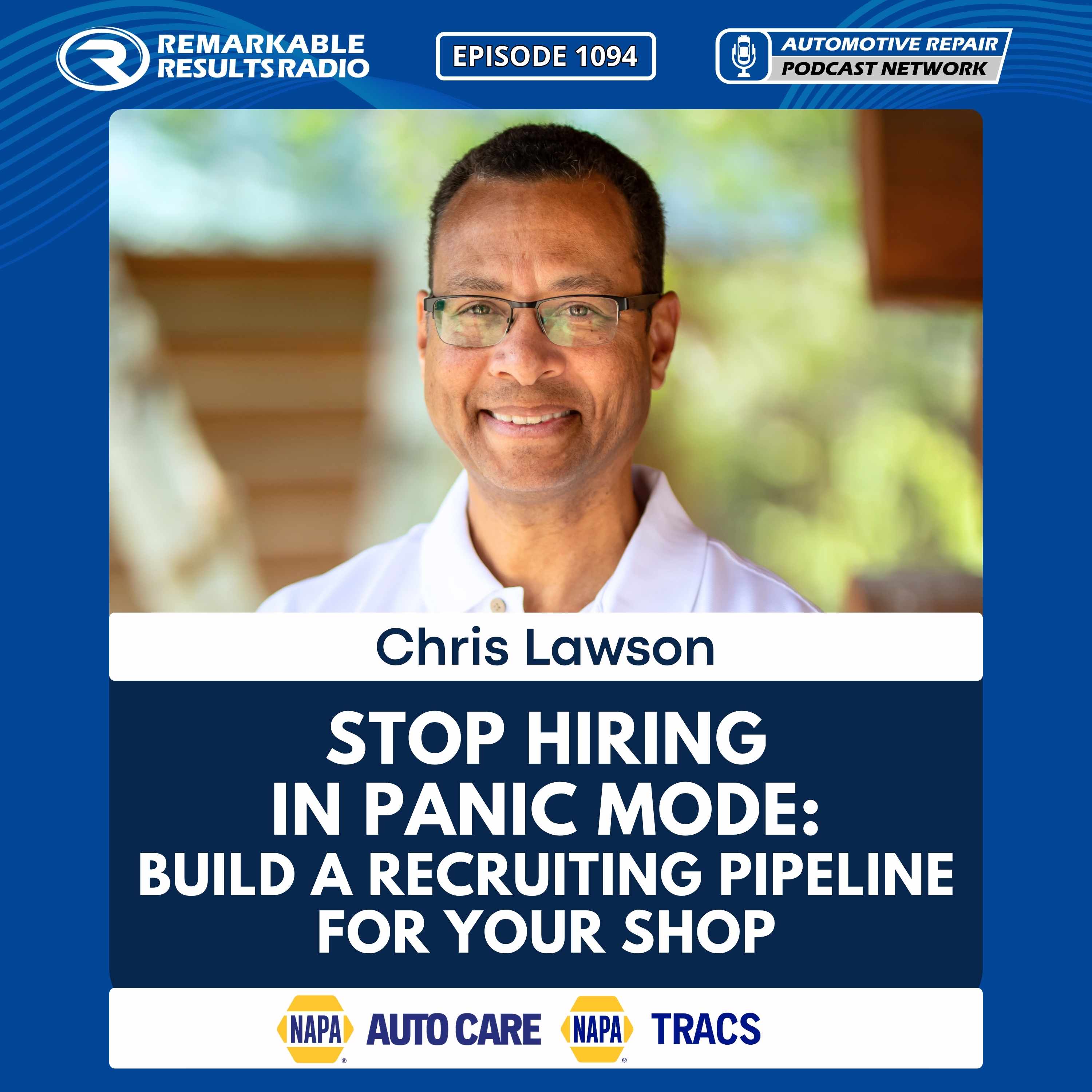
Stop Hiring in Panic Mode: Build a Recruiting Pipeline for Your Shop [RR 1094]
About this episode
Scrambling to hire after turnover hits is framed as “fire alarm syndrome,” where stress leads to poor decisions and even “a warm body.” Instead, the episode argues for building a recruiting pipeline: a “deep bench,” passive recruiting, and consistent “culture ping” and “10-mile famous” social ads that keep your shop visible to future techs. It also covers retention drivers like respect, growth, and clear career roadmaps, plus practical systems and messaging to prevent “ghosting.”
Host Carm Capriotto welcomes Chris Lawson, founder of Technician Find, to discuss one of the biggest challenges facing independent auto repair shops today: finding and keeping great technicians.
Chris explains why many shop owners fall into what he calls "fire alarm syndrome," waiting until a technician leaves before starting the hiring process. That reactive approach often leads to rushed decisions, poor hires, and ongoing turnover. Instead, he advocates for an "Always Be Recruiting" mindset, where shops continuously build relationships with potential candidates long before they have an opening.
The conversation explores practical strategies for becoming a destination workplace, creating a recruiting pipeline, and building a culture that attracts top talent in a competitive market.
What You'll Learn- Why reactive hiring creates costly staffing problems
- How to build a bench of pre-qualified technicians before you need them
- Why becoming "10-mile famous" can help attract both technicians and customers
- How culture-focused marketing can outperform traditional help-wanted ads
- The three things technicians value most: respect, growth, and compensation
- Why sign-on bonuses often fail and how to structure them more effectively
- Practical ways to engage passive candidates who are not actively job hunting
- Resources available through Chris Lawson's free online community for shop owners
The best time to recruit a technician is before you need one. Shops that continuously market their culture, build relationships with local talent, and maintain a pipeline of qualified candidates are better positioned to grow, avoid staffing emergencies, and create a workplace where top technicians want to stay. Recruiting is no longer an occasional task. It is an ongoing business strategy. Chris Lawson, TechnicianFind.Com Love your shop? Stay, but stay ready. Auto techs join to level up, find good shops, and keep tabs on top indie jobs nationwide. Techs only. No BS. Independent Wrench Jobs: https://www.skool.com/independentwrenchjobs
Finding Technicians Part 1- Chris Lawson [RR 803]: https://remarkableresults.biz/remarkable-results-radio-podcast/e803/
Finding Technicians Part 2 – Chris Lawson [RR 816]: https://remarkableresults.biz/remarkable-results-radio-podcast/e816/
Technician Attraction Blueprint [RR 921]: https://remarkableresults.biz/remarkable-results-radio-podcast/e921/
Attract, Develop, and Retain Top Automotive Talent [CC 113]: https://remarkableresults.biz/remarkable-results-radio-podcast/cc113/
Beyond Babysitters: Developing Strong Managers and Financial Transparency [RR 1076]: https://remarkableresults.biz/remarkable-results-radio-podcast/e1076/
Thanks to our Partners, NAPA Auto Care and NAPA TRACS
Learn more about NAPA Auto Care and the benefits of being part of the NAPA family by visiting https://www.napaonline.com/en/auto-care
NAPA TRACS will move your shop into the SMS fast lane with onsite training and six days a week of support and local representation. Find NAPA TRACS on the Web at http://napatracs.com/
Connect with the Podcast:
Visit the Website: https://remarkableresults.biz/
Subscribe on YouTube: https://www.youtube.com/carmcapriotto
Follow on Facebook: https://www.facebook.com/RemarkableResultsRadioPodcast/
Follow on LinkedIn: https://www.linkedin.com/in/carmcapriotto/ Follow on Instagram: https://www.instagram.com/remarkableresultsradiopodcast/ Join Our Virtual Toastmasters Club: https://remarkableresults.biz/toastmasters Join Our Private Facebook Community: https://www.facebook.com/groups/1734687266778976 Join our Insider List: https://remarkableresults.biz/insider All books mentioned on our podcasts: https://remarkableresults.biz/books Our Classroom page for personal or team learning: https://remarkableresults.biz/classroom Special episode collections: https://remarkableresults.biz/collections Buy Me a Coffee: https://www.buymeacoffee.com/carm The Automotive Repair Podcast Network: https://automotiverepairpodcastnetwork.com/ Remarkable Results Radio Podcast with Carm Capriotto: Advancing the Aftermarket by Facilitating Wisdom Through Story Telling and Open Discussion. https://remarkableresults.biz/ Diagnosing the Aftermarket A to Z with Matt Fanslow: From Diagnostics to Metallica and Mental Health, Matt Fanslow is Lifting the Hood on Life. https://mattfanslow.captivate.fm/ Business by the Numbers with Hunt Demarest: Understand the Numbers of Your Business with CPA Hunt Demarest. https://huntdemarest.captivate.fm/ The Auto Repair Marketing Podcast with Kim and Brian Walker: Marketing Experts Brian & Kim Walker Work with Shop Owners to Take it to the Next Level. https://autorepairmarketing.captivate.fm/ The Weekly Blitz with Chris Cotton: Weekly Inspiration with Business Coach Chris Cotton from AutoFix - Auto Shop Coaching. https://chriscotton.captivate.fm/fire alarm syndrome
"[223.8s] That's the question, right? [225.3s] I would say that it is the fire alarm syndrome. [228.5s] It is when a technician leaves [230.3s] or when one of their employees leaves, [231.9s] it sets off a fire alarm and everybody scrambles."
It means you only start hiring when something goes wrong—like losing a technician. Everyone panics and rushes, and that usually causes mistakes in who you hire.
“Fire alarm syndrome” is a hiring mindset where a shop reacts only after a technician leaves—like an alarm going off. Instead of planning ahead, the team scrambles, and that stress often leads to rushed, lower-quality hiring decisions.
poor hires
"[240.8s] But it's also a problem because when you're in stress, [244.3s] and I've talked to, I mean, [245.7s] hundreds of shop owners at this point and GMs, [248.5s] when you're in stress, you don't make the best decisions. [251.9s] That's when the poor hires happen."
“Poor hires” are people you hire who don’t work out—either they aren’t a good fit or they don’t do the job well. The host says panic and stress make this more likely.
“Poor hires” refers to recruiting decisions that don’t match the shop’s needs, resulting in underperformance or turnover. In the episode’s framing, stress-driven hiring increases the odds of poor hires.
hire a warm body
"[251.9s] That's when the poor hires happen. [254.1s] That's when you hire a warm body"
It means hiring someone just to fill the spot fast, not because they’re the right person. The host is warning that panic hiring leads to this kind of shortcut.
“Hire a warm body” is a phrase for filling a vacancy quickly with the least-considered option, rather than hiring for skills and fit. The episode implies this happens when shops react in panic instead of building a recruiting pipeline.

Ford Edge
"...overage your customer counts on and a competitive edge you can't afford to overlook. Want to deliver eve..."
The Ford Edge is a mid-size SUV made for regular driving and carrying people and luggage. It’s designed to be practical, with a comfortable ride and enough space for everyday needs. That’s why it’s a common vehicle mentioned when people talk about choosing a family-friendly SUV.
The Ford Edge is a midsize crossover SUV built for everyday driving with room for passengers and cargo. It’s often discussed in the context of practical family use and mainstream appeal, which can make it a common reference point when talking about customer-focused value and “competitive edge” in the SUV market. In a podcast, it may come up as an example of a vehicle that balances comfort, usability, and affordability for a broad range of buyers.
Request an Explanation
Heard something you'd like explained? We'll add it to this episode.
Sign in to request explanations for terms you heard.
Want to learn more?
Browse our glossary for plain-English explanations of automotive terms, jargon, and concepts.
Help improve this episode
See something that's not quite right? Our annotations are AI-generated and can sometimes miss the mark. Click the flag icon on any annotation to suggest a correction.