Honda is a well-known car manufacturer from Japan that makes reliable vehicles, including popular models like the Civic and Accord. They are respected for their quality and fuel efficiency.
Hyundai is a car company from South Korea that makes many types of vehicles, including small cars and larger SUVs. They are known for making affordable and reliable cars.
Luxury cars are high-end vehicles that are designed to be very comfortable and stylish. They usually have better features and materials than regular cars.
LIVE
This is the Automotive Repair Podcast Network.
Hey everybody, Karm Capriotto,
Remarkable Results Radio and another Town Hall Academy.
Thank you all so much for your continued support.
Couldn't do this without you, don't forget.
We've been working for about a year.
We have our own listening app
and we've changed the name of our network
to the Automotive Repair Podcast Network.
Go to that Automotive Repair Podcast Network or anywhere.
You may see or touch me in any way.
We have the links for both Apple and Android.
We are gonna do a show today about industry trends,
where marketing retention intersects,
or how about that super unbelievable client experience.
I can't wait to dive into that.
And how to survive and advance with AI.
And really, everybody has a different perspective
on how it works.
My guests will talk about that.
In the meantime, thank you so much to our great sponsors.
Hey, did you know that NapaTracks has on-site training
plus six days a week support?
It all starts when a local representative meets with you
to learn about your business and how you run it.
After all, it's your shop, so it's your choice.
Let us prove to you that Tracks is the single best
shop management system in the business.
Find NapaTracks on the web at NAPATRACS.com.
Ready to optimize with today's class?
Boy, listen to an episode we did with David Boyz.
Great program.
Roll out a training plan for your automotive shop.
They deliver four times better website conversions,
automated follow-up, and real-time ROI tracking.
Get industry-leading customer support with Kukui.
That's kukui.com.
You're probably tired of chasing new customers
who never return.
We understand.
Pit Crew Loyalty ends the one and done cycle,
turning first visits into lasting reliable revenue.
On the web at pitcrewloyalty.com.
Hey, let's get started.
Look who's here.
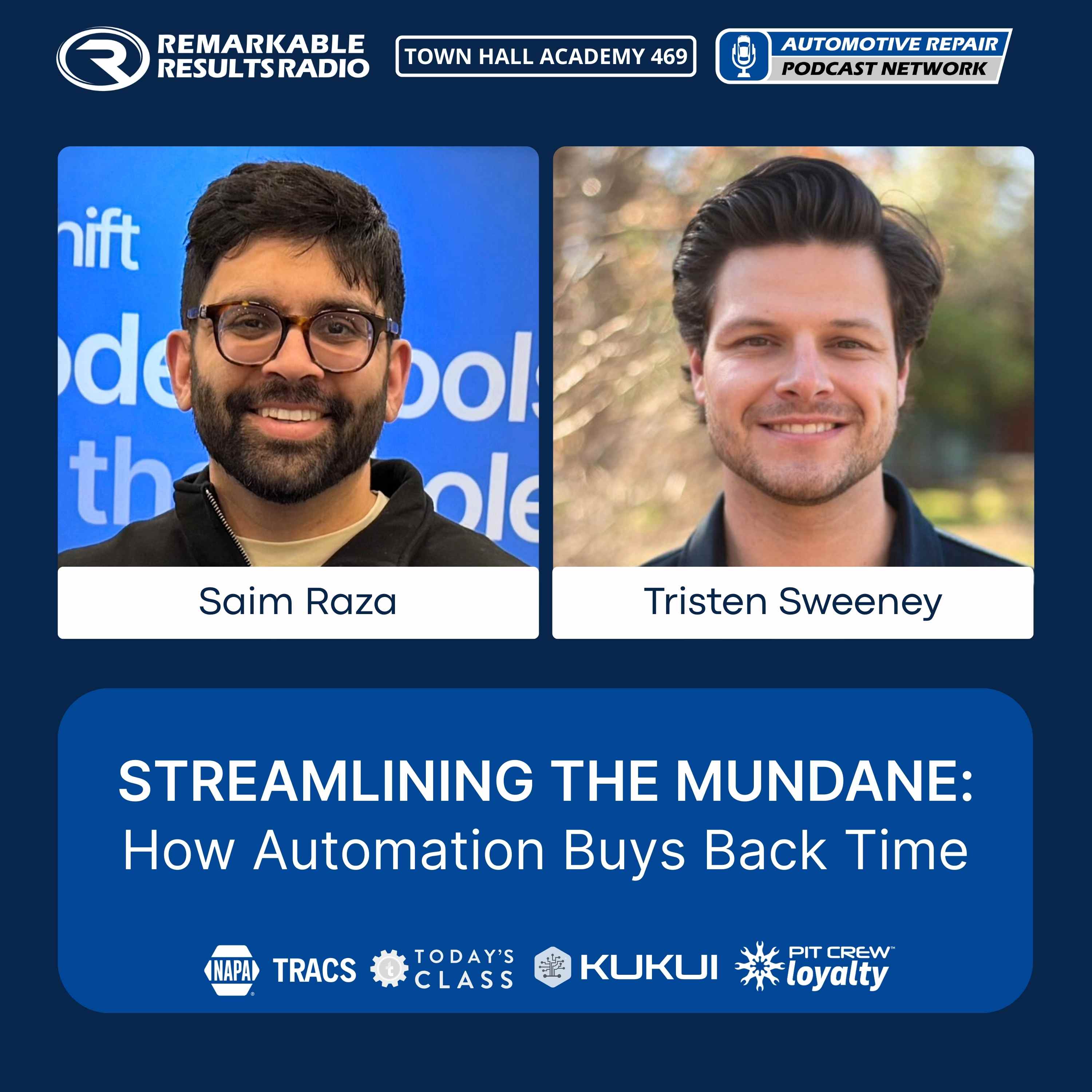
Tristan Sweeney, shop owner and co-founder of Shift Automotive.
Hey, Tristan.
I'm good. How are you, Karm?
I'm great, man.
Excellent.
Saim Raza, co-founder, Shift.
You know, this thing about Harvard,
I've never ever been around an individual
who's graduated from Harvard.
And I'm, I guess, honored to say that you did it.
Or you've done it.
I guess.
Nothing special here.
My parents just wish I was a doctor or so.
Not a doctor.
Oh, geez. Oh my God.
I'm just a lonely software programmer
in the automotive business.
He could have been contender.
Yeah. My three older siblings all went to med school.
So they're like, you know, Sa, I was the youngest.
They're like, it doesn't matter.
Just do your own thing.
So it is what it is.
So we met at ASTA.
He dropped the name of Bill Nailu.
Of course, a great friend, good supporter of the podcast.
Everybody knows Bill.
And, you know, Bill's working with us on some stuff.
Shift-automotive.io and just in case you want to go
to their website and see what's going on.
But yeah, we're here to talk about that stuff.
But, you know, how did you end up getting
to have a shop, Tristan?
I mean, were you in the industry?
Were you curious?
How'd you get to be a shop owner?
Not by accident, certainly.
I have been in and around the industry since I was younger.
I worked for some industry folks.
When I was in high school, I have been building
and modifying cars since I was 15 or 16.
And then in 2023, I met the folks at Shop Genie
when they were first getting started.
My background has been in building early stage software
for businesses of all different sizes and industries
in different startup capacities.
And was introduced to the guys at Shop Genie
and joined that team and really kind of fell in love
with the craziness that is the auto repair industry.
And about eight or 10 months into that adventure,
realized that this was gonna be home for me for a while.
I was really gonna enjoy building solutions for the space.
And as a product guy, I figured the best way
to know the problem was to experience it myself.
And so I set off on this journey to try to find a shop
that could be my testing ground and raw experience
of what it is to own and run an auto repair shop.
The thing that I love about both of you
in your anointment into the industry
is, Simon, you somehow decided to go
and visit automotive shops
because you love the smell of brake cleaner.
Well, I've been in contact.
So I grew up in Michigan.
I'm in Michigan now.
I've always been surrounded by the automotive industry.
It was something that I realized
that I was kind of unfulfilled to kind of backtrack.
Yes, did graduate from Harvard, not a doctor though.
So my parents are still wishing I'm back there
in the medical world.
But I worked for a few Silicon Valley startups
in the West Coast.
I realized that a lot of tech,
a lot of particularly AI tech was just kind of like,
wasn't really doing much in the real world.
And then I came back home.
I just wanted my career to matter.
I wanted it, maybe that was a bit idealistic.
So then, yeah, I visited 150 repair shops in person,
in the cold, and just talked to folks.
I've hit up every single repair shop
in the metropolitan area.
I just talked to technicians,
talked to service riders, talked to owners,
and realized that this was an incredible space
that just is really unique.
And I just fell in love as well.
There's a lot of folks who are doing really good,
honest work, but are kind of like,
there's good software out here,
but there could be something better.
When I was working at one of the Silicon Valley startups,
I connected with Tristan.
Tristan actually onboarded Tristan, we were coworkers.
So then Tristan and I got back together
and we realized that, hey, we can use our skill sets,
we can use our backgrounds to help.
Actually, our first product was on technicians.
We wanted, and we still have a product light on that,
but was helping technicians die cars faster and better.
When you've demonstrated this concept to people,
did they like it?
Did they help you to say, ooh, it could do this?
Was there an excitement behind it?
What's the, guys, I don't care who talks about this.
Where was the evolution of the idea
to create shift automotive to help,
again, you say technicians, I say specialists,
because they're brainiacs in those bays.
They're not techs anymore in my mind.
Where was that evolution of, ooh, this is so cool,
and it kept you working on it.
We picked technicians first because it felt to me
like the area of the space that had been largely ignored.
If we look at what software is available in the space
and the innovation that's happened over the last five years,
it's been focused elsewhere.
The tools that technicians use,
especially from a repair data and diagnostic standpoint,
are largely similar to what they have been for a while.
And so that's why we focused there.
And what we found was that while it was painful
and there were things that,
there were workflows that could be improved,
the pain wasn't great enough to yield a change of behavior.
And so in software, the things we talk about
as we look at how you find product market fit
and you find folks that are obsessed with what you're doing
is the change needs to happen naturally.
And if it doesn't, you'll find yourself just fighting
to get them to use the thing that you're building.
And if that's where you're at, you haven't found it.
You haven't found the thing yet
that has that sort of magical feeling of this is what I needed.
And so the feedback we were getting was that
this is useful, this is cool, this is different.
And also I'm gonna just go back and use the repair guide
that I was using before
because I know exactly how to use it.
I've been doing it for 20 years.
Did they want an easy button?
They wanted an easy button,
but they weren't necessarily willing
to change their behavior to get an easy button.
And that is common.
Oh my God.
I mean, I think you just nailed it.
We can now, the episode's over with.
You're right.
Even myself, I want something new,
but when I realized I got to make some flips in my routine
and how I think things through and how I process stuff,
I stay where I am.
Yeah.
Yeah, same with me, you know, yo-yo dieting.
Sometimes you say, I'm gonna use my fitness towel.
You get on it for a day, for a week.
And then you lose three pounds.
And then you just go to McDonald's
and then you're like, oh, you're back to where you started.
So, you know, some of that behavioral change,
it's like, things sound great in theory,
but when you're actually trying to do something
for the latest software,
is it gonna solve it?
There's no silver bullet, you know?
Well, you know, when we were designing our listening app,
all I kept thinking about was an easy button
just to make it so easy for the listener.
Give them a lot more than they could get
from an Apple or Spotify, really focused,
but try to make it easy.
And we continue to do that.
So I get that.
I really do.
One of the great talking points that you have
that I am more excited than you could possibly imagine
is the customer experience.
And I've been having some dialogue of late
as to how do we create an experience for the client
that goes beyond what we currently do.
And what we currently do in many cases
is we don't even talk to people, we don't even see them,
okay, and COVID gave us that.
And in some cases, they may call
and we may never see them
because they drop off and they pick up later
to have that intimacy and that customer relationship
and how we can promote the fact
that we've got the latest equipment
and we've just sent our people for some continued training.
We rarely get a chance to speak that.
How could we put our arms around that,
this balloon out there and pull it in
and get something that's off the charts?
You guys agree or disagree?
I think it depends.
I agree largely with you.
I think the customer experience
is the thing that allows shops to set themselves apart.
But I think we create sometimes this idealistic idea
of what we see in our business and how we wanna present it.
And we maybe don't spend enough time thinking
about what does the customer want?
And I think I'm a big believer
in like meeting the customer where they are.
And I think that applies in a lot of different scenarios,
but I think in auto repair it's particularly important
because you're gonna work with a wide variety of customers
who are there or wanna interact with you
in a wide variety of ways.
So I think for the customers who care about that,
for the customers who want to see sort of behind the curtains,
being able to find a way to give them an avenue to that
is important.
And then for the customers who don't, maybe not so much.
You know what I just heard,
which was a very powerful statement, see behind the curtain.
And we have to determine who wants that
and then we'll give it to them.
And the other ones that are living life,
skipping along on the high side,
we have to recognize that and just make sure
that everything on the skip high side is perfect.
Got that.
That's just a brilliant deduction.
I like that.
Skipping the high side or the people who really want in
and they really wanna know
and tell me about the person who fixed my car.
I don't think we're promoting our people enough.
I don't think we have those, if you will,
honor frames out there with their picture,
their little bio, their ASC, certs.
I don't know if we're doing enough of that.
I'm not sure we're proud enough
of puffing our chest out with our people.
Can software do this for us?
I think there are ways that it can.
I think that there are a lot of opportunities
to promote your team and to promote the folks
who are doing the work that are providing the experience
that your customers are having.
I think the dealership world sometimes
probably gets this right in a different way
with some of the things that they do
and the ways that they promote the folks
who are working on your vehicle
and with like video inspections and things like that
where the customer sort of interacts
with the folks behind the scenes a little bit more.
On the independent side, yeah,
I think software could help with it, certainly.
I think it's not a one size fits all approach
and that's what I think makes it challenging overall
in this industry is that I think oftentimes
we're in search of a one size fits all solution
that is the right thing for everybody
and the reality is every shop is different
and what they want is different
and what they need is different.
And every client's different.
Part of our talking points in our discovery call
just to get to where we are here today
is the talk about adapting to the changing landscape
of vehicle owners.
What's your view of the vehicle owner?
How long they wanna keep their vehicle?
What they wanna invest in?
Yeah, I was actually talking to my mom about this today
where a new vehicle is $50,000, right?
And amongst a lot of my friends, you know,
I'm on, I'll call myself the board of Gen Z millennial.
You know, a lot of us want to just have a reliable vehicle
where it's kind of strained on budgets.
So I feel like a lot of folks are just trying to extend out
their existing used vehicle.
You know, I'll call, say it, I have a 2013 Toyota RAV4.
I hope it's 198,000 miles.
I wanna keep it another 100,000, you know?
You know, I'll take it to actually,
it needs to go next to Bill's shop.
I need to do some maintenance on it.
But yeah, like that's what I see
the perspective of a lot of my friends are like,
can't really afford a new vehicle
or getting used vehicles from a friend or a relative
or even face the marketplace even just crazy,
but that's how it is.
And like just trying to extend the life out
because of just tight budgets in these days.
You know, as a shop owner, Tristan,
how do you see this changing this ever evolving landscape?
And I just saw some kind of post on,
I don't know, was it Hyundai or was Honda Toyota
were building these little tiny cars overseas,
these little $15,000 things.
When I was a kid, that's what we could buy a car
for $8,000 and that was not what I was a kid
probably in my 20s.
Is that an answer to solving the affordability crisis?
You know, I know this may not have anything to do
with our episode, but I'm asking, what's your opinion?
I mean, I think that is a big part of what is pushing
the folks that are in those positions to fix rather than buy
is that there isn't really a truly affordable new car option.
And so yeah, I mean, I do think that if a brand
can come out with something that provides a really
compelling basic, you know, A to B experience
at a competitive price point
that hopefully has some reliability to it,
then yeah, I think that could be a disrupter.
But in the world we have today, the reality is,
like Simon said, your average vehicle cost new
has gone way, way up.
And frankly, the cost of repairing a vehicle has gone up
but it has really more gone up with like inflation
and sort of just the times as labor rates and things
have adjusted and tariffs have affected parts prices
and that drives, you know, additional costs, the end user
but they haven't gone up in the same way
that the cost of a new vehicle has in addition
to the fact that interest rates are much higher
than they were several years ago.
And so we are finding in the shop that I think
we're surprised every day by the amount of work
that somebody is willing to approve on an older vehicle
and it forces us to have to not make assumptions
about what somebody may or may not want to do to their car.
Not selling from your own wallet, right?
Not selling from your own wallet,
which is I think every shop has to contend with
and every service advisor has to contend with
because there are times where when you're in the industry
you have a skewed perspective of the value of something.
Let's face it, your shop management system
is the single most important tool in your shop, period.
NapaTracks was built from the ground up
to make your business more profitable and efficient.
We provide an extensive set of tools
to increase and track profitability in real time.
NapaTracks offers the industry's best post sale support
hands down and we train your people on site.
Yep, on site and we offer remote refresher training
10 times a week and customer support is open six days a week.
Give us a call, visit the website
or join our Facebook community today to learn more.
We'll prove to you that Tracks is the single best
shop management system in the business.
NapaTracks is always customized and tailored for you
whether you're a one man shop
or a large multi-bay or multi-location company.
After all, it's your shop, so it's your choice.
Visit us on the web at NapaTracks, that's N-A-P-A-T-R-A-C-S dot com.
Hey, wanna test your team's knowledge?
Well, today's class quizzes show how much
your techs and advisors really know
so you can train smarter and build a stronger,
more efficient team.
Whether it's the basic quiz, perfect for all techs
to test their foundational knowledge,
the advanced quiz built for experienced technicians
ready to dive into complex topics
or the service advisor quiz focused on communication
and customer service.
Now, each one gives your team a clearer view
of what they know and where they can grow.
Take the quizzes now at today's class dot com
forward slash T-C quiz.
Shop owners, we know you are overwhelmed
with a flood of missed calls, empty bays
and disconnected marketing tools.
Cacui has spent over a decade building
one integrated platform for auto repair shops,
one login, one dashboard and mobile first websites
that convert four times industry average,
smart, innovative CRM with automated follow up,
24 seven online booking and real time ROI tracking.
With 900 plus years of combined team experience,
we feel the growth of 2,200 plus shops
and have influenced $3 billion in revenue.
Stop working harder, start working smarter,
get industry leading customer support
and book a demo with Cacui.
That's KUKUI dot com.
You know, most shop owners feel trapped
spending on ads while half their first time customers
never come back.
It's frustrating, it's exhausting
and it's not your fault.
The industry average is 54%, one and done.
We understand how discouraging that can be.
Well, pit crew loyalty changes the story.
Our clients cut that rate by up to 38%,
raising lifetime value by more than 50%.
Loyalty members visit nearly three times more often,
creating predictable revenue without extra ad spend.
Pit crew loyalty where customers stay and shops thrive
on the web at pitcrewloyalty.com.
You guys created Shift Automotive.
With what we have just said,
here's Simon coming to your shop saying,
I have 100 and some thousand,
I ain't willing to go down for 50 grand or more
because I know when I go into the dealership,
I'm gonna look at a $69,000 luxury car
because it could last me another 10 or 12 years
like this one did.
Where did the software start
and why is it there to help a transaction like this?
Yeah, so one of the easiest ways to bring services
that are required to the forefront,
I think is through the manufacturer intervals.
They provide us a clear indication of the services
that are required for a vehicle
to as a best practice to extend its life.
What that does is removes the,
well says who from the customer
when you say something needs to be done.
And so what we have done is in part of our product,
we have raised what those OEM maintenance concerns are
against the vehicle's current mileage
and the vehicle's service history
to highlight where the gaps,
where the things that have not been maintained,
what are the things that we can show to the customer
that need to be done
in order to per the manufacturer's recommendations
extend the life of their vehicle.
And then at the same time,
where does our shop's opinion differ
from what those OEM recommendations are
that we may standardize across the board?
We may say, hey, we wanna check your battery
every 36 months or we may just recommend replacement
every 48 months to avoid the problem
or we might recommend a brake fluid flush
at an interval different than most manufacturers
because of our experience.
And we can easily raise those in that same workflow
so that you get a combination
of your shop's specific recommendations
and your OEM recommendations for a specific VIN
to extend that life.
And you can present that to the customer
with the reasoning behind it all in one step.
Okay, why do I always gravitate to the medical field
when I hear great stuff like this?
I just wrote down the word blood test
because that's what you were describing to me.
We've talked about this on our show
over the last 10 years, a whole, whole bunch of times
about extending the life of that vehicle
and what does the customer really want
or get from good maintenance programs.
And it's no different than a blood test.
I mean, the doctors is, listen,
you're getting up there, right?
Simon, your car, it's getting up there.
It's got 150,000 miles getting up there.
We gotta pay a little bit more attention to it
than we had in the past when you were in 50, 60,000.
And so that DVI thing, which is a blood test,
and let me explain how that works.
We need to get you in here a couple of times.
In fact, the battery that this is and that's,
and is the consumer according to how you see things,
gentlemen, willing to buy into that,
if you will, doctoring with this vehicle?
I'd say so because, you know,
speaking to that point earlier,
folks wanna extend the life of their cars.
I'm not gonna buy a new car and sure,
it's a bit more pain.
Yeah, it's like the ARL or the repair order
might be a bit higher than expected, a few hundred bucks.
But, you know, people, I think there is a consumer
behavior change that is active,
especially in the past few years.
And in the shops that Shift is active in,
people have accepted it and people,
the shops have been able to quote more and sell more.
And the customers are end up happier.
They've actually accepted it.
How we Shift helping to make this work, guys.
Yeah, so what it does is it allows for single click
additions of all of the existing maintenance
recommendations by Vin onto the inspection report,
onto the repair order where appropriate,
and into the summaries so that whether the customer
approves the work or not, they get a documentation
of the OEM intervals and the shop intervals
that they are overdue on or the ones that are due soon.
And then on that existing ticket,
you get a one click addition to just add,
to streamline that workflow for the service advisor.
And that ultimately really gets down to sort of
the nuts and bolts of why Shift exists.
We are a tool to streamline workflows for the shop.
Whether you're a technician, a service advisor,
or an owner, our goal is to give you the tools
to let you spend your time on high value workflows
rather than on sort of mundane,
more just automatable things where the person doing them
isn't providing a positive influence or negative influence
on the outcome.
It's just this needs to be done and it gets done.
You know what I just took away from that statement, Tristan?
People know me.
I always say, I wrote this down, I wrote this down.
This is what I've been doing for 10 years.
You fire my brain up.
Here's what I wrote down.
You put words in my mouth.
That's what I wrote down.
Because you're basically coming back,
you're giving me all this information,
putting it on the repair order.
I gotta read it, I gotta understand what it means.
But if it comes back in a great format,
intelligent perspective,
then as I open my mouth to share this,
you're putting the words in my mouth
in an intelligent processor way,
or I have to be smart enough to be able to read what I say
and interpret it right back in non-geek speak to the client.
Or in some cases, you don't.
I think that's the beautiful part about it is that
in some of these situations,
when you are not talking to a customer necessarily
before they're intaking this information,
you're providing it to them in a structured,
reliable way where you're not worried about
was the punctuation right?
Did I capitalize everything?
Did I write something in a way that looks professional?
You just know it was done right.
And it's there on the inspection
and it's there in the estimate and the customer views it.
And depending on where in your specific shop's flow
you talk to the customer, you're all set.
So I didn't have to go to AI to make it nice for me.
It's there.
Yes, like our whole platform is supported by AI,
which I think is an important distinction,
which is that AI is a tool in the tool belt.
It's not the solution.
And so with all the different resources
that we have at our disposal,
AI is certainly prevalent inside of our system
to help process information and access information
where it's relevant.
And in one of those ways is how we structure
the way things are written to people.
It's one of the, I think, best simple uses of AI
and one of the features in the product
is that for things that we don't generate on your behalf,
in a single click, you can just clean it up.
We're not gonna add context.
We're not gonna add content.
We're just gonna make whatever you wrote sound professional
and be capitalized and have the right punctuation
and not have spelling errors.
And I think there's a friendliness
to clean concise communication
that drives trust with a customer.
I love that friendliness.
You guys are saying an awful lot
of great powerful words here
that I think would excite a shop owner to say,
yeah, that's me.
I gotta have something like this
in supporting of what we do
because we all want a greater shop efficiency.
We want more vehicles.
We wanna say yes all the time
and we need tools, not necessarily wrenches or scopes
to get that in and processed.
And dare I say the word sold?
Exactly.
And so the outcome is higher ARO,
items being approved more often
and a cleaner documentation of that entire process.
And we're not changing the outcome
of what you're doing necessarily.
We're just changing how you got there.
If you are running your shop
at the way I imagine a lot of your listeners are
where you're making sure that your communications
going out are clean and concise and professional
and that all of the maintenance items
have been added onto the ticket
and they've been explained to the customer.
We're not changing that outcome necessarily.
We're just allowing you to get to that outcome
in one or two clicks
instead of spending five, 10, 15 minutes
depending on the situation,
putting all of that together,
which just gives you time back to do other things
because in a shop time is quite literally money.
We're in an industry where our ability
to generate additional revenue
is based on a capacity of time.
And so where we can make these minor improvements
on things that are done over and over and over again
on a daily basis, they add up.
They make a difference in what that shop's ability
to turn over additional work
or to improve on processes or keep the shop clean
or whatever the case may be
that doesn't just roll into the next day.
Want to chime in at all time at all?
I know this is your partner over here, Tristan.
He's doing a great job,
but I see your brain on overtime here.
Car count has gone up for a lot of shops,
but how I think about shift is that ARO.
Is that like, if you've got the right parts,
the right labor, the right communication,
then it's about the customer trust.
If you can back that up with the OEM info
with the latest understandings of AI,
shops deserve the best version of AI.
And in many other industries,
there's a lot of money being spent
to modernize healthcare, right?
To modernize government tech, to modernize finance.
But something that I'm just really excited with shift
and obviously with Tristan
is bringing that latest kind of friendly,
kind of actually your partner AI.
That's what has been so inspiring.
And like, for example, we have one shop owner.
He's literally one man shop.
Like right now, he's got a voice assistant,
wherever I call him, I'd never get him,
but he's got a voice AI, he's got an email AI,
and he's got our AI as well that helps him run the shop.
We've got some other shops that are MSOs,
like three locations, if not more, very well organized.
So that's the thing, it doesn't really matter,
something that I've learned of many hundreds of shops
is that like, it doesn't really matter how sophisticated
you are or where you are on your ownership journey
or as a client service advocate,
because I know, I wanna talk about the language as well.
AI can help.
And I think there's just a lot of, it can be a friend.
It doesn't need to be the scary thing that we're like,
oh, what's it doing, what's it coming?
Like it can be an advocate for your shop and auto repair.
Guys, I am inspired by this discussion.
And part of the think that I have going
is what I would call the review of all of my systems.
And I've got software doing this
and API integration over here,
and this click and that over here on this third screen
because they're not integrated.
And all I keep thinking about is where is the consultant
in our industry that says I'm going to do a thorough review
of everything front of shop, back of shop,
back office is doing and using.
And I think of our great friends over at Wicked Filed
being able to do certain things here.
When I think of all these great add-ons and support systems,
we're going to get to the point where there's going to be
20 or 30 options like you guys are new to this
and you're coming on with a brand new toolbox, if you will
and neat news, something that we've learned from the past.
And now, here's the way forward today.
And in three years, there's going to be someone
who rethought that again or you guys are going to keep paying.
Will we ever someday, my question is,
have consultants to help us with all this?
I think we already do to some degree.
I mean, I think coaches are consultants
or they can be depending on what your engagement is
with them.
Yes, I knew you were going to say that somehow.
Interesting, I thought that through
and I know a lot of great coaches that just,
they don't want to get that deep of a dive
into every bit of why this piece of software
fits perfectly in this shop and vice,
because then they have to go to school
or have an extremely strong relationship with you.
Or maybe what the coaches need to,
and again, I'm just brainstorming out loud here,
is they would want to take your system
and someone else's and bring that into their offering
or into their expertise cloud, if you will.
And then go to their clients and says,
listen, we've partnered with and these we believe
will make you, not only are we giving you great guidance
and coaching and leadership and financial advice,
you need to have boom, boom, boom and this.
Yeah, and I think informally,
some of them are doing that today.
Now, I think the way that oftentimes works
is it's just what they're recommending
is whatever they are using or whatever they have used
or have been exposed to,
which isn't necessarily what is the best option
that is available, but best is subjective.
I think the other responsibility there
is on the software company itself,
like where you see some of these companies be successful
and be successful very quickly,
which I certainly got to experience with Shop Genie,
is when you over support your customer base
and you reach beyond what your cloud of influence is,
I think you provide a really unique experience
as a software vendor.
Just today, I was on with one of our users
who was having some challenges with their management system
and having a hard time understanding
how something could work and the natural response would be
to just direct them back to the support team
of their management system,
but it's just as easy for us who spend all day
working in these different systems
and me who spends all day working on it
as a shop owner as well in my background,
like it doesn't take but five minutes for me
to sit there and answer their questions
and that delights our customers
because we over support them.
We become what they feel like is a part of their team
rather than just another tool that sits
in the proverbial toolbox.
You're a giver.
It's the only way to be.
Yeah, you're probably like me, it's tough to say no.
Yeah, I definitely overextended myself due to that
and the ROI is certainly not short term
on some of those interactions.
Well, you've been there and done that
and you saw what happened with Shop Genie
and you've kind of got a taste of that culture
on where that has gone.
But yeah, I mean, when you said,
they're going back to the consultant,
it's almost like, Simon Tristan, I see that
you've got this really neat new cool thing
and I'm not calling it a thing,
but it's a thing, okay?
You're not wrong.
I know, you can say it, you can say it.
I don't, I don't.
I felt wrong.
I felt bad.
No, no, no, I don't mind.
I got my guests out here and I'm calling them a thing.
But to your point, as you were saying,
listen, this is what you gotta do
and you gotta read the manual or go over here
and you're not flipping the right switch and blah, blah, blah.
Guys in your capacity that are so smart
and have this level of knowledge
and how software connects and hooks and works,
you should almost be a consultant first
and then sell your product second.
Well, in some ways, I think that's what we are.
It's like people reach out to us
because there's something about our product
that has scratched an itch for them of a pain point.
And so then those initial conversations
are largely consulting conversations.
It's understanding their problem at a deep level
and then helping them understand whether or not
we can solve that because on a not insignificant number
of these conversations, they'll come in thinking
that we might be able to do something
or thinking that the software does something
or not being aware that it does something
and those are only unearthed
through a consultant-like approach to those conversations.
And sometimes what that means is like,
hey, Joe, I can't solve this for you.
Here's a place that you can go look
or here's what you can use in addition to our solution
to help solve that.
And that's where I think like having partners
and having other folks in the industry
like Alex and the team at Wicked File
who are phenomenal when a customer asks a question
or a potential customer asks a question
about a problem that we don't solve,
knowing where to send them is phenomenal.
Yeah, I actually talked to a shop owner yesterday
in Colorado and I was saying,
hey, did you use AI tools this, that?
He's like, honestly, after hearing about Redshift,
my ARO is good.
I'm actually interested in car count.
And I was like, here you go, sir.
You should talk to these XYZ folks.
So like, I think if you have a more long-term approach,
I think that just leads to more
of like a consultative relationship
where I think a certain time,
certain, if you think long-term enough
and you care long enough, like, it's fine.
Just recommend it to someone else.
Like maybe, and then I emailed the shop owner.
He said, he gave me some good feedback and he said,
okay, maybe not a good fit for me,
but I'll afford this email to another shop owner
who might be interested in your stuff.
So I think you just have like a casual,
just like just be human, be normal.
Like it goes a long way.
I'll tell you, you got to talk to 10 people
to get one sale, isn't that always the thing?
The 10% close rate, right?
It's no different than in the shop.
Like a lot of the things we experience,
and honestly why for me, I think running the shop
has been not natural, but in some ways natural
is like it's not that different from the other businesses
that I have been in at a fundamental level.
The work being done is different,
but ultimately the goal is to delight a customer
in a way that makes them tell 10 other people about it
and then consistently provide that experience
so that that result continues to sort of travel down
the chain of your community.
That's what it is.
This has been a fun, interesting, inspiring to me.
And I look at you two guys as geeks, okay?
No disrespect intended.
The highest level of respect that I can.
And I'm sitting here, we've had a discovery call.
I, you know, a lot of stuff came out.
I saw a mini demo, I think it asked.
And then I can't imagine you guys standing at your counter
talking to someone watching a thing get printed
or you guys probably just see code
going in front of your eyes all the time.
Oh, I could write that better.
Or why did that do the white that screen pop up?
I can't imagine what your lives are like
if you're geek 10 Xers.
I think it's no different than anyone
who just loves to solve problems.
And I think honestly, that's where a lot of folks
find their path in auto repair is loving
to solve hard problems that nobody else wants to solve.
And so there is a uniqueness
to spending your life thus far building software
because when you interact with software
you certainly have a different perspective
on what it could do or how it could work or things like that.
You don't sort of accept the status quo as much
which frankly is how shift happened.
Like a lot of this is born out of me being in my shop
and using the software that we had
and finding these gaps that I was frustrated
just didn't have a solution.
The beautiful part is that then I can build them
with our team and provide them to the industry.
Like that is really where this all sort of came from.
And so I think it's a blessing and a curse.
And we actually have two other co-founders
I grew up with in Michigan.
They worked at Ford
and then they also worked to other tech companies as well.
So that's that like unique kind of understanding.
And I think they're more on the technical side
so they might see like the matrix of it more, but...
Yeah, I should set the record straight
for an appeal and a deal's sake.
Neither was I am nor I write code.
And that is very important facts because...
Oh, I thought you did.
We do not.
So my life has been on the product side.
Yeah, it's about understanding both sides of that equation.
Oh my God.
I don't know if we have time for this, but years ago,
years and years ago, I was really so good
at sitting down with a programmer
and explain to him what I needed in a computer piece
of soft big green screen days, okay?
And explaining to them, the customer sees this.
This is what I want to have happen.
I need this to be the ultimate result.
You need to save this over here and then call it back.
I loved to do that in my old, old days,
way back in the family business.
And when I hear you guys say we don't write code,
either did I, but now I can relate to you.
I can relate to you in such a way.
I'm sorry, I shouldn't call you geeks.
No, no.
But I bet you one thing, and here's my final thought for you.
When you guys are working on V whatever, V12, V20,
whatever, and it comes out and how excited you can be,
since you're not code writers,
cause code writers, I don't know if they get really excited
about that stuff, but the people who help design that stuff
and you put it out and you say,
oh, I can't wait for the world to see this.
This is so cool.
I'm with you.
I know what I get.
I do.
This was really more fun than I expected it to be.
And actually more profound in my think that I had
shift-automotive.io, Shift Automotive.
And it's Tristan Sweeney co-founder,
along with Simon Raza, who's the co-founder,
and Tristan owns Honest Automotive.
And Cary, North Carolina, just outside of Raleigh.
All right guys, best of the holidays to you.
Likewise.
Thanks for the time, Carm.
Thanks, man.
Thank you.
It was fun.
Thanks for being on board to listen and learn
from the Premier Automotive Repair Business podcast,
Remarkable Results Radio.
Get your episodic education on the ARPN listening app
at automotiverepairpodcastnetwork.com.
Also enjoy the podcast on our
Carm Capriotto YouTube channel.
Carm is all for advancing the professional
automotive service industry.
Until next time.
About this episode
Exploring the intersection of automation and customer experience, this episode features Tristan Sweeney and Saim Raza from Shift Automotive, who share insights on how AI can streamline workflows in auto repair shops. They discuss the importance of adapting to changing customer expectations, the need for effective communication, and how software can enhance the client experience. The conversation also touches on the evolving landscape of vehicle ownership and the necessity for shops to embrace technology to improve efficiency and customer satisfaction.
Thanks to our Partners, NAPA TRACS, Today's Class, KUKUI, and Pit Crew LoyaltyWatch Full Video Episode
Saim Raza and Tristen Sweeney, co-founders of Shift Automotive, discuss how their AI-powered software is transforming the vehicle service experience. Their platform automates OEM maintenance recommendations and simplifies shop workflows by integrating manufacturer data into professionally formatted, customer-facing reports. This approach not only improves operational efficiency but also helps service advisors build trust with consumers and increase average repair orders. While the technology is advanced, their core mission is deeply human: to improve communication and support shops as drivers keep their vehicles longer. The conversation ultimately underscores a move toward more consultative relationships and elevated customer service in the independent auto repair industry.
Key Topics:
The “Blood Test” Approach to Maintenance:How using OEM intervals to identify service gaps allows shops to present data-driven recommendations that extend vehicle life—critical as consumers face rising new-car costs.
The “Easy Button” Paradox:Why technology only works when behavior changes, and what it really takes to successfully adopt new tools in your shop.
Friendly AI & Buying Back Time:How AI can enhance communication, automate routine tasks, and give service advisors more time for meaningful customer interactions.
The Consultative Shop Owner:Why the future belongs to shop owners who act as trusted consultants, building long-term relationships through transparency and problem-solving.
Thanks to our Partner, NAPA TRACS
NAPA TRACS will move your shop into the SMS fast lane with onsite training and six days a week of support and local representation. Find NAPA TRACS on the Web at http://napatracs.com/Thanks to our Partner, Today's Class
Optimize training with Today's Class: In just 5 minutes daily, boost knowledge retention and improve team performance. Find Today's Class on the web at https://www.todaysclass.com/Thanks to our Partner, KUKUI
Stop juggling multiple marketing tools. KUKUI’s integrated platform delivers 4x better website conversions, automated follow-up, and real-time ROI tracking. Get industry-leading customer support with KUKUI at https://www.kukui.com/Thanks to our Partner, Pit Crew Loyalty
You’re probably tired of chasing new customers who never return. We understand. Pit Crew Loyalty ends the one-and-done cycle, turning first visits into lasting, reliable revenue at https://www.pitcrewloyalty.com/Connect with the Podcast:
- Follow on Facebook: