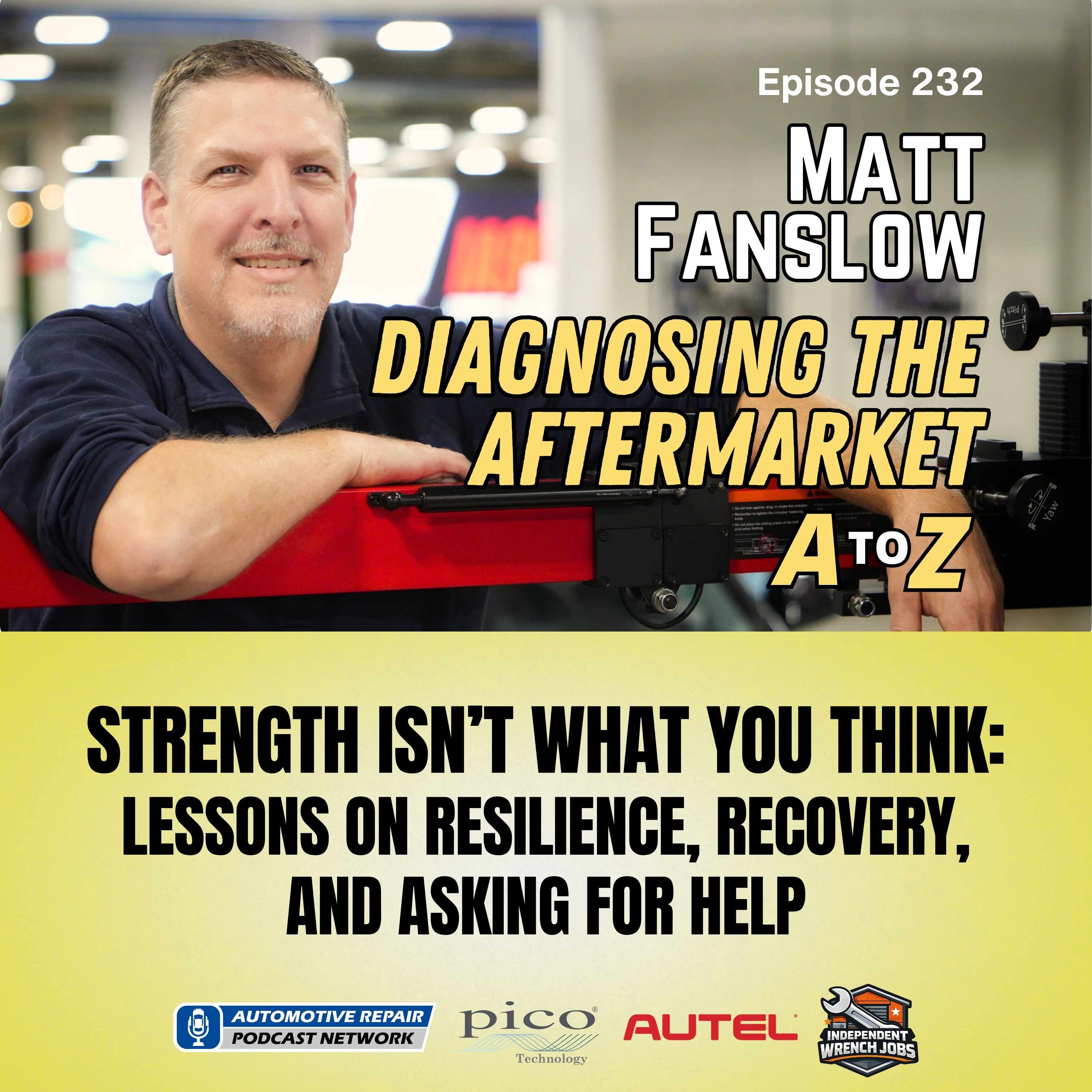
Strength Isn’t What You Think: Lessons on Resilience, Recovery, and Asking for Help [E232]
About this episode
A personal, heartfelt discussion turns into a broader lesson on resilience and asking for help. Matt recounts a friend’s relapse and fatal overdose—highlighting that recovery doesn’t “reset to zero,” fentanyl risk, and how returning to old doses can be deadly. He connects that to a single mom’s refusal to be labeled “strong,” arguing strength isn’t having it all together or spinning plates effortlessly. Instead, real strength is recognizing limits, getting support, and building resources—especially in the shop. The episode also pivots into EV diagnostics sponsor talk and ends with a fun “chainsaw mount rushmore” segment.
Thanks to our Partners, Pico Technology, Autel, and Independent Wrench Jobs
In this episode, Matt Fanslow reflects on what it really means to be strong. Prompted by the story of a young mother navigating grief, single parenthood, and overwhelming responsibility after the loss of her children’s father to overdose, the conversation explores relapse, recovery, endurance, and the often-misunderstood nature of strength. Matt argues that strength is not having everything under control. Sometimes strength looks like hanging on by your fingertips, asking for help, or simply making it through the day without quitting.
From there, the episode ties those ideas back to the automotive repair world, where asking for help is too often seen as weakness instead of wisdom. Whether it is a shop owner trying to keep the doors open, or a technical specialist seeking knowledge and resources to grow, real strength often shows up as humility, persistence, and the willingness to reach out.
And because no Matt Fanslow episode stays in one lane forever, the show closes with a delightfully detailed Mount Rushmore discussion on chainsaw brands and models, pulled from Matt’s background around farms, equipment, and forestry gear.
What’s Inside This Episode
Matt talks candidly about relapse and the dangerous myth that a person in recovery “starts over” after a setback. He reflects on the realities of substance use disorder, the deadly risk of returning to former dosage levels after time in recovery, and the heartbreak that addiction leaves behind for families.
The larger theme centers on strength: how people often define it incorrectly, and how endurance, survival, and asking for help deserve far more respect than they usually get. That idea then gets applied to repair shops, business struggles, personal growth, and professional development.
The episode wraps with a fun listener-driven Mount Rushmore on chainsaws, including discussion of Husqvarna, Stihl, Dolmar, Echo, and a few favorite classic models.
Key Themes
- Strength is not the same thing as having it all together.
- Relapse does not erase the work already done in recovery.
- Asking for help is often an act of strength, not weakness.
- In repair shops, growth often depends on seeking coaching, resources, and better information.
- Sometimes surviving a hard season is its own kind of success.
- Chainsaw opinions are apparently serious business.
Memorable Points
- Matt pushes back hard on the idea that a relapse means someone is “back to square one.”
- He frames endurance itself as strength, especially when life feels like barely keeping the plates spinning.
- He draws a connection between personal struggle and shop life, especially when it comes to pride, survival, and the reluctance to ask for help.
- He makes the case that the best help is not always somebody handing over the answer, but showing someone how to build skill, access resources, and become more capable the next time.
- The episode closes with an unexpectedly passionate breakdown of chainsaw brands, legacy models, and why certain saws still hold legendary status.
Thanks to our Partner, Pico Technology
Are you chasing elusive automotive problems? Pico Technology empowers you to see what's really happening. Their PicoScope oscilloscopes transform your diagnostic capabilities. Visit PicoAuto.com
Thanks to our Partner, Autel
From drivability diagnostics and TPMS service to ADAS and advanced safety systems, Autel helps technicians follow OEM procedures and repair with confidence. Learn more at Autel.com
Thanks to our Partner, Independent Wrench Jobs
Independent Wrench Jobs is a new, tech-only community to help you find better independent shops—fair dispatch, steady work, real leadership. No games.
Built by Technician Find—serving the industry since 2017. Join free at IndependentWrenchJobs.com
Contact Information
The Automotive Repair Podcast Network: https://automotiverepairpodcastnetwork.com/
Remarkable Results Radio Podcast with Carm Capriotto: Advancing the Aftermarket by Facilitating Wisdom Through Story Telling and Open Discussion. https://remarkableresults.biz/
Business by the Numbers with Hunt Demarest: Understand the Numbers of Your Business with CPA Hunt Demarest. https://huntdemarest.captivate.fm/
The Auto Repair Marketing Podcast with Kim and Brian Walker: Marketing Experts Brian & Kim Walker Work with Shop Owners to Take it to the Next Level. https://autorepairmarketing.captivate.fm/
The Weekly Blitz with Chris Cotton: Weekly Inspiration with Business Coach Chris Cotton from AutoFix - Auto Shop Coaching. https://chriscotton.captivate.fm/
Speak Up! Effective Communication with Craig O'Neill: Develop Interpersonal and Professional Communication Skills when Speaking to Audiences of Any Size. https://craigoneill.captivate.fm/
Autel
"That and more after a word from our sponsors, Autel, Pico Technology, and Independent Wrench Jobs. ... Autel delivers award-winning automotive diagnostic tools trusted by technicians across North America... From drivability diagnostics and TPMS service to ADOS and advanced safety systems..."
Autel makes tools that mechanics use to diagnose car problems. The tools can help find issues in systems like sensors and safety features, and they’re designed to work in a technician workflow.
Autel is an automotive diagnostics and service-tools brand used by technicians. In the episode, they’re mentioned for diagnostic tools that cover things like drivability checks, TPMS service, and advanced safety-system work.
Pico Technology
"Pico Technology empowers you to see what's really happening. Pinpoint faults and sensors, wiring, and components with unmatched accuracy. PicoScope oscilloscopes transform your diagnostic capabilities."
Pico Technology makes diagnostic test tools for mechanics. Their PicoScope oscilloscopes help you look at electrical signals so you can spot problems in sensors and wiring.
Pico Technology is known for electronic test equipment used in automotive diagnostics, especially oscilloscopes. The transcript specifically calls out PicoScope oscilloscopes for seeing what’s happening in real time when diagnosing sensors, wiring, and components.
PicoScope oscilloscopes
"Pinpoint faults and sensors, wiring, and components with unmatched accuracy. PicoScope oscilloscopes transform your diagnostic capabilities."
An oscilloscope is a tool that shows the shape of an electrical signal over time. That helps a mechanic confirm whether a sensor or wire is behaving correctly while the car is running.
A PicoScope oscilloscope is a diagnostic tool that displays electrical signals as waveforms. That lets technicians verify sensor output and electrical behavior under real operating conditions, which can be more informative than simple pass/fail readings.
TPMS service
"From drivability diagnostics and TPMS service to ADOS and advanced safety systems, Autel helps technicians follow OEM procedures and repair with confidence."
TPMS service is anything needed to make the car’s tire-pressure sensors work correctly. After a tire change, the system often needs to be updated so it knows the new sensor IDs.
TPMS service refers to work on the Tire Pressure Monitoring System, including reading sensor data and performing procedures like relearning or programming sensors after tire changes. It’s called out here as one of the diagnostic/service capabilities supported by Autel tools.
ADOS
"From drivability diagnostics and TPMS service to ADOS and advanced safety systems, Autel helps technicians follow OEM procedures and repair with confidence."
ADOS is an acronym used in automotive diagnostics for certain advanced, procedure-based work. The key takeaway is that it’s tied to more complex systems than just checking engine codes.
ADOS is referenced as part of Autel’s diagnostic coverage, typically associated with advanced driver assistance or related OEM procedures. In practice, it signals that the tools support more than basic engine diagnostics and can be used for structured safety-system workflows.
Independent Wrench Jobs
"Sponsored by Independent Wrench Jobs, tech-only jobs, no runaround, built by TechnicianFind, helping tech sense 2017."
Independent Wrench Jobs is a website that helps mechanics find job opportunities. It’s mentioned here as a sponsor, not as a car part or diagnostic device.
Independent Wrench Jobs is a platform for technician-only job listings, positioned as reducing “runaround” in the hiring process. The episode mentions it as a sponsor rather than a technical automotive tool.
TechnicianFind
"Sponsored by Independent Wrench Jobs, tech-only jobs, no runaround, built by TechnicianFind, helping tech sense 2017."
TechnicianFind is the company behind the job platform mentioned in the ad. It’s about helping technicians find work.
TechnicianFind is mentioned as the company that built Independent Wrench Jobs. It’s relevant mainly as part of the sponsor ecosystem rather than as an automotive technology provider.
relapse
"Relapse can be deadly. Part of it is what's in the stuff nowadays, particularly fentanyl."
Relapse is when someone starts using drugs again after trying to stop. It can be especially risky because the body may not be used to the drug anymore, so the same dose can hit harder than before.
In recovery contexts, relapse means returning to substance use after a period of abstinence. It’s often dangerous because tolerance can drop during recovery, so the same amount that previously felt “normal” can become lethal.
fentanyl
"Part of it is what's in the stuff nowadays, particularly fentanyl. The other thing is just if you've been using for some time, you develop quite the resistance, if you will."
Fentanyl is a powerful painkiller that can be dangerous in small amounts. If someone relapses after stopping, their body may not handle it the same way anymore, increasing the risk.
Fentanyl is a very potent synthetic opioid. Because it’s so strong, small dosing differences can dramatically change outcomes, which is why relapse after a break can be especially dangerous.
tolerance (resistance)
"The other thing is just if you've been using for some time, you develop quite the resistance, if you will. There are many examples of people who've been using certain substances."
Tolerance means your body gets used to a drug. If you stop for a while, that “used to it” effect can fade, so taking the same amount again can be much riskier.
Tolerance (described here as “resistance”) is when the body adapts to a drug, requiring more to get the same effect. After time in recovery, tolerance can decrease, so using again at prior doses can be far more dangerous.
Electric and hybrid vehicles are here and with them a new era of diagnostics
"Electric and hybrid vehicles are here and with them a new era of diagnostics. Don't get left behind."
EVs and hybrids have a lot more high-voltage electricity than regular cars. Because of that, shops need different tools and safety steps to figure out what’s wrong and confirm repairs are correct.
Electric and hybrid vehicles use high-voltage electrical systems and different control strategies than traditional gas cars. That changes what a technician must measure, how systems are tested, and what safety procedures are required during diagnostics.
Pico Technologies EV diagnostic kits
"Pico Technologies EV diagnostic kits are your all in one solution to safely and efficiently service any electric or hybrid vehicle from comprehensive high voltage system analysis and installation testing to guided step by step procedures,"
Pico Technologies sells EV diagnostic tools made for working on high-voltage systems safely. The idea is to help technicians test and troubleshoot EVs with step-by-step guidance.
Pico Technologies makes EV-focused diagnostic kits aimed at safely testing and servicing high-voltage systems. These kits are designed to support tasks like analysis and installation testing using guided procedures.
high voltage system analysis and installation testing
"...service any electric or hybrid vehicle from comprehensive high voltage system analysis and installation testing to guided step by step procedures,"
High-voltage system analysis refers to diagnosing issues in an EV’s battery, power electronics, and related wiring using appropriate test methods. Installation testing typically means verifying that repairs or component replacements were installed correctly and that the system is safe and functioning as intended.
TPMS systems
"whether diagnosing complex drivability concerns, servicing TPMS systems, validating repairs or working with ADOS and advanced safety technologies."
TPMS is the system that tells your car when a tire’s pressure is wrong. If you just had tires changed, the car may need to “relearn” the sensors so the warning goes away.
TPMS (Tire Pressure Monitoring System) uses sensors to monitor tire pressure and alerts you when a tire is under- or over-inflated. Diagnosing TPMS issues often involves checking sensor IDs, battery health, and whether the system needs to be relearned after tire service.
validating repairs
"servicing TPMS systems, validating repairs or working with ADOS and advanced safety technologies. Autel tools are engineered to support accurate, efficient repairs and strict accordance with OEM procedures and standards."
Validating repairs means making sure the fix really worked. Instead of just clearing a code, the shop checks the car’s behavior and the system data to confirm the problem is gone.
Validating repairs means confirming the underlying fault is actually corrected, not just that a warning light or code went away. In drivability and sensor-related issues, validation often includes road testing, data review, and verifying system readiness/calibration.
advanced safety technologies
"validating repairs or working with ADOS and advanced safety technologies. Autel tools are engineered to support accurate, efficient repairs and strict accordance with OEM procedures and standards."
Advanced safety technologies are the car’s “help” systems—like sensors and cameras that watch the road. If something gets serviced, those systems may need careful checking so they keep working the way they’re supposed to.
Advanced safety technologies typically include driver-assistance systems that rely on sensors and cameras to detect lane markings, vehicles, and obstacles. Because these systems are sensitive to calibration and sensor health, diagnostics and repair validation are especially important.
OEM procedures and standards
"Autel tools are engineered to support accurate, efficient repairs and strict accordance with OEM procedures and standards. To learn more about Autel and their diagnostic solutions, visit Autel.com."
OEM procedures are the manufacturer’s instructions for how to diagnose and fix a problem. Using them helps avoid “half fixes” that might clear a light temporarily but don’t actually solve the underlying issue.
OEM (Original Equipment Manufacturer) procedures are the official diagnostic and repair steps the carmaker specifies for a given vehicle. Following OEM standards helps ensure repairs are performed correctly and that systems (like sensors and modules) are calibrated or relearned as designed.
Independent REN shops
"Independent REN shops is a new, tech-only community to help you find better independent shops, fair dispatch, steady work, real leadership, no games."
This sounds like a group/network for independent repair shops. The idea is to connect shops that want fair pay and steady work, so technicians can focus on doing the job well.
“Independent REN shops” appears to refer to a community or network of independent repair shops focused on a tech-forward approach and better working conditions (dispatch, steady work, leadership). For listeners, it’s a reminder that shop networks can influence how effectively diagnostics and repairs are supported.
arranging for real help
"Again, I don't know if I necessarily mean just like reaching out to the masses, but arranging for real help. And again, that might be in some cases the masses, the groups, the professional groups..."
If you’re stuck on a car repair, it’s smart to get help instead of guessing. You can ask other people who’ve done the same kind of work, or find training that fills the gap.
In an automotive shop context, “arranging for real help” means proactively sourcing expertise when a job is beyond your current knowledge. That can include other shop owners, professional groups, or technical specialists who’ve seen similar problems before.
coached through the repair
"...asking for help on I don't understand how to do this. And that help might be getting coached through the repair, but maybe more importantly, coached on where to go get the resources..."
Coaching through a repair means someone walks you through what to check and how to do it. Instead of trial-and-error, you follow a proven approach.
“Coached through the repair” describes guided troubleshooting and procedure support—someone helps you think through diagnostics step-by-step. In aftermarket work, this often prevents misdiagnosis and reduces rework by ensuring the right process and checks are followed.
resources, skills, knowledge
"...but maybe more importantly, coached on where to go get the resources, where to go to get the skills, where to go to get the knowledge, and then following through and getting it."
The idea here is to learn the right information so you can handle similar problems later. It’s not just about finishing one repair—it’s about getting better at diagnosing and fixing cars.
This segment emphasizes building “resources, skills, [and] knowledge” rather than only fixing the immediate symptom. For automotive technicians, that typically means using manufacturer/technical information, training, and reference materials so future diagnostics are faster and more accurate.
virtual classes
"And maybe that's going to a class, maybe that's going to an instructor like class, maybe that's going to some virtual classes,"
Virtual classes are online training sessions. They can help you learn new repair and diagnostic skills when you can’t get to a classroom.
“Virtual classes” refers to remote training that can help technicians keep up with evolving aftermarket systems and diagnostic methods. It’s a practical way to close knowledge gaps without waiting for in-person availability.
automotive repair podcast network
"Like a remarkable results or the automotive repair podcast network, that site has an unbelievable amount of information on it."
They’re talking about a network of car-repair podcasts and related info. It’s basically a big library of learning material for diagnosing and fixing problems.
The Automotive Repair Podcast Network is referenced as a website with a large library of information. It’s positioned as a place to learn troubleshooting and repair knowledge through multiple shows and resources.
reaching out for help
"So reaching out for help, I suppose it's that adage, right? You want somebody to toss you a fish or do you want them to show you how to fish"
The hosts use a “fish vs. fishing” analogy to describe a key learning approach: instead of just getting an immediate answer, you want guidance that teaches you how to solve the problem yourself. In automotive troubleshooting, that means learning the process—diagnostic steps, test selection, and interpretation—so you can handle future issues.
Mount Rushmore
"And I am getting a lot of messages about the Mount Rushmore stuff. It's crazy. Thank you. I'm glad you enjoy it. So maybe in closing, I will do another Mount Rushmore. I get it. This is an automotive podcast, but some of these Mount Rushmores aren't automotive related."
Mount Rushmore usually means “the most important people.” Here, the host is using it like a fun way to talk about their biggest influences, even if they’re not car stuff.
“Mount Rushmore” is a metaphor for a short list of the most important people or ideas. In this episode, the host uses it as a playful framing device for their personal “top” influences, even when the picks aren’t automotive-related.
chainsaw manufacturers
"My struggle with the question is, what do you mean by that? Are we talking about the manufacturers? Because if I have to go based off that, the makers of the manufacturers of the power equipment,"
The host’s question frames “best chainsaws” as a choice among manufacturers rather than a specific model or spec. That matters because brand ownership, manufacturing changes, and parts availability can influence real-world performance and service.
Husqvarna
"John's Rude, Husqvarna, Steel and then Dolmar. I don't know that John's Rude is really around anymore. I think it might technically be now called Red Max."
Husqvarna makes outdoor power tools, especially chainsaws. The hosts are saying that after some companies were bought and merged, the saws can feel similar even if the colors or branding differ.
Husqvarna is a major power-equipment brand best known for chainsaws and outdoor tools. In the segment, it’s discussed alongside other saw brands and how ownership consolidation affected product identity.
Stihl
"John's Rude, Husqvarna, Steel and then Dolmar. I don't know that John's Rude is really around anymore. I think it might technically be now called Red Max."
Stihl is a popular company that makes chainsaws. The hosts mention it as one of the big names you’d consider when people ask which chainsaws are best.
Stihl (often pronounced “steel” in casual speech) is a well-known chainsaw manufacturer with a strong reputation in professional and homeowner markets. The episode groups it with other chainsaw makers when answering what “best chainsaws” means.
Electrolux AB
"And honestly, when it got bought up by Electrolux AB and combined with Husqvarna, there really wasn't much difference between the two other than color."
Electrolux AB is a company that, according to the hosts, acquired and merged brands in the chainsaw world. When companies merge, the products can end up being more similar than you’d expect.
Electrolux AB is mentioned as the company that bought up “John’s Rude” and combined it with Husqvarna. This is an example of corporate consolidation in power equipment, which can blur the differences between brands.
Dolmar
"So it'd be definitely Husqvarna Steel. Dolmar was bought up by Makita. And I don't know if they even really make that saw anymore, those saws."
Dolmar is a chainsaw brand. The hosts are saying Makita bought Dolmar, which can mean the saws may be made or supported differently than people assume.
Dolmar was a chainsaw brand that the hosts say was bought by Makita. This is relevant because brand ownership changes can affect manufacturing, parts sourcing, and how “different” products really are.
Makita
"Dolmar was bought up by Makita. And I don't know if they even really make that saw anymore, those saws. And because we're with four and to keep Brian Pollock off my back,"
Makita makes power tools. Here, they’re mentioned because Makita bought Dolmar, so some saw brands may have been folded into Makita’s lineup.
Makita is a major power-tool company, and in this segment it’s mentioned as the buyer of Dolmar. That kind of acquisition can influence product lines and whether older branded saws remain in production.
Echo
"And because we're with four and to keep Brian Pollock off my back, I have to put Echo on there."
Echo is another outdoor power equipment brand, including chainsaws. The host is basically naming it as one of the major options people should think about.
Echo is a chainsaw and outdoor power equipment brand the host adds to the list to “keep Brian Pollock off my back.” It’s part of the discussion about which manufacturers to consider when someone asks for the best chainsaws.
bucket saws
"The Echoes that we dealt with were from Arborist companies or tree services that use the bucket saws or the Arborist saws, the top handles..."
A “bucket saw” is a chainsaw used by tree services while working from a lift or bucket. The speaker is saying that’s mostly what they’ve seen in their experience.
“Bucket saws” refers to chainsaw setups used in tree work from a bucket or lift, where the saw is used with controlled positioning. The host is describing the types of saws they’ve mostly encountered from arborist and tree-service companies.
top handles
"...tree services that use the bucket saws or the Arborist saws, the top handles, if you will."
Top-handle chainsaws are built for control when cutting in awkward positions, like in tree work. The speaker is saying the saws they saw were the kind arborists use.
Top-handle chainsaws are designed for overhead or precision cutting, with the handle positioned on top of the saw. The host uses the term to describe the arborist-style saws they mostly encountered.
Steel
"Overwhelmingly, they're Husqvarna and Steel. One time John's Rude, but really Husqvarna and Steel dominate."
Stihl is a well-known chainsaw brand. The speaker is saying Stihl and Husqvarna are the two brands they most commonly see.
Stihl (transcribed here as “Steel”) is a leading chainsaw manufacturer known for professional-grade saws. The host groups Stihl with Husqvarna as the brands they most often encounter.
John's Rude 2051
"I have a very, very weak spot for the John's. So if we're doing a rush more of chainsaws, it's very difficult for me not to call go with the John's Rude 2051."
The speaker mentions a specific chainsaw model they have a soft spot for, but the name is garbled in the transcript. It sounds like they’re talking about a particular brand/model they’d choose if they needed more chainsaws.
“John’s Rude” appears to be a mis-transcription of a chainsaw brand name (likely Stihl, given the surrounding context and the common “Stihl” sound). The “2051” looks like a model number, but the exact brand/model identification is uncertain from the transcript alone.
air injection
"Husqvarna calls it air injection, where they're pulling the fresh air through the recoil housing through a tube off the flywheel."
Air injection means the machine adds extra fresh air where it can help the engine burn fuel more efficiently. Here, Husqvarna is using a tube to move cleaner air into the intake area so the air filter doesn’t get dirty as fast.
Air injection is a system that feeds fresh air into the engine/exhaust process to improve combustion and performance. In this segment, Husqvarna uses it to pull fresh air through a tube connected to the flywheel/recoil area, helping keep intake air cleaner.
supercharger
"So the flywheel kind of acts a little bit like a supercharger, not a lot. They're not running five PSI a boost,"
A supercharger is a device that forces more air into the engine so it can make more power. They’re saying this system feels similar in concept, but it’s much smaller and not like a full-on supercharger.
A supercharger is a forced-induction device that increases the amount of air entering the engine, boosting power. The host compares the flywheel/tube setup to a supercharger in effect, but clarifies it’s not producing a true high boost level.
PSI a boost
"They're not running five PSI a boost, but it does pressurize the air filter housing area."
“Boost” is extra pressure that helps push more air into the engine. They’re saying this setup doesn’t create big boost numbers, but it still adds some pressure to help keep things cleaner.
PSI (pounds per square inch) is a pressure unit, and “boost” refers to the extra air pressure created by forced induction. The speaker emphasizes the system isn’t running high boost (like 5 PSI), but it still slightly pressurizes the air filter housing area.
air filter housing
"but it does pressurize the air filter housing area. So that is somewhat sealed. That's super tight."
The air filter housing is the part that holds the air filter and directs air into the engine. If it’s sealed and pressurized, dirt is less likely to get sucked in, so the filter stays cleaner longer.
The air filter housing is the enclosure that contains the air filter and helps route intake air to the engine. In this segment, the system pressurizes the housing area, which reduces how quickly dirt gets into the filter.
air cleaners off
"But if you run them with the air cleaners off or the air cleaner housing off, they run different."
If you remove the air cleaner parts, the engine can pull in dirt differently. They’re saying this design relies on the air cleaner/housing being in place to work as intended.
Running a small engine with the air cleaners (or air cleaner housing) removed changes airflow and sealing, which can alter how well any intake-cleaning/pressurization system works. Here, the host says the saw behaves differently when the air cleaner components are off.
centrifugal force
"Idea being that the centrifugal force, if you will, inertia... will result in the dirt being thrown... away from the flywheel."
Centrifugal force is the “outward” effect you feel when something spins. In this setup, the spinning motion helps fling dirt/debris away so cleaner air gets pulled in for the filter.
Centrifugal force (often discussed in rotating systems) describes how objects tend to move outward when spun, which can help separate debris from airflow. The speaker explains that the flywheel/tube arrangement uses inertia/centrifugal effects to throw dirt away from the flywheel while pulling in fresher air.
air-filter life / filter maintenance interval
"In many cases, loggers would have to clean air filters every time they sharpened or fueled up... A lot of them would go all day and not have to touch the air filter."
Air-filter life is how long you can go before the air filter gets too dirty. This design helps keep the filter cleaner, so workers don’t have to stop as often to clean it.
Air-filter life refers to how long the filter can operate before it needs cleaning or replacement. The host explains that this intake/air-injection strategy reduces how often loggers must clean filters during sharpening/fueling, improving uptime in real work.
rebadged
"I'm also a rebadged Husqvarna or John Sird and he wanted to try my saw out"
Rebadged means it’s basically the same product, just sold with a different name. That can affect what parts you can buy and how you compare it to other models.
“Rebadged” means a product is sold under a different brand name but is essentially the same underlying design. The speaker is implying their saw is related to another brand’s model, which can matter for parts availability and performance expectations.
John Sird
"I'm also a rebadged Husqvarna or John Sird and he wanted to try my saw out"
This sounds like a chainsaw brand name, but the transcript may have misheard it. The point is that the speaker’s saw is related to another brand, and they’re comparing performance.
“John Sird” appears to be a transcription error for a chainsaw brand/model. The context suggests the speaker is comparing a rebadged saw to another brand, but the exact brand name isn’t clear from the transcript.
fuel injected
"It's fuel injected in all and I get it when stuff breaks. It's expensive."
Fuel injection means the engine gets fuel in a more controlled way. That usually helps the tool start easier and run more consistently.
Fuel injection is a method of delivering fuel to the engine using electronically controlled injectors. On small engines like chainsaws, it typically improves starting, throttle response, and fuel metering compared with older carburetor setups.
80 CCs
"They're like 13, 1400 bucks for a I don't even think it's 80 CCs. So you're plunking on a good chunk of change."
CCs are a way to describe how big the engine is. Bigger displacement often means more potential power, but it’s not the only factor.
CCs (cubic centimeters) are a measure of engine displacement. For chainsaws, displacement is often used as a rough indicator of potential power, though design and tuning also matter a lot.
power to weight ratio
"But that thing rips. The power to weight ratio is it's really, really insane."
Power-to-weight ratio is basically “how strong it feels for how heavy it is.” If it’s high, the machine can do work faster without feeling sluggish.
Power-to-weight ratio compares how much power a machine makes relative to how much it weighs. A higher ratio generally means better acceleration and performance—here, the speaker uses it to explain why the chainsaw feels so “insane” fast at cutting.
five seventy two
"Husqvarna, but now it's probably the five seventy two. Again, the power to write ratios are insane."
“Five seventy two” sounds like a bigger chainsaw model number. The host is saying the saw is now closer to that larger model’s performance.
“Five seventy two” is likely shorthand for a larger Husqvarna chainsaw model (commonly referenced as 572 in the transcript). The speaker is comparing performance between a smaller and larger displacement saw, implying the build has been upgraded.
five hundred
"It'll keep up with that five hundred. I've you do a little bit of massaging of things."
“Five hundred” is probably the name/size of another saw they’re comparing to. They’re talking about which one cuts faster.
“Five hundred” likely refers to another chainsaw model size/class the speaker is comparing against. The context is performance comparison (cutting speed), but the exact model name isn’t fully clear from the transcript.
porting
"It'll out cut it a little bit of porting, nothing over the top."
Porting refers to modifying the intake/exhaust passages in an engine to improve airflow and performance. In small two-stroke engines (common in chainsaws), porting can increase power, but it’s typically done carefully because it can affect reliability and drivability.
anti vibe
"They cut slow and they're heavy and the anti vibe isn't so great. But they served a large segment of chainsaw users very well for a long time."
“Anti vibe” means the saw is designed to reduce shaking and vibration. Less vibration helps your hands feel better during longer cuts.
“Anti vibe” refers to vibration-damping features in chainsaws designed to reduce hand/arm fatigue. Better vibration control can make long work sessions more comfortable and safer.
John's 0601
"It also hurts my feelings not to put like the John's 0601 on there because that was probably the real introduction of John's 0601 entered into the U.S. market before that, the heavy hitters were like home light..."
They’re talking about a specific chainsaw model (“John’s 0601”) that became important when it showed up in the U.S. market. The host is using it to explain which saws were popular and why.
The transcript references “John’s 0601” as a model that entered the U.S. market and helped drive adoption. The discussion treats it like a historically important saw model for a particular region (especially the Midwest).
028
"I don't know how popular John's 0601 was outside of the Midwest... and still, I mean, the 028 was very popular."
“028” is a chainsaw model number the host says was very popular. They’re using it as an example of which saws people commonly used.
“028” is mentioned as a very popular saw model. In this segment, it’s used to contrast popularity across different model numbers and time periods.
032
"So is the 032 that was really, really popular. I know some people out there really want me to say 3120 XP and 880 or 088."
“032” is another chainsaw model number the host says was extremely popular. It’s part of their rundown of which models lots of people had.
“032” is described as “really, really popular,” implying it was a widely used chainsaw model. The host is grouping it with other historically common models to explain market adoption.
3120 XP
"I know some people out there really want me to say 3120 XP and 880 or 088."
“3120 XP” is a chainsaw model name/number the host says some people want mentioned. It’s being brought up as a specific, well-known option.
“3120 XP” is referenced as a model some listeners want the host to mention. It’s treated as a notable chainsaw lineup entry (the “XP” naming suggests a performance-oriented variant).
880 or 088
"I know some people out there really want me to say 3120 XP and 880 or 088."
“880 or 088” are chainsaw model numbers the host is tossing out as ones people might expect him to mention. It’s part of a list of popular saws.
The transcript mentions “880 or 088” as another chainsaw model some listeners expect. The host is listing model numbers as part of a “don’t forget these” style recap.
portable sawmills
"I don't know anyone that ever really used them out in the woods. They're usually using them for the portable sawmills or setting up a sawmill. That's where they would use them."
A portable sawmill is a machine setup you can bring to where the trees are. Instead of cutting wood in a factory, it cuts logs into boards right at the location.
A portable sawmill is a mobile setup used to cut logs into lumber on-site, often in remote areas. It’s different from a fixed mill because the equipment is designed to be transported and set up quickly where the trees are.
0660
"Usually they're trying to use the smallest saw that can get it done. That's why the 0660 is so popular. That's why the 500i is so popular."
“0660” sounds like a specific saw model number people like for this kind of work. The speaker is basically saying that particular model is popular because it gets the job done.
“0660” appears to be a model designation for a saw, referenced as “so popular” in the discussion. Without the brand/model context, it’s unclear exactly which saw it refers to, but the point is that certain saw models are favored for the job.
500i
"That's why the 0660 is so popular. That's why the 500i is so popular. That's why the 372 was so popular and the 572."
“500i” is another specific saw model the speaker says is popular. They’re comparing model choices based on what size/strength is enough for the job.
“500i” is another saw model designation mentioned as being popular for the same reason: choosing the smallest saw that can still handle the work. The transcript doesn’t specify the manufacturer, so the exact product can’t be confirmed from this excerpt alone.
372
"That's why the 500i is so popular. That's why the 372 was so popular and the 572. So, yeah, that's what I'm going to go with."
“372” is another saw model number mentioned as being popular. The main takeaway is that people choose a saw that’s strong enough, but not unnecessarily large.
“372” is referenced as a popular saw model in the same list as other model numbers. The speaker’s underlying idea is that people pick a saw size that’s sufficient for cutting lumber/sawmill work without going bigger than needed.
572
"That's why the 500i is so popular. That's why the 372 was so popular and the 572. So, yeah, that's what I'm going to go with."
“572” is another saw model number the speaker lists as popular. They’re basically talking about picking the right saw for the work so you don’t overspend or overbuy.
“572” is mentioned alongside other saw model numbers as part of the speaker’s shortlist of popular options. The excerpt doesn’t provide brand context, but it’s clearly being used to discuss choosing the right saw size for the job.
Request an Explanation
Heard something you'd like explained? We'll add it to this episode.
Sign in to request explanations for terms you heard.
Want to learn more?
Browse our glossary for plain-English explanations of automotive terms, jargon, and concepts.
Help improve this episode
See something that's not quite right? Our annotations are AI-generated and can sometimes miss the mark. Click the flag icon on any annotation to suggest a correction.