It means if something goes wrong with your car within two years or 24,000 miles, the shop will fix it for free anywhere in the U.S. if you bought it there.
It means if something goes wrong with the car within 3 years or 36,000 miles, the shop will fix it for free. It’s a promise to protect you from extra repair bills.
NAPA Tracks is a computer program that helps shop owners see how much money they make and what parts they need.
LIVE
This is the Automotive Repair Podcast Network.
Hey, everybody. Welcome. Carm Capriato, Remarkable Results Radio. I have a great show for you on
stress with Dr. David Wyman. And don't forget, listen, the sponsors and the partners that make
this show available to you are critical to us. Please support them. Are you looking to take your
shop to the next level? With NAPA Auto Care, you can deliver unbeatable customer confidence through
the peace of mind warranty. Learn how to upgrade your service and grow your business. Connect with
your local NAPA rep today. Hey, for over 30 years, NAPA Trax has made selecting the right shop
management system easy by offering the best, most comprehensive SMS in the industry. We'll prove to
you that Trax is the single best shop management system in the business. Find NAPA Trax on the web
at napatracs.com. Hey, let's get started with Dr. David Wyman. David is a friend of the show,
and you've been on many times before, but it's been a while since I've had you on.
And so I was just chatting with him through email the other day, and I said,
listen, I'm just sensing and feeling there's all kinds of stress going on. We want to talk about
stress, the struggle, and the resilience, and how all this comes together. And obviously,
Dr. David Wyman, a psychologist from wymanconsulting.com is an expert at this.
So welcome. Thanks for joining me. David, leadership comes with all kinds of incredible
responsibility, but also with intense pressure. And sometimes we don't even know, should I make
a left or should I make a right? And the stress is something that we face each and every day.
So I want to explore this topic with you. Let's make sure that we're defining things in this world
of words and stress and how I'm dealing with it. Can you go through what, say, a stress response
is so that we're all clear on this to start? Yeah, most people would know it as the fight
response. And that really is an excellent description of what happens. But there is
typically some life-threatening source. Now, this is an old part of the brain. So when I say
life-threatening, I'm referring to somebody walking through prehistoric times to get food
and a saber-toothed cat jumps out at them. And in that world, that system in the brain was designed
to protect you. So you start to get the physical resources to either fight this saber-toothed cat
off or get away from it. And that's a physical thing. It's a mental thing and it's an emotional
thing. The physical thing is the heart starts racing to pump blood through large muscle groups
to fight this thing off. Breathing gets shallower. We kind of get this acute vision focused on the
thing right in front of us. And we have this energy burst to fight this thing off or run away
from it. Once the threat is gone, that energy use phase, the first phase of the stress response
stops and the heart rate starts to slow down. The breathing gets slower and deeper and energy
starts to get restored to the body. So these two phases, the first phase is using energy to fight
the thing off. The second phase is restoring energy to after the threat is gone. In the modern world,
we typically don't have those actual physical stressors that pop up out of nowhere, those
physical threats. But as you were talking about, we can perceive it and feel like in those moments
where you were saying, do we go left or we go right? If a shop owner is worried about staying
open or they're worried about customers or they're worried about a supplier going out of business or
something else, psychologically, that's a threat. They start to wonder, am I going to make it or
it's going to work? Are we going to have enough employees? And all of these things are perceived
threats, but it still has the same impact on the body. If anyone has ever started to cross
a busy street and they feel like there's something there and they jump back before they even realize
that a car goes by or a bus goes by, that's a great example of the stress response and how
elegant that system is. So it's so finely tuned. Even if you see folks in a movie theater,
for folks who still go to movies, people react when there's a car chase scene and then there's
a crash. You see people in their chairs going like this. They're just sitting in a dark room
watching images on a flat screen. But the brain is set up to perceive threats because it can't
make the mistake that it's not real and protecting you. So it's very much in the service of protecting
us from real, like the saber-toothed cat, or perceived, like the movie or our worries about
things at work, perceived threats as well. Wow, that was heavy.
Feeling stressed is talking about stress. So if you're my listener and you're in the automotive
field and you're saying, wow, this is it. No, please hang in there with us because
every single one of us. There's a lot of good news.
This is really going to help maybe put things in perspective. And while I was listening to you,
you know what hit me? The ride home from work. Think about a very tough, it was a good day,
but there was some stress, things are going on. I'm thinking about a ton of stuff and
I've done shows with people and they've described, yeah, by the time I finally get home, I'm calm,
I'm relaxed, home, it's the kids and it's the plans for the night. Is there some kind of
interesting fact in stress reduction on the ride home?
There was during the pandemic a phenomenon where people who did have a commute and now didn't
lost exactly what you're talking about. They would, on the ride to work, they felt it was
good to prepare, kind of let stuff from home filter out. And by the time they got to work,
they were ready. And then when they were driving home, it's exactly as you described.
They had this opportunity to kind of put things together that happened during the day and
let it kind of filter down and out by the time that they got home. And some people were doing
something called a virtual commute to replace that, where they just leave the house, go grab
a cup of coffee somewhere and drive back because they found that time and that moment, those
markers really important, just as you mentioned it. Go watch a movie with a crash in it. And
huh, anyway, preparing yourself for work. I'm only trying to be facetious here.
A lot of times, David, we think of stress as bad, but there are times it almost seems that
stress can get you back on a track. This term is not a common one, but the opposite of distress
in some research was eustress, E-U-S-T-R-E-S-S. And it was sort of the good stress. So yeah,
the motivation that people feel to succeed or to expand their operation or to open a second
service center, that is a motivating kind of stress. Professional athletes, well, actually,
even amateur athletes feel that. And that's the thing that gets them focused and prepared
and centered and ready. So the lack of stress entirely is not the goal because then nobody
would get out of bed to go do anything. But there is good stress and that it really does
matter to recognize that. It's kind of our mindset around whether or not stress is good or bad is
really important. I was trained at the Human Performance Institute, which is part of Johnson
and Johnson. It used to be a separate entity. The Human Performance Institute is in the Orlando area
and they study and train Olympic athletes, NFL players who don't always like to go there,
and hostage rescue team members. And it's very much about the physical performance under stressful
situations or how to achieve peak performance. It's an amazing place. But they started a
corporate athlete program. It's the one that I was trained in as a performance coach. And it was all
about what we're talking about. It was all about resilience and the recognition that our mindset
around stress, what do we think it's there for, is super important. So talking about the good
stress is key to just understand not everything that's stressful in life is something we should
avoid. Well, we're in the beginning of the football season and I watched my hometown team last night
win. They're 3-0, God bless us. And you see the athletes, they make a great play and there seems
to be a level of way uplifting emotion. And I'm wondering, is there stress going on there?
What is likely happening after a play is that the body's actually restoring energy even though
it doesn't look like it. So they've studied elite athletes of all types at the HPI and
they discovered something they called micro breaks or micro bursts. And it's sort of after a point or
after a play, what an athlete does actually matters for the very next play. So it's not good
to keep expending energy. It's like to be angry about the last play if they didn't do well.
But things that help them reset, you see a lot in sports. I've seen this a lot in tennis where
athletes will kind of like shake out their body, they'll turn away from the opponent,
they'll say something to themselves and boom, they're back. That's a micro break.
And that has applications for the professional world as well because a lot of times somebody
opens their shop and then all day long, boom, boom, they're just putting energy out, putting
energy out, putting energy out. And they think, well, I'm going to work out tonight or I'll work
out over the weekend. But that's not the same as these breaks throughout the day, which are so
important for breaking that stress response. So in football, for example, who's getting ready
for a play is super focused, their hearing and their visual acuity might change based on what
the setting is. Then they're expending energy for the length of the play. But then what they
should be doing is stopping after that to restore energy, whether it's celebrating or just recognizing
now I've got to go get ready for the next play. That's like work as well. They don't play for 60
minutes. Football players don't play for 60 minutes. And some might argue baseball players
don't play much at all. I heard a funny clip, and you can edit this out later, that baseball is a
game where they try to squeeze 10 minutes of action into four hours. I think there's almost
the opposite in baseball where they have to actually get themselves repped up for whatever's
coming next because there can be long periods of time between the action. Anyone who loves baseball
don't think less of us here on this discussion. No, it's a beautiful sport. It's America's path.
Yes, it is. Wow. So you're getting your stress back. I want to go back to this whole football
thing. And so does some of reconstitute my energy have to do with brain energy at the same time?
Because I've got to know what the play is. I need to understand the execution.
It's all related. So there's I mentioned earlier, there's kind of the physical part,
the mental part, and the emotional part. It's why so many coaches tell players,
you can't think about the last play. You can't dwell on that because the brain gets stuck there.
And you're absolutely right. So the prep for the next play, understanding what it is,
the cognition, that's cognitive, right? That's our strategy part of the brain. What am I going
to do next? If you're still stuck in the past, it's interfering with your ability to do that.
You need a clean break. This is perfect to how we lead
today in our businesses, lead people, lead all the responsibilities that we have as leaders,
CEOs of our business. This is a perfect, perfect analogy. Just what was me living in the past and
finding the kind of, if you were physical, emotional, and mental skills or commitment
to get up and out and move forward. Wow. Don't think about the last play. Yeah.
Dr. David, there's got to be different kinds of stress, different categories of stress.
Something that the HPI had developed that I think is really brilliant. So they don't want people to
feel like stress is something you should be concerned, not concerned about, but worried
about as if it's going to defeat you. Because the best that you can do is feel confident in
your ability to handle it. And so they have identified three categories of stressors. And
I think people listening to this or watching this will relate to this very easily.
The first category they call normal stress. That's getting up to go to work. It's getting
the kids out the door. It's the things that we do in the service of just everyday life.
Could be doing the laundry. I don't enjoy that. I don't enjoy doing dishes, but I do it. So
that's normal. It's expected, it's planned, and it's controllable for the most part.
The second, and I think people will relate to this as well, obviously, is the second category
they call training stress. Training stress could be learning how to use a new computer at the shop
that is going to analyze something or improving things, training other people, expanding the shop
or developing some new system. There's a stressful period in that, but it's in the
service of getting better. It's related to just everyday life. If somebody plays a musical
instrument, learning a new piece is difficult. And that all by itself is some stress associated
with it, but that's what helps you get better. So that is not always planned. Sometimes something
happens that forces us to get better. Say a key employee or team member leaves and we have to
figure out what to do about that, but ultimately we're getting better because we figured it out.
But it's still something that whether it's planned or unplanned, we then control what
we do next and we get better from it. And the third area is excessive stress. Excessive stress
is usually not planned. It's not something that's going to help us. It's going to divert energy and
our attention. And it could be chronic or acute. Chronic is if you have an older family member
that you have to help or somebody who's ill in the family and you're not sure how long that's
going to last. So could go on for a while and we're not sure where that's going to end. Acute stress
in the excessive category could be like a tree falls on a car. Either it's going to be repaired
or it's going to be replaced, but there's an endpoint to that. And those are the ones that
probably require more of our energy to deal with. The resources are used differently
than normal or training stressors where most of the time we know they're coming.
As a NAPA AutoCare, you already know that your reputation is built on trust, reliability,
and service. That's why every member automatically provides customers with the 24-month,
24,000-mile peace of mind nationwide warranty. Now that's coverage your customer counts on.
And a competitive edge you can't afford to overlook. Want to deliver even more value?
Well, you can upgrade to the 36-month, 36,000-mile warranty program. Even better,
that extended coverage is also available when your customers use their NAPA credit card
for qualifying repairs and service. With quality NAPA replacement parts built to meet or exceed OEM
standards, you're not just offering competitive pricing and reliability, you're standing behind
your work with the best warranty in the industry. Give your customers peace of mind wherever the
road takes them and give your business the advantage it deserves. To get started, connect
with your local NAPA representative today. Hey, stay ahead of the curve with NAPA AutoCare's
newest auto tech initiatives, fast track assessments, accelerator immersive training,
and tech assist smart support. The future of technician training is here. Connect with your
local NAPA representative for more information. Hey, when customers choose a NAPA AutoCare Center,
they get more than a repair. They get trust, savings, and peace of mind. Want your shop to
stand out? Connect with your local NAPA representative and get the conversation
started to become a NAPA AutoCare Center. Hey, you know the technician shortage is real, but
NAPA AutoCare has a solution at no cost to members. The NAPA AutoCare Apprentice Program builds
tomorrow's technicians through a two-year, nine-stage curriculum. Learn more at member.napaautocare.com
or talk to your NAPA representative today. Let's face it, your shop management system is the single
most important tool in your shop, period. NAPA Tracks was built from the ground up to make your
business more profitable and efficient. We provide an extensive set of tools to increase and track
profitability in real time. NAPA Tracks offers the industry's best post-sale support, hands down,
and we train your people on-site. Yep, on-site. And we offer remote refresher training 10 times a
week, and customer support is open six days a week. Give us a call, visit the website, or join
our Facebook community today to learn more. We'll prove to you that Tracks is the single best shop
management system in the business. NAPA Tracks is always customized and tailored for you, whether
you're a one-man shop or a large multi-bay or multi-location company. After all, it's your shop,
so it's your choice. Visit us on the web at NAPA Tracks. That's N-A-P-A-T-R-A-C-S dot com.
Okay, we have someone ill. We're going to a nursing home. Maybe the inevitable end is near.
Let's call that excessive or chronic. Do we have to stop and consider ourselves
aware of that so that it doesn't, say, if you will, hurt us or drag us down?
Brilliant point. Our awareness of what stressor is occurring to us is all by itself a tool for
dealing with stress. Because if I recognize, you know what? I know I'm in overload right now,
but this is going to have an end point. Whether I like the outcome or not, there's going to be a
point where this ends. I might approach that differently. There, I might need more help,
more support, more time off versus a normal stressor where I know it's coming every day.
So it could be I just do, if I don't like my morning commute because traffic is bad,
I might use some diaphragmatic breathing to help deal with that, some deep breaths.
That also helps with training and excessive stressors. But for the excessive stressors,
I know there's a much bigger load, right? It's like, what do we ask a battery to do?
And if we're pulling too much out of the battery, we can drain it completely where it's useless. So
I don't know if that's the best analogy for what happens during stress. But to your point,
it's the understanding what stressor is happening to me. That categorization of it is super,
super helpful. I guess you don't want to be a what was me person. You want to be,
to your point, I guess you want to recognize it and learn to manage or deal with it. But not
everybody can. And that is where we have so many issues and so many problems. You just mentioned
a deep breath. What was the official word breath you said? Oh, diaphragmatic breathing.
The diaphragmatic. Diaphragmatic.
Sort of a muscle under the lungs. Thank you. I do that. And I don't know why,
but usually in a stressful situation and I take a couple of really deep breaths,
my wife can hear me. She goes, what's wrong?
That's so interesting. It's a signal for her that you are managing something.
Yeah. And to this particular point in our long-term marriage here, I think she just accepts
that. That's how I'm dealing with, okay, get up and over it. Move on. Learn from, I always said,
I got to be able to learn from this feeling that I have. All right. This is so cool. I'm loving
this thing. I'm relating to it in a very big way. How do you know you're under stress? I mean,
I know it's a very sophomore question, but to me, maybe some people don't even know.
They don't. And I'm the same way. When I worked in the publishing business, Sid,
you've been here for two years and you've only taken two days off. What's going on with you?
Because your job shouldn't require you to be here every day. And I think that I was pushing so hard,
I got used to it. And that's a trap for us because I think we get accustomed to that feeling of
always being a little bit like, what's going on? What do I have to respond to next? I don't know
if I'm dating myself too much, but the original Blues Brothers movie with John Belushi and Dan
Ackroyd, John Belushi played Jake and Dan Ackroyd played Elliott Blues.
And in the beginning of the movie, Jake gets out of prison and he goes to Elwood's
Chicago tenement flat apartment and it's pretty dingy. And there's a window that looks out over
the elevated train in Chicago. Jake is desperate to get to sleep. He lies down on the bed.
And as soon as he puts his head down, this train goes roaring past. It shakes the building,
this bare light bulb swaying back and forth, the walls are shaking,
plasters falling off the walls. And Jake goes, how often does that train go by?
And Elwood says, so often you won't even notice it. That's like stress. I think that so many of
us get accustomed to it. And if you own a shop or you're running a shop, you have a principal
leadership role. It's all the time. The phone doesn't stop when you close the doors. People
have issues all the time, even if that weren't the case. And even if somebody just picks up
messages when they go in the next day, I realize it's not like running an emergency medical
facility, but still the concept is the same. There's this sort of endless flow of people
bringing problems to you. I mean, maybe I did once or twice, but I don't know too many people who
said to me, hey, my car's working perfectly and I drove by my mechanics today to tell them.
Like, people don't do that. Why do they go to a service center? Because something's wrong
and they're often jacked up about that. And there's something super interesting called
contagion of emotion that we tend to kind of pick up the emotions of the other people around us.
To use the movie analogy again of being in a theater, sometimes we watch a comedy movie in
the theater for the first time and it seems hilarious. And then we watch it again at home
sometime later, and it doesn't seem as funny. And we're like, why did this seem so funny in
a theater? Well, because everyone around us was laughing too. And we sort of get that.
So imagine working in a business where every day, all day, the only reason people come to you
is because something's broken and they're upset about it. That's a lot to take on, right?
Wow. I am just so moved by what you just talk about. And to your point about the couple of
years, they said, you haven't taken but a couple of days off in two years. And when I think about
ownership, the responsibilities of owners, and they always say to you, I can't take off.
And I keep thinking, maybe they don't really get the leadership or they haven't really
delegated any other responsibilities, or they want to be the answer man.
You wouldn't run a car that way. You wouldn't run a car 24 hours a day,
but we run ourselves that way. And it's interesting because to your question, but how do you know
that you're under stress? Sometimes it's when we finally take time off and it takes three days
until we feel relaxed. We go, oh, this is what it feels like to be normal because the body and
the brain are no longer in that situation where people are coming at us all day with problems.
It's not just customers, it's employees and it's other things. So that's a lot to carry.
But I do think that part of it is getting used to it to the point where we've become accustomed
to that feeling. And then you would know it when you finally get some time off and you start to
relax after a few days and you realize, oh, this is what the baseline should feel. And nobody's
going to use that language, but like, oh, this is what it feels like to be relaxed.
Everything I felt before that was stress. I love what you said. When I think about,
some coaches will tell me stories about a client. They say, listen, you got to stay away from the
business for a whole week. You need to stay away, even if you just stay at home, cut the grass,
do something. And then they come back and they realize the business continued to run.
And there's another side of that that I think is critical is that the stress of the employees,
they want to do this job. They're under a level of stress. I don't know what kind or
category it would be, but please trust us to help you run this business.
And I think we have to open our eyes to the fact that yes, you're living in an incredible
pressure cooker, a vice of stress, but your people are too.
And the recognition that if we divide that stress up by the people that we have,
that we are effectively reducing it. Because if you think about any situation where we feel under
threat, part of what makes us feel more secure is that there's a team, there's other people,
there's people we can talk to. It could be another shop owner, it could be a friend,
it could be somebody to kind of bounce this off of. Because if we're perceiving something
as a huge threat and someone else can say, you know what, I went through that,
and you'll get through it. I mean, Murray Both is popping into my head for some reason with that
sort of reassuring manner that he, at least that's the way that I perceive Murray.
But if Murray said to me, hey, that happened to me and here's how I handled it,
or what do you feel your options are? And we start to get on the path of, again, I'm just
picturing him kind of methodically talking somebody through it. I think that that's an
example of how we start to move from the past, the threat, the perception of the threat to the
future, what are my options, and then doing something about it. A wise professor of mine said,
activity is the antidote to anxiety. So if all I'm doing is walking around thinking,
walking around the shop thinking about it, that's not good. But if I'm connecting with
someone who can help me think through some options and solutions, now I'm starting to
think ahead. And stressed thinking is tunnel vision. When we're over-stressed, we can tend
to only think about one thing at a time and it's the next thing in front of us.
And don't tell me what to do because I got this. Oh, I love that, tunnel vision. So if your team
members, as I was just mentioning, are stressed, are you looking, if your skills of observation,
is your behavior is going to change? All of a sudden, presto, uh-oh, they're right there with
me, they're in the stress mill. Yeah. I think if you start to see
someone who was normally prompt, is starting to come in late, something might be going on.
It's not necessarily something going on in the location, it could be at home.
If you see a change of behavior or focus particularly, they don't seem as locked in
as they used to, that's a sign that something could be going on. If like my boss did to me,
reckons like, Dave, two days off in two years, what's going on, dude?
If you see that they're not taking any time off at all, that's not good because there's always
more work. So we have to, as good leaders, recognize when there's a change in behavior,
to change from the typical way that they behave, it's a change in patterns,
it's a change in focus. But as we see that, to start to check in with people and see what's
going on. Thank you so much for that. Great lessons here, great lessons. I think you said
the word micro break and I don't remember, I thought, or at least you and I were chatting
about that previous. How do you use a micro break to stop a stress response?
It's a great question because people used to think it's only by taking like an hour at the gym
or I have to go do some kind of meditation on top of a mountain for a day to relax. That's
not actually how the system works. What they discovered at the Human Performance Institute was
even a brief break of a few seconds can stop that phase one of the stress response that we talked
about earlier where energy is being expended. And the reason is that it's impossible for the body
to be stressed and relaxed at the same moment. The thing that you mentioned about taking deep
breaths is one of the most effective ways of stopping the stress response. Well, you know,
when you're doing it, how long does it take? Does it take an hour? No, it's seconds. And what you're
doing is breaking that cycle because when we first started talking about what the stress response
looks like, that shallow breathing when we're trying to figure out what to do, that one deep
breath, hold it for a second and then exhale through your mouth, the body starts to immediately
relax. So you've broken that cycle. You've caused it to go into phase two, which is the restoration
of energy. So what a lot of people do is they wait until they're stressed to take a, I guess,
lesson one is micro breaks are super effective. You don't need half an hour. I mean, you benefit
from half an hour at the gym. You benefit from a half an hour walk. I take three 20-minute walks
every day. It took a long time to get into that habit, but that works for me as a baseline measure.
But I use diaphragmatic breathing four times a day. I do it before breakfast, lunch, and dinner,
and I do it right before I go to bed. Why? Because it's so effective. It's portable.
There are no side effects to it. Unless you're, even if you're in a meeting with your team,
you could use diaphragmatic breathing and no one might know what you're doing.
You know, you're getting a lot of criticism from the staff. They want Friday afternoons off.
You can't do that. I'm going to do three to four, three to five diaphragmatic breaths in that moment
just to make sure that I'm staying calm because in that moment, I might want to react right away.
This method of breathing, by the way, is used in the military. In battle, they call it a four
square technique where they inhale to a count of four, hold it for four, and then exhale to a count
of four and hold that for a count of four. I encourage people to use whatever works. Some
people, when they're holding their breath too long, start to feel even more anxious.
So I inhale to a count of three, hold it for a beat, and exhale to a count of three,
inhaling through my nose and out through my mouth, and then repeat that. Three to five of those,
the reason why I do it four times a day is what we talked about before because I'm horrible at
noticing when I'm overstressed for a long period of time. So it helps restore that baseline.
And the concept that they talked about at the Human Performance Institute was oscillation.
We tend to wait until we're stressed, we feel stressed to do something to reduce that,
to put energy... I encourage the people listening to this, just think of it as energy out versus
energy in. If you take brief breaks to put energy in, and diaphragmatic breathing is a micro break
that you can do quickly, then that's putting energy in, that's breaking that stress response.
But if you wait until you feel stressed, it's kind of like thirst. Our bodies typically need
water before we feel thirsty. That's like stress. We probably needed a stress buster before we felt
it. And that's why doing these regularly throughout the day, whether you feel you need them or not,
are important. There's also a bit when we're stressed, that's not a great time to eat because
when you're stressed, what does the body want to do? Use energy. Putting food in your body when
it's trying to use energy can cause an upset stomach, causes acid reflux. Acid reflux causes
all kinds of things. So doing these brief diaphragmatic breathing exercises that you and I
have been talking about before a meal is a good thing anyway, and that's how you get three in a
day. And then doing diaphragmatic breathing before you go to bed is a nice way to relax, fall asleep.
Can you overeat under that stress?
A lot of people do because we start to do it... I do that. We start to do it mechanically.
And we're not thinking... In the moment, it feels like we're doing something and the body wants to
do something when we're overstressed, but it's absolutely that. How many people have you seen
eating while they're working? I see it all the time. I'm like, how does this... It's not helpful.
You described to me, I'll tell you what I heard in the diaphragmatic breathing,
this whole thing started when I told you that I do it and I didn't even know, is if you're so
stressed and there's so much going on that you feel like you're treading in the deep end of the
pool in order to get out of the deep end of the pool, you got to breathe. Wow.
Perfectly said.
Because we talk about that a lot on this show over all these years that I've been doing this.
Get out of the deep end of the pool, walk to the shallow end, get some air.
I think the reason why people don't often do that is, and this is going to sound crazy, but
worry can become this habit. And most of the things we worry about don't happen.
And so it sort of tricks our brain that my worrying about it stopped it from happening,
which is just not true, right? Because statistically, most of the things we worry
about the most don't happen. But your description of the pool, like why would somebody stay
in the deep end instead of moving and breathing and getting to a shallower water?
Maybe that's the excuse to start doing the breathing exercises. When you feel
you're overwhelmed and you've never been told, except now you're listening to this or you've
been going to a psychologist that's helping you with this. Wow. The answer is breathing.
And athletes do this just like I jog on the weekends. You have to breathe diaphragmatically,
that's how the body works. Or people who play a wind instrument, I play the sax,
you have to go before you play a note. So I did a program on this topic yesterday for a company,
there are about 24 employees who were involved in it. And somebody said she did yoga and that
they told her to breathe in and breathe out before every pose. I said, how many poses are
there in a yoga program? She said, the whole thing, it's what you're doing the whole time
that you're there. So although the yoga itself, the physical part of it is important, the breathing
before, I didn't realize this, but the breathing in and out, that exhalation before you go into
a pose is key. I also encourage people, because you could still do diaphragmatic breathing and
be worried, the peak of the inhalation to say to yourself, to count in your mind while you're
doing it. And to say at the top of the inhalation, my body is calm. And at the bottom of the
exhalation, my body is quiet. The reason is it interferes with the anxiety producing self-talk
that we get trapped in. So counting and then saying those phrases at the peak of the inhalation
and the bottom of the exhalation help break us out of that. But the reason why people in leadership
roles don't do it is they think, I don't have time to do that. Like it's going to stop me from doing
something else. The reality is the payoff is focus, sharper, better focus, and you've broken that
stress response. So imagine if I'm going from one thing to another, I call this bleed over. We still
send an email to somebody or we talk to a customer on the phone. Then we're still thinking about it
while we're doing the next thing. Imagine if I just, like the athlete, turned away, shook it out,
I'm ready for the next thing, boom, and turn back. I have better focus and I'm not competing with the
thing that I just did for my attention. So you could do that in 18 seconds and be more focused.
Everyone has 18 seconds. There's no excuse not to do it.
Well, I don't think we as leaders that are embroiled in a problem that we need to solve.
There's so many of them that exist on a daily basis. We can't always shake something off.
We have to find a solution, an answer, a new process to make things work. And I believe under
that stress, diaphragmatic breathing may help you get closer to a solution, but I don't think
it helps you move on because someone has to own the problem.
So if there's a problem in the business where there aren't effective processes for doing what
you just described, let's fix that. Because if that's what's causing me to be stressed all the
time, because we don't have a method of finishing up a report about something that happened or
communicating with a customer about something that happened, or it's not clear whose job that is to
do that, it could also be we don't value the same things. And I think we had talked about this
before in a prior episode, but we don't all have the same values. And I believe you stay until
something's done and the employee believes at five o'clock, I get out of here. It's not going
to work very well. That's going to cause stress. And you're right. You can do all the diaphragmatic
breathing you want. It's not going to fix a car. Absolutely. I think this is an episode, Dr. David,
that may have to be listened to a couple of times, because there's so much in here to unpack.
When I think about all the shop owners that I know in the industry, so many in the top tier,
but I also, when I go to conferences, I hear from a lot of people that are moving up,
they're gaining knowledge, they're getting better at what they do. I'm not necessarily
sure they know that stress could be part of their issue to move forward. That's why I think this
episode is so dead nuts right on. As you're talking about that, it makes me realize what a
shame it would be if somebody didn't recognize it and they didn't have at their disposal all of that
energy that's going into just worrying and being stressed. That's energy that they could be using
to strategize. When we're stressed, it is almost impossible to think about strategy,
but strategy is how you grow your business. Strategy is how you figure out how to get to
the next level. It's inhibiting the very thing that they may want and benefit from,
and it's all energy. That's why I was that, when you talked about that level, what more is available
to us when we have that time to really think about the future and not be worried about the
next five minutes? Great point. Thank you so much for being here, Dr. David Wyman, Wyman Consulting.
I learned so much, and I know that our listener is going to listen and learn just one thing,
but most importantly, and I've just been stressing this so much lately in our episodes,
if you took a great idea from this or a life-changing thing that will happen,
don't just write it down. Just don't think it through. Actually implement it. Do something.
Excellent point.
Thanks for being here, man. Appreciate it.
My pleasure. Thank you.
Thanks for being on board to listen and learn from the premier automotive repair business podcast,
Remarkable Results Radio. Get your episodic education on the ARPN listening app at
automotiverepairpodcastnetwork.com. Also enjoy the podcast on our CARM Capriato YouTube channel.
CARM is all for advancing the professional automotive service industry. Until next time.
About this episode
Dr. David Wyman joins Carm Capriato to discuss the complexities of stress in leadership roles, particularly within the automotive industry. They explore the physiological and psychological aspects of stress responses, distinguishing between normal, training, and excessive stress. Wyman emphasizes the importance of recognizing stressors and implementing strategies like diaphragmatic breathing and micro breaks to enhance resilience and focus. The conversation highlights how stress can inhibit strategic thinking and growth, urging leaders to manage their stress effectively for better business outcomes.
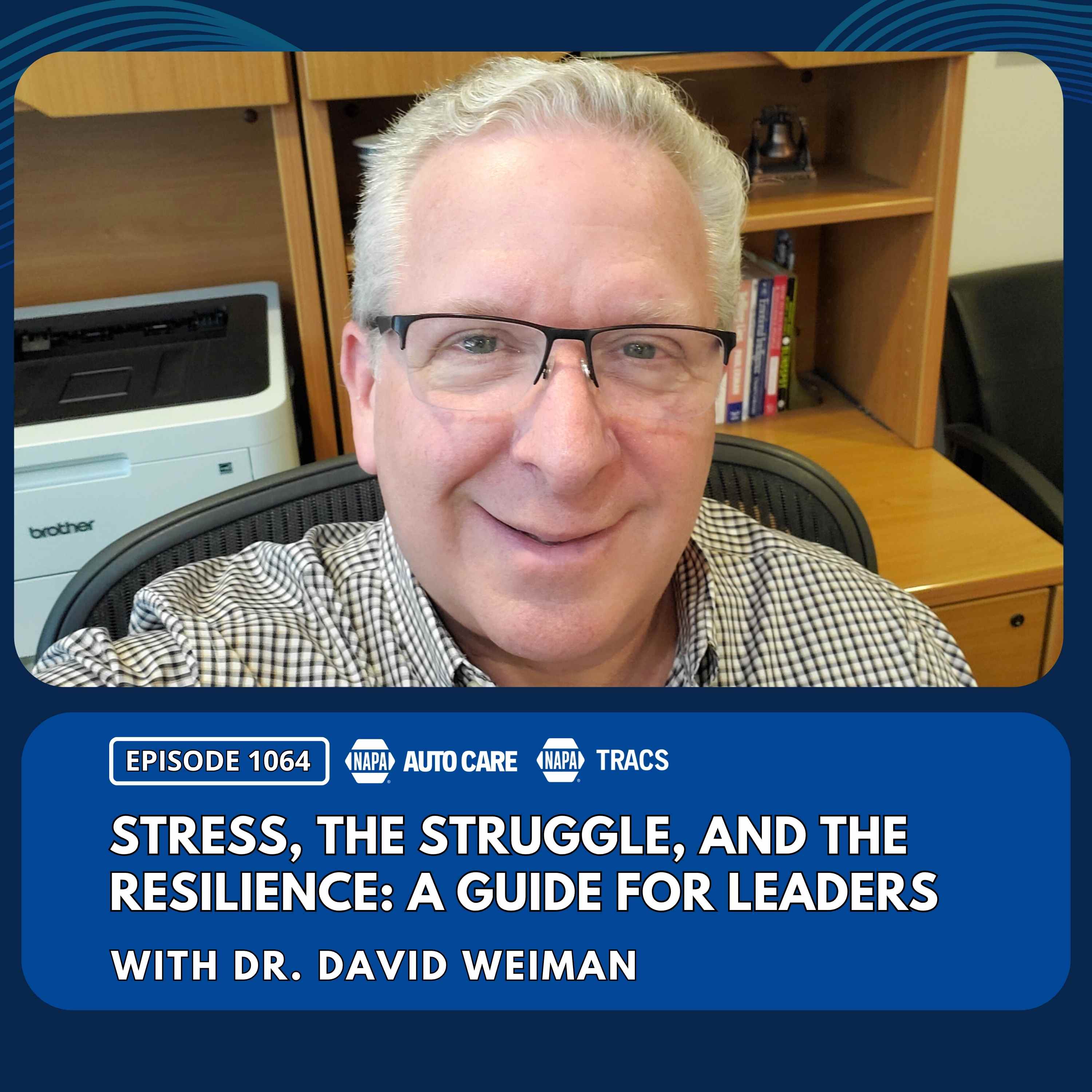
Stress is inevitable, but how we respond to it can make or break our leadership. In this episode, Dr. David Weiman, psychologist at Weiman Consulting, dives into the science of stress and practical strategies for managing it, especially in the fast paced world of automotive repair.
What You’ll Learn:
The fight or flight response and why modern stress feels just as intense as physical danger.
The three types of stress: Normal, Training (Eustress), and Excessive, and how recognizing them can improve decision-making.
Simple, powerful tools for recovery: micro breaks, diaphragmatic breathing, and mindful routines.
How stress affects leadership, team dynamics, and strategic thinking—and what to do about it.
Practical tips to avoid burnout, maintain energy, and enhance focus.
Dr. Weiman emphasizes that the key isn’t eliminating stress, it’s managing it effectively so you can think clearly, lead confidently, and take action.
Dr. David Weiman is the president of Weiman Consulting, a leadership consulting firm in Philadelphia PA. Listen to David’s previous episodes HERE
Thanks to our Partners, NAPA Auto Care and NAPA TRACS
Learn more about NAPA Auto Care and the benefits of being part of the NAPA family by visiting https://www.napaonline.com/en/auto-care
NAPA TRACS will move your shop into the SMS fast lane with onsite training and six days a week of support and local representation. Find NAPA TRACS on the Web at http://napatracs.com/Connect with the Podcast: