LIVE
This is the Aftermarket Radio Network.
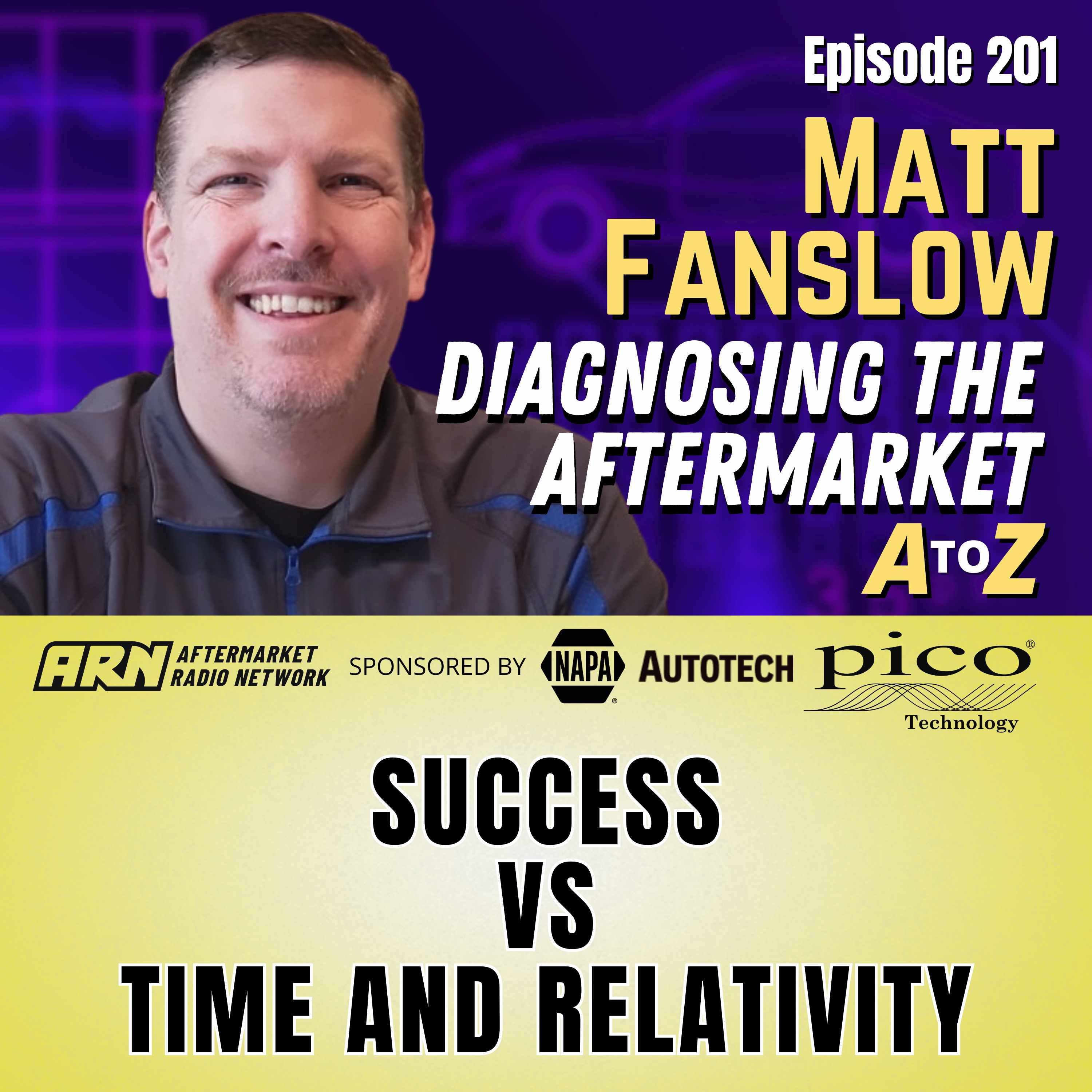
Welcome everyone to yet another episode of Diagnosting the Aftermarket at Dizzy.
I'm Matt Fonsola and hard work may not always result in success, but it will never result
in regret.
Not more after a word from our sponsors, Napa Autotech Training and Pico Technology.
Napa Autotech's team of ASC Master Certified Instructors are conducting over 1200 classes,
covering 28 automotive topics.
To see a selection, go to NapaAutotech.com for more details.
Tired of guesswork and your auto diagnostics?
Need to pinpoint faults quickly and accurately?
PicoScope will turn your PC into a powerful diagnostic tool.
See live waveforms from sensors, injectors, and ignition systems.
See the problem?
Solve it faster.
Visit picoauto.com, that's P-I-C-O auto.com.
A common conversation I've been having lately with multiple people, not just in our profession,
but also just friends, people online, friends online, you know, quote unquote friends
I guess when you get to brass tacks on social media, you have a lot of quote unquote friends
that are somewhere on that spectrum, but not necessarily close friends, but a lot of interesting
conversations surrounding the term or definition better, the definition of success.
And it's something I guess if you've been listening to this podcast or really anything
I've not anything, but a lot of the interviews or participation in other podcasts or venues
I've been in that I struggle to define success in talking to a couple of friends, really
namely was talking to Pedro Delatory for a while about it.
And I kind of gotta be careful how I word this because I'm gonna sound like if not really
really walk the line of and probably even crossing it, a pet peeve of mine is taking
certain physics type of ideas or concepts and trying to apply them to life, like
life lessons. Right. So I'll probably talk about a little bit here. Not I don't want to
go too deep, but relativity, Einstein's relativity, their special or general, you may hear people
say everything's relative, and they apply it to just everything in life. And that's
not true. It's not something Einstein would have ever said. And quantum mechanics,
there's something called the observer effect that gets really, really, really abused.
People that use it in the way they intend about the universe not existing without an
observer and outside observer demonstrates more their misunderstanding of what the concept is
rather than what the concept really is. And but I'm going to relate success to time. And I
don't mean time is we need X amount of time to achieve success or anything like that. I'm
going to relate it to more of the physics, if you will, definition of time. And I would
really like to just start rattling off stuff, or really special relativity and, you know,
inertial Russian reference frames. But they're really defeats the purpose of it all because
I'm not trying to just relate them like they are related. The ideas behind them.
And I suppose I could just talk about success all by itself and not even bring up time. It's
an interesting concept. And it's interesting to think about to me that we start talking.
And when I say we, I guess, when Pedro and I were really talking about success and all that,
it's what it means to him, what it means to me, what others have said. I kept coming back
to the concept of time in my head. And then I rattled it off to Pedro and he liked it. So
if you think this sucks, it's his fault. I'm just kidding. It's my fault. Just a bit of a
history lesson. Again, I don't want to go too off the rails with this. But we'll just say
before 1900, it's close. Somebody might say 1905. That won't be necessarily terribly wrong. But I
think a lot of people are under the notion that time didn't work the way we thought it did. And
the way we thought it worked, and we being, I guess, of throwing the all of us together
into the scientific community. But the idea of time was that at some point somewhere,
the universe had a universal time clock, something that everybody could reference. And it was the
beat to which the universe operated. And Einstein and a few others, but really in his paper,
with special relativity, he kind of changed that perspective. And it wasn't right away.
Don't get me wrong. There's like a whole story about that. Okay. But the reality is that
it ends up, there is not a universal time. There is only personal time. And that gets very interesting,
because now the way time works. And if we really want to sound like we know what we're talking
about, we wouldn't really refer to it as time, right? We'd be talking space time. Because
they're linked, they're kind of two sides, two different sides of the same coin, if you will.
As an example, just a quick example. And, or I mean, there's a couple you're probably
even familiar. One is there was an experiment where they took two very accurate time clocks
and put them on airliners. And one airliner flew to the west around the world,
or the planet. And the other one flew to the east. And they found that when they
got back after their trip, the clocks didn't match. So speed had something to do,
which the clocks ticked away. Another example is GPS. Our GPS global positioning systems do not
work without taking into account where the satellites are relative to the earth. So where they
are in our gravity well, dictates how their clocks tick versus ours. And then the final
example, I'm sure you have heard referenced at least is the twin paradox, where if you have
two identical twins, and one stays on earth and the other gets on a spaceship of some sort or
spacecraft or whatever, what have you, and travels at high speed. And usually the references
near speed of light or speed of light, but it would just have to be really, really fast.
And I don't mean like what we're used to on earth fast. I'm talking, you know,
even half the speed of light, the individual clocks, the personal time will be different.
The one on earth's clock will tick faster. The other, of course, twin, their clock will tick
slower. So when they get back, the twin that was on the spacecraft will have aged
much slower, much more slowly. And the twin that was on earth the whole time
will have aged quite a bit more. That's an extreme example. So time becomes relative.
It's individual, there's almost an individual definition. And when we're on earth, we kind
of all agree in because we're such close proximity that we do have kind of an earth
bound clock, right? What we agree on is Greenwich time Greenwich England that is
kind of like the basis of all of our clocks. Even that will get changed once in a while.
Right. If memory serves, I probably should go look it up. There's a tsunami that was so
powerful, it actually altered the speed of the rotation of the earth on its axis.
And therefore they did have to make a slight correction to that clock. Pretty amazing, right?
I find that fascinating because now that becomes an interesting correlation in my brain,
which maybe I'm alone on this, probably quite rare number we'll think of this way.
And maybe it's not worth thinking it this way, but I don't know. I'd like the idea that
what is universal success? What would be the basis of universal success?
And I'm sure there's names exploding in people's minds right now. Bill Gates, right? Elon Musk,
Ray Kroc, we could go on and on and on. And yet, do they themselves find that,
do they think they're successful? Or would Bill Gates look over to Elon Musk and say,
yeah, he's successful? I don't know. Maybe, maybe not. Any one of those people,
eventually somebody will be more successful and may look at them and laugh like them.
They weren't even in it. Or how did they get their success? You know what I mean? Like,
did some of them get a head start where family had money or is something of that nature?
And therefore that tarnishes their quote unquote success. And then I don't know,
pick a sport. I hope to have Zach on in the next few episodes. One of the next few episodes
about golfing. He's an avid golfer. And it sounds like he's getting quite good,
especially like statistically versus many other golfers. So there again, what does success mean?
Right? Is par success? Is one under par success? You know what I mean? Like,
if you're doing 18 holes, playing 18 holes in par 72 strokes, and you do an 80,
for many of us that would be categorically successful. And yet others epic fail.
And take that to the shop. What is a successful shop? How many thousands of dollars a month or
year or millions or what's the ratio of profit versus, you know, I guess we could just say what's
left over after all the bills are paid. Is it like one cent over everything? I mean, you're in the
black. Is that successful? Everybody got paid, including the owner like everybody got paid.
Everybody got taken care of. So it was just being in the black at the end of the year after
everything's paid. Everybody's happy. Just assume perfect world. Everybody's happy. They've got
their benefits and fringe benefits and all of it. Bonus is all covered. And the end of the year,
they're in the black. They got one cent left. Is that successful? Does that have to be more?
Like there has to be X amount of dollars left over? Is that a percentage of
the income, the net or the gross? Probably more so. So we get into these weird definitions of
success. And if I could just, I don't want to just run out of stuff to talk about with Zach,
but if we kind of go back to the Gulf reference, if you just started playing and you actually,
you know, triple bogied a par four, which means you took seven strokes on something that quote,
unquote, supposed to take four, yet all the other times you're double digits. That's kind of,
that could be wildly successful. And for many others, if you've been playing for a while or
you're used to paring or bogeying, then that's an epic fail. And you see that just with, you know,
the shop that some people would define success as a happy customer. We took care of the customer.
They're happy. That's a success. Others, yes, we want that. But did we get it done when we
said we'd get it done? Did we get it done with the price we quoted? Did, you know, was the production
on that or the efficiency at near or above 100% and was the productivity of the tech
mechanical or technical specialists working on it? Did they break over 100% production?
Because if they didn't, then that's not success. That's, you know, tolerable. We got the card
on. Didn't make what we could have customers happy. So they'll probably be back. You know,
it's not a big win. We eked out a little bit of a win. And I guess I just, I guess I bring that up
because I think you got to be honest with yourself and therefore carve out a little bit of pride
for you as an individual of what is success. And starting out by other definitions,
it may not qualify, but it's very important that you feel proud of your success,
whatever that may be. Maybe it is just getting the job done right. If you're just starting out.
Yeah, it was only supposed to take so long and you took three times that. But it got done.
It is right. Then come back. Maybe that's a win. Maybe that's something to write down
in your journal, which I think I feel should be more common journaling, having a laptop nearby,
a tablet, your phone, something document for yourself and say, you know what, that's the first
car I did beginning to end all by myself. Yes, it was supposed to take blah, blah, blah time.
And I took blah, blah, blah time. And this is why I think it took blah, blah,
blah time instead of blah, blah, blah time, but it's done right. I didn't need any help.
I'm going to chalk this up as a big win. But I have, I have work to do, but I'm leaving work
with a smile and being able to maintain that a little bit, even if you get shunned,
because that's what we do, right? We forgot what it was like when we started.
And therefore, it's, you know, conveniently who never took twice the book time. We never took
three times the book time. Are you kidding me? What was the context of all that? Like,
you grew up in the shop. They didn't, you know, it's like, come on. And then charting
improvement. That is yet another success. Improving every time constant improvement.
Napa Autotech training sessions are being conducted day and night in a town near you.
This training caters to every level within your organization, be it a mechanical assistant,
a mechanical specialist, a technology specialist, or a driver's safety calibration
specialist. Imagine a one stop shop training partner in Napa Autotech that will lead your
team to a path to greatness. Autotech's entry level build the tech classes convert the
untapped potential of your new hires into money making mechanical specialists.
Autotech's higher level tech update classes introduce specialists to the world of ever
changing technologies, which prevents your shop from getting technologically stagnant.
Remember, if you're not moving forward, you're falling behind. And turning to the front of
the store, the Autotech service advisor class is an awesome way to hone your client
advocate skillset, ultimately benefiting the customer through an improved vehicle repair
experience. But it doesn't stop there. Imagine an electric vehicle class that takes your
specialist well past the mundane, yet necessary safety topics. Well, it's here.
Autotech's EV-ready training is a week long curriculum that takes participants through
a hands-on experience involving hybrids and electric vehicles. The session kicks off
with the use of PPE and proper tooling while touching on required OSHA regulations.
Then the students dive into the lab vehicles to gain knowledge of the
common high voltage components on EV and hybrid vehicles and their function.
Attendees will be taken on a path exposing them to different electric vehicle manufacturers to
compare component form and location. Additionally, information about level one and level two
charging systems will be included, along with a quick look at DC to DC charging.
The operation and maintenance of subsystems are explored, including the different modes
of Tesla operations and so much more. So what are you waiting for? Commit to taking
your business to the next level with Napa Autotech training.
Is your shop ready for the electric vehicle revolution? Don't get left behind.
The PicoScope EV kit is your all-in-one solution.
Diagnose any electric or hybrid vehicle from high voltage batteries to complex communication
systems. With guided tests and pinpoint accuracy, you'll tackle more jobs and boost
your bottom line. This isn't just a tool, it's your future. Be the expert in EV repair.
Visit PicoAuto.com to future-proof your shop today. That's P-I-C-O-Auto.com.
So I think where I went with the physics of it, individual time, personal time,
there's also personal success. Yeah, we have to consider the shop's idea or leadership's idea
of success too. And leadership, I think, needs to do a much better job of charting out
a little bit. Not saying it's got to be just all fricking diagrammed, but you can have a little
bit of a chat with somebody about where you want them to be and when. Meaning,
the first example of somebody taking, you know, three times the book time to do whatever job
and being very honest with them and ourselves, you know, or yourself. Why did it take that
long? Was it really all them? Was it an experience where they set up to succeed and meet the time or
get whatever close to the time? Everybody's shop's kind of different, again. So individual time,
personal time, personal success. And then what's the definition of that? So now the shop
has its own idea of success. Some people or some shops, it's, you know, if they're not 120% productive,
they can't work here. And others are ecstatic with 70. I'm sure if we take a really good look
at both shops, they're set up differently. And I don't mean like one's just, you know,
a well-oiled machine and the other one's not. That could be, of course. But honestly,
it could be just the nature of the work, you know, there's a lot of stuff that's going on with that.
So ultimately, what is the shop or management's decision as to what is successful and then is it
built to perpetuate that? But getting back to finish that thought is you have somebody that
took, for example, three times what the book time was. And we'll just say for the sake of
discussion that it was an inexperience that you can share in their joy or happiness over a success,
like actually validate that. Yeah, that's great. You did that without any help. It was done right.
That's great. And then maybe get a senior tech in there. Let's discuss the process here.
Where could we have saved time? And, you know, I don't know that I have to rattle off examples.
Some of the young techs, IAC, mechanical specialists, IAC really, they'll have their
laptop or their tablet up on their toolbox, and they'll be working on the vehicle and
they're going back and forth to read step two, step three, step four, just annihilates time.
Can you bring the laptop with you? Can you print it out? It's a tablet, you know,
can you just bring the tablet with you? Can you read a couple of steps and not have to go
back and forth after each one? Little stuff like that. And of course, time itself, experience,
is going to greatly aid in that as well, if only just comfort and confidence.
Right. A lot of times you take time because you don't want to make a mistake. You don't
want to miss the step and thus kill, you know, over the course of the job, kill a lot of time.
And did they check and recheck and recheck bolt tightness, which makes sense, kills time.
But can we plot out a little bit of, and maybe not even to them right away, maybe in
the back of our heads is like, okay, that's a big win. Good job. And now in the back of our head,
it's like, okay, like to see the time start dropping and improvements made and what kind
of an improvement would be expected. And again, now like it's into what's the nature of the job.
And, you know, can we all agree at least, you know, fuzzily, I think that's the word
fuzzily, the difficulty of the job, the difficulty of the service. And are they on their way to success?
And are they put in a position to succeed? And are they aware of that? Are they aware of
the shop's definition, or management's definition of success? Because it's different.
It's different from shop to shop is different from individual to individual. And I guess,
maybe starting to wind this thing down, there's got to be some communication on what everyone's
definition of it is, and then the path to it. While also having a little bit of the ability to
take some pride or be proud of yourself with successes. Don't shortchange yourself. You got it done.
You know, that car that was just murdering, you know, whatever the problem was, some battery
parasitic drain was absolutely slaying you. And you ended up spending a lot of personal time,
a lot of weekends, popping in, staying late, coming in early. You finally got it figured
out. We'll just assume for the sake of argument ends up being something
simple. You just missed it. That you don't go overboard with berating yourself. Like there's
take some solace in the success. And then, of course, with everything, there's
something to be learned. And then again, I think makes success a kind of a relative statement
because I think we all kind of buy into there's very little to learn from a win or a complete
victory, doing something perfect. There's not a lot to take away from that. The failures,
the hiccups, the missteps, that's where the learning comes in. Don't shortchange yourself.
Give yourself credit where credit's due. And then when it's time to be critical of yourself,
maybe give yourself a little bit of slack. And I think the rest of us too with
colleagues and coworkers and especially those in management positions to also
just kind of regulate what our criticisms are. And what are they founded on? And are they
reasonable? And don't get me wrong, there's plenty of things to be very critical of.
And rightfully so. And it's very reasonable. It's just I don't know about you, but I seem to notice
and I'm sure it's always been this way. A lot of the entry levels who did not have the backgrounds
a lot of us had coming into this years in a shop on a farm in some environment that required
mechanical aptitude or critical thinking. When it comes to system function and whatever
complex, I'll darely say complex systems. You can't compare it. They don't have that.
They're getting it right now. Can we validate their successes? Even as meager as we may find
them to be there, their successes, and those will be the building blocks to getting them
where they need to be and whatever that may be. Is that where you know, quote unquote we're at?
Those of us or those of you that have had maybe the luxury, at least the advantage
of growing up around it. I guess letting them fail and letting them suffer the
natural consequences of it. So yeah, the next time we're watching a clock tick by,
think about success and how it's relative. And there is personal success as well as
kind of agreed. Somebody has set up an idea of success and then, and that would be the managing
entity. And is it reasonable, right? It may not be. They may not like hearing it or
I guess like what we see a fair bit of is businesses flipping through employees to try to
find somebody able to succeed in spite of the systems or lack of systems in place.
Being that we have really such a really low number of entry level, just hit the ground
running type of text, or it's hard to pull mechanical and technical specialists from other
shops or from schools. The pool is kind of depleted. We do have to focus on the systems then.
It now does become more important that is the system such that those larger percentage
can succeed in it rather than can we wait for this type of tech, this type of mechanic,
this type of specialist to be able to do this, that and the other and succeed in spite of
our poor systems. And that can be a tough pill to swallow sometimes where you think you kind of got it
and you don't got it. Something that this profession is really, really good about
pointing out to us is we don't got it. Yes. Again, next time looking at your watch,
looking at your clock, just think about how that time, that personal time ticks away
individually. Not as big a factor here down on earth where we're all
relatively the same, but there is personal time and there's personal success, success,
the definition of which is up to the individual. However, that may be at work success, life
success, business success, and there's really nothing wrong with that. There's no preferred
perspective and that would be something straight out of relativity, special relativity.
So with that, I will leave you. Thank you so very much for listening.
Thank you to the aftermarket radio network for making this all possible. Thank you so much to
our sponsors. NAP out of tech training and Pico technology and until next time.
Interested on what you have to say? Let them know what you'd like them to cover and come on the show.
Matt is all for advancing the aftermarket. Find Matt Fonslow on social media
and connect or on aftermarketradionetwork.com.
0:00
29:26