Transaction prices are the final prices that people pay when they buy a car. It includes any discounts or deals that the dealer might offer, showing how much cars are really selling for.
Monthly payments are the amount of money you pay every month when you buy a car on credit. It helps you spread the cost of the car over time instead of paying all at once.
F&I performance is about how well a car dealership's finance and insurance department is doing. They help buyers with loans and insurance, and good performance means they are making more money from these services.
Service contract penetration is about how many people buy extra protection plans for their cars that cover repairs after the regular warranty ends. More people buying these plans can mean they want to be safe from unexpected repair costs.
The Nissan Rogue is a type of car called a crossover SUV, which means it's a mix between a car and an SUV. It's known for being roomy and good on gas, and the new plug-in hybrid version is designed to be more environmentally friendly by using both gas and electricity.
The Mitsubishi Outlander is a compact SUV that can carry more passengers and cargo than a regular car. It's similar to the Nissan Rogue because they share many parts and designs, which helps the companies save money and offer more options to buyers.
Dealer complaints are when car sellers talk about problems they're having, like not having enough cars to sell or changes that make it harder for them to do business.
Renault is a car company from France that makes various types of vehicles. They partner with Nissan and Mitsubishi to share technology and improve their cars.
The Toyota RAV4 is a family-friendly SUV that has plenty of space for kids and dogs, making it a great option for people with families.
LIVE
Hey, everybody, welcome back to another episode of The Daily Dealer Live.
I'm your host, Sam Darkin. Welcome to this space where automotive comes together to learn,
to share and to grow. You're a part of this today. Thanks for being here on this Wednesday,
November 19th. Let's jump straight into today's automotive industry headlines.
First up today, dealers are gearing up for 2026 with tighter front-end margins and worsening
affordability pressures. According to JM&A's Q3 Trends report, Front PVR has been
declining for four straight months while transaction prices reached $45,795. An average monthly payments
climbed to $756. Now nearly one in five buyers are now taking a $1,000 a month monthly payment.
However, F&I performance strengthened in Q3 with F&I PVR at its highest level since 2022
and service contract penetration rising for the first time since May. What's the big picture
here? Well, the F&I office is providing the stability as front-end profitability continues
to soften. Next up today, the dealership buy-sell market strengthened in Q3 after a slow start to
the year with 149 stores changing hands. By the way, I love that logo. I love the jingle.
Average blue sky values rose to $22.4 million, up 7% from late 2024 and well above
pre-pandemic levels. Profits per store also climbed 13% year-over-year, driven by strong service
and parts performance even as front-end margins slipped. Premium brands continued drawing
record buyer interest while Nissan and CDJR stores sold at discounts, creating momentum that appears
to be carrying on in Q4. Among the buy-sell activity, Hudson Automotive Group has just
acquired 15 of all-star Automotives, Baton Rouge, Louisiana franchises, and according to
Kerrigan advisors who represented the seller, this was the second largest transaction of 2025
by franchise count and one of the highest value deals in Louisiana history.
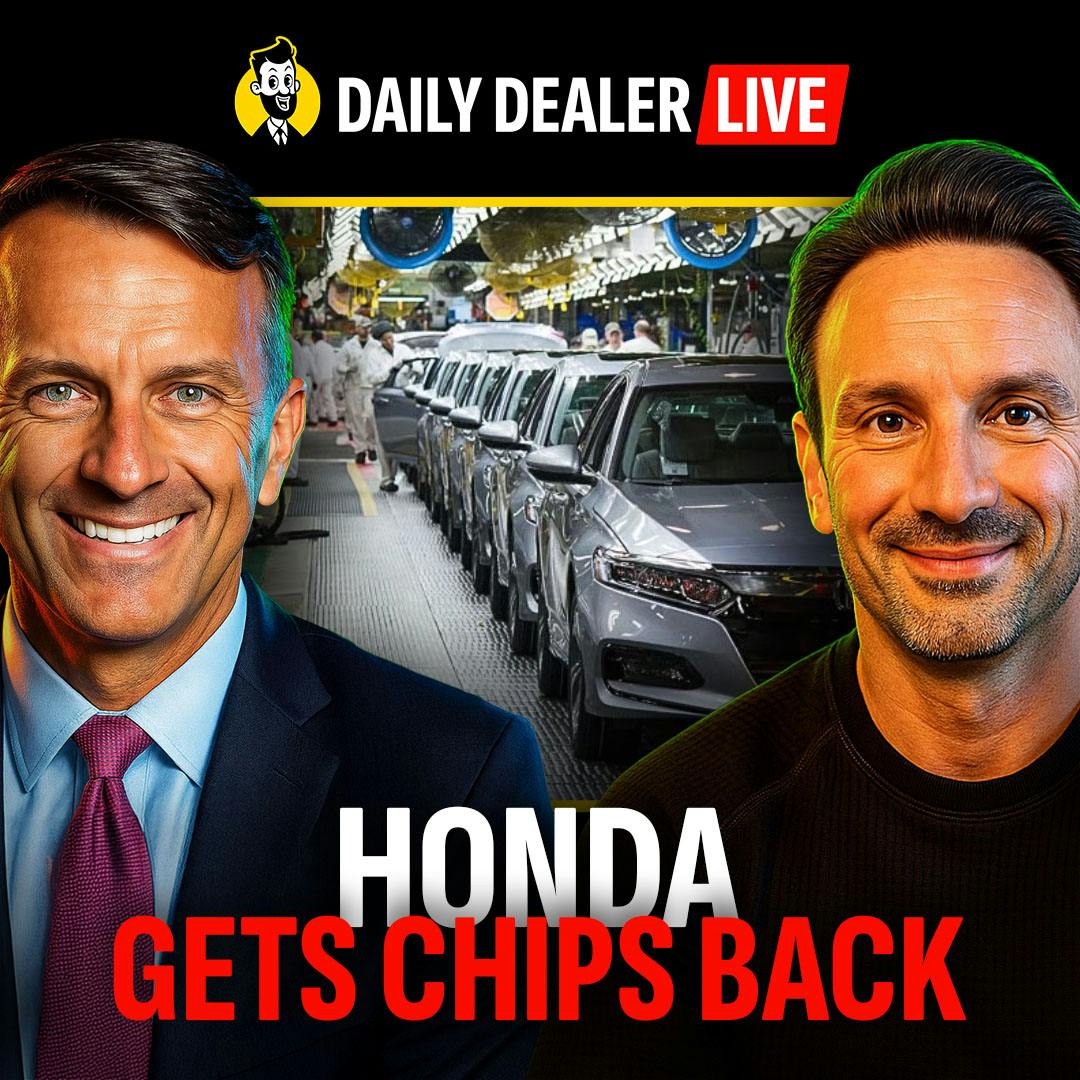
Next up today, moving on to Honda, the automaker is preparing to restart
normal production after halting operations at several plants due to chip shortages tied to the
much-reported Nexperia export dispute. For context, Honda slowed or stopped output in Mexico,
the United States, and Canada after China's ban on Nexperia shipments,
but now expects to return those facilities to full operation next week. However, the company
cautions the plan could shift if conditions change. Meanwhile, the Dutch government said just
this morning it has suspended its intervention at Nexperia following talks with Chinese
authorities. This will no doubt ease threats to the automotive supply chain, but OEMs have begun
sourcing chips elsewhere and automakers like Tesla and GM are directing their suppliers to
avoid China-made components for U.S. production. Truly a good idea, especially after we learned
during COVID, you can't get chips from one place and continue to manufacture. So
diversifying that portfolio in my own humble opinion is the solution for automotive and
the broader U.S. industry. Finally up today, Nissan is introducing its first U.S. plug-in hybrid.
Hybrids are in huge demand right now, as we all know, as it tries to fill a major gap in its lineup
and calm growing dealer frustration. The 2026 plug-in rogue hybrid debuted at the LA Auto
Show and it's effectively a rebadged Mitsubishi Outlander, which, given Nissan's challenges
of late, feels about on brand for where the company is right now. Pricing is expected in low
$40,000 for base models and low $50,000 for the Platinum trim. But the launch follows
months of dealer complaints about discontinued models, limited options and declining competitiveness
in key segments. Big picture here? Well, the rogue PEV is positioned as a critical step in
rebuilding the U.S. portfolio, but its impact will really hinge on re-establishing confidence
among consumers and maybe even just as important or more important re-establishing
confidence among retailers. And that's a wrap on today's industry news.
Yuli, what's up? What's up, buddy? What do you think about a plug-in hybrid from Nissan
that is modeled after a Mitsubishi? It's like a word puzzle. I mean, it's a great idea,
but modeled after a Mitsubishi, maybe not so much. It sounds a little bit like a punchline. I'm
excited because the head of Nissan, Vinny's successor, will be on the show Monday. So if you
want some more context and follow-up questions on that, I'm having a conversation with him Friday,
he'll be on the show Monday. We can ask him some questions about this hybrid piece. And
where did the Mitsubishi part come in? I think it is due to a relationship between Nissan,
Renault and Mitsubishi, but fascinating in a world that's highly competitive. And where hybrid
is the key to the future, it seems at the moment, right? Hey, as a reminder to our loyal listening
audience for those joining the live stream, we're live across all CDG, social media platforms,
post your comments on those platforms. We'll bring them into today's show, for example.
Bill Vaughn is already in the comments, highly disappointed. I was excited about
finally having a hybrid and they just gave us a Mitsubishi. So I guess that answers that
question. And then Cole says, Yuli's mustache makes me so happy, Yuli. So you're getting
some props. Yep. And then Craig White says, Nissan leaning on Mitsubishi says a lot about
Nissan. So we'll let that commentary stand on its own. So Yuli, what a show we've got today. We've
got the car dealership guy. He'll be along in our second segment along with a special announcement
from some partners. And it actually has to do with our big NADA party that's coming up. So
there will be a special unveil coming up shortly. But first, we actually turn to
my own geography, my own auto group here at the Ziggler Auto Group and someone who proved you can
go from a D1 collegiate football quarterback to an NFL quarterback into automotive. So we're excited
to hear his story. Up next, Zack Terrell. Zack, welcome to the show. Thanks for having me,
Sam. And Yuli, it's fun to be a part of with somebody in the group. I feel comfortable
in this interview. Well, because you and I have done this many times in our own studio,
in our own world and shared it internally. And I know exactly where you're sitting today,
which is a heck of a lot of fun. So before we dive into it, Zack, for our audience that doesn't know
you, tell us how's biz and then give us some information about you and what you do at the
Ziggler Auto Group. Yeah, absolutely. So the way that I look at things is the business is elite,
right? We don't let the circumstance dictate our behavior. There are some
definitely some pressures out there from the market that are making it a little more
challenging. But we look at it as an opportunity, you know, in Kalamazoo, the stores that I oversee,
yes, what I do, I oversee four locations here in Kalamazoo. We're up 20% year over year,
so we're really proud of that growth. Have a great team here. And then I also oversee
our Holland location. That's more recent in nature. But yeah, I mean, there's definitely
some challenges, but there are definitely windows of opportunity within those challenges. And
we're doing our best to exploit those and hit them head on. And I'm excited you announced the
Honda chip shortage. We have a Honda store, so I'm excited to hear about that news. That would be
huge for us and production. But you know, we're rolling into the end of 2026 here. So we're
just trying to finish 2025 strong. All right. So let's pick up the thread on the Honda
next period chip shortage. I was talking with another one of our leaders who was told by
Honda that the production is resuming. How has it impacted you and your supply at your store,
the Honda chip shortage, if at all? Yeah, and limited information from Honda,
the manufacturer itself, but we've definitely seen it in the production numbers and what will we
getting has definitely been limited. Our turn is the best in our region. So we're obviously
doing the turn and earn and to see, you know, a lack of production was certainly disheartening,
but it's good to hear at least that it's been that there's an end in sight. So we're looking
forward to at least getting those numbers back up into next year. Probably won't help us this year,
but at least next year we'll get back on track. Yeah. All right. So I want to give you props.
And this is unusual because you and I know each other. This isn't a normal interview,
right? So when I first came to know you, you were a salesperson at our Kalamazoo campus.
And you know how then this is usually to our audience to you, you know how when you
walk around, you're just like, Hey, how are you doing? Like that's the traditional question you
ask any. And what's the answer, Yuli? You typically say if I was to see you in the halls, and it was
just a question just to basically say, Hey, I just be like, Hey, Yuli, how are you doing? What
would your answer be? Great. How are you? Yeah, it's like a casual throwaway question that means
nothing. Zach drove me nuts for the first many months when he and I knew each other,
because when you walk up to Zach and you say, How are you doing? Zach? What's the answer?
Elite. And by the way, he doesn't accept anything but elite. Talk to us about the meaning of elite
and how that filters into your leadership, into your leadership. Yeah, I mean, like you said,
it's a throwaway question. And part of the reason there's a method to the madness, when somebody
asks me, Hey, how I'm doing, I say elite, I can tell whether they're paying attention or not.
Because if you know me, you expect that answer. And if you get something different,
it means I'm not having a good day. And you'll, you can tell quickly. Yeah.
But for other people that don't know me, if they don't ask, okay, what's up with the elite thing,
then I know they're not listening. They don't care. So I mean, it's definitely something,
it goes back to college, you know, I played football at Western Michigan University.
So actually, before you get into that, I want to ask this question to tee that part up. So
thanks for sharing on the elite. Sure. When you were in college or when you were in high
school or as a kid growing up, did you imagine you'd be selling cars or that you'd
be in the automotive industry? No. No, what was your plan? I wanted to play in the NFL.
But the NFL to me stands for not for long. That's why I'm here. Okay. Yeah. Yeah. So tell us about
that trajectory. You played college D1 football at a school Western Michigan in Kalamazoo,
Michigan. And you joined as a highly sought after recruit, a team that had lost a lot. Tell
us that story. Yeah. So when I started, we went one in 11. That was my first year as the
starting quarterback. We're the worst team in the country. I was the worst quarterback in the
country. So I know what bad teams look like. And I know what bad execution looks like. And then
by the time I was a senior, we went 13 and I'll have the best season in Matt history,
set a lot of records, which was a lot of fun. So I know what elite teams look like as
well. So I've seen the ball. So what on earth made you say yes to Aaron Ziegler when he came to you
and said, come join the auto group. You were selected to join an NFL team. You had a contract.
Tell us what that decision looked like to go from elite athlete into automotive. Why automotive?
Well, first I learned that car guys are really good closers. I learned that out
and close, especially dealing with principles. Aaron Aaron. And but you know what, there's so
many similarities between athletics, especially, you know, collegiate and professional athletics
and the car business, the competitive landscape of it, the accountability, right? There's just so
many things that translate. I tell people all the time that the car business is the closest
thing to a locker room that I've ever been a part of. And when you need athletics, that's
the one thing you talk to any athlete, thing they miss the most is the locker room become
Rotary, the constant accountability, you know, trying to achieve something that's never been done.
And you know, now we get, now we get that in the car business. So you're only as good as your
next month in the car business. And in sports, you're only as good as your next game, right?
Everybody forgets about it. So there's a lot of similarities. And that's why I feel comfortable
working in this business. So you came into this industry from the outside, you'd never
sold cars before you your parents, your family had never been an automotive. And you went straight from
NFL into car sales. And you took that role you watched, you grew into a sales manager and ultimately
a GM. And you've done a great job at that Kalamazoo campus, Chrysler, Lincoln, BMW,
Honda, you're going to be uncomfortable to hear this, but I'm going to say it.
You have drastically changed the trajectory of profitability, success, and just the
overall trajectory of that location. How has give our audience one or two key takeaways
from your sports background that you've applied to leadership at Kalamazoo that have helped
provide that big result? And I don't want to say a turnaround because it wasn't broken,
but 180 in terms of profitability and everybody rowing in the same direction.
Yeah, I think the first thing is vision, right? You have to set a clear, direct vision on what
you guys want to go, just like in sports, just like in life, like, hey, what does everybody want
to achieve? I know what I want to achieve, but does what we want together as a team does that
match, right? I think the second thing seems simple, but it's caring. People don't care how much
you know, how much you know until they know how much you care. I think being able to show the
team that you're in the trenches with them and that you're willing to do whatever it takes
and you're there for them is a huge piece. And then consistency, consistent messaging,
consistent accountability, I think is the real reason why we've been able to take it to the
next level and then talent and development. You're only as good as your team. And we have a
great team here, we've been able to develop, we've been able to bring in key pieces that have been
able to add to what we have here. And that's what we're constantly looking to do. I had that
conversation the other day, hey, we need to be out recruiting our best people here, because
if we do, we're going to continue to get better. So a lot of similarities, like I said, between
athletics and the car business, but that's kind of how we've been able to achieve what we
have so far. So as you've built what you've built at Kalamazoo and then you're looking
to do very similar at Holland, how have you recruited new team members? Where have you
gone to do that? What's been your messaging? And then how do you bring them into the organization
in such a way that they're a profitable and participating part of the team?
I don't want to give everybody that's listening in Holland or greater Kalamazoo area all my
secrets, but I mean, to be honest, there's only five people watching. We do whatever it takes.
We've done some undercover driving into service lanes to recruit. We do whatever it takes to be
honest. And, you know, we're very diligent about making sure we get in front of as many people
as possible. And like, you know, we've hired eight technicians in our Holland stores already,
and I keep hearing you can't hire technicians. Well, I refuse to accept that notion and we do
whatever it takes to find it. If we need it, we got to find a way to do it. And
just setting ourselves apart, laying out a clear vision. You asked me earlier how I ended
up joining the car business, Aaron gave me a clear vision for what my future will look like.
He said, you stay here, you'll learn how to run, you know, a couple hundred million
dollars worth of a business. I was like, well, that sounds like a great idea. I'd love to do
that. It's no different to a technician. Hey, we can lay it out and show you how we can
make your life better and how we can grow your income and how we can give you more down
the road. If you want to develop into something like what do you want to achieve
and being able to put a plan in place for them, that's all people want.
Yeah. So your time as a leader in creating this vision, bringing people onto the team
is limited. You only have so many hours in a day. What are the top three most important
activities that you engage in daily, regularly as a general manager at that location and now
a second as you're expanding to an additional? Well, it's unique now, right? Because you've
you have geography. So you have a lot more road time, but it's all comes down to people.
The number one thing is people, right? My directors that report to me are fantastic.
They're elite. They know what my expectations are. I know what their strengths are. They
know what my strengths and weaknesses and vice versa. So we're able to kind of work
together as a unit to make that happen. So one of the biggest things is people,
obviously accountability is huge. I think that was the thing I was I was really shocked when I
first got here is the lack of accountability in terms of tracking and reporting. I live in our
our financials. I live in our CRM to make sure that we're on track and we're tracking where
we want to go. We try not to be reactionary. We really try to be proactive when there's
issues. And then, you know, the third thing is feedback from the team. I walk our campuses every
day and I talk to every single individual on campus. It's a very simple activity. It helps me
get my steps for one. And number two, it makes me get in front of problems is because it's amazing
how much comes up by just visiting somebody at their office space. And it can be very simple
just to low or can get even deeper. And we're able to, you know, cut off issues
immediately, now let them linger. So as a relatively new but growing and successful GM
mentors are important, right? And having a good source of people to learn from. Who do you
count as some of your most significant mentors and why you could pull from sports, from business,
from wherever? Yeah, I mean, when you just said it, there's from all different industries,
you know, obviously, you know, we have the luxury within our group to have a connected
auto group. So there's a lot of people that I lean on internally, that have different strengths,
or, you know, that have similar brands, you know, we're struggling with the brand. Hey,
what do you guys do? And you have a lot of success. So we're fortunate with that.
Obviously, you know, Aaron is a huge mentor of mine, but then outside of it, I still,
you know, I space timed with Coach Flack yesterday, and just little things, you know,
things that you can pick up on leadership, but then also personal development and things
like that. So yeah, those are some really key people in my life that I lean on heavily on a
regular basis. So Coach Flack, PJ Flack, he was the coach at Western Michigan, took it from losing
to winning is with you. He's now head coach at Minnesota, right? And having success, famously
the guy that will run the coach that will run one end of the other. Why does he do that,
by the way, at field change, he runs the team, he doesn't walk as a coach.
Same reason we say elite, it's different, right? You're at Minnesota, you're at like most guys
when they're growing up, the first place they don't think that they want to go play at in college
is not Minnesota, right? So it's like, hey, how do we attract talent? How do we be different?
So, you know, that's, that's what makes him different, makes him special.
That's been a, been a, been a differentiator. All right, you mentioned
data and watching metrics. Last question up today, we appreciate you being on.
What are two or three key metrics or KPIs that you look at regularly as a GM,
and you drive the team towards you keep focus attention on that maybe a lot of GMs may miss
or maybe they don't, but what are those key two or three KPIs, Zach?
It's not so much what, in my opinion, it's that you're doing it on a daily basis and that
not just you understand what the numbers are, your team understands. So it's not just about
me being in the numbers. My team needs to be in the numbers. So if I call somebody and say,
Hey, what's going on here? They should already know that there's a problem and they should
already have addressed the problem and have a solution. And if they don't, then that's where
we work together to find it out. But I don't think so. I think that's where people get
confused that like, Hey, I have to know every single number and I have to be the one that
only knows it's the collaboration. It's working as a team. And if your team, if you can't
go up to them and say, Hey, what's your number and they can't spit it back to you,
then you don't have, your operation isn't operating at maximum capacity yet.
Yeah. All right. So I lied. One last question. I'm just putting these pieces together. I did a show
yesterday with CDK. They had a service report that came out. And maybe I'm not supposed to
share this, but who cares? This is our daily dealer live audience we're sharing.
We would have this conversation personally anyway.
Yes, we would. Yes, we would. And they're surveying buyer sentiment. And one of the
stats that really jumped out to me is the average hold time for service departments
is just through the roof. Like more people prefer to be contacted other than phone calls.
But when customers do call service, I think that the average hold time went to like six or seven
minutes. And the person Kim Saylor that I spoke with on the show, she's like, I'm like, I can't
think of anything or anybody I'd wait that long to talk to on the phone. And I think you
and I have had this conversation. What's the solution in fixed ops to stopping the craziness
of that long of a hold time and that long of a wait time? Because as much as we all want to say it
never happens, it happens when we rely on on on staff that's overburdened in some cases, Zach.
That number doesn't surprise me. I mean, anytime you cross shop or you call other places,
they have similar issues. I mean, I know you're going to have some guys on like
Impel, I believe later, with AI capabilities. I mean, we've tested a few of them and have
looked into it. We never had a BDC ever in Kalamazoo before we added one because we couldn't
handle the volume. So there's different approaches. I mean, we're monitoring the AI piece really
closely. We have some pieces of that to kind of fill those gaps. But it is a huge problem in
this industry, and especially the younger generation, there's no way that they're going
to sit on the phone for six minutes, let alone 15 seconds. So we have to be able
to capitalize when someone calls, they have to be answered immediately.
So to that point, you have used Impel. Devin will be on up next with Yossi for a special
unveil related to the NADA party. That actually works as a strategy to shortening that call time,
which makes CDK stat that much more astonishing. That means for every call that gets picked up in
a minute because of AI, there's a call that takes 16 minutes because they've got no tool.
What do you see? Where in your operation do you see the most effective use of AI at this point, Zach?
Currently, it doesn't replace anything. It just enhances the experience. And I feel
it's a gap filler for us here. Any pain point for a customer is a delayed response,
whether it's on the sales or service or part-side of things. And right now,
it's a gap filler for us to make sure that they are contacted or at least get some type of
relatively appropriate response within an acceptable amount of time, which for us is immediate.
So we don't want them to have to wait at all.
All right. So closing comments, Zach Terrell. What message would you give to anybody considering
joining your team in Holland as you look to grow that and win it at GMC Nissan, Hyundai,
and Kia in Holland, Michigan?
I have the same trouble doing all 8-2. I would just say anybody out there that's looking
to join an auto group that continues to grow and invest in their people,
that are looking to develop and working for an elite culture that can change their life.
And we'd love to have you jump on board and be around for a ride like no other.
So we're looking forward to the future.
Zach, guess what I think of that message?
What's that?
It's a elite.
Zach Terrell, General Manager, Ziggler Auto Group, Kalamazoo, Michigan,
Holland, Michigan. Thanks for being on the show, sharing your perspectives.
Thanks, guys.
Thanks, Zach.
That's fun, just because he and I work side by side daily and he truly lives what he
talks about that elite. I hear a lot of the stuff you see on Twitter with Nick Saban
and talking about raising your standards and good people don't tolerate people that are
mediocre. You've got to commit to a level that's above and beyond ordinary to get
extraordinary results. And he lives that. And a lot of that, I think he did pull from
sports and people connect and relate to that. So I love as a strategy hiring folks with us.
And Aaron talks about this all the time with a super strong sports background because they
understand team, they understand how to get everybody working together on a goal,
they understand basics and training and metrics and all that. And Zach is a great
example of that.
That repetition. And don't forget, I mean, in sports specifically, you have two teams
competing against each other with the same goal. So we know that the goal is not what
gets you there. It's your processes that get you there. So whoever's got the tighter
processes and that repetition, that training, that's who's going to win.
Yeah. Yeah. All right. Let's talk escalating fines and enforcement actions.
So escalating fines and enforcement actions are hitting dealers hard these
days. If you doubt that, check out the industry headlines we read occasionally.
KPA's complete compliance suite protects you from every compliance risk while helping to
reduce insurance premiums and liability exposure. Learn more at kpa.io forward slash automotive,
or you can scan the QR code there or you can check out in the show notes.
We appreciate KPA for sponsoring today's content, including that elite conversation
with Zach Terrell from Ziggler Automobile Group. But thanks to KPI for today's content.
We appreciate you supporting the show.
And before we launch into our next, I just want to remind everybody,
Cardiola Ship Guy is back with our second annual NADA party. It's happening in Vegas
Thursday, February 5th. I think Yossi is going to talk more about this.
It's the hottest ticket at NADA 2026 with special guests and top automotive personalities.
Unfortunately, spots are limited. We can't invite everybody. So RSVBP today,
so we make sure that you are in Vegas with us. Next up, let's bring on first,
Cardiola Ship Guy, Yossi. Yossi, welcome to the show.
What is up, gentlemen? Good to see you. Yossi, it's good to have you back.
So and you've got, you've brought some guests with you today. Who do we have?
We've got Devon Daly, co-founder and CEO of Impel, and we've got Ben,
CEO of Call Review, right, Yossi? We do. Yes, we do. So really good to be back on.
We, as you said, Sam, you brought this up. We are hosting our second event at around the time
of NADA this year in Vegas. We're extremely excited about it. And so we brought the squad here,
that everyone's participating in this event, to say a few words, talk about the intent.
If you think back to last year at New Orleans, where we had attendance was somewhat
down due to travel and the weather. Snowpocalypse. Yeah, exactly. Snowpocalypse. That was,
that was, you know, quite a trek. And we held our first NADA party back then. And it was truly,
it was a great, great time. You know, just incredible people from the industry, dealers,
partners of ours, but just everyone coming together for, I like to call it a non-pretentious
event, somewhere where you can come, you can enjoy. It's high end. It's a great time,
but you know, we're not here to create something that's pretentious or not inviting. We're here to
really bring people together for one time a year where you can have great food, great company,
and meet just incredible people. I actually, I still get text messages from people that tell me,
oh, I met this person at the event and we ended up, you know, doing that together. I went
to work at that company. It was really, really cool stuff happen just from this one evening.
But this year, we decided to take it even bigger and better. We doubled the occupancy
size to about 250 people. Our very own Jay Law, who is, he leads our partnerships here,
had Cardioship Guy, believe it or not. He has lots of hospitality experience. And so he put
together something that should be quite the spectacle this year in a bigger venue. It's
actually going to be at Bourbon Steak, you know, phenomenal venue in Vegas. And of course,
we teamed up with Impel and Call Review this year. One of the things that we were thinking about
and we were planning this event, we said, we were looking for brands who really align with
the ethos of Cardioship Guy, which is, you know, forward thinking, focused on the most
progressive dealers, people that are asking themselves not what's just today, but what's
going to be tomorrow? How can I be best positioned to have an edge for tomorrow and to win in this,
you know, rapidly changing car market that everyone's going through? And, you know,
this isn't something that we publicize. You know, we made some phone calls and just, you know,
went through our network and it was clear that after a couple of conversations,
this is the crew that came together to put on this event, which is not cheap. It takes, you
know, it takes a lot of funding and a lot of logistics and coordination to do it right. So
we brought them here together and, you know, happy to answer any other questions. But as you
can see, I'm obviously very excited about it. We already have a great guest list in the works.
Yeah, that's awesome. Yossi, thanks for making this announcement. And Devon, with Impel, what
does it mean to you to be part of this? How do you see this? What made you decide to say,
hey, we want to invest in this relationship with CDG and throw this party for the audience? What
makes the CDG audience different? Yeah, absolutely. Yeah, great to be here, guys. Thanks for the
invitation. And yeah, I could not be more excited about the event with Car Dealership Guy and Call
Review. Event last year was definitely the who's who of automotive. And yeah, I think what
excites us about this is, you know, our ability to send the message to folks that are there
that we are a partner with you as a dealership. Impel is here to help consultatively help you
navigate this rapidly changing landscape. We firmly believe that in a very cyclical industry
like automotive, AI can play a very critical role in allowing somebody to scale up or down
or seamlessly change strategy. I think we talked in the past about how we did that with tariffs.
So within 24 hours of tariffs being announced, we were able to train our AI model to be able
to respond consistently and thoughtfully to that. And so that's the message we want to send is,
you know, in conjunction with Car Dealership Guy and Call Review, we're in this with you. AI can
be a phenomenal partner as you evolve your strategy in 2026 and beyond. Yeah, that's awesome.
Ben, same question. Oh, go ahead, Yossi. I was just going to say, you know,
based on the last interview, I'm sure I could speak for Devon. We feel elite that we are going to get
out. Oh, I like that. It's spread, Zach. It's spread. It's going everywhere, Zach. No, but it's,
look, we as an organization, we were born at the dealership. I mean, business started and it
didn't start as, hey, we have this technology, which is pretty amazing. And let's go into auto
because it's a way to make a lot of money in auto. No, we were built from a dealer for
the dealer industry. Dealerships are trusting us with their most valuable moments, right? Every
single call that comes in, which is eight to 10 times more valuable than any other medium coming in. So
for us to be able to be in that room and be at that event and be able to, you know,
not only just recognize the industry but applaud the industry because we get to
represent 6,000 dealerships and every one of their intimate interactions and building their
customer intimacy is so important to us. So being part of the event and partnering with
Impel that does incredible work and with this organization, it's just, we can't wait. I mean,
you know, NAD cannot get here fast enough for us. So here's an interesting thing I learned
from listening to it with some Tony Robbins podcast. He gave a great quote. He said,
the quality of our conversations determines the quality of our relationships. And I think the
quality of conversations determines the trajectory of our business in 2025 and 2026. And one thing
I noticed last year, you'll see being at the party and then every week as part of DDL,
industry spotlight, the podcast, all the other stuff, the quality of these conversations helps
change the trajectory of what we're doing and better serve our customers, our employees,
our business, everybody. And so I think the big challenge is, as we think about this party coming
up, is how do you go into it and have those conversations where you're going to get key
takeaways you can take back into your business and change the trajectory, whether it's
elite, whether it's a process, whether it's something you got to grab onto that,
make that commitment go away from it. And so on that tone, Devon, I want to ask you,
where do you think like dealers are heading as it relates to AI in 2026? You heard Zach
Terrell talk about that stat from CDK, which was shocking to me how long it took a dealership to
answer the phone. And yet it's not shocking once you actually start to look at the business.
What's the future of AI in your product in this next year?
Yeah, absolutely. First off, Zach's been a great customer and driving a lot of value
from our product. So I appreciate the shout out there in terms of where we see AI heading,
right? I mentioned in the past, we believe every technology follows what's called the
Gartner hype cycle, which is this very sort of parabolic adoption curve. Our data shows that
2025 was really the year of mass AI adoption where we had large OEMs, right? People that we were
banging the doors on forever, they're starting to come to us because somebody in their boardroom
is asking, you know, what's your strategy for generative AI? So we saw that in 2025.
What we believe in 2026 is when we will really see AI being used to drive shareholder value,
recognize cost savings and automate more roles in the dealership. We now have large dealers coming
to us saying, hey, we want to drive an SG&A improvement in 2026 to, you know, come in line
with our pure companies, for example, how can we use AI to drive a five or 10% cost savings
improvement in SG&A expenses, a percent of revenue? So again, we really believe 26 is the
year where AI stops being optional or use case specific and becomes a true operational
imperative for dealers. And we're also, I think, lastly, watching it evolve from,
you know, what many dealers have, which is a patchwork of tools instead into one unified
operating layer, really that central nervous system that connects and unifies the entire
technology stack. Yeah. And Ben, same question for you as well. How does your technology continue
or what are different ways dealers should be thinking about your technology as it relates
to some of the problems we're seeing in the world? Well, first, I think Devin answered it
perfectly. So but also for us is we're not just AI because it's hot or it's sexy and everyone's
doing it. We've been AI from the beginning. Like we were AI before even people, you know,
before chat GPT was even in the market because you got to look at it as we've always been
taking every single phone call in from sales and service. And if you use our phone system
throughout the entire dealership and we were transcribing them and it used to be humans
transcribing them, then we got it to machine learning doing it. And then when AI it was
instant in real time, theoretically, if you're in sales or service and you're using our technology,
we're helping you make decisions in real time while the conversation is happening,
not afterwards, not before while the conversation happening. This is not what it's all about.
How do we better engage with our customers, have all the tools and AI is the best tool to
make it happen because it gives you real insights, real information, real time while the call is
happening. And why is real time in progress? Why is that speed to execution so important?
I mean, I'll give you just two personal for me. If you don't have your answer for me right
now, I am one click away from going to another dealership. And if it's on the surface side,
I am one click away or one voicemail because you didn't answer my call because you weren't using
AI or you didn't engage with me from going down the road and going to Jiffy Lube. And guess what,
am I ever going to bring my car back to get service with you? And if I don't get my car
service from you, then what's my loyalty by my next car from you? So I think you owe it to
your customer as a dealer to build that bond and give them all the information in real time
and as quick as possible. So another stat, not to the hijack this conversation from CDK,
but I was so fascinated by the conversation I had with CDK. They also said Gen Z is more likely
to service at the dealership where they buy a car than any other prior generation. And it's
interesting to me, it out punts geography, that choice about where they buy drives where they
service, but then it deteriorates in my memory if we don't communicate efficiently and effectively.
For example, they were not bringing their car back to the dealership for recalls because they
thought the recalls cost money. And so it's like twin speed to execution and one part
education and technology can help educate. That stat blew me away because I assumed Gen Z
would be very frugal. They'd be researching all over the place. They take the path of least resistance.
It's not the case, Devin. Thoughts on that? Yeah, absolutely. We've seen similarly within
some of our demographics and data. We really find that AI is the solve for preventing service
defection and preventing that person from going to a Jiffy Lube. If you think about it,
an AI service concierge that is reaching out to somebody at every touch point throughout
their five, seven year ownership lifecycle. In many cases, a consumer is saving that contact in
their phone as whatever Miami Chevy concierge, for example, and they're texting with them back
in for 24 hours a day. If that person is driving down the road and they get a flat tire or their
check engine light comes on, they're not going to go to a Jiffy Lube. They're going to communicate
with that person that they know is going to get back to them in five minutes, 24 hours a day.
Again, that service AI concierge is really the fix or the solve for finally preventing service
defection to independent repair shops. And Devin, if you don't figure how to get in that narrow
subset of search for that Gen Z, you may not be considered at all because they're not doing
the broad Google search looking at 100 answers. They're taking that dished up solution and
suggested, right? Devin, any tip for our dealer clients watching today as it relates to that
AI search and being relevant in that search? I know we'll have more of this conversation at NADA
and this will be a little tease to the TB2B continued convo later. That's a big topic nowadays.
It is. It's huge. Yeah, absolutely. No, I mean, I would just say that you want to preempt the
search, right? Again, if you are proactively having a concierge reach out to remind them,
you know, that's another way to prevent defection. You're preempting that search because
you're notifying them and you're staying ahead of that. You're actually sort of
assuming or assumptively communicating loyalty or assuming loyalty by staying in front of that
and proactively communicating on each of those touch points. Yeah, Ben, you're at a conference
right now. Actually, you're both at a conference right now, put on by Pash, I think it is, and
you hosted a part of this conference and you just educated dealers on just one component of
AI. Tell us a little bit about what you educated dealers on and what the response was.
Just on the ability to use a DBA, a digital voice assistant, right? Just so that
the first ring, the call gets answered. Or if it's for outbound, why shouldn't you let me know the
status of my car? Why shouldn't you let me know if there is a recall? I mean, that's what it's
all about. It's about how you make your customers the happiest. But you actually asked
Devon a question that spurred something for me and because you brought up the Pash event.
Brian's always talked about GA4. Everyone's talking about what are we going to do in Google?
How do we get our search better? The real question is, when is everyone going to start doing
GEO? When are we going to do generative engine optimization? When are we going to start figuring
out? So what happens now theoretically is I don't go into Google anymore and search for
something. I'm going to go into chat GTP or one of the others is going to say,
I have a Toyota. I'm looking for, you know, I have a family of four and I have two dogs.
What should I do? And it's going to spit up and go, oh, RAV4 might be the ideal car for you.
But really what it's going to be saying to you is, oh, RAV4 is the perfect car for you.
And you should go to Ben's Toyota dealership. It's 3.5 miles away from you. But it's not
pulling that from Google and pulling that from GA4. It's pulling it because you put
the right landing pages. You've done the right things to reach that audience. And then
you've talked about the Gen Zs. Where do you think Gen Zs are getting the information?
They're not going into the space bar on Google. They're going in one of the GTPs, right? GPDs.
And they're asking the information. And that's really what all of our organization is trying
to do. How do we educate the dealers so they can actually get in front of the customer?
But more importantly, first ring, give me my answers. Doesn't matter. 10 o'clock at night.
If at 10 o'clock at night I want to schedule my oil change, let me schedule my
oil change at 10 o'clock at night. All you want to know is can I fill every day?
And do I want to fill every day for the next three months out? That is really my goal.
So let us help you. So, Yossi, this is what's coming at NADA. These are the conversations we
get to have. And this is the whole purpose of DDL, these gatherings, these conferences,
and these get-togethers is to understand how this impacts us in the automotive industry
and how we prepare going forward, Yossi. There's no question in there. It's anything you
want to say. Yeah, no. I mean, I'm excited. Just listening to the guys speak and share their
insights. So I'm really looking forward to it. I was going to tell you that I think
when Zach came on, I was listening closely to how he was responding. And I've met Zach in person
when I first visited your store and we got to interact. And I think what I was going to
mention a couple of questions ago was simply that one of the things I love about this
platform is that we're a filtering mechanism. If you think about, there's this trend where you
see people get accepted to the Ivy Leagues and then they maybe don't even attend. But they say
accept it to Harvard but didn't tenders, things like that. And I think about how this relates
to the car business. And I always go back to this one example of the podcast I did with
Brett Morgan two years ago or a year and a half ago where he said that one of the coolest
parts of him coming on the podcast was the outreach of talent that reached out to him
afterwards, which he assumed were the most, you know, kind of well-informed talent in the industry.
So anyways, I put all that together just simply to say that I think it's super cool
that we are in a way a form of like a filtering mechanism where we're able to simply attract
the most forward thinking people in the industry, not because we are special,
but simply because we are concentrating all that automotive talent, insight, knowledge
in one place. And so, you know, as we say here, like we are trying to give, not trying, we are
giving today's automotive leaders the edge they need for tomorrow. It's kind of like a corporate
slogan. But the point I'm trying to make there is that that's the point of this platform. So
I'm just really excited. I'm thrilled to be here. I'm listening. And I'm looking forward,
looking forward to the event. All right, we're looking forward to it as well.
Devin Daly, co-founder and CEO of Impel, Ben Choder, CEO of Call Review,
and Yossi, the car dealership guy himself. Thanks for joining the show, sharing your
perspectives. We'll see you all in Vegas at NAD. Thanks.
Thanks, guys. Thank you.
And Yuli, the comments are just lit up. I got to show, I got, we got to share a
couple of these. Paul Solz, who says, inspired by Zach's story and how he uses
what he learns. Seems like a great guy. He is, I'll tell you.
Colin says, shout out to Jay. I'd say Jay's one of the smartest people we know there. So
Aurel says, I have, let's see, yoga car says, I remember the days when phone calls were human
transcribed at Call Review. Call Review has come a long way, truly. And Lauren Klein says,
customers are used to and demand that instant gratification or they move on.
They won't wait eight or nine minutes for service to pick up the phone call. We've
got to learn that in automotive. I hate to say it too loud, but yeah. And Richard Fahler says,
loyalty comes from continued communication, letting people know they're important.
Proactive conversation drives sales through service and vice versa. So fun, fun conversation,
just learning about all this, thinking about it and trying to figure out how do we put this into
the business. But let's go to our next guest because we're not done yet. We've got one more
great conversation coming up, Gray Scott former VP of marketing of Ultimate Toys Inc. Gray,
welcome to the show. Thank you for having me, Sam. It's a pleasure. What a great conversation
you guys just had. It's always fun. And you're actually in similar geography with some of those
gentlemen. So I'm going to let Yuli ask our first question and then we'll go from there. Yuli.
Our signature question, you already know what's coming, Greg. In your neck of the woods,
how's biz? And as you go into that, tell us a little bit about yourself.
Yeah. So I'm, I'm, I'm, I'm Gray Scott. I was formerly vice president of Ultimate Toys. I've
been automotive retail my entire career. Generally what I've implemented in our retail
establishment, whether it's been in large group, small group, or we're going to
as a fractional CMO within groups has always been the latest and greatest technologies. And
so I've always been six to 12 months ahead of the curve when it comes to technology
and retail. And so having both those guests in Pell, as well as call review was fantastic.
I'm a power user of both. And I believe in them from the early days back to when in Pell was
actually spin car and they were tested in the product. I was one of the first 20 dealers to
get on their AI solution called sales AI. And it was an absolute gang buster solution back
then. It was actually a friend of mine that brought into Ziggler many years ago when
they first came out because of the results that we were having with the in Pell solution
at the time. So my background has been really auto retail, and I'm still auto retail, but
using the most progressive technologies to win. Right? See, if you want to know what that looks
like and kind of dive in based off the last conversation, I got, I got all the gears going
of how do we show up for bots? How do we show up in in the large language models? Right? So
there's a few things to think about that, you know, if you're listening to this conversation,
I can go into a few of them to take up, you know, for a few takeaways if you guys
want. Actually, absolutely do that. In fact, I apologize to call review because I
think I I credited him with having that session at MRC Modern Retailing Conference with
Brian. They both did. Okay, but you did as well, right? Yeah, so they both they were both
in Pell and call review were here in sessions with with the conference. I had my own session
workshop on prompting. So it's okay. So I did a prompting workshop. And what that told me
before I get into the how to get on on the bots and how do you get on AI search,
we were 80 plus people whose shoulders shoulder standing room only to learn how to prompt and
to use AI systems. I broke it down to the five key components that you need to have in every prompt
when you're looking at the different generative systems. And then we broke into small groups
where we actually executed things like creating video creating a one page ad script for voice
over a song. And we still had about 65 people who we ended the session, which was absolutely
fantastic. And what that tells me is exactly what Devin was saying is that at this point,
we've been through that mass adoption. And now operators are looking at how can I reduce the
cost? How can we augment our teams? So if I've got two or three graphic designers,
how can I get the work of 10 graphic designers using some of the AI products that are out there
for both video and graphics copy as well? It was a fantastic session. Before you leave
us down the road of killing the bots, tell us the video just give us the prompt for the
video and the music because I love your vision. I think customers are going to expect higher quality
video. They're going to expect more innovation. It's not going to replace the headcount necessarily.
It's going to we're going to expect more from fewer people. And so it's going to be a race to
figure out how to execute on that better. And you'll have a little bit of an edge for a while
till everybody else figures it out. And then you're going to step forward a little bit
longer. We'll get into the video, but let's get into the images too. You can use generative
AI for image creation. We get some of the most exotic or relevant backgrounds. So you can then
take into another system and then overlay your compliant jelly beans, your incentives,
whatever it is that you're trying to do. But for the video, I'll tell you the use case for me.
Very lean and ultimate toys add one designer. We need to completely change our brand. We need
to go into lifestyle marketing, not product marketing. Love stuff. Go ahead and start with
why. Why do you want my product? Because it's ultra luxury and you live that lifestyle.
So how do we do that? Well, I had two options. I could either go hire a video production team
for a lot of money and pay for actors and actresses to have red carpet nights and,
you know, get a camera crew and just stacks and stacks and stacks the expense,
or go into generative AI and say, I need you to create an ultra luxury scene
of a group of people going out red carpet style where they exit the sprinter band
and slowly walk up the red carpet cameras flashing. Boom. Eight seconds.
And what AI tool, Gray, are you using for that? I like Vio, Vio 3.1, which you can do in Gemini.
And then there's a fantastic platform that we use and I use called Artlist.
And Artlist is a subscription model, but you can go into Artlist and use any of the video AI
languages that are out there, any of the models. So you can choose. Do you want
SOAR? Do you want Vio? Do you want something that's even older that's maybe less refined?
So there's lots of different options. And they give you a base level. You can scale it
up. You can start with pictures to video, text to video. So it's really, really easy to use.
And the user experience on it means anybody sitting in any position at any dealership
or in any organization can get in there and create some assets within minutes, not hours.
Yeah. And Vio is V-E-I-O.
V-E-O. Yes. V-E-O. Vio 3.1. If you go into Gemini, Gemini is the platform that you want
to use to do that. And if you pay the $20 a month, it's the best $20 you'll ever spend.
All right. Yep. Go ahead.
No, I was going to say, so when you think about it, we have these product booklets,
these brochures. And when you buy one of our bands at $200,000, the first thing you need to
realize is what are the things you need to do? Turn on the power, AC, the music,
all the different components. And so to switch between the different segments,
we used AI to create those cross sections like at the private hangar, at a beach,
whatever it is, because it's a lot cheaper for me to do that. So there's a lot of
use cases. And it's really easy.
Yeah. That's so fascinating. We get a comment from Yoga Cars says Higgs Field is good for video AI.
I don't know.
Yes. Higgs Field is really, they're fantastic. I just thinking about the general audience of
dealers, I don't know if Higgs Field would be the one because I think that that's super advanced
for the average kind of videographer that's kind of toying around within the retail
environment, but it is one of my favorites as well. But one of the things I want to say
here too is, is how do we show up on the LLMs, right? So step one is really simple.
Make sure that your website providers have an LLM dot text within the site map.
That's how they read, right? So that's kind of the early basics. The other thing is stick
to the basics, stick to the ask, you know, answering questions, making sure that your
content is written conversationally, test it, go into Gemini, ask it a question, do you
populate, go into Google, just type a question in the search, do you populate.
So here's a fun test. Type in J, lounge, space limo, J-L-O-U-N-G-E, space limo. And if you do that,
you'll see that UltimateToys is mentioned a few times generally wherever you are in the country
for that particular model, just in the Google search bar. So what that tells you is that
you can master and get into that equation, but you just have to get back to the basics
and start off with the core foundation of conversational information.
I also put you on chat GPT and that it offers a wealth of information, including a ton of photos,
videos, and all the things from your Oklon location. So that is fascinating. So how do you
beat the bots? You talked about that. Which bots? You talked about how do you beat the search
queries? Yeah, yeah, yeah. Sure. So I don't know if you necessarily beat them. I think it's
just making sure that you have content that's super relevant to what it is that you're
trying to say. And it goes back to, people don't search keywords in AI. They ask questions.
So you need to answer questions in your content. The old school providers of fill in the dots,
the template SEO, dealer here, model, there isn't going to work. You've got to have the right
titles and the headlines that answer the question so that they can find that the old FAQs,
that works. And I'll be honest with you, at this point, nobody needs to spend money on
shiny new toys to rank in those systems if you just get the basics right. Now you really want
to be progressive and ahead, do some searching for this. But the next level of success, this is
kind of what I get into in the ski query, is you're going to have an agent that lives on the
backside of your website. So when that agent prompts to find information on your website,
rather than it's crawling the site and generating what it's going to say, you're
going to tell it what to say. You're going to have prompts pre-programmed into your system
that tells that agent what it needs to regurgitate in the generative system for your business or the
quarry. And I'll go back about 10 years when Alexa and Siri and Cortana was initially coming out.
I had a guy that I worked with when I was at Muller, Muller Auto Group in the north side of
Chicago. Yeah, I know them. Yeah, I was there for a while, did a lot of great stuff there.
And if you asked anywhere within, I was an hour away when the guy called and said,
it's ready to go. I said, hey Siri, can you find me a used car? And it literally said to me,
Muller Honda certified located in Highland Park, the 4.8 star rating and XYZ, we basically had fed
the system what to tell us when people were looking for my voice assistant. I don't know
whether that worked today, probably not. But that's kind of what's going to wind up happening
if you're ahead of the curve when it comes to the LLM battle and how to kind of beat that
system is trying to find, it's still very research technology, very, very early stage.
But it's something I'm starting to play with now. But it's already here because I mean Ben
mentioned it mostly that a lot of people are going into chat GPT to ask questions,
but you can't avoid it because even if you go to that Google search bar and ask it there,
it's still going to serve you up an AI generated response through Gemini at the top.
So this is now that new entry level of, do we have the right pictures of our car on the
website? Like this is now the new rudimentary barrier of entrance to being effective in automotive.
Correct. So it starts off with the basics. Do my pictures have the proper alt text?
Are my pictures alt text in a way that an AI would find that relevant to the query?
And then it just goes back to also, you know, yes they are, but I will say this,
when you look at search in AI systems, it is heading there. I just don't want anybody to
freak out about it. It is heading there, but most of those searches are just gathering
information. It is a very top funnel. The transactional searches are not nearly as dialed
in there as they are, say they will be in the future and as they are currently on Google,
but it just goes back to that basic manner. You got to make sure your sites are dialed in
and we're not taking orders anymore. The pandemic is over. We got to get back to work
and the architecture, the technicality and the schema.
So Gray Scott, you've been former VP of marketing at Ultimate Toys. You recently
left there. What's next for you in the world?
I'll be honest. You know, I crave the franchise environment. Ultimate Toys is fantastic. It was
super niche. We crushed it. I was able to increase our sales by 34%, over 30% in revenue as well,
even up 49% year over year. It's about audience. So it's looking for the next match,
but probably looking for a large retail environment that's looking to be progressive
and kind of move the needle and make that change, man.
If anybody wants to reach out to you, we've got a little QR code on the LinkedIn side.
We appreciate the insights you provide us as it relates to
generative search and just some things to think about for our auto dealer clients as they're
going out to market. You've built your brands through lifestyle storytelling,
and we'll have this be the last question, but I think this is important. So maybe in a minute
or less, what kind of social content today drives leads for dealers and what's just noise
and wasted budget? And I'll actually combine that question along with the $10,000. If you
had $10,000, you had to put it in the best place to sell a car today, November 2025. Where would
you put that $10,000 and what's the best? In my media, in my content, wherever.
Yeah, I'm telling you, yeah, I would put it in, I would make sure it goes into my media production,
into my content, and then my social. And at the end of the day, you have to sell
why you, not necessarily the product or what it is, and good advertising boils down to one
thing, emotional intelligence. How do we strike the emotion that's going to drive
the purchase or the interest or the click? But, Gray, what do you say to the dealers,
particularly in some very highly competitive marketplaces? New York, L.A., Chicago?
Chicago. So race to the bottom, and the cheapest price will win. Storytelling
doesn't count for anything. What do you say to them, Gray? People buy experiences,
and so if you sell the experience and the value and the luxury, make Mitsubishi
as luxurious as you can, right? And people will buy that experience, but they may not buy
that car necessarily. But what I'm going with is, if you create the experience and you create the
value of you, you may be a few dollars more, but if you enhance that with the post-sale
follow-up, the service, the tech that you're going to put in to continue that communication,
so make sure they have that VIP experience all the way through, the bottom's just a thing.
You can overcome that. So 10 grand to experience. I'd say 10 grand to your message,
to your content, to emotionally intelligent advertising. If we wanted to put it at the bottom
funnel, sure, throw it in AdWords, but what a waste. You need to build your brand and build
your value so that they want to come to you, and they have that emotional connection.
All right, so just off the top of your head, Riff with us in 10 seconds, 15 seconds,
what is the one ad you had placed to drive that experience today for you?
For me? Oh, I've done that. I created a 30-second ad that's all about luxury, living,
the things that you work for, you work hard, you deserve this, right? So you put that
psychology, you work hard, you deserve this. Now, that's something that's it. If you have
that disposable income, you need this, and that's ultimate toys.
And a salesperson could do that, a GM could do that, a general manager, a dealer,
everybody could do that across. Great, Scott, former VP, marketing manager, ultimate toys.
Thanks for joining the show, sharing your perspective with us.
Julie, social is on fire today. I don't know what's going on, like people are
just commenting all over the place. Lauren Klein, thanks for saying, yes, it's the stash,
and it's not going to happen here. Lauren Klein says SEO on steroids, and definitely
an important thing to think about. Dan C says, EI EQ is so key to lots of things in life.
And I love that answer of 10 grand experience, not race to bottom on price. It's about selling
the experience. And then Richard says loyalty comes from continued communication,
letting people know they're important. Proactive conversation drives sales through
service and vice versa to the producer. I may have clicked something. I shouldn't have clicked.
Sorry about that. But it's very, very, very cool to see all the messages that are out there.
And then the announcement from Yossi about the CD, the NAAC party and all the things
that are coming up. So a lot of exciting. And next period, Honda's back making cars. So
giddy up. So I love it. All right, Julie, thank you to our daily
deal live audience for watching today, where we break down the biggest moves in the car business
as they happen. So don't forget, we are here live every Monday, Wednesday.
Julie, you and I will be back here on Friday. Yes. So if this is your world, hit like,
hit subscribe, turn on those notifications so you never, ever, ever miss a beat.
And we'll see you next episode Friday, everybody. Thanks for being here. Thanks, guys.
About this episode
Automotive industry trends take center stage as dealers prepare for 2026 amidst tightening margins and rising monthly payments. The episode features insights from Zack Terrell of Ziggler Auto Group, who shares his journey from NFL quarterback to GM, emphasizing leadership and accountability in the dealership. Discussions also cover Honda's production recovery from chip shortages and Nissan's new plug-in hybrid. The episode wraps up with a preview of the upcoming NADA party, highlighting the importance of networking and innovative technology in the automotive space.
Today's show features:
Zach Terrell, General Manager at Zeigler Auto Group
Devin Daly, Co-founder & CEO of Impel
Ben Chodor, CEO of CallRevu
Gray Scott, Former VP of Marketing of Ultimate Toys, Inc
This episode is brought to you by:
KPA – Escalating fines and enforcement actions are hitting dealers hard across safety, privacy, and F&I compliance. KPA's Complete Compliance Suite is the only all-in-one solution that protects your dealership from every compliance risk. Our integrated software, expert consulting, and award-winning training help you reduce insurance premiums, mitigate liability exposure, and protect your reputation. Learn more at https://kpa.io/automotive/
Impel – Dealers everywhere are delivering concierge-level customer experiences with Impel's AI Operating System. Learn how to ditch disjointed customer engagement at https://impel.ai/CDG
CallRevu – AI-powered communications intelligence platform that helps dealerships turn every phone call into a revenue opportunity. Learn more at https://www.callrevu.com/
CDG Circles – A modern peer group for auto dealers. Private dealer chats. Real insights — confidential, compliant, no travel required. Visit https://cdgcircles.com/ to learn more.
Car Dealership Guy is back with our second annual NADA Party—happening in Las Vegas on Thursday, February 5th. It’s the hottest ticket at NADA 2026. Spots are limited and unfortunately we can't invite everyone —so RSVP today at https://carguymedia.com/cdglive and we hope to see you in Vegas!
—
Check out Car Dealership Guy’s stuff:
CDG News ➤ https://news.dealershipguy.com/
CDG Jobs ➤ https://jobs.dealershipguy.com/
CDG Recruiting ➤ https://www.cdgrecruiting.com/
My Socials:
X ➤ https://www.twitter.com/GuyDealership
Instagram ➤ https://www.instagram.com/cardealershipguy/
TikTok ➤ https://www.tiktok.com/@guydealership
LinkedIn ➤ https://www.linkedin.com/company/cardealershipguy/
Threads ➤ https://www.threads.net/@cardealershipguy
Facebook ➤ https://www.facebook.com/profile.php?id=100077402857683
Everything else ➤ dealershipguy.com