A pre-purchase inspection is when a mechanic checks a car before you buy it. It's important to find out if there are any problems with the car that you might not see yourself.
The Illinois tax title license is the money you have to pay to register a car in Illinois. It includes taxes and fees for getting a title and license plates for the car.
Preventative maintenance means doing regular check-ups and repairs on your car to keep it running smoothly and avoid bigger problems later. It's like going to the doctor for a check-up to stay healthy.
Depreciation is how much a car's value goes down as it gets older. When you buy a new car, it can lose a lot of its value quickly, especially in the first few years.
A car payment is the monthly amount you pay to own a car that you bought with a loan. It can be a big expense, and many people try to keep it manageable.
Specialty oil is a type of motor oil that some cars need, which can be more costly than regular oil. It's important to check if your car requires this kind of oil to avoid higher maintenance costs.
An oil change is when you replace the old oil in your car's engine with new oil. This is done to keep the engine healthy, and it can cost more if your car needs special oil.
A heated windshield helps keep your view clear in the winter by warming up the glass so ice and snow don't stick to it. It makes driving safer when it's cold outside.
Spark plugs help start your car's engine by creating a small spark that ignites the fuel. If they're not changed when needed, your car can run poorly or have trouble starting.
The transfer case is a part of some cars that helps send power to the front and back wheels, which is important for driving on slippery or uneven surfaces.
Shocks are parts of a car that help smooth out the ride by absorbing bumps from the road. They keep the tires in contact with the ground, making the car easier to control.
Kukui's integrated platform, they deliver four times better website
conversions, automated follow up and real time ROI tracking.
Get industry leading customer support with Kukui.
That's K-U-K-U-I dot com.
You're probably tired of chasing new customers who never return.
We understand pit crew loyalty ends the one and done cycle turning
first visits into lasting reliable revenue on the web at pitcrewloyalty.com.
Hey, welcome back everyone.
Here's this great panel that I have.
As I said, Brett was on that eight and a half years ago.
You haven't aged one bit, sir.
I just want to let you know.
Thanks, Carl.
There's a little bit of gray on the goatee, but you look good, bud.
Am I supposed to say ditto to you too?
Okay, sorry.
You're supposed to say you look younger every day.
Oh, good one.
I didn't hear that.
Okay.
Brett is the CEO of Beachlers Tire and Automotive Center, Peoria, Illinois.
Family owned since 1951, 75 years.
I was in your place this past fall.
Sure.
Yes, you are.
Carl, my subtitle is owner and culture leader.
Yes, I love that.
This is a very high culture operation.
I have to tell you, I so admire everything that you've done.
And that's why he's here.
We're also going to show a picture of his client lobby or the in-processing center.
I mean, it's exactly like that.
And the beauty of why we're here to talk about this, hopefully if you're
watching on YouTube, you can see a lot of this stuff is the intimacy that happens
when you can stand shoulder to shoulder with a client as you're doing the
delivery mode, if you will, on the vehicle.
Rena Rena-bomb is here.
Coach, consultant, empowered advisor.
Empower your advisor.com.
Rena's been in the business doing this stuff on the counter her whole life.
You've done a lot of great episodes with us.
We've broken bread here in Buffalo with her, and it's great to have you on from
the perspective of the client advocate.
And I just can't wait to get started here.
Look, the previous takeaways, and I think they're important that I need to
bring up a couple of them.
The panel last time agreed that modern vehicles are engineered to last far beyond
a hundred thousand miles.
And so when that thing clicks over and says, oh my God, maybe time for a new
car, I guess, if the no-liking, love, trust, loyal shop that you've been going
to hasn't convinced you that we can do another hundred.
And that's the mentality.
We have to work with them.
We have to be their coach and advocate.
Another point was a major focus on the discussion is cost per mile.
And I think we forget about that.
We just do.
Oh my God, I finally got my car payment done.
Isn't this great?
Look at what I don't have to pay.
And now I'm itching for a new vehicle because I kind of had that payment budgetized.
It was in my life and I want that new car smell going on.
And so I think more than ever, Brett, Rena, this whole affordability thing, I can't
turn the TV on unless I hear somebody talk about affordability, affordability.
It's old stories.
It was years ago that we were eating less eggs and today they're back down there.
Gas is coming down.
I'm tossed between that whole affordability thing and the car payments and, you know,
leasing is coming down.
I believe since there are this, if you toss up all these issues that we're dealing
with as consumers and all the noise that comes in, we're confused.
And I think it really takes a client advisor and Brent, all the work you've been doing
to calm that vehicle owner down and says, we can get you 50 years out of this house
or 100 years out of this house, we can get you 250,000 miles out of this vehicle.
But you need to do what these manufacturers recommendations are.
And it's really important.
And please, let's go into that 10,000 mile oil change idea later.
And then one of the other great points coming out, and I know we're going to get
to it, is emphasizing the role of the service advisor, the service advocate
as an educator and not a salesperson.
And frankly, that's what you've done, Brett, in your place in Rena.
You're out teaching this all day long and you're coaching this all day long.
So what two perfect people that I could have on to do this.
So I know that was a long introduction, but I've set the bar pretty damn high.
The things that we have to talk about.
So, Rena, I'm going to start with you.
This approach isn't just for cars with a lot of miles.
It works for any car with any miles.
And if we get them when they just came out of the birth canal, we probably
can make them last until they're 80.
Yes.
That's what I found to be the most important message that I received
from this podcast.
And, Kerm, I think you know that I have actually been episode 20.
I personally, in my classes, I teach this episode.
So when I go out and I am working with service advisors, if you're a coaching
client of ours, you watch this episode.
If you come to one of my in-person training events, we talk about this episode.
And, Brett, I use your sheet to this day.
We've made edits, right?
Because your sheet is still from 2017.
But I'm sure you have updated yours, but we have updated it.
So what I have found so important here is that this isn't just for cars
that have 250,000 miles.
And we have a lot of people that, you know, like if you live in a really
low emission state or if you live in the Rust Belt, you're going to say, well,
we don't have cars that have 250,000 miles.
And so when I would introduce the podcast, I would tell people, don't be
distracted by the name because this works for anybody, everybody at any mileage.
Yep, you can be more right.
Interesting, Brett.
Wherever she goes to teach, everybody gets a chance to know you.
Carm bought in on a class that I was teaching and it was up on the screen.
And that was a very cool moment for me.
Yeah, I got a warm one on that one.
That was a good one.
The first time I shared that, actually a friend of mine, Carm knows Gary, but
Gary Ponies and I put this, I'm a little wacky.
And I had the weird idea like, how about if we compare like new versus old?
Somebody that has that habit.
So Gary and I put this together and I have gotten more miles out of this thing
than you can shake a stick.
But I will say the critical rubber to the road aspect of this is if the owners
of shops are not educating their people, their specialists, their advocates,
and what this means because the average human being, when they don't
understand a spreadsheet like this and if you really look at it, it's rather
simple, it glows, goes over their head and they're too embarrassed to go.
What does this mean?
Most people, not everybody.
So you got to sit your crew down.
You got to say, Hey, here's what happens.
Carm, I've told you this before I've told you, I've explained this to you
before my apologies and pointing my finger at you.
If I was in this industry and I was costing people more money to keep their
cars than to go out and buy a brand new car every two to four years, I probably
wouldn't be in this business.
But the fact that it's reversed, it almost makes this, if you understand
this concept, it almost makes this business easier.
I know it's not easy.
I know there's a bunch of owners out there going, this business is not easy.
But it's all about education of your people because if your people are
educated, then they can go out and educate your clients who fund your
people's paychecks, right?
Cause I have two sets of clients, my employees and the people who fund
my employees paychecks.
I'm just to go between.
This is a fantastic tool for service advisors.
And I agree, not everybody is going to be able to really grasp it.
What I suggest to people is that, and we're talking about the mileage
cost per mile, not everyone's going to grasp it when they first look at it.
Cause there's quite a bit to it.
But if you just play around with it a little bit, you see where the numbers
change and it really becomes, you know, really understandable and logical.
And maybe everyone isn't going to buy into it.
But if you do, it's a really, really neat tool.
And like you said, service advising, it is a difficult job.
And this is a tool to help you because here's what I think.
The reason why I'm here on this podcast today is I'm from the service advocate
or customer advocate perspective because we have to have the customer
advocate buy into this in order for this to work.
They have to be trained.
So you're right, it's like shop culture is like, this is our shop culture is
we help people, you know, we educate people, we help them make decisions,
big decisions on their car.
The statistic that I read, and maybe you guys can verify this, like this is
like the second, third biggest decision that people make is like car repair,
car stuff is a big decision for people.
Is that true?
Second most, second most.
Behind their house, behind their home.
So it is.
I just want to give the advocates as much information and as many tools
as possible and then help them buy into this because a lot of advisors
don't believe this.
And if the ownership of the shop doesn't believe that customers
should keep their car, I can tell you guys, I listen to calls for a living
and I hear it all the time.
Well, I don't know if your car's really worth it.
I don't really know.
I hear it too often.
And that's when I send them your cost per mile tool.
Here's the big thing on the, I don't know if my car is worth it aspect.
I flip that around on people on about a two tenths of a second.
I say, okay, let's go for a ride.
We're going to go on an adventure and we're going to go hunt for a car.
How many hours you think you're going to have hunting for a car?
You're going to make a, if you find it really fast, you either very
fortunate or you made an irrational decision and it's going to cost you even
more than what this repair is going to cost you.
Okay.
Now you find a car and it's got 80,000 miles on it.
So you don't want to buy an $80,000 brand new, whatever truck there is out
there and you want to bring it to beachlers or whatever shop you want
of your choice.
And it's a $200 inspection.
Okay.
You do the inspection.
It doesn't pass.
We find $3,000 worth of work on the car and the car is $40,000.
They don't want to negotiate.
So you go find another car, right?
And then you bring it back and you do another $200 inspection.
Then you find it in the Illinois tax title license is $350.
The amount of time you spend, what's the value of your time?
You're going to spend, what, 40 hours looking for a car, 20, 60, whatever it is.
Take the value of your time looking for a car.
In the meantime, what if you just spent less than two car payments by doing the
preventative maintenance and the repairs that are on the car of $900 and just get
it over with.
Every time I present that to people, it's a little more pithy.
When I present it, they're like, gosh, I never thought about that.
And that's our job as a teach people is I never thought about that.
I never thought my car could make it 300,000 miles.
I never thought it could.
I listened to anecdotal information from people and they say, oh, 100,000 miles.
It's over.
Go find another car.
And that's what the new car world teaches us because we are inundated with car
commercials all of the time.
And, you know, it's like Dave Ramsey always says, the only people who should be
buying brand new cars are people with a million dollar net worth or more because
they can take that 40 to 60% depreciation hit just like that.
They don't even blink an eye, which I understand.
But the average person doesn't want to go out and sign up for a five or $600 car
payment like goals for me.
It's just easy to present all the facts on the table.
And then they start thinking rationally instead of irrationally and emotionally.
It's your duty to present those facts.
And that's what I just heard.
That's my feel.
And, oh my God.
So these were two great rants, but I got to stop and I got to collect a few
thoughts that are going through my mind.
And Rena, I want to say this to you.
When the students in your classes, you're helping them become the advocate for
this long-term miles.
They go back to the shop and they say, oh my God, the training was fabulous.
Here's what we're going to start doing.
And the owner doesn't let it happen.
Because the owner wasn't in the class.
The owner didn't buy in and or Brett, when you were working with friends that
you have in the industry and says, really, I want to get this thing done.
And then they come back and say, well, my people really don't want to do this.
And then my next question is, well, who owns the business?
If you want this done, where is the discipline to say this is what we're doing?
I'll even go further.
You know, I went to a shop, a name shop.
I won't state the name, but I went to a shop recently.
And I usually go to the advanced shop meetings.
It's a day ahead before, you know, how elite structure works, Karm.
You go a day ahead and I become like a fly on the wall, asking questions,
just whatever.
I'm talking to the advisors, I'm advocates, I'm talking to the specialists.
I'm just kind of feeling out the area like what's going on.
I ask about pay plans.
And 90% of the time when I talk to them, I don't even have to ask about the
pay plan, I can tell by how their front counter people are paid and how motivated
they are in learning this kind of stuff.
So what I mean by this is say you're an advocate and 90% of your pay comes
from a base salary or an hourly pay and 10% comes from how well you move
that needle on the business.
Humans are going to perform like they want to perform.
What I'm saying this for is if there's any advocates on this call that are at
90, 10 or a super high salary and a low, go back to your owner and say, hey,
would you ever consider going lower on my salary, but a higher production
bonus because I will tell you, like our system is about a half and half.
It's give or take 40, 60, 60, 40, it fluctuates.
But I have mine dialed in so tightly in terms of gross profit dollars,
fund the production bonus.
And all my guys focus on is giving me $160 to $200 per GP dollars per hour.
And that's it.
And I simplify their pay system and it makes them hungry.
And that's why I have three guys on my front line that go, I want to call people
every week, I want to be able to understand this stuff.
Two of my three guys have gone to elite training, nothing against
your arena, but they've gone to elite advisor training and they're hungry.
And if the owner wants to do certain things, he's got to structure his
pay plans to make it to where the guys and the gals want to do this kind of stuff.
But you're 90, 10, you're not going to move any kind of needle.
You're not going to implement any of these systems if they're that way.
Now, I'm not an advocate of going 10, 90 either, because I think you can get
into ethical things in that nature.
That's just my personal opinion.
That's me being in the saddle for close to 40 years in this business.
That's just where I'm at.
I'm not saying I'm all right and everybody else is wrong.
It's just what's worked for me.
So yes, I agree with you, Carm, the owner's got to want to do it, but he's
got to have a structure that invites people to want to do this kind of stuff.
You got to pull them in, not push them in.
It's a great takeaway.
I think the pushback from the shop owner that I hear is it's going to take too long.
Like this approach is going to take too long.
They push the advisors.
There's that old school thought of like, well, your sales call should be five
minutes or less, your incoming call should be X amount of time or less.
And I don't think they've realized that what they're doing is they are reducing
the relationship with the client and the advocate.
Transactional.
We are making it too transactional.
Yes.
And these things do take time, right?
Like to build a relationship to go over a cost analysis with someone
that's going to take time and it should, but we're helping somebody make
possibly the second biggest decision in their life.
When you talk about time, I completely agree with you because I always say
there's a life cycle to a client, right?
And when they first, like Carm's heard me say a couple of times, when they first
get into the cold pool of learning the shop and their processes and their
like their wives and all that stuff, it takes more time to develop rapport
and trust with people and you can't micromanage that stuff.
I mean, I'm a micromanager.
I'll admit it, my guys would ever listen to this podcast.
They go, yeah, he's a little bit of a micromanager, but I also strive for
excellence and they all know that.
And that's what I'm driving at.
Like I want my guys to be one of my deals when I interview people is I want
humility, I want humility and I want coachability.
I'm humble.
My guys can come to me and say, Hey, would you consider doing a different
way and I don't strong arm and say, Nope, that's the way I do it.
And I saw it.
I go, let me think about that.
And I want my people to be just like that.
So super important aspect of what you just brought up, Rena.
Wow.
And if you're like that with your people, they're like that with the client.
Of course.
Yeah.
Let's face it, your shop management system is the single most important
tool in your shop, period.
Napa Tracks was built from the ground up to make your business more profitable
and efficient.
We provide an extensive set of tools to increase and track profitability
in real time.
Napa Tracks offers the industry's best post sale support hands down.
And we train your people on site, yep, on site.
And we offer remote refresher training 10 times a week.
And customer support is open six days a week.
Give us a call, visit the website or join our Facebook community today to learn
more.
We'll prove to you that tracks is the single best shop management system in the business.
Napa Tracks is always customized and tailored for you, whether you're a one
man shop or a large multi bay or multi location company.
After all, it's your shop.
So it's your choice.
Visit us on the web at Napa Tracks.
That's N-A-P-A-T-R-A-C-S dot com.
Hey, Karm here, suggesting you discover a smarter way to train your entire
automotive team, experienced powerful bite sized training sessions accessible
from any device in just five minutes daily.
It's perfect for technicians, advisors and managers alike.
Today's class prepares your shop for sustained success by reinforcing crucial
knowledge, plus add a competitive edge with our leaderboard to make learning
fun and rewarding for everyone for effective training that delivers.
Turn to today's class dot com.
Shop owners, we know you are overwhelmed with a flood of missed calls, empty bays
and disconnected marketing tools.
Kukui has spent over a decade building one integrated platform for auto
repair shops, one login, one dashboard and mobile first websites that convert
four times industry average, smart, innovative CRM with automated follow
up, 24, seven online booking and real time ROI tracking with 900 plus years
of combined team experience.
We feel the growth of 2,200 plus shops and have influenced three billion
dollars in revenue, stop working harder, start working smarter, get industry
leading customer support and book a demo with Kukui.
That's kukui.com.
You know, most shop owners feel trapped spending on ads while half their
first time customers never come back.
It's frustrating.
It's exhausting.
And it's not your fault.
The industry average is 54% one and done.
We understand how discouraging that can be.
Well, pit crew loyalty changes the story.
Our clients cut that rate by up to 38% raising lifetime value by more than
50% loyalty members visit nearly three times more often creating predictable
revenue without extra ad spend.
Pit crew loyalty where customers stay and shops thrive on the web at
pitcrewloyalty.com.
One of your notes, Brett, was that you have a CSR.
I would like to dive into this a little bit with you and we can do it even
off air a little bit as well, because I have found that it's a really hard
thing for a CSR to really grasp the concept of maintenance.
And so you must do some really serious training with your CSRs.
Even like beyond the CSR, like even the advisors themselves, because when I
listen to calls, what I hear when we have our, it's in an advisor or a CSR,
sometimes even the shop owners.
Yeah, you know, your vehicle just needs some maintenance.
I hate the word just.
It's a devaluing word.
I can't stand it.
I'm not picking on you.
That's what people say.
And I'm like, Hey guys, it's just an oil change.
No, no, no, no, no, no.
This is BeachSource 27 point inspection oil change.
Don't devalue what we've created the value on.
That's my point is we, for some reason, we devalue maintenance.
And we say, look, you know, you brought your car in.
This is what we found.
And then there's some other items, just some maintenance.
And this is where I just, you just took the knees out from my
dinner, right?
She said, just gone, gone maintenance.
If your spark plugs out and they take out ignition coils, you just have
to give me two or three hundred more dollars.
It's no big deal.
What'd you just say?
Yeah, hang on, back up just a little bit.
It's preventative maintenance for a reason.
Find out that reason.
Get to the punchline.
Make it one line on all of your preventative maintenance.
It's kind of like that.
Why should I share it with you, Carm?
And teach it to your people, because you can't have three and four
sentences when you're talking about a multitude of preventative maintenance.
It's TMI, too much information for your client.
They're going to go glaze over and fall back and keel over.
Especially if they've never heard it before.
If no one has ever talked to them about maintenance before, and then all of a
sudden we overwhelm them with it, it's going to feel like we're overselling.
So there is a happy medium to it.
Absolutely.
Rina, I guess what bothers the hell out of me, because I'm already sold in.
I mean, we're, what, 23 minutes into this episode, I'm bought in.
Why is it taking so much buy-in, so much arm twisting, so much convincing
to get this industry flipped and turned around and let them realize we perform
such an incredible service for the motoring public.
But we just want to fix broken cars.
And I use the word just in there purposefully.
Purposely, you know, I think it's a lot of things, honestly.
I think to some degree, it's like people don't want to put in the effort.
I think it's a lack of confidence.
Here's the other thing that when shop owners call me and say, gosh, you know,
my advisors, you know, whatever their ARO is low, their conversion rates low,
they're whatever is low.
And that's like, well, have they ever had training or coaching?
So we expect people to do this job without any training, any coaching, without anything.
And that to me is probably one of the biggest, like, I think it's
deflating for the advisor because they aren't achieving their goals, yet they've
never been trained how to achieve their goals.
Yeah.
Not give me the tools to figure it out.
Yes.
I think it's a lack of knowledge, lack of effort.
And I think that people don't like change.
And I also think that to some degree, people don't like confrontation.
And so they're willing to just say to the customer, hey, this is just this.
Instead of saying, these are some things that if you'd like to get your vehicle to
like, I've uncovered the life cycle of the car, I know they want to get to 250,
300,000.
If you want to get your vehicle there, this is how we can do that for you.
I got this wild idea.
And every time I do an episode, you're such great dialogue.
My mind goes a mile a minute.
This is the first time you've ever had a wild idea, Carm.
I have them about every 49 seconds.
I just want to let you know, Brett, which is why I can't.
Girl, girl.
I can't go through life without a pen.
Just.
I write stuff down on my hand.
Here's what I wrote down.
Ownership of a new day of client trust building.
But when you say it's the owner who's in the way of this thing, the owner of
the shop has to say to their team, it's a new day of client trust building.
Today, going forward, we're going to do this stuff.
We're going to shape it.
I need your help.
We've got to figure out how this works.
We need to get our papers.
We need to figure out what this cost per mile thing is.
But going forward, I'm your biggest advocate.
You are with me hand in hand, walking down the aisle together in this new day
of client trust building.
It's an action statement.
You know, you need to treat it the same way you're like physically my best
position when I talk to a client is when I stand shoulder to shoulder with them.
Okay.
I don't know what it is.
I don't understand psychology completely, but I've had enough positive feedback
when I stand shoulder to shoulder, somebody they're comfortable.
Okay.
You need to be able to do that with your people too on the inside.
You need to be able to come alongside them and go, Hey, can I show you something
real quick?
I've got my team convinced that I'm not here to point fingers and dictate how
you do things.
I'm here to help.
I mean, I mean, really, you'll laugh at this.
I could be an advisor coach.
I have no problem doing that.
And I love to coach my people and I'm here to help you get better.
And when you get better, you have more successful days and weeks and months.
We go through a quarterly deal.
I've got my pay system is so dialed in that it's starting to be shared
throughout elite because it's simple.
It's base pay plus percentage of gross profit.
So every quarter I reset my team.
So this guy sold 35% of the business, the gross profit business.
This guy sold 27% and this guy sold, whatever, 29%.
I'm trying to get to 100 between three people plus a client experience rep,
which is what you call Rena CSR.
And I get to them, I show them the sheets and I go, here's how it works.
And it's so simple and they love it because I come in the room.
They always, well, how can I do better?
Okay.
Just you and I work with each other throughout the quarter and I will drop
things throughout the quarter on like high approach people and subtleties
and just understanding people psychology and things like that.
And you will get better.
And I want a team and everybody out there should want a team that comes
to their coach and says, how can I get better?
Whether it's Rena or whether it's a shop owner or whoever it is.
And some shop owners don't have the capability that some of other shop
owners have of coaching and that's why we send them off.
But I think sending them off is no matter what, it's a healthy thing.
But you got to take a different stance with people and not be
nose to nose with them and say, okay, I'm going to tell you how to do this.
And you got to listen to me.
It's like, just be gentle.
Well, we have enough experience with the cost per mileage.
And maybe the advisors don't even recognize it, but we have customers that
had a car, they decided that they were going to buy a new one.
And now we see the result of them buying a new one.
So when I read your spreadsheet, I realized so many things like when
you're buying a new car, there's like, is it going to take the same gas?
You could buy a car that's a dollar more a gallon in gas.
Yes.
The oil, right?
Is your car require a specialty oil?
And a lot of people don't look into that.
So your oil changes are going to go from, you know, 100 to 250 or 60 to 150
or whatever it is tires, the cost of tires, because your car had like a
standard sized tire and now the new car that you have has a, yes, a wider,
more specialty tire.
And here's another one, windshields.
You buy a car that has a heated windshield.
By the way, they're $2,500 if you've never had to replace one.
Brett, you were saying your guys is tax title license, right?
350.
Yeah, 350 to give or take.
I don't know exactly what the number is like on the West Coast, but I know
that it's much different than that.
So we pay a percentage of the value of the vehicle.
Sure.
And I don't know what that number exactly is, but like registration for my car,
which is a, you know, a nicer car, but still it was over $800.
Add that up.
Wow.
That's why you R&D, the spreadsheet that I sent out, you rip off and duplicate it.
Yes, yes.
You can change all the numbers you want.
R&D, rip off and duplicate.
Oh my God.
Gene Merrill.
I first heard that 10 years ago from Gene Merrill.
Brett, he's a great guy.
Yeah, he's my biggest fan, by the way.
He doesn't mind telling me that.
After what you both said, I just came up with here's another write down
sophisticated professionalism.
Think about that.
And that's one of the thing I think we're lacking in our industry, why somebody
would argue the fact that I can't do this too complicated.
My people won't get it.
Well, aren't you going to take a step up and be more professional than ever before?
And if we're going to do this in the face of our client, let's call
that being sophisticated.
Let's step up and let them realize that we want to be their professor.
We want to be their CPA.
We want to be their not money manager, but vehicle manager.
We could draw some analogies to what goes on in their life and to say,
look at us differently now.
It really goes back to your title that the whole challenge you're
putting to the industry of retitling us.
Like I had somebody today, Brett, advocate for me.
It was a client out there and I was behind the wall and made me smile.
But that's what we're doing.
We're advocating.
We're not selling anybody anything.
We're advocating.
I think sometimes selling is such a demeaning word.
And I don't think it's an ugly thing because you got a choice between me.
You got a choice with the dealership.
You got a choice to go out and buy a new car.
You got a choice to go out and buy a used car.
I want to be your choice.
And you just got to figure out the why for you.
It's like the book start with why by Simon Sinek.
You just got to figure out your why.
Well, it was a perfect lead into what I want to talk about next.
And that is how to get this whole why thing going on your inspections.
You got to build in your templates.
We do.
I'm not saying it's the end all be all, but my guys and I didn't need to be
able to turn around and read the template and refresh your memory at any time
and go, why do I do a cooling exchange on my car?
OK, let me repeat after myself and go talk to the client.
Here's your one liner.
Why do you do a cooling exchange on it?
Why do I need to change spark plugs on my car?
OK, because if they are called, they'll take out ignition coils.
And it gives us I've joked with hundreds of people on those lines.
And I go, hey, if you delay your spark plugs too long and then you're going
to spend more money with me, I'm good with that.
And they start laughing when I start laughing.
They're like, OK, sign me up for the spark plugs.
It becomes fun because you're helping people save money over time
and you're educating them and you're just having fun with explaining the why's.
That's it. But you're not overselling.
You're not selling up.
You're saying, hey, the manufacturer recommends this.
And that's why we're bringing it to your attention.
Hold on, Karm.
I've even gone so far as to say your vehicles engineer requires this.
I love that.
I saw that and I. Oh, yes.
Oh, I love that.
But think about it, though.
What does manufacturer mean to our clients?
It's pie in the sky.
It's Detroit. It's wherever the.
It's not a good word, in my opinion.
Yeah, it's not a good word.
Like your factory, your factory.
It's like, what does that mean?
Like they're going to sit there and go, oh, my factory recommends
and they turn around and go, what does that mean factory?
But if your vehicles engineer requires this to help you prolong
the life of your components that you're protecting, bingo.
It's like you want to hit them square between the eyes, right?
All day long.
That's all we're doing is hitting people square between the eyes
with understandable verbiage that we're talking about.
That's it. Can I add it to the rise?
Yes. I'll add it to the rise, Brett.
Thank you. It's everybody.
You know, it's funny as I'm not a big AI chat GPT fan,
but I went on chat GPT to figure out why isn't that I kind of massage them
from there. I put them in there because I'm like, I want them to do
the heavy lifting and then I'll refine it.
Here's what I say to service advisors when I am talking about maintenance
is give me one item that you can think of right now,
that if the customer waits on it, it will be cheaper later.
Tweety birds.
What is the one thing?
There's nothing.
There is no such thing as a maintenance, a repair, anything
that if you wait, it's going to be cheaper later.
I think the biggest challenges for owners is getting the muscle
memory instilled inside of their advocates heads
that you have to think about that at all times.
You know, it's like all wheel drive cars.
You got a customer of five, 30 seconds tread all the way around.
They ruin a tire and we come back to them and just replace the tire.
I'm an amateur tire shop if I do that.
But if I flip the table and I say, hey, by the way,
you need to buy four tires and here's why.
Because I don't want you coming back to me in 3000 miles
and having a $2000 transfer case out because I was not educated
and smart enough to tell you, oops, sorry about that.
You probably should have done four tires and they're going to
thump me over the head for not knowing that information
and educating them in that one particular process.
But it feels good to be the hero.
People have to become knowledge.
It does. It does.
To me, a be graded advocate comes up to somebody and has to sell them
four tires and they know that they wouldn't replace their tires at five,
30 seconds. They're not going to say anything.
But if they turn around and go, wait a minute, I'm helping this person.
Stop. Just put the stake in the ground.
That's it. It's shifting the mentality that the hero is the one
that sold the four tires, not the one that sold the one tire.
And that is for that's what I feel like I work with my advisors on
is instilling that thought is you actually are really saving
the customer time, money like if you sell it now.
Yeah, exactly.
I love what you said, Reena, about being the hero.
But I do want to move everyone to listen to episode 1073.
Reena, we just released it this past Tuesday.
And now everyone knows when we're recording this.
But here's the deal.
This gentleman who came on and it was JJ Peterson, never had him on before.
He's a PhD and he did do time with Donald Miller,
its story brand and he came in to talk.
And I don't want to steal his thunder from this episode,
but it is so fabulous to want to listen to.
And I think every service advisor and owner should listen to it.
Of course, the story brand is about villain, victim, hero and guide.
And you stopped and mentioned, Reena, I want to be a hero.
But in his entire pitch, the service advisor at our counter
is not the hero that's solving the problem for the client.
They're not. They're the guide.
And they make the client the hero.
Absolutely.
Well, this is a new mindset.
Yeah, but it's solid.
And he explains and there's many different versions of it.
There isn't a movie that you would ever go watch.
I don't care if it's Game of Thrones or if it's he goes back to Star Wars.
And if I ask you, what do you think Obi-Wan Kenobi is?
What do you think Yoda is?
Yoda is the guide.
And Yoda is the one who says to Luke Skywalker, you can be the hero.
But this is what you need to do about it.
You need to make great decisions on fixing your car.
Let me tell you how you have to do that.
You, the service advisor has to be the guide in the entire relationship.
Of course, there's no victim or villain in a two way with the client.
But if you adopt the fact that there's a hero and a guide in this
trusted relationship and you're not I'm a hero, let me fix it.
Get the four beautiful tires on and you're never going to skid again.
No, I'm the guy I'm telling you make that decision.
Wow, I love that.
That is going to be my next lesson for our advisors.
Yeah, watch it, listen to it this weekend.
I think you'll scramble, take in all kinds of great notes.
And you may make it another requirement to the class you're going to.
Because I think, again, part of the value of this at this current time
in our industry to do this episode again, is to reenergize the think we have going on.
And, you know, I talked about sophisticated professionalism.
It's time, world.
If you're listening and you say, I can't do it.
No, I think you can.
Now, can you jump into this stuff we're talking to right now?
If you've never had a coach, you've never been in a networking group.
If you're really behind the eight ball, you don't have enough cash, your
profitability, you know, reeks for what you think are all the right reasons,
but they're probably all the wrong.
You know, I think another thing it's going to require is for the entire
shop to be on the same page.
And what I mean by that is I did an R.O.
audit, maybe last week, and I found a car that had, I think it was like 89,000
miles, the technician had documented that the shocks were leaking, but he
wanted to monitor them.
And the service advisor also just went along with that.
And so we pulled up the car, we pulled up what the manufacturer said that
time that you should be replacing those shocks.
And I don't remember what it like 70, maybe 75,000 was the manufacturer
suggested time we were at 89, we were leaking.
To me, that's the problem is that you said it earlier, Brett, that they
wouldn't do it themselves.
So they're not going to recommend it to the customer.
And so we have to look at it from a different perspective as what does the
entire shop, what's our shop's philosophy?
And I feel like that's what's lacking is everybody gets to have their own
philosophy in your shop.
You know, your CSR has one, your advocate has one, your specialists have
another and all of your specialists have their own.
If you have three different technicians look at a car, all three of them are
potentially going to give the advisor and customer different information.
It goes to the word of consistency, like Reggie White of the Green Bay
Packers, you say one of my favorite players, consistency wins championships.
Consistency in a business will win all the time and you'll continue to grow.
And it's just what SLPs are, playbooks are, it's not rocket science.
It's just, yeah.
Well, selling from your own wallet is really a crime in our industry.
But because in my mind goes back to the medical field and, you know, to have a
doctor say, well, I don't think I would have that ward off because I know it's
not going to hurt me.
But the person that came in that had this ward problem and they can't walk
right, what are you going to tell them?
Not to get it done, not to worry about it.
And then you don't feel like a hero, like you're saying, Karm, if you say, no, I
want to have that work taken off because you feel dumb because a professional
that's supposedly more, more intelligent than you is telling you, I don't think
I'd do that.
Think about the psychology behind that.
Like if your advocate's sitting there saying, ah, you'll be all right.
You got leaking hydraulic fluid out of your, I mean, technically it's a
failure of those things, but you'll be all right.
Oh, okay.
And then you go down to the next professional shop and they go, who lets
you go without these things being replaced?
You're right, because that person who said, don't worry about it wants to be
the hero in the eye of the customer and they're wrong.
Their job is to be the guide.
And my guide says, if I am shaping your future and in safe and reliable vehicle,
it's my job to guide you that those probably need to be done, not probably
and not just, it needs to be done.
Let's get that scheduled.
We educate and inform and you decide.
It's that simple.
It's just education and guidance.
Wow.
Man, did we cover a lot of stuff here?
And I have about 30 more things I want to talk about, but we'll go on for four hours.
Oh, it's like a Joe Rogan show then.
We'll probably have to do the delivery process some other time, which whatever
you want to do, I'm fine, but it's delivery and CRM followup is absolutely
critical in businesses.
Let's do that.
Would you come back?
I mean, in a short time, within 30 days, let's do this.
If you will, this 250k part two, because I think the delivery piece.
Wow, what a piece in this educational process that we're working on.
You could teach a masterclass in this type of stuff.
I mean, Rina, I'm sure you got, you know, knee deep in this kind of stuff,
but you could teach a masterclass in understanding proper delivery, the tonality,
the language, the word choice, everything you use in a delivery that carries over
into your CRM.
Like, you know, like I was telling you, I'll put a teaser out there.
This week, we made 48 phone calls on Tuesday.
Last week, we made 46 phone calls on Tuesday.
I don't have any shop owner friends, maybe a handful that do follow up or the
CRM like we do, and I'm not bragging to myself.
We've been doing it for 15 years and it's been a refined process.
So I'm happy to come back and talk about that.
But if a shop is not doing that, they're missing the boat big time, big time.
And the biggest pullback is going to be your advocates.
They're going to say, oh, man, I don't know about calling the guy.
But if you don't have time, there's time.
But if you pre qualify it and explain to the client at the delivery,
the last step they're at, hey, I'm going to call you April 26th,
give or take a couple of days and we're going to see if you want to schedule in.
And if you don't want to pre schedule it now, like you do with the dentist.
So word choice is everything.
Why is the advocate saying, no, I'm not going to do this.
I don't have time.
Well, wouldn't you think that the owner or their manager needs to figure out
how to find the time or re-discipline the job priorities during the day?
And what we do on a Tuesday, come on, man.
I'm sorry.
I can't take a breath today for some reason, who I don't have time.
I think you're on to something, Carm.
It's critical that shop owners are able to do what they call,
I think the Japanese call it kaizen and step back and go,
okay, if my guys don't have time, how can I help the process?
What load can I take off their plate for them to be able to do this highly
valuable procedure every single week?
Like, what do I do to take off their plate to make this happen?
That's where you have to be.
You can't just say, yeah, you guys got to go do it.
You got to figure it out.
You can't be like that.
You got to go, okay, what can I do?
Because this contact of the client is so important.
What do I do?
How do I do this?
I don't know the answer.
Is every shop's different?
100%, what you just said is legitimate pushback.
Okay.
All right, I hear you.
I know I'm giving you a lot of things to do, but if we can't get this thing
through, let's figure out how we can.
And instead of forcing someone to say, I'm sorry, you have to do it.
And then you get a half ass job.
Legitimate pushback.
Let's revisit this thing.
Why can't we open up some hours in your week to do this?
I think that it is you have to create a process.
And I think you need to give an example.
So just because you say make a follow up call, that doesn't mean that
somebody actually knows what that looks like.
So I think there needs to be a process for it.
And I think you guys need to role play it.
So have a team meeting and everybody that's making that phone call,
let's role play a couple of scenarios.
Even ask the person, what do you think?
What's the worst thing that could possibly come from this call
and help them overcome that fear?
Because I think there's fear in it.
I mean, I think sometimes maybe people can just be lazy, but I also
think that there's fear.
Here's where I think the innate fear is, though, is generally speaking.
Advocates, I used to work in the cold call world.
I was in the corporate world and it's a tough world.
Generally, our advocates are dealing with warm leads, pre-qualified leads.
And what happens is, we can talk about this more, but in that delivery process,
if your client doesn't know you're calling, it's kind of a cold call.
Because they're like, why are you calling me?
Well, this is our process now and I'm calling you now.
If it's preempted before that and you say, hey, I'm going to call you,
it becomes a warm lead.
And generally speaking, advocates don't mind doing warm leads.
It's just you got to remember the nature of what they're doing every day.
They're having people come to them, they're all warm leads.
And then suddenly you ask them to do cold calling, kind of cold calling
because it's part of your client list.
But at the same time, they're like, they don't know I'm calling.
Hey, Bob, this is Brett.
Hit your car in six months ago.
Has called the scheduling for the stuff we talked about.
You never told me you were going to call.
It's a full picture.
And like I said, it's another episode and I'm happy to get into it, but it's critical.
Wow, this was great.
It went far beyond what I thought it would be.
And it went in a completely different direction.
And I'm so appreciative to you, Rena and Brett, for coming on and doing this.
And look at that right underneath everyone's noses.
We've scheduled another one because we did so much in this one.
And we want to respect our people's commute time and the time they want to
invest in getting all this great content they reproduce.
So thank you so much.
Be looking for this whole thing on the delivery side of this.
Thank you to Rena Renebaum, CEO.
Coaching consultant from Empowered Advisors and EmpowerYourAdvisor.com and
Brett Beechler, CEO, owner and culture leader at the 75 year young Beechler's
tire and automotive center.
I was standing out in front of your place and what your digital sign says.
I got tired at Beechler's.
I love that.
I love that.
Thank you so much, guys.
About this episode
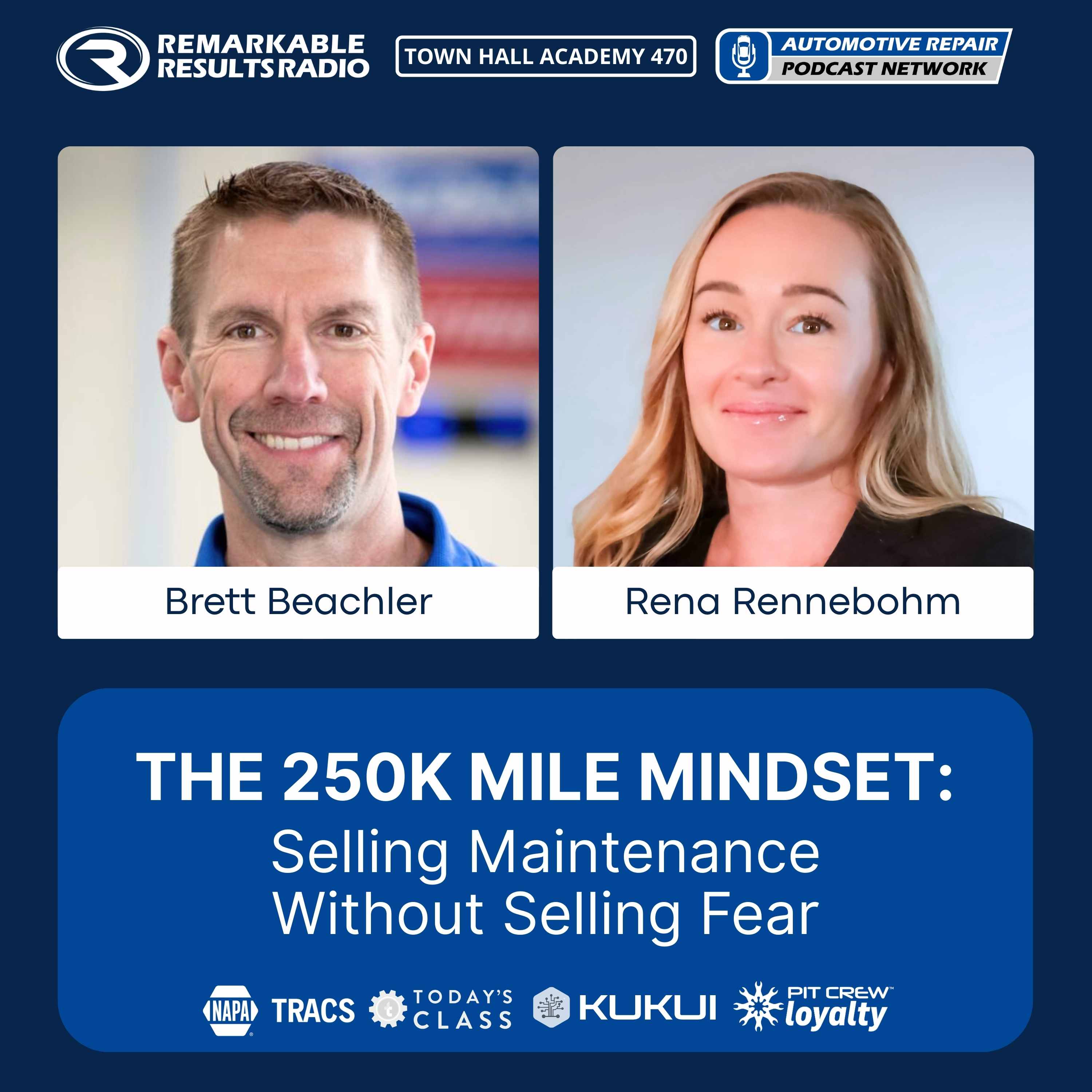
Exploring the 250K mile mindset, this episode features shop owners Brett Beechler and Rena Renebaum discussing strategies for promoting long-term vehicle maintenance without inducing fear in customers. They emphasize the importance of educating service advisors to advocate for preventative care, helping clients understand the cost per mile concept, and fostering a culture of trust. The conversation also touches on the challenges of changing mindsets in the industry, the role of service advisors as guides, and the significance of consistent communication with clients. Insights into effective follow-up practices and building customer relationships are also shared.
Thanks to our Partners, NAPA TRACS, Today's Class, KUKUI, and Pit Crew LoyaltyWatch Full Video Episode
Reaching 250,000 miles on a vehicle isn’t luck—it’s leadership.
In this episode, we explore what long-term vehicle maintenance really looks like and why today’s shops must rethink how they communicate with customers. Too often, maintenance is treated as a series of isolated repairs. This conversation reframes it as a strategic process built on education, transparency, planning, and advocacy.
In this episode, you’ll discover how to:
Shift your shop culture from reactive repairs to proactive planning
Position service advisors as educators and advocates
Use cost-per-mile analysis to demonstrate real vehicle value
Build trust through professional language and clear expectations
Align inspections with long-term ownership goals
Improve maintenance acceptance without fear-based selling
Create systems that support consistent follow-up
Key Discussion Topics
Why 250,000-mile vehicles are built through strategy, not chance
The difference between transactional service and advisory leadership
Using documentation and trends to guide decisions
Structuring pay plans to reinforce professionalism
Turning maintenance into a long-term relationship
Why This Episode Matters
When customers understand that their vehicle can realistically reach 250,000 miles with the right care, everything changes.
Trust improves. Approvals become easier. Loyalty deepens. And your shop evolves from a repair facility into a long-term partner in vehicle ownership.
This episode shows how sophisticated professionalism, consistent processes, and education-first communication can transform both customer relationships and business performance.