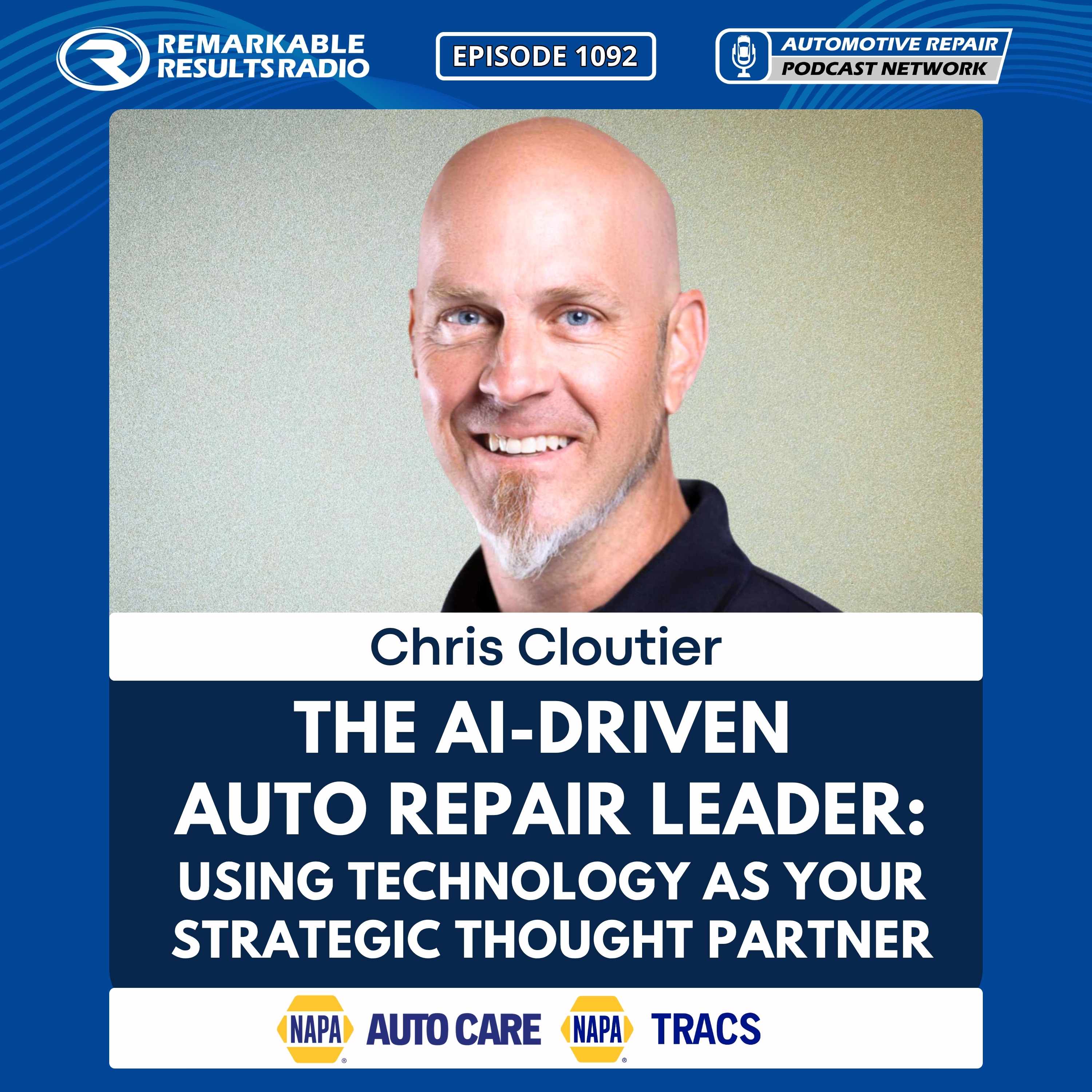
The AI-Driven Auto Repair Leader: Using Technology as Your Strategic Thought Partner [RR 1092]
About this episode
AI shows up as a strategic thought partner for auto repair leaders and beyond—helping streamline shop workflow, hiring, documentation, and customer communication. Chris Cloutier of AutoFlow discusses using algorithms to move from inbound appointments to work assignments and promise times. The hosts also cover how to prompt AI for better context, turn transcripts into structured outlines, and rewrite repair-order notes so customers understand issues. Across the conversation, “trust but verify” and quality control keep recommendations grounded.
In this forward-looking conversation, Carm Capriotto and Chris Cloutier, CEO of AutoFlow and owner of three Golden Rule Auto Care locations, explore how artificial intelligence is rapidly transforming the automotive repair industry; not as a replacement for people, but as a powerful tool that helps shop owners lead smarter, communicate better, and operate more professionally.
Chris shares firsthand experiences using AI inside both his software company and his repair shops, revealing how the technology can dramatically reduce time spent on leadership and administrative tasks while improving workflow efficiency and customer communication. From refining technician notes to helping build business plans and expansion strategies, AI is becoming what Chris describes as a 'thought partner' for today’s shop owner.
What You’ll Learn:
- Why AI should be viewed as a strategic business partner, not a threat to the automotive repair profession
- How effective prompting and providing context can dramatically improve AI-generated results
- Ways AI can streamline major business tasks such as SBA loan preparation, SWOT analyses, and growth planning
- How AI-powered technician note rewrites improve customer communication and strengthen professionalism
- Why clear, polished communication acts as a “curtain of professionalism” that builds customer trust
- How AI can help bridge language barriers by translating repair orders and inspection results
- The risks and humor of “AI versus AI” hiring practices, where both employers and applicants rely heavily on artificial intelligence
- Why Chris believes today is the least expensive AI will ever be, and why shop owners should begin learning it now
The biggest takeaway from this episode is simple: AI will not replace highly skilled automotive professionals, but it will absolutely enhance the shops that learn how to use it effectively. From improving efficiency and communication to elevating the image of professionalism, AI offers tremendous advantages for modern repair businesses. However, Carm and Chris emphasize one critical principle throughout the conversation: trust, but verify. Just like quality control in the service bays, AI-generated information should always be reviewed carefully before being shared with customers or used to make important business decisions.
Chris Cloutier, Golden Rule Auto Care, and CEO of Autoflow. Listen to Chris' other episodes HERE
Thanks to our Partners, NAPA Auto Care and NAPA TRACS
Learn more about NAPA Auto Care and the benefits of being part of the NAPA family by visiting https://www.napaonline.com/en/auto-care
NAPA TRACS will move your shop into the SMS fast lane with onsite training and six days a week of support and local representation. Find NAPA TRACS on the Web at http://napatracs.com/
Connect with the Podcast:
Visit the Website: https://remarkableresults.biz/
Subscribe on YouTube: https://www.youtube.com/carmcapriotto
Follow on Facebook: https://www.facebook.com/RemarkableResultsRadioPodcast/
Follow on LinkedIn: https://www.linkedin.com/in/carmcapriotto/ Follow on Instagram: https://www.instagram.com/remarkableresultsradiopodcast/ Join Our Virtual Toastmasters Club: https://remarkableresults.biz/toastmasters Join Our Private Facebook Community: https://www.facebook.com/groups/1734687266778976 Join our Insider List: https://remarkableresults.biz/insider All books mentioned on our podcasts: https://remarkableresults.biz/books Our Classroom page for personal or team learning: https://remarkableresults.biz/classroom Special episode collections: https://remarkableresults.biz/collections Buy Me a Coffee: https://www.buymeacoffee.com/carm The Automotive Repair Podcast Network: https://automotiverepairpodcastnetwork.com/ Remarkable Results Radio Podcast with Carm Capriotto: Advancing the Aftermarket by Facilitating Wisdom Through Story Telling and Open Discussion. https://remarkableresults.biz/ Diagnosing the Aftermarket A to Z with Matt Fanslow: From Diagnostics to Metallica and Mental Health, Matt Fanslow is Lifting the Hood on Life. https://mattfanslow.captivate.fm/ Business by the Numbers with Hunt Demarest: Understand the Numbers of Your Business with CPA Hunt Demarest. https://huntdemarest.captivate.fm/ The Auto Repair Marketing Podcast with Kim and Brian Walker: Marketing Experts Brian & Kim Walker Work with Shop Owners to Take it to the Next Level. https://autorepairmarketing.captivate.fm/ The Weekly Blitz with Chris Cotton: Weekly Inspiration with Business Coach Chris Cotton from AutoFix - Auto Shop Coaching. https://chriscotton.captivate.fm/ Speak Up! Effective Communication with Craig O'Neill: Develop Interpersonal and Professional Communication Skills when Speaking to Audiences of Any Size.service advisor
"And what technicians, I have not seen this yet, service advisors and those resumes that we do feed into the machines to say, hey, let's look at some of their qualifications,"
A service advisor is the person at the repair shop who talks with you about the problem, writes up the job, and keeps things moving with the mechanic. They help turn your description into a clear repair request.
A service advisor is the customer-facing role at an auto repair shop who interviews the vehicle owner, writes up the work order, and coordinates with the technicians. They’re often the “translator” between what the customer reports and what the technician diagnoses.
background checks
"If you got a Facebook or, you know, I know there's some legalities around, you know, you're not supposed to do some of this stuff. But, you know, I think that allowing it to kind of go and do some background checks for you is okay."
Background checks are ways to verify information about someone before you trust them for a job. The speaker is saying AI can help do some of that research, but you have to handle it legally and with proper notice.
Background checks are a screening process to verify information about a person (for example, employment history or other records). In this context, the host is discussing using AI-driven research to flag concerns during hiring or resume review, while noting legal/consent considerations.
RO descriptions
"So at your stores, Chris, are you saying to your service advisors, whatever you call them, client advocates, to use AI to improve RO descriptions and for your guys in the back"
“RO” usually means repair order. The RO description is the written explanation of what the customer says is wrong and what the shop plans to do, so the mechanic has the right info.
“RO” typically means repair order, and the description is the written summary of the customer concern and the shop’s planned work. Clear RO descriptions help technicians diagnose faster and reduce misunderstandings about what needs to be fixed.
AI technician rewrite notes
"Yeah. So a practical sense was auto flow back a year and a half ago, we launched AI technician rewrite notes. Where is exactly that? And Karma, I wrote this,"
This is AI used to rewrite the mechanic’s notes in plain, clearer language for the customer. Instead of confusing wording, it helps explain what’s wrong and what can be done.
“AI technician rewrite notes” refers to using AI to rephrase or improve the technician’s written notes before they’re shown to the customer. The goal is to make the explanation clearer—e.g., stating what’s leaking, why it’s happening, and what remedies are available.
hose leak
"so-and-so, he likes to use the word sipping whenever there's a hose leak instead of seeping, he puts sippi ng versus sepa, which is a simple mistake."
A hose leak means a hose in the car is letting fluid escape. The point here is that the shop should describe it clearly so the customer understands what’s happening.
A hose leak is when fluid escapes from a rubber or reinforced hose in the vehicle’s cooling, vacuum, or other fluid systems. The speaker’s example contrasts confusing wording (“sipping”) with clearer phrasing (“leaking”) so customers understand the issue.
tokenized data
"it's all based off tokenized data and right now we're getting in at the ground floor"
It means the AI turns words and text into smaller chunks it can understand. If the chunks are good and relevant, the AI’s answers tend to be better.
“Tokenized data” means text is broken into smaller pieces (tokens) so an AI model can process it. The model learns patterns from those tokens, which is why the quality of the input data affects the quality of the AI’s output.
AI rewrite everything
"in autoflow we're about to launch AI rewrite everything so that's from any time there's any type of writing back to the customer"
They’re talking about using AI to automatically rewrite messages customers receive. Instead of sounding like a template, the goal is for updates to sound more natural and personal.
This refers to using AI to automatically rewrite customer-facing text. In an auto repair context, that typically means generating clearer, more natural messages for updates like check-in, inspection progress, and work status.
prompting
"we've improved our prompting and all this right because what we've noticed is yeah why go one place to generate"
Prompting is the instructions you give the AI so it knows what to write. If you phrase the instructions well, the AI tends to produce better results.
“Prompting” is how you instruct an AI model—by giving it a specific input or set of instructions—to get the kind of output you want. Better prompting can improve tone, accuracy, and consistency of customer communications.
customer communication
"any type of customer communication whether it be the workflow message carm it's the same thing every time right"
They’re talking about the messages a repair shop sends customers during the process. The idea is to make those updates feel more personal instead of using the same canned wording every time.
“Customer communication” here is the automated messaging flow between an auto repair shop and the vehicle owner. The speaker describes using AI to make those messages more personalized and less scripted by leveraging data about the customer and the vehicle’s status.
unscripting those
"they're scripted we could do so much more with unscripting those and making it very seem very natural"
They want to stop using the same fixed template replies. Instead, AI should help write responses that fit what’s happening with your car so it sounds more human.
“Unscripting” means reducing rigid template-based responses and replacing them with AI-generated text that can vary by situation. The goal is to sound more natural while still reflecting the correct vehicle/work context.
inspection
"because we understand the inspection is not necessarily a good thing it's so [1767.5s] yes dvi is a good thing but carm when you have 20 items you got to go look at and you got to go [1773.0s] through all these different sections and you don't really understand it gets confusing"
In an auto repair context, an inspection is the shop’s process of checking a vehicle to identify issues and determine what work is needed. The hosts are pointing out that an inspection report can be overwhelming when it lists many items without a clear, prioritized summary.
natural language way of communicating
"what your service advisor does but in a more natural language way of communicating [1784.1s] with the customer I just love what you said"
This means describing what the car needs in normal, easy-to-understand language. Instead of a confusing list, it’s meant to be clearer about what’s important and what can wait.
“Natural language” communication means explaining repair findings in everyday wording rather than technical jargon or raw lists. The goal is to make inspection results easier for customers to understand, prioritize, and act on.
perceived value
"if that can be stronger to this client then the perceived value coming back is professionalism [1832.9s] that's it carm we have great people in our shops"
Perceived value is how “worth it” the customer feels the service is. Even if the work is the same, better explanations and professionalism can make customers feel more confident and satisfied.
Perceived value is how valuable a customer feels the service is, based on experience and presentation—not just the underlying work. In this episode, they connect clearer, more professional communication (including wording and summaries) to higher perceived value.
AI
"you always say this you know you said it before AI is that man this is just not [1866.7s] going away it's only going to improve it's only going to get better this is the worst it's ever [1872.5s] going to be which means that wow if this is the worst what we have is going to be amazing I'm"
AI is computer software that can help with tasks like writing and summarizing information. Here, they’re saying AI can help shops explain car inspection results more clearly to customers.
AI (artificial intelligence) refers to software that can generate or assist with text and decisions based on patterns in data. In this episode, they’re discussing AI as a tool to improve how repair findings are summarized and communicated to customers.
TSB
"in the shop your specialists in the bays are they using AI maybe to punch in look for a TSB [2237.3s] or a code or anything we have used the chat GPT in some of the AM models to see and try and go down [2244.0s] diagnostic trees to see what's going on"
A TSB is a manufacturer’s “here’s how to fix this known problem” document. Shops use it to make sure they’re following the right troubleshooting steps for a specific issue.
TSB stands for Technical Service Bulletin. It’s an official manufacturer notice that describes known issues and the recommended diagnostic or repair steps for specific vehicle problems.
chat GPT
"or a code or anything we have used the chat GPT in some of the AM models to see and try and go down [2244.0s] diagnostic trees to see what's going on I'm not going to promote any tools there's some on the [2248.8s] market that are starting to rise and pop and then it goes to okay how well of their is their data [2254.8s] trained right"
ChatGPT is an AI chatbot. In a repair shop, people use it to help think through troubleshooting steps—like asking for the next thing to check based on what you already know.
ChatGPT is a generative AI tool that can produce text-based answers and reasoning prompts. In an auto-repair context, it’s being used to help interpret information and suggest next diagnostic steps (for example, by working through troubleshooting logic).
diagnostic trees
"we have used the chat GPT in some of the AM models to see and try and go down [2244.0s] diagnostic trees to see what's going on I'm not going to promote any tools there's some on the [2248.8s] market that are starting to rise and pop"
Think of diagnostic trees like a decision guide. You check one thing, and depending on the result you move to the next check until you find the cause.
A diagnostic tree is a structured troubleshooting flow that branches based on test results (symptoms, codes, measurements). It helps technicians narrow down causes step-by-step instead of guessing.
LMS
"okay how well of their is their data [2254.8s] trained right so you have these large LMS these smaller LMS we're not going to get the technical [2258.9s] details but like some of the bigger ones your chat GPTs and your quads like they're not bad"
Here, LMS means AI language systems. The idea is that some are trained on more information than others, which affects how well they can help with troubleshooting questions.
In this context, LMS refers to large language models—AI systems trained on lots of text to understand and generate language. The speaker contrasts larger models with smaller ones and discusses how “trained” the data is for diagnostic usefulness.
repair data
"there are some in the industry they're now [2273.1s] trying to train models specifically with repair data so say take this data set leverage it with [2278.1s] this data set and let's get more specific"
Repair data is the history of what mechanics saw and how they fixed it. If AI learns from that kind of real repair record, it can give better troubleshooting suggestions.
“Repair data” is the real-world information collected from past diagnostics and fixes—what failed, what was measured, and what ultimately worked. The speaker’s point is that training AI on repair-specific datasets can make it more accurate for shop use than generic training alone.
front counter
"more and more Karm I mean in [2282.9s] the future what is our front counter going to look like will there be one person at the front [2287.3s] counter and two texts in the back of the shop and that's all you're going to need right because [2291.3s] your phones are going to be answered by an assistant"
The front counter is the shop’s customer-facing intake area where service requests are handled and communication is coordinated. The speaker is describing a future workflow where an AI assistant handles phone calls and outbound communication, reducing the number of people needed at the counter.
Request an Explanation
Heard something you'd like explained? We'll add it to this episode.
Sign in to request explanations for terms you heard.
Want to learn more?
Browse our glossary for plain-English explanations of automotive terms, jargon, and concepts.
Help improve this episode
See something that's not quite right? Our annotations are AI-generated and can sometimes miss the mark. Click the flag icon on any annotation to suggest a correction.