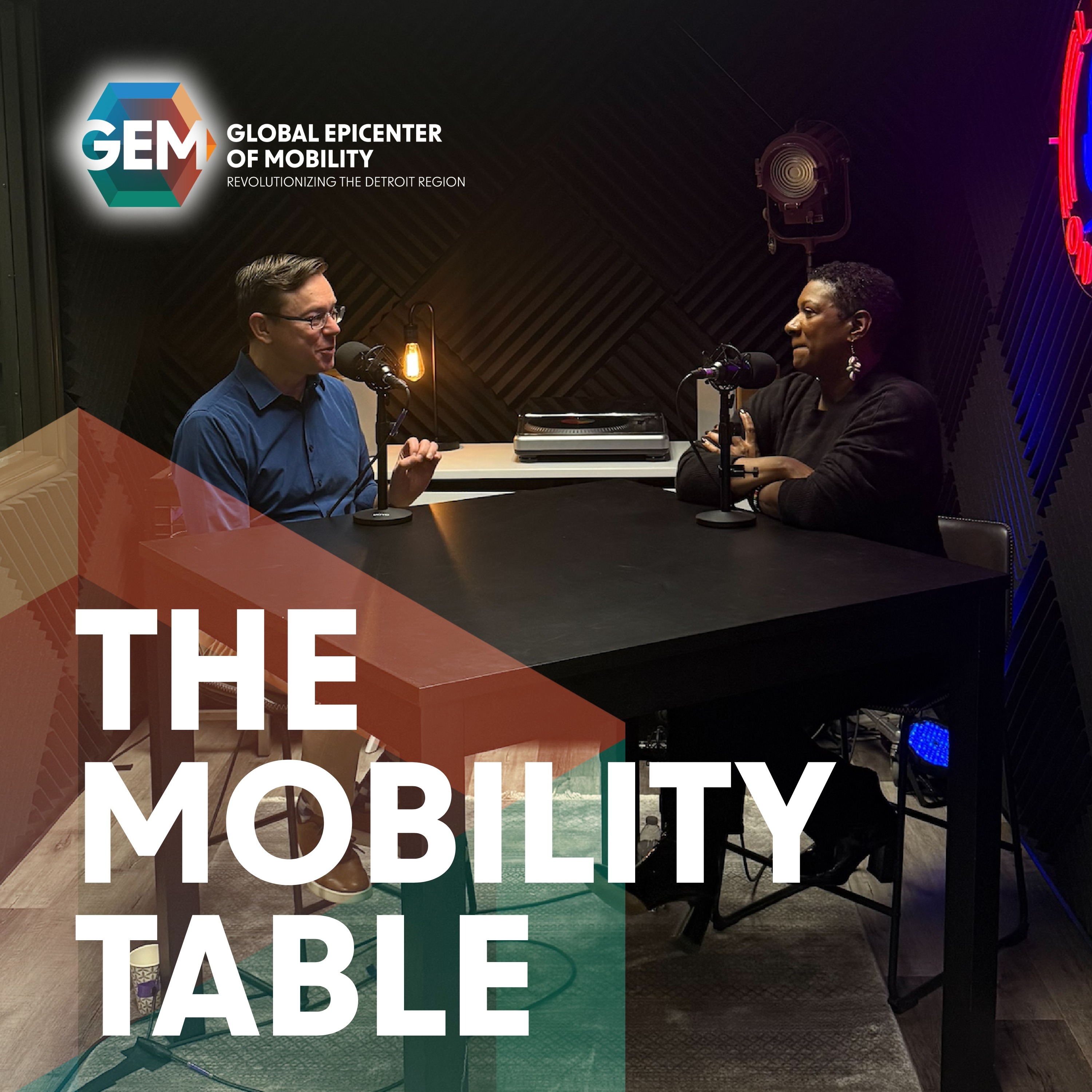
The Broader Application of Mobility Technologies with Josh Bitterman, Co-Founder and Strategic Advisor for IonDynamics Energy
The Mobility Table
The Broader Application of Mobility Technologies with Josh Bitterman, Co-Founder and Strategic Advisor for IonDynamics EnergyThe Mobility Table · Jun 30, 2026
A Michigan-based company that builds mobile, battery-powered robots to charge electric cars wherever they are parked, instead of installing permanent charging stations.
A super-fast way to charge electric cars. Instead of taking hours like a home charger, it can fill up a car's battery in under an hour by pumping electricity directly into it.
Electric flying vehicles that can take off and land straight up and down, like a helicopter, but run on batteries.
LIVE
Hello and welcome to the Mobility Table, powered by Gem.
I'm Bernard Swicky, VP of Mobility and Research at the Detroit Regional Partnership and the Global
Epicenter of Mobility, and I'm joined by my co-host, Janine.
Hey, I'm Janine Gantt, the Mobility Engagement Officer for the Global Epicenter of Mobility,
and we are happy to be back again talking about all things advanced mobility, clean energy,
electrification at this Mobility Table housed right here in the Detroit region.
So Bernard, I am excited to kind of look at how we move beyond just EVs and other types of mobility.
Correct. I think today's episode really gets into some of the benefits of perfecting technology
that maybe was originally meant for more traditional mobility replacement purposes,
and then you see what we can do with it when it becomes truly portable.
And we're talking about electricity, which means grid implications.
It means clean power in places where maybe something internal combustion powered could be problematic for any number of reasons.
But I think Janine, having these conversations at all is an indication of these technologies reaching a greater level of maturity,
where we're incorporating them into more parts of life.
I agree, and I think people are being smarter, too.
You know, one of the things that you and I talked about was this idea of mobility.
So when you think about the infrastructure, we often think about charging stations and things like that being very stationary.
I remember, I think I was in Washington, D.C., and I actually saw a van that pulled up and parked right alongside a car,
and they were their electric charger, right?
So these folks would get out and they'd actually plug in to someone's car that's on the street.
So I think we have to think about different ways that people can access these kinds of new technologies.
No, this is a technology for which you can't just run to the local gas station with your gas can when you run out of electricity
in an emergency situation, but also having something that is portable and powerful,
that just opens new doors for non-traditional deployment.
Everything from emergencies to different kinds of mobility, you can now get things out close to the water
without building the infrastructure that you'd necessarily need to get that in a traditional sense.
You don't have to run an extension cord or some sort of gas access.
And I think that is a very cool benefit of being farther along in the process.
We weren't having these conversations in the early days of electrification.
No, we certainly weren't. In fact, you said something about the last mile.
This conversation we're going to have today is really focused on the last mile in some ways.
And I think this conversation is also reflective of the fact that as we electrify mobility,
we're sharing a grid that isn't just for mobility.
Originally, it was built for homes and businesses and so on, and now we're also adding vehicles to it.
At the same time, we're adding data centers and other things that are going to be challenging this grid
in ways that we didn't conceive when we first built it.
Absolutely. I think that the infrastructure is a big conversation right now.
And some of the partners that we're seeing at the table are the utilities, right?
And those conversations that are happening right alongside our global epicenter mobility conversations.
We're talking about innovations and technologies, but there's also a conversation about the grid and the infrastructure
and what does that look like? What kind of upgrades do we need to have to make things accessible for people?
I've always been really concerned about, if you think about solutions that are needed for urban areas,
are really different than solutions that might be needed for rural areas, right?
Yes, 100%.
I think we've gotten really smart with how we're putting those kind of solutions together.
Yeah, and as we think about future power needs, the topic has always been addressed at
what grid do we need for a peak load, right?
And so we are building towards peaks that only materialize sometimes, right?
So if we can sort of smooth out some of those valleys, take peak electricity, store it for times
when there isn't necessarily the demand that we need, that has huge implications just throughout the economy.
And there are people doing some really interesting things here in our region, and I'm excited to talk to ION Dynamics.
I also had a conversation with a founder called from Thermalverse,
and they're actually looking at how they can put these kind of tile structures inside HVAC systems
to be able to pull this residual power from that that can then turn around and be used for charging vehicles.
So I think people are being very creative with how we take care of the grid that we currently have,
kind of recycle, but at the same time build out what might be new and needed for what's coming.
Yeah, and with the engineering expertise, the product development that we have here in the Detroit region,
we have the basis for these companies to start here and then hopefully branch out globally if we can,
but I'm really excited for this conversation here today.
Yeah, and I love that you said that, Bernard, branch out globally.
Things start here and then they emanate out, right?
So yeah, I'm looking forward to talking to Josh Bitterman from ION Dynamics.
In fact, let's bring him on now.
Let's do it.
Josh, welcome to the mobility table. We are happy to have you here with us today.
It's great to be here. Thank you for having me.
You know, we always like to spotlight companies that have received support from the Global Epicenter Mobility.
Tell us a little bit about how you got involved with this industry.
So after graduating from University of Michigan, I was paired up with a gentleman that I did a tech consulting project for as part of my education.
And what fascinated me in industry is just the growth in AI, robotics and energy.
And for this particular company, ION Dynamics, which is an energy mobility company,
we're touching all three of those things and helping to solve a real global challenge.
So that was what was so exciting to me.
I love it. So tell us a little bit about ION Dynamics and kind of what you're solving for.
Yeah, so ION Dynamics Energy, we're an energy mobility company.
We're headquartered right here in Novi, Michigan.
Probably the biggest challenge that we're helping to solve is the infrastructure challenge.
I heard you all talking about the growing energy demand and needs and what the future grid system is going to look like.
And so we're offering flexibility, efficiency and resiliency through mobile energy technology that doesn't require really expensive and longer lead times for laying infrastructure needed.
Yeah, and I find, Josh, when we talk about these things, people often refer to the grid.
But what I have found is there is no the grid, right?
It's many, many grids working together and they have very different strengths, very different levels of capability.
And I could see how depending on need, certain places will probably have a much more urgent need for this kind of support.
Yeah, no, it makes sense. I think right now, last year, we saw peak demand on the national grid system, so to speak, about 760 gigawatts with data centers taking about 4% of that.
We're anticipating that that's going to grow to somewhere between 10 and 12%.
That's roughly the equivalent of a regional grid system of extra demand on the system within the next five years.
And so you're going to see massive growth in baseload production, battery storage, and that's the space that we're playing in.
Right, so Ion Dynamics, what do you do? How is it that you actually address this issue that we're talking about?
Yeah, so we brought to market a unique product called Flashbot.
It's actually a suite of equipment that works together to provide different use case capability.
But Flashbot in a nutshell is a mobile DC fast charging robot.
Right, it's on wheels and it can move from place to place.
Exactly, and so unlike fixed charging infrastructure that can only do one thing that has to occupy specific space, it's flexible, it's mobile, it can be deployed on demand.
We have autonomous driving capabilities if you think about a consumer being able to pull into a parking lot and rather than circling, trying to find one EV specific spot,
they can park where they want and use an app to deploy the robot to come to be able to charge their vehicle or a fleet operator or manager can remotely deploy energy to where it's needed.
So we're bringing energy to the asset as opposed to the other way around and we see efficiency in operations, we see efficiency in planning,
but we're also able to really help speed up deployment.
We often see fixed DC fast charging installations that'll cost here in the U.S. $150,000 per station and a lot of that is really the expense of the infrastructure work.
Is that even really the equipment?
And typically because of delays with permitting and planning and conduit laying and transformers, you might see 8 to 12, 18 months go by before that happens.
We're able to deploy in days that charging capability.
So if I'm not mistaken, you did some testing with some of the GEM assets, right?
So Detroit Smart Parking Lab, I believe, I think you were doing some work at the airport as well.
We did.
GEM has been fantastic as well as OFME and that to me has been one of the greatest things is to see the level of support that GEM and OFME, the state MEDC are providing to support this innovation ecosystem that's developing and burgeoning here in Detroit.
And so our first pilot happened at the Detroit Smart Parking Lab downtown and that turned into another deployment at the Gerald Ford International Airport in Grand Rapids.
And what was great about that was not only proof of concept testing, but the visibility that it gave to us as a young company.
And I can tell you a number of real world customer deployments that came as a result of grant funding that we were able to utilize for those pilot tests.
I love that.
So when does it become more about scaling versus the innovation, the coordination of partners like you're talking about versus the innovation itself?
I mean, you all have been moving pretty quickly.
We have.
And that's the stage we're at now is trying to scale, but scale smartly.
A lot of businesses, I think, can just jump at any opportunity and they're not strategic in their thinking.
And all of a sudden you can be operationally strained.
You can create complexities that you're not yet able to meet.
So we have to be careful about how we do that.
And we're thrilled to be here in Detroit operating in this innovation ecosystem.
We see it as a really good base of operations and consumer activity for us to start growing and scaling smartly here so that we can branch out across the country.
Similarly, we've plotted another operation over in Europe.
We've established a joint venture with a team that is handling business development and operations of our tech there.
But yeah, this has been a great jumping off point for us.
And as we look towards things like eventually, you know, manufacturing and whatnot happening here in Michigan, we see nothing but opportunity with the workforce, the innovation mindset and the collaborative approach that's going on.
And Josh, we've talked a lot at this table about automotive serving as kind of a jumping off point for Detroit region businesses into other mobility sectors, be that aviation maritime, you name it.
But your product can also go beyond that.
You know, literally everything in the world just about seems to use electricity.
And so you talked about, you know, remote installations, places where there can be a situation, you know, whether it's an emergency situation, a film shoot, you name it, where, you know, this mobility solution can serve a fantastic role in non-mobility applications.
And I really see that as a sign of maybe a greater maturity on the part of this industry, but also what happens when you really sort of try and open those doors.
So for our viewers and listeners, can you talk a little bit about some of the non-mobility related benefits that you can realize by a solution like yours?
Yeah, absolutely.
And I talked a little bit about EV charging, but we love opportunities for multi-use case scenarios.
Our equipment can dub as a generator as well and an energy storage, a robust energy storage piece of equipment.
And we're doing a number of things from film production sets.
We're working closely with Netflix and HBO over in Europe right now as they have company-wide mandates to get rid of gas-powered generators.
And you can think about why the noise, of course, the pollution, et cetera, on production sets.
Doing a lot of work in that industry, if you find a site, you know, you talked about maritime applications, our ports that have infrastructure constrained areas of the port site,
we can use our FlashBot system to move mobile power, you know, up to 480-volt three-phase power, you know, to a site where it might cost hundreds of thousands of dollars to lay conduit to enable that type of grid connection.
So the flexibility is a huge benefit to our tech.
And I think when you look at, like, a fixed charger, like a fixed EV charger, it does one thing, and it's buried in the ground, and that's all that it can do.
When you have opportunities to use our technology to provide remote power to charge EVs, to do multi-vehicle charging, and we can flexibly move it around,
you think about the asset utilization and the return on investment compared to, you know, a fixed charger, again, that's just sitting in the ground doing one thing.
Those are the things that really excite us.
Well, and I really love the idea that, you know, I think a lot of folks have been frustrated around EVs, and they feel like they're stuck.
But it sounds to me like you all are saying, let's think outside the box.
Like, let's think outside of what we thought we were going to do and look at some additional opportunities.
I mean, I've heard that they're going to have electric taxis on the water in Detroit, right?
And so it sounds like there's an opportunity there as well.
I've seen some other founders who are looking at more than just the road.
We've talked about the air, but water is a whole other opportunity for folks as well.
Yeah, it is. You're absolutely right.
And we're very excited about a forthcoming deployment that's been funded by the DTE Emerging Tech grant that's out there.
And we're going to be deploying our equipment at the Gross Seal Airport, which is an old Navy site that's getting rehabilitated,
reinvigorated with advanced innovation technology.
And when they pose the question to us, they've got a long runway that goes out to the river and there's a seawall down there.
There's a little bit of a rocky path to get down to the seawall.
The thought of laying conduit and what that cost would be, very cost prohibitive, very challenging.
And so the call came into us, hey, would your robots be able to traverse the runway, go over this path and get down to our seawall?
And so we're like, let's try it.
So we brought our robots down and we're able to demonstrate that.
And that opened their minds to the possibility of what a solution like ours can do.
And we now have a forthcoming deployment where we are going to be providing EV charging for restaurant customers and airport partners.
We will also be able to supply charging for EV toll and other advanced mobility solutions.
But as the need arises for things like maritime applications, law enforcement, water taxis,
they now have the ability to move a DC fast charger all the way down to the water without much cost.
I feel like you're opening up the opportunities for others as well because Gross Seal is a perfect example of an asset that we have in our region
that may not have initially thought that they could be a part of this advanced mobility space.
And you have brought in a new opportunity.
So I see that with a lot of our innovations.
They're bringing in new ideas and new possibilities for folks that didn't really think that they were a part of this.
So thank you for that, right?
Because I think that's how our region continues to grow and can really begin to see this as a viable industry here in Detroit.
Yeah, and thank you for that.
I mean, again, the collaborative environment, the support coming from JEM, from OFME, the state, it's been fantastic.
And I don't think it'd be possible without all of us working together.
Right, because we talk about we have this mobility ecosystem in the Detroit region,
but then we talk about the ecosystem behind the ecosystem, right?
The enablers that actually make the enabling happen.
And if you could talk a little bit about, Josh, your experience with OFME and sort of that JEM environment.
Can you give us an idea?
OFME means the Office of Future Mobility Electrification.
We're trying not to do that.
Yes, of course.
Good catch. Thank you very much for that, Jeanine.
And they are running, are proving and testing Pillar at JEM.
And so it's great to see, one, JEM living up to its vision of supporting these mobility solutions.
But it's also a great example of non-mobility applications of those things down the road.
But Josh, if you could just tell us a little bit about, okay, so what support did you receive?
What is it that it helped you do?
Yeah, absolutely.
We received a couple of early innovation grants and we were part of an autonomous mobility solution set that was deployed at the Detroit Smart Parking Lab.
Without that funding, because of the stage that we were in, we would not have been able to fund the deployment of our equipment, all the personnel testing that needed to be done on site, staffing for events.
So it was really crucial at that stage for us to have some resources to make that a reality.
And as I mentioned to you all, not only proof of concept and the testing that we were able to do, which was fantastic.
It was also all the showcase events that came as a result of that that started to broaden our network and started to create real world customer deployment opportunities.
The DSPL Detroit Smart Parking Lab deployment was a springboard for our ability to do another similar grant funded project with the Gerald R Ford Airport and the flight program out there to demonstrate our ability to deploy EV charging in two hours.
That was our task there.
And both of those have funneled us into automotive applications, fleet applications, government applications, aviation opportunities that would not have otherwise been possible.
Maybe we could have gotten there.
I think it would have just been a lot harder of a slog for us without the resources that you all provided in order to get us jump started.
So, you know, you all, again, as I mentioned, have been moving quickly.
I mean, it's fantastic.
What would meaningful progress look like for not just your organization or your company, but for the region and this innovation ecosystem?
It's a great question.
Of course, the easy answer for us is more sales.
But I think with where we're at, my assessment and I had a business development and marketing for our organization as one of the co-founders.
I think that in the innovation, tech, you know, and even certain fleet aspects, automotive, they get it, you know, they get it in terms of this is the future and how do we get there.
Outside of that, I still think my experience in talking even with commercial property owners and property managers that could utilize our technology.
I can share with you that by and large, there's a broad consensus that we get it.
This is the future.
We don't fully understand it.
I think where they're a little bit stuck is what is the right time?
What's the right equipment?
What's the right investment?
So I think there's a bit of an education hurdle that we need to help people clear.
And I think that that's where this collaborative spirit amongst the innovators, you know, and JEM and the Office of Future Mobility Electrification,
I think it's an opportunity for government and private companies to come together and collaborate on this.
And I think we're doing the right things, but I think we need to clear that education hurdle to get wider spread adoption.
I think you're right.
Yeah, I think there's just a lot of uncertainty for folks.
Yes.
You know, because you hear certain things in the news, you're not sure.
So how much do I, as a perfect example, urban solutions where you've got people living in multi-family homes or condos or whatever,
do I really invest in the infrastructure?
Do I do that now?
Do I bring in a technology like yours now?
Or do I wait?
Yeah.
So, you know, I think we're just not sure, and that might be a little bit of the educational piece.
I appreciate that OFME is continuing to build out the grid.
They're continuing to build out the infrastructure because it's needed.
I talked to a guy yesterday that has this amazing new EV truck.
I was like, that's beautiful.
Is that used?
He was like, no, it's brand new.
So I mean, folks are still buying, but I do think that the educational piece is critical.
It's still really important across the board.
I couldn't agree more.
And you are seeing folks buying, especially with gas, you know, over $5 a gallon right now.
That demand is starting to naturally pick back up.
And I think as the technology gets better and people see that the innovation and the new technology is coming that will make this easier,
you're going to see greener adoption.
One of the larger automotive OEMs that we work with to help solve some operational challenges and then marketing and PR challenges with,
you know, remote site events, interestingly enough, their PR folks have talked to us that they said,
we love including your technology in events like this because it starts to demonstrate to the end consumer that the future of charging,
the future of the support that's needed for this type of vehicle, it's here and it's coming.
So it kind of helps clear that hesitancy of that.
Well, it's also back to this concept of future-proofing, right?
Because, you know, you have a solution that can be mobile.
It can be deployed in different places or in different ways.
And it's not, you know, hardware in the ground, cables, conduits and so on, which is so expensive to put in.
And then if you're not a hundred percent sure about the deployment or the demand and so on, you're stuck.
You've put it in the ground, right?
So, you know, it is also, to me, it's a sign of maturity, the fact that we now have these solutions as part of this maturing
electrified mobility system.
But it's also hedging your bets a little bit and deploying something where if it turns out the use case is different,
you can deploy it differently.
You can't do that.
You know, once you've put conduit in the ground, it's just there.
It doesn't pick up and go somewhere else where it's needed more.
Bernard, I think we should hire you for our sales team.
But it is really interesting.
And it's getting back to where the consumer is at, you know, the commercial property owner, for instance.
Why am I going to potentially spend a half a million or a million dollars to put fixed charging infrastructure in the ground
when I really don't know, is this future proof?
Is this going to be obsolete in a few years?
When I could look at something that's maybe a more comfortable entry point from a cost perspective,
I'm not doing all the permanent infrastructure upgrades.
And by the way, you know, we have a leasing model that's available.
It's where I can ensure that I'm always keeping up with the latest and greatest innovations.
And Josh, we've talked a lot about commercial applications.
But can a consumer, can an individual somehow either rent or buy or interact with your products?
They could.
From an EV charging perspective, probably too expensive.
We're more in the business.
It's B2B, B2G applications, I think, at this point make the most sense.
However, we have thought about different models.
For instance, with backup power needed for communities, for homes, right?
In developing an insurance model where rather than spending $15,000 to put a gas power generator in the ground next year at home,
and you're going to use it once a year, perhaps you engage in an insurance model
where if there's a massive power outage where you're dazed without power,
we can deploy flashbots to help, you know, serve that need.
You know, maybe it becomes more cost effective.
We've thought about applications with Airbnb where as charging demand and key markets comes up,
could we create charging oasis, you know, with our technology, you know, things like that.
Yeah, yeah, yeah.
No, you know, I think about things like my parents live in northern Michigan.
And we're starting to electrify things like snowmobiles, right?
And that's a big thing.
And those things are seasonal and they're mobile and they move around, right?
And so it just seems like a terrible fit for permanent infrastructure,
but a good fit for mobile, flexible infrastructure.
Definitely.
And we've talked a little bit about maritime, but recreational boating, too.
We've got jet skis, we've got boats coming out of the markets in northern Michigan talkably, right?
Summertime, we're using it for these applications.
Wintertime, now we've got other things that we can be powering.
That's a good idea, right?
I'm glad we came on.
This is getting more business ideas.
No, but I keep coming back to this is what's possible, but this kind of a flexible technology, you know,
and as we have these episodes of the mobility table, you know, I grew up working in mom and dad's car repair shop
and I did my whole career in automotive.
And it is impressive to me the way that now we have conversations we wouldn't have had before, right?
And this Detroit region, because of that automotive expertise, that asset base, that capability base,
we can play in this sandbox like just about nobody else.
Well, and you know, the other thing, too, is you don't have to be the one that came up with this technology.
I mean, just like what we're talking about, but is there a use case that someone could come up with
to leverage the technology that you've created that perhaps you haven't thought about?
That might be a business partnership opportunity for someone.
Again, I think those are the kind of things we need to think about.
You know, as we look at how do we build out this industry in a way that everyone can participate and get involved in.
Just put your thinking caps on.
Understand the technologies that are there.
Get yourself educated and look for that opportunity, that niche that you might be able to find yourself in.
I know we've got to wrap up.
So kind of what are you optimistic about as you think about the future and the industry?
I'm optimistic because I think that the demand and the increases in energy requirements to power data centers
and the productivity gains we're going to see as a result of that.
The market is there.
I think that's the thing that we're most excited about.
We know there's a market for the solution as part of the solution set.
It's not the solution.
It's a major part of the solution set.
I think when you take that and you understand there's a real market opportunity and need,
and then you couple it with some of the things we've already been talking about,
which is the collaborative spirit, the energy to support the gem.
I know for me and others are providing here.
It creates real opportunity for genuine success.
I don't think this is a situation where you've got a picking of winners and losers.
I think it's just the right collaboration to meet the need that the market is showing right now.
And overall, incredibly optimistic about that.
I'm a native Detroiter and to see all of this going on in Detroit is so cool to me.
So I feel like there's real energy that's palpable.
And yeah, I think we're going to see a lot of success stories come as a result of this.
I love it.
Well, thank you to ION Dynamics for continuing to put Detroit on the map globally
as the advanced mobility epicenter.
I really appreciate that.
And we thank you so much for joining us.
And we'll keep an eye out for the great things you're going to continue to do.
We appreciate you.
Thank you all for having me.
Pleasure.
Thanks so much, gosh.
So that wraps up today's episode of the mobility table.
Thanks for joining us.
We'll see you next time.
About this episode
Explore the future of mobile energy with Josh Bitterman, co-founder of IonDynamics Energy, as he discusses how portable power is reshaping EV infrastructure. Instead of forcing drivers to find stationary chargers, IonDynamics' autonomous "Flashbot" robot brings DC fast charging directly to parked vehicles. The conversation dives into the massive strain on the electrical grid, the challenges of scaling hardware, and how Detroit's innovation ecosystem is fostering global solutions. Bitterman also highlights how this mobile technology extends beyond vehicles to power emergency sites and remote events.
Josh Bitterman joined Jeannine and Bernard at The Mobility Table to discuss how mobility technologies can extend beyond their intended use and create new opportunities across industries. They explored the need for flexible solutions for infrastructure, how the Detroit Region fosters connections and creates the platform for startups and other organizations to branch out globally.
Josh Bitterman is the co-founder and strategic advisor for IonDynamics Energy. He is also the co-owner and strategic director of Goldfish Swim Schools in Kansas City. Josh has previously served as the president and certified wealth strategist at Insignia Wealth Management.