The Chevrolet Trax is a small SUV that's easy to drive and park, perfect for city life. It has enough room for passengers and their stuff, making it a good option for people who need a bit more space than a regular car.
They deliver four times better website conversions, automated
follow up and real time ROI tracking.
Get industry leading customer support with Kukui.
That's KUKUI.com.
You're probably tired of chasing new customers who never return.
We understand pit crew loyalty ends the one and done cycle, turning
first visits into lasting reliable revenue on the web at pitcrueloylety.com.
So meet my panel.
I would have never thought I would have Connor and Lisa in my studio
all at once here to talk, to do the chicken or the egg thing.
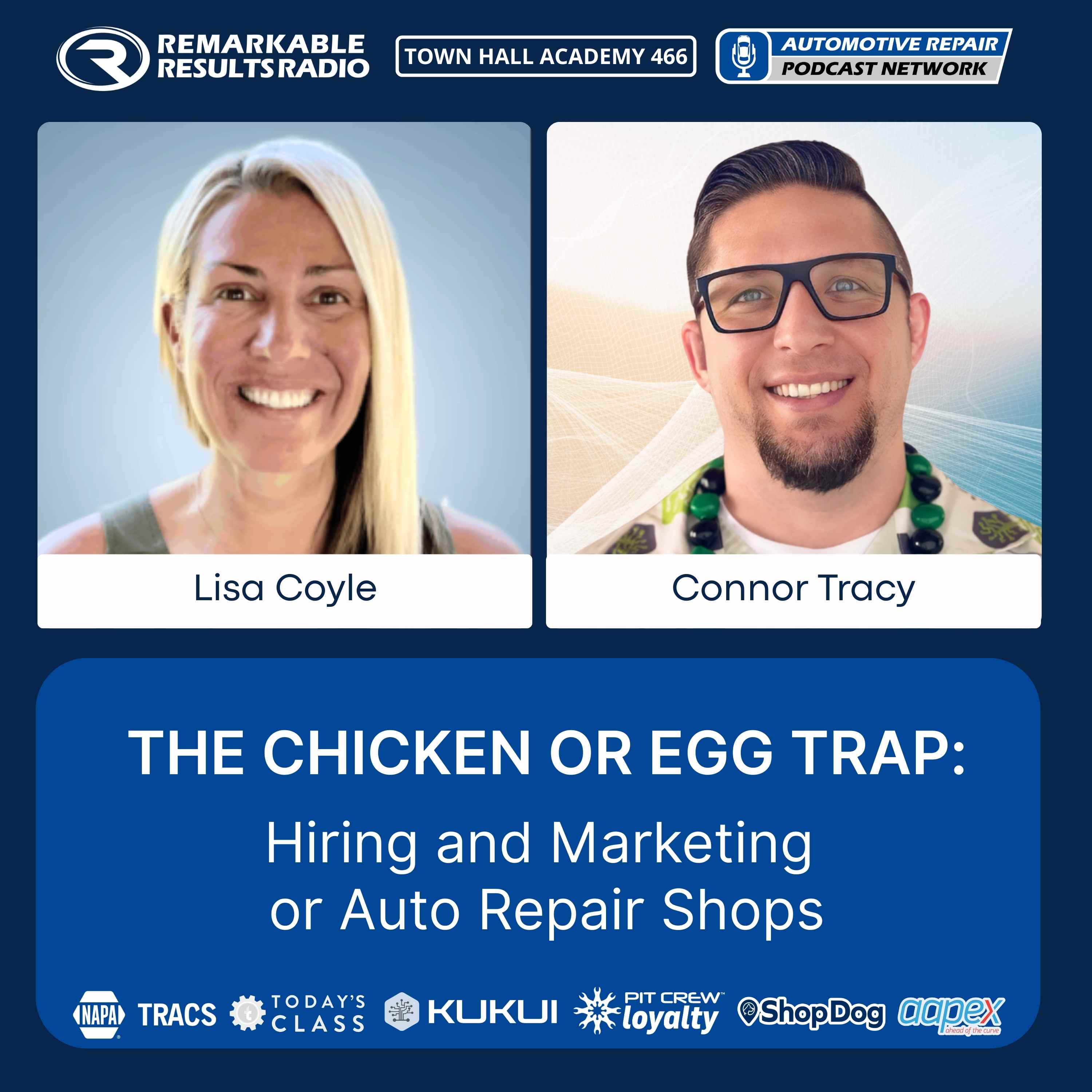
Lisa Coyle, Promotive CEO.
Great company.
Man, you guys are on fire.
It's been a lot of fun for sure.
I'll never forget when you guys started that company.
I heard about it here at Apex at a, I think 360 was maybe doing.
Somebody, somebody whispered in my ear and it boom.
And look at where it's come.
Yeah.
Amazing stuff.
Amazing stuff.
And Connor Tracy, Director of Partner Development and Product
Evangelist Kukui Corporation.
We just recently did a great episode with you.
We did.
Yeah.
And I listened to it again and I learned even more.
Good.
You know, you know, we have our own app, everyone.
Yes.
And we changed our name from the Aftermarket Radio Network to the
Automotive Repair Podcast Network.com.
Go on there.
You're going to see red boxes and download the app and have some fun with it.
But anyway, chicken or the egg.
So here it is.
I need to market, but I need a technician or as I love to call them,
specialists today.
You see me, I get a technician, then I can get more work.
Or do I need to get more work so that I can hire a technician?
And both of you, I guarantee in both what you do, you're always
faced with that dilemma.
How did we get here?
We started because in my past 360 payments and all of the Velo companies in
the shop software that I ran sales for, the number one reason that somebody
wouldn't switch their payments or switch their software outside, of course, that
they were happy where they were was, you know, Lisa, I just don't have time
right now because I'm short staffed.
I don't have my service advisor.
They're on maternity leave or I just got this large job.
So it came down to time.
So the reason that we started was because that was an objection.
It was an issue.
And Connor deals with something similar.
I'll let him speak on that, but we want to help shops not just find time, but
figure out how do you have, you know, the right balance to hire at the right
time and bring in the business for their shop too.
I mean, stop for a moment and think of how many great companies in our
industry are doing, for example, call screening and they're evaluating with
AI, the call.
Now that's something extra to help you be better, but in your particular case,
you're saying, wait a minute, you don't have time for that.
Let's take that up and off and away from you.
And I know that a whole bunch of great companies, I talked to a lot of shop
owners that just love what you do and it's promotive gopromotive.com.
Good job.
Yeah.
Go promote.
You know what?
I'm impressed.
Well, I drank some water this morning.
So my recall is just a little bit better than normal.
I have like this four hour recall.
So they call Kui and they say, listen, you got to enhance my website.
You got to help me or I got to turn this thing on and my cart count is not.
And do you ever stop and say, do you have enough people that can handle
that what we can bring you?
Well, we get that as a big objection.
You know, when we're talking about, hey, you know, in your marketplace, you know,
this is how we can grow your revenue.
And then we get this pushback like, well, I'm so busy.
I can't take on anymore.
It's like, wait a minute, like you're making too much money.
Like how that I ran shops for 20 years.
I'm sorry, but like I never made too much money.
You were a bring it on mentality.
100%.
But I was always hired.
I was always interviewing.
I always had a stack of resumes.
So I was very blessed that I tried to be forward thinking about that.
You know, I tend to push back when I'm having those conversations with shops.
It's like, well, I get that.
But like if you wait until you hire the guy, the guy or gal is going to want to be busy.
What have you done to get them busy?
And that's where Lisa and I kind of had this conversation was like, OK,
which one makes sense first?
Is it do I need the tech and then I spend the money to get the marketing?
Or but wait, like if I don't have the marketing, I can't really afford the tech.
So that's where OK, OK, I've heard both of you today.
And I'm excited to share with you what I'm thinking about throttles.
OK, and it's kind of like, do I turn on the recruitment throttle or the marketing
throttle or do I do them both or do I pull back?
And it's like, you just don't set it and forget it.
You have to manage it.
Am I thinking along the line that you both want to talk about?
Yeah, I mean, so like I said, my philosophy was that I was always hiring.
Even if I was full staff, I'm always interviewed, right?
Marketing is no different either.
Just because I'm busy doesn't mean I'm going to be.
Just because I'm staff doesn't mean I'm going to be.
The only thing you could guarantee in a shop is that it's dynamic.
So why do shop owners get stuck in this loop?
I think they have the you said complacency.
Yeah. Comfortability.
When I've got money and things are going OK, because it's fricking hard.
Come, yeah, it's just the job sucks.
You're telling people bad news all day every day.
So when there's this thing, the piece that finally is working out.
Thank God it's working out.
And then they wait, then we don't change.
And then you get kicked in the ass when things outside of our control change,
the technician moves or somebody farts on the other side of the world.
Gas goes to six bucks a gallon and car counts fall off the end of the earth.
You know, I got to come back to you because they're probably
saying confession to you or can't do this.
What about this?
You're probably hearing this perpetual loop all the time.
Do you have to sit people down and say, listen, get on the couch?
Let me be your psychologist right now.
Let me walk you through this terrible pain or pressure that you have.
And it's wrong.
We hear everything.
Usually when somebody comes to
Promotive, it's when they needed somebody yesterday.
So we're all football fans here in an honor of Joel Go-Bills.
You know, I like to say that we get put in a fourth and 20 situation
instead of a first and goal.
Way behind the stairs.
And that the shops expect us to be Jeff Bezos and have a technician
deliver on the doorstep tomorrow with Amazon Prime or Promotive Prime.
You know, could it has a little ring there?
But a lot of times they do this to themselves and not for the wrong reasons.
Right.
I think one of the things I personally love about working with shop owners
is that they have huge hearts and they want to do what's right for their people,
what's right for their family and their people's families and their customers.
And if you bring in too much marketing, then they feel like they're going to
under deliver to their customers.
And then if you bring in candidates too soon and you're always recruiting,
then they feel like their employees aren't going to be busy enough,
which of course ties in to money.
But also it's the boredom.
You know, Connor was talking earlier that they want to be busy.
These are people that want to work with their hands.
We've lost candidates who were getting paid hourly at the shops
because they weren't turning wrenches enough.
They were bored.
And I think that the shop owners are constantly trying to throttle
as you're saying this balance.
And I believe in one of my favorite books is Good Degree by Jim Collins.
And they talk about having the right people on the bus
and that you could move the seats around.
You know, I was in the back of the bus at certain parts of my life, right?
And then there's the front of the bus.
Now I'm trying to get off the bus as fast as possible.
You know, I think that you need a bus driver.
You do need a bus driver, right?
But I think that there's so many things that you can have your employees do
in the shop that will benefit the shop in the long haul.
If you do over hire in the beginning, but to Connor's point,
like if you're always marketing, it takes time for Google and Facebook
and Instagram, all these tools out there to learn the algorithms.
And by the time that you have it figured out, they change them on you.
And you can't stop doing those things.
And I'm speaking as a business owner on that stuff.
Brilliant stuff. It's not instant oatmeal.
No, either of you do.
Yeah, I can't even imagine how long it takes to cook a ribeye in your business.
Think about it.
Well, you know, if you like a super rare, like my mom, like, you know,
you know, it's a little quicker, but you imagine picking up the phone
and saying, listen, this has been going on for a while.
The ribeye is well done.
We got to move. We got to change something.
This is really like medium meat here.
It's a great analogy that sometimes things take way too long.
We're not patient enough.
And to both of your points, complacency, it's hard to do this,
get up every day and say, I got to talk to Connor, I got to talk to Lisa.
And there's so many variables.
That's the word. There's too many variables coming at us.
And here's the thing about my tribe.
And I think it's a reflection of what they have to do all day every day.
And we lose sight of that sometimes, you know, they're giving bad news
to good people all day long.
That's difficult. That's exhausting.
Right. Telling somebody that they need hundreds and thousands of dollars
worth of repair that they don't want to hear about is hard.
We're an industry of outwardly pessimistic,
but internally optimistic people is who we are. Right.
We've had to build this shell, this toughness about us
because the job is hard. It's physically demanding.
It's psychologically demanding.
But if we weren't internally optimistic,
we would have gave up and left a long time ago.
It's that optimism that keeps us death gripping
on to what pieces of success we've had
to where we don't become open to grab that next opportunity sometimes.
So I've done this this way and it's yeah, it's kind of working.
I can make it work.
OK, but if we recognize that you've looked at this and this
and this looks like it's you can see that we're going to bring results.
Here's what we've done.
Here's our process and here's how our process works.
Why wouldn't you do it?
Let's face it, your shop management system is the single most important tool
in your shop, period.
Napa Tracks was built from the ground up to make your business more profitable
and efficient.
We provide an extensive set of tools to increase and track profitability
in real time.
Napa Tracks offers the industry's best post sale support hands down
and we train your people on site, yep, on site.
And we offer remote refresher training 10 times a week
and customer support is open six days a week.
Give us a call, visit the website or join our Facebook community today to learn more.
We'll prove to you that Tracks is the single best shop management system
in the business.
Napa Tracks is always customized and tailored for you,
whether you're a one man shop or a large multi bay or multi location company.
After all, it's your shop.
So it's your choice.
Visit us on the web at Napa Tracks.
That's N-A-P-A-T-R-A-C-S dot com.
Hey, Karm here, suggesting you discover a smarter way to train your entire automotive team.
Experience powerful bite size training sessions accessible from any device
in just five minutes daily.
It's perfect for technicians, advisors and managers alike.
Today's class prepares your shop for sustained success by reinforcing crucial knowledge
plus at a competitive edge with our leader board to make learning fun
and rewarding for everyone for effective training that delivers.
Turn to today's class dot com.
Shop owners, we know you are overwhelmed with a flood of missed calls,
empty bays and disconnected marketing tools.
Cacui has spent over a decade building one integrated platform for auto repair shops,
one login, one dashboard and mobile first websites that convert four times industry average.
Smart, innovative CRM with automated follow up, 24 seven online booking and real time ROI tracking.
With 900 plus years of combined team experience,
we feel the growth of 2,200 plus shops and have influenced three billion dollars in revenue.
Stop working harder, start working smarter, get industry leading customer support
and book a demo with Cacui.
That's kukui.com.
You know, most shop owners feel trapped spending on ads while half their first time customers never come back.
It's frustrating.
It's exhausting and it's not your fault.
The industry average is 54% one and done.
We understand how discouraging that can be.
Well, pit crew loyalty changes the story.
Our clients cut that rate by up to 38% raising lifetime value by more than 50%.
Loyalty members visit nearly three times more often creating predictable revenue without extra ad spend.
Pit crew loyalty where customers stay and shops thrive on the web at pitcrewloyalty.com.
So let me pose the question to you.
When a shop owner says, I can't market because I don't have enough tax.
What do you tell them?
Give me a simple one answer that could rock the world.
My question for them is, what are you doing to get them?
Okay, the technician genie isn't going to show up on the doorstep.
How are you going to get the tech you need?
And actually, let me back up.
The first question I asked is, what kind of tech do you want?
And 100% every single time they want an ATech.
All the time, but no one knows what an A is.
Okay, that's a whole other topic, but even there.
Yes, we do need more of the ATech, the top diagnostic techs.
What we need to be growing this industry and we need to be building
this industry is your entry level production technicians.
This is a very firm.
Absolutely is what makes the money in your shop is breaks.
It's steering suspension.
It's not advanced diagnostics.
Now, this is talking about my growth.
I mean, when I started out as a technician, I started out doing breaks,
steering suspension and oil changes.
I did do diagnostics.
I grew into B and ATech at one point.
But every time I talked to a shop, they're like, yeah, you know,
I'm down to two guys, you know, what kind of tech?
And I always ask them, what kind of tech are you looking for?
Well, I need somebody who can do everything.
No, you don't.
You already have two techs that aren't getting enough diagnostic work.
And by the way, that work makes 35% gross profit, but I don't want to
bring someone in who could turn 60, 80% gross profit all day long.
But we can teach them how to do everything or be expert in a certain field.
So you prompted me to tell my story about Johnny, who came out of two year
school and, you know, mom and dad, when he was holding him at two years old,
looked down at him on their lap and said, my Johnny, my doctor, Johnny, my
lawyer, profession.
And he comes to mom and dad and says, I want to be an auto mechanic.
And they go, really, Johnny, are you sure?
Mom, remember when I, you remember I took the toaster when I was like 12 years
old, I took it apart, I put it back together and it toasted better than ever
before. I love to work with my hands.
I love to tinker with things.
I love this stuff.
Okay, send him to school interns at Karm shop.
And I loved him six months there.
And I said, listen, Johnny, when you graduate, come and see me.
Johnny graduates and comes and sees, oh, and by the way, way back two years
before he started, they went to the club, they were having dinner and their
friend says, so what's Johnny going to do for college?
And he goes, well, he's going to become an auto mechanic.
And they say, oh, that's nice.
Bless your heart.
Bless your heart.
So he comes into my shop and I says, I loved what you did.
I see you got great grades.
Let me outline a career path to your point about lifting the young people.
And I'm telling him that I want him to become a mechanical specialist, but
there's also calibration specialist, thermal management specialist, all
these great specialties that you can learn along the way and become a
well-rounded specialist in our business.
But you know, the Bay over there got the beautiful LED lights and the
marble floor and you know, Bobby over there, he's wearing the white lab coat.
He's holding a tablet.
He's got those four screens in front of him.
He doesn't get dirty most of the day.
He's troubleshooting all of this technology.
Oh, by the way, Johnny, did you know there's 150 million lines of
code and have 150 blah, blah, blah, blah, blah.
And I outlined him.
He goes home to mom and says, I got a job.
I'm working at a carves.
That's nice.
You're going to be a mechanic.
He goes, no, I'm going to become a mechanical specialist with a career
path in front of me, 80 hours of training, all this stuff.
And one day, not an A to B or C, I'm going to become a technology specialist.
Mom, did you know, dad, did you know that that is, we're in a high tech industry?
Did you know the computers that are on those vehicles?
Mom, dad, I'm in a high tech industry.
No, I'm not a mechanic.
And that's the story that we have to share to all of our clients, to all of our
parents, to all of our educators, and to your point about these young people coming
up, we're not doing it right.
We got to stop for a moment.
If I need to hire Lisa to find me people, then find the young people on your own
and build them up, not that we don't need you because we need you, but you can't
fill every position if they were all available to you right now.
We have to be a team in this.
I'm off my box.
Well, you look at, you know, how many shops are called automotive medics or they
have this doctor analogy, right?
Yeah.
Okay, let's use that analogy.
Yeah, I go to school.
I get accepted to med school.
Do I instantly just start as a brain surgeon?
No, because another 10 years you intern, you become a resident, you do the hard
work, you do the gritty work, you do that.
And then as you build the skill set, you become that the differences is our
industry is unique because most of us, like myself, came up through the ranks
and we want to hire ourself as that replacement.
I mean, and I'm sure that you hear that quite a bit is they're looking for that,
but really what they need is production.
And that's where to answer that question from earlier.
Reason why I ask them that is at the end of the day, do they need that ATEC?
Well, first off, that a diagnostic tech, if you're going to tell that guy that
he's going to be doing breaks and staring at suspension all day, he's not going
to be happy because his skill set has grown beyond that.
And he wants to be doing the advanced but from a profitability standpoint, I
need somebody that that's where their skill set lies.
So it's finding that piece.
Oh, my God, this just hit me, Lisa.
Do you ever stop and say to a shop owner who wants to hire the top guy and say,
can I help evaluate who you currently have?
Because maybe there's someone to move up.
Maybe I should bring in some beginner with maybe five years instead of 15.
So yes, we've offered to do that kind of stuff with them, but at the same time.
They need now.
Yeah, they needed someone yesterday.
And oh, my God, it's another service.
All right, now let us come in and totally evaluate your shop, get onto our
maintenance program and let's work this thing.
Yeah.
No, I mean, we definitely can do that kind of stuff.
And we're not trying to be a coaching company.
That's the last thing we want.
You need to be their thought partner.
No, there's a lot we can do.
And for the record, he's right that they want an ATEC.
That's what they'll tell you.
But they will change their mind a week later and say, actually, I need to see.
And it's because so much changes in the landscape of their business that they
may have landed a big fleet job that they didn't have two weeks ago, that they
now need a ton of oil changes done on these vehicles.
And they're operating in the moment of what they need today.
And I think it does really come into planning and looking at all the data and
what their business needs over the next three, six, nine, 12 months or so.
We get so many jobs, Carm, that we do all the work on.
And then they change your mind.
You know, actually, I want a service advisor right now.
And I don't know what it is in the month of October, November.
We have a ton of service advisor roles.
The only thing that logically makes sense to me is that they're training and
ramping somebody for spring for, you know, the upcoming time of the winter and spring.
But yeah, it's they change their minds constantly.
And they really need to look at data to see what they need.
Lisa, could you describe a shop that has learned to throttle it well on the
marketing and the technician side and the hiring side?
Yeah, I mean, I hate to say that most of the multi shop owner, they get it.
They've been around for a while on it.
A lot of shops that their past was working in other businesses, whether it
was finance or, you know, managing Chick-fil-A's or whatever the case is,
like having that business background makes a big difference.
And I tell shops all the time, stop competing with your neighbor shop and
start competing the companies that people want to go work for long term.
And when I started 360, that was the advice that I got, don't compete with
other payment companies, compete with Google, compete with Netflix,
compete with Apple, LinkedIn, et cetera.
And it was more, you know, become that employer that people want to go work for.
And in that mindset, you know, there is a always be hiring and it's we
hear that constantly.
It's a term in this industry.
I don't ever say no to somebody that fits in on my team ever.
I don't care if I don't have work for them.
I don't care if I don't have the budget.
You figure it out because the number one hardest thing in any business that
I've talked with, worked with, started, whatever the case, I consult.
I'm on advisory boards.
It's the team.
It's the people.
If you come across somebody and you want to hire them and you say, I don't
have a spot until January or February, like that.
Do not do that.
I've heard that story over and over again.
They're a fit and I'm hiring them and we're going to figure it out.
We're going to invest.
I didn't spend $30,000 to hire somebody.
Person walked in, it was a resume from a friend of a friend and boom.
No, yes.
The answer is yes.
It's like the NFL, though, going back to that.
Like how many guys are restructuring their contracts constantly to make
room for somebody else on the team to fit the salary caps and the budget and
all that stuff, because they ultimately want their team to win.
So they're willing to negotiate and renegotiate the contract.
They already agreed on to make room for the right person.
So let's talk about the website.
And to the point, you just got a brand new client, Lisa.
And one of the things before you get to a yes, let's do this together.
As you're going to go to their website, you're going to look at stuff.
And so what an individual gets a sniff that somebody shop is looking for someone.
And what I would really like to know is what two potential specialists
see first or look for on a website.
So what we really focus on in that conversation is one, making sure that
you have a good looking website.
Your brand image is positive, right?
If you have a website that looks antiquated, not recent reviews, those kinds of
things, you're being judged by nobody wants to enter a world of chaos.
From a technician standpoint, you're aligning yourself with that brand
you're going to work for.
We put the patch for that brand on their shirt for goodness things, right?
So that becomes part of their identity.
If they're going to send a selfie to their wife while they're at work,
that logo is on their chest for goodness sake, right?
So aligning themselves with that brand identity, but then also telling
the story of what we do for our employees.
There's so many things that so many shops now do.
I saw a big pivot just before COVID and it really expanded
with all these extra things that shops do for their teams.
Weekly, we close down early, we get to employee engagement.
We do a Christmas party.
We pay for your, we match your 401k.
There's so many other things, insular things that they do, the equipment
that they have, the benefits that they have, and they say nothing about it.
Put it on the damn website because you don't want, you know, we always talk
about that, the technician that you want is not the guy that comes and knocks on your door.
That guy that walks in at 3 a.m. on a Thursday because he has nothing to do
is generally not the technician you want to hire.
Why? Because if he's that damn good, he'd be working for something.
But that guy that Lisa can, you know, suss out that talent for and can bring
is different, right?
So when we have talent come to our door or we have a technician refer another tech,
where do they get the confidence that we want?
And we need to tell those things.
We actually strive with our shop, we put that on their site.
We actually have a job links portal.
So like when we work with the shop with Promotive,
we add those different job postings to the site, not just for what I'm
hiring for right now, but what I want to hire and they're listed out.
Is this an automatic link or does Lisa have to provide that to you?
We work together, so they work directly with our client service team.
So we will actually have that to their site for on their behalf.
Let me ask you, Lisa, there's a person who's a new client, a shop,
car shop. Yep.
Do you do all kinds of research before you say yes to me?
Oh, yeah, we absolutely will.
Right now we are doing everything from start to finish.
So posting the job to the offer letters with the shop's letter.
What about what about my image, my brain?
So we're doing all of it, right?
And we're telling technicians we believe in this shop.
We would work at this shop ourselves.
OK, we would tell one of our family members to go work there.
It's the number one thing that we will not bring on any shop for the record.
Like that's that's my curiosity that we work at.
And to add on to Connors on the website, something that I think is
completely overlooked in this industry is put your employees on your website.
And there we have this like fear of oh, they might get poached by somebody else.
Like to me, it exudes confidence that you believe that you're treating them
the best and that they'll never want to go somewhere else.
If you're throwing all of their information on the site and then future employees,
they don't necessarily think it right away, but it will click to them.
And they want to know who they're working with.
They can take that link of, you know, click and say, oh,
this person has 20 years experience.
I can learn from them and they can go look them up on Facebook or Instagram
or the Tik Tok, you know, whatever they're calling it.
These doing a profile is one of your social media posts.
Yes, free for you to do.
And guess what?
By the way, from a social standpoint, their wife is going to reshare it
because we're really proud of Bobby and their memos going to share it.
Like it's a free post that you can do on your social.
It's the same mindset of how many shops you talk to over the years,
Karm, that don't bring their employees to trade shows because they're afraid
that they're going to get poached or talk to somebody else that tells them,
oh, I'm making $40 an hour and they think I'm only making $30 an hour.
And there's this fear, but we're as business owners and leaders
holding people back if you don't put your people in the forefront
of everything you possibly can.
By the way, she just said a ton right there.
I talk a lot.
No, no, no, no, no, I don't mean the number of words.
I mean the heavy of the words.
If you have fear of being poached, that's you just admitting to yourself
you're not doing things the right way.
Exactly right.
My point is that the ego is getting in the way, self-confidence,
the struggle that I'm going through that I'm unwilling to want to get help
to get to get into a networking group.
I don't know, you know, I'm fording these rapids every day of my life
and I cannot afford to lose anyone to poaching.
And I find that to be such an ugly word.
I find that to be a word that is just an excuse word because I'm not profitable.
I'm not successful.
I don't have a good culture.
There's a lot of things that prevent me from being proud of my chickens
in the rooster cage or what I call it, chicken cage.
It's the same thing as like what Lisa said about being afraid of your competition.
I have that conversation in marketing.
I just talked to a shop last week and they're like,
well, what if you work with a competitor that's near me?
I said, who cares?
I said, I'm going to be really frank.
I ran shops for 20 years.
I could care less what my competition was doing.
He goes, what do you mean?
I said, I did it the best.
I said, if I know that I'm doing the right thing all the time,
I'm doing the right job.
I'm doing things well for everyone.
Why would I care what the guy down the street is doing?
Why do I care what's on his website?
I don't.
We get us that a lot too.
And for us, it's actually, we tell everybody it's better
that we have shops in your area that we work with
because we have candidates in our database.
Then they might be hiring for a B.
You might be hiring for a service advisor today.
And then it flip-flops three months from now where you need a B
and they need a service advisor and we can use that database
to go after employees that are currently working
and they're not on the job boards and all of that.
So in our case, it's actually better.
And probably in yours, you learn the different keywords
and you learn what's working and what clicks are happening
and you learn the demographic.
And for us, we create an individual marketing plan
and we're looking at SMS data anyway.
And I just look at myself, well, we're not using empirical data.
So frankly, what gets an RO for that shop
shouldn't matter for your shop.
I mean, I can't change what I do based on somebody else's business.
Just because they do a diagnostic for this,
guess what?
I'm still going to charge what I need to charge
because I do it the way I do and that's what matters.
Okay, I've been asking a few people that I know
over the last month this question.
I don't know if there's a real answer,
but I think both of you could help me nail this.
Let's kind of summarize the episode with this.
How do we find stuck technicians?
What I mean by is, let's assume that the top tier
of our industry is 20% of all these great shops
that are out there, say it's like 40,000 really top.
There's so many other ones that actually have
real calm technicians, specials, mechanics, whatever you want.
They're out there and they're languishing.
It's like, oh, they know they feel they need some education.
They want to get out.
They want to work at a professional place.
They want to have a team that supports and helps.
How do we find them?
They're everywhere.
Message board?
You see, they're everywhere, aren't they?
They are everywhere.
Yeah, I mean, they are in your old Indeed ads
that you had posted from two or three years ago
that they may have applied.
And now they're ready.
Or now they might be ready.
They're better.
Yeah, that's a great thought.
They're friends with your friends on Facebook, on Instagram.
They definitely follow all the YouTube channels
and TikTok channels that are geared towards technicians.
They are everywhere and you have to be intentional
to stay in touch with them.
It's liking their posts.
It's commenting like great idea.
It's simple stuff, but they really are everywhere.
And I'll tell you that they're stuck, Carm,
because they're afraid of making change.
They're afraid of hurting the family
that they've been working for.
Like I said, the shops who work with have hearts.
So do their employees.
They have hearts.
And I think you have to also make it very enticing
for them to want to have that conversation
and to build the trust with them.
I love what you just said.
There's a lot of heart in some of the smaller shops
that there's a dedication of the people to work there.
But yet they could be worth 30%, 40% more in income
at another place and they could blossom.
And they don't know how to get out of that emotional pullback.
And they've been, for lack of a term, screwed before.
And I think the turnover in our industry,
I will say if there's one thing I would tell every shop owner here
is do not judge a resume.
I don't think the job hopping is fair to the technician
because they get hired under circumstances
that may not be accurate.
Maybe they got hired being told
that they're going to be flagging 50, 60 hours
and then they cut their marketing and whoop,
there goes the business.
And now is that the candidate's fault
that they want to jump ship because they want it,
they need to be making a certain level of income
or is it the shop's fault
because they're not bringing in the marketing.
And there's so many variables.
But yeah, these guys are out there.
I think the biggest risk is more than that, it's engagement.
And I have a whole class where I talk about engagement,
but it's this working for me.
It's this subservience that we've had
that's prevailed the industry for so long.
This person works for me.
Where we see those techs that have been at a shop for 30 years,
they feel like they are part of that business.
They feel that they have ownership within that business.
And engagement is a massive, massive part of that.
So come work with us.
Here's what we do.
As you as, whether it's a revenue share program
or you helping the decision making in these things,
I have a whole class on engagement about how to,
because I struggled with it.
I hired amazing techs.
I hired amazing service writers
and I blew them all out the damn door
because I micromanaged everything.
Get them engaged, have them be part of the decision making.
Hey, we want you to be a leader within our business
as a technician
or we want you to be a leader within our business
as a service writer.
And here's the things that I'm going to want you to be involved in
over and above just turning a wrench.
Because if we commodify that technician to be like,
hey, you're just a guy with a toolbox with wheels
and bup, bup, bup, that same damn store
we've always fricking told,
then that's what they're going to be.
Just like you said, don't change that resume,
but that's how they were treated.
But when we engage them at a deeper level,
hey, you know what, I want you to be involved in this.
By the way, once a week, we're going to sit down
and we'll have a decision making.
So, you know, I'm a business owner.
I'm taking these different interviews.
I'm doing this different demos.
But before I make a decision on anything,
I want you to know I'm going to talk to you about it
because I want you to understand
if I make a decision how that's going to impact the business.
That's a great last word.
Some of my takeaways here.
This don't judge a resume.
This just landed heavy on me.
I love that.
What if there's no resume?
We come across that all the time with a resume.
Do you help them build one?
I do have a resume builder tool,
and it's geared specifically for the automotive industry.
But I will tell shops all day,
like do not wait for the resume to get the interview scheduled.
And the last thing you want is them to go make a resume
and then put it on Indeed or they go on Indeed
and make the resume.
And guess what?
The second that resume goes on,
a lot of smart shop owners have the smart sourcing on where,
you know, within this radius, they have this experience.
They get that notification.
Now you're in a bidding war,
and they are interviewing with five or 10 other places.
So I don't think the resume per se matters
and going to the point on what's an ATEC earlier.
Like, it's not what the resume says necessarily.
I'm a reflection of that.
I grew up working at Volkswagen since I was five years old.
That's good.
I'm sorry.
But I knew in front, sideways, different.
But when I started wanting, when I actually left college
and like had to go get a big boy job,
I had a resume and I got passed over for actually,
there was one that I was the perfect candidate for.
They wanted a Euro tech.
I was Euro tech.
I was passionate about it.
I knew everything about what I wanted to do.
And they're like, yeah, you don't have any experience.
So we're going to move on.
So you know what I did?
I went work for the big box shop, two doors down,
and I buried.
Had a boy.
But the fact of the matter is that happens, right?
That's you.
Just because it's not on paper doesn't mean they can't do it.
Yeah.
So this was great.
We started off talking about chicken or the egg,
and then we brought throttle on, I need a tech and I need marketing.
The answer is yes.
Yeah.
Exactly right.
Yeah.
Chicken or the egg.
You need both.
You need both.
And you need to do it consistently.
You can't stop it, right?
You have to truly always be recruiting
and you have to always be marketing.
I'm telling you, the algorithms on Indeed,
the algorithms on Google, everything changes.
And if you stop doing it, it takes months to get back.
And it's like going to the gym or on your treadmill,
and you're three or four days.
If you go a week without running three or four days,
that next week back is hard.
Oh, absolutely.
Right?
It's a lot harder at least.
And that's the same thing with recruiting and with marketing.
You lose that muscle memory of how to interview.
All right.
I think I'm going to oil the treadmill.
All right.
I think, Tracy, we just have to buy a new one for Christmas, I think.
Inside story joke.
Okay.
This is Coil.
Gopromotive.com, CEO of Promotive.
Connor Tracy, director of partner development
and product evangelist at Coil.com.
Thanks for being here.
Thanks, Coil.
Thank you.
Carm is all for advancing the professional automotive service industry.
Until next time.
About this episode
Navigating the delicate balance between hiring technicians and effective marketing is a common challenge for auto repair shop owners. Carm Capriotto hosts a lively discussion with Lisa Coyle, CEO of Promotive, and Connor Tracy from Kukui Corporation, exploring the 'chicken or the egg' dilemma. They delve into strategies for attracting talent while ensuring shops remain busy, emphasizing the importance of always recruiting and marketing. The conversation highlights the need for shops to adapt, engage their teams, and leverage technology to thrive in a competitive landscape.
Thanks to our Partners, Shop Dog Marketing, NAPA TRACS, Today's Class, KUKUI, and Pit Crew LoyaltyWatch Full Video Episode
Recorded Live at AAPEX 2025, this episode tackles the classic “chicken or the egg” challenge for auto repair shop owners: should the focus be on marketing to generate work or recruiting technicians to handle it? The answer is simple—both. Sustainable growth requires managing two throttles at once: marketing and recruitment. Neither can be set and forgotten.
Key takeaways include reframing the role as a high tech career with clear advancement paths, adopting an “always be recruiting” mindset, and not judging candidates by resumes alone. Many capable technicians want to move but are emotionally stuck due to fear, loyalty, or past instability. Long-term retention depends on engagement and making employees feel like part of the business, not just workers in it.
Consistency is critical, as marketing and recruiting take time to gain traction and lose momentum quickly when stopped. A shop’s website should double as a recruiting tool, confidently showcasing employees, culture, and benefits.
Ultimately, the challenge lies in the demanding nature of shop ownership. Owners tend to protect what’s working instead of continually investing in the systems—marketing and recruiting—that ensure long-term stability and growth.
Connor Tracy, KUKUIThanks to our Partner, Shop Dog Marketing
Shop Dog Marketing at Shop Dog Marketing.com. "Want to see your auto repair shop thrive? Let Shop Dog Marketing be your guide. Our customer-first approach, combined with AI-driven creative content, ensures top rankings.
Thanks to our Partner, NAPA TRACS
NAPA TRACS will move your shop into the SMS fast lane with onsite training and six days a week of support and local representation. Find NAPA TRACS on the Web at http://napatracs.com/Thanks to our Partner, Today's Class
Optimize training with Today's Class: In just 5 minutes daily, boost knowledge retention and improve team performance. Find Today's Class on the web at https://www.todaysclass.com/Thanks to our Partner, KUKUI
Stop juggling multiple marketing tools. KUKUI’s integrated platform delivers 4x better website conversions, automated follow-up, and real-time ROI tracking. Get industry-leading customer support with KUKUI at https://www.kukui.com/Thanks to our Partner, Pit Crew Loyalty
You’re probably tired of chasing new customers who never return. We understand. Pit Crew Loyalty ends the one-and-done cycle, turning first visits into lasting, reliable revenue at https://www.pitcrewloyalty.com/Connect with the Podcast:
- Follow on Facebook: