The Chevrolet Trax is a small SUV that is easy to drive and park, perfect for city life. It has a roomy inside and comes with helpful tech features, making it a good option for people who want a practical car without needing a lot of space.
A purge valve helps control fuel vapors in your car, making sure they get burned in the engine instead of being released into the air. It's important for keeping your car's emissions low.
LIVE
This is the Automotive Repair Podcast Network.
Hey, everybody. Carm Capriato, Remarkable Results Radio from the great Remarkable Results Radio.
So glad you're here. I've always reached out and say, if you got an idea for an episode,
please email me at carm at remarkableresults.biz. Love to hear from you. We've got a great show
today. We're going to talk about training, but a different kind of training, and hopefully the
kind of training that you're involved with in the company's today's class. We have not only the CEO
of today's class, but we have a top shop operator who uses it and is finding great benefit from it.
But before we get started, thank you so much to our sponsors. You know, Napa Trax,
they've got local representatives to optimize your SMS, and you get daily training for your
entire team. And today's class, David Boies is with us. It's a quick way to spot gaps and grow
stronger teams. Kukui is here. Great industry-leading customer support with Kukui and
Pit Crew loyalty. Turn first visits into lasting, reliable revenue. Hey, for over 30 years, Napa
Trax has made selecting the right shop management system easy by offering the best, most comprehensive
SMS in the industry. We'll prove to you that Trax is the single best shop management system
in the business. Find Napa Trax on the web at N-A-P-A-T-R-A-C-S dot com. Hey, how well does
your team know their stuff? Test their automotive skills with the today's class of basic, advanced,
or service advisor quizzes. It's a quick, effective way to spot gaps and grow stronger teams.
Take the quizzes now at todaysclass.com forward slash tcquiz. Shop owners stop juggling multiple
marketing tools. Kukui's integrated platform, they deliver four times better website conversions,
automated follow-up, and real-time ROI tracking. Get industry-leading customer support with Kukui.
That's K-U-K-U-I dot com. You're probably tired of chasing new customers who never return.
We understand. Pit Crew loyalty ends the one-and-done cycle, turning first visits
into lasting, reliable revenue on the web at pitcrewloyalty.com. Hey, welcome back. Let me
introduce my great panel. I have to tell you something, everyone. Talk about daily training.
Hell, I don't even want to send my people to training once a year. Can you imagine someone
making a commitment to daily training? And we want to talk about the benefits of this.
David Boies is with us, the CEO of today's class. Hello, David.
Hello. Thanks for having me back.
David, thanks so much. And thanks for your incredible sponsorship of this podcast. It's
like every two months, you're doing something new and brand new and exciting and different.
You are now a Napa partner. You're doing some really cool stuff there, I keep hearing. You're
doing cool stuff with ASE. And Dave Johnson, when do you sleep?
Well, we got to make time for it here and there. But it's fun to continue to push and come up with
new ideas. More coming, some announcements in early 2026. But it's an exciting time to
do what we're doing. Good for you. Glad you're here. And thank
you for asking Lola to come on in. Or Laura Lee Schmidt. We all know who her is. Lola Schmidt from
Schmidt's Auto Care, Springboro, Ohio. Hi, Lola.
Hi. Hey, nice to see you again.
Shop with her husband, Eric. And Lola is going to be doing two training classes at Apex this year.
I'm not sure if this episode will go out before or after Apex. But if you're going and you've
checked the box to see Lola, she's doing the power of processes and the business of branding.
You're good at both of those.
Thank you. I feel very passionate about them.
Yeah, I've seen you do the power of branding. It's really good stuff. Well, look, so David,
let's talk about gaming a little bit as to how you can actually literally take today's class,
get it in front of your people, let them start scoring themselves and learning themselves and
engaging themselves and then seeing the great dashboard and being in publish how we are doing,
and then get some awards going. So you have done some statistics. I believe you've pulled them from
Lola's account. And I find what you've sent me so fascinating. And you and Lola kind of talk about
how it's benefited you and David, how you see those stats helping her out.
Yeah. So what I can share is a little bit of background on us. For those that aren't familiar,
the way that we deliver training is through three to five minute daily training sessions,
typically delivered to a mobile device. So the idea is to make it very convenient,
but also personalized over time as learners engage with the training, whether you're following an
ATAC path or a service advisor path, the system will learn a bit about you and start pushing you
training in areas where you need it. As you do that, though, you can earn points, earn badges
and so forth. And a lot of times that opens doors for some different engagement tools,
such as Lola's leverage with her team. Sometimes those additional layers to the experience
really help a team kind of come together, communicate, collaborate. It just adds a
little different dimension to their learning experience. There's a lot I can learn one on
one with an app. However, if I see something that trips me up and then I talk to you two about it,
that really enhances that memory that I'm going to develop related to that aspect.
So that's really at the core of what we're doing day by day.
Do you find it benefiting you and your team, Lola? I guess one of the things,
Oh, this is really cool. I like this. But the reason you're here, Lola, is I want to hear from
what your people are telling you.
Yeah, I actually have my managers go back and talk to them this week to get some sound bites
from them on how they felt about it. And all of them love the fact that it's short form learning
and they don't have to sit and listen to something for a half hour to an hour. They can get in,
they can get out of the training very quickly. They are a competitive group within themselves.
So for them, they're so blown away by the gamification. They love it. That is what
is talked about the most in my shop. It's like, who's winning? Who has the most questions? Who
has the most answers? Who's correct? Because they get rewarded. So they love that.
One of them actually said they wouldn't have done it if we hadn't kept enforcing it every day and
saying, are you doing this? Are you doing this? But now that they have been doing it,
they see the benefit and they actually are learning things like, now he's very confident
what a purge valve is. That was his exact example. So they are learning. And so we can see the
metrics. And that is so, so exciting for me because then that shows there's value, right?
So my team's jazzed.
I have a question. Is there anyone that may feel so embarrassed to play
in that arena and not be doing well, or are they encouraged?
That varies. I'll kind of share what we say globally a little bit. I'd love to hear
your perspective. So the way that the experience works, it's private, but my coworkers can't see
if I'm doing really well or really struggling with a particular concept or area. What they do see
is the points that I've earned. However, points, the primary lever for earning points
is being consistent with your daily training. This isn't intended to be a test or something
like that, where you're only rewarded for showing you're right. We want you to learn.
And the algorithm is designed such that it's going to find where you need help. You're going
to get stuff wrong. So as long as you're consistent with it, you'll be competitive
and with your peers. That said, the data about where you need more help is visible to your
managers. And we think that's very important to enable opportunities for coaching and so forth.
So for example, if Lola can see that I don't understand what a purge valve is,
she can review that. She can pull me aside and say,
Hey, look, I can now see that you're struggling with this.
Why don't we run through this together? Why don't I pair you up with Karm who's really
strong in this? And it really starts to bring down that barrier because now you have some visibility
to what's going on with somebody's knowledge.
We can be sarcastic in this industry just a little bit, you know, and play grab ass
with good and bad stuff. And I love the idea that they just see the points,
but I am sure every once in a while people say, Hey, I got this. I didn't think I'd get this
right. And I got this right. And then everybody opens up to each other. And I'm sure Lola,
that's what's going on. How people are finding out how each others are doing,
even though the points are in general, right? David, the points are in general.
And what I find that could be fascinating... Lola, please help me with this.
To David's point about the encouragement, is that happening at your place?
Oh, yeah. My team likes to see everybody win. So it's the first thing they do in the morning.
They go to their morning huddles and then they break to their toolboxes and they do their
today's class training. That's the way our morning rolls. So they have immediate conversations
almost right after it with each other. The question... I'm assuming my team must have
leveled up in hardness on questions over the last week and a half, because they all went
to the foreman to blame him for leveling their questions up. So that's been a content...
You make my questions harder. That's been a good conversation. But they do have these
smarter conversations now. More focused conversations. And they help each other too.
If someone is struggling, they're like,
Hey, well, this is what I thought about it. Or did you read the module? I'm hearing more of that.
Did you check out the module? So they're even doing more than just looking at the initial
questions. They're going above and beyond for like the modules, the extra videos,
all the extra stuff too. Encouraging each other. They all still want to very independently win.
So if you get questions wrong, they also will make fun of you. But in a loving way.
Wait a minute. That's just too perfect. That is just whoa, in a loving way.
David, I don't remember if it was you or Lola just a few minutes ago said the word enforcing.
It hit me. Lola, what are you doing? I don't mean to be an enforcer. But the encouragement of
enforcing that it happens. I think I just heard you say it's part of the daily routine.
Yeah. It's just the standard.
It's the standard. It's what we do. We have our huddle. We do today's class.
It's just the day.
And if you don't, you're square. You're out.
Oh, yeah. Everybody follows in line. The odd man out, it doesn't work well at our shop.
They will just weed themselves right out to the curb. Everybody... I have exceptional people,
I will say. We talked about this yesterday. If we had a prior team, this would not be the
same scenario. We worked really hard on the hiring this time. And we have educational
processes in place that we hold true to. And it's just the standard. It's the expectation.
We know as insiders in this industry, a secret that only the top shop operators know. And that
is we have to be a perpetual student, period. Nothing more, nothing less. Forever learning.
And I don't think there's any better way than with today's class. If you will, it's like a drip.
And you don't really realize you're taking a bath. But you are. Right, David?
That's part of what we try to articulate early on when working with a shop is,
you don't know what you don't know. You're gonna struggle to absorb a lot of information at once.
You're gonna forget stuff. Things change. So it's very difficult, given all of those factors,
to plug that gap with an hour of training a year or something. It's a moving target.
So we believe it requires a dynamic solution to that problem. One that's going to grow with you,
grow with the industry, challenge you as your memory maybe fades over time,
or maybe you haven't done any AC work since it's been cold, and now it's time to freshen
that back up. So again, being dynamic, we think is critical. Our memories, our knowledge, again,
they're all moving. So we need something that will keep up with them from our view.
What I find so interesting and powerful about today's class, I think we as creatures in modern
society today, in the three-second attention span, the amount of incoming that we can absorb or see
on a daily basis, today's class is so perfect for it because that's how it comes to you,
in small little chunks. It is not like, oh, I gotta go to another lunch and learn. Not that
they're bad. Trust me. And not that getting in front of an instructor at Apex or all of our
great venues isn't important for maybe a hands-on for a couple of hours and immersion. But it's
almost like, David, again, I'd love to have been in your think tank a few years back when you
started to do this. This is, we need something real tiny and brilliant. That seems to be what it
is. And again, the data leads to other things. So we can use data on our side. The algorithm
is using that to figure out what training you should get today based on where we're trying
to drive you and where you need help and what you need to be refreshed on. But we can also
look at that data, for example, across Lola's shop. She wants to bring in a specialized trainer.
We can run some reporting very easily, say, okay, here are three or four things that really stand
out. Or you want to send a technician to vision or ASTA or something like that. Here are some
things that they could really benefit from. So we're doing a lot of that from the shop level
and also starting to work with training groups as well to be able to say, well, hey,
what if we put together a really consistent class for you where you don't have to worry about
somebody being an ATAC and somebody being an apprentice level? We'll give you a sweet spot
of an audience that's right there. And we can share with you where this audience seems to be
really thriving and where they could use some work. And we know instructors tend to really like
that as well, because that way they can really focus and dial in and kind of see their audience
light up because they know it's resonating with where they truly need to develop.
It's brilliant. If you manage it as a leader of the business and or a manager, CEO, take this data,
realize what's coming up, Apex Vision, all these that we have, look over what the training schedule
is and pair it up with what today's class data gives you. My foreman reports to me every single
month about what learning opportunities are. And we actually talked about who's going to go to what
trainings next year and whatever's left for the end of this year. And over these last couple of
weeks where we have been a little bit slower in business, we have taken that those findings and
that's what he's been able to train on hands-on in the shop. Set a car up for XYZ so we can educate
on that. So for us, this has really expanded beyond those 3-5 minutes that they do each day.
It's just almost like an instilled in the shop, just like Techmetric or our app or anything else
at this point. I love that. It's instilled. It's installed. It's part of your fabric.
Listen, culture is about behaviors. And if the behavior is there, then it is part of your
culture. Let's face it. Your shop management system is the single most important tool in your shop,
period. NapaTracks was built from the ground up to make your business more profitable
and efficient. We provide an extensive set of tools to increase and track profitability
in real time. NapaTracks offers the industry's best post-sale support, hands down. And we train
your people on-site. Yep, on-site. And we offer remote refresher training 10 times a week. And
customer support is open 6 days a week. Give us a call, visit the website, or join our Facebook
community today to learn more. We'll prove to you that Tracks is the single best shop management
system in the business. NapaTracks is always customized and tailored for you, whether you're
a one-man shop or a large multi-bay or multi-location company. After all, it's your shop,
so it's your choice. Visit us on the web at NapaTracks, that's N-A-P-A-T-R-A-C-S dot com.
Hey, Karm here, suggesting you discover a smarter way to train your entire automotive team.
Experience powerful bite-sized training sessions accessible from any device
in just 5 minutes daily. It's perfect for technicians, advisors, and managers alike.
Today's Class prepares your shop for sustained success by reinforcing crucial knowledge. Plus,
add a competitive edge with our leaderboard to make learning fun and rewarding for everyone.
For effective training that delivers, turn to Today's Class dot com.
Shop owners, we know you are overwhelmed with a flood of missed calls, empty bays,
and disconnected marketing tools. Kukui has spent over a decade building one integrated platform for
auto repair shops, one login, one dashboard, and mobile-first websites that convert four times
industry average. Smart, innovative CRM with automated follow-up, 24-7 online booking,
and real-time ROI tracking. With 900-plus years of combined team experience,
we fuel the growth of 2,200-plus shops and have influenced $3 billion in revenue.
Stop working harder. Start working smarter. Get industry-leading customer support and book a
demo with Kukui. That's K-U-K-U-I dot com. Most shop owners feel trapped spending on ads
while half their first-time customers never come back. It's frustrating. It's exhausting.
And it's not your fault. The industry average is 54 percent. One and done.
We understand how discouraging that can be. Well, Pit Crew Loyalty changes the story.
Our clients cut that rate by up to 38 percent, raising lifetime value by more than 50 percent.
Loyalty members visit nearly three times more often, creating predictable revenue without
extra ad spend. Pit Crew Loyalty, where customers stay and shops thrive.
On the web at pitcrewloyalty.com. David, you sent me some great stats for Lola's Place. Let's kind
of cover a few of those and give our audience a taste of what's going on there. Yeah, so what
these stats are really about is what we try to deliver is meaningful impact but without disrupting
the operation. So as Lola said, they've really done an excellent job of driving this into the
day-to-day of their shop. Starting several months ago, we've delivered many, many hours
of training to this group in just small bursts of time, which again, I'd have to defer to Lola to
say whether that's disrupting shop operations, but given this three to five-minute burst per day
and how she explained that they kind of weave that in to the startup of the day, that's where
we're able to make those gains. On average, her team is training almost 20 days per month.
So think about that in terms of the impact you can make on anything you're trying to get better at.
You invest a few minutes a day on that. That consistently, 20 days per month, that's going
to add up over time. Now, we'll get into the weeds in terms of knowledge growth metrics,
which I've got some up to the side here. So significant growth in brake power systems,
refrigeration system, wheel alignment, where we're north of 10% in those metrics. We've seen
discretionary training time be pretty significant. 17 hours of additional time that her group has
done since June, diving into that. And again, we think that's pretty compelling because in the
traditional online world, what we've observed over time is it's less common that somebody's
going to say, oh, today I'm going to go take a course. In our world where we're prompting them,
nudging them forward, and maybe revealing to them that they need a little more work,
or to Lola's point, a shop foreman is looking at some of the data and pointing out,
hey, you need to get better here. Often that just sets the stage where somebody says,
you know what, I will go take a look at this because now I've got a reason to do so.
And if it's convenient and in the app and very easy to do, all the better.
Don't get today's class because your buddy down the road has it, or your buddy in another city
has it. If you're not going to manage it, you're not going to listen to it, look at it,
share it, engage with it, then you've just checked the box for no reason.
We say that a lot. We try to be very careful, probably to a fault in some cases. We've heard
from some of our customers in terms of just setting expectations because you're right.
This can check the box, but you can really get a lot of value of it if you apply it.
With Lola's talk on process, this is a very process-focused solution. We can aim it at a
variety of different targets. If you leverage the data, use the engagement tools, use it for
reviews with your employees and so forth, there's a lot it can do. If your hope is, well, hey,
this just is an easy thing where my team will train and I can feel good that I'm providing
them training and that's it, that can work. But you're not maximizing the value out of it
in that case. And typically in those situations, we won't see the type of engagement that Lola's
team sees. We'll see half the team maybe doing it some of the time because there's not really a
compelling business argument or relationship to the rest of what the team is doing.
Lola, let me ask you a question about that 17 hours that David talked about in discretionary
learning. What do you think motivated them to do that?
I wish I had a golden answer. I just really have good people.
That's not a bad answer.
I did not ask them to go and do this on their time off. I'm a four-day workweek shop.
They all still do this on Friday morning. I don't ask them to. I had a girl go on vacation to Alaska
and would still do it every morning. And I was like, you enjoy the mountains.
They are competitive with themselves. So they want to level up themselves.
They're professionals. And I think if you hire in professionals, you get professional behavior,
and this is what that looks like.
I feel good about that answer. But can you turn it into a number like comebacks,
efficiency in the bays or per individual, per specialist? I can't imagine that your company
isn't growing or finding so much fruit from that vine. I guess your company's got to be better
because of this.
It's one thing to do training. But we have people that actually go and implement what they learn.
And so that makes a big difference. So where it's short chunks, a lot of times they have
opportunities to implement that education that day of. And it's very tailored to them.
So that can continue the growth, which obviously does cut down on things like comebacks and whatnot.
But we also have a lot of processes in place to protect that as well.
There's just value on a lot of levels here with this. But I do think taking that and putting it
into implementation immediately is really important for any education. That's why
we're good at that, I think. So I just hired a superstar unicorn.
And he just joined our team. Yeah, this is movie-like. Okay.
And he just joined our team and he's now there. And everybody says,
oh, wait, you got to get signed up for today's class, blah, blah, blah, blah, blah.
And Lola finds out that this person needs a lot of work or a lot of training,
or there's some lack thereof. And I guess what an assessment this can be.
Well, and we do that. We do have a capability where in the hiring process, we have that happen.
We use the same content that we use for training, but we can essentially flip it around.
It's something that we've kind of slowly been rolling out. We're going to make a big push for
this in 2026 and really kind of formalize it, for lack of a better term. But we've had really
good feedback from shops that have done this, whether it is helping to confirm that, hey,
this person told me they're terrific. And yeah, now I can see it. And now I can feel very,
very comfortable providing them that offer of employment.
On the other hand, we've heard the opposite spectrum too, where it's,
hey, this person said they were a rock star. But this data doesn't quite line up. And not
that somebody would be dismissed based on that alone. But what we do is surface up data where
you can say in a follow-up interview, hey, let's dig into some of this electrical content a bit
here, because I can see four questions here related to charging systems that you answered
incorrectly. You said you had high confidence in, but yet you got them all wrong. So give me
a little more context on your experience working with these types of systems. And again, that can
often just open that discussion thread a little bit so that the hiring manager can just get more
context. So yeah, the data can be used in a variety of ways. And the new hire capability
is one that we're seeing shops use more and more. Ever use that, Lola?
I didn't. My team was in place when we brought this in.
Okay.
But I absolutely will. This will be something I utilize for sure.
I'm sure you will. I love the medical field in contrast to who we are and what we do. And I was
just thinking as you were talking, David, about, so how's your cholesterol? Oh, it's great. It's
just, it's perfect. And then they come to work for you and you say, oh, by the way, we have to
send you for a blood test. And it comes back and it's bad. And so that helps you understand
how bad this person wanted to come and work for you to get in the door because they love your
place. They respect your place. And now you have to get them to eat better or learn better.
Well, I think that that example is useful. I haven't used that whenever we talk about sports
a lot and understanding for a particular athlete, whether it's baseball and they can
hit a curveball or they can't, that sort of stuff. But I would argue there's a lot of value
to understanding where your team is really strong and where they need help so that you can coach
them, give them work where they're going to thrive. And in the absence of that data,
how are you going to know? There are indicators, whether it's years of experience,
ASC certifications and so forth, but there's not a lot of great tools out there to get very granular
in terms of what they know. And that's what we're trying to push for to really pinpoint
that, yeah, you're pretty good in electrical, but 80% may not be good enough. I'd like to
find those few things where we can turn that 80% to 90 to 95 and so forth. But you need to have
that level of visibility to pursue those things and close those gaps.
Wow. Let's level up team. Look at, we're the best diet shop in 30 miles. Let's make sure we are.
It's actually... Some of my top performers, it's interesting when they get a question wrong
and they're so, so confident. It's wrong. And they do learn and they're humbled and they can
put that new answer in and they're like, okay, so I don't know everything. I've got my main guy
right now. He's got the same question wrong every single time. And he's about to jump through a
window. Once he gets it right, he will never forget this answer.
We all have mental blocks, David.
Yeah. And that's the reality of this type of training as well. If there's a common complaint
about the way we deliver training, it's what Lola just described. We're very persistent.
If there is something that you struggle with, we're going to come after you on it and work
with you on it. The reason is that you're getting that training because your boss or your manager
has prioritized that content. And the system has detected that you don't know it very well.
So in our view, we need to come after that. And we're not going to hit you with it every day.
Might be this week and it might be next week, but we're not going to forget.
Again, as I said a minute ago, in our view, 80% is nice, but we want to find those things that
level you up, get you better. And in many cases, I have them too, questions that always trip me up.
But that's where surfacing the data, maybe talking with a co-worker,
shoot, even if you screenshot it to kind of help you get over it,
that's fine. We're not looking to only improve your score. We want to improve your knowledge.
And if by writing it down or kind of cheating a bit on it might help you,
it's kind of like high school kids that maybe write a little cheat sheet and then they do that
and then they know it because they put the effort into doing it. So it's a similar consideration.
I love to write things down. Somehow mentally over all these years, David, Lola, I said I
could remember it better if I wrote it down. And if you're doing everything on your phone and you
don't go to a side note or sheet of paper, screenshotting that thing may just be like
writing it down. You're going home, you're at dinner and says, how come I can't get that right?
And you keep looking at it. How come I can't get that right? Are you sending them the exact same
question, David, or something a little different? So it changes a bit. So the core of the question
would be the same. The distractors or the options could vary. But we also have a capability in the
platform where users can flag feedback. They may want to challenge a question. They may think that
technically there's room for improvement. Or maybe they have some service information that
conflicts with our diagnostic recommendation here. Or maybe just wording wise, it wasn't clear to
them. So users have the opportunity to flag questions for feedback and then we can interact
with them. It could range from, well, hey, let me send Lola some additional information on this
because it's clear that there might be some help that's needed there. So we'll review somebody's
profile when they submit that. On the other hand, we might say, whoa, Lola made an excellent point
here. This particular process doesn't line up based on what she's saying. And we need to pull
this down, rework it and deliver it. I mentioned memories and learning are dynamic. Our content
is dynamic too. We're not going to release it and just assume it's fine forever. It's getting
stressed by thousands of users every day. They have opportunities to flag it and challenge it.
Then we'll rework it and refine it over time. So while technically a question could be perfect and
well executed and kind of remain in place for a long time, more often than not, there's tweaks that we
implement over time that really refine it. Well, you're just not a set it and forget it company.
I mean, you're constantly tweaking and evolving and really leaning over your skis. I would love
to see what your three-year plan looks like. It would probably be like a kid in a candy store,
all the stuff you're working on. Lola, current participation rate, employees are training 19.7
days per month. It's off the charts. How many people do you have? Five or six or do you have
like 10? Oh, I have five techs that are training and two in service that are trained. So seven
total. I mean, that's huge. You got to stop and think for a moment. 19.7 days. We're talking
eight-hour days, David? No. So what this means is that on average, Lola's team, so you think about
each one of those seven folks, 19.7 out of the past 30 days, they're doing their training. So
it's more like that level of consistency. Ah, not full days of training, but they're in it for 19.7
days or 20 out of four times. That's almost every day based on... Yeah. And as you said,
four-day-a-week shop. So again, that level of consistency is key. Got it. You also sent me
some other information. I'd like you guys to discuss this knowledge impact stats. Let me
understand, break power assist systems plus 16%. Where are you going with that? Yeah. So what that
means, so we measure everything. So some areas that I shared in our prep for this session was
areas where we've seen big knowledge growth. So for example, our training approach heavily relies
on a question-based learning approach. It's not just a quiz. We teach through the questions,
but we will establish your baseline knowledge by, for example, asking you 10 questions about
wheel alignment. If you go through those the first time and you get six out of 10 right,
well, we've established your baseline at about 60%. The next round, we go through the next
iteration. We're going to lean on those four things that you got wrong and see if you're
starting to pick those up and learn from those either mistakes or maybe things that you needed
to pick up. So we start to separate from where you are or where you were to where you are now.
And that's where we see those knowledge growth numbers. So for Lola's team, again, we've seen
16% increase in brake power assist, 15% HVAC refrigeration systems, 13% wheel alignment,
10% EVAP, nine in ignition system operation service. We also do technical training for
service advisors. They're up 9% as well. So again, these numbers themselves, what does
knowledge growth really mean? Is that something I can really embrace? Perhaps not. But what we're
showing is that incremental improvement. And if we compare those, we can say, okay, here's the area
that we're struggling in, or here's the area we've really improved. Are we seeing the operational
benefit that we would expect from that? Are we having fewer comebacks in this area? Are we more
efficient in this area? And if there's operational areas that we struggle, we can aim the training at
that to try to work on that area and overcome that limitation. Think about an owner, Lola,
wanting to invest in equipment test, be it hard equipment or software equipment for HVAC
systems coming up, thermal management today. And you see that the group is up 15%. We got it.
I'm not going to buy something that's going to sit on the shelf. My people got this. It's a
wonderful test. Or, you know, that's the word I'm looking for, David. It's a confidence builder to
invest because my people, they got this. We not only have this personal knowledge, we have the
stuff that can support all of our work. I mean, my team wants a new alignment machine. And this
is the one of the things that I'm definitely looking at. I'm like, I'm going to need to make
sure that we're actually discovering needs for alignment machines, but also that we're educating
on it and that we are confident in it. Really, this has just dropped into another level of
metrics for us that we just put against all the other metrics when we're reporting. It's added
quite a bit of value just on that side. David, work with me on what she just said. We want to
upgrade our alignment. Can she go to her dashboard and kick up alignment stuff so that she can get
an evaluation in 30 days of her people that they got this? And so that investment is going to go
skyrocket for her? Yeah, there's a number of ways to it. So first, you could look at the data right
now. Where are we? Where do we start? Where are we now? Who's strong? Who's weak? And what specifically
do they have difficulty with? Going a step further, if you say, well, hey, I really want to push this
a bit further, a couple of user level changes and say, all right, we're going to really focus on
alignment. For the month of November, we're going all in on alignment because we really want to
inform this big decision that we're going to make. And what that would do is that from that
daily training experience, shift everybody from maybe the blend of stuff they're on right now,
make it very narrow. We're going to push them there, gather data, observe what's going on,
see if we're improving. And again, we can use that data to inform other business decisions
that need to be made. I'm fascinated by this great discussion and the real world environment,
Lola. You know, electrical people always say, if you don't have basic electric down,
you're not going to go too far today. And I saw that Ohm's law plus eight percent, David,
was on your list. And I find that when you go to classes, listen, the trainers out there see the
same people in the class. They know what they're teaching and they have these great classes.
Nobody wants to show up for because it was set at basic electric. Oh, I know that. I get that.
But everyone who said no to it should be in the class. And that's one of the things that I love
about if it were just hammering Ohm's law or basic electric, David, any shop benefits so greatly,
not only in the gaps that exist, but in the training that comes with it.
It's like the first thing you would want to do is kick everybody up about 10 notches in that.
Well, yeah. And I think that's one of the areas where, again, we intend to further
collaborate with a lot of these instructors, because if you are hosting an electrical class
and you have to spend the first hour working through Ohm's law, imagine a world where we've
prepared that audience for that and you can just jump to step two rather than working through
those basics. So we think there's some advantages there. And again, some people are going to know
it, right? So they don't want to go through that for the first hour. They've heard those
explanations again and again. So that's where I think that combination of data, establishing a
baseline for somebody, and then bringing a good, consistent audience in can be really powerful.
You and Lola know so many people in the industry that are trainers, and I've had a chance of late
to speak to a bunch of them. And David, you're close to all of them. I wish I could have assessed
the people that were in here because I've got this great, if you will, B-level class,
and I got all these Cs that are in here. So in order for them to catch up, I've got to go back
a little bit, pull out a few more slides, and the people that were here for the mid-range class
aren't going to get as much as they expected. Everyone wants to have that level of knowledge
in that room based where they are and why they're there. I don't doubt one day that
today's class is going to be a precursor to attending my class, as an example, if I was an
electrical trainer. Yeah, and our hope would be that would make it... So Lola, for example,
if that gave you confidence to say, all right, well, look, I know this class matches where this
person is, it is now easier for me perhaps to stroke that check to send my team to go because
I've got that good of fit and it's well aligned. And I think there's good opportunity to do that
to the benefit of the shops and the employees. So Lola, how long have you been on today's class?
I think... Was it June or July? June.
Not that long, really. Yeah, not that long.
Whoa. Was it an easy decision?
Oh, yeah, it was. I had spoken, I think, to Jim Kakanis about it in North Carolina at one point.
That sums that up.
Yeah. And he was like, listen, you're a shop that needs this. And I was like,
okay. And that's basically how that went. So we were signed up.
Okay. And so you took Jim blindly for this and continues to prove that it was a really good move.
Yeah. Well, I think he's smart. And if smart people tell you to do something,
you should probably listen. I still did the trial. There's a very long onboarding situation
for them to make sure that they like you and you're the right shop for them.
It's not just let me sign up and take classes. There was a whole thing. Finally, we all decided
we were a good fit for each other. And I saw the value immediately because I believe in small
chunk continual learning. So it was a no-brainer for me.
Well, good for you, Lola. And good for you, David. There was a little discussion before
we flipped on the microphones about some kind of gamification thing and awards. Tell us about that.
When they told me they could gamify it and we would get points, I have a whole shop of gamers.
So I knew that they were immediately going to be on board with this. So when I told them,
hey, you have the opportunity to win some prizes, we can do this as a shop or I can look at it as
the shops that we're up against because we're against... You can see other shops too.
They decided they would like to do something internally, but long term,
like to have an external goal as well. So the first month, I was like,
what do you guys want? Do you want individual prizes?
So one month, we bought a big cooler, then we did a gift certificate. And then they came to me and
they were like, we want a team gift that everybody can just share and we can fight over.
So I was like, okay, well, I don't know what that would be. And they brought me this
idea of... They brought me a website of a boxing belt and they wanted it customized.
So it says Schmidt Auto Care, then it says Undisputed Champion of Today's Class
Winner. And it's blue and gold or blue and silver. It's so awesome.
And so it hangs over the toolbox or the service person that wins.
And my service manager won last month and he wore it out into the shop every day
when he would just walk around. And my techs were so mad. They were like,
so he'll never win again. They're determined to beat him now.
But you have to make it fun, right? Make it a little worthwhile. Make it fun.
Give them something to talk about.
I love it. She also said other shops. So David, you can choose, I guess,
as an owner to have a buddy who's also in today's class to do some comparative analysis.
Yeah. So it rolls back to this points competition, at least at default. But yeah,
you can, whether it's a 20 group or you're in a group of auto care shops or similar,
we can carve it out in different ways. But yeah, the idea is as well as if this can be fun,
all the better. That individual competition often triggers a lot of folks to get engaged.
But if Lola's got a buddy that she says, Hey, we got to beat that shop. Basically,
it's a shop average score. And whether it's bragging rights or betting a lunch on it or
whatever it is, a traveling trophy, we've seen different things. There's another customer of
ours that does the championship belt approach, but it goes from shop to shop based on who wins.
So there's a lot of different aspects like that. But we're trying to bring in
other elements of this to just drive that engagement up. The more a team is talking
about it, the more a team is competing with it. The end result of that is they're going to be
learning more. They're going to be talking about it more. We should see as meaningful benefits
down the road, whether that is technical or whether that's just engagement and employee
retention and so forth. And that feeling of culture within the shop itself.
This was a fascinating walk down the aisle of today's class with Lola explaining how it's
been working for her for only what, four or five months? And that she's got this really cool
belt as the monthly award. That must be the top point getter, right? Is that how that works?
The top point getter. I love it. Lola or Laura Lee Schmidt. I have to get used to,
I know Lola, but I also like Laura Lee. And I guess that's where Lola came.
You can call me whatever you would like to call me. I'll answer.
Just don't call you late for dinner, right? Schmidt's Auto Care, Springboro, Ohio,
along with husband Eric and David Boyd, CEO of today's class, sponsor of this
podcast. We have just launched our own listening app. Scan that QR code in the top. If you're
watching on video, it'll go right to our app page and download it. You are going to absolutely fall
in love with how cool we've been working on this thing for about a year. So thanks for listening.
We are now the Automotive Repair Podcast Network. We've rebranded that to lots of really cool,
fun things. A lot of great shows. Hunt Demarest, Matt Fonslow, Kim and Brian Walker, Craig O'Neill,
Coach Chris Cotton are all on the show. Please get that thing and get your episodic education.
David, Lola, thanks for being here. Thank you so much.
Thank you.
Thanks for being on board to listen and learn from the premier automotive repair business podcast,
Remarkable Results Radio. Get your episodic education on the ARPN listening app at
AutomotiveRepairPodcastNetwork.com. Also enjoy the podcast on our CARM Capriato YouTube channel.
CARM is all for advancing the professional automotive service industry. Until next time.
About this episode
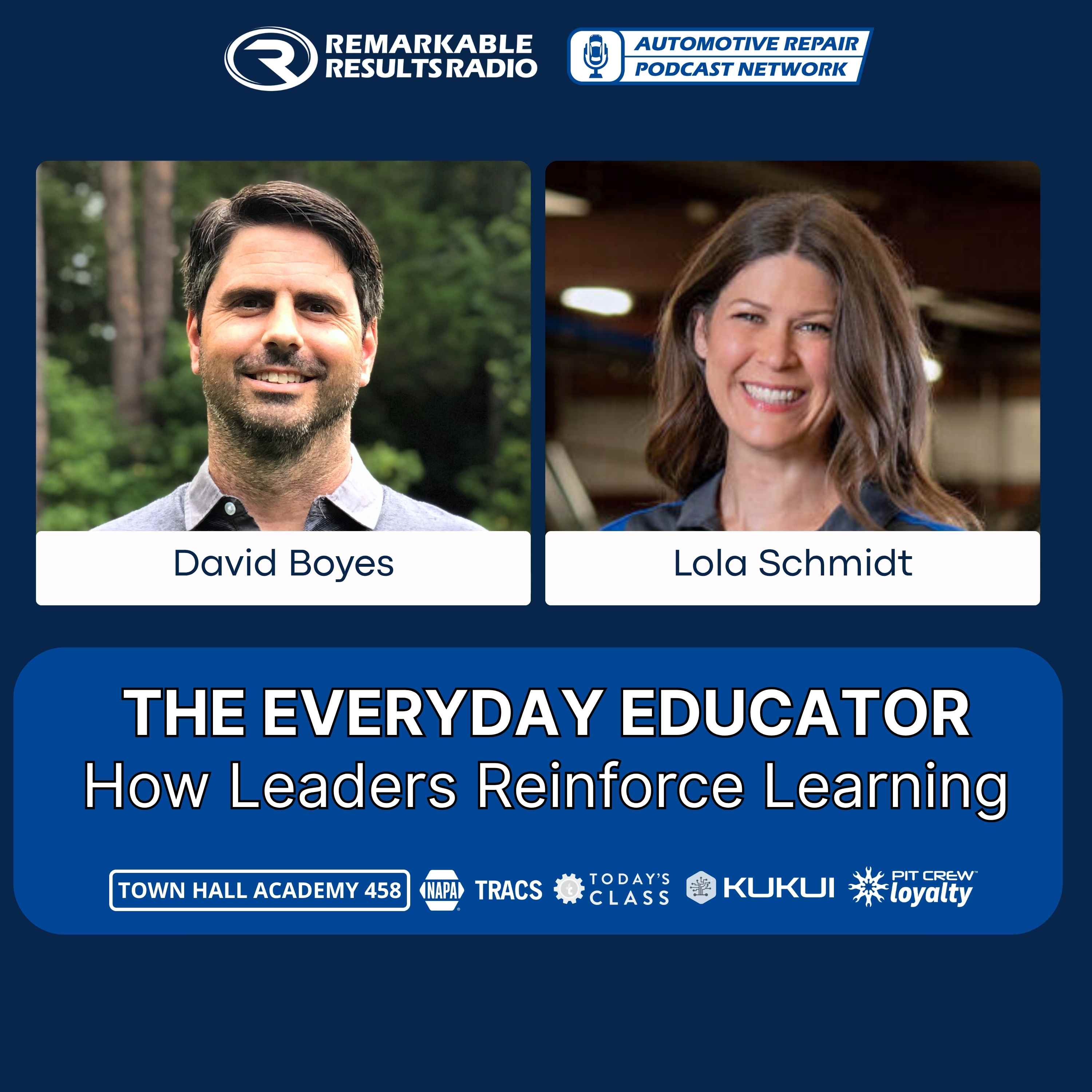
Exploring innovative training methods, this episode features David Boies, CEO of Today's Class, and shop operator Lola Schmidt, who share insights on daily training practices that enhance team performance. They discuss the benefits of gamification in learning, with Lola's team engaging in short, effective training sessions that foster competition and collaboration. The conversation highlights the importance of continuous education in the automotive industry, showcasing how data-driven training can lead to significant knowledge gains and improved shop efficiency.
Thanks to our Partners, NAPA TRACS, Today's Class, KUKUI, and Pit Crew LoyaltyWatch Full Video Episode
David Boyes, CEO of Today’s Class, and Lola Schmidt, Schmidt Auto Care, explore how short, personalized, and gamified training is transforming team development in the automotive industry.
The discussion centers on how Today’s Class delivers 3–5 minute, mobile-friendly training sessions that fit seamlessly into daily shop routines, often completed right after morning huddles. This consistent “daily drip” of learning minimizes workflow disruption while fostering a culture of continuous growth.
Gamification drives engagement through points, badges, and friendly competition, sparking team conversations and collaboration. Shops like Schmidt Auto Care have seen measurable improvements in technical knowledge, such as increased proficiency in brake systems, wheel alignment, and HVAC performance.
Lola shares how her team’s enthusiasm for competition has built deeper learning habits, while David explains how the platform’s data-driven insights help shop leaders identify knowledge gaps, coach effectively, and make smarter business decisions from equipment investments to targeted, hands-on training.
The takeaway: Small, consistent, and data-informed training can create powerful results, driving engagement, improving technical skills, and strengthening both team and business performance.
Thanks to our Partner, NAPA TRACS
NAPA TRACS will move your shop into the SMS fast lane with onsite training and six days a week of support and local representation. Find NAPA TRACS on the Web at http://napatracs.com/Thanks to our Partner, Today's Class
Optimize training with Today's Class: In just 5 minutes daily, boost knowledge retention and improve team performance. Find Today's Class on the web at https://www.todaysclass.com/Thanks to our Partner, KUKUI
Stop juggling multiple marketing tools. KUKUI’s integrated platform delivers 4x better website conversions, automated follow-up, and real-time ROI tracking. Get industry-leading customer support with KUKUI at https://www.kukui.com/Thanks to our Partner, Pit Crew Loyalty
You’re probably tired of chasing new customers who never return. We understand. Pit Crew Loyalty ends the one-and-done cycle, turning first visits into lasting, reliable revenue at https://www.pitcrewloyalty.com/Connect with the Podcast: