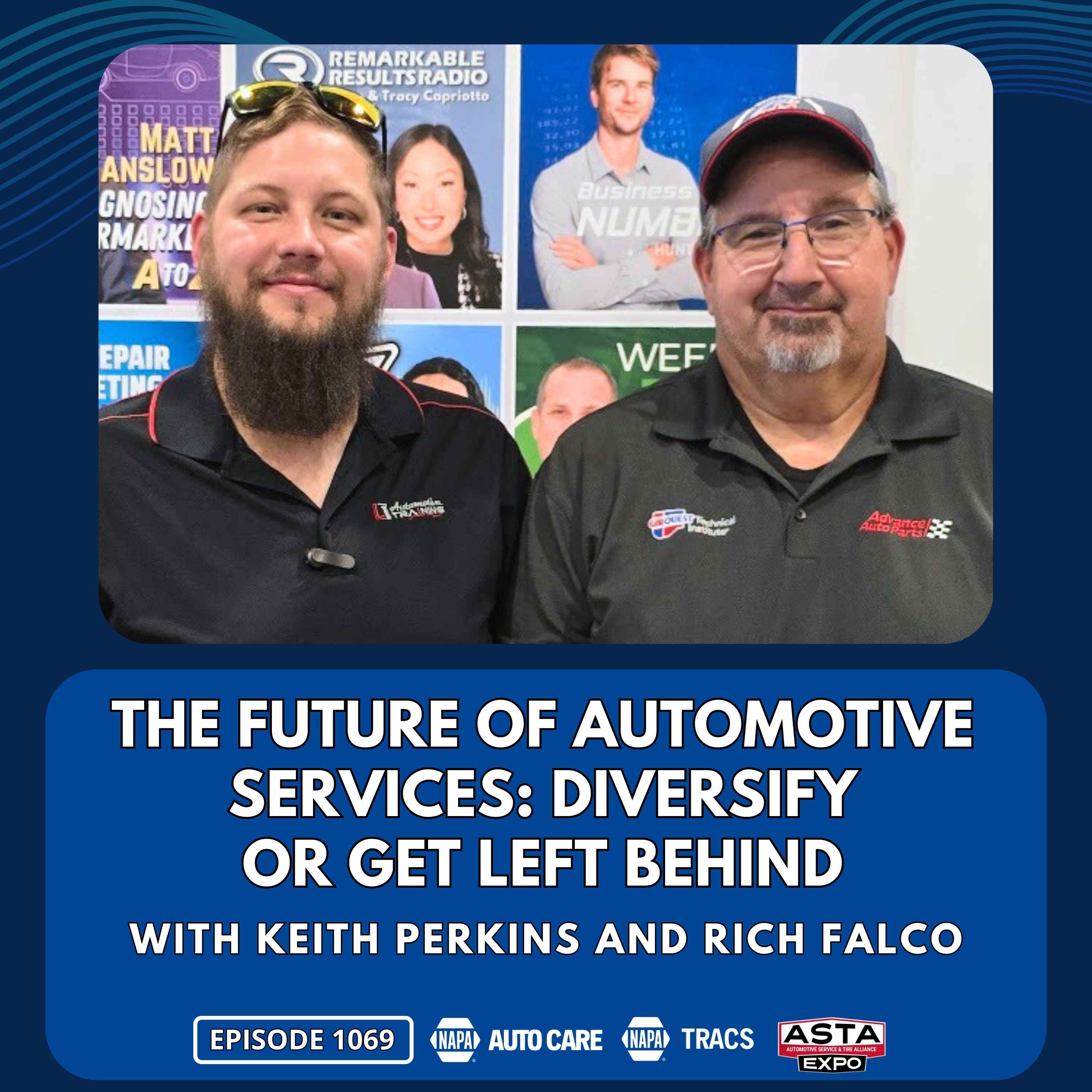
Exploring the evolving landscape of automotive services, this episode features insights from industry experts Keith Perkins and Rich Falco. They discuss the rise of mobile businesses, the importance of technician training, and the challenges of adapting to new technologies. The conversation highlights the need for shops to diversify their services to stay competitive in a rapidly changing market. With anecdotes from their experiences, they emphasize the significance of education over mere training and the necessity of understanding the industry's future demands.
Thanks to our Partners, NAPA Auto Care and NAPA TRACS
Recorded Live at ASTA 2025, we explore the rise of the automotive specialist and why the industry needs a language shift—calling instructors “educators” instead of “trainers” to reflect the complex, continuing education modern technicians require.
We also dive into the mobile diagnostics and repair market, discussing strategies for growth, high-complexity work, and the investments needed to compete. Looking ahead, the industry faces a technological turning point by 2030, with new vehicle architectures and ADAS calibration requirements threatening shops that fail to keep up.
The episode closes by emphasizing the power of networking, connecting with peers, and staying ahead in a rapidly evolving industry.
"I got my 15th car last week. It's like a 99 suburban with a big block."
The Suburban is a big, roomy SUV from Chevrolet. In 1999 it used a powerful V8 engine that people call a "big block" because it’s very large and strong.
The Chevrolet Suburban is a full‑size SUV produced by General Motors. The 1999 model year had a large V8 engine, often referred to as a "big block" Chevy due to its displacement and power.
The Crossfire is a sporty car made by Chrysler. It looks like a coupe and has a strong V6 engine, but it’s not very common today.
The Chrysler Crossfire is a mid‑size sports coupe produced by Chrysler from 2004 to 2008. It was built on the same platform as the Dodge Viper and featured a powerful V6 engine.
"And we've got pictures of pictures of other shops doing camera calibrations outside in the direct sunlight."
Camera calibration is like fine‑tuning a camera so that the pictures it takes are exactly right for the car’s computer to understand. This helps safety features such as lane keeping or collision avoidance work properly.
Camera calibration is the process of determining a camera’s internal parameters (like focal length and lens distortion) so that images can be accurately interpreted by computer vision systems. In automotive contexts, it ensures that cameras used for driver assistance or autonomous driving provide reliable data.
"I don't mind. I don't mean outside. No, I meant at a client... I've done radar cows outside."
A radar cow is a big, shiny object that looks like a car to the car’s radar system. It helps engineers make sure the car’s safety features that use radar work correctly.
A radar cow is a large, reflective object used in automotive testing to simulate a vehicle’s radar signature. By placing it on the test track, engineers can calibrate and validate the performance of a car’s radar-based driver assistance systems.
"But if they're in the Tulsa area and it's a Subaru eyesight,"
Subaru EyeSight is a safety system that uses cameras to help the driver keep the car in its lane, maintain safe distance from other cars, and even stop automatically if a collision looks likely.
Subaru EyeSight is a suite of advanced driver assistance technologies that use dual forward‑looking cameras to provide features such as adaptive cruise control, lane keep assist, and pre‑collision braking. It is a key safety system in many Subaru models.
"[1587.5s] safety feature. You know, it's crazy. Do you remember the Dodge shifter recall?"
Dodge makes cars and trucks that many people drive. It’s a well-known American brand that has made popular models like the Dodge Charger and Dodge Ram.
Dodge is an American automotive brand known for producing a range of vehicles from compact cars to powerful muscle cars and SUVs. The brand has been part of Chrysler Group (now Stellantis) since the 1920s.
"[1587.5s] safety feature. You know, it's crazy. Do you remember the Dodge shifter recall?"
The shifter is the part you move with your hand or foot to change gears in a car. It lets you go from low speed to high speed and back again.
A shifter, also called a gear selector or shift lever, is the component that allows drivers to change gears in a manual or automatic transmission. In some vehicles, the shifter is integrated into the steering column or mounted on the floor.
"...and we got a Nissan CVT tomorrow. And it's convoluted..."
A CVT is a special kind of automatic transmission that can change gears smoothly without the usual gear shifts you feel in a regular car. Nissan’s CVTs are popular but older ones can wear out faster, so owners often need to keep an eye on them.
A continuously variable transmission (CVT) is a type of automatic gearbox that uses a belt and pulleys to provide an infinite number of gear ratios, allowing smooth acceleration without distinct shift points. Nissan’s CVTs are common in many of its models but have been known to suffer from durability issues, especially in older generations.
"…you need to talk to Isaac to take some of the CTI programming classes to have an idea of the level of equipment you’re about to get involved with…"
CTI programming classes are lessons that teach mechanics how to use tools like the AutoJ box to change settings in a car’s computer system.
CTI (CarTech Institute) offers specialized training courses that teach automotive technicians how to use diagnostic tools and perform vehicle programming. These classes cover software updates, ECU remapping, and other advanced electronic procedures.
"…you can get what $10,000 of equipment and program 85% of everything you touch, which is the same as what everybody else is doing…"
An AutoJ box is a small device that you insert into your car’s diagnostic port. It lets mechanics read error messages and sometimes change settings in the car’s computer.
The AutoJ box is a handheld automotive diagnostic tool that plugs into a vehicle’s OBD-II port to read and clear error codes, monitor sensor data, and perform various programming tasks. It’s commonly used by technicians to troubleshoot and update vehicle software.
"...he got a car with a bad BCM. When can you do a GM BCM? And you know, me or the boys, meet them somewhere and get it done."
A BCM is like the brain of a car’s electrical parts. It tells things like windows, locks, and lights what to do and keeps everything working together.
The Body Control Module (BCM) is an electronic control unit that manages various electrical functions in a vehicle, such as power windows, door locks, and interior lighting. It acts as the central hub for many of a car’s electronic systems.
""...we put a used module in a 17 equinox and it doesn't work.""
A module is a small computer inside the car that controls things like the engine or lights. Replacing it can fix certain problems.
In automotive terms, a module usually refers to an electronic control unit (ECU) that manages specific vehicle functions like engine, transmission, or body electronics.
""...we put a used module in a 17 equinox and it doesn't work.""
The Equinox is a small SUV from Chevrolet that’s popular for its roomy inside and easy handling. It’s a good choice if you want a car that can carry family or cargo without being too big.
The Chevrolet Equinox is a compact crossover SUV produced by General Motors since 2005. It’s known for its spacious interior and comfortable ride.
""...we've been programming GM since the early 90s.""
GM is a big car company that makes many different brands of cars and trucks, like Chevrolet and Buick. They’re one of the oldest car makers in America.
General Motors (GM) is an American multinational corporation that designs, manufactures, markets, and distributes vehicles and vehicle parts under various brands such as Chevrolet, Buick, GMC, and Cadillac.
"When it's got variable compression ratio, variable valve timing, there's gateway module. I see requires seven networks behind each gateway, two nine channel gateways does require"
It lets the engine change when its valves open and close, so it can run smoother and use fuel more efficiently at different speeds.
Variable valve timing (VVT) adjusts the timing of engine valves opening and closing, optimizing performance, torque, and fuel economy across different RPM ranges.
"When it's got variable compression ratio, variable valve timing, there's gateway module. I see requires seven networks behind each gateway, two nine channel gateways does require"
It’s like a router that directs information between different parts of the car’s computer system.
In automotive electronics, a gateway is a device that routes data between multiple communication networks within the vehicle.
"When it's got variable compression ratio, variable valve timing, there's gateway module. I see requires seven networks behind each gateway, two nine channel gateways does require"
Some engines can change how tightly the piston squeezes the air‑fuel mix. This helps them run better in different situations, like city driving or highway cruising.
Variable compression ratio (VCR) is a technology that allows an engine to change its compression ratio on the fly, improving fuel efficiency and performance by adapting to driving conditions.
"an OEM tool. You can't put a window switch in it without programming."
OEM means the tool comes straight from the car company that made your vehicle. These tools can read and write data in ways regular tools can’t.
OEM stands for Original Equipment Manufacturer. An OEM tool is a diagnostic or repair device that is designed and sold by the car manufacturer, often providing deeper access to vehicle systems than generic aftermarket tools.
"The brake system requires calibration and you can't change a tie rod in without doing an 8-os calibration."
The tie rod is a part that links the steering mechanism to your car’s wheels. When you turn the wheel, the tie rod moves the wheels so the car goes where you want.
A tie rod is a component of the steering system that connects the steering rack to the wheel hub, translating steering input into wheel movement. It helps maintain proper alignment and handling stability.
"bought a $500 tool online to fix his wife's Alexis and his son's truck because he needed to have codes and do some things."
Cars have hidden computers that give out short numbers or letters when something goes wrong. These are called codes and they tell a mechanic what part needs fixing.
Vehicle diagnostic codes are numeric or alphanumeric identifiers that a car’s onboard computer generates when it detects a malfunction. They help mechanics pinpoint which system or component is having an issue.
"there's going to be a limit to it, but they're always going to be able to get something... some Amazon special that'll give them some data or at least pull a code."
Some tools can do extra tricks with a car, like turning off certain warnings or changing settings. These are called special functions.
Special functions refer to advanced diagnostic commands that can perform tasks beyond simple code reading, such as resetting maintenance counters or activating specific vehicle systems.
"you don't have the special functions and bidirectional controls, you're going to be lost."
Some tools can talk to a car’s computer and tell it to do things, like turn off a warning light. These are called bidirectional controls.
Bidirectional controls allow a diagnostic tool to not only read data from a vehicle’s computer but also send commands back, enabling functions like resetting service lights or performing active tests.
OEM service information is the official manual from the car maker that tells mechanics how to fix or maintain a vehicle correctly.
OEM (Original Equipment Manufacturer) service information is the official repair guide provided by the vehicle manufacturer, detailing proper procedures and parts.
Front radar is a sensor on the front of a car that sends out radio waves to find nearby objects, helping with parking or avoiding crashes.
Front radar refers to the sensor system located at a vehicle's front that uses radio waves to detect objects and assist with parking or collision avoidance.
"giant or do you put an aftermarket park sensor in one side"
An aftermarket park sensor is a replacement part made by another company, not the original car maker, that can be installed to replace or upgrade the car's parking sensors.
An aftermarket park sensor is a third‑party replacement or upgrade for the factory parking sensors, often offering improved performance or additional features.
Select text to request an explanation
This is the Automotive Repair Podcast Network. Everybody, Carm, Capriato, Remarkable Results Radio. Glad to have you here. We're at the 2025. Ask the conference. Lot of great training. We're sitting here in our podcast studio on the convention hall. Lot of great stuff going on. I just want to tell everybody what's going on here. We're in our third day, and everybody's, you're going to find out from one of my guests.
It's been slept in three or four days. But anyway, it's going to be fun. We're going to talk about the mobile business here today. And what's going on with that? And a million other things. But first, thank you so much to our sponsors. Hey, let's face it. Your shop management system is the most critical tool in your shop. And NAPATRAX will move your shop into the SMS fast lane. When on-site training, six days a week support and local representation. Find NAPATRAX on the web at NAPATRAX on the web at NAPATRAX on the web.
This is NAPATRAX.com. Hey, stay ahead of the curve with NAPATRAX Auto Care's newest auto tech initiatives, fast track assessments, accelerator immersive training, and tech assist smart support. The future of technician training is here. Connect with your local NAPATRA representative for more information. Welcome back. Wow. Keith Perkins. How are you, Keith? Good morning. L1 diagonal one training. What else? Level one automotive. Level one automotive. Yeah. That's right.
You're on brick and mortar. Yeah. Damn. How long has it been like three years? Yeah. 2020 in the form. It's in now with like a service advisor and a forward-facing business like almost three years now. Almost. Yeah. Rich Falco's with me. Diagon demand. Yep. The boys are running it for you. Yeah. While you're doing the curriculum development for Carcois Technical Institute. Yep. Damn you. I got slave labor. It's great. Do the boys just send you the check? Yeah. I'm
just phone support at this point. And the guys are in Florida. CTI is here in Raleigh. And so is the wife here in Raleigh. Oh, yeah. You have a complicated life, sir. Yeah. I'm bouncing all over the boys. Back and forth. You should get ready to go on a cruise and just settle down for. I think I am.
Both of you, Carm cruise, too. We're just thrilled to have you on that. Look, Keith, he comes in and he goes 36 hours of training talking, talking and not all here.
No, no, you've been out. I think the world needs to get an idea of what some of the top trainers in our industry do. And you haven't been home in how long?
I was home for 10 hours. Oh, yeah. Okay. So I did a car max event. I was supposed to fly out the following morning to the Christian Brothers event. And flight stuff was all trashed. Everything for American telecom was down in Dallas. So I had a drive. So I drove eight and a half down down to Houston.
Did the event there taught three sessions drove back had to make a pit stop in Dallas for the wife had exchanged some shoes long story.
Get back home. Lean late, late Tuesday. Get back late Tuesday. Take clothes out of out of my out of all my luggage, throw it in the washer dryer. It's in the closet.
You got to wash your car combo for for efficiency because I don't have to run up and downstairs and pull them back out the following morning at 3 a.m.
Thumb and back in the same luggage jumping a plane. Come here. Too much information.
Wait a minute. We're going to do a TV show when these reality shows. Yeah, they wouldn't be able to keep up with us. Yeah. No, honestly, God really.
That's around two or three camera people to take shifts. Yes. By the way, guys, where's all of our young trainers going to be coming from in our industry?
That's a good question. That feels really terrible because I thought it was a young trainer.
I'm sorry, but you are. You are. Yeah. But you are. And in fact, you're one of the ones who probably needs to get out there and start assessing and evaluating and recruiting too. Yeah.
I've got one of my guys who is interested in doing in-person training events. Okay. So Jeff, we're calling you out here. You got to.
Now, he's already told me he's taking all the steps. Really, I'm calling out rich because I was just going to say I only have to do a bootcamp because I said a couple times.
We got to do a CTI bootcamp again. Yeah. Run Jeff through it. And then Jeff wants to do the local regions for training.
The boot camps are important. I've actually had some side discussions here about this whole concept.
And I don't mind repeating it just for a tiny moment here. I think it may be worthy for our audience to hear this.
There's a lot of people that want to train, that feel inside of them, they have it, but they just don't have the chops as to how to do it. Yeah.
Okay. There was this thought. And the thought was, and it came from Matt and a couple of other who was here, Trace, Matt and Bob Leonard.
The idea was this, take some of the scholarship monies that are out there that aren't necessarily being utilized to a point. And there's not enough people applying.
Carve out four to five scholarships for train the trainer, hire some of our top retired trainers to come in and do that five-day week-long boot camp
to transfer the charisma, the quality, the knowledge transfer, the pay attention to the audience, the performance, the walk-alon, the preparation, the shake the hand when they're walking in, all that stuff that
brings the training experience together. And you take that scholarship money, you pay the trainers that are going to train. And the maybe we cover the plane ride for these up and coming. I mean, submit to me an application. And you want to go to the train, the trainer boot camp independently, not necessarily a brand like yours.
What do you think is that crazy sound? Not at all. Not a bad separate of CTI. Yeah. I mean, CTI's done boot camps for 20 years, but it's been a while. It's been a while. Yeah, absolutely.
I have more than once, you know, my bounce around classes of vision are here or whatever it may be. And I walk out and I'm not frustrated with the technical content. It's how it's being presented.
That's what I keep hearing just basic PC skills. You have instructor up there that's spending 15 minutes to figure out how to put a window screen up on the projector. And it's like, all tab, dude, just hit all tab, you know, so.
And you lose the audience if you spend in 10 minutes, just fumbling with your laptop up there. So yeah, if you're seamless and how you can share your stuff, it really does help. And again, yeah, I mean, having a John Thornton or any of the, you know,
well, we were thinking like a John Scott, yeah, Scott Manage on Thornton, get him out of retirement, a couple of weeks a year, paying really well. Yep. Okay, really well to do this because they're deserving of it.
Why the wife's out. Make sure it's a family thing. Okay, I don't go anywhere without my wife. I know, Liz, God, and Liz taught something here, didn't she? No, no, okay.
Well, she might have presented with the class next door to my, I don't know. She was heavily involved. She's like me. She talks a lot.
Maybe she's not teaching, but she's teaching. I know that only because after her class, there were four other shop owners questioning her about what she said.
That's good though. Yes. Oh my God. Not in the bad way. They will. How are you making network? How does that work? We can't get job scheduled. How are we just pull four cars in in a day and hope we can touch something.
How are you guaranteeing people days you touch cars and have 40 cars and a lot and cost it.
It's always great. The students come up to you guys at the end and to actually verify that they were in the right class and you got through to them.
No, yeah. Yeah. Great feeling. Isn't it awesome? I don't have questions afterwards. I failed something. I don't know if they feel like it hasn't happened yet, but I would feel like if I got done and everybody was just like, thanks great class
left. I would reassess everything that happened in that class. Did you do eight ass here? Did not. Okay. Yeah. What did you do here?
Hey, they got to go through everything in the past week. Yeah. It's I did. He's an immobilizer yesterday morning. I did our push to start class or CTI class.
Both CTI classes. One of them. I wrote one of them Peter put together and it was really cool class. I really like it. It's different because I would have taken that class to a totally different direction.
But the way he took it was like, oh, this is what everybody needs. When you press that button, what happens to make the starter turn? Yeah. Yeah. You don't have an ego. I mean, it doesn't seem like you got to present your own material. No, no, I enjoy it more because I'm more familiar. It's gives me less anxiety. Exactly. It's someone's going to ask a question. I know I wasn't there at that car. I don't know.
Oh, you know, so this part of what we do in the bootcamp talking about owning the material. Yeah. How to have that confidence. People wouldn't know that I didn't do that.
Is all the training built on case studies. Not all of it. Okay. Not all of it. It's a lot of theory. Yeah. It's good to have a case study to back up the theory. Yeah. That we're presenting. I'm not a big fan of case study classes. We're just an endless. Here's how I fix this car. Who's how it becomes look how smart I am.
God, given the theory. And if you've got a case study that backs that up or how we diagnosed using that knowledge, here's one of the problems. Oh, the scope says this. And you could show all these different screenshots of what you could see or should see, right?
The word training is part of my language shift. And I gave my keynote yesterday on the rise of the specialist. I got so much positive feedback. I got to tell a really cool story. Can I tell it? Yeah, please. Okay. It's your show car.
I'm going to speak to the Illinois Automotive Instructor Association in a few weeks in Peoria. There's going to be about 150 in attendance. And the guy who actually said,
Carm, we need you to come out. We want you to come out. He was in the audience yesterday. And he's already gotten my declaration on the rise of the specialist. And he says, we're already changing the curriculums.
In our school to special that's nice that we're going to be trainings automotive specialists. Yeah, not mechanics, which is ultimately from the consumers perspective, all we really are is mechanics.
In all the positivity that came back and all the ideas, I have another idea of a language shift for you. And I talked about the word training.
And I don't want to be moaned what you guys do. But in my mind, you're not trainers. You are educators. Okay. And the word training. And we use it again. One of those casual always things. Someone came up to me.
They wanted to help in this language shift. And they said, Carm, let's stop and think for a moment.
We train athletes to do this repetitive thing to make them so good at what they do to see and understand the moment they're in.
And that muscle memory has to click in and that's training lifting the weights and doing all these things. And he says, and even to make it sound worse, Carm, we train dogs.
And I go, my God, you're right. Do the trick again. Do the trick. Yeah, yeah, yeah, over and over here here.
Is it true? Yeah, it's true. And think about that. Did you have treats in your class yesterday?
I had to think about it. I was like, wait a minute. That might work better. I miss it.
But this continuing education, I see the words continuing education come up so much. But we say the continuing education is training.
Da, you're educators. Yeah. And I'm going to be educated because so much of the stuff that you talk about.
The person may not see for another four years. It wasn't a repetitive thing that you're teaching your teaching theory.
When we go to college, we don't go to college to say I'm going to get trained. We say I'm going to get educated. And you're doing the same thing.
But we have laced out ourselves into the word training. What's your thoughts on this?
I like that. Does it make sense? It makes sense. Yeah. I, uh, now I'm thinking I need treats in my class. No, no, go in the wrong way. No, you should. It should be C.E.I.
Yeah. Not C.T.I. Oh, yeah.
Education Institute. Think about it. Yeah. Yeah. Yeah. I like it. Yeah. I like that. All right. Do you see all the head shaking over here?
I know we had a realization, like a couple of years ago, like that because somebody was like, so what do you do? I was like, oh, well,
I had a mobile company where I was saying, but at the time, I had just gotten to the point where I was probably doing training as much
because I was doing that. And somebody goes, aren't you a teacher? Oh, my God. I see you online all the time. Go in places and teaching. I was like, yeah.
And then it hit me. I was like, oh, crap. I'm a teacher. I was like, I got to go back to my school when go tell my teachers that said
I would never be anything like that. Not only a teacher.
I'm teaching everybody things that are difficult now. Yeah. High level. Yeah. Yeah.
And so I better write that down. We just can't say that training is education. Perfect.
But we have to say that the trainer is not the educator or the teacher to educators. I'll take both. I like educator. Yeah. Sounds like I love educator. And it takes the sophistication of what's necessary in our industry to another level.
Anyway, I'm throwing that out there. The audience needs to hear this because we are on stage yesterday as I gave this keynote. I said, it's my ministry.
It was the first time I ever said that. Yeah. And I says, I'm becoming an evangelist for specialists.
Anyway, guys, mobile business years ago, it was like, oh, it's a fad. God doesn't want to open a shop. So he threw some shit in the back of his van or SUV. And he went out.
And man, it is a viable industry today. Isn't it? Very. Yeah. And there are people getting out because people want to get in.
Yeah. You know what I mean, right? God help it. You've got the boys running your mobile business for you. Yep. And probably have no reason to get out. But there's a lot of gray haired guys that have been doing this for say five to eight years.
They stopped standing on the concrete floor under her car. And they decided to do this. Trainers and mobile guys. Erick Ziegler's a great example of a guy who just recently sold his mobile diet business. Yeah.
And so it's going to become a consolidated portion of our industry. This is our. It is. Yeah. Yeah. Wow. I mean, I got a load full from Tanner who picked us up at the airport and came here. And it was so interesting to hear Tanner talk about what's going on on that consolidation side. What do you think of it?
I field those phone calls and request and do those meetings every couple months. I'll entertain any offer. At the very least.
The last time I took the offer my bank just said someone's willing to give me this much for it. Would you loan me 30% of this so I can grow. And they said, yeah. See, so that is a great. I got a free non bias business evaluation.
Holy crappers. Would you loan me 30%? Wow. I mean, that's beautiful. A great business plan. Good financial statements. Yeah, they said we'll loan you 80%. I said 30. That's all I need.
That was smart. Oh my God. Yeah. Don't take all the cookies out of the cookie jar. Yeah. Hey, let's face it. Your shop management system is the single most important tool in your shop period.
Napatrax has made selecting the right shop management system easy by offering the industry's best most comprehensive SMS. Now it all starts when a local representative meets with you to learn about your business and how you need to run it.
After all, it's your shop. So it's your choice and having local representation is a huge plus customizing tracks to your business, whether you're a one person shop or a large multi bay or multi location company, a representative consults with you to help optimize your shop's workflow efficiency and profitability.
Tracks always has the flexibility to do business how you need to do it, which means it can also grow as your business grows. And unlike the other guys will be there for you after installation with the best training and support in the business. Yes, a learning management system tailored to each role in your company.
Simply put, tracks was designed and built for shop owners just like you visit us on the web that Napa tracks that's NAPA TR ACS dot com.
The automotive world is changing fast and customers are expecting speed accuracy and confidence in every repair to keep your shop competitive. Your technicians need training that's smarter, faster and future focused.
That's why Napa AutoCare is excited to introduce three new auto tech initiatives, fast track assessments, the accelerator training program and tech assist.
It all starts with fast track assessments. This tool pinpoints a technician's exact skill level, whether they're a student, job applicant or a new hire so you know their strengths and where they need improvement without putting a customer's vehicle at risk.
Then comes accelerator training program using immersive technologies like virtual reality augmented reality and AI driven simulations.
It compresses years of technician development into just months, trainees practice real world jobs, alignments breaks diagnostics in a safe virtual first environment with instant feedback.
Instead of tying up your senior techs, they can focus on customers while new hires become billable competent team members in record time.
And once they're on the job tech assist keeps that support going through AR capable smart safety glasses. Your technicians can instantly pull up torque specs, wire colors, component locations and even connect with a live expert who sees exactly what they see providing guidance step by step.
System integration with information platforms and DVI stream line workflow and boost efficiency. This assess accelerate assist approach helps your shops deliver better quality repairs faster training and long term success.
The full solution launches March 2026, but beta registration is now open.
Want your shop to lead the future of automotive training connect with your local Napa representative today.
So I've been seeing the writing on the wall of and this is where like Ritz is going to be like, I didn't even say that, but so for years, I've noticed that the consolidation happens and what's going on is a lot of these larger companies are making deals directly.
It's mostly collisions. So if your mobile business is predicated on just collision work.
It's very volatile, right? I mean, yeah, I'm learning that firsthand. Yeah, absolutely. Yeah. So I diversified. And that's why I said, okay, I'm going to open a brick and mortar shop.
I'm seeing that diagnostics looks like something you could never mass produce. They're taking all Ados work because they can get the lights and codes out whether they've been the bracket, move the target, whatever.
You can't fake your way through a diet because you just don't fix the car if you don't actually diagnose it.
So I said, all right, I got to find a way to capitalize on the diagram part and grow that. So what I'll do is I'll start a brick and mortar.
I'll continue to service all of my clients, mobility that I can. I will push them to send me to diagnostic jobs by sending the customer to me.
Take the load off your shop. Don't deal with it. Send the customer to me. Build my own customer base.
Last year was the first year it happened, but our automotive repair shop did more in our mobile business.
So it's growing more and more every year. I was going to ask you that.
So mobile for us isn't ever going to go away. We're always going to drive around a program, but there's always going to be a remote company that will do it cheaper.
A new tool that will allow someone else to remote in and take all the gravy work.
So we're going to continue to provide the solutions that no one else can offer. And that's the thing that we use now is that I can do every single thing period, which is not the financial viable thing.
So these big companies are never going to look at me and go, we want that modded. We want the lowest ROI possible model.
Where you buy all of the crazy tools and do the job, nobody else can do it. Because of that, I don't have two boats, but I do have a team of technicians that would do anything to take care of the business that serve people like nobody else possibly could.
And we're going to be there forever. I didn't know boats was a determination of success.
Yeah, it's not. It's not. It's big block Chevrolet's.
Oh my God. How many of them do you have? Only one. I'm really excited about it.
What's a big block Chevrolet? Yeah, I got my 15th car last week. It's like a 99 suburban with a big block.
You have the big gay rush for him? No, it's not flashy. I like eclectic stuff. Okay. Hybrid escapes.
Chrysler crossfires. Okay. Nice. Are you ever going to go brick and mortar one day rich?
I don't think my guys would ever do it. And I had brick and mortar for 15 years up in Jersey.
I can look back and say I regret selling it. But at the same time, I was burnt out when I sold it.
I don't know if I would still be married if I still had it. So, you know, I'm here where I'm at and we'll play it by ear.
And like he said, you know, there's a lot of companies, a lot of competition out there. So,
anybody can do a calibration and not anybody can fix a car. So you have to be able to say to that shop,
well, yeah, we can do the calibrations. And when it goes wrong, we can also diagnose that problem.
Yeah. So are you doing calibrations on the road? Mobile, yeah, you are. Yep. What's the equipment you're
using a little bit of everything? Okay. Autel topped on a lot of OE. I mean, whatever gets the job
done accurately and correctly. So you're setting up at the client's place? Yep. Yes. You have
the necessary room all the time. If we don't, we won't do the calibrations. We're very, very picky.
OE says do it this way. We're going to do it that way. And we're going to try our best to do it as
accurately as possible. And we've got pictures of pictures of other shops doing camera calibrations
outside in the direct sunlight. And it's okay. Yeah. It's an issue. You were doing them outside.
And then you brought them in, right? Didn't you? We still do them. Well, not outside. We tried. I
don't mind. I don't mean outside. No, I meant at a client. Yeah, I've done radar cows outside.
One of our shops had a old building. They tore down. So the concrete pad was still out there.
No, I was like, great. There's like, but there's two cars parked over there. I move those two cars.
I got this giant, perfectly level concrete pad out of the way of everything. It's a radar job.
Sunlight doesn't matter. We're good. But yeah, we still do the mobile today. Okay. My fans all
still have Ados in them. Okay. But if they're in the Tulsa area and it's a Subaru eyesight,
I say, no, thank you. It comes to my shop because I can do it one time and it's right because I've
got all the lighting correct. The environment is exactly designed in a way. It's going to be successful
almost every single time. I don't have to fight it. So I hung out in Keith's class at Tools. I was
there for 40 minutes and I couldn't leave. I was mesmerized by, I mean, you're a great trainer.
And you had some really good slides. It's just my shoes. And I don't know if I raised my hand and I
said, this is your class. I don't remember. But I said, where is the other 200,000 automotive
specialist technicians, mechanics, whatever you want to call us? Where are they? They should be
in this room. They should be in this class. Yeah. Facebook group. Yeah. Oh, yeah.
That's Liz and I's class, by the way, by class. I have to tell you guys, it was such an interesting
class that I've been bugging him. And one day, I mean, I know you're busy. I get it. But I've
been bugging him to take some of his slides and create a countertop graphic to explain what
calibrations are all about on a vehicle. When the client says, listen, a guy down the road will do
this alignment and fix my front end for X. And we say, we'll fix it for X plus the calibration.
And they don't want it. And so we try in our slang vernacular at the front of our counters
using every acronym in the world that people don't understand. Your car's got 8S and all that stuff
works. How about a picture that says, if you're one degree off, let me show you what it looks like
a thousand feet in front of you, right? And they were such powerful slides. We need like
one page, four graphics in front that show the reason that we're doing this. And oh, by the way,
your car manufacturer says, this is a must. It's required. Yeah. So you can go down the road and
have this. But please be careful. You might sense or feel the car not just really acting the same
anymore. And none of this is BS. We're not trying to upsell anybody. We're trying to keep it safe.
But I don't think we have the capabilities of explaining it thoroughly to the customer.
We did an in-person 8S class at our research center a couple of months ago. And the shop owner
in Philadelphia said, I have better luck selling 8S calibrations to my mechanical customers than
the body shop. And I went, I'm going to your shop. I want to see you are presenting that because
I'd never heard that from another shop. He said, we do alignments and we explain to them the
requirements. How about this? The insurance company's getting in the way. Yeah. Maybe. Yeah.
Now insurance industry is a disastrous mess that should go away and be burned to the ground
or rebuilt. That's a pretty heavy company. Yeah. And I agree. We're a direct repair shop provider.
You probably haven't fixed a car correctly under insurance. You're not being paid to do it correctly.
I could promise you that. It's the laws of the insurance company. The insurance companies are
deciding how the cars get fixed. Yeah. And how much they'll pay for it. I can almost guarantee you
and somebody, hopefully somebody will just erase crazy amounts of contention about this statement.
I almost guarantee you that if you got your car fixed under insurance and you didn't pay anything
but you're deductible, it wasn't fixed correctly. No one's proved me wrong yet. I said in my class
yesterday that the shame of it is somebody really important or famous needs to get hurt. Not
killed in an accident. I have to before it happens. Before anything has changed,
somebody really important is going to get put the fear of doing it well.
Before a politician goes, wait a minute. We don't have a standardized training. We don't
these systems don't all work the same way. We're going with the cheapest bidder to calibrate a
safety feature. You know, it's crazy. Do you remember the Dodge shifter recall?
I said that yesterday in class. I said an actor from Star Trek had to die.
The guy who were Dodge fixed and they check off. Yeah. I know that. What is shame, huh?
Yeah. That's the only reason why that recall happens because there was enough of a stink of this
is everyone to drive it about every forum. Every forum out there with every owner goes,
this is dumb. I can get on my car. The car rolls. Sometimes I think I try to radio down and I put
the car in low. Yeah. Really? That's how that got fixed. Somebody famous died. You got crushed
against the wall. Yeah. I mean, what? He got out of the car to get his mail or something.
Yeah. Yeah. And his driveway was sloped so he walked around front and got the mail and the car
pinned him against the wall and he passed away. Oh, unbelievable. And then I think of the words
sublet. I think that that is, is it changing? Do you hear that they're trying to get more control
of the sublet because the coalition shops would you send them the bill and the insurance company paid
it? But rumor has it that they're trying to take a little hand. It's no rumor. It's a state
farm put out a price list and said, this is all we're going to pay for a sublet on these kind of
for this specific calibrate. So I don't remember the prices off top my head, but they're why
wouldn't the collision shops seriously invest in their own equipment? Some of them do. I know.
You know, but some of them don't. No. The same guy who's really good at fixing the body
and painting the car is not going to be good at diagnosing a no car on a radar after the repair is
done. And then calibrating the radar is two skill sets. And I also think some of the body shops
think they're shifting the liability to somebody else. Right. You know, I'll have him do it so
if it doesn't work, it's not my problem. Okay. Yeah. I love where we went. Thank you so much for
this really refreshing dialogue. If someone came up to both of you at this event and they said,
what would it take for me to start a mobile business? How many times have you got it at this event?
At least five or six for me to the mic. I've had three or four people are standing in the
advanced booths. Okay. So what are you going to a couple of things you're going to say to
honestly, the first thing I tell most of them is training. I said, you need to know what you're
getting involved with. And I point them to obviously CTI. But also Keith, I tell them I'm to this day
still paying a subscription for Keith's because he's got every manufacturer programming video out
there. And when my guy's call and go, we got a Nissan CVT tomorrow. And it's convoluted. And I'm
like, go watch Keith's video and call me tomorrow and we'll walk through it. But training is step
number one before anything else to get into mobile and also do the research into does your market
support it? Who else is out there? I hate to say it, but I talked to all the mobile guys. There's a
Russian in every town or Alex, or a locksmith that's doing programming and a lot of them are
using hacks, yeah, act tools and taking short. That's why you said Russian. Oh, yeah, it's always
a guy named Alex. And the shops will go, oh, we got this Russian guy that does that for us.
And he's doing it for $75 and the subscription is 50. So it's like
not any more than four went up to 120 for the short. So they really need to do the research to see
if this is something that is supported, that they can make work in there. Before I decided to do
this mobile thing, John Rogers, who's been doing this for about 20 years, he called me and he goes,
you call me. We're gonna have a conversation before you do this. And I don't think we finished
that conversation. We started it and yeah, you really need to know what you're getting into.
Yeah, you need to be really good. There's been a couple of mobile texts that come mobile like
they're doing break jobs and stuff and people's driveways. And they say, I really want to get into
programming. And I'm like, okay, you need to talk to Keith. You need to talk to Isaac to take
some of the CTI programming classes to have an idea of the level of equipment you're about to get
involved with because they think they can buy a AutoJ box and go out there and program every
making model. And that's just not yeah, not realistic. Buy a J box and you can get what $10,000
of equipment and program 85% of everything you touch, which is the same as what everybody else is
doing. Yeah, you got to be able to do that 92% to really say, yes, all the jobs not lose out.
Do you talk to them about, to me, one of the things that I would say to someone, confidentially,
what are you making now? Oh, I don't ask that question. Think about that. That's what are you making now?
Happy secure wife working. What are your responsibilities at home? Because you got to market
your company. You just don't go out there and make the same amount of money you're making today.
Unless you're making so little now and you feel you're so talented and you could do a lot and maybe
you can double what you're making in a couple of years. But there's a wait time to get where you
would love your business plan to go. It's a business. This isn't just a little hobby though,
because to what you both just said, I guess to make out what's the investment in that vehicle
that you're driving around. I would probably know better. I mean, six figures for sure.
Six figures for sure. Depends upon the cost of vehicle. But no, forget the vehicle. I've got to,
oh, inside the vehicle. Yeah. No, it's not quite six figures. Depends upon, again, what the mix
of what you're doing is. Okay. A lot of it's the mix of what you're doing. So because
there's five to 80 72,600. Okay. That's our standard lowdown. I do. He had it. That's why I said,
that's him. But I got to clarify someone's like, that's outrageous. We're doing it for 30. I'm like,
yes, but can you do Mercedes keys? Yes, but can you do? But can you do? But can you do? But can you
do? So what I found that works in my market to give the mix of what I need to be Uber competitive
and do things. No one else can do 76,200. I've almost got all of it shifted to Isaac. So for
those listening, just call Isaac and be like, I want to key float out. And it'll be pretty dang
close to having everything. And if Isaac was here, we would be hearing from him. Yeah. I have a
mobile mechanic in my area who we literally cross pass at a shop. I was there programming. He was
there doing something else and he asked me, you know, oh, wow, you do programming. I thought about
getting into it. But he did the research and realized it wasn't worth it. And he says, yeah,
well, you guys do it for me. And I said, I don't go to people's houses. So find a shop that you
deal with and we meet at that shop or a shop that I deal with. We meet there and we do the programming.
And it's been great because he knows what he can do. He can do break jobs and diagnostics and
he'll call me and go, hey, I got a car with a bad BCM. When can you do a GM BCM? And you know,
me or the boys, meet them somewhere and get it done. Are you surprised of the number of shops that
haven't mentored or educated their people to know how to do this? No. It's just I buy their equipment
at liquidation auctions. Yeah. Because they refuse to do what they need to really update. Yeah, yeah,
yeah. I hate to get negative. But Keith and I see the same people, the same training events over
and over and over. Yeah, that's the broken record. It's a problem. Your face is honestly. Yeah,
and you know, it's so nice to see somebody in your class. You don't recognize. Yeah. I love you.
Would you put on a different mask? Yeah. But the majority of the shops aren't keeping up with this and
don't I have had shops in 2025. Call me and say, we put a used module in a 17 equinox and it
doesn't work. What's this programming crap? Dude, we've been programming GM since the early 90s.
What do you mean? What is this? Oh, and by the way, you can't put a used module in a global
A car. What's global A? Oh, and my scan tool can't scan this 2020 Dodge. Well, you need a
auto off. What's that? Yeah. It's like how far behind can you possibly get and still have a
viable business? It blows my mind. I got shops that update their one scan tool every other year.
Yeah. Yeah. And we won't say the name of that's the brand of that scan tool. You said a really
powerful word. You said viable. For some people, given Mama, 300 bucks a week to go by groceries
is viable. Some people want to make 20% on a million bucks. And they have invested and done
this and they're the same people you see at classes. They're the ones that got accountants for
professionals. They're the ones who are paying really big bucks. And yes, would you think there's
going to be a shredding of the week ever someday? Or is there just so much business that the shop?
I'm seeing it happen. Last year, we had 97 shops closed and only 34 new ones. Wow.
And also honestly, kind of want to say good because we've been saying it for as long as I've
been in this industry, how are these shops going to keep up with the technology and they keep
figuring out a way to hack it up? Well, so hold on. I've been using the same year, 2030.
If we look back at this conversation in 2030 and five years from now, it will be different
because the average age of a car inside of a shop being seven to 11 years old today, we're seeing
it right now. It's getting rougher and worse and worse because all that stuff. And so I said
about five years ago in 10 years. And then so the last three years, I've been saying 2030
is the year that we can look at and look back at what we said and go, yep, we were all right.
I got up close to my phone. Yeah, 20 2030. Yeah, because in the average vehicle that will be in
a bay will be over, like, it'll be a 2020. 2020 isch would be a 2019. Our average age is about 12
right now. And it's been going up maybe what three or four or five months a year.
But the $300 is viable shop doesn't work on five-year-old vehicles. They work on 10 plus
year-old vehicles. So when the 10 plus year-old vehicle is the 2020, then they don't have the skill
set to fix that car. When it's got variable compression ratio, variable valve timing, there's gateway
module. I see requires. Seven networks behind each gateway, two nine channel gateways does require
an OEM tool. You can't put a window switch in it without programming. The water pump requires
programming. The brake system requires calibration and you can't change a tie rod in without doing
an 8-os calibration. So everyone's going to YouTube to fix the cars. Boy, you said that pretty quick.
I told everyone to go to YouTube yesterday when they were like, where's the key slot on this car?
I said, you can find it in service info, but you can YouTube it faster. I don't mean YouTube's 99%
trash of what's out there. And there's 1% of fantastic information. Great people, same thing with
TikTok and all the other things, right? But you got to find that 1%. Yeah. And you got to be able
to differentiate. You need to know enough to say, okay, that's not good information. Yeah.
So how is it that a friend of mine, a former tech, he's a hands-on. He's got every piece of equipment
and barns that he's got on his property, right? He will never go to a professional for anything.
It's just how he was built. But he also owned a shop for like a dozen years.
He went out and he bought a $500 tool online to fix his wife's
Alexis and his son's truck because he needed to have codes and do some things. And I was blown away
by that. Is that going to continue that kind of access and availability for people,
DIYers to fix their own vehicles? Yeah, to a point. There's going to be a limit to it, but they're
always going to be able to get something, you know, some Amazon special that'll give them some
data or at least pull a code. But it's getting like he's saying, it's getting to the point where if
you don't have the special functions and bidirectional controls, you're going to be lost. But
I think the backyard mechanic is going to be there, but there's just going to be limited to what
he could do. Yeah, I'd much prefer them understand their limits. So that's the problem.
They don't understand their limits a lot. Yeah, they don't know what they don't know. And right,
the next thing, you know, they take a bumper off and now every parking sensor is freaking out.
They don't know why. Yeah, yeah, we had that one guy fixed his own highlanders wife bumped into
something. He's like, I pulled it off. I painted the bumper, I put it back on. I just needed
the park sensors calibrated. And I said, I'm not going to do just the park sensors. You pulled
the bumper. The front radar has to be done. That's what the OEM service information says. He's like,
well, I only want this done. I was like, you're welcome to take it wherever you would like, but
we're only going to do it this way. He's like, every place I called says I have to bring it to you.
I said, because we only do the job right and make sure it's prepared correctly the first time.
And so in it turned into a giant or do you put an aftermarket park sensor in one side,
it works, it bothers a connector because he didn't fix the connector. You know any shops that also
have a mobile specialty business? Yeah. Are there a lot of? No. Kirk is the one I model my stuff
after. Oh, yeah. Gladly. Yeah. Kirk, Colin from Gladys. Yeah. He's a little profile. You
will never get one of podcasts. He doesn't. We won't do that. I think Matt's trying, isn't he?
I don't know. Matt tried today or yesterday. Yeah. Kirk is the most humble human being. He runs an
amazing facility that he takes care of his people. Like, I try to model all the cool things I do
after what Kirk does. Well, geez. I gotta go to Kirk model. So he's got brick and mortar and
a mobile business and he started mobile and built a brick and mortar. That's just like you
I mean, I just like him. Oh, oh, me just like him. Not him. Just like him. And in that kind of
situation, there's no conflict with the shops in town wanting to use his mobile business to help
them out. No, he won't do diagonals on the road. Oh, okay. Yeah. Which we're pushing anywhere I
have a brick and mortar. I am pushing my mobile shop to push the direct to. We doubled the price of
direct on the road and kept it the same if they send the car to me. That's smart. And some of them
still want me to die. I get there. That's fine. So what's next for you? What day is it? I don't
know. I leave for Kansas City tomorrow. God, you guys, are you going to actually have a chance
Keith to slow down for a few days? A whole weekend. I don't have to teach him till Friday and it's
in Tulsa. There you go. What? Yeah. And so you're going to a car max thing? Doing a car max thing
on Monday. We have a huge amount of classes for car max for October. That's what I do at Friday.
I can slow down. Yeah, I mean, I think I'm in Vegas on Friday or, or no, LA. What are the classes?
Diagnostics, breaks, steering and suspension, scan tools. Okay. Carmax, he's the need for training.
They really do treat their text well and train. They know they need it. It's like
hello industry. Hello. Yeah. Then you're right. Keith is the same faces. That's what everybody
tells me. I mean, you're getting to have friends from all over the country showing up. And I guess,
oh, here's an idea. If there's a new face, raise your hand. First time training, first time in
this glass, you need to celebrate them. I did have the CBA event asked how many of you first MTB.
I always do it at vision. I always vision. I'm like, who's here for the first time?
Celebrate them. And then I tell them everybody applause them and I go, don't just go back to your
hotel room. You go to the lobby. If you're sitting down and having lunch, you sit down
on the total strangers. I want you to network. In fact, meeting and shaking hands with the people
that are left to right front to back of you as an individual. You could force them
to learn and meet new friends that could benefit them for the rest of their lives. Oh, absolutely.
Wednesday night, Tanner sitting there talking about a car that he figured something out on and I went,
I have one of those right now called the boys. I said, hey, you let Ed's know we know what's wrong
with his car. You know, and it's just that kind of networking and talking would be yelled at.
I call the boys.
Well, even shops do it now. Like I'll show up and they're like, we were hoping to get the boys,
but we got you. Oh, that's really, that's really funny. That's you're still early on. I
show up and they go, new guy, huh? And I go, yep. I told them I said to Zach when we first started.
I said, I don't want these shops to know who I am. I said, you are the face of the business and
I'm just back up. All right. So Keith, where do you get your energy?
I have a passionate drive where I just can't. It's a mental disorder, you know,
that I just can't stop pushing, but I don't know. I'm like Isaac. We manufacture caffeine in our body.
Yeah. So we just can't slow down. I, you know, even if I didn't have the mobile business,
it was just CTI. It would be game on like whatever we've talked about so many times. Yeah,
that we just both would just no matter what we're just going to do something.
Speaking of caffeine, yeah. Can you drink a cup of coffee and go to sleep? Absolutely. Yeah. Yeah.
You too. I drink them in the hotel room to go to bed. Yes. I took a cup of coffee two nights ago
to the bedroom. I went to Starbucks. I drink a cup of coffee for it. I love the taste of coffee.
Yeah. Me too. That's what it is. Yeah. It's not the fix for me. And the morning I drink a cup of
coffee. I don't wake up. It's just, it's just there. I do feel groggy without it. Only because I'm
so used to it. I feel like it breaks my routine. But it's not, it's not the caffeine. It's just a
war. Yeah. Yeah. All right. Hey, guys, this was enlightening. We went to a lot of fun places.
We've been all over the place. Yeah. We, yeah. I was in a fan's low podcast. Welcome to what's like
a score my brain. To our listener, listen to learn just one thing. But if you got something and it's
solid and you've written it down or recorded it somewhere, just implement it. Do something about it.
That's what's going on here. I've been in front of trainers that said, look,
you learn anything, you write anything down, go back and teach it. Right? Go back and share it.
I can use it. I tell every attendee, don't believe me until you've gone back to the shop and
done it yourself. Yeah. Yeah. Yeah. Because then you, you apply it. Rich Falco, Keith Perkins,
thanks for being here. Thanks for having me. Appreciate it. Yeah. Thank you.
Thanks for being on board to listen and learn from the premier automotive repair business podcast,
Remarkable Results Radio. Get your episodic education on the ARPN listing app at automotive
repairpodcastnetwork.com. Also, enjoy the podcast on our Carm Capriato YouTube channel.
Carm is all for advancing the professional automotive service industry. Until next time.
Request an explanation for:
3 cars
3 cars featured
Request an Explanation
Heard something you'd like explained? We'll add it to this episode.
Sign in to request explanations for terms you heard.
Want to learn more?
Browse our glossary for plain-English explanations of automotive terms, jargon, and concepts.
See something that's not quite right? Our annotations are AI-generated and can sometimes miss the mark.
Click the flag icon on any annotation to suggest a correction.