All right, welcome back to the MartiniWorks podcast.
We're here with Gels, myself, Dakota, and a very special guest.
Ooh, special.
Yep.
Austin Perush.
Austin, how you doing, man?
I'm well.
Well, thank you so much for coming on over here
and hanging out with us.
So you want to explain a little bit to the audience
who you are, what you do?
Yeah.
Like I said, my name is Austin.
I'm a car builder.
I'm a metal fabricator.
You could call me a coach builder, perhaps.
Yeah.
I'm also the founder of Motivator Coffee.
We're working on a project together.
So we're getting into some stuff today.
Absolutely.
Do you want to explain a little bit what a coach-built car is?
Yeah.
So before we had stamping equipment and massive factories,
all cars were built by hand.
You're talking just after the stagecoach days,
like well into the 60s, at least in Europe.
A lot of American cars had switched over earlier,
but if you're talking 50s, 60s European cars yet,
a lot of that stuff was hand-built.
There's some transitional periods where they were maybe
hand-assembled, mechanically stamped kind of things,
depending on the era.
But yeah, so coach-built cars are basically hand-built cars
built by humans.
That's insane.
That's so much work to me.
I modify cars and I get pissed off and throw wrenches.
I can't imagine building one entirely.
How do you even get in?
Do you want to talk about a build?
Yeah, for real, yeah.
She'll build that part sort of with a sheet of metal.
OK, so that's the thing.
It's like, OK, stack of tubes, pile of flat sheet.
Let's turn it into a car.
Insane.
Can I do that?
I can do that.
It's just a matter of time.
How do you get into something like that?
Is that like a family heritage thing?
Is it something you self-taught?
It's not.
So I, you know, my family's entrepreneurial.
My mom's an artist.
So I kind of went the art way initially.
I went to college for a sculpture.
Gotcha, OK.
And then you can kind of see how that blended once I got
into the automotive trade.
Absolutely, yeah.
So I went through a restoration program.
Kind of, they're like, OK, you're good at that.
So they stuck me in a, I got kind of an apprentice program
at a Rolls Royce restoration shop in Ohio.
That's cool.
Old stuff.
Oh, sure.
And like late 1800s, early 1900s, brass-era Rolls Royce.
Dang.
That's crazy.
And I mean, that stuff, a lot of that
was like the body structure was made out of wood,
wrapped in aluminum most of the time.
Tons of brass fittings and headlamps,
like, like, hair scene, like headlights, you know?
Like, they got a wick in them.
Yeah, wow.
You know, weird stuff like that.
So I learned some cool stuff there.
And then from Wisconsin, I wanted to come back.
My now wife, we were dating long distance,
and that was kind of the thing.
So came back to Wisconsin and got a job at Motion Products
here in town.
You guys probably know that.
They do Ferrari restorations.
And that's where I got the majority of my skill set.
Nice.
It's just kind of getting thrown to the wolves,
working with the older guys that work there.
Yeah.
And then I went out on my own.
So awesome.
I mean, that's sort of the gist.
It's just a lot of time with the cars.
A lot of time with the tools.
You know, I've gotten into restorations and rebuilds
and stuff where I personally had over 2,000 hours
on the project.
Oh my gosh.
And that was just one of a few guys in the fab shop.
So holy, that's so crazy.
And what kind of cars were you working on?
Mostly we're talking 50s and 60s Ferraris.
There was some other Italian marks in there.
I think a few Porsches and stuff.
But when I was at that organization,
it was mostly Ferrari.
And we're talking everything from like little 50s race cars
to short wheelbases, a couple of GTOs,
and then some of the street cars too, the GTEs, 330s, 400s.
Yeah, nice.
Yeah, it's so crazy across the board, all kinds of stuff.
Yeah, that's so crazy.
You think, Wisconsin, there's not much that goes on up there.
And you got guys like Austin just putting
thousands of hours in resurrecting 50s Ferraris.
That's so crazy.
It is.
What are the majority of projects
that are coming in for restoration?
What are you doing?
Is it accidents that happen?
They need replacement parts?
Or what is it?
So a lot of times, they're just old cars.
There were cars that got crashed.
There were cars that would be out at events like Goodwood
or whatever, the wall or get t-boned in an intersection
or something.
So there was stuff where it's to pull it out, straighten it out,
remake some components.
A lot of it was this been just sitting in some place
in a barn in a garden yielding Argentina
somewhere, all kinds of stuff.
And yeah, it wasn't so much a crash shop.
It was some of them were older restorations too.
Gotcha.
Right?
People didn't put the time and money back in the 80s
into it.
They didn't have the crazy multi-million dollar price
takes that they do now.
Absolutely.
Is it ever, did you have to turn away any cars?
Is there ever like they're too far gone?
I mean, I personally have in my business,
I can't speak for the Ferrari shop.
But there were times when I was just like, you know,
man, I know you love this car.
I know you drove it in high school
and you made out in the backseat, cool.
It's not.
She's cooked.
Yeah.
We can do it.
But there's not going to be any car left.
Right now.
So I have done a couple of those.
I mean, I've re-bodied Camaros top to bottom inside out
where the only thing left were those two inner structures
right?
Cows, new firewalls, full floors.
Yeah, enough to keep the bin.
So it kind of depended on the customer.
There's some stuff I just was like, I don't want to do that.
Yeah, that is just so crazy.
I imagine a lot of rust repair stuff, yeah.
Yeah, and especially being in the Midwest.
And a lot of vintage cars did not
have the rust prevention and thicker metal, which is nice.
It took a little longer to go through.
18 or 19 gauge metal, as opposed to like 20, 24 gauge
on modern cars.
So yeah, yeah, there's been a lot of that.
I'm trying to move away from that in terms of my building.
Yeah, kind of trying to do clean, new stuff.
Yeah, and what does that entail?
So I've got a customer that I'm going
to be building some bodies for.
I don't know if I can get into it or not.
But we'll just say it's a Wisconsin-based, whoa.
There's a big thunder.
It's part of the thunder.
It's a dramatic effect.
Don't know if I can say who it is.
All right, I think that is a sign.
Building cars for Batman, I guess.
But long story short, they have a limited production
run of some vintage indie special kind of cars.
That's super cool.
Going to be doing some stuff for them.
I'm still doing some restoration stuff, hot rocks stuff,
whatever.
You kind of want to get more into the custom side of things.
Yeah, and to be honest, I kind of got really burned out
on it for a while.
Oh, I can imagine.
I've been doing it for 15 years.
We've put that many hours in.
Yeah, I believe it.
It takes some of you.
Yeah, I can imagine.
I've worked with people that say,
every one of these cars take a little bit of your soul
with it when it leaves, and especially when you're
given it thousands of hours or at the minimum hundreds of hours.
So yeah, did that answer your question?
Yeah.
My brain trailed out.
No, that's fine.
That's what podcast is for, is what happened.
Did you ever have any restoration jobs
that you're like, it's impossible,
but you were able to save it and do it?
I've never said it's impossible.
And in fact, I'm more inclined to take on a job that's
super challenging.
Because I'm more challenged by it.
Perhaps to you.
If it's just replacing a quarter panel on a 68 Mustang,
it's kind of like not really into that.
Gotcha.
And there it requires very little, I shouldn't say that,
requires some skill.
But it's just not what I'm looking to develop.
It's just a job at that point.
Yeah, once you figure it out, it's just work.
Gotcha.
So you like the more creative aspect of what you do.
I really do.
I like creating things and solving problems,
building things.
Work is part of work, but you can't avoid it.
So that's where I'm at these days.
Is there any misconceptions people
have about high-end restoration or building cars?
Oh, man.
Maybe.
Yeah, what would somebody's conceptions of it be?
Maybe price, time frames, stuff like that.
According to television, it takes two weeks.
Yeah, YouTube and television has kind of ruined
restoration, that's for sure.
And Bad Chad is a great craftsman.
No.
Yeah, those are things.
For sure.
It's super expensive.
It's super time-intensive.
And when we're billing by the hour,
that can be problematic.
Yeah, 100%.
You guys put stuff together.
If you guys itemized every hour on it,
and we're charging customers, like, oh.
It adds up real quick.
When your time is involved like that and the amount of time
it takes, there's no quick way really about it.
No, there's not.
And you can't tell pulling the heads off a motor
and six of the studs snap off in the block.
You're like, OK, well, that's a week.
Yeah.
Yeah, that's a couple.
That's going to set us back.
So there's so many ways things can go totally sideways.
It takes a long time.
It takes a huge team, too.
Honestly, it takes a team of really good people.
Oh, 100%.
No, it's not just one person.
It's a group.
I was going to say, how does that kind of work
get split up?
I imagine, like, you're looking at a car
somewhere and it needs a ton of stuff done to it.
Is it like a person takes a corner
or someone's responsible for this part?
It's usually clustered by group.
If it's a well-organized shop with a good crew,
someone's going to take it apart.
Someone's going to itemize the problems.
Someone's going to sort out the parts.
And the car's going to get totally stripped.
Paint removal, whatever process
to go through that off to the fab shop for repairs.
And in that point, sometimes it's like one guy works on a car,
does the whole thing.
We usually worked in pairs.
There's a guy working on two guys working on the car,
kind of working around each other.
That way it doesn't get too monotonous.
And we would also typically have somebody that kind of
specialized in doing the real trinkety trim stuff.
So figure a few guys in the fab shop, then off to the paint shop.
And then, God knows how many guys you
got to have to get it out on time.
So it's more of a step process.
Like, this person's responsible for this step.
It goes to this person.
This person's got to get it.
At a high level, you need to have experts doing everything.
Ideally, yeah.
If you're restoring an MG in your garage,
you can do the whole thing.
But when you're at a concor level show event,
everybody's got to be on point.
Yeah, absolutely.
I mean, you're working on Ferraris, Rolls Royce,
these high-end cars, one-off cars.
Is there any notable movie cars or celebrities
that you can mention that you've done stuff for?
So it's not too many Joe Schmoes bringing those in,
I feel like.
I'm trying to.
So I have worked on numerous celebrities' cars,
both the Ferrari world and in my own business.
I don't think I should bring them to the table.
Just, I just don't want to get anybody in trouble.
Yeah, no, that's totally right.
There's sort of a confidentiality,
whether it's written or not.
It's like, hey, you know.
No, that's so crazy.
Yeah, there's sort of said that the client base
is a little different of a client base, I can imagine.
For real.
Like the Rolls Royce restoration, I find that so fascinating
because I'm like, I mean, granted, the work is there.
Once you get someone in, it's hundreds to thousands of hours
on what you're doing.
But I feel like, man, how much of a clientele
is there for Rolls Royce restoration, you know?
You know, they're out there.
It's crazy to me.
When you look at the global stage,
I mean, you see those cars it shows.
Right, yeah, true.
People are having them.
I do think there may be a declining number.
I think that group is aging out.
Even the Ferrari generation is shifting, I think.
Some of the old Ferraris and some of the 70s, 80s Ferraris.
What do you see it kind of moving towards?
Do you see it like the newer, the Ferraris?
Do you see it moving towards like Porsche stuff?
You know, I think there's going to be a shift more
towards 70s and 80s stuff.
And I definitely think you're going
to see a shift into JDM at the concor level
and the really crazy rest of model level.
Yeah, because even we were talking about Larry Chen,
he has his Skyline, his R34, with a crazy restoration
and stuff like that.
And yeah, I kind of 100% see, because I even think back
to like, oh man, if I could save my eclipse
back in the day, it just rotted out.
The strut towers rotted out, the whole subframe was gone.
It's like, I looked at that, I'm like, that car is junk.
There's no saving that.
But I don't know if I would want to put them on the money
into what it probably would have cost to do what it would.
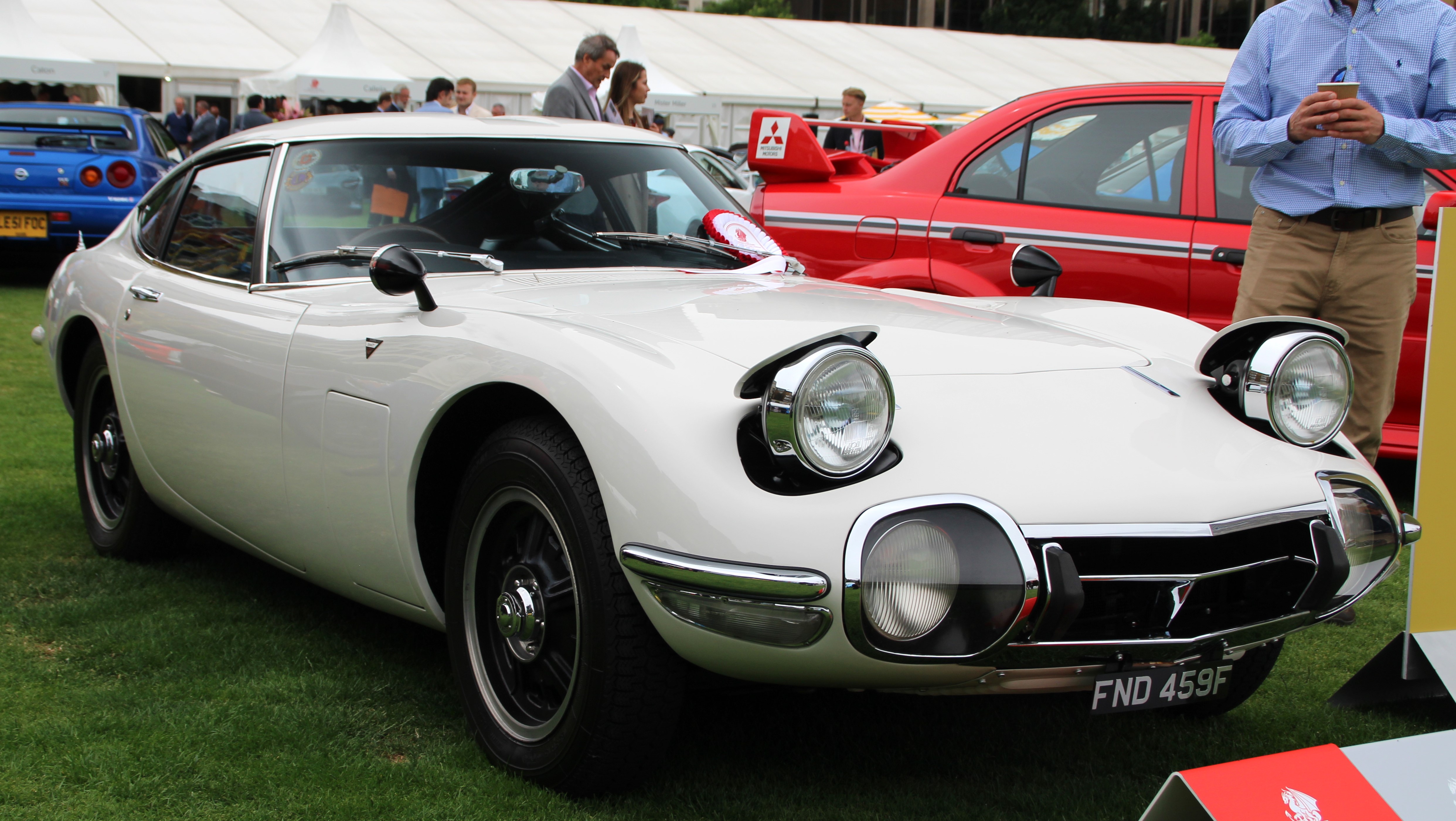
But when you're talking R34 GTRs or Toyota 2000 GT,
things like that.
I mean, they're going for Ferrari prices.
So I could 100% see it moving towards that.
Yeah, absolutely.
If a young enthusiast wanted to get into fabrication,
what advice would you have for someone looking to dabble
into that industry?
I'd start with YouTube.
I'd buy some cheap tools and I'd start with YouTube.
There's some really good guys out there.
I've got a couple of friends with a solid YouTube channel
where they're doing all kinds of stuff
and showing the skills.
Yeah, absolutely.
Join a Facebook group.
I'd start manually.
There's some courses you can take,
but you can do apprentice stuff.
You can get into workshop seminar type things.
I would go that route.
And just like, I mean, if you really
want to get into it, find a project to build a chopper.
Maybe make the vendors, make the tank.
Find some things that you can approach without having to do
a whole car.
Right.
That's a good idea.
I didn't think of that.
Yeah, it's small.
Maybe like a cafe racer, or a chopper.
Yeah, build the safe for your cafe bike.
I mean, start there because diving in,
you've got to kind of start at the bottom of that.
100%.
Right.
It's probably a 10-year process.
I was going to say, yeah, it's really daunting.
That's why I asked.
It's like, it's such a big thing.
I feel like it's hard to get into it.
Yeah, it's a great example to get into bikes.
You mentioned burnout and stuff, too.
What do you do to kind of get over that burnout hump?
What gets you fired back up again?
Lately, it's the coffee thing.
Oh, cool.
I kind of needed to just put my mind on some other project.
Yeah.
I really like skilled trades.
And every single day when I'd go to work and work up a coffee
and hit the work bench and get to work.
And I took a little time off.
I was in a business partnership that didn't go as planned.
And I was brainstorming, like, what else can I do?
So the whole motivated coffee thing came up.
And building a coffee company that
can help support the next generation.
I mean, that's kind of the goal is to give back
to the community, working with a couple of foundations
in early talks with them to give back through their foundation.
One of them funds scholarships.
One of them funds the sort of look for apprentices.
Oh, yeah, cool.
So they actually have.
Whoa.
It's thunder.
I think it was thunder.
And one of them, yeah, works with employers, actually,
to help cover the cost of training.
Oh, OK.
So if you are a restoration shop or a custom shop
or a hot rod shop and you need to bring in somebody,
in general rule, if you see a job application,
they're all going to say they want five years of experience.
How do you get it?
You're not going to get the right experience at a body shop
most of the time.
You're not going to get it on your own most of the time.
I was lucky.
I got in with virtually no experience.
But they were willing to invest the time in me
because they figured I could do it.
But yeah.
So that's cool.
So you're essentially giving that opportunity to others then.
Because I can imagine as like a business nowadays,
things are the way that they are.
And it's like, oh, well, we're going
to have to invest hundreds of thousands of hours
in training this person.
That's expensive.
So being able to cover that cost, I think, is super cool.
Yeah, I think what they're working out right now
is they cover roughly like 75% of some of the training costs.
And it involves the Department of Education,
some paperwork and stuff.
But it's a pretty cool program that I'm learning more
about, and hopefully we are going to work together soon.
That's awesome.
So yeah, that's something I'm pretty excited about.
Love to hear it.
Something that I'm excited about
is one of our sponsors of the Martini Works podcast,
Continental Tire.
They just released the Viking Contact 8,
which you can check out over at martiniworks.com.
Winter Tire.
Winter's coming up, unfortunately.
But a set of winter tires will change your life.
It'll make you like winter just a little bit more
because it's tolerable.
It's tolerable.
You can have some fun in the snow when you can actually
control your vehicle.
So make sure you head on over, beat the rush.
It's already getting to be like too late.
So if you need winter tires, go check them out.
Otherwise, Continental offers awesome all-seasons
performance tires, the DWSO6, the Extreme Contact Sport 02.
Whatever you're looking for, and they
have a ton of sizes and awesome warranty.
So head on over to Martini Works.
And thank you to Continental for being a sponsor
of Martini Works podcast.
We'll be right back.
Well, getting back into it, what do you currently drive?
Do you drive anything cool?
And do you have a dream build?
No, I don't drive anything cool.
You got to build something.
Working on it.
Once you leave here, maybe you
should go round something up quick and just.
Being the dreamer that I am, just before COVID hit,
I created this idea that I was going to build my own car,
like a scratch-built one-off, tube chassis, constructed
like a vintage Cobra car, aluminum body.
And I got well into that, but I have not completed that.
COVID hit, business got busy, and I was actually
going to maybe do a limited production run of those,
but I just learned that was going to be tough.
What a crazy concept.
That's so cool, though.
I'm sorry.
But yeah, that's sitting in the storage unit.
In terms of the automotive community,
I was thinking about this on the way over here.
You got the drivers, you got the builders,
and then you got all these people behind the scenes.
You got the craftsmen, the mechanics, that whole.
And I've been more in that.
I love building it.
Driving stuff is fun.
Going to car shows is fairly fun.
But to be honest, for me, when I'm around the stuff all day,
I'm less excited about car shows.
Fair enough.
Then I used to be.
When I was a kid, I thought I was the coolest thing.
You get a little desensitized with some of this stuff.
But I've got one on my radar.
My buddy's got something I'm interested in buying.
So we'll see.
That's a, you have to run it by the wifey.
That was a good call.
I get the stamp of approval.
It's an investment.
I think it's a solid investment.
He's got a 308, which I really like.
Solid car, solid driver car, mechanically sound.
Not crazy price tag.
It would actually be fun.
Not afraid to hurt it.
That one's, that's an idea floating around.
But he's on defense about selling it, too.
So that's what I'll see.
Yeah, I feel like with having all the projects you do,
it's got to be tough to work on your own thing, too,
and make time for that.
It super is.
And that was kind of the plan with my car.
I was feeling the gaps here.
But I got two kids.
Yeah.
There's no gaps.
Yeah, that's the problem.
OK, where did my gaps go?
Yeah.
Yeah, so yeah, it's tough.
Starting a business, you get a lot of obligations.
Not just the work, but keeping up with payroll
when I had employees and all the paperwork.
Yeah, it's not like you're just at work doing the stuff.
It's like you're running the dang business.
Yeah, you're doing everything.
And I was doing everything, right?
I mean, I was kind of the lead at the shop.
And also doing work, too, so it was busy.
It still is busy, absolutely.
So this might be a silly question, but I don't know a lot
about the world of fabrication.
Has it been modernized at all?
Is there tools that really help you?
Or is it still kind of the way things were in the past?
A lot of stuff is still done the traditional way.
There are some new tools.
There is incremental sheet metal forming stuff out there.
I did get some time this year to experiment
with one of those machines.
And I found it has its uses.
It definitely has its uses.
There's some limits to what I found,
at least in terms of the types of alloys required
and how the metal has to be treated most forming.
So there's modern technology out there.
Slow adoption.
Slow adoption, I think, because there's some hangups with it
yet.
And there's also resistance to traditional crafts.
And we're like, well, why are you doing that?
Yeah, it's like we've done it this way.
I feel like there's always that mentality,
that it's got to be done this way.
That's how it was done.
Yeah.
And I mean, to put something into a machine,
you've got to have a 3D model or scan a part.
You've got to get it in CAD.
You've got to write the program.
You've got to load the machine with whatever.
It's like, OK, the craftsman's standing next to him
and be like, I could be done already.
I was going to say, how does that work?
So you've got to balance the costs and the time of like,
is it faster?
Yeah, you put that much time into engineering or just
actually do it.
I was going to ask, too, because I
know about the sheet metal forming machine
like you were talking about.
I've actually seen that.
And we have a partner that has one of those as well.
And a crazy, crazy concept, crazy cool machine.
That's the machine.
I mean, not them, but the same machine.
It does a really cool thing.
You put it in a piece of sheet metal,
you tell it what to make, and it makes it kind of crazy.
But in the case of hand-forming stuff,
it's like, are there blueprints you go off of?
Is it just like referencing the old photos?
How do you even start times?
I mean, sometimes you start with photos.
Wow.
I had a customer approach me to build a kind of off-the-wall
project.
It was an X-caliber race car.
Before X-caliber, there were like weird fiberglass things
on the Corvette chassis that had a race team.
And they would race out at Elkhart Lake.
And they had, I think, three hand-built race cars that
were built in Milwaukee.
And guys like, I got a bunch of the parts
of the one of the originals.
Could you build me a body?
Yeah, sure.
So we did do that.
I started with reference photos.
And from there, I had the chassis.
We were able to get one of the other old cars
to look at the construction methods.
It was different.
But at least we could see how they built it.
So we built what's called a wire form.
So imagine just a skeleton of what the body would look
and then shape the metal to the skeleton.
So we could prove the shape's kind of in the wire form.
And then as we were shaping it, we
could see if we wanted to do anything.
It's a lot of make parts.
You guys know what Clico's are?
Yes, I don't explain it to me.
Clico's are little temporary fasteners.
I didn't want to throw that in there in case you guys
have no idea.
But yeah, you drill a little eighth inch hole,
and it's just a little repeatable clamp.
From the aircraft industry.
Anyway, Clico, all the panels back.
Just kind of eyeball it.
See it well.
Hey, you got to do what you got to do sometimes.
You just study it and make art.
A lot of those old cars were not symmetrical.
So there's some leeway there.
I was going to say, yeah, because in my mind,
that would just bug me so much when something's not
perfectly symmetrical.
I feel like, yeah, like you said,
that's just kind of how it was.
A lot of times you can't tell.
And what makes it work is the craftsman's
going to stand in 20 feet back and like close enough.
But I mean, really, that's it.
I've worked on Ferraris where the doors were like inch,
two inches different.
Wow, wow.
Inside, and you can only see one side at a time.
One side at a time.
One of them, yeah.
That's the thing we'd always say,
well, you can only see one side at a time.
But there's anomalies.
I think to an extent, it makes some of that stuff
more beautiful.
I mean, it's unique.
It's unique.
It's like the face of a beautiful model.
They're not all perfect, you know what I mean?
So when somebody asks you to do something,
it's like, you shoot for perfect,
but when it's a little off, it still fits the mold.
Yeah, 100%.
That's kind of feel really amazing, though.
Once it all does come together
and you're able to look at something you create.
It's incredibly rewarding.
Yeah.
That like, it's incredibly rewarding.
That final day or two or whatever,
when it all comes together,
there's a lot of just like taking it in.
At least for me, I like to just stare at it.
Grab a cup of coffee or average and just like,
okay, I built that.
Yeah.
And it leaves and you never see it.
Yeah.
Yeah.
Well, I was going to put some of that.
See ya.
Yeah, you might have a customer
sending you some pictures down the road
or you'll see it at a show someplace.
That's cool.
So yeah, there's some reward there.
Yeah, that's super neat.
But there are other ways,
like if somebody is building a new car,
they'll build a buck.
A buck is basically like a wooden model.
Okay.
Essentially, and you shape the metal to that.
Oh, wow.
And then take it off and put it on the chassis.
Whoa.
I was gonna say,
because I remember like the old car commercials,
I think still some new car,
they're showing the guys are sculpting stuff
out of like clay.
Yeah, I've seen those too.
That is actually like a real thing then.
Oh yeah, for sure.
For sure.
And you know, a lot of custom shops will still do that.
Sure.
You know, even if it's just like grafting a tail light
into a hot rod, they can sculpt that corner.
Right.
Create patterns from that.
Sure.
So I do that sometimes.
I'll use the clay.
Yeah, that's cool.
Oh, that's super cool.
Because I've seen a lot of stuff move,
kind of like in the fiberglass world
and things like that.
Making like body kits and things, you know,
they'll shoot a bunch of expandable foam on stuff
with cardboard and then they'll just start carving away.
And it's like,
that's such a crazy concept,
but like it kind of stems from that.
Yeah, I mean, you're sculpting it.
And then, you know, you get something close.
You can lay fiberglass on,
make a mold, pull a pattern or whatever you need to do.
Yeah, that's it.
That stuff's fun.
Yeah.
I mean, that's like really creative.
You know, get your hands dirty a little bit with that.
Yeah, for sure.
For sure.
That's dope.
I like that.
I like the hubs that are like,
during this process that are like more difficult
or like, oh, shit, we're at this point now.
Yeah.
Yeah.
The whole thing.
I would say the fun part.
Yeah.
At least from my perspective is shaping the parts.
Right.
You know, you break a fender down or a quarter panel
or whatever part of the car down
into pieces that you can manage,
shape them appropriately, fit them to your form,
whatever you're using,
then they all get to get welded together.
That's the process that I find a little more tedious.
Yeah.
You know, if you're really good at the welding,
like I take weld everything together,
there's like very little grinding.
I don't like to waste my time doing that.
Welds are then hammered back out.
They, when you weld it distorts the material,
so you got to bring it back.
So there's welding, grinding, metal finishing,
filing, you know, that gets.
Like one of those one step forward,
two step back kind of thing.
Okay, well now it's one piece,
but now I got to reform the whole thing.
Yeah.
Yeah.
And you know, you wind up taking parts off
and putting them on and taking them off.
Oh yeah.
You know, little tweaks here
and a little file swipe there
and a little more shape here and a little, you know,
you know, when I had a boss at one of the places
like just leave it on the car.
It's like, well, I got to take it off.
Like, oh man, we're getting close to the end.
No, no, that's got to come on.
The whole thing's got to come back on.
Like 50 more times.
But it's got to fit.
Everything's got to fit just right
before you put it on for good.
And there's, you know, many, many, many areas
where you get around into fitment issues.
Those old, like the whole front clip was one piece.
Not like a modern car with fender bolts on, hood bolts on.
They were one thing.
Yeah, that's crazy.
So you imagine all those pieces going together.
You got to figure out the order.
Yeah.
You got to do that puzzle in your mind first.
Right.
A lot of times that's,
that's you'll wake up in the middle of the night.
You're like, oh, OK, I'm going to weld that piece
to that piece.
You're going to have like a breakthrough moment?
Yeah.
Yeah, it's the back brain working when you're not at work.
Figures it all out.
And then you go to work the next morning, put it all together.
Nice.
So crazy.
Out of all the, like, cars or projects you've worked on,
is there any specifically that stand out to you
that, like, pushed your skills the furthest?
Yes.
I worked on a car that was called a Ferrari.
I believe it was 400 super fast.
It was a prototype vehicle that Ferrari put out,
and they used it as a design mule for several shows.
And that car had been through many iterations
in many different design changes.
And they did it very crudely in period
there was, like, inches of lead on that car.
Oh my god.
Yeah.
They sculpted parts of the car out of lead.
Oh, man.
We made it steel.
So that car came in with the wrong front end on it.
I wound up building the entire front half of that car.
Wow.
Because it was gone.
The door skins on that car, 70% of the quarter panels
on that car.
I did a lot of that.
And that was a unique car.
So it was essentially kind of like a concept car for that.
It was a concept car.
Man, it's so crazy.
Yeah, after I left, it came back, and they went through
and did a couple iterations of the progression again.
So the guy restored it fully, brought it back,
and then did another.
So that's like one of those instances
where it's like you're looking at a bunch of history then.
You're looking at all the old photos.
That's the one and only reference to it.
My gosh.
Yeah, there was so much to fix and so much to replace.
That was the one where the car was very,
the cowl was like racked off-center from the factory.
And you can see it in period photos.
So we left it.
Yeah, if that's what it was.
It was an inch in this way and an inch out that way.
So this side of the car was a rounder than this side of the car.
It's so interesting.
Is there ever times where you make the call or made
the customer specifically makes the call like they want it
improved or they want it different from the original?
Or is it usually you're trying to get as close to that original
as you usually are trying to go as close to original as possible
with the restoration stuff, the concor stuff.
Customers may dictate some of those decisions
or they might go to a very specific period of car
where if it was raced at an event, like at this event,
it had these louvers.
And they're interesting like that.
Yeah, we're going to paint it that way,
even though it wasn't the way it came off the factory.
They match like a period scheme.
That's really cool.
I like that.
You guys do the painting of everything.
So when the car is done, where you are, it's completely done.
100% ready to go.
That's what you're saying?
What's that?
Like the whole process, when you're restoring a car,
you do everything.
You've done everything.
Do you paint personally?
Oh, no, I do not.
I just do the metal stuff.
Got you.
I am a specialist in that.
I do not sling bondo.
I do not sand.
That's not my wheelhouse.
There are very talented people that can do all that.
And they should be doing it.
That's a whole skill set.
It's off to you.
There's just so many things that can go wrong
when you're painting a car.
Oh, yeah.
You need somebody that really knows what's off.
Yeah, I can barely spray paint something without getting
paint runs in it.
So I give all those guys props in the world.
I totally understand you every single time.
What skill set in what you do, would you say,
took the longest amount of time to learn or perfect?
It's the metal shaping aspect of things.
Really curving amount.
Yeah, to get it really nice.
A lot of it was on the job.
But I did do a seminar.
And the seminar just jumped those skills forward
several years, just because I was
able to have very intensive time with somebody
who really knew what was off.
But yeah, that's probably the hardest.
Beyond that, you kind of have to have a built-in ability first.
And once you have it, if you're born with it,
you can kind of take that path a little bit.
Yeah, you've got to have an eye for it.
Be able to visualize it.
And in the problem solving, the sort of deconstructing
things and reconstructing things in your mind,
if you have those two things,
then the actual skill set takes time.
I mean, I would say I got pretty good at it
within five to seven years.
But I mean, there's always incremental gains.
And I reached that point where the gains were not
so significant.
I really enjoyed when I'd make big leaps.
Oh, wow, this panel is way smoother than the last one,
because I did it like this.
But now it's just like, it's the little wins that like,
really perfecting.
Yeah, and it's actually harder to stay motivated for me
with the little wins.
The learning curve tapers, it's kind of like, OK,
well, a little more monotonous.
Right, yeah, absolutely.
So swinging back to the coffee side of stuff,
you said I was able to kind of bring your spark back.
What have you learned by delving into something
so different?
A lot.
I mean, just everything that goes into a coffee business.
A lot about the coffee itself, where
it's grown, like acidity and roast profiles
and different types of beans.
All that stuff was, I was aware of it.
But when I was like, I think I'm
going to try to build a brand here.
Yeah.
I have this idea, ran a test kind of with just
like a really crummy little Shopify store.
But just to see if it was of any interest,
there was enough interest that I was like,
I can't let this fall.
I got to keep going at it.
And so yeah, I've learned a ton.
And it's not just related to the coffee.
The learning experience has been setting up
the entire online facade.
Yeah, 100%.
Everything that goes into that.
I mean, there's a lot there.
And there's many times I've been totally
overwhelmed by it, honestly, because it's like,
you can set up a Shopify store in 10 minutes
to make it look good.
And function and function and cause people to buy
is like a whole nother animal.
Oh, 100%.
That's why, even for our site and stuff,
we have these guys that kill it and their web developers.
And we give so much credit to them
because it is truly hard.
And that's a skill sentence itself
is creating all that and making it user-friendly.
There's a craft.
Not having a billion issues with it and all that.
100%.
Yeah, so I mean, that has been engaging for me.
I like to learn new stuff.
And just kind of absorbing all that.
The next massive mountain for me is marketing,
which you guys are awesome at.
Oh, well, thank you.
I feel like I'm a little toddler wearing my marketing
diapers.
Maybe I'll get my trainers out soon.
But yeah, there's so much, so much to learn.
I think the brand is super cool.
So the motivator coffee, obviously,
tying it back to a lot of the automotive stuff.
So the brand is very automotive forward.
I think that's super cool.
I wanted it.
One of the reasons why you guys
are coming to Gatlinburg this year
is why we partnered with you to help with our own coffee,
essentially, that we are bringing to Gatlinburg.
So make sure to check that out.
It's fantastic stuff.
Yeah, if you're there, you got to pick up a bag.
No joke.
Not just saying it's like, we brought in and test it.
We want to see.
It's the first time we've ever done anything like this, too.
So we learned a lot about the process.
We're getting to go there and check out
where it's actually roasted, which is exciting.
So stay tuned for that video.
But it tastes so good.
It's some of the best coffee I've had.
Like, I drink it straight.
Normally, I always, I'm a creamer person.
I had creamers and sugar and whatnot.
I didn't have to.
I legit was drinking like the espresso straight and stuff.
So I was super excited.
It's neat, too, to have the automotive side tied in
with that.
I really like that.
And I enjoy it.
There have been a couple brands, I think, in the space
that were automotive-oriented.
Yeah.
They did a good job.
But I think a lot of it was flash.
Sure.
Right?
My angle.
I'm the guy here doing it.
It's not just a guy that has some money that
can put a bunch of marketing materials out there.
Yeah, right.
I really like kind of catering it to the people that
are in it.
And then, hopefully, the people that are outside of it
will help support it and see that.
So I'm really excited about it.
It's really something that kind of,
it's a labor of love for me at this point.
Yeah.
Yeah.
I think that's how you win, though.
Those are some of the best projects.
Because when we started doing this,
we didn't know anything about marketing.
I didn't go to school for marketing.
I was a security guard at a Walmart distribution center.
And I think the golden ticket to marketing
is just enjoying what you do and sharing that with others.
I truly, I don't think it's a class you take.
I don't think it's any of that.
So I think you're right in the, you're just passionate about it.
You like it.
You wanted to have another creative outlet.
So I think that's why it will be super successful.
I think it will.
I've got to figure some things out.
Yeah.
That's a beast of it, though.
Yeah.
No, you're right.
And I've heard people say you should scratch your own itch
when it comes to businesses.
Things that generally interest you.
Yeah.
So you used to talk about it.
I tell you, man, when I scoop my own brand in the morning
and it's fucking delicious, it's the coolest thing in my world.
I've already made it.
Yeah.
I'm going to pursue my own brand.
Yeah.
I don't care if it's profitable or not at this point.
Exactly.
But we will make it profitable.
And I hope to do actually a lot of partnerships.
I've got some ideas for limited partnerships
that could be really cool.
Absolutely.
And support other businesses in the process.
Yeah, 100%.
I think it's awesome.
I'm super excited to see it.
And then to have our own blend to that,
we get to collaborate with you.
It's so cool.
I'm excited to try it.
I got you guys a sample.
Yeah.
I'm going to steal one of the bags before I drop off.
Oh, absolutely.
I'll make sure you get a couple bags of it
because we've got to meet up in the morning
and have some coffee.
But legit, we're excited.
We're actually going to go there.
We're going to film some of the process of it.
So we can show you guys how it's done.
And it's just super neat.
Talking about some stuff we're into,
Melco Automotive, another sponsor, the Martini Works podcast.
Another thing besides coffee that we're bringing down to get
is our car show detailing stuff.
Got to make sure everything is nice and clean for you guys
down there.
We have two exclusive cars we're bringing down there.
You might know about one.
You might see Alex open his big mouth about it.
But the other one, we haven't.
We haven't spilled the beans on the other car
we're bringing.
So we're super excited to show you, but we do that.
Have them all showcased.
We get down there and we spend hours making sure they're
clean and we do that with Melco Automotive.
It's been really great using their stuff.
So the Cherry Flash, it's phenomenal for quick detailing
at shows.
We've even used it.
They taught us when they came and taught us about the stuff.
Use it in direct sunlight.
A lot of other brands can't use it in direct sunlight.
It gets all weird.
This stuff, it works really well.
So I sprayed it on the car like baking in the sun
all day.
And it's done a great job.
It's not streaky.
No, it works good.
And it smells really good, too.
It smells great.
So check that out.
We have a bunch of detailing kits
that you guys can pick up or you can buy them individually.
It's up to you.
Check them out over at Martiniworks.
And a huge thank you to Melco for being a sponsor
of Martiniworks podcast to be back.
Tell me about barn finds.
I've been fascinated by them since Forza Horizon
integrated them into the video game where you could
drive around and find barn finds.
I think it's every car enthusiast's dream
to find the old lady that has her old deceased husband's Toyota
Supra just chilling in a garage and wants 5K for it
because I'm still looking for that.
What's it look like when you guys get a barn find in?
Well, you've seen the pictures.
Yeah.
Right?
So that is the dream.
But yeah, sometimes they show up.
So they are a real thing.
They are a real thing.
You're telling me there's a chance.
So you're telling me that.
Yeah.
Yeah, they'll show up.
And sometimes, honestly, I don't get emails from people.
And they're like, hey, let's snap a picture of a barn.
And I'm like, dude, there's two of those in the back.
Really?
And I'm like, I clapped out Porsche 356 or something.
They're still out there.
And that's what blows my mind.
But I've seen some of those pictures come out
on the internet like, oh, this car, it's just phoned.
And some guys' garage or barn or chicken coop or whatever.
And they come.
They show up just like that.
I mean, usually they'll sell them at auction
kind of looking that way if the family wants to.
If that's the way they go.
Otherwise, the family sends it out for restoration.
But yeah, they send it to the shop.
And it's like covered in grime.
Smells like mouse piss.
Always.
The animal mold.
It's not a question.
It's just like, oh man, this thing reeks.
So what's like step one?
It shows up.
It's there.
Smells like mouse piss.
What's the first thing you're doing with it?
You probably maybe rinse it off a little bit.
Spray it out.
Yeah.
Maybe blow off some of the dust outside.
But yeah, itemize parts.
OK.
Take off little stuff.
Leave it together.
Just kind of dig in and see.
Usually it's an exploration.
Like you pull the seats out.
You open the trunk.
You see what's under the mat.
Is there anything under the mat?
You've got to have found some like,
is there ever anything in the cars
that you find that's interesting?
Maybe you'll post card monies.
I have also some old tools.
Periodically, you find some old newspaper stuff and stuff
in the corner that gives you some sort of sampling
of the time frame.
That's kind of cool.
And so I would have fun with that part.
Seats or something.
I find it fascinating when I buy a used car.
And I go through it in detail for the first time
when I'm finding old receipts.
And you kind of find that story of the car.
Oh my god, this receipt was in Ohio.
This thing was in Ohio.
I didn't even know.
Just like old stuff like that.
I think that's cool.
I found some tools.
Yeah, that's neat.
You were left in there from when it was built.
Old tools, stuff behind the upholstery.
Like there's only had to be there.
Little signs that the craftsmen were there.
But yeah, it's a fascinating process.
There's usually all sorts of weird stuff in the glove box.
Yeah.
I bet.
I don't imagine.
So yeah, we've had cars that we joked
were like some drug cars from like South America or something.
Because they just looked wrong.
Yeah, yeah.
Oh, there's no reason for these holes here.
Yeah, that's crazy.
So OK, so you itemize it.
You get everything listed that's
saveable, I'm assuming, right?
Yeah.
And then do you kind of have like a storage facility
for that and kind of organize it in that way?
Just storage racks like you got here, guys.
You just want it out on a rack, inventory invisible.
And you just go through it.
Makes sense.
But yeah, you start with junk.
So it's inventory.
You get it stripped apart.
What's step two then?
After step two, after step one, I'm sorry, it's a, yeah.
So full disassembly, mechanical disassembly.
OK.
And that's getting everything out.
Yeah, getting everything out, pull the motor,
pull the transmission, see what's going to be usable.
Is it a lot of times I'm assuming with barn finds engine
and transmission got to be replaced, too,
that it's probably seized up?
Yeah, yeah, yeah, there's nothing.
I mean, you can save them, but you can tear them apart.
You got some of these older cars coming in that it's
old Ferrari or something like that.
I can imagine the engines aren't super available
for that kind of stuff.
It's like you just sent almost have a whole other shop
to send out an engine to resurrect an engine, essentially.
Yeah, there are a couple of specialist shops.
The shop in town can handle all of that.
They're actually very good at that end of it.
So yeah, it's a process.
The cheap barn find starts not being so cheap.
It all seems really cool in theory, right?
It's like, oh man, I just found my dream car just
chilling and I get it for essentially nothing.
And it's like, yeah, but now you got
to stick a couple hundred grand to where it should be.
It's like, ooh, that got hit really bad.
Yeah, it's wild how much of that stuff is still out there.
And then too, I'm interested with the business side of it.
It's got to be kind of a logistical nightmare
if you get a few vehicles in at a time
and you're doing all this custom stuff.
And are you typically working on multiple cars at a time?
Or is it you kind of focus on one for a week or a month
or whatever?
Depending on the shop that you're at.
Like my shop, I was just a metal shop,
but I would have three or four projects going at once.
And logistically, that's because we'd
get stalled out for one or another.
We would just need to keep people busy.
Bigger shops, yeah, they'll have anywhere
from like two to six projects,
probably going pretty consistently
through at least full projects.
There's always like the continual repair.
What's like the longest project that you can remember?
How long did the longest one take?
It's got to be crazy.
Yeah, well, that would probably be that one
that I had 2,000 hours in.
I think the biggest project I was part of.
I don't know what the total hours were on that.
I wasn't privy to that information.
It was probably a couple year project
with a lot of people.
I can imagine.
Dude, that bill had to be just absolutely insane.
No idea.
No idea.
This has to be atrocious.
Yeah.
Oh my gosh.
But yeah, that's crazy.
Just be like, yeah, take this car for a couple years
and do what you need to do.
And it comes out the way that it does.
It's such an interesting concept.
I love that that's a thing because I think
it's important to keep those cars like that.
Keep that history around.
Keep those stories around.
Because every single one of those cars
has just some sort of insane story attached to it.
And I think that that's super cool to keep them on the road
and keep them in shape and literally reviving them
from the dead in some cases.
Many of them are essentially fine art.
Just beautiful as a sculpture.
So definitely worth saving and putting in the time
if the rarity and value makes sense.
100%.
Absolutely.
So then once it's disassembled, you
get all torn apart, engines out, transmissions out,
you're basically just left with the frame.
And then you start with what's left of it.
Sometimes.
Sometimes you actually peel the aluminum skins off.
Dang, wow.
So you take all the skins off the car
and you're just left with the framework and the frame.
Sure.
You got to see if what's all going on in there.
Yeah, and you got to get in there and sanitize the corrosion,
fix what's bad.
Take care of all that.
And then the eclipse got to go back on.
And that's a fun process because everywhere
you peeled that edge off, you've
got well, little two-inch strips of aluminum
around every single edge.
Oh, man.
So you have fresh edges to wrap.
Sure.
Because they've been, you know, they're thin.
They're filed through.
They're cracking all over the place.
You can only bend aluminum so many times
until it just breaks right off anyway.
So that's like a big thing.
With aluminum cars, you can do that.
Steelers cars, it's harder, but it's definitely been done.
Yeah.
But yeah, sometimes you get really deep into the weeds.
Yeah.
Not just like, you know, taking the suspension off
and painting it, you get all the way down to the bones.
Is it ever happened?
I feel like it's had to have happened
because I'll work on a brand new car
and I'll break something.
But like, I would be so stressed out.
You have one of these rare prototype cars
or just an older Ferrari and you're moving something
and you're like, she breaks?
Yeah.
You're in an environment, though, where the guy next to you
can fix it.
Oh, fair enough.
Right?
Yeah.
There's a place that you were to do that.
Yeah.
You'd probably be there.
Yeah.
It's like, oh, no big deal.
I got it.
Yeah.
And that was nerve-wracking.
But when I first got into it, I was like, OK,
I'm going to cut the front of this.
Yeah.
OK.
Where's it going?
Timothy.
I'm cutting this quarter pound.
Yeah.
And they're like, man, just there's
nothing you can mess up that I can't fix.
Yeah.
That's crazy.
That's such an insane concept.
And now, I mean, I have that same attitude towards it.
It's like, it's just metal.
Yeah.
I'll figure it out.
It's all just metal.
The hardest part is if you lose rare parts.
That's what I was thinking.
Like, little things.
Right.
Yeah.
Gages and little doodads.
The gifters and whatever.
Well, that's just like, we'd make ashtrays.
Oh, really?
We'll scratch out of bounds.
OK.
Sodering little pieces together.
Down to the details.
Yeah.
I'm getting stuff engraved, doing all that little stuff.
Because that stuff does get lost over the years.
There are junk guys out there that will save every little piece
if you can find those guys and if they speak English.
And if you can get them to talk to you,
they might send you the part for an exorbitant amount
of money.
Yeah.
Right?
Yeah.
So sometimes the hole just make it.
You just got to be.
Yeah.
But that's what I was thinking of because it's like, again,
I'm tearing into stuff and I'll crack something.
Barn find, you break something.
Imagine everything's got to be so brittle
if it's just been sitting and dried out.
Yeah.
I mean, like interior stuff, it's gone.
I mean, it's basically turned into dust, you know?
So all that stuff is shot.
I was going to say, interior stuff, that stuff,
I would imagine most of it's got to be sourced or something.
Well, it's usually one-off made in-house.
You can't, some cars, like little newer ones
with higher production, you can get some, like seat covers
and floor mats for.
But most of the time it's got to get to work.
Custom upholstery shop.
My gosh.
Custom upholstery shop from the springs and the C-frames
all the way up.
Wow.
So if you're getting a barn find, just
think about what you're getting into a little bit.
You're basically starting from square one or something.
Yeah.
I mean, every once in a while, you find a car out there
that's been sitting with like no miles on it,
500 miles on it or something.
Even that, there's going to be gremlins.
Oh, that's nice.
You might get away with changing the fluids.
But there's going to be corroded wires.
There's going to be.
It's all the stuff you don't chewed on something.
All the stuff you don't really think about.
Like you said, mice are, the animals in general
are atrocious to those cars I can imagine, like, Jesus.
Yeah.
You know, as we're talking here, I just want to shout
something out because there are so many talented people
in Fox Valley in the car.
I'm realizing that.
It's absolutely crazy.
I mean, obviously the shops we're talking about,
but there's several others.
And there's a lot of skilled people here.
It really is.
It's not just the Fox Valley.
There's some really great builders in Wisconsin.
Down by Milwaukee, up by Madison.
I mean, there's world-class shops within an hour of here
doing all different kinds of stuff.
So I just want to give this shout out.
Like we're talking about me.
I'm just one little P on you, right?
I do some stuff now and again,
but like there's so many talented people out there.
And in the end, like all of those people contribute
to the whole.
100%.
And it's a huge team effort.
And I appreciate that so much because like, you know,
we go to the car shows, we go to the museums,
we go to, you know, a race day at Road America.
And it's like, the reason those cars are there
is because of, you know, people like that
and people like yourself.
So, you know.
Whole support system.
Yeah, huge shout out to anyone that has a thing in there
because like you said, it's not easy.
It's a lot of hours.
It's a whole lifestyle to make sure
that these cars are staying so you can see them.
Yeah.
And I think like you're saying too, a lot of it,
like you got to be born with it a little bit.
You got to have the eye.
You got to have the skills.
You got to have the ambition.
Yeah.
The drive to do this.
So much goes into it.
So may the next time you're walking through a car show
or something and you see that older car
that's in mint condition.
Think about what it took to get it to that point.
It either is one guy who's been really diligent
about maintenance.
Yep.
Yeah.
That happened.
Oh yeah.
But sometimes it's a whole crew of people that brought it back.
That's why those conversations are so important.
Go ask somebody about it because I'm sure they're happy
to tell you about what's going on with it.
But what do you got going on, man?
Where can people find you if they want to see
what's going on with the coffee, cars,
anything like that?
Easiest thing would be probably Instagram.
Yep.
Motivator on Instagram and motivator.com to talk about.
Check out the coffee business.
Yeah, we'll make sure to link them in the description.
Yeah, go in the description and check out the website
that he's working on and the coffee.
And then too, of course, you can head on over to the booth
and check it out as well because we're going to have some.
Come try some.
Down in the...
Definitely go buy it because it is hands down
some of the best coffee you're going to get.
Yeah, for real though.
It's no joke.
I'm not just like proud on that.
Yeah.
No, it's legit.
That's why we do what we do.
This whole journey that we've been set on
is to just choose the stuff that we want to choose,
the stuff we believe in.
And this is just one of those things.
So make sure you come check it out.
But thank you so much for coming on the podcast.
Thanks for the chat.
Hopefully I didn't bore everybody.
No, I find it fascinating
because I'm so on the other realm.
I go to install an intake and I get frustrated
and I'm pass it.
So I literally can't wrap my mind around what you do.
I'm going to have to have you form my head
or something around it.
It doesn't make sense to me.
So much appreciation for your skill set,
what you do, your stories.
Super neat.
Make sure you guys go follow them
and check out what's going on there.
And finally, a shout out to Fortunato
for sponsoring Martini Works podcast.
Suspension of the podcast.
We've all ran it.
We've really enjoyed it.
We've been using it on all of our vehicles
and it's tested the stands of time, so to say.
Because I've been running it
since I was like 17 years old on my Evo
was the first car I put it in
and then my focus I put it in
and the super I put in
and that was before it was ever a sponsor
for the Martini Works podcast.
So we've really enjoyed working with those guys
and the crew down in Virginia
got to go check them out,
hang out with them
and see how passionate they are
about getting their suspension perfect for you.
So if you guys need help picking out
a set of coilovers like Fortunato's,
you can shoot us a message.
Otherwise they have stuff ready to go off the shelf
perfectly for your car,
whether you just want to lower it,
whether you want to do some spirited driving
on the weekends,
maybe you're going to the next autocross
or track event.
Fortunato's got you covered
with a million different options
and some customizable options for you too.
So thank you to Fortunato
for being a sponsor of Martini Works podcast
and we'll talk to you guys on the next one.
All right, thanks guys.
Yeah, thanks Austin.
Thank you so much.
Have a great weekend.
About this episode
Austin Perush, a skilled car builder and metal fabricator, shares his journey into the world of coach-building and automotive restoration. He discusses the intricacies of hand-built cars, the challenges of restoring vintage Ferraris, and the labor-intensive process involved in bringing barn finds back to life. The conversation also touches on his new venture, Motivator Coffee, aimed at supporting the next generation of automotive enthusiasts. With insights into the craftsmanship and dedication required in the industry, this episode highlights the artistry behind automotive restoration.
Support the podcast by getting your car mods here! https://martiniworks.com/Today on the podcast we have Austin, from Motovator! Austin has been restoring and creating cars for a long time, and with that has learned a thing or two. Listen in as we dive into car restoration and why picking up that barn find might not seem as fun as it does on paper. #cars #automobile #podcast Check out Motovator Coffee! https://motovator.com/Follow Austin @motovator.incFollow Dakota @dakotastoneFollow Gels @akagels