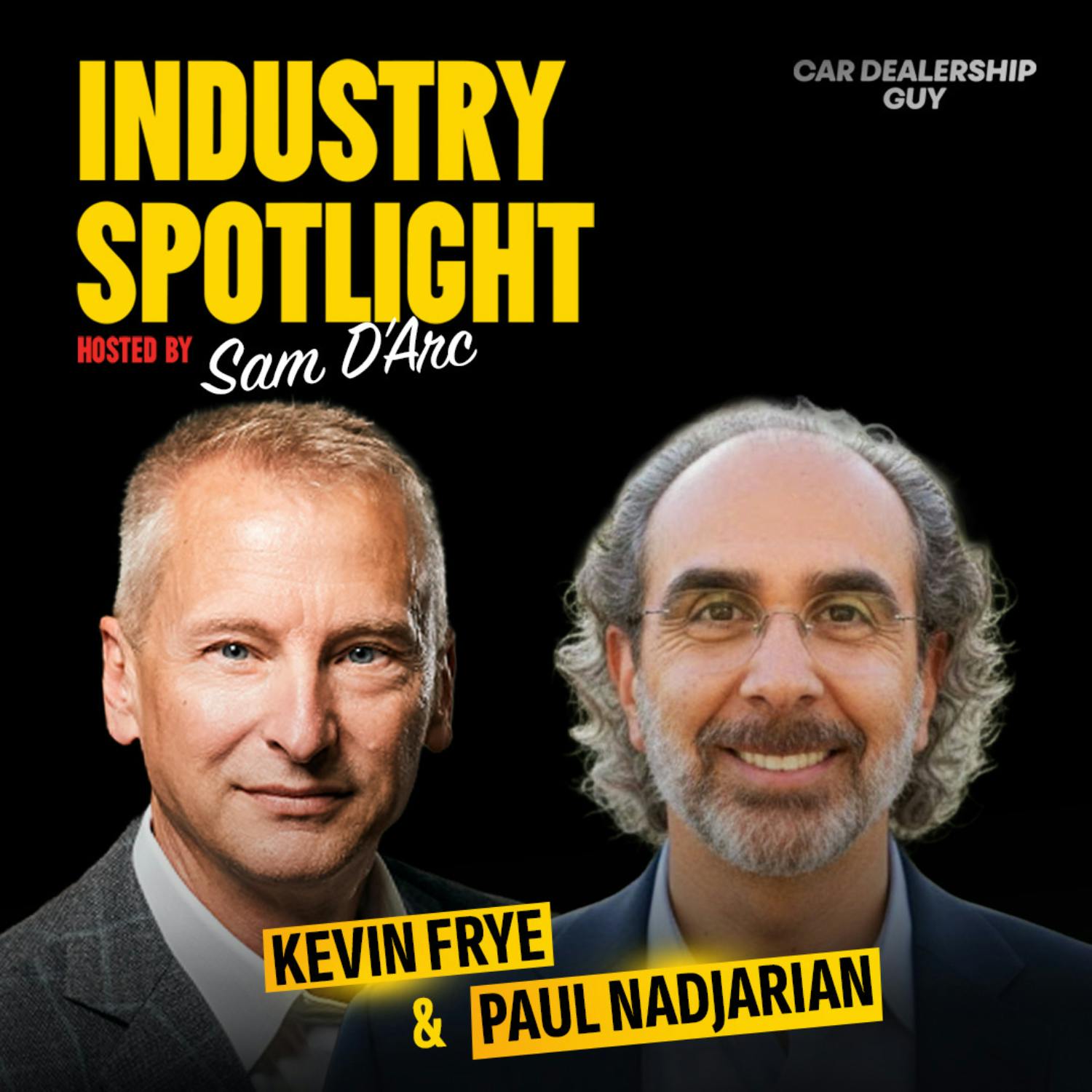
Exploring the critical issue of service retention in dealerships, this episode reveals that 55% of customers don't return for service in their first year. Host Sam Dharik discusses strategies to improve retention with guests Kevin Fry from Jeff Weiler Automotive Group and Paul Najarian from Carfax. They delve into the importance of effective communication, leveraging data, and the role of AI in reshaping customer expectations. The conversation highlights innovative approaches, including the Carfax for Life program, which enhances customer engagement and retention through personalized communication.
Welcome to Industry Spotlight—a focused series hosted by Sam D’Arc, highlighting standout dealerships and innovative companies, and exploring the trends driving success in today’s automotive market.
Today, Sam sits down with Kevin Frye, Marketing Director Jeff Wyler Automotive Family, and Paul Nadjarian, Chief Product Officer at CARFAX.
This episode of the Car Dealership Guy Podcast is brought to you by CARFAX.
CARFAX - Here's a reality check: CARFAX data shows that 55% of car
buyers won't return to the same dealership for service in year one. That’s lost
revenue walking out your door. But Carfax Lifetime Dealers don’t stop
after the sale. They partner with CARFAX to deliver co-branded, VIN-specific
service reminders that drive customers back to their service lane. The
CARFAX Lifetime program: Give customers the insight they want, earn the loyalty you need. Contact your CARFAX representative today. Learn more at carfax.com/CDG.
Check out Car Dealership Guy’s stuff:
For dealers:
CDG Circles ➤ https://cdgcircles.com/
Industry job board ➤ http://jobs.dealershipguy.com
Dealership recruiting ➤ http://www.cdgrecruiting.com
Fix your dealership’s social media ➤ http://www.trynomad.co
Request to be a podcast guest ➤ http://www.cdgguest.com
For industry vendors:
Advertise with Car Dealership Guy ➤ http://www.cdgpartner.com
Industry job board ➤ http://jobs.dealershipguy.com
Request to be a podcast guest ➤ http://www.cdgguest.com
Topics:
01:27 Why is service retention so critical?
02:34 Biggest customer communication challenge today?
03:10 OEM vs. dealer loyalty: who wins?
05:41 How is Carfax for Life game-changing?
07:52 Using data to boost retention how?
10:42 Future of customer engagement in service?
18:28 Most actionable insight for dealers now?
27:20 AI and data hygiene's role?
35:09 Final advice for improving retention?
Car Dealership Guy Socials:
X ➤ x.com/GuyDealership
Instagram ➤ instagram.com/cardealershipguy/
TikTok ➤ tiktok.com/@guydealership
LinkedIn ➤ linkedin.com/company/cardealershipguy
Threads ➤ threads.net/@cardealershipguy
Facebook ➤ facebook.com/profile.php?id=100077402857683
Everything else ➤ dealershipguy.com
"I think there's a natural tension between the OEM, the manufacturer, the people that build the cars, and the dealer group about who needs to maintain that connection."
OEM means the original company that made the car or its parts. It's important because it indicates the source of quality and compatibility for repairs or replacements.
OEM stands for Original Equipment Manufacturer, which refers to the company that originally manufactured the parts or vehicles. In the automotive context, it typically means the car manufacturer itself.
"is they came up with the Carfax for Life program where you can download an app on your specific vehicle to your phone. And what that helps to do, which we've been poor at is establish ongoing communication with the customer via push notifications."
Carfax for Life is a program that helps you keep track of your car's history and maintenance needs using an app. It sends you reminders for things like oil changes, so you know when to take your car in for service.
The Carfax for Life program is a service that allows vehicle owners to access their vehicle's history and maintenance records through an app. This program aims to enhance communication between the service provider and the customer, ensuring that owners are informed about necessary maintenance and service reminders.
"whether it could be an oil change, a maintenance aid,"
An oil change is when the old oil in your car's engine is replaced with new oil. This helps keep the engine running smoothly and prevents damage.
An oil change is a routine maintenance procedure where the old engine oil is removed and replaced with new oil. This is essential for keeping the engine lubricated and functioning properly, preventing wear and tear over time.
"...ide agency that's been doing this for the Fortune 500s. Cause honestly, it's something new thing for aut..."
The Fiat 500 is a small car that's great for driving in cities because it's easy to park and maneuver. It has a cute, vintage look and is known for being fuel-efficient, making it a popular choice for people who want a stylish and practical vehicle. It's often talked about because of its fun design and how it stands out from other cars.
The Fiat 500 is a compact city car that has gained popularity for its retro styling and efficient use of space. Originally launched in the 1950s, the modern version was reintroduced in 2007 and has become a symbol of urban mobility and Italian design. Its significance in discussions often revolves around its unique character and appeal in the small car market.
"...if I know that you own a specific Toyota Camry that it's almost clockwork between 70 and 75,000 miles..."
The Toyota Camry is a well-known car that many people drive. It's known for being dependable and comfortable for everyday use.
The Toyota Camry is a popular midsize sedan known for its reliability and comfort. It's often used as a benchmark in its class for performance and value.
Chevrolet is a car brand from the United States that makes many types of vehicles, like cars and trucks.
Chevrolet, commonly referred to as Chevy, is an American automobile brand known for producing a wide range of vehicles, including cars, trucks, and SUVs.
"...that was a car fax as to recall. Oh, interesting, really."
A recall happens when a car company finds a problem with their cars that could be dangerous. They ask owners to bring their cars in for free repairs.
A recall is a request by a manufacturer to return a vehicle to the dealership for repairs due to safety issues or defects. It's important for buyers to check if a car has any outstanding recalls before purchasing.
Why is service retention so critical?
Biggest customer communication challenge today?
OEM vs. dealer loyalty: who wins?
How is Carfax for Life game-changing?
Using data to boost retention how?
Future of customer engagement in service?
Most actionable insight for dealers now?
AI and data hygiene's role?
Final advice for improving retention?
Select text to request an explanation
Dealers, last chance to join our dealer chat groups.
Initial groups are forming now.
Registration closes on November 25th,
and we won't open new groups again until April.
If you want real operator-to-operator insight
heading into the new year, join hundreds of top dealers
at CDGCircles.com.
I'll see you inside.
Hey, everybody, welcome back to another episode
of the Car Dealership Guy Industry Spotlight.
I'm your host, Sam Dharik, and today we dive in
to one of the most important, yet often-overlook drivers
of dealership profitability, service retention.
Find out why 55% of customers never return for service
in year one and how to fix it.
What's the biggest mess in dealership retention?
Plus, how one dealer combined trust, accurate data,
alongside a laser-focused message to increase retention,
and tips for you to do the same this month.
Joining me today, Kevin Fry, Marketing Director,
Jeff Weiler, Automotive Family Dealership Group,
and Paul Najarian, Chief Product Officer, Carfax.
Today, truly, we have one of the most tactical,
revealing conversations we've had about retention
in a long time, what's broken, how to fix it,
and where those real opportunities are
as AI and automation reshape customer expectations.
Let's jump into it.
So, Kevin, tell us a little bit about yourself
and what you do as Marketing Director
at the Jeff Weiler Automotive Group.
Well, I'm the head coach of marketing here at Jeff Weiler,
and I'm handling all things marketing.
But often, I'm quite involved
with a lot of the strategic things as well.
Our department's well-known for its innovation
within the industry, so we're always trying
to push the edges of being out in front
of the ongoing things that are happening in an automotive.
So, I'm marketing and somewhat of the jack of all trades.
Well, it's fascinating.
That actually leads us into our conversation today.
You mentioned, before joining the show,
that retention, service retention is something
you're thinking about as a Marketing Director.
What the heck is a Marketing Director
doing worrying about retention?
You're supposed to worry about the leads, right?
You would think so,
but we're really trying to look at the entire picture.
And while we do a great job marketing
and creating more sales,
the truth is that fixed ops has often been neglected
across the entire industry,
and we'll raise our hands and say we're guilty
of that as well.
But the way things have been changing
in the market with compressing sales margins,
there's a greater emphasis now
to look on the fixed upside.
The other thing that's really stuck out to me, Sam,
is that the OEM loyalty and the dealership loyalty
just continue to decline.
Why?
And I'm convinced it's because we do a poor job
communicating to them through the customer ownership cycle.
We do a poor job showing them how valuable they are
as part of our family,
and that ties into that whole customer retention thing
that we're trying to improve.
So, Kevin, why do we do such a terrible job as auto dealers
at communicating with that customer?
The answer is, honestly, I think because in automotive,
it's a very profitable industry,
and so we get sloppy,
and so what we tend to do is we just keep regenerating
the same new customers every year
versus retaining them,
which is much more inexpensive.
And I think what's happening is that profitability
is driving us towards the fact
that we need to be more efficient,
which means doing a better job with customer retention.
Yeah, I actually also have another thought.
You tell me what you think about this.
I think there's a natural tension between the OEM,
the manufacturer, the people that build the cars,
and the dealer group about who needs
to maintain that connection.
So a lot of OEM programs retain them back to that brand.
A lot of our programs at the dealer level,
we want to retain them back to the dealer level,
and I think there's a mix of messaging.
Why is that, Kevin?
Why do dealers and OEMs kind of struggle with that?
Who's going to communicate best to the customer?
And why don't dealer groups who sell that car
win in that argument consistently?
Well, it's an age-old argument,
and I can tell you that Jeff Weiler was at the forefront
of this because we were one of the innovators
of the automobile concept.
And the idea was rather than just, for example,
brand Chevrolet, we wanted to brand Jeff Weiler,
where you could buy Chevrolet or Mazda or Aesha
or whatever the case may be.
So this continues to this day.
We want to be diversified in providing a great selection
of a lot of different OEMs to our customers,
because as you know, a lot of them,
Sam, will switch between brand to brand to brand.
For us, the brand we want them to be loyal to
is Jeff Weiler.
Yeah, yeah.
You discovered, through a partner Carfax,
a stat that to me was astonishing.
When we talk about retention,
Carfax data shows that 55% of car buyers
don't return for service in year one.
Is that a symptom of the problem you've identified?
And what have you done in the past
to try to solve for this?
Well, I mean, the reality is the car that the customers
are kind of captive to us as the dealers
while they're under warranty, right?
So I think many cases taken for granted
that these customers will come back
to do that warranty work,
which has kept us pretty busy.
So we're completely neglecting post-warranty,
which is where we have to compete
with the independence that are out there.
And that competition is pretty fierce
and it also drives down our margins.
So I think that's kind of the layout
of what we've seen the last 10, 20, 25 years.
So Kevin, you went to Carfax
and said, help us solve this problem,
which I think is an interesting solution
because Carfax, they're his vehicle history reporting.
They have nothing to do with retention, do they?
Now I say that tongue in cheek
because as an auto group at Ziggler,
we're a great partner with Carfax
and we see the value of them.
But what would you say to the dealer that says,
what does Carfax have to do with retention?
They're about vehicle history.
Yeah, if you just left it in vehicle history,
I'd agree with you.
But one of the big changes they made
is they came up with the Carfax for Life program
where you can download an app
on your specific vehicle to your phone.
And what that helps to do, which we've been poor at
is establish ongoing communication with the customer
via push notifications.
We always check our texts, right?
It's allows us to know when we're coming due
whether it could be an oil change, a maintenance aid,
a recall, whatever the case may be.
So it's created another communication channel
during that life cycle,
which has helped us retain that customer.
So it's fascinating, speaking of the OEM,
the OEMs try to do this,
auto groups in the past have tried to do this.
Paul, how does Carfax, as Carfax for Life,
do this differently and more efficiently,
more effectively than either one of those?
Yeah, thanks, Sam.
You know, the foundation of what we do as Carfax
is we build trust with the consumer.
And so that trust is foundational to the consumer
really engaging with Carfax.
So we've partnered with the dealers, like Kevin said,
with the Carfax for Life program.
And in partnership with the dealer,
we're reaching out to that customer co-branded
with the Carfax brand and Carfax information
to answer those questions of what's due and when
and so forth.
Now, the way we do it that's special and unique
is that it comes in the form
of a holistic dashboard every month.
So what does that mean?
It means it has everything on it you need to know.
It has, when your registrations do,
your emissions, it has whether or not you have a recall,
it has oil change, tire rotation, brakes,
it has major service.
So it's an entire list with a countdown for you.
So we count it down every month, like one is due.
And that holistic type view, what we've seen over time
is that customers open that communication
at a 50 to 60% rate when they open
and read that communication.
And that rate doesn't go down over time.
Why not, Paul?
Kevin, do you agree?
Like for whatever reason is the customer more engaged
with this technology than they are other attempts
to reach out and connect with them
that you've tried using other platforms?
I think it's the simplest communication channel right now
because they've opted in when they downloaded that app
to get those push notifications.
I promise you when I'm getting these little pushes
all day or text, that's the first thing I check
versus an email, a direct mail, a phone call,
whatever the case may be.
Yeah, yeah.
Paul, what's the secret sauce with Car Facts
that gets that amount of engagement
and retention with the customer,
which ultimately points them back to the Weiler Auto Group
or the Ziggler Auto Group?
It's gonna seem counter-intuitive, but less is more.
Ooh.
So less.
Let it do too much in automotive, Paul.
I mean, I don't know if you're in,
email list, but I get five emails a day from.
Way too many.
I just, I don't need sporting goods information
five times a day.
And so what we're doing with a holistic view
and we have all this different data
we can bring together in that dashboard view
and it's highly accurate is we send it once a month
and you get it the same day every month.
So if you get yours on the 11th of the month,
every 11th, you'll get it.
Yeah.
Then if you actually have something that's coming due
we're gonna send you more dedicated alerts
to let you know about that one thing that's coming due.
But I think the brand is trusted by consumers
and the brand helps the consumers build confidence.
And so it's the car facts,
partnering with the dealer,
communicating with the consumer drives that confidence
and the alerts is just a way that we're communicating.
But ultimately we're able to leverage that trust
and confidence and the accurate information
in order to prompt them to come in
and come back for a service.
I mean, we talk about retention is really loyalty, right?
But what is loyalty?
Let's break it down.
When someone buys a car from you,
loyalty is that they come to you for service
and they keep coming back for a service.
And then loyalty is when they're ready,
they trade that car back into your dealership
and they buy them in the car.
And then they trade in is homegrown
because it's been sold and serviced at your dealership.
So that is really what the loyalty cycle is.
And we designed Carfx Lifetime,
which is our bundled solution around that life cycle.
So it includes that entire life cycle
of selling the car, servicing the car
and then driving that loyalty back into sales.
So Kevin, to that point
is you think about retention
and owning that customer for life
or for a much longer time.
We at the Ziggler Auto Group,
we think about what's the value
of that lifetime customer.
We think about that often, right?
And how do we again,
retain that customer as long as we possibly can?
And you're right.
I think in the generation or the era of insane,
there were other priorities, insane profits
and other things that sometimes took precedent
over the concern about how to retain
that customer for life.
What is your benchmark for success on retention?
What is a job well done?
Where do you want to be?
Is there a percent?
What's the KPI or the metric?
So Sam, I'm going to throw out a very direct question
that I put out at dealers.
And that is this.
What is your current retention rate?
And it's pretty much crickets and blank eyes every time.
But I know it's-
Why is that, by the way?
Why is that?
How do you know it?
We do a horrific job in our industry managing our data.
So I'll tell you, we have 23 rooftops
and each rooftop averages between nine
to 13 separate databases.
None of these consolidated all over the place
and most of us have no idea.
And I was with that in mind.
And with our CDP efforts,
step one was to consolidate all the data.
I'm making this sound simpler than it sounds.
It takes time.
Then complete data hygiene on it to clean it up.
And then measure what your current customer retention rate is
so that you can see if it improves.
Yeah.
So you create the CDP, you clean it up,
and then you figure out
where is your actual retention rate today?
Was it surprising what the truth of the retention was
once you had clean data
and once it was all in one place?
Well, there's two things you got to define.
One is your customer retention rate.
And the second one is the lifetime value
that you brought up before, right?
And we actually started with lifetime value,
but it's trickier said than done.
And I'll give you an example where like,
we'll just take the top 25 revenue producers per store.
But the problem is all of a sudden
I got all these fleet deals mixed in
or I'll see duplicates.
And there's all these efforts of data hygiene
just to resolve what you think that is.
And then the customer retention rate
can be a little bit different
how people define that as well.
I'm not gonna punch out my actual numbers right now
but it's a five.
Oh, come on.
You gotta give it to us.
We're still refining how we define
the customer retention rate
and we're working with an outside agency
that's been doing this for the Fortune 500s.
Cause honestly, it's something new thing for automotive.
We've struggled to get a good, accurate answer.
And by the way, we're working on that.
So that's something we're starting in.
Paul, what are your thoughts on creating a CDP
where you have a singular repository,
cleaning up the data?
It's gotta create better engagement with your tool
and other tools if the Carfax tool
connects up with the CDP.
Is that how it works?
Do you connect with the CDP
and then is that a best practice
that you recommend as well?
Well, we actually run our own CDP at Carfax.
Okay.
So we have 52 million users
that use Carfax Carcare.
They manage 80 million vehicles in there.
So we collect all the behavior data
not just from Carfax Carcare
but from Carfax listings
and the Vehicle History Report
cause that's all over the industry.
The report is published everywhere.
So we collect all that behavior data
and then we know all the information on the vehicles they own.
We know when they've been in service.
We know what the odometer.
We know all those things.
We're attaching all that information
in order to give the best possible experience
back to the consumer.
Which means give them good information
to do what they should do for their vehicles.
What's best for their vehicle?
What's best for them?
It probably increases the engagement rate, right?
And then the overall retention rate.
Why do you think dealers are so slow to adopt that, Paul?
I think Kevin kind of said it earlier
that in good times,
you kind of get a little bit lazy
around certain things around the fundamentals.
I think tough times drive fundamentals
where you really have to have the offensive
and defensive line have to be very strong,
the fundamentals, the blocking and tackling.
What we do specifically is partner with the dealer
to communicate with the consumers,
leveraging our trusted brand and our better information
in order to drive the referrals back to the dealer.
And that is getting them from sales into service,
getting them to keep coming back in service
and ultimately from service back into sales.
Okay.
Because that group is the definition of the oils.
Which by the way, with cleaned up data, that's easier.
Your dealers are gonna be more effectively spent.
So props to you, Kevin, for doing that.
It's interesting, are there data points, Paul,
that car facts with your wealth of information
and customer kind of attitudes.
Are there data points that point
to traditional drop off points
that prevent a customer
from coming back into the dealership?
And how are you working to solve those
to bring that customer back in?
Well, we published that one year point
at 55% on come back.
And Kevin was right, when there's warranty issues,
obviously they'll come back, recalls they come back.
Once warranty is over, there is a big drop off,
which is intuitive.
But it really does come down
and the different dealers perform at a different level.
There are some dealers that actually perform much better.
So there are things that you can do.
And I think that the key is
in order to be able to communicate with the customer
with good information and a trusted source.
I think one thing we're looking to do in 2026
for car facts lifetime dealers,
and those are the dealers that have our bundle
of all three products,
is that we're looking to allow them to coordinate
off of car facts car cares better information.
So what does that mean
that we would give them a file that lets them know
what's due for everyone that month?
So then they can coordinate off better information.
So if they have a CDP with better customer information
in it, then they can have better information
about what's actually due.
So then they can coordinate their efforts around it.
Paul, why wouldn't, to help me with that though,
every dealer has the list of OEM service requirements.
Like we know what's due.
How is the car facts data better at knowing what's due?
Right, I mean, you know that at five, 10, 15,000 miles
at two, but you don't know how many miles from the car.
You also don't know if they've gotten service work done
already someplace else.
Okay, so that's what you know.
Yeah, exactly.
Right now we're collecting close to 80%
of all the service visits in the United States.
So, and that's not just a dealer,
that's an aftermarket as well.
So then we have an understanding
on what's truly due at this time.
And then that way, when they get the alert from us,
it is accurate.
Plus we have an understanding
of whether or not they truly own the car still.
Got it.
So again, more accurately spent dollars.
So Kevin, give us an example.
Now that you've got the cleanse data,
you've got the CDP, you've got it plugged
into this car facts tool, car facts for life.
You're able to market directly to those customers
with better data on your end
and the more accurate data on their end.
Give us an example of a campaign
or a way you've outreach to those customers
that has been successful at your goal of retention.
Let me, I want to share two actual points
for the dealers on this session today.
We just pulled from the CDP
when you're asking where are we losing people?
Number one, we quickly found out with AI and data
that the biggest drop off point online service scheduling
was literally on the actual page
where they're scheduling a day time
for the services they needed.
And most likely because what they wanted was an offer.
So if we set up a real-time API of that abandonment
with our CDP and then bringing a third car provider,
a call center, we can have them call within five minutes
and see, hey, we saw that you were on our scheduling
when you dropped off, how can we help you?
And then rather than lose that entire experience,
we can retain that customer.
Second one, just basic telephony with AI reading through it,
we found we were losing a lot of service people.
Of course, it's when they don't pick up on service,
but some of our bigger automalls,
the phone trees were just too long
because we had so many brands.
So let's switch to smaller phone trees.
But now let's go to the Carfax example
and I'm gonna give you a real future example
of where we can go with this.
We can pull for an example, a recall list,
do a create a custom audience on Facebook,
run up a campaign to people that we know right now
need to have some recall work done
and we've got service base open.
We've done that especially with,
we had a new Hyundai point
that really needed some help filling the base, works great.
But Sam, let me challenge you
of where I believe this is going in the future
of what we can do.
If the customer calls you to schedule service
in the future, you have failed.
And what do I mean by that?
Because we're gonna have enough data available,
whether it's our own, whether it's from Carfax,
whether it's from the manufacturer,
whether it's from the vehicle itself, the telematics,
to know when a vehicle needs to be repaired.
When, you know, if you had an engine light
we know exactly what it is.
But we can get in deeper that if I know
that you own a specific Toyota Camry
that it's almost clockwork between 70 and 75,000 miles,
you're gonna have to have this issue fixed,
we can be proactively communicating with these people.
This is where the data is gonna come in
to provide a personalized ownership experience
to every car owner we have.
Interesting, you know, it's interesting.
You said like Longo Toyota was on the show
and the service manager there said the same thing.
He said, if the customer has to reach out to you
in service, you've already failed
because with those data points.
So Kevin, thinking about those campaigns.
So it is Carfax that engages, that gives you the data
to be able to engage on those campaigns.
Well, actually, I mean, a lot of the stuff
is automated with the Carfax for Life platform.
We're setting out the recalls,
whatever the case of things needing to be done.
We've actually built upon that
by pulling those same audiences
to create custom audiences and Facebook
to get some social media marking out
in front of those same people.
So are there any particular campaigns, Paul,
that you're seeing as being extraordinarily successful
once this is set up?
What Kevin described as the future
is what we're actually doing today.
Today.
So what we're doing is we're campaigning co-branded
with the dealer and due to those customers
referring them back to the dealer to the dealer scheduler.
So within our system, they can get directly
to the dealer scheduler and then schedule right online
there.
So that kind of vision of that automated campaigning
with better information and the third party Carfax brand
is happening today.
And it's happening at scale to give you a sense.
I mean, we send that monthly dashboard
to 52 million different people on 80 million different cars,
let alone all the other alerts we're sending
for what's actually due.
In fact, on recall, it performs extremely well
because we're getting the data directly from the OEMs
and we get it very quickly.
And then we can alert them on the recall,
but we can let them know that the remedy is not available
yet or parts aren't available yet
because dealers get a lot of calls from customers
on recall when they're just not ready to do the work.
And so then we're keeping the customer warm
and letting them know we're gonna be back in touch
when the remedy is available or when parts are available.
So yeah, so I think that the key is it's automated campaigning
and that automating campaigning
is referring directly to the dealer.
And you get reporting back
on how effective those campaigns are
and the value of that.
Kevin, what does that mean to you
to be able to get that type of reporting
that quantifies the value of that back on a regular basis?
The biggest thing we do at the summary reporting
is we kick back out to the service coaches
and each one of our dealerships to see the value
that it's creating for them
with that ongoing timely communication.
Yeah.
Yeah, and you say, I can tell you nationwide
for dealers that are on Carfax for Life on that program,
we see that on average about 40% of the ROs
that are written are a Carfax car care user.
So they're the ones getting the dashboards
from the alerts that are coming in
and spending money at the dealership each month.
So we're seeing that it's a big portion of the folks
that are actually coming in and spending money.
Interesting.
You know, it's so fascinating.
So I was just looking back at the reports I get.
So again, just full disclosure in the Ziggler Auto Group,
we use these campaigns.
And I do think there's some really good value.
So I have a theory and tell me, Kevin,
if you think this is right,
I think as we become more automated in the world today,
more AI is engaging.
I think some companies think the value
of having really good field support isn't that great
because AI will just automatically do everything for you.
I have a theory that the more automated,
the more AI, the more technologies implemented,
it's actually the reverse.
The more you need great field staff
to help get buy in and help get engagement
and help get everybody running towards that same goal.
So you can create this CDP.
You can have the cleanse data and you can have a tool,
but if nobody knows how to use it
and they're not running towards it, it's worthless.
It doesn't do anything for you.
And I think props to you guys.
You went from being a condition report company
to a company that really kind of owns that full life cycle
and supports it with really good people
that provide valuable tips and resources
back to us in the dealership.
Any thoughts on that, Kevin?
That's just a button for my own perspective.
I think it's a hybrid in there
because I think the winners
are going to be doing two things successfully.
Number one, providing a personalized experience
while number two, making that customer feel valued.
So the two simplest plays that I often...
Ooh, that's good.
A personalized experience and value.
I'm getting ready to fly to an event this weekend
and I'm sure when I go put my boarding pass
and it goes beep as I'm boarding my flight,
they're probably going to say something like,
thank you, Mr. Fry for being a Diamond Medallion member.
If I pick up my phone
and I call American Express today,
their CDP is going to recognize my device ID.
And they're probably going to say,
thank you, Mr. Fry for being a valued member since 1988.
How can we help you today?
That's just the really simple part
of making one feel valued.
But where all of us should be just incredibly excited
to be an automotive right now,
there has never been a bigger transition in our industry
since websites first come out
in creating a personalized customer shopping
and ownership experience like we've never seen before.
If I can paint a picture for you,
if someone that we've de-anonymized in our database
comes into my website and starts engaging with the site
and I already know their lifetime value,
they've always bought the Mazda CX-9,
they've already leased,
I thank them for being a valued Wilder customer
for the last nine years.
Would you like to look at our lease specials
on the Mazda CX-9?
I mean, that's just one small example.
And Sam, this is not smoke and mirrors.
It is finally come to fruition
with the technological breakthroughs we have today,
especially with the fact AI can go through
a immense amount of data like a snap of a finger
and finally make it actionable.
Okay, so going back to our North Star,
retention both in service and repeat returns in sales,
how have you moved that needle over the past few months
or after the past period of time
since implementing this solution, Kevin?
Making slow progress because almost everything
we've been doing is the prep work.
So Sam, I've been sharing an analogy with dealers
because here's the reality of most either a struggle to see
or understand what a CDP is,
but more importantly to see the value in it.
The story I share with them is this,
you're having a guest over for dinner, what do you do?
You clean your house and you prepare their best meal.
So I tell them, I got news for you,
you have a guest coming over sooner rather than later.
That guest is named AI and their favorite meal is data.
So you need to clean up your house,
consolidate your data and clean it
because that is gonna be the fuel
for all of these AI solutions that are coming out right now
that are so exciting.
So once your data is clean
and you come to Carfax and Paul,
Paul, what are you thinking about
as being kind of the next thing you're working on?
Obviously with correct data,
with all the data points and resources you have,
then you're able to push campaigns out
and increase retention for groups like Weiler,
for groups like Ziggler.
What's next for Carfax?
What do you see as the next big change?
I think the key for us is the partner with the dealer
in order to be a consumer relationship company, right?
We were a vehicle history company,
but now we've gotten into the entire life cycle
and we have scale and a big audience
in the entire life cycle.
So partnering with the dealers
in order to drive that consumer relationship
and get people into buy cars obviously
and help with the sale of cars
but then transition to service.
Keep them coming back
and then transition to trading.
Back to buying.
Yeah.
I think very, very successful dealers
do well in the transitions.
They do well transitioning from sales to service
and service back to sales.
And I think that's a role that we are playing
in partnering with dealers,
leveraging the Carfax brand
and all this great information that we have
in order to help consumers.
Ultimately, you need to be super, super helpful
and you need to be likable.
And if you're helpful and likable,
people want to do business with you, right?
Because they trust you.
And so it really is simple.
And I think that's the key
is bringing that simplicity into all these solutions
because from a consumer standpoint,
they don't want it to be complicated.
Like there's a lot of complexity in the background.
Consumers don't care.
They just want it to be simple.
They want someone like Charles to let them know.
Yeah, to your point, trust.
They want it to be simple.
And to both your point, they also want it to be accurate.
And I think that's something
but all of our brands have created a lot of equity
around is accurate data.
And then simply and correctly delivered,
that is the future of automotive
and truly connecting with that customer.
Kevin, as we wrap, what keeps you up at night
as you think about the next three to six months
and what you're doing?
I think you're really simple answer on it
because it does keep me up.
And that is the transition in search today.
If you go to Google,
you're probably gonna get a Gemini AI search experience.
And when you ask a question like,
who is the best Chevrolet dealer near me,
I could put a hundred people in the same room,
all in the same location
and see it give a hundred different answers.
Because AI is trying to define sentiment
to give you the most relevant answer.
And Sam, when you ask who the best Chevy dealer is
in Cincinnati, for you it might be based upon lowest price.
For Paul, it might be based
on the best reputation management.
It's gonna be very difficult to position yourself
in these searches.
And if you've looked, they'll on average go
across 200 different sources to generate the answer.
So in the optimal...
That is a genetic AI.
That is a genetic AI
because it anticipates what I'm looking for.
Paul, how are you innovating at CarFace?
This is the thing that impresses me
about CarFace as a brand when we think about it.
You are a car history company.
You've got accurate data.
I would argue, I've had experience
of many different providers
with vehicle history reporting.
And as a company,
if there's something not on the report
that should have been,
ultimately a dealership or a dealer group
will get sued over it, right?
And so having the most accurate data is the game,
you guys have done a nice job of that.
Why have you innovated beyond just being
a vehicle history company
into partnering with dealers like us, like Kevin,
at helping to solve these future problems?
A genetic AI search being one of them, right?
How to show up in the right way
as people search you in AI?
How is CarFace,
why have you continued to innovate in that way
rather than just being satisfied
as a vehicle history company?
Well, because I think our mission is to help consumers.
And we have the ability and the information actually,
the unique information to help them
through the whole life cycle,
not just with shopping for a car and buying a car,
but servicing it and selling it.
And so what we found is as we stretched into those areas,
the consumer reaction was very positive.
And we were able to scale up
all those audiences and solutions.
And so now we have a really significant scale
in all those areas.
And it's really just based on this intense,
intense focus on the consumer and helping the consumer.
We feel if we can create products that consumers love,
then we have the opportunity to refer them to the dealer.
If the consumers don't love the solutions that we're doing,
we won't have that opportunity, right?
So we're very, very focused on helping consumers
and then referring them to the dealer.
Hey, Kevin, so what's one of the most surprising things
you found in your CDP as you evolved that?
Well, one of the biggest things
that every dealership in a country wants to know
are what are the top events on their website
that equate to a sale?
And so with our data,
we were able to go through the last two years,
compare all of our website data
that matched up with customers that bought a car
for the top 10 events.
And I'm here to tell you, it's not what dealers think.
It wasn't they submitted a form
that they did a live chat or they submitted a phone call.
But there was one direct event that popped in the top 10
that was a direct action
and that was a car fax as to recall.
Oh, interesting, really.
Yeah, Paul, does that stand with what you see?
Yeah, totally.
I mean, I actually had my own listings company
before coming to car fax
and I would see it at my company where, you know,
the click on the car fax report was a huge indicator
that that person was a real buyer.
And so, yes, definitely.
And Kevin, what's the nexus there?
It's credibility, right?
It's trust.
It's absolutely got accurate data
and being able to trust it.
Sailed one-on-one.
I get you, why can you trust me or buy from me?
Well, Paul and Kevin,
appreciate you sharing best practices again today
for increasing retention,
for owning that elusive customer for the entire cycle,
not only breaking this 55% no-service trend
in the first year,
but ultimately owning that customer throughout.
And Kevin is a little aside,
we need to get you back on the show for the Daily Dealer
because we're always talking about this
agentic AI search
and just what people are doing on digital leads.
And by the way, on Daily Dealer,
props to car fax too.
You guys consistently show up
as one of the best lead providers out there.
So, fun conversation.
Hopefully everybody took a lot away from it
and we appreciate you joining the show.
Thanks for being here.
Thanks, Sam.
Thanks, Kevin.
Request an explanation for:
3 cars
3 cars featured
Request an Explanation
Heard something you'd like explained? We'll add it to this episode.
Sign in to request explanations for terms you heard.
Want to learn more?
Browse our glossary for plain-English explanations of automotive terms, jargon, and concepts.
See something that's not quite right? Our annotations are AI-generated and can sometimes miss the mark.
Click the flag icon on any annotation to suggest a correction.