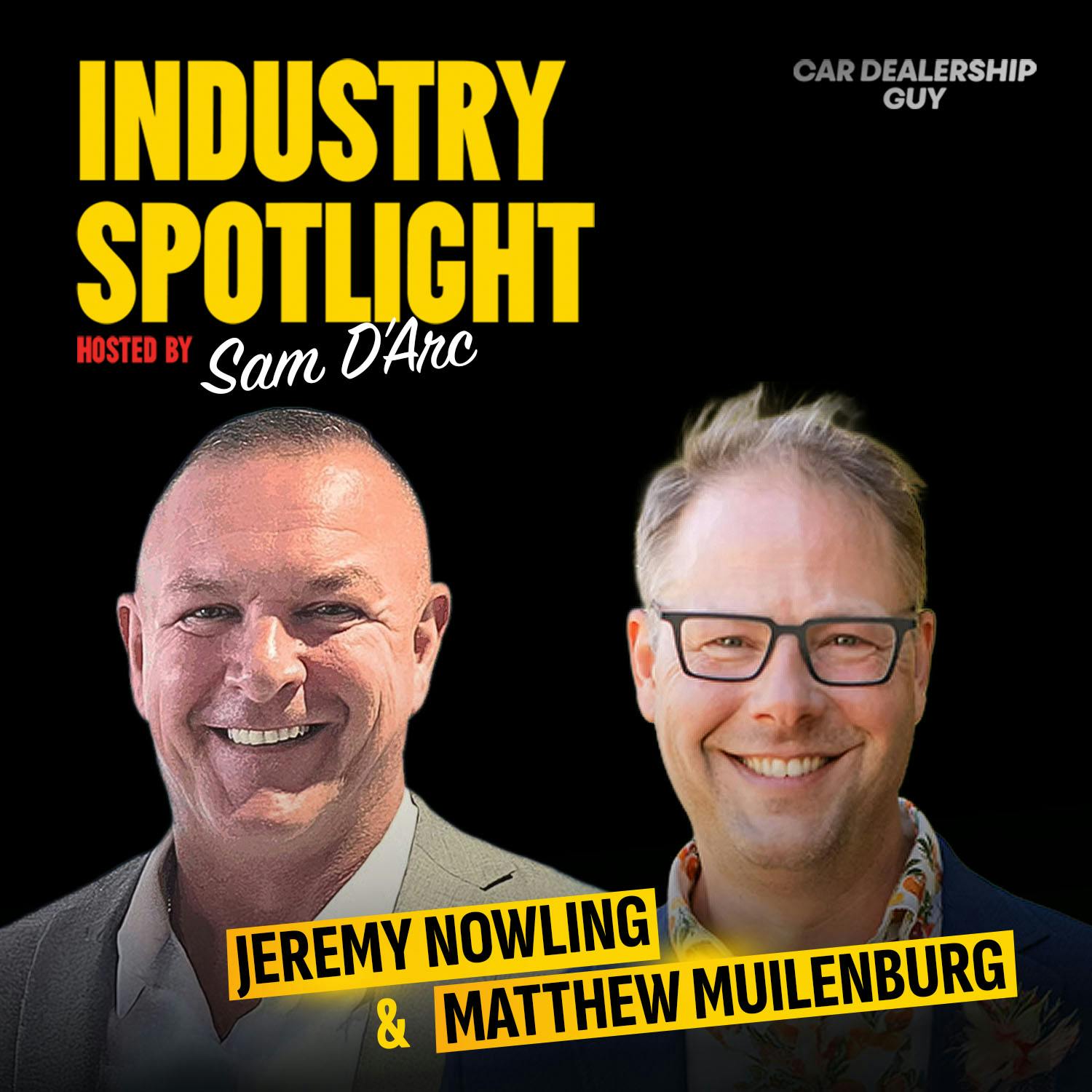
The Human Skill the Industry Lost — and How Great Dealers Are Scaling It to 10K+ Leads Daily | Industry Spotlight
Car Dealership Guy Podcast
The Human Skill the Industry Lost — and How Great Dealers Are Scaling It to 10K+ Leads Daily | Industry SpotlightCar Dealership Guy Podcast · Dec 6, 2025
The Honda Pilot is a large SUV that can fit many passengers and has lots of room for cargo. The 2024 version has new features that make it safe and easy to drive.
Lead nurturing means keeping in touch with people who might want to buy a car. It helps build a relationship with them so they feel more comfortable buying from you later.
AutoTrader is a website where you can search for cars to buy or sell. It helps you find different options and compare prices easily.
LIVE
Hey, everybody, welcome to another Cardiola Ship Guy Industry Spotlight.
I'm your host, Sam Dark.
Coming up today, check out tips for general managers to manage AI as a team member, how
Rohrmann solved the ultimate online CTA challenge, and how a quick path to the best price increases
overall engagement and close rates.
Joining me today, Jeremy Noling, Sales and Digital Retailing Director, Rohrmann
Auto Group, and Matt Mullenberg, Chief Product Officer of Impel.
Props to Impel for supporting today's content.
Now, let's get into it.
So Jeremy, tell us a little bit about yourself and what you do at Rohrmann.
Hey, Jeremy Noling, Sales and Digital Retailing Director at the Rohrmann Automotive Group.
What do I do with Rohrmann?
Anything tech-related, sales process, accountability, deep diving, just finding opportunities, looking
for deals, and digging for gold, that's what I like to claim my fame to.
Well, and welcome back, Jeremy.
You've been on the show before.
It's fun to have conversations with people over and over again who are doing great things,
and you and Rohrmann are famous for having, for being very, very deliberate and very specific
about building your tech stack, like you're very forward thinking, and you've shared a
lot of that Ryan has and you have on this show and other shows.
So let's talk about something we talked about in the green room, which is in automotive
right now.
It feels like customers are wanting more than they ever had before, more communication points,
more touch point, more communication that's transparent, consistent, non-message.
Talk to me a little bit about what you see in that demand, kind of, or need from customers,
and what burden that puts on dealerships to meet that need.
Yeah, Sam, so great question.
One thing I'll say is that with consumers, we are consumers as well, and when we
want an answer, we don't want to wait 15 minutes or two hours or half the day.
And I think that with the Impel product that we're using, it's allowed us to get that
answer to that consumer super fast.
And it doesn't matter whether it's about an appointment, availability, feature, additional
photos, a service appointment.
I could go on and on, but that is how AI is working for us at the Worm and Automotive
Group.
And again, it's a very thorough, consistent message that we work with performance managers
and our people on to drive that experience.
So let's back up just a little bit, and let's talk about what automotive looked like
before AI and as AI was entering into our supply, right?
Because you're forward thinking you're in a place where a lot of dealers aren't,
right?
You've embraced it, some haven't.
Right now, the demand and the need from customers for that transparent, consistent, educated
communication puts a lot of burden on you to staff a dealership, right?
In fact, I think you said really to be able to meet a basic level of communication with
customers, you'd need like seven to 10 BDC agents.
What do you think you need in today's world to be able to meet customer demand for
communication?
AI.
Yeah.
I think you need an intelligent platform that understands how to be very transparent and
thorough with responses to drive the engagement from the consumer.
And yes, I am going to date myself, but I remember the days when BDCs weren't even
a topic of discussion.
And then all of a sudden in the mid 2000s, we all say everybody needs a BDC department.
What does it look like?
I don't know, but we need people just to make phone calls and send out emails all
day long.
And what are they going to talk about?
I don't know.
They just need to follow up with all the opportunities that we're putting in the
CRM.
And so I remember at times, we had seven BDC agents and we started with one.
And one thing we never really increased was the amount of salespeople on the
floor.
It was always neat.
We've got leads and we've got customers.
Somebody needs to follow up with them.
And so we thought that the fix was always hiring a BDC agent just like everybody
else in the industry.
That's what it was.
And now you fast forward to 2022 and we learned we don't need BDC agents.
We need a technology that can help with the cadence and know how to be very
thorough with the consumers, but work alongside the salesperson to drive that
ultimate consumer experience because AI is not going to replace people.
Okay.
Yeah.
People that don't know how to work alongside AI is what's going to replace the people.
And you know, I think that that's one thing that I think we've done really well
is the handoff and managing the AI and through onboarding the proper way of
introducing AI.
So Jeremy, take us back to pre AI.
Before you turn the AI agents on, what did a typical lead journey look like in
your organization?
Right?
What kind of leads created?
It's there.
It's in the inbox.
How did that get handled?
You would have a BD agent that would try to do the phone call, email and text to
the consumer and they would maybe try that once in the morning and then maybe
swing around and try again in the afternoon.
And then they would continue to repeat that process every day.
And they may be touching the customer at the wrong time or they may be saying
the wrong message or they may not be identifying the proper source of how
that consumer came into the CRM.
And in addition to not only working the internet leads, these folks are also
working your walk-in customers and they're answering phone ups at the same time.
So for them, it's a little overwhelming and what type of experience does a
BD agent truly have if you don't onboard the right way?
Yeah.
Yeah, that is true.
Consistency with people is tough, especially when there, you know, Glenn
Lundy talked on the show, he talked about BDC agents should be
frontline sales.
As soon as they're as good as frontline sales, you want to bring them to
the frontline to sell because that is such a needed task, right?
So how are you setting up different lead types inside these journeys and
how do they perform versus?
So bring us into AI now.
So AI obviously starts engaging with your customers, answering phones,
sending text messages, engaging with them where they want to be.
You went to Impel for that AI.
Why Impel instead of any one of the other number of companies out there?
First I'll add something to the point that you just mentioned.
I went to Dan Cummins-Chevy.
I drove down there through Glenn Lundy's success and I've seen his army
of BD agents that he had at the time.
And so now fast forward, you know, now it's about arming the AI with
how to follow up through specific sources because, Sam, you could put in a lead
about a KBB lead or a trade pending lead of selling your vehicle.
Mac had put in a lead of he just built his deal online through our digital
retailing tool.
The first response on both of those customers is completely different.
But the way that we've trained our people is to reach out and try to
schedule an appointment.
So I'm not solving either one of your problems.
I'm just asking, when can you come in or just trying to get you on the phone?
And through our success with Impel, it's been about identified by specific
source and let's customize something to build it unique to the journey
that the consumer is on.
So that first response hits you right where you're at versus walking you backwards.
So give me an example of that.
So KBB ad, that's a different lead source.
It comes in.
How is the response at Roarman with your AI tool different than Cars.com or Cars.
Yeah.
So if there's a consumer, we're with trade pending, but if a consumer is on
there through trade pending and they go to our 15 second appraisal, that's
going to come in and we're going to acknowledge, hey, Sam, it looks like
you're trying to sell your 2024 Honda Pilot.
Please let us know if you'd like to schedule an appointment to do a
final evaluation on that car.
But what we're doing is we're actually, we let the AI know that you're
responding to a customer who submitted a form to sell their vehicle via trade
pending or KBB and acknowledged the entrance, the interest that the consumer
has in referencing and acknowledging their vehicle and the evaluation
that we gave to them.
Interesting.
Matt, enter Matt from Impel.
Is it, are you seeing big differences in lead response and conversion
when you are that laser focused on the different lead source and responding
to the lead source uniquely and differently?
Yeah, it's truly amazing, Sam.
The transformation that has happened as we've introduced this
agentic first response capability is meaningful across the dealership.
When you look at the core sales AI platform that we deliver for
lead nurturing, it was really honed and refined around internet purchase leads.
You were on Cars.com.
You were on AutoTrader.
You were on the dealer website.
You wanted to buy a car.
We focused the scripting around solving for that problem.
The negative downside of that is every other lead type that came into
the CRM got treated exactly the same way.
So when we introduced agentic first response, the first thing we did
is ask the question, well, how many lead sources are there?
Well, surprisingly, 10,500 unique lead sources come into our system
on a daily basis.
Wow, 10,000, that's, that's insane.
I mean, you can't train that with people obviously, right?
So yeah, how would you possibly 500?
You couldn't know.
So we did one thing first.
We took those 10,500 sources and we broke them into primary categories.
And we came up with 11 initial categories that those leads fell into.
Marketplaces is the one I like to talk about.
Jeremy is talking about digital retailing, another great one to talk about.
But when you think about marketplaces, you could get a lead
from Edmonds and you could get a lead from OfferUp and you could
get a lead from AutoTrader.
And the reality is we were really successful at handling those
all the same way, but we're tremendously more successful when
you reach out to that OfferUp customer with a subprime message
because that's the kind of buyer that lives on that site.
And when you reach out to that Edmonds buyer, that's a high credit score.
You can assume that in the initial response.
So you're going to treat them entirely differently.
So while the core internet lead bucket has seen some improvement,
the leads that have really seen improvement are those longer tail leads,
those instant cash offer leads, those trade pending leads,
those digital retailing leads because of exactly what Jeremy just said,
you're meeting the customer and regurgitating back to them the context
where they started the conversation and they feel heard in some of the
categories we've seen appointment rates go up more than 100% by making
this small change.
Wow, that's interesting.
And how long has this been in place where you've been able to have
this laser focused type of response to those 10,500 different lead
sources across the different leads?
We introduced it as an early adopter program about three months ago, Sam.
We've got quite a few dealers that are on it now on a hand raising
or preferred customer basis on December 8th.
The feature goes generally available availability.
It'll be out there for anybody who's on our platform to take
advantage of and we're super excited about the transformation
that's going to cause in the industry.
So do you sit down with Jeremy and say, Hey, here's all the different
leads, here's all the different digital lead providers that you have.
Here's the different sources, including trade in the service drive.
And then do you craft those individually with Jeremy or does your
system do that on its own, Matt?
We do it up front as a default starting point for the dealer so
that people can onboard and start to use the system.
But what we quickly learned is dealers want to personalize that
and customize that for the unique source, not just for the
source, but for their own dealership background and behaviors and policies.
So the messaging actually becomes really tailored at an individual
dealer level and there's entire control to go in and do that.
If you want to tailor all 10,500 leads, you can do that.
If you want to keep them in buckets of leads, you can do that as well.
Interesting.
So Jeremy, where have you seen the biggest time savings now that
AI is moving leads through the funnel on its own and you're
not having to push it?
You know, I think that first response is everything.
So I think that's the biggest time saver.
So one of the things we work with our people on is, you know, as
soon as the lead comes in, go look at the general note.
If the general note that's pushed into the CRM has multiple layers,
that means there's currently a conversation taking place before
you even get your first response out.
So educate yourself on how you're going to handle your next text,
phone call or email to be supportive of what conversation the AI
is already having with that consumer.
And where do you go?
So, all right, I pull up the lead in my CRM, whatever the CRM is.
Where do I go to see that conversation?
So I'm fully up to date before I connect with that customer.
It's right there in the notes and activity.
And then there's also notifications that are sent to the sales
people that they can open up the link and read that conversation as well.
Interesting.
And how do you manage and work with that, Jeremy?
Are you training it as it goes?
Like if it gives a response that's not quite what you want or
you need to tailor it a little bit, are you training it?
Or what is, how does that, is it a two way street there with the Gentek AI?
No, so, I mean, just kind of the way Matt described it, you know,
there's there's a bunch of default ones.
And then we use the term romanize.
So we can romanize some of those first custom responses by source.
So for, for myself, I worked with the team at Impel.
We had a good two hour session where we just started going through these.
And then we identified, well, maybe this source here doesn't
really need to go to this journey.
Let's go ahead and move it.
So there were a few that we moved.
And then there's the, the, the, you know, just mind blowing of like, wow,
wait a minute, we can make so much more out of this.
And then that's how we evolved into developing our own CTA and working
with Impel and trade pending to drive that experience even further.
All right, we want to hear about the CTA, this call to action.
We're going to get to that in just a moment.
But this does spark a thought, Matt, in the world of a Gentek AI
and technology and all that.
There's probably some dealers that are less comfortable with it.
That'll just say, Hey, Matt, put your tool in, make a happen, rock and roll.
And then there's others who are more engaged like Jeremy, who will
sit down with your teams for a couple of few hours, go through and review
this and make sure it's set up correctly.
Speak to the importance of great preparation in advance
so that you succeed and win later on down the road.
Do you see differences in engagement with teams
and then how that impacts success later on?
Yeah, of course, Sam, like if you take something out of the box
and turn it on, it's going to do work for you, but it's not going to do it
in the context of who you are and what's my why buy here message
and what's my why buy now message and how do I participate in my community
and all of those things that make dealerships unique.
So of course, there's value when you initially turn it on,
but our customers that really lean in and embrace making the AI
a member of their team, they get the most out of the solution.
Yeah, you got to think about it as a member of your team.
You do Monday morning meetings to train your human staff
on the things that are new or the things that are changing.
That should be a regular process inside the dealership for your AI staff as well.
And I think about it as an AI staff.
We've talked a little about that a lot on this show
is that you've got as a general manager, almost a new addition to your job description,
which is working with the gentek AI to make sure it's doing what you're doing.
Jeremy, what what what insight would you provide to dealers
or GMs watching about the importance of engaging with these tools
so that it gets the result almost like a BDC agent did it in 10 years ago?
Well, I mean, number one, be present.
Be present in the meeting with your performance managers.
Don't blow off the performance manager.
If you're going to launch a product that's going to drive the success of your store
and also help to reduce the people count, you need to be involved with it
and watch it all the way through.
And I think that that's where I'm fortunate is working with Ryan Rorman.
We have great training.
We have great accountability.
We continue ongoing training to drive the ultimate success of the organization.
And I think that that that individual at the at the leadership level
in the store should bring his management team into that conversation.
And then what does the drive behind launching it to the sales floor look like?
It can't just be, hey, we signed up with this, those Impel guys.
Good luck.
You know, you're going to you're going to have an AI assistant now.
No, it needs to be a little bit more thorough in the sense of paid managers.
You're going to watch the dashboard.
You're going to manage the handoff.
You're going to look through some conversations to make sure
that the AI is responding in an appropriate way.
And then, you know, what do our guardrails look like?
Are there certain sources that we still want the people on the store
level to handle, or do we want to just let Impel handle everything?
And we only respond when we're notified to.
So how do you keep how do you keep dealer oversight in place
so that those agents don't go off script or off brand?
Like, yeah, what what does your process look like for that?
You know, feedback is important, right?
So when we launched the product, you know, the one thing that we want
to tell the folks is that if you see a response from the AI that you feel
is not what we believe in or the direction that we believe that we
should be going, let us know because we're going to communicate that
to our performance manager.
And, you know, I've seen other AIs in the world.
So I can say that, you know, initially there was a couple of things
that I provided feedback on.
Do I have it all the time now?
No, I don't because the AI has gotten more and more intelligent
and these guardrails are there for a reason.
And Impel is very supportive in the sense of if there's an issue,
there is a team jumping on it.
It's not going to, you know, an email thread that somebody
might answer it three days.
No, it's they raise the alarm to say, hey, you know, there's a problem.
Let's fix it.
And I will say that Impel is different in the sense that most
of my vendors that I meet with, and I meet with a lot of them,
it's only one person, typically.
But with Impel, I have a week-to-week call and I have a team
of three to five to seven people that are sitting there in the room
listening to what we're trying to do and how they can bring them.
You know, Jeremy, hearing you talk, it occurs to me that people
that may not understand a Gentik AI and how these things work at the very
beginning of the relationship might point to it and say, hey, it's not working.
It's not doing what it's supposed to.
It's actually harming our process.
And with a Gentik AI, it may not be the case.
It may be a learning more than it is a result.
Matt, is there anything you could talk to us about, you know,
or a warning to dealers or general managers?
Hey, if you see something that's not answering the way you want it to,
this is an education just like a new employee.
It's not a verdict of, therefore, it doesn't work, Matt.
Yeah, I mean, it's multifaceted, Sam.
There's a huge component of it, which is what's the context
for the dealer and the dealership where they are.
And we only know that context through the engagement that the dealers provide to us.
So you can't put this in and not adjust your processes.
You need to know how you're going to integrate the AI to work with your people.
And then you need to be dedicated to training that AI
to talk in the language that you wanted to talk in,
whether that's using the agentic first response capability we've been talking about
or the core knowledge banks that power the AI brain
that is serving all of the products that are in our suite.
The other thing that our customers don't see is in the back end,
I've got a team of 12 people that are sampling conversations
from every one of our applications on a daily basis.
And in that process, what they're looking for is where did it go wrong?
Because it does go wrong sometimes.
It's not perfect, just like the humans aren't perfect.
Unlike the humans, you can go back and you can trace back to where the air happened
and you can make an adjustment in the model so that that air doesn't happen again.
So every single week, I get a report from my team
that shows the 10,000 conversations that they sampled across our platforms
and the air rate by application type that occurred.
And, you know, when you first launch products, the air rates are higher
than you want them to be, but when they're ripe and mature the way they are now,
I have air rates that are 0.0005 percent.
Like it's it's pretty small.
So so in a new relationship, when you go do an install,
what does it look like in the first month or so or six months?
How long does it take before that air rate becomes as small as you just described?
Well, so the core air rate we've taken care of that doesn't happen.
Those air rates are things like not recognizing an attempt to set an appointment.
Maybe the machine didn't quite understand the way the humans spoke about
Tuesday afternoon when my dog's home from daycare or something.
And so we got to figure out how do we teach it to know that that means something
on the flip side of that, you know, our best customers
are participating in the tool on a regular basis because the marketplace changes.
You know, a great example of this is when tariffs started back in January.
We saw a 4,000 percent increase in questions about tariffs
coming through our system over the span of five days.
Well, in a legacy world, we would have had to go written code,
create a new logic tree, created a new intent and map to that
and then deliver content that was responsive to the question about tariffs.
In this modern, agentic world within a couple of hours,
we had preloaded a question into our knowledge bank
and offered our customers recommended response to that particular question.
So we could see, here's what the consumers are asking,
and here's what we think is the best response to it.
And then we were able to provide that to our dealers and say,
do you want to tweak this or use it as it is?
So this process is constant.
You have to always be learning and you have to be paying attention
to the zeitgeist because things change in how customers are talking to you.
So, Matt, with agentic AI working the way it does, then are you able to get
are you able to glean buyer sentiment in a way in broader automotive
that maybe we haven't had before?
Like, are you able to see what is on customers' minds
and kind of understand how buyer preferences are evolving and changing over time?
Like, do you have that capability, Matt?
Yeah, I mean, I love taking the content at scale
and mining it for benchmarks and insights across the entire dealer body.
Of course, you can do that.
And in fact, we use AI to do that.
It used to be I had a whole bunch of data analysts
and machine learning specialists that would take that content
and would spend weeks munging through and trying to build models
that made ration out of it.
Now I turn to my Impel Insights tool and I say, hey, here's a data set.
Across this data set, stack rank the 10,500 lead sources
by highest contribution margin to a dealership
or show me the lead types
where the humans tend to take over more frequently than other lead types.
You can ask it just about anything.
And the more data sources you can plum into it,
the more interesting the responses become.
So, Jeremy, you know, you've talked about how AI in your cases
replaced a lot of headcount within the BDC.
There are people within automotive that are terrified
that AI is going to replace them one day.
I don't think that's true.
I think what it's going to do,
I think customers are going to expect more out of us more
and more and more and increasingly we can't deliver as people
without technology in the way the customer wants to be.
Like, you know, we can't have somebody respond to a text message
at 2 a.m. or respond to an email at 3 a.m.
Our people just can't work like that that long.
How do you communicate at the beginning inception of AI
with your team so that you get by it?
They see the vision and how it helps better deliver
to the customer instead of fearing for their jobs
and fighting against it.
Yeah, I mean, good question.
So I would say, you know, with headcount,
it's important to know that, like, you know, those those
BD agents, I would love to have spread across every sales floor
in the group because they work the CRM the best.
They understand the CRM more than most.
And so I think that they they're growing their livelihood
by transitioning from a role of a BD agent
to an actual sales professional.
And it's almost flawless the way that they can transition
to that role.
And if not, there's still that opportunity
of moving into a service BDC role
to manage the handoffs for the service AI.
As for overall importance of it is,
you know, letting the sales folks know is, you know,
if you have a consumer that walks in the front door
of the dealership, do you want a salesperson to help them
or do you want to be the agent to help them?
You know, 10 out of 10 times I've asked that question.
Everybody says, well, I want a salesperson to help them.
And it's like, OK, so now we need to educate
our front line salespeople on how to become
a digital showroom salesperson with the assistant
of a virtual agent 100 percent of the time.
And by doing that, again, you're now getting your best people
in front of the area where the most consumers are at,
which is your digital showroom.
That's now the course of our opportunity starts
on the digital showroom.
And the last thing you can have is you can't just have four
to five BD agents or even some stores
with one to two BD agents working 300 leads a month.
That it's just too much.
And then it leads job had consumer experience
and then they go shop elsewhere.
So that that's first way of identifying the problem.
Now, the training side of it is pretty easy.
It really is.
So, Jeremy, you talk about how to how to meld
your employee staff into this AI world.
And that your world is the AI world.
And it's it's melding the AI into the dealership staff.
What are some concrete sales tasks, Matt?
The agents are already executing end to end
without human touching it every day or every step.
I mean, think about that or start to finish.
Yeah, I mean, the the clearest one
that start to finish a service scheduling, Sam.
So getting out of the front side of the business and into the back.
Customers can engage with an AI now
and can go all the way down to booking the appointment
right into the scheduling system.
And that's that's pretty powerful.
If you think about the challenge in the service department
when it comes to answering the phone and handling the inbound volume.
It's 70 percent of your phone calls.
Like if we can take care of that, that's amazing.
And there's tremendous innovation
that'll come in that space over the next 12 months.
I couldn't be more excited about the things that are happening in that area.
But even on the sales side of the house, Jeremy made a nod to it.
You get 300 leads. You've got to work.
A human can't possibly do that effectively.
They they get discouraged too quickly.
And the reality is it takes four or more touches
to get engagement back from that consumer.
So if you're calling once in the morning, calling once in the afternoon
and trying again the next morning, you're not doing enough to get that consumer.
So we monitor, you know, how does behavior in the dealership change?
We like to do process mapping before we get there
and some blueprinting on how we think the processes need to work with the AI.
And then we monitor things like, well, how many emails is the human sending?
How many text messages are the human sending?
How many phone calls are the humans making?
And no surprise, the number of emails and text messages
that are being sent by the human is plummeting.
But the number of quality phone calls that they're making, it's going up
because at the time it's ready for a phone call, it's been handed off to you
from the AI to say, hey, Jeremy's now ready to hear from you.
Pick up the phone and dial. Yeah.
So, Matt, Jeremy is far ahead some dealers.
Like he's farther down the road with AI with a gentek AI than many are.
What would you say to a dealer would be the first couple steps
to implementing a gentek AI into the CRM?
Like what is what is mapping the journey look like?
How do they make sure their culture is infused into it?
Like what are those first few steps for somebody that's just not quite there yet?
Yeah, I mean, that's a fun question to answer, Sam,
because it's going to depend on who the dealer is
and what they're trying to accomplish.
I think the easiest step for any dealer is a gentek chat on your website.
I'm so surprised by how few dealers are using an agent chat system today.
It's so powerful.
We were working with a four dealer who took our agent chat tool
and instead of the typical chat pop up that you have that, you know,
drives the consumer crazy,
it's replaced all of the calls to action through his website.
And so when you hit on something that says, give me a price.
Well, it's not a form that you're sending off.
It's an agent chat window that pops up and starts qualifying you
and trying to get contact information and help to generate a lead out of you
and delivering that into the CRM system as a new opportunity.
So there's low hanging fruit there that doesn't require a lot of
infrastructure and integrations with partners.
You can go do a gentek chat today.
Where I think it gets more interesting is thinking about what are my
challenges on the service side of the business and the sales side of the
business and which one of those things do I want to tackle first?
Sales is where a lot of our customers go
because the opportunity to nurture leads that are being neglected
by the team is such a dramatic opportunity.
And that becomes about training your team to understand the importance
of allowing the AI to do its work, taking a step back
and not interrupting the AI as soon as that lead comes in.
Let the process run.
Let the AI do what it's supposed to do because at the end of that
as a salesperson, you get a much richer, much more qualified customer
who wants to talk to you instead of a customer
who's feeling hounded by you trying to get to them.
So understanding that fit, I think is important.
So many dealers come and say, hey, I'm going to put AI in,
but my humans are going to work all the leads during the day
and AI is only going to work at night.
And while I understand that sentiment, the reality is you're
going to get a lot more out of it.
If you spend time teaching your team what AI is all about,
you can go to RockEd.
We provide free courses for the entire industry for people to go
get certified in what AI is, go become part of that.
Let your team understand how it's working, encourage them to do it
because they begin to then understand how it augments
what they're doing and why it makes their job better.
So I think this is excellent advice on the education piece.
What is RockEd?
Where do you go to get these courses and what are the next?
Yeah, RockEd is a downloadable app.
It's an automotive specific learning management platform
that has these little short fight two to five minute
educational classes that are interactive and video based.
And, you know, I love it because you can do it while you're walking
across the street to the Starbucks or while you're sitting, you know,
on point waiting for a walk in to come into the store.
It's just these these little snippets that allow you to go and learn
something along the way.
And by the nature of the platform, it prompts you every couple of days.
Hey, Sam, you haven't checked in and done a course.
Why don't you come do a quick three minute little lesson with us?
So it's an easy way to get engaged.
We we think we've been able to any anybody with a dealership domain
name to be able to access that platform.
But if somebody's working in this industry and can't get in and wants to
drop us a note, we'll make sure that your your dealership domain gets
whitelisted and you have full access for everybody on your staff.
That's a great takeaway from today's conversation.
One, I'll definitely take back to my team, because I do think
the education piece is super important, right?
If you don't have a Jeremy in the organization that is, you know,
a subject matter expert that's a huge advocate for the technology
that's teaching people how to plug it in.
It makes it tougher to embrace it.
And then you get the disconnect, right?
You get the hey, it doesn't work.
The I I'm proving it doesn't.
When, in fact, it's about the coaching, it's about the teaching,
it's about making that agent, that agent is a GM part of the team,
which just sounds bizarre.
It is the paradox and the paradigm shift of automotive for our day.
Jeremy, right? It is, which is which is interesting.
All right, Matt, as we wrap up our conversation, fast forward a few years.
What will feel completely outdated about how we run sales and service journeys today
if dealers don't adapt?
What are we doing today that will just seem super outdated?
You know what we do today?
We walk into the dealership and we flip on system one
and then we flip on system two and then we flip on system three
and we're doing little steps in each one of those systems as we go.
I believe that there is going to be an AI orchestration layer
that sits on top of all of the software tools that you use,
and you're going to be able to script that layer to do what you need to do.
I was talking to this great guy named Calvin a few weeks ago
at a four dealership down in California,
and he literally has 10 different systems he has to go to
in a sequential order to tee up his morning.
So he gets to work 90 minutes before the shop opens
so that he can go through all of those steps.
Yeah, imagine all the friction you could take out of the system
if the agentic tools flipped on each one of those 10 systems
and did that step for you, and instead surfaced
in a single pane of glass all of the information
that you needed from those 10 systems.
That's where we're headed.
Does that capability almost exist today?
It just needs to be honed and delivered
or is it a little bit of a people learning thing
and acceptance and people embracing it, Matt?
You know, it's more of a vendor ecosystem challenge,
Sam, than anything else.
Vendors are protective of their systems
and have not warmed to the idea of letting a dealer's
agentic staff use those tools the same way
that a human would use those tools.
That's gonna have to change in this industry.
Staying away from robotic process automation
has been something that core systems have done now
for a couple of decades.
And I get it.
Historically, RPA was used to scrape in rapid succession
all of the information out of the systems
and that caused problems.
When it's an RPA that's oriented around a agent
doing the same tasks that the humans do,
those systems need to think about those staff members
differently than the traditional RPA integrations
that they're leery of or fearful of.
So that's the education that has to happen.
The vendors need to understand the importance of this
to the dealers for operating their businesses
and that to be part of those ecosystems,
they're gonna have to learn to play with the AI agents
that are doing the coordination work.
So Matt, what message would you deliver to the industry
with these different vendors,
with all their disparate systems about coming together
in the way you just described?
Like, will it be an event, some sort of a catastrophe crisis,
some economic need?
Like, it's a big hurdle getting everybody
to drop their own interest and come together
to work towards the one goal.
What will it take?
I mean, it's interesting.
We see it happening right now around consent management.
We talked about that a little bit in the green room
at the start of this call, right?
The regulatory landscape is changing so quickly
and it is different on a state-by-state basis
that compliance becomes a challenge
and consent management will become part of that process.
You're going to need as a dealer a single source of truth
for what rights do I have to communicate with this customer?
A lot of that's driven by the California laws,
the GPC that they've enacted
and the impact that's gonna have on privacy controls.
But you can expect that that same sort of blueprint
is gonna roll across all of the states.
So just like that example for consent management,
those types of regulatory changes
and environmental changes are gonna impact all of the vendors.
And somebody said this to me,
people right now believe that data is the moat
that protects their business
and so they're trying to keep people away from the data.
And as I talked to more and more
of the dealers and major dealer groups out there,
what I hear is, no, in fact, data is what powers the AI
and I need to be working with vendors
that are willing to make that data available
to the AI that I'm using
so that I can be as good as I possibly can
with my consumer in the moment that I'm out
with that consumer.
So dealers are gonna ultimately drive this change,
they have to, there will be vendors
that choose to try to protect their data.
I think they're dinosaurs,
I think they're gonna die as a result of that.
Getting into a common orchestration environment
is a place we all have to be.
Wow, that's a, that is a great vision of the future
and couldn't be said better.
And it's interesting, it's the data problem
that existed 10 years ago with fragmented data.
And now it's bringing it together
and getting everybody to work together is the North Star.
So, Impel, Matt Molenberg, Jeremy Nolan,
Rohrmann Auto Group, thank you both for being here
to have this fascinating conversation to talk about
all that Rohrmann is doing to meet the needs
of their individual customers using a genetic AI
and technology to deliver their best.
Thank you both for being here.
Thank you.
Awesome pleasure, thank you, Sam.
Great to see you again, Jeremy.
You too.
About this episode
Exploring the integration of AI in automotive sales, this episode features insights from Jeremy Noling of Rohrmann Auto Group and Matt Mullenberg from Impel. They discuss how AI enhances customer communication, streamlines lead management, and increases engagement through tailored responses. The conversation highlights the shift from traditional BDC roles to AI-assisted processes, emphasizing the importance of training staff to work alongside AI. Key takeaways include the necessity of adapting to customer demands for transparency and the future of dealership operations with AI as a core team member.
Welcome to Industry Spotlight—a focused series hosted by Sam D’Arc, highlighting standout dealerships and innovative companies, and exploring the trends driving success in today’s automotive market.
Today, Sam sits down with Jeremy Nowling, Sales and Digital Retailing Director at Rohrman Auto Group, and Matt Muilenburg, Chief Product Officer of Impel.
This episode is brought to you by Impel:
Impel - Meet the AI Operating System built for a new era of automotive retailing. From CRM to service bay, from website to DMS, it unifies and orchestrates every part of your dealership operations—and your customer lifecycle. Visit @ http://impel.ai and and discover how Impel AI turns routine interactions into VIP experiences.
Check out Car Dealership Guy’s stuff:
For dealers:
CDG Circles ➤ https://cdgcircles.com/
Industry job board ➤ http://jobs.dealershipguy.com
Dealership recruiting ➤ http://www.cdgrecruiting.com
Fix your dealership’s social media ➤ http://www.trynomad.co
Request to be a podcast guest ➤ http://www.cdgguest.com
For industry vendors:
Advertise with Car Dealership Guy ➤ http://www.cdgpartner.com
Industry job board ➤ http://jobs.dealershipguy.com
Request to be a podcast guest ➤ http://www.cdgguest.com
Topics:
00:45 What do customers expect from dealerships now?
02:01 How is AI changing modern dealerships?
04:32 How did dealerships operate before AI?
05:53 How to implement AI for leads?
07:30 How to customize AI for engagement?
11:14 Why must dealers engage with AI?
14:24 How to train staff on AI?
20:28 What is AI's future in dealerships?
31:56 Final advice for AI adoption?
Car Dealership Guy Socials:
X ➤ x.com/GuyDealership
Instagram ➤ instagram.com/cardealershipguy/
TikTok ➤ tiktok.com/@guydealership
LinkedIn ➤ linkedin.com/company/cardealershipguy
Threads ➤ threads.net/@cardealershipguy
Facebook ➤ facebook.com/profile.php?id=100077402857683
Everything else ➤ dealershipguy.com