Calling Formula One the 'Mount Everest of motorsport' means it's the hardest and most important racing competition, like climbing the tallest mountain is the hardest climb.
In old race cars, the steering wheel had only a few buttons, but now drivers can change many settings on the wheel to make the car faster and handle better while they drive.
Driver bandwidth means how much information and tasks a driver can handle at once. Today, race car drivers have to think about many things while driving, like talking to their team and changing car settings.
Drive to Survive is a TV show and movie about Formula One racing. It shows what happens behind the scenes and has made the sport more popular with many people.
The Dakar Rally is a very long and tough car race that happens over deserts and rough land. It challenges both the cars and the drivers to be very strong and skilled.
The 24 Hours of Le Mans is a famous car race where teams try to drive as far as they can in 24 hours. It checks how well the cars and drivers can last a whole day.
Rallying is a type of car race where drivers race on different kinds of roads, like dirt or gravel, not just race tracks. It tests how well drivers can handle their cars in tricky conditions.
Formula E is a type of car race where all the cars run on electricity instead of gas. The races usually happen in cities to show how electric cars can be fast and fun.
The development race means teams are trying to make their cars better faster than others during the season to win more races.
Car
Supercars
Supercars is a type of car race in Australia where special racing cars that look like regular cars compete on race tracks. It's very popular there.
LIVE
Welcome to the Motorsport Brief, a special edition with a sports car superstar.
Good day everybody, Rusty here.
This ep has come together with the help of BP, who I did some work for over Grand Prix
week at Albert Park, including a fun 2026 season preview with my good mate Mark Howard from
the Howie Games.
That is in both our pod feeds, in fact, and you can check it out on YouTube too.
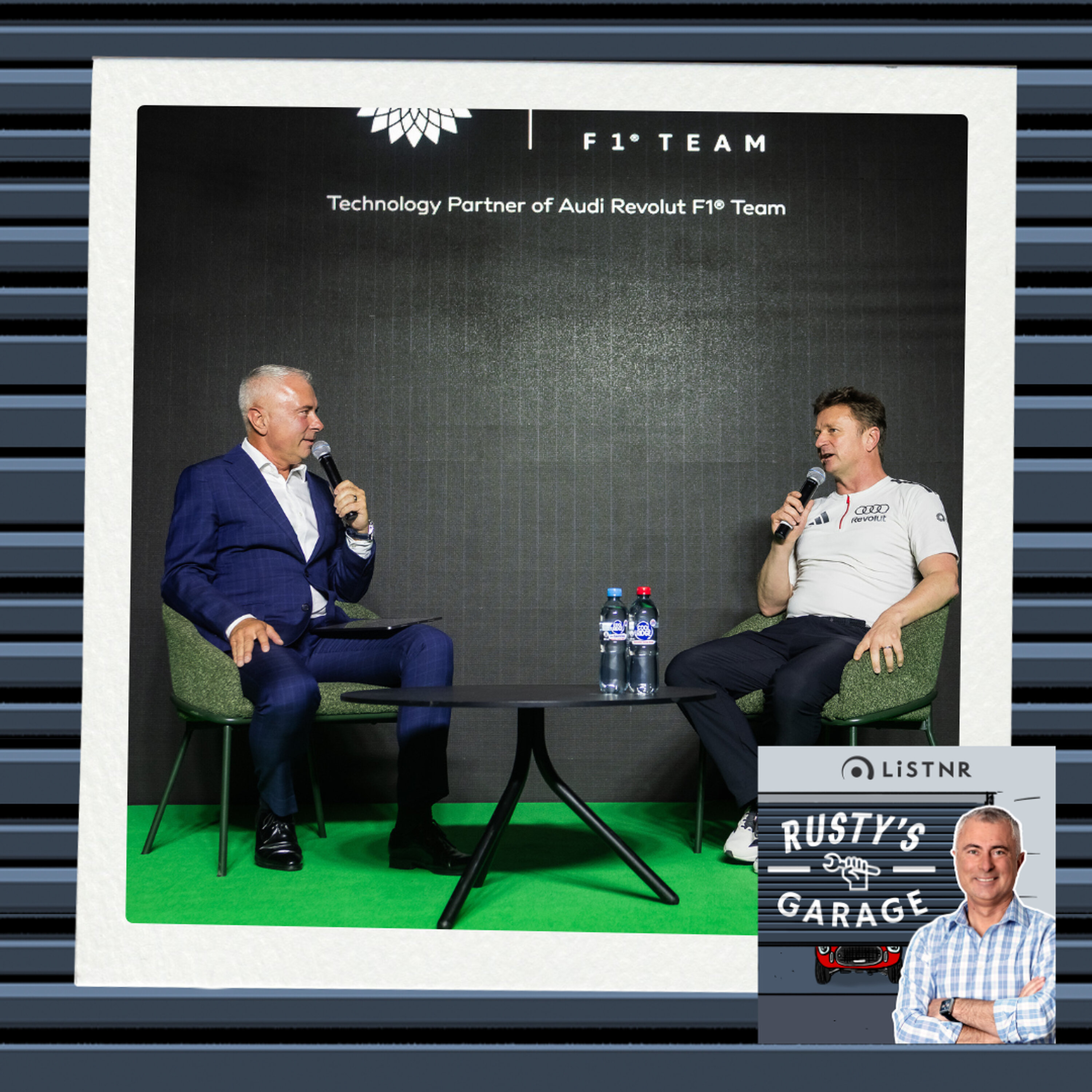
Now, on the eve of the event, I went along to Lindsay Fox's car collection, his museum
in Docklands, which is awesome, to emcee an event for BP's customers and staff.
The focal point was a garage-style chat with a special guest, who's perhaps best known
for his brilliance in sports cars.
He is great in these situations for fans and for clients, so engaging and insightful.
So as a little bonus, and off the back of out his impressive point-scoring finish on
its F1 debut at Albert Park, we thought we'd release the chat as a little bonus.
I hope you enjoy it as much as I did.
Ladies and gentlemen, our special guest tonight has an email signature that these days says
Audi's director of driver development.
That's a program that he is incredibly well-credentialed for.
A multiple winner of the famous Le Mans 24-hour, one of the gruelling and most toughest races
on the planet.
A three-time winner of the prestigious American Le Mans series and winner of the World Endurance
Championship for sports car racing a little over a decade ago.
He raced in Formula One.
He's worked around its broadcasts.
He is perfect for a chat on the eve of round one of the 2026 World Championship as Audi
enters Formula One together with BP.
Would you please make welcome Alan McNish, everybody.
Thank you very much.
The travel at the moment is understandably tough for a couple of people, but you got
in nice and early.
You reunited with an Aussie engineer.
You worked with an a cool car that you raced at 1.2.
Yeah, I actually arrived last Tuesday night at midnight and at 6.30 on Wednesday morning
I was down in Great Ocean Road driving a car that I had not driven for 25 years, which
was the Audi R8, the Crock car, because it was liberated in the style of a crocodile.
And this car was a 650 horsepower race car that we raced in Adelaide on what they called
the race of a thousand years.
It was on the 31st of December 2000.
The race finished at 10 o'clock at night and that car then went into the museum as the
first sports car that Audi ever won a championship with.
And so I was reunited with that little bit of a heartbeat, was down here in Flinders Street
and create havoc in the traffic in Thursday morning and Audi of Australia have put that
out on a really pretty cool video.
It's a great car that evokes a lot of memories for different people.
Great race that too.
The crocodile livery, right, that naturally leads me to Australian wildlife.
Are you OK with crocs, sharks, anything along the spiders?
Are you all right with that stuff?
Well, I'm OK with them as long as they're not near me, that's the thing.
I've got to be honest with you.
I'm Scottish, so we're used to a bit of wildlife up there, but not necessarily quite as aggressive
as you have down here.
But it's fantastic to be back here.
You know, Australia has got a great culture heritage in motorsport as well.
A lot of drivers that I know very well, Mark Webber, for example, is someone that I came
through my career with.
In fact, was racing in and around that point when we raced the crocodile car.
And so it's great for us all to be back for the kickoff of a new season.
Yep, let's talk about that if we can.
I mean, this is a really significant change for the sport.
Audi, as it's done for so long over its history in motorsport, is not afraid of a challenge
like this.
How big has this undertaking been?
And you've been with them as it's happened, haven't you?
Yeah, it's well, 25 years ago is when I signed for Audi.
So I've seen a lot of change of the company.
In fact, just don't say there's a beautiful area cars there.
And that was really the start of them becoming a leading sports car premium
manufacturer.
But the one thing that's quite clear is they've gone into every category with
one clear focus and that's to win.
And Formula One is the Mount Everest of motorsport, isn't it?
It's the one that everybody wants to do.
And it's the last thing that Audi has gone into because it's been into every other
category and successful.
So now it's the biggest challenge, I would say.
And to do that, you need really strong partners on board right from the beginning.
And I fortunately have been part of this program since day one, since the first
phone call about if we're going to do Formula One, how would we do it?
And so to see it on this journey from the beginning to this point where we're
just a few days away, God, my heart's beating a little bit, I can tell you,
but it's exciting times because are a little bit shorter, they're lighter.
The power plants this year have a kind of a 50-50 split between the
traditional combustion engine and the regenerative or battery support that
the drivers can use.
They can deploy that at certain times, there is active aero.
But one of the things that I think is great is the partnership
that teams can have with fuel suppliers.
And what you guys are doing with BP Ultimate is integral to this whole thing,
isn't it?
I think it's very easy to underestimate how important it is to actually have
I mentioned the right partners on board from the beginning and actually
the first partner that we decided and committed to was BP for the very
simple reason that, as you say, there's a lot of change in the regulations.
Actually, the biggest change in the history of the sport for regulations
because it's not only the chassis regulations with the activated dynamics,
it's not only the electrification of the 50-50 split of power coming from
the electric motor or the internal combustion engine, but the fully
sustainable fuels.
And that advanced sustainable fuels is a very complex thing to get right.
And we had to work with BP from the beginning because we wanted to make
sure that our power unit was developed in parallel with the fuel,
not just that we take fuel and put it inside, but actually that it's developed
for us.
And that is the way that we think we can maybe have a little bit of an edge
over the competition.
And there's nothing like having an edge over the competition.
Just to give you an idea of how extensive this program is and the
commitment from Audi, they're already looking further down the road at
younger junior drivers that might ultimately come into its Formula One
program. And over summer, I got to work in New Zealand with a category that
brought in around about a third of the field that will be racing in Formula
Three here this weekend.
And while we were there, just ahead of the New Zealand Grand Prix, some news
came out that a British driver by the name of Freddie Slater had been given
the call up to be a part of the program.
You posted about that.
He's a great young man with a very bright future, isn't he?
I said to you that we're looking to be successful in the future and we always
do have long term goals.
Clearly, we've got short term goals, no question about it.
And Freddie is part of that vision for the future.
It was announced three weeks ago now, three, four weeks ago.
We actually signed the contract in the middle of 2024.
Wow. So he's been under the radar and we've been working with them in the
background since then.
And so he'll be racing here in Melbourne.
First round of the FI Formula Three championship.
So you've got F1, Formula Two and then Formula Three.
He's just 17 years old, but he's won the World Karting Championship,
the European Karting Championship, and he's won three racing car
championships in the last two years.
So I think he definitely has got a lot of potential, but like everything,
we've got to make sure that potential is fulfilled.
And that's part of that all that I've got in my team to give him all of the
opportunities to make sure that he can be successful.
Maybe someday, hopefully, he's sitting up here talking about him,
just about to start a Formula One Grand Prix in his career.
One significant part of that, I guess, is F1 Academy Two.
And the people in the room that don't necessarily know about that.
At Singapore, for example, last year, we got to see F1 Academy in action.
All female drivers that we celebrate through lots of areas
of the sport, the involvement of women.
And this is important to Audi as you embark on this too.
So Emma Felbermeyer is a part of this.
She's a significant female talent, isn't she?
Yeah, F1 Academy, actually, our team in its prior guy, Sober,
was the first Formula One team to support the championship.
It's an all-female series.
It's going into its fourth season.
So next weekend in China is the first round of the 2026 season.
Emma is the driver that we signed last year, 25.
So then she could learn and develop.
She was a young 16 year old at the time and now is really, I would say,
coming on song.
But the championship itself is fantastic because what it does is it's on
the Grand Prix calendar.
It's just before Formula One qualifying.
And so they've got a fantastic platform, never mind television coverage
to actually show what they can do at the same time as well.
We are trying to look at it to maybe in a slightly different way
because I've got a 17 year old daughter and Charlotte, she did a lot of gymnastics
and it was very clear that she needed different things as an athlete than I did
when I was 17 and driving.
And so we're looking at Emma as an athlete on her own, not necessarily
as someone that you would just necessarily replicate what you did with Freddie.
And that comes back to even equipment, shoes.
Female drivers have got different hips set up.
So therefore they need different shoes, they need different things.
So we're looking at all of the details of how we give our athletes the best
opportunity and we're looking forward to that.
And it's actually a partnership that we have with BP as well to develop
these younger drivers in this category.
So I think we all believe that, you know, they're underrepresented without
doubt, but the next generation, I'll tell you, they're feisty, feisty drivers.
Let's go with a quick break in here.
More of my live chat with Alan McNish in just a few moments.
You're listening to the motorsport brief, a special bonus set with former F1
driver and sports car great Alan McNish.
We spoke on stage on the eve of Audi's F1 GP debut in Melbourne.
Let's get back to the chat now.
Formula one is a sport that used to be a grid of just 20 drivers.
It's now 22.
The one in the world chosen to do that is an enormously difficult thing.
What separates those that make it from those perhaps that don't?
Oh, now.
I think there's a lot of different things, but there's one thing that does separate.
There's actually two things.
I think that separates out the good to the really good.
And when we are talking about 22 seats, that's effectively, I don't know
if people watch soccer, you know, that's a World Cup.
So it's not all of the different leagues on the European championship.
So it's actually the World Cup final 26 times, 24 times a year.
Sorry. And so it is the elite group.
But I think you need two things.
You need to be absolutely determined.
You've got to go through because you lose more races than you win.
You go home thinking what the heck could I have done to beat the other person?
So that's one fact that you've got to have that strength of character.
But the other thing which is much more than ever has been before,
the way you use your brain and I talk about it as a muscle.
So if I go back in my history, the first Formula One car I drove was 1989.
And it was a McLaren Honda.
It was a World Championship winning car and in the garage next door
was a guy called Iyerton Senna.
I had three pedals, a manual gearbox and two buttons on the steering wheel.
And when you drove around, you remembered things and you came in.
They plugged in the radio and then you basically told them what you remembered.
And that was it off you go.
Now they've got 120 different things that they can change on the steering wheel
to optimize the car.
They're driving around about 10 seconds a lap faster than they were in those days.
So the absorption of information, never mind the fact you've got your engineer.
You're talking about strategy.
There's all these different things going on.
So I think the driver's brain capacity is a much different requirement than it used to be.
But if you take an Iyerton Senna and Alan Prost, Nelson Piquin,
stuck them in today, I'm sure they would be successful.
But I think those are the two real key factors.
But the one that I fall back on, determination.
Yeah, determination.
And I reckon that bandwidth that you're talking about, that ability
will be a big factor in the 2026 season.
A couple to finish here if we can.
Drive to Survive, the Formula One movie, they have made this sport
absolutely box office, right?
We're all obsessed with it here, even if they're not necessarily
motor racing people to begin with.
Does that mean sometimes that our perceptions of drivers
maybe a little misaligned?
What are the things that are maybe misunderstood about some of our drivers?
Well, drivers are like sharks.
We're all misunderstood, in that respect.
Now, I think Drive to Survive has been fantastic.
It's opened up a lot of people to the sport as entertainment,
but it's also brought new fans along in that respect.
And I think it's been a very good thing.
For example, Netflix followed up Drive to Survive with an F1 Academy.
Drive to Survive last year.
And so from that perspective, I think it's it's definitely
I would say brought us to a wider audience.
What is always been the case is that there's been a lot of characters
in the bit lane.
However, maybe they weren't necessarily seen as characters.
But now with the fly in the wall sort of pictures and things that they are,
I'm sure some play up to well, I know some play up to it.
Some of them like it a lot more than necessarily the day job in reality
and make it their day job.
But from my point of view, it's been excellent.
The only thing is now my daughter has said about Charlotte.
She's absolutely in love with Charlotte Clair.
Now he's just got married there.
And that's kind of that's disappointed her for the day.
You've talked about Audi's heritage there before across all sorts
of different kinds of motorsport there.
Their commitment to this is is immense.
Have they got a timeline for success in this in Formula One?
We've been very fortunate that every category we've competed in back
from the rallying in the 80s to, you know, laterally with Dakar
and everything in between Le Mans touring cars, etc., etc.
Formula E that we've been successful.
What is quite clear is that it's difficult.
Nigh on near impossible to be successful overnight.
You've got to cut your teeth as my father used to say.
I didn't understand that, but you have to do this.
You've got to go through this process and we're basically got a timeline
where we want to be competitive and fighting for race victories by 29 30.
That sort of area.
And I think that's realistic.
Trying to think that you could come in and beat such a strong competition
that I mean, doing it for decades would be naive, very naive.
However, we're on a journey and that journey is something that we've got
that clear target and I think that, you know, you've got to have that.
I would say understanding of the marketplace and the marketplace
is a pretty ruthless one.
Well, I think you've seen that by drive to survive.
It is a pretty ruthless one.
Lastly, you talked about the enormity of the regulation change there.
How has the buildup been in coming into the opening round
and what can fans expect, do you think?
Well, there's two things.
One is that we've been active, effectively building the power unit
since back 2022.
So it's that sort of time period to develop the power unit
and the fuel and the oil inside it.
So it is quite a complex environment.
I think a lot of teams are learning about it.
They're learning about how you try and harvest energy and then deploy it,
especially at the levels that they are now, what's important.
And what I would say is that some will get it right, some will get it wrong.
Some will have reliability problems.
I think this could be a race weekend that if you finish,
you could be somewhere near the top 10.
And so reliability will be a factor.
But teams recover very quickly.
They're super intelligent, super quick to react.
And so therefore people will develop very fast.
And I think the story of the season, not necessarily this race,
the story of the season is going to be who develops the quickest,
who gets their head around these new regulations, the quickest
and then gets a march on the opposition.
And that's something that, you know, I think everybody's going to be going all out for.
But it is a hell of a challenge.
I had a massive week in and around Albert Park, thanks to all of you who came
and said, G'day, or posted such lovely feedback on socials.
This interview was a real highlight for me.
I could have spoken to him for hours, but F1 Week in Melbourne
is so busy for the drivers and team people like Alan.
So we're grateful to him, to Audi and BP for the time that we had.
Don't forget the other reps we released in recent days too,
to celebrate Grand Prix Week in Australia.
F3 driver James Wharton, Motorsport Australia CEO, Josh Blanksby
and a brilliant discussion with my friends, Richard Krell, Chad Nailon
and Matt Nolte, who are all taking turns in the driver's seat,
doing play by play commentary for supercars this year.
It is a beauty.
There's also a feature with the Blanchard racing teams,
James Golding and Aaron Cameron, who swung by the studio before heading to the track.
Check him out at your leisure. We'll catch you next time, everybody. Bye for now.
About this episode
Allan McNish, Audi's director of driver development and a motorsport legend, shares insights on Audi's ambitious entry into Formula One for the 2026 season. He discusses the challenges of new regulations, the importance of sustainable fuels developed with BP, and the integration of electric power in F1 cars. McNish highlights Audi's long-term vision, including nurturing young talent like Freddie Slater and supporting female drivers through the F1 Academy. He reflects on the evolution of F1 driving skills and the impact of media like Drive to Survive on the sport's popularity. Audi aims to be competitive by 2029-2030, embracing the sport's ruthless nature and rapid development pace.
The sportscar superstar and former F1 driver had a busy GP week in Oz including a function with Rusty at Lindsay Fox’s classic car museum in Melbourne.
Recorded with the assistance of the Audi’s F1 team’s partner BP the pair spoke on stage about all sorts of things.
Reuniting with the ‘Croc’ car and getting to drive the Race of a Thousand Years winner around some iconic parts of Victoria.
What his work as the Director of Audi’s Driver Development Program entails.
How long they have had Freddie Slater (who you can find in our library at last month’s New Zealand Grand Prix) in their sights for.
The serious talent they are supporting in F1 Academy and a special memory he has of the great Ayrton Senna.
As well as insights on the magnitude of Audi’s F1 project and the quiet determination to conquer the very pinnacle of the sport just like they did in World Rally in the 80’s, in Sportscar Racing and more.\
It’s like you’re in the crowd at the function with a cool treat, surrounded by some amazing cars and listening in on an engaging chat with a legend.
Head to Rusty's Facebook, Twitter or Instagram and give us your feedback and let us know who you want to hear from on Rusty's Garage