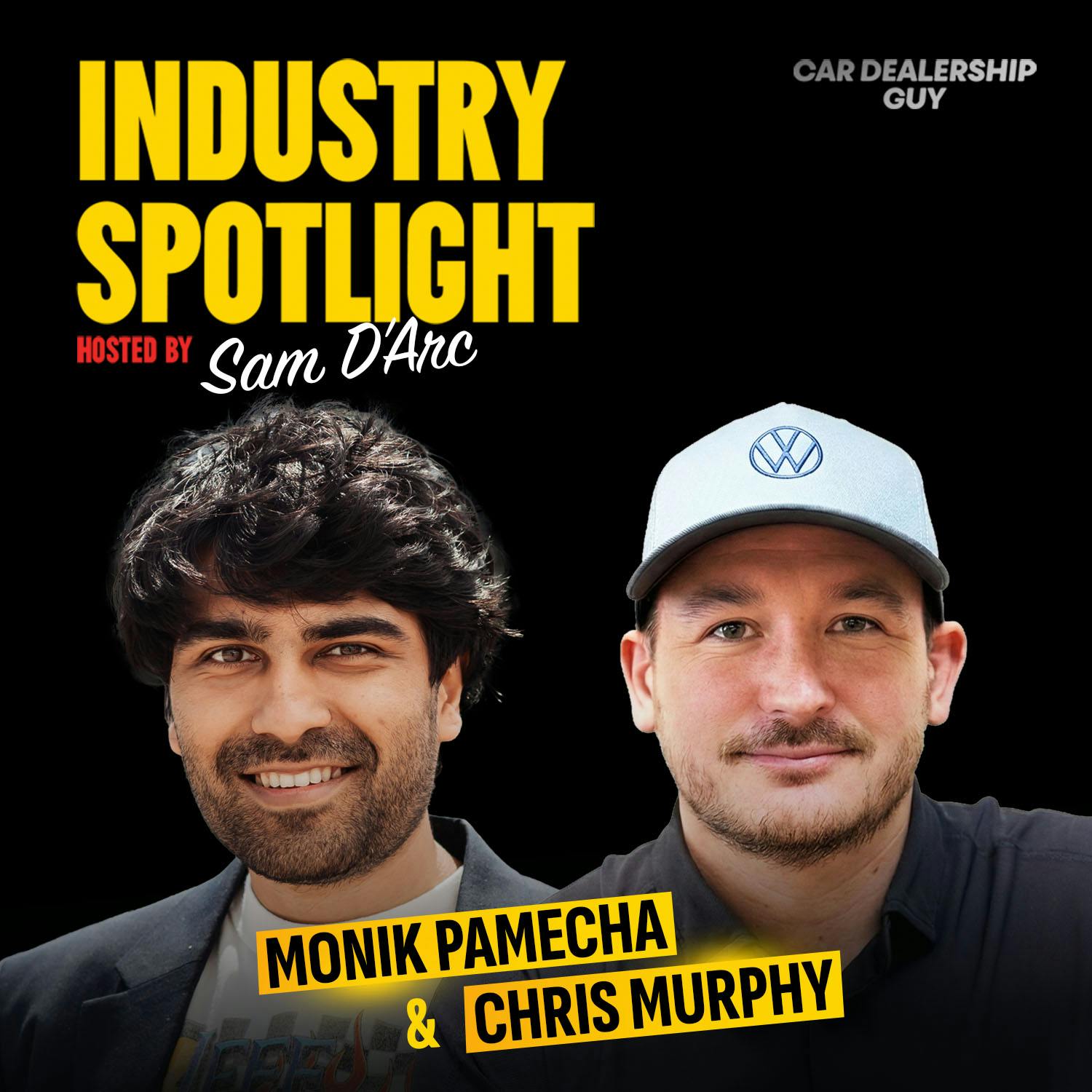
Exploring the transformative role of AI in dealership service, Chris Murphy, GM of Volkswagen of Oakland, shares how his team eliminated the BDC, empowering service advisors to handle calls directly. This shift not only improved call handling efficiency but also increased profitability. Monic, co-founder of Toma, discusses their AI technology that streamlines communication, allowing for better customer engagement and reduced call wait times. The episode dives into the challenges of staffing, the importance of effective call management, and the future of outbound communication through AI.
In part 3 of our Pre NADA AI Spotlight series we break down why call handling is still broken, and how a new generation of agentic AI is changing the equation.
Today, Sam sits down with Chris Murphy, General Manager of Volkswagen of Oakland and Monik Pamecha, CEO of Toma. We explore how forward-thinking dealers are reallocating human talent away from low-value phone work and back into high-impact, in-store customer interactions.
The conversation also tackles a harder truth: as AI becomes a true operational layer, GMs are now managing AI agents the same way they manage people—training them, auditing performance, and holding them accountable.
This episode is brought to you by:
Toma - Toma builds AI agents that protect dealership revenue, retention, and reputation by automating communications and workflows with safeguards that protect the customer experience. If you’re evaluating AI at NADA, see what thoughtful deployment actually looks like by pre-booking your demo at: http://toma.com/nada-2026
Check out Car Dealership Guy’s stuff:
For dealers:
CDG Circles ➤ https://cdgcircles.com/
Industry job board ➤ http://jobs.dealershipguy.com
Dealership recruiting ➤ http://www.cdgrecruiting.com
Fix your dealership’s social media ➤ http://www.trynomad.co
Request to be a podcast guest ➤ http://www.cdgguest.com
For industry vendors:
Advertise with Car Dealership Guy ➤ http://www.cdgpartner.com
Industry job board ➤ http://jobs.dealershipguy.com
Request to be a podcast guest ➤ http://www.cdgguest.com
Topics:
02:41 What is the biggest challenge in call handling?
04:54 Why transition service advisors to AI?
08:17 How to implement Toma AI?
14:03 How does AI enhance the customer experience?
24:34 How does voice AI improve customer interaction?
27:11 What was the biggest AI integration challenge?
36:59 How can dealerships use AI for outbound communication?
41:11 What is the future of AI in dealerships?
Car Dealership Guy Socials:
X ➤ x.com/GuyDealership
Instagram ➤ instagram.com/cardealershipguy/
TikTok ➤ tiktok.com/@guydealership
LinkedIn ➤ linkedin.com/company/cardealershipguy
Threads ➤ threads.net/@cardealershipguy
Facebook ➤ facebook.com/profile.php?id=100077402857683
Everything else ➤ dealershipguy.com
Volkswagen is a car company from Germany that makes many popular cars. They are known for models like the Beetle and the Golf.
Volkswagen is a German automotive manufacturer known for producing a wide range of vehicles, including the iconic Beetle and the Golf. The brand has a strong presence in the global automotive market and is recognized for its engineering and design.
"So a customer calls in saying, I have my 2020 Atlas in the drive and the last I spoke to you, you said the part is in transit, has it arrived yet?"
The Volkswagen Atlas is a large SUV that can fit many passengers and their belongings. It's designed for families and has a lot of space inside.
The Volkswagen Atlas is a mid-size SUV known for its spacious interior and family-friendly features. It offers a comfortable ride and a variety of technology options, making it a popular choice among families.
What is the biggest challenge in call handling?
Why transition service advisors to AI?
How to implement Toma AI?
How does AI enhance the customer experience?
How does voice AI improve customer interaction?
What was the biggest AI integration challenge?
How can dealerships use AI for outbound communication?
What is the future of AI in dealerships?
Select text to request an explanation
Hey, everybody, welcome to part three
of our pre-NADA AI Spotlight series.
Joining me today for a conversation on use of AI
in dealership service to maximize service rider effectiveness,
learn how one dealership eliminated their BDC,
leaned into service riders and increased profitability
as a result, plus how inbound call handling
is turned now to outbound and the possibilities there.
Joining today are Chris Murphy,
General Manager, Volkswagen of Oakland,
and Monic co-founder and CEO of Toma,
props to Toma for supporting today's content.
Let's jump into the show.
So Chris, welcome to the podcast.
Thrilled to have you here.
So tell us a little bit about yourself
and about the store where you work
as GM General Manager.
It's kind of just a typical story.
It was a family-owned dealership.
Going back to, we bought it in 1997.
And then more recently,
we partnered up with an auto group
and we bought out my dad,
who was the original owner and founder of the company.
Okay.
What auto group are you part of now, Chris?
It's Putnam Auto Group.
So we're 10 rooftops, 15 brands.
Okay.
And then, so do you still have some ownership
or are you there as a General Manager
that was part of the acquisition?
Just a General Manager now.
By the way, you can't say just.
What is the toughest jobs to recruit
for an all-of-automotive?
I tell everybody this is General Manager.
It's the measly General Manager.
Dude, what's that like going from,
so you were an owner,
you were part of a family with ownership.
You may have made plans your entire life.
Hey, I'm gonna be an owner.
You must have thought a lot of the Putnam Auto Group
to say, hey, I wanna be part of this group.
Yeah, I mean, it was probably like a five-year negotiation.
We really, you know, we had to find the right partner
that was willing to, you know,
partner with the existing alarms,
which is, it's hard to find.
So we kind of really started getting along
with this other owner and it was just five-year process
of us kind of going back and forth
and finding the deal that works for everyone.
So it's interesting, your family has experienced
an automotive for how many years, Chris?
Since 1996.
Okay, yeah.
And has it always been in Volkswagen
or have you had other brands as well?
We had other brands, we bought and sold a few dealerships
and then just slowly started focusing on Volkswagen.
It's interesting, telephones, answering calls,
handling call volume has not only been a challenge
of automotive for the past 20, 30 years,
but it's become even more significant
the past five, 10 years.
Why is that, Chris?
Why is it so tough to get people to answer the phones?
Well, I mean, it really comes down to staffing, right?
Like, you know, I've always been super sensitive to it
because we're in a really high cost of living area,
you know, we're in Northern California and downtown now.
We can't have this big bloated receptionist BDC staff.
So it's like, what do you do?
How do you balance that?
How do you balance the cost of adding additional plays
with having a great customer experience?
And I think the real impetus was getting software,
getting the phone tracking software, like that came in.
You always knew it was a problem,
but you didn't know how big it was.
And then once we were able to get the data,
once we were able to get the software
to track our phone calls,
you realize, wow, this is a huge problem.
Once you started tracking the calls, Chris,
what did the data show you?
What I quickly realized is a lot of calls are getting missed.
So the solution was BDC teams.
And then also what we really pushed for
was as the online schedulers improve,
we really pushed for promoting online appointments
because that reduces call volumes.
So with those two things, we thought problem solved.
Calls are getting answered,
people are setting online appointments.
The next stage in that journey
was these phone rescue systems.
Then you start realizing, well, calls are getting answered,
but then what's happened to that call after?
They're getting, a lot of times
they were getting transferred to our advisors.
And then our advisors were so busy
that the calls were not getting picked up.
So we realized calls getting answered initially,
but it's not getting to the right person
with all the information for the customer.
So then we realized we're back to square one.
So it was just like, now what do we do?
And the easy answer for us,
we scrapped our whole BDC and receptionist team
and we went to just all service advisors.
What was that like scratching BDC?
Because in our group, we haven't thought about it.
It's been a debate, right?
It does seem like in auto groups out there,
there's two paths, right?
There's leaning into the BDC going away from a BDC.
I like what Glenn Lundy says.
Glenn says, hey, BDC should be frontline sales
because if they're gonna handle leads and calls,
that's the first contact with the dealership.
They've almost got to be better than your salespeople.
And if they're better than your salespeople,
they should probably be on the floor selling cars, right?
It is the challenge of automotive today.
And then you layer onto it,
the typical age of a great BDC manager.
In a lot of cases, they don't,
they're not accustomed to calling being on the phone.
They're a little bit younger.
They're used to smartphones.
They snapchat rather than get on the phone, right, Chris?
Yeah, I mean, we exhausted ourselves with the BDC,
constant training.
And what we realized is,
if they're not in it like a service advisor
getting that knowledge every day,
a lot of the times the questions the customers
are calling in for are a lot more complex.
Yeah, majority of those time,
there's a reason they're calling
and not just booking online.
They have kind of more difficult questions
that usually generally need to go to a service advisor
who's got the background, who's got the expertise.
And that was the big problem.
So we exhausted ourselves training the BDC.
And finally, we realized,
let's just go more service advisors.
Let's streamline the whole process.
So how many service advisors did you add
to accommodate that increase in demand?
So we went from four service advisors to having six.
Okay, okay.
And the real reason we needed six when we broke it down
is because of the call volumes.
Now that advisors are answering the phones,
the amount of call volumes that we have,
we're gonna need at least six advisors.
Before we had three BDC,
so but advisors are able to handle the calls more effectively.
Yeah, so as you reroute the call volume,
CDK reports in their service engagement survey
that average call wait times for service,
if you don't utilize any type of intermediary,
any AI or any technology or anything else
is about nine minutes, which in any other industry is crazy.
No one would ever wait nine minutes to pick up the phone.
Did you find that to be true, Chris?
No, not initially.
I think there were still calls getting missed.
So we're still, that's kind of where AI comes into the picture,
but it was a step up from what we had before.
Yeah, yeah.
So yeah, the wait times, they weren't as bad,
there's just still calls getting missed.
And then that was the big paradigm shift for me.
It wasn't just the missed calls, but it was also,
now I have these really skilled advisors,
do I want them on the phones,
book in an oil change appointment,
book in a maintenance appointment?
No, I want them focused on the customers in our shop.
Yeah.
So in our technology, AI, agentic AI even,
you went in search of the perfect AI
that would work for you and your organization
that would allow your newer service reps,
service advisors, including your olders,
to be able to take the correct call volume.
How are you thinking about the problem?
What were you searching for?
What did you want to make sure you avoided, Chris,
as you made that decision?
Well, I knew we needed really good voice AI.
Like some of the things I've experienced
with some of the larger companies was pretty good.
And I wasn't sure if there's anything out there for automotive.
This was just a little before
where all the AI hype started in automotive,
where all these new companies were coming out.
So I hadn't really heard about much.
So I knew the voice AI needed to be really good.
And then for us, what we were trying to accomplish
was we needed like an end-to-end solution.
So it was kind of those two things
and we'll figure out the rest later.
And that's kind of what started our journey of finding TOMA.
Okay.
And why was TOMA a good fit in that moment for you?
What did they deliver on well
that kind of set them apart in your mind
to all the other AI solutions out there?
Yeah. So it was kind of two things.
Like one, it was just first demo,
hearing some of the real, real-life calls
and the interactions and the speed of the AI
and how well it was able to handle
like kind of differentiated questions,
kind of like had me hooked from the beginning of that demo.
And then the second thing was the customization on the fly.
Because that was so important because,
brands, dealerships have different information,
customizations, nuances.
So we needed to be able to do that
once we figured out those,
TOMA could offer those two things
where we knew this was the company we wanted to work with.
Before we go to TOMA, do me a favor real quick.
Give us a sense of the call volume
that you have incoming to your dealership
with these service advisors.
How many calls do you take on a daily basis?
Yeah, we probably get 40 to 50 calls a day.
Okay.
So that's kind of where I broke it down.
I was like, all right, six advisors, 40, 50,
okay, can everyone do 10 calls a day?
Now what you kind of fail to realize
is those calls are coming in all at one time
in a lot of cases.
So that's where we needed a little help in that sense.
So enter Monic, a co-founder and CEO of TOMA,
Monic, welcome back to the show.
We appreciate having you back.
So tell us Monic, how do you think about the problem
that Chris brought to you of,
he had a BDC, it just wasn't working.
He wanted to find a better way to connect directly
with the customer in a way that would ensure
correct call handling.
How can AI help solve that Monic?
I think Chris said that he was looking
for something that was end to end, right?
Which means that if you break down those 50 calls
and what are those dispositions,
there are some that are calling to book appointments.
There are some that are calling to get some kind of a status.
There are some calling for some informational,
informational like pricing or timings or things like that.
Just purely in service at least.
So then we figured out, okay, what can we do
to solve each one of these?
For the appointment piece,
and this is all the thought that we had in the past
as we were building the product,
which is can we book the appointment
without involving someone?
Yes, the maintenance appointments, yes.
Some kinds of recalls depending on the customization
and whatever Chris wanted us to book, we can and we cannot.
And then there's diagnosis, there's repair,
there's all these categories where again,
you need some more information from the dealer themselves
as they decide what is the criteria
for actually booking it and what needs more intervention.
So that's how you manage the appointment piece
where you're actually able to book
maybe 70% of those calls directly
and then the 30% are handled separately.
For informational calls, again,
the more information you give like on the pricing,
on timings, what works,
how much does certain service take, you can handle that.
And then there is this middle, I guess,
30, 40% of those calls which deal with
about a car that's already in the drive.
So what do you do over there?
Now, when Chris said end to end as we built the product,
and this is something that actually
we iterated quite heavily with Chris's store
as we built out, we have a feature called inbox
which is basically the place, it's like a task tracking system
where any time a customer calls in,
maybe we try to transfer to the service advisor
because the car is in the drive
and we've already captured the question that they wanna ask
but the service advisor is busy
because they're talking to somebody.
So we make a note of that
and now we are on the hook for getting the answer
from the service advisor
and the service advisor only has one place to go
and look at it, it's assigned to them.
They know what exactly the customer is asking for,
they can see the previous conversations,
they can see what happened.
So this, maybe in the past, what would have happened
is they would have just called five times
until they got an answer
and they would be frustrated.
Here, what would happen is,
they'll call customer, let's stop at this
for just a second, Monic.
This is a hugely important point
because this is something that drives us crazy in service.
Customer needs a status update on their car,
they need to find out about a particular piece
of the repair.
They call in, they can have a conversation with the AI.
The AI doesn't necessarily know what the next step is,
so it needs human intervention to get that.
So instead of passing it over to the service rider
and say, hey, you go get it, call that customer back,
in which case, maybe they can, maybe they can't
because they're slammed,
they got all sorts of things going on.
Normally, the customer would call back over and over
and one call, two call, three call, four call, five call.
And you're saying, Monic, what happens with the AI?
How does it engage with the service rider
to get the answer and then respond to the customer?
So a customer calls in saying,
I have my 2020 Atlas in the drive
and the last I spoke to you,
you said the part is in transit, has it arrived yet?
Are we ready to go?
When can I pick my car back up?
You know, I'm waiting to whatever,
take my daughter out on a trip.
Now the AI listens to the customer,
knows who the service advisor is,
will try to transfer them, tries to transfer,
waits five, 10 seconds, you can configure that.
The AI takes it back, which is try to connect you
with that person, we couldn't get to them,
we call it clawback.
So what I can do, can you give me some more information
on what you're trying to find out?
And I will make sure that you capture is that.
Now on the advisor side on the inbox, there's a timeline,
which just says two days back, they are called,
one day back, they've called again, they've said this
and the advisor has the ability to text them as well.
So it's not just call, it's also texting.
So now, from the manager perspective,
you see how many customers are there,
how many of them have called multiple times,
how many of them are annoyed.
And from the advisor perspective,
you know exactly who it is, it gets auto assigned
to certain teams, gets escalated,
if it's not been responded to as a heat case, for example.
So all of these things are built in.
The main thing is what would have taken maybe four days
for somebody to get back because it lost to the cracks,
now is organized and maybe the service advisor
comes to the desk, has one hour in the day
where they go through all of these
and make sure they close everything out
and everybody's responded to, even if you don't have
the answer, but you tell the customer
that I will get you an answer by tomorrow at this time,
that is still far better than just not saying anything.
Yeah, no response at all is far worse, far worse.
Does the AI help engage with the service writer
to remind them that, I mean, it's in this inbox, right?
So it's constantly coming up in front of
and then as a service manager or as a general manager,
this is what I think is fascinating in our world now.
As a general manager, Chris, our job now
is to manage an AI agent, almost as an employee.
It's to watch what it's doing, how it's engaging
and interacting with our customers and take the feedback
and then engage with our teams on it, Chris.
Are you seeing this help reduce the number of heat cases
by following up with customers on super basic items
like scheduling and status check on vehicles
and that sort of thing, Chris?
Yeah, I wouldn't necessarily say it's AI assisting in that.
I would say it's just software in general.
Yeah, yeah.
Like we've used other systems prior to TOMA,
but this is the same type of concept
of having a accountability system for those missed calls.
Yeah.
So you still have to manage as a leader.
You've still got to understand how it works,
set the guardrails and then follow up
with your team to make it happen.
Exactly.
But without having a system,
I mean, how do you know customers are getting followed up
with what you're tracking system for missed calls?
It's really hard to do that without bringing in
one of these specialty software companies.
Chris, are you using this TOMA technology
in only service or is it in sales as well?
No, I mean, it's important to understand TOMA is involved
from just a service booking assistant
to a full phone platform system.
So when you call our store now,
instead of getting your typical phone tree,
one for service, two for sales,
which was when you break it down, it's extremely inefficient.
So when you call our store now,
your first greeting is with our TOMA AI.
How can I direct your call?
So not only is it booking service,
but it's making sure that transfers are getting quickly
to the right person in the store every single time.
And then the beauty of it too is like,
the way you're able to instruct the AI,
and I'll give you an example,
customers routinely call in and ask for service
for like lease return questions,
which is bogging down our service advisors once again
with calls they shouldn't be answering.
So we were able to just instruct the AI
if customer mentions a lease return,
transfer it over to sales.
Now we're taking more weight off the service department
with having to answer unnecessary calls
and figure out transferring them out.
Yeah.
So what are the top two or three call types
that previously were kind of bogging your team down
that now AI is able to handle
and it frees up your team to deal
with the tougher, longer calls?
Yeah, I mean, I would say like,
the ones AI are really good at handling
is just the basic service appointments,
like oil changes, maintenance, simple repairs.
And they're just really basic calls
and they could actually be pretty time consuming.
And I'll give you some, I'll give you an example.
Someone books, you know, for a Tuesday
and then said, oh, wait, no, let me check my schedule.
I'm busy that day.
I want to book next week.
What do you have next week?
Those calls can go on for three to four minutes.
Yeah.
And now having our AI assistant do that
where it's not taking the time of an advisor
and helping filter out those easier calls,
which are just basic appointments
or just general inquiries.
So our advisors can reserve their time
for the more complex ones.
You know, how much is this repair gonna cost?
What's involved in this recall?
How long does it take?
Are parts available?
So that's where it's become super ineffective
and it goes back to just easing the burden
off our service advisors
so they can focus on the customers in the drive
and just really making their job easier.
Yeah.
All right, I want to hit an area
that Monic has talked to us about is available now,
which is outbound calling.
But before we get to that,
I want to ask you, Chris,
as you rolled this out to your service advisors,
was there pushback, was there nervousness
where they like, hey, look, this could replace me?
And if there was, how did you message around that
so that there was collaboration,
not competition against this technology?
Oh yeah, I mean, absolutely.
There's skepticism, they'll probably, you know,
give me some grief for just even doing an AI podcast.
But I mean, the narrative's been captured a little bit
about AI replacing jobs, you know,
and they see that on the mainstream media.
And it's just, that was never our goal.
I think the most important thing
if you're going to roll out an AI system
is one, just explain the vision to the team,
make them feel part of the process, get their feedback,
and then ultimately just use it as an efficiency booster
rather than a job replacement idea.
So Chris, here's my take on it, Monic.
Tell me if you think I'm right on this.
I actually think AI doesn't replace as many jobs
as we fear in automotive
because I think automotive is pretty labor-intensive.
Here's what I think AI does do,
is it raises the bar in how we deliver to our customers
to the point where it will be impossible
with complete people-managed manual processes
to deliver at that level.
And there will be dealers that will be out of business
before they even know it
because they won't have implemented this.
A great example is what you're talking about.
I don't know if you leave your Toma system on at 1 a.m.,
but what dealership can answer a call at 1 a.m.
and get a service LOF appointment made at 1 a.m.?
Not many unless you've got AI implemented
or respond to a lead at 1 a.m. in the morning.
And yet customers today expect that level of service.
We're not going to staff for it other than AI,
but customers want to get responses
in the moments they want it.
And I think that is the future of automotive.
It's not going to displace people.
It's just going to raise the bar on what's expected
because people will still need to manage that process.
Monik, any thoughts on that?
Yeah, I think it's like the glue.
So all of the gaps that you had in your processes
and staffing and people,
I think it glues it all together and makes it complete
so that for the customer, the experience is bulletproof.
And it's much better than what it was before.
And yeah, as you said, it's not possible.
Like even if you hired more people,
they cannot work all the time
and they're busy in the store because things happen.
So what do you do then?
And as the technology progresses,
there will be different things that come out of that.
Who knows what the future holds for us,
but as of today, that's what it does.
Makes a bulletproof.
Yeah.
So what KPI Chris actually moved the most that mattered?
Set rate, show rate, retention, CSI revenue.
What KPI's moved the most
with this implementation of AI technology at TOMA?
I think the ones you mentioned
is kind of the wrong way to look at it.
There's so many variables when tracking that stuff.
It's hard to point to one system or one process change.
What I really look at is like minutes saved,
for advisors being on the phone.
They only have so much mental capacity.
It's one of the most difficult positions
in the dealership in my opinion.
And times money.
Right, I wanna save all their capacity,
all their mental capacity, all their emotional capacity
for just dealing with the customers in front of them.
And so I'm really looking at how much is voice AI
saving our advisors time of being spent on the phone.
I think that, and then two,
is just the customer experience process.
Like building the AI into our dealership
where we're enhancing the customer experience.
So I think those are the two things
I'm really tracking and paying attention to.
And just to give you some note,
like TOMA in the last two months,
this saved our advisors about 40 hours on the phone.
Wow.
When that's time, they can,
I mean, go sit back and relax with that tie, you know.
By the way, any service advisor would say
that time saved is not spent relaxing.
It's been dealing with all the other things.
Like I go back into our service departments
across Ziggler Auto Group,
and those men and women are,
they're always running, right?
And so if it's not one thing, it's another.
So to your point, Chris,
like that does free them up to do higher value tasks,
which is pretty cool.
And that's got to result back,
not only an hour saved,
but CSI I would imagine customer satisfaction, right?
Yeah, I understand exactly.
Chris, I think he was one of the most,
I mean, and most people will see this as he's speaking.
He's very thoughtful,
and he's very systematic in his approach
to trying solutions at the dealership,
whether it is personnel, technology,
and he's really hands-on and involved.
You know, the degree which I haven't normally seen.
And since they're in Oakland
and we're based out of San Francisco,
we visit the dealership quite often.
Our entire team goes there,
including our engineers,
and we're sitting with Chris in his office
figuring out what to do,
you know, if we run into some hurdles.
Very impressed, and I'm very happy
to have somebody like Chris working with us,
where, you know, in terms of our product,
and I think he went into details of like specific things,
even like how he portrayed like the right way
to measure the value of AI,
because he's taught really hard about this,
and he's tried a lot of things.
So, you know, all of these things
are pretty well thought out
and, you know, have a lot of evidence.
So, Monique, it's interesting,
AI is such a buzzword right now in the industry.
You hear it everywhere,
and I am approached,
Chris, maybe your perspective on this as well,
by hundreds of AI vendors and companies each month.
It's almost overwhelming.
And so, as thoughtful as you've been, Chris,
is there a right way and a wrong way to buy AI
in the marketplace today that's so flooded
with all these different options and competitors?
Well, I mean, I've been thinking about AI
for the last, you know, decade,
and trying to build it into our store.
And the technology, I mean, it just,
it was, there was never really like AI agents
and then solutions.
I mean, it has evolved so much.
I think the hard thing now over the last few months
is just the amount of vendors that have come out
saying AI, everything, AI this, AI product this,
and it's hard to sort through that.
Like when I was looking,
there was only like a couple that really had the technology,
so I wasn't getting bombarded from different companies.
Now it's a mess.
Yeah, it really is, I mean.
So the right way to buy AI is just talk to dealers
that are using it like effectively.
Yeah, Monik, what would your perspective be
being in the industry and a founder and a creator
of a company that uses voice AI?
Not all voice AI is equal.
What's your advice to dealers looking to fill this gap,
this need that Chris has filled so well?
What should they be looking for?
And what's the biggest areas
they could potentially get burned in?
So I think the reason for a lot of noise with AI
is because what AI has done it
has made it easier to build AI tools as well,
which why there is so much noise.
So you could have something, could be a demo,
could be a full-fledged product,
or it could be somewhere in between.
They all look the same, which is why, hence the confusion.
But that is where the difference is.
And we've made some mistakes ourselves
with integrations, for example,
like the depth of the integration.
How well do you integrate with,
let's say a specific scheduler?
Can you actually respond to the customer
and do the things that they're asking for
and give them the correct information?
That would be one area where dealers get burned on
because maybe the scheduler,
it may not even be the vendors,
it's just, you have four systems talking to each other.
And then something over there is not correct
or not correctly integrated,
that causes downstream issues.
So it's usually finding, testing that entire path
and speaking to a dealer who's used that exact thing,
that same integration with the same setting,
maybe with the make,
there are different factors that come into play.
And sometimes it's the customers may not like it,
the way it's presented to them.
Like if you force people to just talk,
like if you're calling AT&T
and all you get is a machine on the line all the time,
they're going to get us.
But if you pitch it in a way which makes sense,
which is like you could do this
and you'd be done in 30 seconds or you could wait.
And because the service advice are busy,
then the customers will choose it to get,
so getting that opt in through better experiences.
So I'd say all that combined,
like what software lets you do that will win.
I think the dealer should,
I would say they probably want to focus on these aspects.
Think about how all the things will go wrong
and assuming that they will go wrong,
what option do you have?
Like how have you handled this before?
Tell me more about that.
Can I see it?
Can I look at that?
And I'm not saying everybody who's going to get YCR tomorrow,
it will work for them right out of the box.
That is not possible because some part of it involves
some kind of process change, behavior change,
and these are all tough things with people, right?
And if AI is not replacing people,
it's going to work with them
and now that involves some behavior change.
So how much of a behavior change is acceptable to you?
That is also a question that you probably want to answer
before you get into it.
Yeah, so it's interesting.
One of the things we've learned on the show,
Daily Deal Alive and on this show as well,
is with voice AI and any AI, it's a learning, right?
And so the tool develops over time,
it becomes more a part of Chris Murphy's culture
and his dealership over time.
It knows how to speak like a true employee
from the dealership.
You've innovated some really interesting ways
that a manager can engage with the tool
rather than just going in and typing text to correct
or help educate or learn.
Tell us a little bit about that
before we talk about outbound calling
and what innovations you've created in that modic.
So Chris, as I said, is very hands-on
and every little thing that he was initially trying,
he's like, can I add that?
Can I change this?
Can we do that?
And at some point, I told my team,
we had this flag inside of it where we're like, let it,
let's just give Chris admin access, he'll figure it out.
And Chris was making changes in there,
doing stuff by himself, asking questions,
and he was getting it to work.
And that got us thinking that for the longest time,
we were handling it through our own team
where requests would come in and we would make changes
or the AI would determine what needs to be done
and it would still be verified by a human
before putting it in.
Looking at Chris, we started thinking that maybe
there's probably savvy dealers who wanna go in
and hopefully if the interface was easy enough,
anybody could change it.
So that's what we did internally when we built this system
where you can actually talk to the voice AI
or you can chat with it and you can tell it
to do things differently.
And it keeps a log of all the instructions
it has received from you.
And let's say if you say, from now on,
no diags after 3 p.m., just,
and anything on Saturday, make sure that everything's
before 12.
And let's say you give something conflicting,
you change your mind and you're like,
you know what, let's do diags up until four.
And then when you tell that to the AI,
the AI will tell you, since it has a log
of everything that you've told it,
it's like, hey, didn't you just tell me to do it till three,
like two weeks ago?
Which one do you wanna do?
And then you'd be like, oh yeah, for those cases,
you should do three and then for these ones,
it's okay if you do four.
And then the AI keeps that.
So overall, that's how it lets you customize it.
By the way, that's a great employee, right Chris?
Have you engaged with the tool this way?
What's your experience been?
Oh, absolutely.
I've been inside the settings and,
I mean, it's not complex, right?
The way they built these systems,
I mean, I'm just speaking plain English,
like I would to an employee and saying,
hey, when this happens, do this.
And when the beauty of is it,
you tell it everything once and it just does it, you know?
Perfect.
And then it will remember and remind you,
it'll say, hey, wait, you told me this two weeks ago,
which, you know, we don't have the perfect memory.
So that's a good reminder of prior asks, right?
The way I understand where Tom is heading with this
is like, eventually, the AI will be able
to make suggestions to you by just listening
into your calls, because I will say,
I've had to put in a lot of work of like listening to,
or reading every call through transcript,
and then picking out those things where maybe the AI
didn't respond the way we wanted it to,
and then go in there in the back end and customize it.
And I think Tom looking to solve that problem
of that, you know, a lot of that workload
of having to listen to every single call
and start customizing the AI.
And Sam, to add to that, I think that is,
and Chris basically just laid out a vision.
The first step is obviously letting the dealer engage
with the AI to tell them what they already know.
But a lot of times you don't know
until you read the transcripts,
which Chris has painfully done, right?
But that's an incredible amount of, you know,
time that you won't have to put in.
And so how can we avoid that?
And how can we get ahead of that?
Which is anytime the AI doesn't know something,
it transfers, it listens to the transport call,
and starts making suggestions on the basis of that.
So that is, it's basically called reinforcement learning
with human feedback.
You know, that's what the word is outside of automotive,
just in technology in general,
but that is the application of it,
where if somebody asked a question,
and you didn't know, you transferred,
or maybe they handle an appointment,
it's, if I just kept watching every call,
and like, okay, how about we do this as well?
And you know, that's really like
what the product is tending towards.
And we have a beta version of that, that we're testing,
and we're going to roll it out
with all of our dealers very soon.
So it saves them time with the product,
and while building out the product as well.
That's amazing.
And again, it reinforces that idea of,
as a general manager, one of our new roles
is going to be engaging with AI, almost as an employee,
and managing that employee in a way that we do,
you know, a lot of other employees,
it'll return on investment,
just like an ordinary employee would.
So Toma and the technology has done a nice job
of dealing with and addressing,
and effectively handling that inbound communication.
Now the next step it would seem is outbound,
like going out and getting additional customers,
communicating service needs,
all the different things that staff would do
on outbound communications.
How are you thinking about that future state, Monik?
So we've actually been working with Chris
on some of those features,
and I've run some successful campaigns.
Up on, you have two options.
You do voice, or you do text.
On the voice piece, there are regulations around that
in every state, you know, and just overall,
the FTC has guidelines around that as well.
You have some options with outbound,
where recall phone calls are actually okay,
because they represent a specific use case.
It's a safety issue, and the NTSB has said
that it's okay to make those calls
because it's safety, right, Monik?
Correct.
And then there are other issues where,
let's say your caller ID will get flagged as spam,
you know, there are all these troubles
where you would put in the effort
to do all of outbound calling,
but your conversion rates will be pretty terrible.
And also nobody likes getting called at random times,
you know, even from a human, right, you'll cut that.
So the probability of, you know, it's like spaying and praying.
That's a challenge with voice, you know, outbound,
quite honestly, but on the other hand, with texting,
and this is assuming you have consent from the customer,
you know, let's say you captured that at some point,
you know, when the customer came to you.
On the texting piece, let's say you're doing,
I think, let me see, we had a campaign
that we had launched with Chris on overdue service, right?
So customers who came in, who had agreed
to, you know, receiving communication,
and now we're letting them know
that you're overdue for service.
On text, you can see the message,
you can, you know, exactly what you've been, you know,
whoever's reaching out to you, why?
And all you have to do is, okay, yes, I wanna get it.
And then the next message is, okay, when are you free?
When can you come in?
Because we already have all the information,
and it's like five text messages,
and you can complete the whole transaction,
as opposed to even a phone call.
So you can do both, but outbound text communication
is actually with AI, is very effective,
because there's nobody, you know, required to go answer that.
And let's say if there's a part where a customer
asks something where you need a human to intervene,
we have the inbox, so it dials in to that.
So it's like end-to-end because of that.
So that's cool.
Yeah, you can drive more than on,
you can have recall campaigns, you can do open service.
And you know what's great about all this, by the way,
guess who wins in all this?
The customer, the consumer, and our employees,
because in my mind, when you think about it,
our employees are freed up to deal with the tougher stuff
that really needs our engagement, interaction, involvement.
And the consumer gets the information they need
when they need it.
It reduces the amount of heater cases
and just frustration.
I don't know what the statistic is,
but most frustrated people who come into a dealership
are frustrated because of a lack of communication.
And I love what you guys are doing, Monic,
because you are filling the gap of communication,
void, deficit, whatever, both you and Chris
at your dealership, and you're filling it with technology,
and you're providing communication faster,
more effectively, more efficiently to customers
in a way that benefits everybody in the industry,
which is just really cool.
So Chris, as you think about the outbound communication,
are there any, what are the early results?
What are the early metrics impacted by that?
Yeah, I mean, it's super early in testing,
so I don't want to get too ahead of myself,
but we launched a couple of things with Toma
and the outbound communication, which is text-based,
and some for things like overdue service,
recall outreach, and we're seeing really,
really strong engagement upwards of 30%
on some of our campaigns.
And then we even started getting into a little bit
of service acquisition for vehicles,
for use car acquisition, and we're seeing upwards
of like 20% engagement on that campaign as well,
so really positive and very early.
Nice, that's fantastic.
Well, Monique, as we wrap up today,
any closing thoughts, things that are coming up,
things you've got going on at Toma, Monique?
Two big things are coming up.
First is NADA, and we will be there.
Please come meet us.
Our booth is 7507 North, and if you do come,
the second big event that's happening
somewhere in San Francisco,
we might have some tickets for you
to go watch a really, really big game.
Can I win them if I go?
If you're being a friend.
Then both of you, I want in on this, I want in on this.
I look forward, Monique, I look forward to seeing you
at NADA, Chris, will you be there as well?
I'm on the fence, I'm on the fence.
All right, well, we look forward to seeing
both of you potentially at NADA.
I'm gonna try to score these big tickets to the big game.
Maybe we'll see at the CDG party, both of you,
but we appreciate you both joining the show today,
and we'll come check you out, Monique,
at the NADA booth 7507 in the North Hall.
Look forward to seeing you all there.
Thanks, everybody.
All right, thank you.
Request an explanation for:
1 cars
1 cars featured
Request an Explanation
Heard something you'd like explained? We'll add it to this episode.
Sign in to request explanations for terms you heard.
Want to learn more?
Browse our glossary for plain-English explanations of automotive terms, jargon, and concepts.
See something that's not quite right? Our annotations are AI-generated and can sometimes miss the mark.
Click the flag icon on any annotation to suggest a correction.