Year-end carbine is a time when car dealerships try to sell as many cars as possible before the year ends, often offering special deals and discounts. It's a good time to buy a car if you're looking for a bargain.
Destination fees are extra costs that you pay when buying a car, which cover the shipping of the car from the factory to the dealership. They can change depending on how far the car has to travel.
The destination charge is an extra fee that you pay when buying a car, which covers the cost of getting the car from where it's made to the dealership.
The Porsche 914 is a classic sports car that was made a long time ago, and it's known for being fun to drive. It's special because it was one of the more affordable ways to own a Porsche back then.
An EV is a car that runs on electricity instead of gas. They are better for the environment because they don't produce exhaust fumes like regular cars do.
Chevrolet, or Chevy, is a popular car brand that makes many different kinds of vehicles, from cars to trucks. They are one of the top-selling brands in the U.S.
Ford is a well-known car company that makes many types of vehicles, including popular trucks and SUVs. They have been around for a long time and are a big name in the automotive industry.
The chip shortage means there aren't enough computer chips available for car manufacturers to use in their vehicles. This can slow down production and make it harder to find certain cars at dealerships.
Semiconductor chips are tiny electronic parts that help cars run their computers and other technology. If there aren't enough of them, car manufacturers can't make as many cars.
The Volkswagen Jetta is a small car that is well-liked for being reliable and good on gas. It's a popular option for people looking for an affordable sedan.
The Volkswagen Tiguan is a small SUV that is great for families because it has a lot of space inside and is easy to drive. People like it because it has modern features and is considered safe.
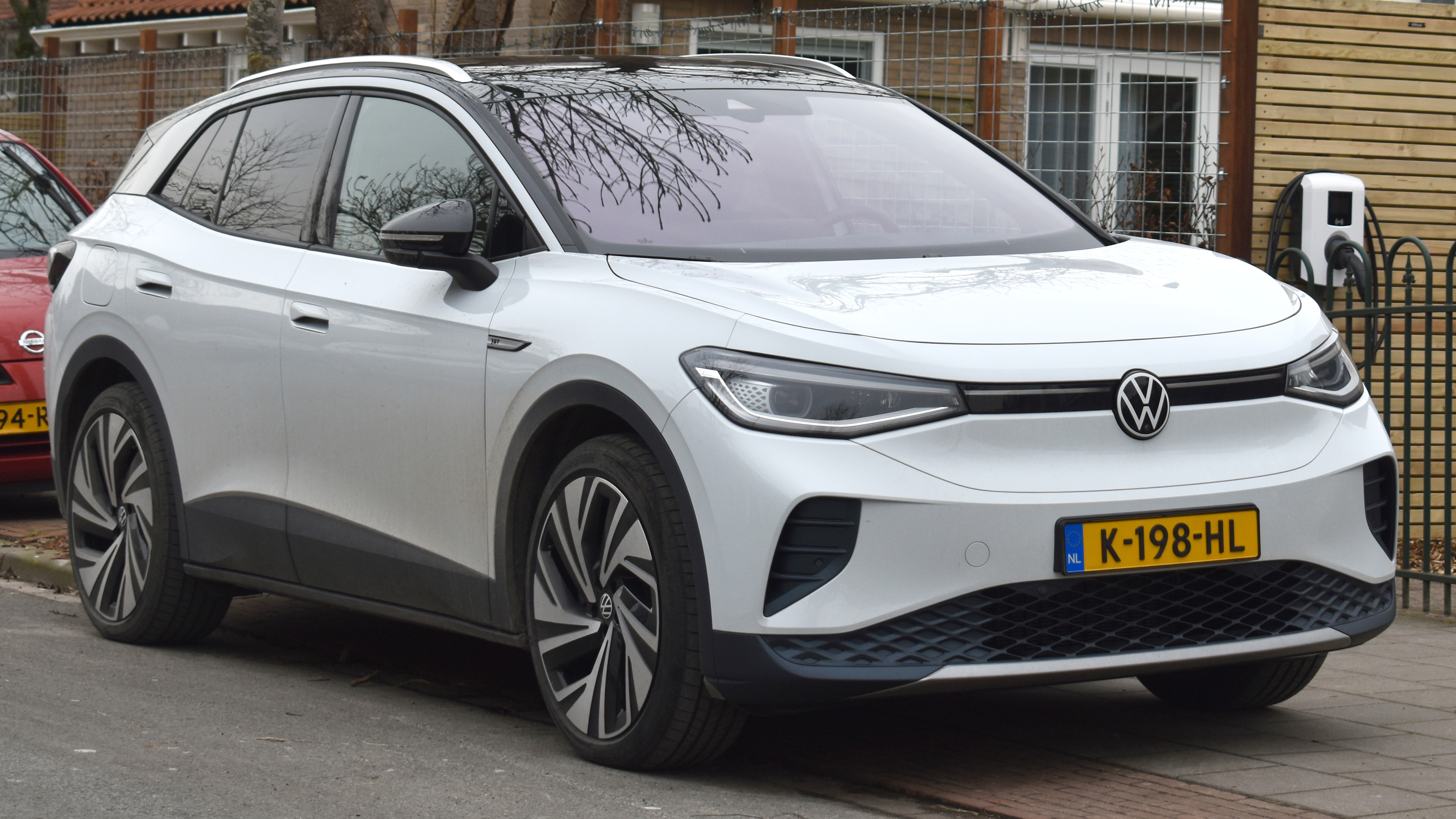
The Volkswagen ID.4 is a new electric SUV from Volkswagen. It's designed to be environmentally friendly and offers a different driving experience compared to traditional gas cars.
The Volkswagen Bus is a famous old van that many people recognize because it looks different and has a lot of space inside. It's loved by many for its fun design and is often seen in movies about road trips.
LIVE
Happy Holidays! Want to give your host a gift? Consider subscribing, rating, and reviewing the show this holiday season. It really helps the show grow. From all of us at Believe, have a Merry Christmas everyone, and a Happy Holiday!
It's noon here in Venture City, New Jersey, and our nation's capital, Washington, D.C., and this is Car Edge Live from Monday, October 27th, with your hosts, me, Ray, here in Venture City, New Jersey, and well, Zach, who said a personal best record running the Marine Corps Marathon yesterday in Washington, D.C.
in three hours, 26 minutes, and 22 seconds. No. No, actually, it was not 326 that Strava runs long. Actually, the course was different than what I was going to watch. It was 323 pops, 323.
Great, but thank you for the kind words. Either way, today's show folks brought to you by us, caredge.com. We've got a limited offer going on right now. Year-end carbine, things are starting to heat up.
We're going to talk today about why car prices, unfortunately, seem to keep going up and uncover one of those dirty little secrets of the car business. But for those of you that are in the market between now and the end of the year, it is officially the season to get the best deal on a new or used car, and we are offering a $300 discount off of our carbine services and 30% off Car Edge Pro back on caredge.com.
If you want to learn more about those and see how we can help you, go for it, pops.
You are a little echoey, so I'm not sure that your audio is set correctly, but I just thought I'd bring it to your attention.
Okay, appreciate that. Let me know in the chat, folks, if anything's feeling echoey and things are set up correctly over here. Let us know in the chat if we are okay. Maybe, Dad, if you want to just do a quick refresh and see if it feels better, I can continue with the show for a hot second here.
You want to try that, pops? Yeah, what do you want me to do? Just refresh your browser. Refresh my browser. I'm not sure how I do that. Reload?
He fidgeted how to do it. Oh, it is echoey. Okay, interesting.
No, people are saying I'm echoey, pops.
See? Yeah, buddy.
Alright, well, whatever. Let's kick off the show and then I will come back over in a second here, pops. The thing that we were going to talk about, destination fees increasing significantly, automotive news pulled together, all of the data.
I'll pull it up on the screen here, the chart that I'm going to do a quick refresh. Why is this the secret reason why car prices keep going up?
Well, because it is a way to manipulate the price without manipulating the price. So what do I mean by that?
Well, you can keep your MSRP, your base MSRP on the vehicle with, say, a small or no cost increase, but the total MSRP of the vehicle could go up by five, six, seven, eight hundred dollars based on the fact that the destination charge went up significantly.
And so it is a way to, I don't know, hide the cost of tariffs without saying it's the cost of tariffs. Now, from what I understand, I am not the brightest man in the world, but from what I understand, fuel costs haven't gone up significantly.
We do know that maintenance costs for vehicles and insurance.
Do you mind if we start, though, actually, can we stay on destination fee for a second here? Just how much it's gone up?
Yeah.
Okay, look at the chart. We're talking about, is it showing you year over year, 2021 to 2025. So over the past four years, excuse me, how much the destination charge has gone up.
Look at that, guys. 26.9% is the increase that we've seen on average for these destination charges. So before you go into even other places, Pops, let's just focus here for a second.
This is one of those secret reasons why car prices are going up. You've seen a 27% increase in the price for the destination charge that the manufacturer charges, that hidden cost like you were talking about.
Yeah, that's the industry average. If you scroll up, you'll see some brands are well below that, but other brands, particularly Stellantis, we've seen increases in destination charges in the last four or five years.
For instance, Hyundai has gone up 29.4%. Porsche, 47.8%. Stellantis, 34.8%. Subaru, 31.4%. Those are significantly above the industry average.
Ford and GM, 39% for both of them. And we're talking about now the average destination charge for Ford being almost $2,000. Over at Stellantis to your point, Ed, the average destination charge $2,120.
It is a way for them to ultimately increase the bottom line MSRP, the total MSRP on the vehicle without having increased the base MSRP or only moderately having increased the base MSRP.
But the ultimate outcome is that the total MSRP with destination charges is much higher than it had been. And the total price increase that way ends up being much higher.
But they can show statistically that the base MSRP did not go up all that much. Jerry says it best. It's masking. They are simply masking the price increase by showing it somewhere other than as a price increase on the vehicle itself.
Now, a lot of the most popular vehicles that folks are out there buying from those domestics are pickup trucks. And we have now seen at Chevy, Ford and Ram, the destination charge on their mid-duty, full-size pickup trucks, $2,595.
You and I covered this when GM was the first brand that announced that those year-over-year model year change over destination charges were going up so much. And we actually, we went on a, we did it that day in the video.
I mean, we went, there's like a General Motors dealership, a Chevy dealership 20 miles away from where these vehicles get final assembly. Yet that vehicle still has a $2,600 destination charge. It makes no sense.
And so this is one of those secret reasons why you keep seeing car prices go up. And to Jerry's point to your point, it can also be masked fairly easily. You can say to your point that the base MSRP hasn't gone up. It stayed the same.
It's just the destination charge over the last four years has gone up. Drum roll please, 27%. It's absolute lunacy. And this is, this is like the equivalent, I think, that of the dealer Dock fee, but for the manufacturer.
It has no real purpose. It's just some arbitrary number. It's extra profit for the manufacturer. The dealer doesn't make more money when the destination charge goes up. It's the, it's the profit for the manufacturer.
Sure. It's, it's not as if you can negotiate the destination charge.
Yeah, that was one of the questions we just got right here. Can it be negotiated?
No, the destination charge is the destination charge. That's part and parcel of the final MSRP. But that portion of it is not negotiable.
So can you negotiate the price of the vehicle? Yes, you can. Can you, can you say, well, I won't pay for that destination fee? You can say it. You're not going out with a vehicle. You're not going to buy a vehicle when you say that.
Because that is not a negotiable item. And so when the manufacturer increases on average 27%, the cost of destination over the last four years, that is a way to compensate for whatever tariff costs these manufacturers are eating.
We've had this conversation. There's only so long that these manufacturers can go where their profit margins have dropped from 10% to 12% to 5% to 6% before the stockholders are saying, we need to be closer to the 10% to 12%.
Yeah, for sure, Pops. I also want to be very clear because it's an opportunity to get very confused. You negotiate off of the MSRP. Yes.
The base MSRP that we're referring to is before the destination charge. So you know what, let's actually do this. Let's, let's.
Click on research. From research, click on free window sticker. I'm going to take just the example then that we have here, put a VIN in here for a free window sticker.
We can't wait.
Well, let's do it. Let's take this thing out of obscurities and make it very real. What we're talking about. So this particular window sticker shows an $81,043 MSRP.
What we're talking about is before this is added. We're calling that, we're just our nomenclature today. We're calling that the base MSRP is before that delivery and processing and handling fee is added.
In this case on this particular vehicle, what was it? This was a Sequoia capstone. Holy cow, an expensive Toyota. There's an $1850 delivery fee.
In Toyota's case, delivery processing and handling fee. Just want to be very clear that $81,043 below it, you're going to negotiate that. That's the MSRP of the vehicle.
You do not pay MSRP for new vehicles. You negotiate, negotiate, negotiate. That MSRP is being inflated today as a result of this number going up even more.
That's the point that we're trying to make in today's show. That's what the data here from Automotive News points out so clearly is that we are seeing a sharp increase in that extra line item, which to be clear, ultimately gets factored into the total MSRP of a vehicle.
I just hate sometimes how confusing our world is here with all the different prices and things like that. So I want to show an example there for what we're talking about.
Nicely done.
Okay. Anything else, Dad, here on the secret reasons why car prices keep going up? You were talking about some other stuff earlier. I'm sorry. I wanted to redirect and keep us on the price increases.
If you can pull up that list again.
Yeah, sure.
And scroll up to the top and you will see that there are certain brands where, for instance, luxury brands, look at BMW, look at Mercedes Benz.
Their destination charges haven't increased anywhere near what mass market brands have increased.
The increase in destination charges for the mass market brands, and think about this for a second.
Mass market typically means there's more of them.
And typically, the more volume you can promise somebody, the lower the cost they provide for their service.
If they're shipping only one vehicle for the year, it might be $10 million.
If they're shipping 10 million vehicles for the year, it might be $1,000 per vehicle.
And so the mass market brands are going up significantly higher on the destination charges when they have the leverage to negotiate even lower prices for the destination fee simply because they can promise these transporters greater volume.
So that says to me that the manufacturers are just many of the mass market brand manufacturers are just being greedy.
I don't believe originally the destination fee was supposed to be a profit center for most of these manufacturers.
I believe they have figured out a way, much like the dock fee for dealers, to turn it into a profit center.
And the ones that are abusing it the most are the mass market brands as opposed to the luxury brands.
A couple of comments here, Dad. Rich has a great point. You say up 27% over the last four years, tariffs have only been in effect for eight to 10 months.
And I think it's really important to call this out. We've seen destination charges going up, up, and up more recently, and Jerry pauses it out here as well.
And during his career, he never saw destination fees go up more than $100 a year. I'd love your comments on this as well.
So this has been Rich an area where the manufacturers, to my dad's point, have been trying to capture more profits.
This is just like a masking profits. Now the justification for in the case of if I'm Ford or Chevrolet or Ram going from $1,995 on my mass market pickup trucks to $2,595 on my mass market pickup trucks in one year.
It's not clear a sign as ever that they're doing this in response to tariffs. But this has been a growing area of concern for consumers for a long time because the OEMs just keep the original manufacturers, the automakers, just keep increasing it more and more.
So sorry, I wanted to pull that up. I don't know if you have additional thoughts there, Pops.
No, that and you know, I get it, you know, because we can say both tariffs has only been around for a short period of time in comparison to the to the four year window that we're talking about.
But the significant increases in the destination charges have been recent and more recent and more significant recently than they had been up until this point.
And much like Jerry, I don't ever recall in 43 years of being in retail automotive where where I saw destination charges go up more than $100 or $150 in a year, certainly not $600 in a year.
And like I said, these are the mass market brands. These are the brands that have leverage over their transporters because they can promise them more vehicles to transport than Mercedes can or BMW can.
Yet Mercedes, BMW, some of the other brands are are much lower per vehicle to transport.
Now, I know there are many out there who will say yes, but vehicles are getting bigger vehicles are getting heavier.
So the cost to transport them has gone up because they're bigger, heavier vehicles.
Yeah, I'm sure there is some truth to that.
But they didn't suddenly get heavier and bigger to the point where the increase in the destination charge would be $600 year over year.
We don't we don't normally see increases like that in the industry.
Now pull this up from Richie agrees. He thinks it's more greed than just tariffs.
And you know what, I for the most part, Rich, I agree.
Although the most recent action we see here of the $500 increases on those pickup trucks, that makes me think it's a little more.
Oh, crap, the tariff side. Oh, what lever do we pull as strategists at sea level, sea level executives at these automakers?
Oh, what, what, what lever do we pull? Just make the destination fee higher. Who cares? No one will notice.
We're noticing.
Well, and they show.
And the other thing about that is in so many cases, online advertised prices are the MSRP excluding the destination fee.
So if if there's a vehicle that's listed, say, it's a pickup truck that's listed at $60,000 and it's excluding $2,595 of destination charge.
Well, suddenly that $60,000 pickup truck when you go to look at it at the dealership is $62,595.
That's a significant surprise to the customer who came in expecting to look at a $60,000 pickup truck.
So the negative impact of inflating these destination feeds, it just makes it harder and harder for customers to be able to afford these already overpriced vehicles to begin with.
All right, let's switch gears, Pops. Let's talk a little bit on the chip shortage front.
Unfortunately, we are a few weeks away from feeling some ramifications of the next Sparia outage.
Dad, give us an update here at a high level.
It's not like you have two into the weeks because there's another big story I want to talk about as well.
But what's going on? Chip shortage 2.0. Give us, give us the rundown here pretty please, Pops.
Well, there's a Chinese firm experience that produces the older style, less expensive, less robust chips that many of the manufacturers still need and utilize today when it comes to their vehicles, things.
And the chips might control things like windshield wipers and windows and things like that.
And because they're the older generation, less profitable chips to be made, there isn't a lot of backup chips available from other manufacturers.
And the Chinese government is insisting that they look very closely at where they're exporting these chips to.
And already there's been some issues that they're trying to resolve in Europe for European production.
And according to this article, we could be two to four weeks away from the chip shortage, negatively impacting manufacturing for automobiles and trucks in this country.
And so just as we see inventories building up again and we're thinking, OK, we could end up more in a buyer's market than a seller's market.
If this chip shortage truly does happen in the next two to four weeks and production is lost and production is turned off for some vehicles,
then inventories are going to go back down, leverage is going to go back to the dealers,
and ultimately the customer who wants something is going to pay more to get it,
which ultimately makes it even less affordable for less people.
That's what we're keeping our eyes on, is will new car prices go back up because these semiconductor chips are not being produced
and that will ultimately impact the amount of new vehicles that are being produced.
That being said, still a couple of weeks away, so we'll keep you posted on it.
And right now the inventory situation and supply demand situation favors car shoppers more than it favors dealers.
That is different for every brand, but the broad strokes analysis of the industry right now
is you have way more leverage today buying a new or used car than you did earlier this year
or even in the most recent past few years.
If this chip shortage turns into something like it did a couple of years ago, like four or five years ago,
then we could be talking about a very different tune, one that is much more of a seller's market and not a buyer's market.
That being said, we'll keep you posted on it and I thought it was worth sharing that.
The other story I wanted to talk about this morning, Dad, comes by way of Volkswagen.
There was an analysis done that suggests that Volkswagen is going to fall $11 billion short of what they need
from a cash perspective next year.
You can see it right here.
According to a report from Europe, internal reviews suggest the Volkswagen group could be more than $11 billion short
of their free cash flow it needs to continue operating past 2026.
Dad, if Volkswagen runs out of money, which Porsche actually, we didn't even talk about it last week,
Porsche lost money for the first time in their company's history in one of the quarters.
This is big news.
If Volkswagen runs out of money, it also comes on the heels of some other reporting talking about Stellantis
potentially wanting to divvy up assets there.
You and I have been talking about for a while a potential shakeup and restructuring in the auto industry,
but I'll shut up for a second here.
What did you make of this, an $11 billion projected shortfall at VW?
Well, if I was running VW, I guess I'd be looking to increase my destination charges even more.
Because apparently the solution to everything is to just increase your destination charges.
Listen, $11 billion is a lot of money.
I don't know how you could do long-term planning and not realize until, I don't know, yesterday.
Looks like we can have an $11 billion shortfall in cash by next year.
I mean, you would have to have seen this coming.
Well, let's do a little bit of the, you know, we always balance the micro and the macro here on the CarEdge channel.
Dad, let's go. Where do you want to go? Where do you want to go for this analysis?
San Diego.
All right, give me a second. San Diego zip code 91911.
Cool. So now we're going to go to San Diego. I don't need to be nationwide.
I'll do within 100 miles. We're in Chula Vista, so near San Diego.
Dad, what do you want to do? A VW, a Volkswagen? What?
What's their most popular? A Jetta?
Well, based on inventory, it looks like here would be the Tiguan. The Tiguan is going to be the one they have the most inventory.
So this is Volkswagen's best-selling car, most inventory. Let's just click into one.
The first one here, I want to get a sense for what's going on on the ground market conditions.
So 2025 Volkswagen Tiguan, we're in San Diego, California.
The MSRP is almost $32,000. That seems approachable.
The dealer invoice price is $30,687. The dealer discount should be between $2,500 and $3,200.
Drum roll, please. Holy cow. We do these live. We do these live.
We do not plan this stuff, okay?
1046 days supply of inventory.
Dealers in the San Diego area have only sold eight of these vehicles in the last 45 days,
yet those same dealers have 186 of them for sale right now.
So Dad, just going macro, the headline reads, $11 billion cash shortfall looms.
We're not even talking about VW's strategy of going electric, which has ended up biting them in the butt.
We're looking at their vehicle with the most inventory and in the San Diego market,
and it has a thousand days supply. If you're managing a Volkswagen dealership, Dad,
what are you doing? You're tweaking discounts left and right on these things.
If I'm managing a Volkswagen dealership in the San Diego area,
I'm sharing my resume with non-VW dealers hoping to get a job at a dealership.
I don't know where they can actually sell some cars.
Perhaps, and I don't know, but I'm assuming that the Tiguan S is the base Tiguan,
and if that's the case, that would indicate to me.
Unfortunately, and I don't understand this for the life of me,
but that would indicate to me that base vehicles that are not particularly well-equipped
as far as a lot of extras is not what the public is willing to buy.
That is unfortunate because when and as we talk about an affordability crisis,
when there are vehicles that are affordable but aren't equipped as nicely as perhaps the customers would like,
they pass on them.
Well, Dad, that's the Tiguan and to your point of base one, but let's come back here.
Let's say they were all in on EVs.
You want to look at what, the ID for the ID buzz.
Look at this, this bus.
There's 144 of them.
Let's look at this bus.
Oh my God.
$72,000.
Yeah.
So again, Volkswagen's got an $11 billion projected cash shortfall next year.
One of their big bets was on EVs.
One of their big bets was on this retro ID buzz van.
$72,596 MSRP.
The invoice price is $69,692.
We don't have a target discount on this one.
I'll ask the team why that is shortly here, but let's go down and let's look.
And there you go.
There's your days supply for your big bet, expensive new EV.
333 days supply for those of you that listen to the podcast and don't tune in live here on YouTube.
Those dealers in San Diego have only sold five of these in the last 45 days, yet they have 37 for sale.
So again, another example, macro $11 billion shortfall.
The automaker doesn't even care if the dealer sells it initially because they make money when they wholesale it to the dealer,
but eventually they do care because the dealers start to complain.
The dealers won't take new inventory.
I mean, this is two total polar opposite examples of white Volkswagen's in trouble.
Think of how crazy that is.
We're talking Southern California.
We're talking the EV capital of the United States, California.
Okay.
There are more EVs sold in California than anywhere.
And in California, they have almost a, in Southern California, in the San Diego area,
they have almost a one year supply of the ID buzz on the ground.
That is, if you can't sell those there, then I suppose I should say,
if you can't sell them there, you can't sell them anywhere.
Okay.
That is just pure insanity to me in the EV capital of this country that they can't sell that EV.
And dad, again, we only spent a second mentioning it, but Porsche lost $1.1 billion.
And a lot of that was because of all their EV ambitions that are now facing setbacks.
Porsche, obviously a part of Volkswagen here.
So yeah, it's really interesting to see what's going on.
And we didn't even touch on it too much, but those rumors about what's going on at Stalantis,
I think you and I may end up looking like some really smart guys next year when we start to see
some of these automakers divvy up their assets, divvy up their brands, and start to restructure.
And I think it's really important for our community to know the general theme here as we head into the end of the year
is it is a buyer's market, some of these Volkswagen products.
I'm not saying you go into the dealership and you negotiate with the salesperson and say,
did you know Volkswagen is supposed to lose $11 billion or not have cash, not have $11 billion worth of cash?
Does this say in operations next year?
The salesperson doesn't care.
Use the other tactics we've taught you to negotiate the deal.
But have in your back pocket the knowledge that you know they need to sell that car.
They need to move the metal because there's pressure at the dealership level
and obviously pressure coming from the manufacturer that you've worked for some brands that have struggled to sell cars.
What are the conversations like between you, the sales manager, and your area rep, your factory rep, the manufacturing rep?
I can't imagine they were pleasant.
No, they're not pleasant.
And I remember some of the conversations where the factory rep would look at me and he'd point his finger at me and he'd go,
well, what are you doing to move these units?
And I would look at him and I'd go, you know, every time you point your index finger at me asking me what I'm doing,
you're pointing three fingers at yourself.
Ask yourself the same question.
What are you as the manufacturer doing to create enough excitement for this product for people to want to come in and buy it?
It is not my job to create that excitement.
It is the manufacturer's job to create the excitement.
Once they've created that excitement, then it is my job to say, now that you're excited about that POS,
you need to buy that POS here at Gotcha Motors.
So think about all that stress that's going on right now and then you as the customer come in
and you're the beautiful, incredible opportunity to actually finally move one of these pieces of metal.
This is why we continue to reinforce buyer's market instead of seller's market.
And obviously, if you watch today's show, you're more knowledgeable about where some of the secret price increases are coming from with those manufacturer destination charges.
Dev, let's come here for Matthew.
Really appreciate your kind contribution, Matthew.
Nobody wants the Volkswagen bust.
I see what he did there.
Don't listen to Janice.
They all want Porsches.
Picking mine up in Donnerstag.
Picking mine up in Donnerstag in Leipzig.
Don't know what that means.
Thursday, Zach, great marathon.
Let's freaking go.
Well, congratulations to you, Matt.
I'm picking up your new Porsche.
That sounds really fun.
Yeah, Leipzig, Germany.
Oh, Leipzig, Germany.
Yeah, yeah.
Got it, got it.
Yeah, yeah.
And maybe they'll make them run 26 and a half miles to get to the car.
I don't know.
I kind of doubt it.
So, Dev, let's recap here.
If you're in the market to buy a car and you watch today's show, what are the takeaways you should be taking away from today?
That you know prices are going up and the reason prices are going up is the total price of the vehicle is going up primarily because there's been significant increases in the destination charges.
The manufacturers are doing the best that they can to keep the base MSRPs relatively close to what they have been.
If we don't suffer from a chip shortage two to four weeks from now and we don't suffer from production losses due to that impending chip shortage and if inventories continue to climb, which we suspect that they will, then utilizing market day supply and on-hand inventories,
you should still have leverage as, let me rephrase that.
As the buyer, you always have leverage and the reason you always have leverage as the buyer is because the seller isn't going to sell the stuff to themselves.
They need you, the customer.
Now, sometimes the seller takes the position, well, there's more customers than there are vehicles.
That's not the case right now unless it's Toyota or Lexus.
You have the leverage.
You are there trying to help them out.
They're not trying to help you out.
Don't ever forget that most important two-letter word, no.
You keep working on a price that is acceptable to you and if they don't get there, just say, as Nancy Reagan used to say, God bless her soul, just say no.
Drugs, this is to the high prices.
Just around Toyota and Lexus, you still can get better deals or worse deals, so definitely do your work there.
It's not an excuse to not put in the work.
Dad, let's remind everyone one more time, caredge.com.
Fourth quarter, folks, we're gearing up.
We're busier than ever before.
$300 off our car buying service, 30% off Car Edge Pro.
If you click onto the car buying service, a couple of things.
One, get a free consultation.
Learn more and see if this is even a good fit for you as you contemplate buying a vehicle and meet our team.
Meet the incredible team behind the scenes that are helping hundreds of customers every single month.
Learn more back at caredge.com.
Car Edge Pro, watch the different videos, but ultimately what this is giving you is all of the data that you need to be informed as well as the AI agent to do initial outreach to dealerships.
This is best for those of you that want to do it yourself.
Get access to those tools back at caredge.com.
Now, my dad mentioned it at the beginning of the show yesterday.
I ran in the 50th anniversary Marine Corps Marathon.
It's the 50th year they've been running this marathon.
What an incredible opportunity to run through the nation's capital.
Dad, as you'll see here, I'm going to slow down just a little bit.
My time was 323 and 36 seconds.
I'm really excited about that.
I also raced in a way, dad, where I tried to set a half marathon personal best on the second part of the race.
I came up about 40 seconds short, but I was definitely running fast at the end there.
What a beautiful course, what a beautiful race.
I will share, I got my bib literally at 5.45 morning of the race.
These are some text messages back and forth with friends.
Here's a quick video of me running by in a second here.
Wait for it, wait for it, wait for it.
There you go.
There I am.
I'm really happy to be out there sort of being some friends.
I took a red-eye flight back from California that morning and landed at BWI Airport at 4.45 AM.
I actually don't know if I got the three hours and 13 minutes to sleep.
My watch says I got and had a lot of fun out there.
That's me and my friend, Dino, who helped me get the bib so that I could run the race.
It was a hell of an experience, dad.
It was pretty crazy to run that race and not know I was going to run it until, I don't know,
an hour before it started.
It was pretty wild.
You beat your personal best by what, about 15 minutes?
About 12 minutes, yeah.
12 minutes?
Yeah, so I ran that race last year.
I also didn't really know I was going to run the race last year,
but I knew two days before that I was going to run the race last year,
and I ran it in 3.35 right around there.
Then this year was 3.23.
I think I could actually do like 3.10 probably.
I ran 75 miles last week.
I had no clue I was going to run.
But apparently the key to you running fast is not getting any sleep the night before?
Adrenaline, man.
I slept 12 hours last night, but I had a lot of adrenaline.
That's for sure.
I had a ton of adrenaline.
If any of you are on Strava or do endurance sports, stuff like that,
I'm just chef's guy over on Strava.
It's really fun.
I love sharing what I'm up to over there.
Thank you, Matthew.
Appreciate the kind contribution here.
Zach Donnerstag is Donner's God of Thunder day.
Hence Thursday comes from Thursday, getting cultured on cards.
Appreciate that.
Love learning.
What's that?
Something new.
We appreciate it, Matthew.
Okay, Pops.
Let's call it a show.
Do it all again tomorrow.
Does that sound good to you?
What's tomorrow?
Tuesday?
Tuesday?
I'm free.
Oh, I also should mention had the first lung cancer foundation of America board meeting
last weekend.
That's why I was over in California.
Guys, I am so excited.
So excited to be working with this team.
So for those of you, if anyone's been touched by lung cancer, consider making a contribution
on lung cancer foundation of America.
But dad, holy cow, I fired up to help them grow, to help us.
I got a guy I don't remember.
To help us grow.
Yeah.
You're on the board, buddy.
I'm on the board.
It's not them.
It's you.
I mean, to help us grow the amount of contributions from the fund.
That fund, early stage research.
Really good stuff.
Anyway, okay.
We're back tomorrow, folks.
I love you, Pops.
I love you too.
Nicely done, young man, on both fronts, the LA front and the Marine Corps Marathon front.
Proud of you.
Appreciate it, Pops.
Love you, dad.
Yep.
If you're a maintenance supervisor for a commercial property, you've had to deal with everything
from leaky faucets to flickering light bulbs, but nothing's worse than that ancient boiler
that's lived in the building since the day it was built.
50 years ago, it's enough to make anyone lose their cool.
That's where Grainger comes in.
With industrial grade products and dependable fast delivery, Grainger can help with any
challenge from worn out components to everyday necessities.
Call, click Grainger.com, or just stop by.
Grainger, for the ones who get it done.
If you like the show, please take a moment to rate, review, and subscribe.
It really does help the show to grow.
Thank you for listening.
Happy holidays!
Want to give your host a gift?
Consider subscribing, rating, and reviewing the show this holiday season.
It really helps the show grow.
From all of us at Believe, have a merry Christmas everyone, and a happy holiday.
About this episode
Car prices are on the rise, and the hosts uncover a hidden factor: significant increases in destination charges. Over the past four years, these fees have surged by an average of 27%, allowing manufacturers to inflate total prices without altering base MSRPs. The discussion also touches on the impact of a potential chip shortage on production and Volkswagen's alarming projected cash shortfall. With insights on negotiating tactics and market conditions, this episode provides valuable information for anyone considering a vehicle purchase.
Today on CarEdge Live, Ray and Zach discuss the latest info on why car prices are skyrocketing. Tune in to learn more! Hosted by Simplecast, an AdsWizz company. See https://pcm.adswizz.com
for information about our collection and use of personal data for
advertising.