LIVE
This is the Aftermarket Radio Network.
The Aftermarket is done to donate $2 million to the Prescancer Research Fund at Cleveland Clinic. This is legit. I did an episode with them guys, and I gotta tell you, every one of those different research centers at the Cleveland Clinic, and I've been there, and I've been inside this lab, and I've seen all these other labs and all this equipment, they all run as separate businesses inside of Cleveland Clinic.
It is amazing the culture and how they drive themselves toward all these medical breakthroughs, and I have to tell you, luckiest people in the world to have the industry get together with, you know, the Cleveland Clinic, the founders are from Cleveland, so it was just one of those impressive endeavors that are going on in the industry. We want you to get involved, breaksforbrets.com.
Hey, look, great partners that are part of this show that bring you these great episodes. Let's give a listen.
Hey, let's face it, your shop management system is the most critical tool in your shop, and NAPATRAX will move your shop into the SMS fast lane, when on-site training, six days a week support, and local representation.
Find NAPATRAX on the web at NAPATRACS.com.
Hey, how well does your team know their stuff? Test their automotive skills with the today's class of basic, advanced, or service advisor quizzes.
It's a quick, effective way to spot gaps and grow stronger teams. Take the quizzes now at today's class.com forward slash T.C. Quiz.
Shop owners stop juggling multiple marketing tools. Kakuwi's integrated platform. They deliver four times better website conversions, automated follow up, and real time ROI tracking.
Get industry leading customer support with Kakuwi. That's K-U-K-U-I.com. You're probably tired of chasing new customers who never return.
We understand pit crew loyalty ends the one and done cycle, turning first visits into lasting reliable revenue on the web at pit crew loyalty.com.
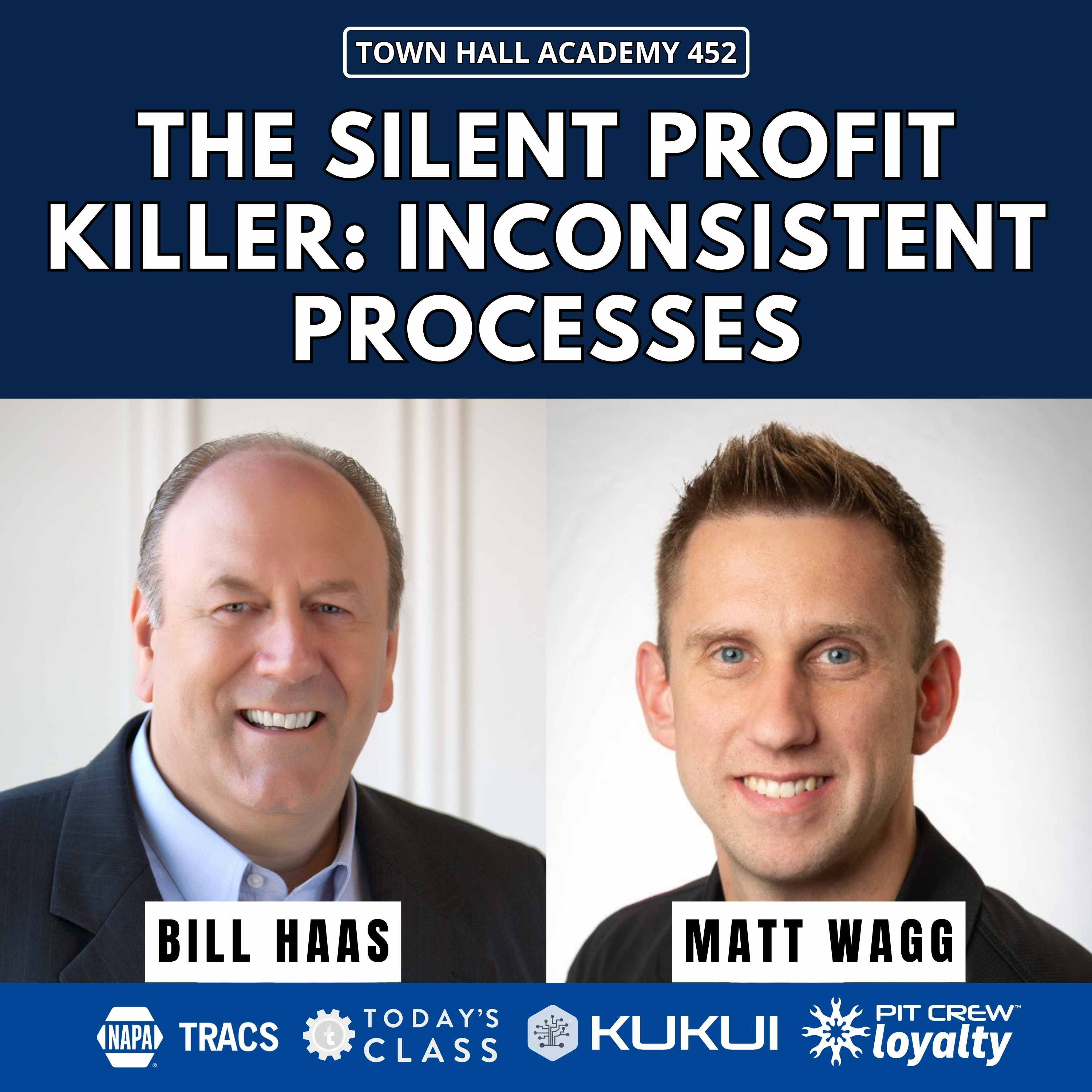
Hey, welcome back. Bill Haas, auto ignite management CEO, auto ignite management.com. Welcome, sir. Hello.
Now, and you for a lot of years, great coach in our industry. Thank you for that.
That storied career. Matt Wag is here, accelerated diagnostics and automotive Bennington in Nebraska and a coach with the Haas organization auto ignite.
Thank you for having me. Yeah, good to have you here.
Honor to be here.
You and I have done episodes in the past heard about your great experience and all the great things that you've done in the industry.
Yeah, but he's just getting started.
Frankly, you only look about 32.
I've got a long way to go. We've got a lot to take care of. Don't we, Bill?
We covered some great stuff. We covered coaching. We covered a lot in the last episode.
But I really want to talk because you guys, I know drive systems so strongly with your clients.
And I believe systems win wars, good systems win wars, processes systems.
I want to talk about this. And we sometimes say, well, this is how we did it yesterday.
I love it. Let's keep doing it tomorrow until it fails or breaks. And then we'll find and do something new.
We seem to have systems and processes that are on like a stock market board up and down and up and down.
Nothing purely steady. No one managing all the great things that we need to do.
And I was kind of playing around in my mind.
I want to get to the last page of this document that I have here.
You know that we have vehicle checking to check out processes.
Really? I just thought they come in drop their card and then they leave and we give them a salute and they get.
No, if there's not a QC process, there's not an inbound and an outbound way to process people.
How about hiring SOPs? How about KPI trackings and reviews and how all that becomes systematized and managed?
How about internal communication systems?
It is one of the hottest topics of late that's going on communications.
Do we build an estimate? How do we build it? Is there a process to build it?
When do we order the parts? When do we quote it?
My God Bill, it seems like you could almost hire a coach that just leads and manage processes and systems for your clients?
Well, you could.
It's a big part of what we do, honestly.
And I think you'd find that to be true with most coaches is we're helping shops by getting them to understand
how is the better we manage the throughput, the better life is going to be, right?
The less frustration or the less stress there's going to be.
And I don't care who you're thinking, right, is it less frustration for the owner?
Yeah, but how about this? How about it's less frustration for the gasp for the customer?
How about it's less frustration for the technician?
How about it's less stressful for the service advisor?
That's what systems and processes really do is they remove and eliminate all the stress and frustration that makes business hard.
Business should be hard. Business should be easy. And when you have systems and processes, things run smoothly.
And people enjoy coming to work.
When there's no systems and process and everybody kind of does what they do the way they do it, because that's what I know from where I used to work and the way we used to do it.
It's no fun to come to work.
You just hire somebody they come in and there's no real good discipline or structure.
And they start doing it the way they did it the last place.
And now you've got one person doing it this way, one person doing it that way.
I mean chaos ensues.
Well, you know, I always take the DVI and I use that as the cutting example, right?
So, if I have this car and fit this shop has four technicians, if I give this car to the four different technicians, will they do the same DVI?
Will they do it the same way? Will they get done in the same amount of time and will I get the same result?
And you know what I hear from shops all the time?
Well, no. He does it better than he does it or he does it faster than he does it.
And it's like, wait a minute.
How come we haven't brought the four of them together to find out what he does that makes him quicker?
And what he does that gives us better results.
And why haven't we assembled that into a single process?
So instead of having four processes, we got billies and Johnny's and Tommy's and Bobby's.
How come we don't have the shop process?
This is how everybody does it. So it's done the same every time to get the same result.
You've got a car that comes into the shop and it gets inspected.
And whatever got found on the inspection got estimated and the work got sold.
And then another tech is doing the actual work.
And they go, hey, how come nobody mentioned anything about this?
Because we're not doing the same inspection.
And there's an opportunity to fix it, to change, to improve.
Absolutely.
How long did it take you to solidly make systems and processes constitution in your business?
I think it's an ongoing thing.
I don't think you can ever be fully done with it.
I think you've always got to be looking for ways to improve, constant improvement.
Process improvement is something that I really focus on in the business.
I will say this was one of the things.
It was me and maybe one to two other team members on the team when we were early in business.
This wasn't as big of a challenge it was once I got to four or five, six, seven people.
Because when it's me and one other technician back when I was one of the working technicians in the business.
It's really easy for us to do things fairly similar.
When you start adding another technician, another technician.
And then my duties change.
And I become more of an owner.
I'm not in the shop anymore.
Like Bill said, the DVI is a great example.
And that was one of the biggest challenges we had.
One guy is taking an hour, one is taking 15 minutes.
There's no way they're doing the same job.
What we started to do is figure out what are the tasks that were the biggest obstacles that we needed everybody in alignment on.
And we started writing procedure around them.
Now, the procedure then, you've got to train people on how to do it.
So there's a little bit of time there.
One thing we did, we got the stakeholders, which, you know, depending on what the procedure is for.
Or what the process is for.
We would get the stakeholders involved.
Whether that's the service advisors, whether that's the technicians.
And we come together and we write these together.
That way everybody's got ownership in this process.
And it's not just, well, Matt said, I need to do it this way.
So that's the way we got to do it.
I think when you come together as a group, the team building these things together.
Obviously, I'm the one that's got the final say in it.
And I'm going to direct how it goes.
But when you get everybody to buy into these and help direct it,
you're getting the best of everything involved here.
And that's when these really work well.
What I heard Bill say is you're trying to reduce the chaos by putting everybody on the same page.
And create order.
You're trying to get repeatable results because you have a system to live within.
And also as an individual, be it an owner, be it a service advisor manager, be it a shop manager.
They're stopped micromanaging some of the duties that are not adding value to their job.
The thing that I'll add to that car, that's really important for the owners to hear,
is that once these processes are done and they're in place, owners are not exempt.
I love that.
I'm going to add on to it.
Okay. I'm a big policies and procedures person.
And I've learned that some of my weaknesses, you know,
and we talked a little bit about leadership in our last episode.
But some of my weaknesses I learned as I started developing myself further as a leader was accountability.
You know, and holding people accountable.
I think accountability is a two way street to add on to what Bill said.
And that's what I tell everybody with policies and having procedures in place is that
this is for you to hold me accountable to give you the opportunity to do this job properly.
And if there's something that I'm not doing on my end as a business owner,
you need to call me on it. It's isn't writing. This is the way we're going to do it.
This allows for a good two way street here.
If one of my team members isn't doing the job properly, I now have a written document that we've all gone through.
We've been trained on. I bring it up and makes that conversation go that much easier.
Rather than me saying, well, you remember when you started here back three and a half years ago,
I told you to do this, this and this, and you didn't do it last week.
You can't be bad at somebody for that.
You know, there's just nothing for them to go back to to refer. How is I supposed to do it?
Good output equals happy clients and profit.
And I've heard so many people say that the profit comes from processes.
And if it's really working in its streamline and it adds value at all steps of the way,
and you got a whole bunch of things right, pricing margins, all the mathematical stuff right,
the shoring up of the profitability is the strength of the systems and the processes.
To me, that drives the strongest way you can improve the process.
Oh, increase your labor rate by this. Yeah, okay, great.
It's sustainable. Not if the process is, it's not going to make you have the kind of money
to grow an incredible business if you don't get it working right.
Well, how about this? What if even you have the money?
What if the profit's not the problem and you have the money?
But without the process, you have the friction.
Why do you want the profit with friction? I wanted to be without friction, right?
And it's something that we see a lot of times when we work with somebody
and we're setting them up with a process for estimating.
And it's like, this is where we start.
Number one, we need to know what's wrong with the car.
The technician has to tell us what's wrong.
What tests did they perform?
What evaluation did they make?
What failed?
So this is what we need.
And now we have a plan.
This is what we will do to correct this.
And these are all the parts I need.
Now, an advisor can write an estimate based off the knowledge of what's wrong,
what we're going to do, and all the parts that are going to be used.
And now they can make sure that,
oh, the other piece of technician has to tell us how long it'll take them
to make that repair.
So now I can write an estimate.
I know what parts are going to be used. I know how long it's going to take.
And then I create an estimate and I check my profit.
And I make sure that my parts are hitting my margin.
I make sure that I'm using the correct labor rate so that my labor hits my margin.
And then I reconvene with the technician to review.
This is how much time is being sold.
This is what you ask for.
And that's what I'm selling.
And these are all the parts you need, and here's the parts.
And guess what?
There's no friction.
And if you think about it, this is one of the big friction points in a lot of shops
is the technicians find work and the advisor doesn't sell it.
So he's the bad guy or the advisor selling work and the technician takes
too long to get it done.
And so he's the bad guy.
And there's all this friction that's going on in the shop
in something that could have been completely avoided if we had a simple process
for creating estimates that everybody got what they wanted.
And guess what?
At the end of the day, the two things you were looking for happen were profitable
and the customer had a great experience.
Let's face it, your shop management system is the single most important tool in your shop,
period.
NAPATRAX was built from the ground up to make your business more profitable and efficient.
We provide an extensive set of tools to increase and track profitability in real time.
NAPATRAX offers the industry's best post sale support, hands down, and we train your people on site.
Yep, on site.
And we offer remote refresher training 10 times a week and customer support is open.
Six days a week.
Give us a call, visit the website, or join our Facebook community today to learn more.
We'll prove to you that tracks is the single best shop management system in the business.
NAPATRAX is always customized and tailored for you, whether you're a one-man shop or a large
multi-bay or multi-location company.
After all, it's your shop.
So, it's your choice.
Visit us on the web at NAPATRAX that's n-a-p-a-t-r-a-c-s dot com.
Transform your team with today's class where automotive training is easy, quick, and fun.
Just five minutes a day on our app can eliminate hours of looking up for gotten information later.
It's perfect for technicians, advisors, and managers alike.
Keep critical knowledge fresh and top of mind ensuring your team operates at peak efficiency.
Today's class is impactful, accessible for anywhere, and a bit of fun too,
and we're not talking about after-hours pizza, either, for training that gets results.
Turn to todaysclass.com.
Shop owners, we know you are overwhelmed with a flood of missed calls, empty bays, and disconnected marketing tools.
Kakui has spent over a decade building one integrated platform for auto repair shops,
one login, one dashboard, and mobile first websites that convert four times industry average.
Smart, innovative CRM with automated follow-up, 24-7 online booking, and real-time ROI tracking.
With 900-plus years of combined team experience, we fuel the growth of 2,200-plus shops
and have influenced $3 billion in revenue.
Stop working harder, start working smarter, get industry-leading customer support,
and book a demo with Kakui, that's kukui.com.
You know, most shop owners feel trapped spending on ads while half their first-time customers never come back.
It's frustrating. It's exhausting, and it's not your fault.
The industry average is 54% and one and done.
We understand how discouraging that can be.
Well, pick crew loyalty changes the story.
Our clients cut that rate by up to 38% raising lifetime value by more than 50%.
Community members visit nearly three times more often, creating predictable revenue without extra ad spend.
Pit crew loyalty, where customers stay, and shops thrive.
On the web at pitcrewloyalty.com, Matt, I got this wild thought going through my mind about training.
And the group getting together and saying, hey, listen, we're kind of not on the same page.
We need to have some training on this thing, whatever it is.
But you don't have a well-defined process. You can't train on it.
Everybody's going to go back and do it their way if you don't have it.
So I think in my mind, training gets easier when the processes are clearer.
Without a doubt.
And that was one of the hidden side effects of having processes.
I think when we wrote processes, a lot of our real core processes that we had a couple of years ago,
it was to just get everything down. And so everybody was on the same page.
Now the hidden side effect of that is when we've hired a new team member,
it makes this training go very smooth, very fast. People come in and they go,
wow, I can't believe you guys have such a comprehensive plan here for me in being this small of a business.
You know, it's kind of an unheard of thing to be in small business and have documented processes and procedures.
That was one of the cool things is that now when I do have to train somebody,
we bring this out, I give everybody their own book.
Do I have quite a few procedures and processes? Yes, they're very defined by job role.
But everybody gets a book and we go through it and we take the time to train them on it.
And this is something we talk about almost on a weekly basis.
Is there anything we need to update in our processes? Is there another process we need to write?
One of the things we had an issue with this, this is a great example to share.
But we've got a couple newer teammates as technicians on our team that joined either at the end of last year or kind of middle of summer.
Well, we've had issues with how we're assessing air conditioning systems on vehicles.
And some people are doing this, some are doing that.
Climate control can be one of the harder things to troubleshoot on a car,
especially in our area when we're only doing it two months of the year.
So you have ten months to forget about it.
My lead technician Chris, he ended up taking it upon himself and we worked together
and we built a great procedure on a test plan on how we're going to look at every car
that comes in with an air conditioning concern.
And it's already shown great success.
This is something we implemented about a month ago.
And we're evaluating where are shortcomings and how can we improve?
And here's what we're going to do to combat that going forward.
It's always looking for those opportunities to better ourselves.
And where are we weak and where can we improve?
And what can we do to get everybody on the same page?
So that's where we've had so much value.
That climate control thing.
Can you reduce some of the temperatures here in Buffalo for me?
We've got them today here too.
Oh man.
I wish I could.
All right, I thought you had great reach.
I need to understand something about the accountability of the processes and the systems.
I remember listening to Kim Auer and Hymer give a segment of a speech on the accountability of processes.
And she used a piece of software called Trainable.
And it allowed people to go in and read the process.
If it was an update, say I read it, it's highly effective.
It seems to me and I haven't seen it completely.
That you know that that person did it, trained on it, gets it, understands it, signs off on it.
So you can all stay on the same page.
Matt, do you use anything like that when you'd update it at any process?
So Trainable, something new that we're actually looking into right now.
Right now we're using like we've got everything on a cloud.
So there's a couple of us that have the ability to edit.
But it stays real time when we do that.
So we've got like a Google Drive folder that we're going to utilize to put all of these into.
That's one of the challenges though if you're doing it just with paper and you're expecting it.
If you make any updates because then you got to print it and get it out to everybody.
Bill and I have a client who uses Trainable has great success with it.
And I've been in there and I've looked and it's just captivating how we can use something like that.
It's just a phenomenal tool to give people access electronically to give them a process on how they're going to train.
Track and see where they're actually at improves it.
I think that stuff is going to change the game as it comes to documenting this and keeping it.
I was kind of skeptical until I started to get deeper and deeper into how intelligent it was in allocating responsibilities to what people had to learn and what they had to know.
And that you can really hold them accountable for having said you knew this.
Hey, Bill, a question.
A statement that I write about processes and systems and I got to read it to you and I want you to tell me it's a good or a bad statement.
Without systems the owner becomes the system.
Well, I would agree to that.
And the problem with that is everything that goes on in that business is a result of what that owner wants to have happen.
So if there isn't process documented, everybody has to go to the owner to find out what the process is.
How do you want me to do this?
How long should it take me to do this?
Why? Right.
I mean, it's just a constant.
You can never leave.
You can never leave.
And here's the thing.
And I say this to clients frequently, but they'll be telling me some story about I had to do this.
And boy, it's a good thing I was here, you know, and I'm like, well, let's hope you never die or get sick.
Because without you, there's no business.
Okay.
So Matt, I'm going to ask you this question.
Do some of your coaching clients just love to micromanage to Bill's point?
And can you break them?
I think.
Yeah.
One of the biggest challenges we have is shop owners to answer your question.
I think, yes, I think they do.
I think that that's one of the challenges with somebody that went into business on their own is they want to have the control.
They think they're good at it.
Or they think that they're the ones that need to have the control.
And it's really a perception thing in my opinion.
And it's very hard to get them out of.
I had a big ship, like a paradigm shift you could say and we've done an episode on this in the past.
But I got forced the hard way to get out of the business.
And I had a catastrophic arm injury about three years ago.
And it took me out of the business on a large basis for multiple surgeries over a six month period.
And I was forced the hard way to trust people that I've hired to do the job that I'm paying them to do.
And I think the thing there is that you hired these people to do a job.
And as long as you as the owner have given them those duties and expectations.
And again, this is documented processes.
It's procedures you've explained and trained to them how to do the job.
Get out of their dang way and let them do it.
And sure they're going to fail at times, but help them learn and grow from it.
And I think once I learned to do that, my job became so much easier.
And this bill said, you know, I want to take vacations.
I look forward to having time off.
I want to be with my family and I still want the business to be able to thrive and be successful with me out of it.
I don't want it to be to the point where do I want to feel needed? Yes, I do.
But and I think many of us shop owners, we want to feel the success or hear these affirmations from people that
oh, you're doing a great job. We couldn't do this without you.
But at the end of the day, it's our job to empower the people that are with us and lead them to success.
There's a difference between being needed and being required.
Good point.
But the comfort zone that micromanaging can give to certain people, okay?
It's a comfort zone. I'm going to micromanage it to your point bill I'm needed.
But they have notes because they don't want to find time to be held accountable to make, you know,
great profits to lead a great group because I'm comfortable with being a leader and I just want to be one of the guys or dials.
I love where this whole systems thing went because it still went right down inside the heart and the soul of the leader.
God, it's amazing how you're never ever going to get good processes and systems if the leader can't get out of that micromanager comfort zone.
It's never going to happen.
Never. Maybe this is the slap upside the head that some of our listeners need to have heard in this episode.
Well, what a leader needs to remember is a leader job is not to do the work.
A leader's job is to create the environment where the work is done.
And when you let go that that actually happens, that you are empowering people to do what you hired them to do.
One of the biggest frustrations for employees is what? Why am I here? Why am I needed if you're going to step in and do the job?
What do you need me here for? So I don't feel valued. It's not important. I might as well go work somewhere else.
If you didn't hire me for my brain, then my hands can go anywhere.
Exactly. Yeah.
I loved this episode. It's tight. It's succinct. I think we hammered a bunch of great things.
Hopefully we've changed some worlds and some lives. Let me give you each a final word.
Anything that maybe you wanted to cover that we didn't. I mean, we could have a five-hour episode on processes and systems.
Everybody knows that. But again, these podcasts are about just getting people charged up and rethinking.
And I always call it. You know, what was that moment, the Gatorade moment? What was that?
People have that hard-knock moment. It was a commercial from years ago.
I'll think of it. I'll think of it. Matt Weg, any final words?
Yeah, I think to kind of sum it up is that, you know, as a leader, it's our job to empower the people and to help them develop and grow.
And, you know, as we talked about here towards the end is we need to get out of their way.
And one thing I've learned is that it's very uncomfortable as us as business owners because we want the business and we have a vision of it being a certain way.
I've had to challenge myself, especially the last six months to year, to step out and let people step up.
Because when you let people step up that really care, you're going to see things that you've never believed could happen.
People want to succeed. They want your business to succeed.
And some people have such great ideas out there that they just need the environment to cultivate them and grow.
And my advice is trust the people that you've hired.
Give them a little bit of room to see what they can do, you know, trust them.
Get out of their way, quit micromanaging.
Let them step up and help you. You'll be amazed with what will happen.
Powerful advice, Matt. Step out so that other people can step up.
And I know there's an awful lot of coaches that tell people, listen, I don't have any days you're open, but I only want you to work for.
And I want you to step out of the business, even though you may be working from home and let them survive.
But I don't have any processes and systems. Oh, then let's work on them, which is what this episode's kind of about.
Bill, I just remembered it. It had a V8 moment. Could I have a V8 number?
Oh, could I have a V8? I remember that. Yes.
It came back to me. It just took a minute. Bill Haas, final words.
People need to remember that everybody started somewhere.
So our best opportunity with people is to give them experience.
Make sure they're getting a good experience.
I love it. People started somewhere. And some of those people are at the same spot.
Well, that's true too. That's not now.
That's my point. That's why we did this.
Well, again, Bill Haas, auto ignite management, Matt Wagg, a coach from auto ignite management and accelerated diagnostics and automotive embeddings in Nebraska.
Thanks guys for being here. So appreciate this.
Thanks, Carm. Thank you very much.
Get any advice from this thing? I appreciate it. Go out and do the right thing. Thanks.
Thanks for being on board to listen and learn from the premier automotive aftermarket podcast.
Until next time.
0:00
30:26