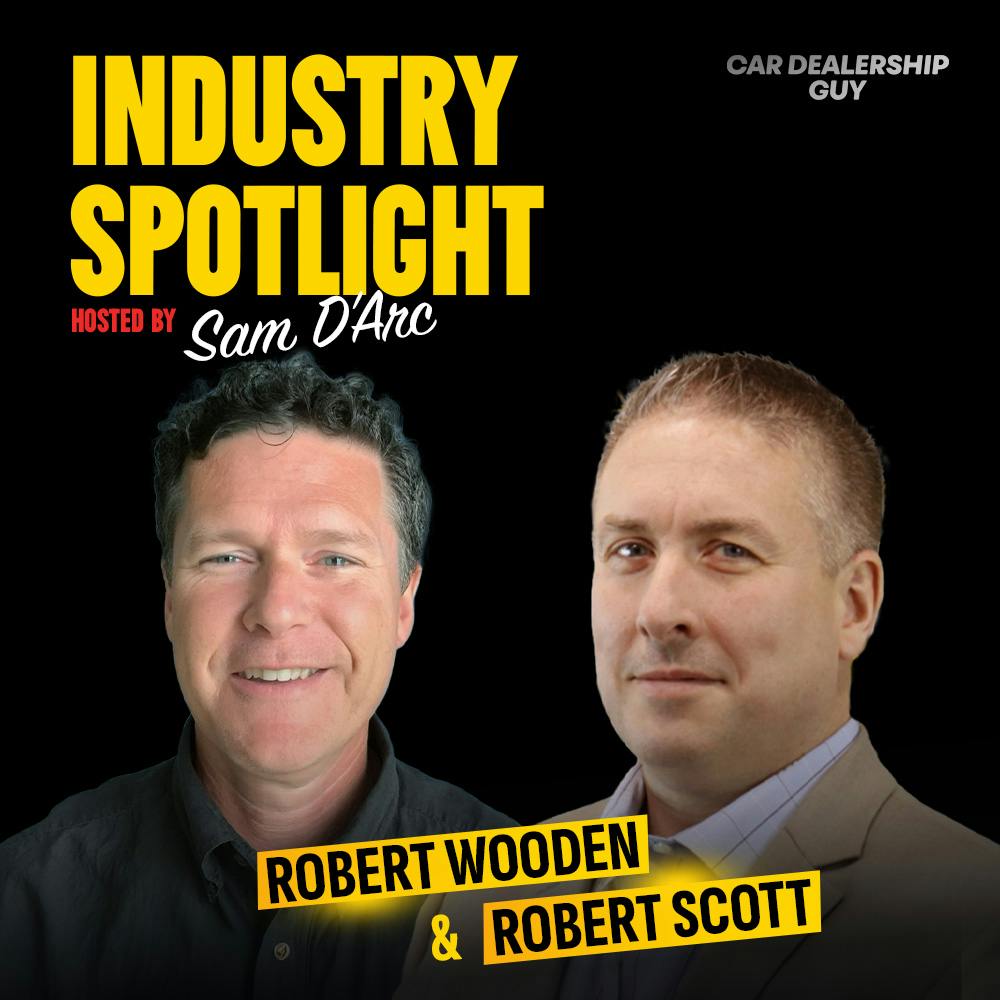
A deep dive into the complexities of labor rate increases and parts reimbursements in the automotive dealership industry. Rob Scott from Bob Johnson Auto Group and Robert Wooden from Wooden Automotive Consultants discuss the impact of rising costs on dealership profitability and share strategies for maximizing labor rates without damaging relationships with manufacturers. Key insights include the importance of proper documentation, understanding state laws, and the balance between fixed and variable operations. The episode also highlights the evolving role of fixed ops in dealership leadership and the potential revenue gains from effective management.
Welcome to Industry Spotlight—a focused series hosted by Sam D’Arc, highlighting standout dealerships and innovative companies, and exploring the trends driving success in today’s automotive market. Today, Sam sits down with Rob Scott, Executive General Manager of Bob Johnson Chevrolet, and Robert Wooden, Owner of Wooden Automotive Consultants LLC.
This episode of the Car Dealership Guy Podcast is brought to you by Wooden Automotive Consultants.
Wooden Automotive Consultants - Using their proprietary analytics program, Fixed Operations Intelligence, Wooden Automotive offers a free rate analysis, a $1500 value, so you know what rates your store qualifies for before committing to anything. Go to http://www.fixedopsintel.com and drop us your contact info.
Check out Car Dealership Guy’s stuff:
For dealers:
Industry job board ➤ http://jobs.dealershipguy.com
Dealership recruiting ➤ http://www.cdgrecruiting.com
Fix your dealership’s social media ➤ http://www.trynomad.co
Request to be a podcast guest ➤ http://www.cdgguest.com
For industry vendors:
Advertise with Car Dealership Guy ➤ http://www.cdgpartner.com
Industry job board ➤ http://jobs.dealershipguy.com
Request to be a podcast guest ➤ http://www.cdgguest.com
Topics:
00:42 What is Rob Scott's background?
01:59 Why are fixed operations vital?
05:50 Solving labor/parts cost challenges?
10:53 Best labor rate strategies?
22:30 Dealer-manufacturer relationship dynamics?
24:00 Common labor rate mistakes?
27:44 Financial impact of rate increases?
30:24 Future labor/parts cost trends?
43:55 Final advice for service managers?
Car Dealership Guy Socials:
X ➤ x.com/GuyDealership
Instagram ➤ instagram.com/cardealershipguy/
TikTok ➤ tiktok.com/@guydealership
LinkedIn ➤ linkedin.com/company/cardealershipguy
Threads ➤ threads.net/@cardealershipguy
Facebook ➤ facebook.com/profile.php?id=100077402857683
Everything else ➤ dealershipguy.com
No annotations found
Be the first to request an explanation below.
What is Rob Scott's background?
Why are fixed operations vital?
Solving labor/parts cost challenges?
Best labor rate strategies?
Dealer-manufacturer relationship dynamics?
Common labor rate mistakes?
Financial impact of rate increases?
Future labor/parts cost trends?
Final advice for service managers?
Select text to request an explanation
Hey, everybody, welcome to another episode of the CDG Industry Spotlight coming up today,
a fascinating conversation about all things labor rates and parts reimbursements. For example,
is asking for that labor or parts reimbursement ruining my relationship with the manufacturer?
Also, top three tips for getting that increase. Plus, the repair order is a legal document.
What time bomb to avoid having your service riders document on that customer pay arrow?
A special thanks to Wooden Automotive Consultants for supporting today's content.
Joining us today, Rob Scott, Executive General Manager, Bob Johnson Auto Group,
and Robert Wooden, Founder Wooden Automotive Consultants. Welcome to the show, gentlemen.
Let's get into it. So, Rob Scott, tell us a little bit about your dealership and your role
there. How long you've been there? How many stores where you're located?
So, we're in Rochester, New York. I have been here since 2009, so 16 years working on
17 years. Currently, I am the executive manager of this store. I started out in 2009 as one of
two service managers and kind of worked my way up to parts and service director, to a fixed
ops director. And then a few years back, the company started getting bigger and bigger and
bigger. And we went more into giving each individual store control of their destiny, per say.
So, when we did that, I kind of came out of the fixed ops role and became a full-time executive
manager of this particular store. So, this store here were a high-volume Chevrolet store. We're
selling anywhere from 350 to 475 new and currently around 215 used cars a month. Our service department
is generating about five to 5500 repairs a month. So, Rob, it's interesting because you are on the
tip of the spear of a trend that we're starting to see more of, which is folks with fixed ops
background coming into general leadership as an executive manager, a general manager.
And my theory on that is maybe part of the reason for that is the importance of fixed ops to the
overall health and operation of a store, where in the past maybe that wasn't as valued as much.
What's your perspective? Like, you've certainly seen, you sit in meetings with other GMs and
executive managers that have variable or sales background, not fixed ops. What's the advantage
to you coming into that leadership role with the fixed ops background?
So, typically when we're in these meetings, I'm the one that probably understands it the best.
But what's happening in our company is, well, first of all, we belong to a 20 group
in the store. I belong to one. And then we brought our moderator in
to moderate for our general managers and our executive leadership team.
And fixed ops has been a focus for the group. So, for me, it's kind of refreshing because
they're talking my language. When I sit around with them, sometimes it's a little intimidating
on the sales side because I don't know everything.
But you balance it out a little bit though, right? Like, that's a good balance.
I do. And the sales departments are very synonymous with the service department.
You can almost say a service advisor is very similar to a sales manager. Salesman is very
similar to a technician. And they're all extremely important to us.
But the fact is, the service puts more revenue on the statement than sales does.
But we need the cars to kind of come back in and break and fill up our service department.
So, it is a circle.
So, given your background, what do you think the biggest misconception
or misunderstanding most GMs coming from a sales role or a variable ops have
about the operation? What's one or two things that most people just don't get that you get
because of your fixed ops background? I'm going to say the importance of fixed operations,
the importance of internal labor sales. Especially when you get into used car
reconditioning, it's important to do stuff that retail rates and not overcompensate
your salespeople because you're reducing the rates and overpaying the sales side of the house.
Because fixed really is where the bulk of the revenue is coming onto your statement.
So, that's probably number one. And the second biggest champion that we tend to overlook is
the parts department. Without them, nothing gets fixed. And generally speaking, they're
not appreciated. Nobody really understands what they do. Nobody really wants to understand what
they do. But they really are, they're pivotal. In some ways, they can almost be the doormats of
the store. Yeah, it's not a particularly sexy department or role or position. But without it,
you can't fix anything. You can't recon use cars. You can't take care of customer recalls.
You can't service customer calls, do any warranty work. It's a mess.
Accessories, all of it, accessories. And we expect to just walk over to the parts department and they
just can pull it out of thin air. And then if you have a stop sale on something, they want to
know what the part's going to be here. There certainly is a lot to what they do back there.
It is interesting because you're talking about that balance between fixed and variables.
You're in a huge volume store. So, you're selling a lot of vehicles and you're doing
it supporting both sides of the house. I just think that's fascinating. So, we're here to talk
about a couple best practices that you and the Auto Group have done. You kind of realized a problem
a while back and that's something all dealer groups, myself included, are seeing across the
country. And that is cost of repairing vehicles, cost of parts, all of that is just escalating.
In fact, to quote a phrase from Anchorman, that escalated quick and through COVID it did,
right? Tell us a little bit about the increased cost of labor and parts and all that.
How that impacts the business, what are some of the things you've done to try to solve that as
an overall problem? Being transparent, knowing what our competition is doing and staying in
line and not getting a reputation for gouging people. We don't charge over MSRP in sales
and service. There is no MSRP in service but there's a list price in parts. We don't charge
over that either. You have to be transparent with the customers and most customers understand
there's not anybody in your service department or your sales department that doesn't get a
paycheck to some degree or another. They understand and profit should not be a dirty word.
And with that your employees expect more. Trust me, if we get a labor increase,
there's definitely somebody standing outside your door wanting some more money.
You get a parts increase, you got the parts guys wanting to make sure.
But just because we get an increase doesn't mean that your costs don't go up. Because
the costs are up on everything. It's not just the cost of goods, the cost of services,
the investments that we've had to make in the facility for EV chargers and I have
four high powered EV chargers outside that were a significant investment. And then the
capitalization of just the normal projects that you work on, updating your showrooms,
updating your service departments, it seems like there's always computers that the
technicians need that can support to do wireless programming and stuff like that.
You can run into a scenario where if you had a poor computer and you're trying to reprogram a car,
if you burn a module, it's more than the computer cost.
So you mentioned labor rates. Let's talk about that. We've seen the cost of labor and technician
labor go up and up and up and up. Labor rates as they're approved by the OEM haven't
necessarily done the same thing, right? And you recently identified that as a
friction point in the dealership. Tell us a little bit about how you came to that point
and what you did to try to solve that as a problem. So well, the first thing that you
have to do is you have to make sure that your people are selling for the right rate,
get to make sure that your advisors when there is an issue are selling the job up front
the correct way. If it's a variable, if you need to do A and then reassess and then let the customer
know that there's more money at that point, it's not really reassess and the price doesn't change.
So communication is big. Controlling discounting is big, which I rely on the service manager to do.
And then making sure that we're selling the job at the right price, that you don't have a
technician that is using his own labor time guide per se. You really want to stick to all data
or the motor manual and make sure that you're right in line with that. Because in New York,
we have retail reimbursement for warranty where we use the motor all that time.
And in order to stay compliant with the factory, you have to charge that all the way through
on the customer side as well. So you're going to discount one, you've got to discount the other.
So we really have gotten away from the discounting model and just selling it. And our dealership
here, we have a rewards program. So selling the value of the rewards program, capitalizing on
the GM rewards, which is a manufacturer program, which they can use for parts and service as
well. And then identifying services and sticking to a best price that we've predetermined for them.
And that transcends into the parts department as well. Making sure that if there is a discount,
that it makes sense. And you don't have a service advisor over discounting the parts department.
You know, when we did our most recent study, you know, Robert had identified a few things that
kind of hurt us. Yeah. So Anna Robert, tell us how you met Robert with Wooden Automotive.
So what I was saying is at the time, you know, the dealer group had been expanding. I was over
parts and service for the group. And I was kind of being worn a little thin. But we had an
agenda that we wanted to really work on fixed operations profitability in every store we have.
And, you know, the easiest way to do that is to maximize your labor rates, you know, internal,
customer pay, and of course, warranty. And warranty can be difficult. And there's a
couple of different companies out there that do things in some different ways. Someone
to say a consulting, someone a processing fee plus a percentage of the lift for a year.
And I, I wasn't interested in any of that. I didn't see the value on it. And then I just
Google searched companies that do this. And, you know, I seen a 585 number and I'm like,
this is interesting. So it was a Saturday afternoon. I called, left the message,
and just as I hung up the phone's ringing. And I, it was Robert and we talked probably for
about a half hour that afternoon and told him the portfolio stores, what I was looking to do.
And then we, we started working together. And, you know, he did everything that he promised
he would do. So, so Rob, tell us, you said it's difficult warranty labor rate increases.
What, what makes it difficult? Why is that hard? You should, you know,
you can get an increase. You should just be able to go say, Hey, give me the increase and
you're off to the races. Why, why is it hard? Well, because we have opposing agendas, right?
We want more money. The factory doesn't want to give us more money if they don't have to.
And they, they hold you to the letter of the law. Some, some manufacturers a little bit
more stringent than others. Some are, are very black and white that this is the law.
This is what we do. And then there's some that will kind of challenge you. And Robert knows,
you know, which manufacturers they are. And he was able to kind of guide me to what we need to do.
And as we started working, you know, we did one store, then two stores and three stores. And,
you know, he's, he's doing the overwhelming majority of the stores now, not all of them.
Yeah. But in everyone that we've done together, we've, he's, he's gotten exactly what, what,
what we asked for. For me, it's peace of mind that he's going to do it. It's going to be done
right. It's going to be done in a timely fashion. I mean, all I do is I create a logon for him.
I give him access to it. He does what he needs to do. And our system, he even
extracts the data out of our system. We don't have to print repair orders. All I have to do
is sign a letter and send it off to the factory and just set a diary for 30 days.
Typically I get so excited, I never call him, tell him that they did it.
Yeah. He'll call me like a week later. He's like, you're supposed to call me.
The last time I, I did this, one of my service managers needed a presentation
and he waited until the night before to tell me that he needed this for his 20 group.
Oh no. So I was like, wow, we just did a parts increase and I did this pro forma for him and
yeah, you know, he, he, he didn't do a good job presenting it, but I gave him something and it
was concrete and I could attribute it back to a statement because, you know, anytime that you
have vendors, everybody claims this lift. Yeah. But a real lift you can measure,
you know, what on your labor rate is, let's just say it's 175 and you move it to 200.
That's, that's real money. Yeah. Let's go back just a little bit. So you said,
you looked at the different ways that you could be charged for this labor rate increase and you
said, hey, I don't like any of these. What, what did you end up preferring? Like was, what was
the structure to get compensated for helping with this? So it's just a flat retainer fee.
Okay. So a flat fee. So it's not a percent of. So it's a flat fee and it's paid when,
when I get my money. Oh, nice. Okay. So if, if it doesn't stand outside my door. Yeah. Well,
well, he has, if it doesn't work, he doesn't do it, you know, he'll tell me, hey,
you're not going to get what you want. Yeah. If this is what you want,
wait a month. These are the areas I would, I would look at, you know, it doesn't tell me
exactly, but, you know, this is low. Look at this, this specific service advisor seems to be a little
lower than others, you know, look at him. And, you know, it just, it just allows somebody like me
to just dial in. And again, a lot of my general managers that run some of these stores, they're
not that well versed and fixed. So I'll call it up. We'll talk about it. This is what you
want to look at. But surprisingly, you know, I got some, I got some really talented GMs that
work alongside me. Some of these guys are better than me. And they're really starting to dial in
with, with fixed operations, which is, it's refreshing to see that, you know, that we can kind of have
a talk like that. So, so Rob, one last question. Let's go over to Robert and get his perspectives
on, on this, this issue. So did you try on your own to get some of these labor rates
escalated and you just kind of are like, Hey, this is either it's too much labor,
there's not good ROI on the time spent, or it didn't work because either competing
interest that you mentioned between the OEM and yourself as a dealer.
So I was successful in doing it, but it's an inordinate amount of time, right? So you got to,
you got to know how to get the data. You got to know how to sort it. So a guy like me,
I don't know how he does it. But a guy like me was dumping in Excel, writing a formula,
looking at some stuff. And then, you know, you pull an ROI out and it's like, all right,
it's not what it says. You know, Robert just goes into my system and, you know, the next
afternoon he calls me and says, you know, this is what we're going to do. And, and that to me
is my time, right? So me, me personally doing it, and then having somebody reprint all the
ROs and box them up. And, you know, it's, it's just your business is fixed off. You're
not there to do that, right? You're there to, right? It's the, it's the convenience. So we had
another conversation while we were on hold earlier, but, you know, if something is convenient and
easy and there's a value proposition to it, why wouldn't you do it? Yeah. Yeah. All right.
So Robert, walk us through. You know, you met Rob. Rob said, Hey, help us out with this.
You know, there's a lot of documentation. I'm not sure I understand all the different
requirements. Like you know this world. What do you do from that point? And, and then I'd love
to have you walk us through. What are the top three mistakes most dealers make when they try to do this
on their own? But what did that pick up look like from Rob? Yeah. So yeah, again, like we were
talking earlier, you know, Rob called me on a Saturday night and, you know, like, like anybody
in the car business were on 24 seven, right? Somebody calls you and they want to buy
something, we're going to sell it to them. So I appreciate that. And yeah, it's been a great
relationship. And, you know, as far as what we do is, you know, we're taking that work
and we're making it as turnkey as possible, right? So literally you're going to call us up.
You want us to do an analysis for you. We do the analysis. We don't charge you for the
analysis, right? So before you spend a dime, you're going to know if, if it's going to be worth
the ROI. Yeah. Because I don't want you to hire me and pay me some money for something you're not
going to get. And how do you calculate, Robert, whether it's worth the ROI? Yeah. So we have
a software that we developed. It's called fixed ops Intel fixed operations intelligence. We
call fixed ops Intel for short. We're integrated with, you know, CDK and Reynolds and Techian
and dealer track, PBS and automate soon to come. So we don't have to access your DMS. We don't
remote into a manager's computer. You know, we used to do that years ago. We don't have to do
that anymore. And, you know, we started working on fixed ops Intel almost three years ago now
way before the CDK debacle and people were really worried about security. And, you know,
I started that project because, you know, we've been doing warranty uplifts for almost 28 years.
We started in 97, almost 30 years we've been doing this. And, you know, Rob alluded to it
earlier, you know, he used to look at our office and there was just stacks of paper
everywhere. Yeah. And I wanted a way of making it more efficient for us,
more efficient for our clients, more secure. So that was really the genesis for fixed ops Intel.
So we're able to take that information, take the data directly from the DMS. It'll analyze it
and come back and say, okay, here's where you're at now. Here's where you're going to be if
we submit. And along with that data, like Rob had talked about, you know, we're able to pick out some
things that maybe you're impacting that rate that, you know, you can make the decision. Do you want
to apply for it now? Or do you want to wait and make those changes? And we can continue to monitor
it. Again, the fixed ops Intel is going to be running there. And the manager in the store
has access to that software and they can watch the rates. And when we send them an update every
Monday morning, it's in your email box. So they know exactly where they stand. So yeah, that's
how we do it. As far as the top three items, oh boy. I think Rob alluded to it before.
Discounts is a huge thing. A lot of managers are not paying attention to that and allowing their
people just to discount stuff that they have no idea what's going on. So what's a tip you
would have to get your arms wrapped around that and prevent that? So typically, what we do is
we'll help and, you know, we know all the DMS is pretty well. So we can help the manager
set up their DMS to restrict or, you know, limit the discounting so that an advisor or
a parts person has to go get an authorization or is going to be responsible for that discount
and not just have discounts fly through without a manager looking at it.
So I'm just fascinated by this. You say you've got a process. You know what? Let's actually
let's walk back and just look bigger picture. I think most dealers that are watching this
can empathize with that challenging relationship between the OEM and the dealership.
You don't want to tick your partner off and the OEM is your partner. And so going to them all the
time and asking for the maximum labor rate increase, sometimes it feels like you're pushing
that relationship or trying to take advantage of it. Robert, give us some tips and suggestions
on how to approach this so you get what you need so you can pay people. You can
deliver great service, but you still maintain that great relationship.
Yeah. So I've said this for years. The factory is not your friend. Okay.
Interesting. Again, they're your partners, but you're in a relationship with them that yields
benefits for both parties. Yeah. Once the benefits for one party goes away, the relationship is
going to dissolve. So if the manufacturer is not giving you product to sell, are you going
to continue to be a rep for that product? Probably not. And vice versa, right? If you're not hitting
your MSR, they probably are not going to keep you around as a dealer. So there's a relationship
there. And oftentimes I hear that from dealers that like, well, I don't want to ask for this
because it's going to piss them off. Yeah. At the end of the day, a profitable dealership
is going to service those customers better. And on the front end, the manufacturers are saying,
no, no, no, we don't want these higher rates. But many of the manufacturers on the back end
are telling their dealers to call us because they understand that a profitable dealer is going
to be able to pay their technicians. They're going to be able to have the facilities and
the tools to be able to take care of their customers properly so that they keep that
retention. So it's kind of a funny relationship. Dealers should not worry about
angering the factory. That's long gone. This is just a normal process that is the law in every
state in the US. So what are some of the biggest mistakes dealers might make? Robert didn't
because he made the phone call and he got somebody that has expertise in it. But what are
some of the biggest mistakes you see in trying to get these labor escalations in dealerships?
So not understanding the rules or kind of the rules of the game, right? And every state
is different. So every state has their own statute. They're all somewhat similar,
but they all have their own little tweaks. So understanding the state laws in all the
states is a huge part of that. And understanding the proper process. There might be, there's other
companies or there's other individuals, maybe consultants that are out there that will do
this for dealers. But having the process to be able to do it quickly, that's a very common
question that I get when we have a potential new client is they always ask, how long is it
going to take you? And for us, it typically is the dealer that we're waiting on because of,
like I said before, WIP. Like they have open tickets that are open for months back that we
need copies of. And I can't move forward with our document review until they supply us with
all those documents. So typically from the time that we get the documents, what we call missing
documents from them, it's about five to seven days and we're done and ready to file. So that's it.
And one of the things that we do, Sam, is we actually have designed Fixed Ops Intel so that
if there are other companies and consultants out there that want to offer this to their clients,
we offer the service for them to use. And there's dealers out there and Rob did his own for years
that say, hey, I want to do it myself. That's fine. With Fixed Ops Intel, you have all the tools that
we have to do it and we'll show you how to use it. It's super simple. So let's say you're
sitting in a Honda store somewhere and you want your labor rate to get increased, your factory
labor rate, you feel like there's let's say a $50 an hour bump you could get. What does the timeline
look like from that late night Saturday call that Rob made to you to having that change enacted?
Well, again, it depends on the state because different states will have different time periods
that the manufacturer has to respond. Most states are 30, some of them are 45 days. There are states
that are 60 days and our friends in Hawaii is 90 days. But yeah, it must be they still have you
put it in a bottle and let it drift with current. But for us, like I said, it can be as quick
as seven to 10 days. Again, depending on depending on how many documents we're waiting on the dealer
for. Because again, with our system, we don't have to get documents from the dealer. We have the
documents that we're generating them on the spot. So we have all the documents that we need
to submit to the manufacturer without having to bother the manager or bother the warranty clerk
or anybody at the dealership. Interesting. So now Rob, Robert, let's or Rob, let's take it
to the practical level. What was the savings or the revenue generation to your store
for one of the store's labor increases that you did? So my most recent parts left
in one of my stores is $7,000 a month. Yeah. So nice. I mean, essentially,
the first month is free and then we move on and it's all mine. But when you look at parts,
again, there's no additional cost once you get this. So it's just money that just falls right.
It's net profit. It goes straight to the bottom line. And if I could build on, when you do it
your own self, when you talk about reprinting, let's say you have a thousand repair orders.
If you're missing one repair order, your sample gets thrown out. So for somebody like me,
and you talk about $7,000 a month, one repair order could be $7,000.
So would you have a company? Because now I could look at Robert and say, hey, do that.
But I haven't had to do that. Yeah, you put it on him. But he has a better process.
Right? And it just works and I'm not relying on people because don't think that I'm upstairs
printing out $1,000. That's not happening. I get somebody that's running up and downstairs
and then we got to box it and then we got to schedule a UPS and call Robert and tell him what
I'm looking for. He says, yep, this is optimal. This is what we can do. A couple of days later,
he tells me this is what you're going to get. I write a letter, basically a demand letter.
I send it out and about 31 days later, I'm running around clicking my heels.
And to Rob's point, with the number of repair orders, so a typical domestic dealership takes
around 2,000 repair orders. And again, it depends on the work mix, but it generally is around the
2,000 to 2,500 repair orders. An import like a Honda, Toyota, something like that, we've had them be
upwards of 8,000 to 9,000 repair orders in order to get the number of qualifying repair orders
that we need. And again, it just depends on work mix. So think about, how much time would it
take one of your employees or even a couple of employees to source and pull, make copies
of 8,000 repair orders and make sure that there's not a single one missing out of there.
By integration, you're able to do that. You're able to collect that data instead of having the
dealer do it. Correct. What is the future of price increases on labor rates and parts and
whatnot? Inflation has escalated. Labor costs so much and parts cost so much so quickly.
Looking down the road six months, 12 months, and five years maybe, what is the future of this?
You want to take that one, Rob? What do you think? Well, I can tell you that the dealer here
put a letter on my desk shortly after they opened, and the labor rate was like $32 an hour.
Wow. Yeah. And now what is it? We're over 200. But the point to that is, it's just going to
go up. And I can remember being a service advisor in 1999, and my boss taking us to $89 an hour.
I thought, oh my God, how could there ever be a customer? And now it's just like,
we'll talk about it and like, yeah, let's see what our competition is. Okay, they move $10,
they really move $10. All right, let's do it. And you'd be surprised. I mean, our customers,
they don't ask. They really don't ask. At the end of the day, I think that when you bring
your car to a franchised car dealership, it's about accountability, the quality of the repair,
the timeliness, the loaner cars, the sales relationship, quality of the part. But it's
all those things wrapped into one. And for that, there's a lot of people that have to get paid,
and I don't have a turnover issue here. So we pay our people, but you got to have the
revenue coming in to do that. Yeah, you know, it does seem to me that like,
keeping up on those increases is super important for all those reasons, retention,
delivering your best product to your customer. And it does seem to me, if you get behind the
curve on that, it's tough to catch up, right, Robert? Like, if you haven't requested an increase
in five years, and you try to do it all at once, that's a challenge. Yeah. And you know,
we just had a client, an import client, I'll just say that, that had never done a parts increase,
very high volume in a major market. And we did the analysis, and it's going to be 1.2 million a
year net. And so that's great that they're going to do that, that we're taking care of that for
them now. But I look at that and I say, how many years, it's been 15 years or more that they could
have been to having that revenue, what could they have done in their facilities or for their people
or expanding their business to, you know, with that revenue, it's huge. And to come back to your
earlier question, Sam, about the labor rates, you know, we're kind of harkening back to the
days. But I'll tell you the genesis of warranty uplift. Okay, so how this whole thing started.
In 97, we built a brand new facility. And we moved into that facility. And at that time,
my warranty labor rate was $45 an hour. And everybody in the metro market, which was about
seven miles away from me, was in the $65 to $66 an hour warranty labor rate. So that was back
in the day when you had to call around to all the dealerships, fill out the paperwork and send it
into the zone. And I knew all the guys at the zone office, they were all buddies. And I got the call.
Yeah, we're not going to, and I was only asking for $60 an hour. I wasn't even asking for 66.
I said, yeah, give me 60 bucks an hour. And they said, no, they flat denied me. I'm like,
but why? We built a brand new facility. We're double our MSR CSI is great. Why?
You're a rural dealer. We're not going to give that to you. So they, they pissed me off. And so I
went back through the warranty policy and procedure manual. And there was a process that's
very similar to what warranty retail reimbursement is today. I went through that process,
mailed it into Detroit. And a couple of weeks later, I got 72 bucks an hour.
And I was like, wow, okay. And so I started telling other service managers, other friends,
and then they started calling and it just, it's organically grown over the last 30 years.
So that, that was the genesis for that. So again, 30 years ago, I was at 45 bucks an hour.
We have clients now they're in, in the 320s and will have 120% plus parts markup. I don't know
where it's ever going to end because inflation is never going to stop. No, right? Yeah.
It just COVID definitely accelerated that. Yeah. You know, the inflation, everything that was
happening. And I just think that this is going to be a perpetual thing going forward unless
something drastically changes in the auto business, which I don't think it's going to.
So as we, as we round out the conversation, and this is super fascinating, just a simple
process, a small process that maybe some service managers and dealers may not think about where
there's hidden revenue. There's hidden profits that will help us deliver our best selves to
our customers. What are some of the states that are toughest to do this in? And what
are some of the easiest? You mentioned Hawaii is an example. You know, it's nine ways,
the approval process. What are some of the toughest states? Yeah. So some of the states
where the manufacturers have a little more sway is just based on the vagueness of the law.
And I'll just pick on Texas, for instance. So Texas for years, their law is still
not as clear as some of the other ones on what is allowable, what's not allowable.
There's also some states that have what they call an unreasonableness clause, which
essentially allows the manufacturer to say, yeah, we think that that's not reasonable.
And we're going to compare you to other dealers in your geographic area. New Jersey
just comes to mind. They have that that statute. So the manufacturer has all their data from all the
dealers and they can just come and say, well, everybody else is getting this. So we're going
to give you the same. Well, the dealer has no way of knowing if that's true or not. And I'm
not saying that the manufacturers are lying, but you know, that's those states that have
those vague laws or have laws that allow the manufacturers to dictate some of this
are stunting the dealer's ability to get the retail rates. And like I said, you know,
what ends up happening with that is I still have to pay my technicians and my parts people and
my advisors. So the burden of that expense is going to get shifted to the customer pay
side of it, right? So your customer pay is going to rise quicker than your warranty.
Something's going to have to happen. So, you know, really the higher warranty rate in parity with a
customer rate in a way is helping the customer pay people, not pay as much as it would have been,
you know, when you used to have a $100 an hour labor rate and your warranty was only $50 an
hour. Now they're in parity. Yeah, interesting. Are the labor rates more dictated by
metro versus rule? As you mentioned before, is it state by state or is it just cost of
living in the marketplace? Like, do you see trends where you're like, Hey, in New York, it's,
you know, well, you know, higher. Yeah, I mean, you know, major metro areas tend to have
higher rates. But that's not always the case. You know, we have some dealers in some more
rural areas that are there in the 300s, right? Yeah, it depends on the facility and marketing.
And like Rob had said before, customers are more concerned about, am I going to get my vehicle
fixed properly? Am I going to have a good experience? And do they trust them? And price
is pretty low on that priority list. So yes, they're obviously, you know, LA, San Francisco,
DC, New York City, of course, they're going to have higher rates, but that's not 100% true. There
are there are dealers in more rural areas that have really good rates as well. Well, you know,
a fascinating conversation. Robert Wooden, founder, Wooden Automotive Consultants,
and Rob Scott, Executive General Manager, Bob Johnson Auto Group, appreciate you joining the
show to share your perspectives on on all things labor rate, warranty rate increases, and how to
go about effectively getting those in different marketplaces, even when I think it's fascinating
that the friction point between OEM and dealer and, and how ultimately this ends up serving
not only the customer, it also ends up serving obviously the dealership and the employees
generating more revenue to be able to pay back. So just appreciate you both being on the show.
Robert, any any closing comments as we wrap up? Yeah, a couple of, you know, recommendations for
the managers out there to help you is again, lack of documentation, customer
repair or repair order has to be just as good as a warranty. Get your three C's on there. Use proper
labor op codes. Not only does that help you guys in the future and your service advisors,
but it helps us to do a better diagnostic on the on the fixed ops intel side.
And then customer states and customer requests. Be very careful with those statements. I know a
lot of advisors and a lot of managers have that as their first few words on every op code.
But what's happening now is the manufacturers are saying, you know, warranty wouldn't pay for that
because a customer requested you to do it, right? They're not going to replace an engine just
because the customer requested it. And so if a customer requests replacing the alternator,
that's not a warranty like repair. So they're going to refuse that. And those kind of repairs
are very good, you know, high labor rate, you know, good parts markup. Those will get kicked out
because they're using this can statement of customer states and customer requests.
So make sure your advisors are properly documenting things. What was the customer's
concern? What was the failure? Parts aren't bad. They didn't misbehave. They're failed.
They broke or wore out or whatever. So proper documentation is huge. And that's,
this is a legal process. And so that document, that repair order is a legal document and it
needs to be treated that way. So make sure that we're documenting things properly. Those are
How often do you see the improper documentation preventing a labor rate escalation?
Nine out of 10 stores. Yeah. There's maybe even be a little too critical, but maybe it's
maybe it's eight out of 10, but there are more poorly documented repair orders than
properly documented repair orders. And again, you know, advisors are like, Oh, it's customer pay.
You know, I don't have to worry about a warranty administrator or, you know, Ford or
Chrysler or whoever kicking it back on me. Because once the customer paid for it,
it's good down the road. But, you know, we live in a litigious society today and that repair
order will either help you or hurt you. And, you know, having to go to court is not fun.
And that doesn't happen. Hopefully it doesn't happen very often. But if you're having to do a
labor rate increase every year, that can cost you big time, maybe even more than a court case
in a long run. So it's interesting. RO is a legal document. Go ahead, Rob.
It is. And most of the motor vehicle agencies, their authorities, they're not state run. They
follow their own rules, their own laws per se. They're not really laws, but they interpret them
different. And, you know, to Robert's point, you know, another takeaway from this really
is any repair order should always be written like a warranty repair order. Just all the way through.
It really, you know, somebody that knows nothing about cars should be able to pick up and understand
what was wrong with the car, what the diagnosis was, and what they did to fix it in a clear
and concise manner. If your grandmother, your grandfather doesn't know anything,
you know, can pick that up and understand that it'll cascade all the way through.
That's way more important than all of this. Yeah, that's nice. And one other thing I want to
throw out there, too, is the thing that's happening now that the change in the warranty
uplift landscape is that the normal process, the manufacturers are not adhering to the
dold norms. They're ignoring state laws in a lot of cases. They're trying on dealers. You know,
we just had a Honda dealer the other day that, you know, we documented 95% parts markup.
And Honda came back and said, we're going to give you 72. And the dealer's like, well,
I think that's good. It's better than 40%. Like, no, it's not good because
20 percentage points less than what you're owed. But what's happening is they're just
trying you on. They're like, hey, let's throw it out there. And a lot of times,
coming back to your early comments, Sam was, oh, well, we want to be a good partner with them.
Well, would a good partner try and knock you down 20 percentage points? That doesn't seem
like it's a good partner to me. Yeah, a good partner is going to ask for, to be as healthy
as they can in paying their employees and providing quality repair to their customers.
That's what helps, I think, provide that best service. And it is interesting how you say some
OEMs will actually coach dealers to come to you just so they can get the process nailed.
Because I can see how, like, if you don't dot every I cross every T in the process,
it's going to get rejected. It's going to get sent back. And it just elongates the
process. Even, you know, your own story, you ended up getting more just by reading the manual
and doing it exactly as they said, right? So, yeah, and I think that that's why we've been able
to be successful because there's an auditor on the other side. You know, we have auditors on our
side. There's a, there's a, you know, a flip side of that. And when they get that documentation,
and it's all done properly, clean, they can understand it. And it's easy to do.
Yeah, our success rate is going to be a lot higher. And we're going to get more for our
clients. So Robert, there are other vendors that provide similar services. What sets you apart from
those vendors? Yeah, a few things, Sam. Experience is a big one. You know, we started doing this in
1997. It's grown organically over the last 28, almost 30 years. Our staff are experienced
dealership warranty admins that have been doing this a long time. That's one thing.
And we are the warranty uplift company. We own the trademark. If you Google warranty uplift,
you're going to find us. That's, you know, that's where we get a lot of our clients from,
as well as repeat customers and referrals. We charge a flat fee. We don't pay kickbacks
to organizations. We don't, we never take a percentage of the uplift. There's a contingency
fees. We have fixed operations intelligence, fixed ops Intel, which is our own custom design
reporting and analytics program. And within that, we just launched dash AI and, you know, dash is
a data concierge. You just ask it anything you want to know about your fixed ops data.
And it's going to serve it up to you. And it's not chat GPT. It's a closed system.
It does not share anything with chat GPT. It's custom design. No data goes outside of our system.
There's no customer personal data that is shared with the AI engine. So, you know, we take data
very data security very seriously. And so we want to make sure that we protect our clients
and their clients. Well, my gosh, 28 years doing that. That's, that's an incredible accomplishment
in and of itself. And then going from those beginnings 28 years ago to the AI connection
today and being able to dish that back up. It's neat to a fall the trajectory of your company.
So thank you. Yeah. Thanks. Well, Robert Wooden, Wooden Automotive Consultants,
Rob Scott, Executive General Manager, Bob Johnson Auto Group. Appreciate you both
being on the show, sharing your perspectives with our audience. Thank you.
Request an explanation for:
Request an Explanation
Heard something you'd like explained? We'll add it to this episode.
Sign in to request explanations for terms you heard.
Want to learn more?
Browse our glossary for plain-English explanations of automotive terms, jargon, and concepts.