ADAS calibration is when a shop adjusts the car’s safety sensors so they “see” the road correctly. It’s especially important after repairs, because the car may otherwise misread lanes or objects.
The “80 10 10 rule” is a way to describe how people learn. Most people won’t change quickly, some get stuck believing they already know, and a smaller group stays curious and keeps learning.
Static calibration is when a shop sets up the car’s camera/sensors while the car is parked. The goal is to make sure the system “sees” the road correctly before you drive.
A 360 camera is the set of cameras that gives you a “bird’s-eye” view around the car. If it’s not calibrated, the view can be wrong and parking/parking sensors can feel unreliable.
This is the camera that looks at the road ahead to see the lane lines. If it’s calibrated wrong, the car may think you’re drifting when you aren’t—or miss a real lane drift.
Lane centering is the feature that helps keep the car lined up in the middle of the lane. It depends on the camera being set up correctly so it can judge the lane position.
Term
blue crew system
“Blue crew system” sounds like a specific name for a lane-keeping feature. It’s basically the car’s way of helping you stay centered in your lane.
Service information is the official manual from the carmaker that tells you what repairs and steps to do. For safety systems, it’s especially important because it tells you when recalibration is required.
Lug nuts are the bolts that hold your wheel onto the car. They have to be tightened to the right tightness—too loose can be dangerous, too tight can also cause problems.
“Wheel fall off” means the wheel comes loose and separates from the car. It’s the kind of worst-case failure that can happen if key steps aren’t followed correctly.
In this podcast, “Master” doesn’t sound like a car—it sounds like a person’s job title or experience level. The speaker is talking about needing to reprogram a camera after doing work, which helps the car’s safety features work correctly again.
Reprogramming is like updating the car’s camera software. Calibration is more like adjusting how the camera is aligned to the car—so one doesn’t automatically replace the other.
Lane departure assist is a safety feature that watches the lane lines and helps keep you from drifting out of your lane. It may warn you or help correct the car depending on the system.
Lane keep assist is a feature that helps keep the car from wandering by using the lane lines as a guide. The car may nudge or steer to help you stay centered.
Term
LK
LK is shorthand some manufacturers use for lane keep (lane keeping). The point here is to use the same abbreviation the service manual uses so you calibrate the correct system.
Dynamic calibration is when the car is calibrated while you drive it (or move it) in a specific way. It helps the camera and sensors line up so the lane-keeping system behaves correctly.
Coding is programming the car’s computer settings. After you replace a sensor or module, coding helps it work correctly with the rest of the car.
Term
as built a programmable module installation function
This is a dealer/scan-tool step that programs a replacement module with the car’s correct settings. It’s how the new part is made to “match” your specific vehicle.
This is a setup step that gets the camera talking on the car’s internal communication network. Without it, the new camera may not communicate correctly with the rest of the ADAS system.
This is the camera mounted at the front of the car that watches the road ahead. If it’s replaced, the car usually needs special setup so the ADAS features work again.
Term
PMI
PMI is a programming step used when you replace a module. In this case, the speaker says the camera didn’t just need the usual module-install programming—it needed a different setup step.
A 360 calibration is when the shop adjusts the car’s cameras/sensors so the “view around the car” is correct. It helps the system understand where the car is and what’s around it from all sides.
OEM procedures are the manufacturer’s official instructions for repairs and calibrations. Following them helps ensure the car’s safety systems are set up the way they were designed to work.
“Ados” here seems to refer to the steps needed to calibrate driver-assistance features. If you skip a required step, the system may not work correctly.
Caliper replacement means replacing the brake caliper, which squeezes the brake pads against the rotor to slow the car down. Brake caliper jobs often require specific hardware and tightening steps.
In some brake repairs, the instructions say to throw away certain bolts after you remove them. That’s because the bolts may not be meant to be reused safely.
Napa Tracks is a software/service the host is talking about for running a repair shop more efficiently. They’re saying it helps shops track and improve how well the business performs.
A “re-learn” is when the car is reset to relearn how a system should work after something was changed or repaired. It helps the car’s computer make the right adjustments again.
Flat rate means the shop gets paid a fixed amount of time for a repair, even if it takes more or less time. People debate it because it can affect how much time a technician spends double-checking steps.
Term
hourly texts
Hourly pay is a compensation model where technicians are paid based on the actual time spent performing the repair. In the context of this episode, the speaker contrasts it with flat rate to argue about incentives for completing jobs correctly (including service-information lookups and calibration steps).
A control arm is part of the suspension that helps hold the wheel in the right position. If it’s replaced, the bolts have to be tightened correctly so the car drives straight and handles properly.
The Ford Mustang is a sports car made by Ford. The podcast mentions doing suspension repairs on an older Mustang, like replacing parts that help the wheels stay aligned and ride smoothly. These repairs are often needed as the car gets older and parts wear out.
Torque-to-yield bolts are tightened in a way that makes them stretch a little in a controlled, one-time manner. If you reuse them later, they may not clamp as tightly as they’re supposed to.
Breakaway torque is how much twisting force it takes to get a bolt moving after it’s been tightened. The point here is that once the bolt has been tightened, it behaves differently the next time.
A one-time-use bolt is made to be tightened once because the tightening process changes it. If you reuse it, it might not hold as securely as it did the first time.
Clamping force is the tight squeeze that a bolt creates to hold two parts together. If the bolt’s threads are already deformed from the first install, it may not squeeze as hard the next time.
Term
stretch of the threads
When a bolt is tightened, it can stretch. If it stretches the first time, reusing it can mean you don’t get the same tightness as the manufacturer intended.
General Motors is mentioned to show that this isn’t just one brand’s practice—other automakers do it too. The takeaway is that bolt tightening specs are designed for how the bolt stretches and holds parts together.
Here, “warranty” means the time period where the manufacturer pays for certain repairs. The speaker is saying specs and costs can be planned around that coverage period.
“Cost of ownership” means what it costs to keep a car running over time, not just the purchase price. The speaker is suggesting manufacturers may tune specs to keep those costs low during certain periods.
An independent shop is a non-dealer repair business. The point is that even if you’re not at the dealership, you still need to follow the proper repair procedures.
“Self-learning” here means the car tries to improve its sensor settings based on how you drive. The takeaway is that this usually isn’t a substitute for having the sensors calibrated correctly.
A scan tool is like a computer that plugs into the car to talk to its electronics. After ADAS-related work, the shop uses it to run the right setup steps and confirm everything is working.
A module is an onboard computer that controls a particular part of the car. ADAS calibrations may require telling that computer to run its setup steps and then checking the results.
Information asymmetry means one person knows more than the other. In car repairs, the shop often understands the problem and the fixes better than the owner can, which can make it harder for the customer to judge the work.
Concept
credence
Credence is when you can’t really tell if the service was done right, even after paying. With complex car tech, the customer often has to trust the shop’s expertise.
Tie rod ends are parts in the steering system that help control which way the front wheels point. If you replace them, the car usually needs an alignment afterward.
Ball joints are pivoting joints in the suspension that help the wheels move up and down while still steering correctly. If they’re replaced, an alignment is commonly required.
Drag links are steering parts that transfer movement so the wheels turn correctly. If you replace them, the car typically needs an alignment afterward.
An alignment machine measures and adjusts wheel alignment angles (like toe and camber) to restore proper steering and tire wear. The host uses it as an analogy for why ADAS calibration tools are also part of the job after related repairs.
A LiDAR/radar component is the car’s “sensor hardware” for spotting objects around it. LiDAR uses lasers to measure distance, and radar uses radio waves—together they help the car understand what’s around it.
LiDAR is a sensor that uses lasers to map what’s around the car. It measures how far away things are so driver-assistance features can work more accurately.
Calibration means setting up the car’s sensors so they read correctly. If something related to the sensors is taken off and put back, the car may need to be recalibrated so driver-assist features work right.
Teslas just means Tesla cars. The point being made is that shops may have trouble servicing them if they can’t access the right diagnostic/service information.
This is a camera setup step for Ford cars after certain work. If the car’s position changes (like from tire size changes), the forward camera has to be re-aimed/calibrated so it reads the road correctly.
Tire size affects the vehicle’s rolling diameter and can change how the car’s systems interpret speed, steering geometry, and sensor calibration references. The speaker highlights that changing tire size can trigger additional ADAS-related alignment/calibration requirements.
Term
routine
In this context, “routine” means a guided service procedure in the scan tool that performs steps like sensor setup and verification. ADAS calibrations are often run as specific routines rather than being done by “feel.”
Term
8-USC camera or radar
The car uses sensors like a camera and radar to “see” the road. If you do work that affects where those sensors point, the shop may need to recalibrate them so the safety features keep working correctly.
Wheel alignment is adjusting the angles of the wheels so the car drives straight and the tires wear evenly. Some cars also need sensor recalibration afterward because the safety systems rely on the car’s exact geometry.
Thrust angle is a way of describing whether the car is actually tracking straight or slightly angled while going down the road. If it’s off, the car may pull or feel “crooked,” and that can confuse safety systems that rely on accurate vehicle direction.
Term
8-USC system
The “8-USC system” sounds like the car’s safety tech that needs to be set up correctly. The host is saying that if a shop skips the required calibration, the safety features may not work the way they’re supposed to.
A “knob shifter” is a gear selector you turn or press like a knob rather than moving a stick. If it’s easy to bump or mis-set, the car can end up in the wrong gear and roll.
“Go into park” means the car automatically selects the Park gear. That helps stop the car from rolling if someone opens the door and forgets to secure it.
“Back up assist” is a feature that helps you when reversing. It can use sensors or cameras to warn you or guide you so you’re less likely to hit something.
Car
Lincoln
Lincoln is a luxury car brand. In this segment, it’s the car that was involved in a serious crash and is being discussed in terms of how its safety systems performed.
“Safety functions” means the car’s protective features that help prevent or reduce crashes. In this story, the host says those features worked during a serious accident.
The Ford Explorer is a Ford SUV. In this story, it’s the vehicle that had a tire blowout, and the speaker uses it to emphasize how safety equipment matters.
This means the car’s sensors are pointed slightly wrong—by about one degree. That small error can make the safety system “read” the road differently and react less accurately.
Term
adaptive crews
This sounds like adaptive cruise control, which automatically slows down or speeds up to keep a safe distance from the car in front. If the sensors aren’t calibrated right, it may not judge distance correctly.
Long range radar is the car’s sensor that can “see” other cars far ahead. If it’s aimed wrong, the car may misjudge distance and timing for safety features.
Personal protection equipment is safety gear like gloves, eye protection, or a helmet. The point of the analogy is that you don’t need it as much on good days, but it matters when things go wrong.
“ADS system” here means the car’s driver-assist tech—things like cameras and radar that help with safety. If it’s not calibrated correctly, those safety features may not work the way they’re supposed to.
Automatic emergency braking is the car’s safety feature that can brake for you if it thinks a crash is about to happen. The message here is that you can’t be sure it will work correctly unless the system is properly calibrated and checked.
OE specs means the exact settings the car maker intended. When a shop calibrates to OE specs, it’s trying to make the car’s safety systems work the way they were designed to.
Original equipment specs are the factory rules for how the car should be adjusted. The point is that calibration should follow the car maker’s instructions, not guesswork.
The windshield matters because some safety cameras are mounted behind it. If you replace the windshield, the camera’s alignment can shift, so the shop may need to recalibrate the system.
Term
PROM exchange
PROM exchange is an older style of car computer repair where a memory chip inside a module gets swapped. It’s like replacing the “instructions” chip so the computer can work correctly.
Firmware is the software that’s built into the car’s computer modules. If a module is replaced, the shop may need to upload the right firmware so it works with the rest of the car.
A camera radar system is how the car uses two kinds of sensors together—one for “seeing” (camera) and one for “measuring distance” (radar). Calibrating it helps the car interpret what it detects correctly.
Term
adaptions
Adaptions are adjustment steps where the car’s computer fine-tunes how it responds after something changes. The goal is to get back to correct behavior after repairs.
The mass air flow sensor tells the car how much air is going into the engine. If it gets dirty or starts reading wrong, the car may run poorly and can fail emissions tests.
IM240 is an emissions test that checks whether a car is meeting pollution limits. A problem with a sensor can sometimes pass temporarily, then show up during the test.
Here, calibrations mean re-setting the car’s sensors and systems so they match the way the car is built and repaired. It’s important for driver-assist features to work as intended.
LIVE
This is the Automotive Repair Podcast Network.
Hey, hello, everybody.
Carm Capriotto, Remarkable Results Radio in another town hall
academy. I have a show here today for you that I'm calling a
reaction to a viral real episode.
What the hell are you talking about?
Well, stick around.
I'll explain details just a minute and don't forget your
your critical job in this episode is this.
Hang out, listen, learn if you got something from this episode
from our very brilliant group here, Matt and Keith, then I
want you to implement it.
It may not necessarily be about what we're going to talk about,
but it's probably you're going to probably write something
down and says, you know what, I think I better learn about that.
And I think I better do something about it.
And so my challenge in podcasts that you listen to, and
especially ours is to walk away with something that makes you
better, smarter, more learned.
You may even laugh a little bit because I guarantee that's
going to happen.
Thank you so much to our great partners.
Hey, let's face it, your shop management system is the most
critical tool in your shop and Napa Tracks will move your shop
into the SMS fast lane with on site training, six days a week
support and local representation.
Find Napa Tracks on the web at NAPATRACS.com.
Hey, how well does your team know their stuff?
Test their automotive skills with the today's class basic
advanced or service advisor quizzes.
It's a quick, effective way to spot gaps and grow stronger teams.
Take the quizzes now at today's class.com forward slash TC quiz.
You're probably tired of chasing new customers who never return.
We understand pit crew loyalty ends the one and done cycle turning
first visits into lasting reliable revenue on the web at pitcrueloylty.com.
Kukui's integrated platform, they deliver four times better website
conversions, automated follow up and real time ROI tracking.
Get industry leading customer support with Kukui.
That's kukui.com.
Hey, get our app, A-R-P-N dot A-P-P, whole bunch of stuff, all in one place.
Share episodes with friends, create your own listening playlists.
You can download them to listen when there's no internet.
It's a great, great app.
All the shows on the Automotive Repair Podcast Network are there.
Let me introduce our panel.
Look at this.
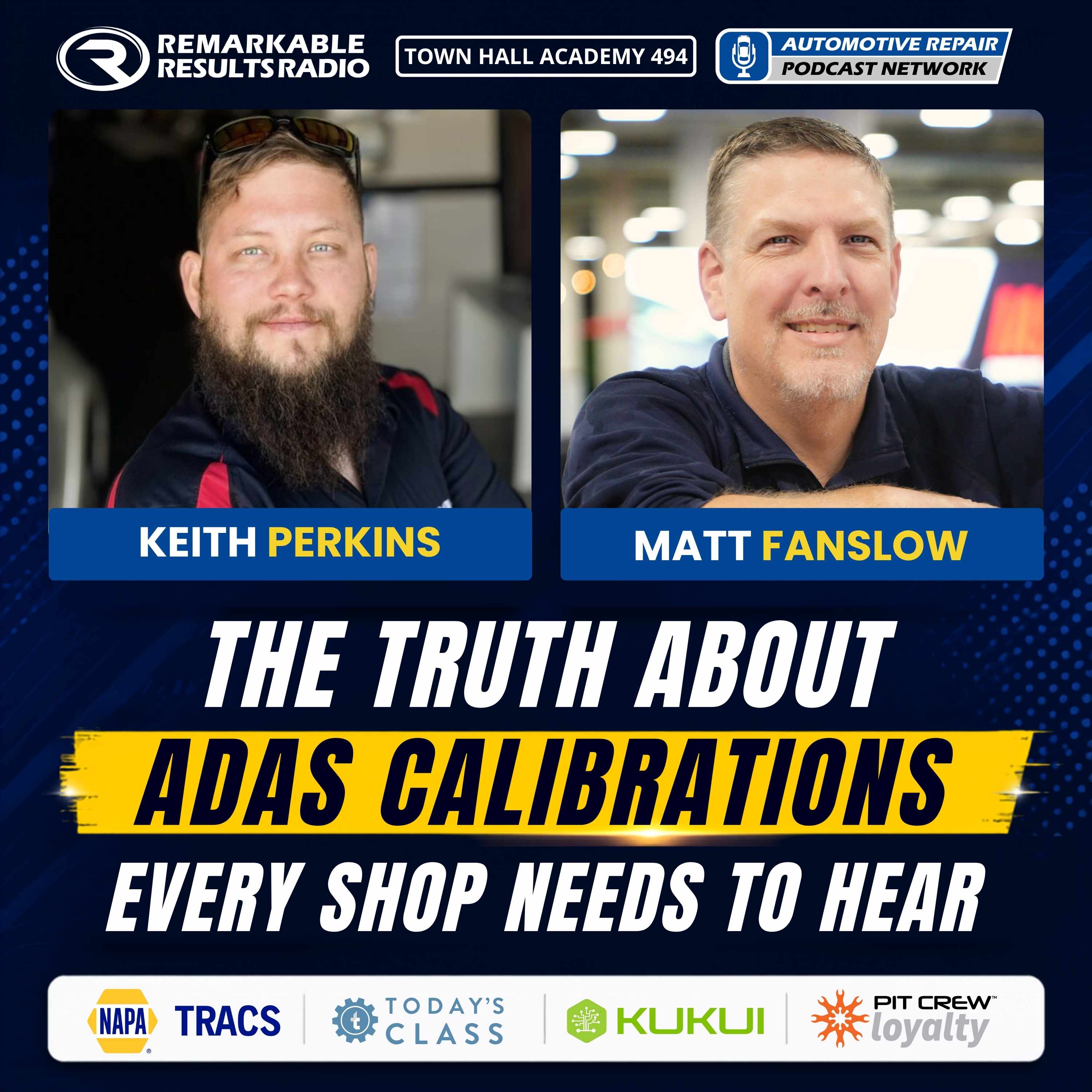
Keith Perkins.
Hello, Keith. How are you?
Good, how are you?
I'm great.
L1 training, L1 Automotive, L1 programming, industry educator
and ADAS specialist.
Hmm. Maybe that's what we're going to talk about.
Remember the NASDAF advisory board, Keith?
Yeah, I'm on the executive committee and the treasurer and secretary.
Very good.
We have Fonzlowe's here, technical specialist and shop manager,
Riverside Automotive, Red Wing, Minnesota.
Hey, Matt. How's it going, man?
Good, ASC, subject matter, expert, industry educator and the podcast on the
Automotive Repair Podcast Network, diagnosing the aftermarket A2Z.
Guys, Keith, you and Liz were in my makeshift studio in Tarrytown, New York
at the TST big event.
And it was a really great episode.
And we got into the details because I was really curious about how do you talk
to customers about ADAS and you were sharing some of your background.
And Tracy, our executive producer, my daughter takes this three minute clip of yours.
We put it up on YouTube as a short as a real and it's had 433,000 views.
OK, I just have it on constant loop.
So half of them are probably just from me.
Oh, OK. Well, thank you, Matt.
Appreciate that. I just like hearing it in the background.
That was nice. Nice of you.
So when I saw all this going on and I realized the impact that that segment
that you were kind of not necessarily ranting, Keith, but you were really talking
about the reality of what was going on in your world with your wife's car
and an ADAS calibration and the dealership.
We're going to talk about all the talk that was going on in those threads.
And I was blown away by some of the gaps of knowledge, Keith.
Yeah, where people wanted to come in and say you were wrong in almost every case.
Believe it, maybe it was Matt who chimed in who was if you will put a support partner
and all the other great people we know in the industry were saying you're nuts.
So it showed me this huge knowledge gap that we happen to have in our industry.
And the old do right rule, Keith.
And so thank you for doing that.
Thank you for Tracy to put it out because I think what it did, Matt Keith,
it opened up some eyes and perspectives on this education, this training,
this knowledge gap.
That's the 80 10 10 rule, right?
Like 10 percent of people will be stuck in their mind forever.
They will never learn anything.
They are convinced that they know everything.
There's 10 percent of people that will always learn that are always going to find out.
They're always going to have the information because once they're curious,
they will outreach and find that info.
And so they won't argue in community.
You know, they won't even really converse much about something.
They're going to listen to go. That's interesting.
Think to themselves, I need to go find out.
And that's who most educators are and all the people that we see at all the training events.
And then there's the 80 percent of the industry that are just
fixing cars, trying to at least do their thing.
And that's the ones that we can hopefully sway, right, to the one side or the other.
But there's 10 percent of them that usually comment that are not willing to learn.
They're not willing to understand.
And, you know, I saw two parts of that.
There was that 10 percent talking about that.
And then there were some that didn't closely pay attention.
It was a sound bite.
Maybe that's part of what happens with with reels.
They didn't realize there were that was actually a period of five minutes of time,
I believe it happened, but it was crushed into a reel.
And there was a cut there where we were talking about one percent of the Ford.
And then I was talking about another system for two different Ados system,
two different setups and designs.
I was talking about a static calibration of a 360 camera.
And then I was later talking about the forward facing lane departure camera
and lane centering system or blue crew system, whatever particular instance of that there was.
And because those sound clips were together, a lot of them blew up with that.
It's not true. That's it's just a 360.
It doesn't matter. I'm like, well, what I was talking about was not the 360.
So people just miss out.
That was exactly the talking point I was going to bring up is that they
seems to be confusion about what he was talking about.
And it could have been the editing and all that.
But the reality is, is if you know, you know, and.
You can blow off a 360 however you want.
It says at the end in service information that this calibration needs to be done.
You need to do the calibration.
When do we get to decide what really needs to be done and doesn't?
When did that ever become a thing like not from a diagnostic perspective,
but from a actual repair procedure process?
When did we ever get that type of power, if you will,
to decide what really needs to be done and what we can look the other way on?
That doesn't fly.
And you can pick so many different examples of that.
Nissan transmissions come to mind.
Like, are we going to skip some certain steps?
You certainly can, but it may come back and bite you.
If you torqued four out of five lug nuts on every car,
how many of them would a wheel fall off?
None of them, probably, right?
Well, statistically, tens of thousands of cars, no wheels would probably fall off
because you did four out of five or five out of six or I wouldn't do two out of three
on a smart car, but, you know, that's just statistically, right?
Like people talk about why don't have to follow.
It doesn't matter if you do this.
It doesn't matter.
You're right.
It probably actually doesn't matter if you did four out of five lug nuts, honestly.
But would you ever really do that?
Like that's your job is to do that.
It's important to do it correctly.
You're probably paid to do it correctly.
And that's the argument a lot of those guys had is they were like,
oh, I worked at a dealer and they didn't pay us to do that.
That's a warranty job when some you lose some toolboxes have wheels.
I don't even want to get into that argument.
If you don't think you should, you know, I think you're being paid enough
to do your job, go somewhere else.
Jim Farley said himself there's 600,000 open job positions, right?
Go find another one.
Why do we love to complain all the time?
Is every other industry that has like skilled trades like we are,
do the plumbers and the carpenters all bitch like that?
That could be such a rabbit hole.
But yes, they do, especially the ones that take their jobs very seriously
because there is minimum code.
But most of the ones that really take their jobs very seriously,
consummate professionals, oftentimes minimum code isn't good enough.
Yeah, they do complain.
It's a little bit different in licensing and all that.
And that's probably a subject for a different episode.
But but Matt, based on all the stuff that came out,
is our gap in our industry way too big?
The knowledge gap, the knowing, doing gap, is it way too big?
That's hard to answer, because just the nature of what we do has
so many ranges and levels, like who should know?
In this case, it's an excusable specifically
with Ford facing cameras inexcusable because it's rate in service information.
Keith linked it.
He talked about it in the short where to go to find it on Google, by the way,
not just a paid service information.
I double checked. I googled it today.
You could still type in Ford job, Ados and Google it.
And Ford Crash Parts website comes up and it's the actual PDF
from Ford service information for free 90 free free free hundred dollars.
I'm kidding. It's free.
I just googled it and found it.
That's what I'm saying is like it's inexcusable.
That's I agree with Matt on that.
It makes no sense if you're like, well, I didn't know it was there.
Well, you shouldn't work on the system.
If you're not trained in it, I don't know.
There was a comment that said
I had 35 years as a master tech.
I've never reprogrammed a camera after doing an alignment.
It's like, was that the actual words?
I don't want to beat you up on this one, Karm.
But if he said he's never reprogrammed a camera,
we wouldn't reprogram one after you write an alignment.
You would do a calibration because a calibration, a configuration
and initialization, a programming event are all different things,
but they are conflated together.
I think those are the real words.
I think Trace pulled them off.
He probably and very probably.
That's why I didn't I didn't want to try to correct it if it was your words.
And yeah, no, but you just brought up something huge.
Reprogramming versus calibration.
Yeah, totally separate ordeal.
The vehicle in question that we took was a 19 Lincoln.
So a bunch of the other comments I saw where was that's a dynamic calibration.
That's not even static.
He doesn't even know what he's doing.
Well, since no one looked up the service information that was a 19 Lincoln,
it has a static calibration only.
There is not a dynamic calibration for the 360 camera on that car.
The lane departure and lane camera or lane centering
or what it depends upon what system we're working on on that 19 Lincoln.
It just has lane departure assist or lane keep assist, whatever we want.
Whatever acronym you want to use.
Think Ford uses LK a lane keep assist just to check
since I have the document up from Google right in front of me.
I'll just quadruple check here.
Lane keeping camera.
That's the component and the lane keeping system.
So on the LKS, it is a dynamic calibration.
So those were the two systems we were talking about in that video.
That's the issue.
And a replacement of one of those components requires
probably not even programming, to be honest.
It probably requires coding, which is typically done
through an as built a programmable module installation function on Ford,
specifically, that's their terminology.
But that is coding and configuring that module.
It already has software in it.
Now, there may also be a software update that is a programming event,
but replacement of that front camera actually required a LinBus initialization
and not a PMI. And so that's what I spoke about.
And I thought it was really entertaining that there was so much
either confusion with the car.
And a lot of it was they watched the sound bite and they didn't watch the video.
And if they watched the video, I talk at great lengths,
even when people don't want me to.
So to quote a movie there, Matt, in case you look at that one now,
we'll dog my action.
I gave the whole story and what's crazier about that story.
And you guys know this.
Since that video came out, that car has been rolled.
Yeah, my wife and both of my daughters were in that car
and that car got rolled and it saved their life
because all of the safety systems were thus calibrated.
Somebody said, we didn't do it yourself.
I did. After that, we used that car
in every ADOS class we do used that car in every ADOS class we did.
We have one coming up in one week well after this air.
So you guys all missed it. Sorry.
But we have an in-person one that we use it and we always use that car.
We do a 360 calibration.
We do dynamic calibration.
That car gets calibrated over and again,
along with many other vehicles we have.
And we replaced that vehicle.
So now there'll be a new vehicle we're using.
Unfortunately, does not have a static calibration anymore
because it's like the system the other people talked about.
So you make models important.
Looking up the service information was important.
And yes, it has to be done to Matt's point,
regardless of what you think you're not the engineer, lawyer,
you're especially not the prosecuting lawyer.
So I would follow the OEM procedures.
Yeah, or a group of 12 of your peers.
And another example that comes to mind,
I was thinking about the lug torquing or wheel lug torquing.
We're talking about not doing the procedure correctly.
With Ados here in the example of the video is skipping it entirely.
So one example that kind of comes to mind would be there are some car lines
where on jobs that we have done and some of the people listening
have done literally thousands of times, literally.
A car line will change something where a certain part has to be replaced.
I'll use an example of Ford.
I don't want to be picking on Ford because we're talking about Lincoln in this case.
But it's the best example I can come up with off the cuff
is that there's bolts that need to be replaced with caliper replacement
or if the calipers have been removed and in service information,
it tells you to discard these bolts.
There's people that have done thousands of break jobs.
They don't read service information.
They never look it up.
Those bolts never get thrown away.
They get put back on.
And when they find out that they were supposed to,
they probably in this case, comparing it to this Ados situation,
they're blowing it off like what are they going to do?
Are they going to break?
I don't know.
They want you to replace them for a reason.
They're, you know, torque to yield or something once.
And now if you don't do that, what position are you taking?
Presumably in a courtroom or just amongst your peers, your friends,
what position are you taking?
Like, well, they looked good.
I mean, Cripes, they're big enough.
Why would they shear off?
None of us would do that.
They should have been fine.
It's not my fault they can't design a bolt, but they told you flat out.
This needs to be done.
You're going to tell a jury of your peers, like, well, I know better.
I've been doing this for like 30 years, 20 years, 15 years, 40 years.
I know better than them.
That's going to fly.
That's your argument.
It's no win.
It's you can't.
You don't have a leg to stand on.
Let's face it, your shop management system is the single most important tool
in your shop.
Period.
Napa Tracks was built from the ground up to make your business more profitable
and efficient.
We provide an extensive set of tools to increase and track profitability
in real time.
Napa Tracks offers the industry's best post sale support hands down
and we train your people on site.
Yep, on site.
And we offer remote refresher training 10 times a week
and customer support is open six days a week.
Give us a call.
Visit the website or join our Facebook community today to learn more.
We'll prove to you that Tracks is the single best shop management system
in the business.
Napa Tracks is always customized and tailored for you, whether you're a one
man shop or a large multi bay or multi location company.
After all, it's your shop.
So it's your choice.
Visit us on the web at Napa Tracks.
That's N-A-P-A-T-R-A-C-S dot com.
Hey, Karm here, suggesting you discover a smarter way to train your entire
automotive team, experienced, powerful, bite-sized training sessions
accessible from any device in just five minutes daily.
It's perfect for technicians, advisors and managers alike.
Today's class prepares your shop for sustained success by reinforcing crucial
knowledge, plus at a competitive edge with our leader board to make learning
fun and rewarding for everyone.
For effective training that delivers, turn to today's class.com.
You know, most shop owners feel trapped spending on ads while half their
first time customers never come back.
It's frustrating.
It's exhausting.
And it's not your fault.
The industry average is 54 percent, one and done.
We understand how discouraging that can be.
Well, pit crew loyalty changes the story.
Our clients cut that rate by up to 38 percent, raising lifetime value by more
than 50 percent.
Loyalty members visit nearly three times more often, creating predictable
revenue without extra ad spend.
Pit crew loyalty where customers stay and shops thrive on the web at pitcrewloyalty.com.
Shop owners, we know you are overwhelmed with a flood of missed calls, empty
bays and disconnected marketing tools.
Cacui has spent over a decade building one integrated platform for auto repair
shops, one login, one dashboard and mobile first websites that convert four
times industry average, smart, innovative CRM with automated follow up, 24,
seven online booking and real time ROI tracking.
With 900 plus years of combined team experience, we feel the growth of 2,200
plus shops and have influenced $3 billion in revenue.
Stop working harder, start working smarter, get industry leading customer
support and book a demo with Cacui.
That's KU, K UI dot com.
Why are we so quick in our industry to jump in?
Well, I know better.
Why do we always want to be right instead of being humble and constantly wanting to learn?
Shame.
Yeah, shame.
Psychologically, shame.
Yeah.
I mean, you're based on everything you do all day.
Every day is pretty much being right.
Right.
You know, every time you're wrong, it's a comeback.
Right.
Right.
And you get most shops have some kind of thing.
Most every shop I've worked in has had some kind of thing.
A car comes back on a rollback and they go set the comeback bus on top of your
toolbox, little rubber magic school bus.
And I had for two shops had one like that.
I was like, what was the comeback bus?
I've seen dunce caps.
I've seen all of those things who had the most, you know, it's a metric, right?
And we all talk about it.
It's the thing we hate is being wrong or missing something.
And every single job.
And that's, I mean, it's a, to lean the car side and away from that side on this
one is, I think it's way worse than what it should be.
It's a much bigger gap.
If you go look and read service information for every job you do, you will find
out you've probably only done like 40% of every job correctly.
There's something that was missed.
There was a calibration or re-learn a Torx, it's Torx specs.
Right.
If we really want to beat people up on it and I won't name names, but like I had a,
there was a conversation between a bunch of people of someone saying, Oh, well,
flat rate texts are by and large better than hourly texts was what someone said.
They said, I would venture to bet.
And I said, I will not only venture, I will indulge you in that bet.
I will bet.
And then at the time I bet that person $10,000 to the charity of their choice.
We would both bet $10,000 charity of our choice.
And we would put two of his best flat rate texts versus two of my, I only have hourly texts,
two of my best texts.
And they would both diagnose a job and they would both do a repair.
And they would be judged on who got it done the fastest.
So leaning towards the job of the flat rate, but it had to be correct,
which meant they had to go look up service info.
And I wasn't going to lay out what meant correct.
You either know how to do a job correctly or you don't.
That was not taken up.
I made every effort to make that happen.
So it didn't.
And I'm, it's not an open bet.
I don't have 10 grand back on my pocket right now.
A few investments now, but, and it's because that person realized, yeah,
my guys don't torque every bolt.
They don't read every instruction.
They don't relearn everything they're supposed to relearn.
They didn't replace every component they were supposed to replace.
We just did a calipers, we didn't, we pulled calipers off, but we did a control arm on,
and some other suspension work on a Mustang recently.
And it was a 2000, like a seven, like 20 year old Mustang had to replace all the bolts,
$89 in bolts.
Thank goodness we estimated because otherwise that would have been $89
coming out of the incidentals fund that we would have, that we estimated on that job.
Right.
And it was, why do you have to?
Are they torque to yield?
They're not torque to yield to Matt's point,
because I know what he was alluding to, and I know he didn't want to get too technical with it,
but I'm going to get technical with it.
A lot of bolts are made to be tightened one time in the threads warp and move and tighten and flatten,
and the breakaway torque of that bolt after it's torqued one time is,
like, what was it, I think it's 68% higher was the number that, there's a test that we,
that everyone passed around for a while, a bolt that's made as a one-time use bolt,
torques and the threads fold, and then the clamping force is that force, but only one time.
Reduced, yep.
And then the next time you try to reuse that bolt because the threads are already warped over,
it doesn't have the same clamping force.
So the torque that you would install it at actually isn't correct.
And there isn't a way to replicate that because of the stretch of the threads every time.
So a lot of bolts are made that way.
General Motors does it too, not just forward.
Every manufacturer has many one-time use bolts, some torque to yield,
and some not torque to yield, but some one-time clamping force.
So it's important, and there's a reason why, and there's always a reason why.
If there wasn't a reason why, you got to think this manufacturer is factoring in,
we might have to do this under warranty.
What is it going to cost us?
So the plan is to make the car last 36,000 miles or whatever the warranty is, right?
Everything beyond that, you can argue that they made that spec up just to get it out of warranty,
or they set that to get that JD Power Associate Award for the lowest cost of ownership in the
first 90 days or first two years or whatever award they were trying to get.
You can come up with all those examples if you want, but there's a reason for all of it.
And it's always weighed on safety and cost.
If I want to make the devil's advocate argument here,
well, they only said that because they want to sell more parts, or they want to do more work.
78% of every repair of a vehicle outside of warranty is done in an independent shop,
not at the dealer.
So they're trying to make us more money?
Okay. I agree with you. I'll take it.
So there's a reason.
Our job is to follow your procedures and fix cars right the first time,
and to fix problems.
And most of the time, that problem is a car.
Regardless of what your reasoning of how long you've been doing something,
your argument of authority doesn't work. It doesn't matter. I'm not going to take it.
Guys, let me jump in here and talk about static and dynamic, which you guys, of course, brought up.
Are we, as an industry, say, oh, it's probably dynamic, so I'm not going to worry about it.
Has that clouded the issue?
Keith probably has a better take on this. I still think it's a...
They're basing it off something they've seen, read, or heard in a class,
but they take it to an extreme, meaning that there is a little bit of self-learning going on,
even after a calibration, but then they assume that if I drive it long enough,
it will recalibrate itself, and that really hasn't shown to be the case.
No. I agree with Matt on that one. There's a massive shift on
towards vehicles having both options, static and dynamic.
I'm seeing more dynamics than what I've seen before.
The problem I see is a lot of manufacturers are not going to make everything
all dynamic, mostly because not everywhere in the country,
everywhere in the world, do they fit the infrastructure of what's needed for that.
A lot of them you have to drive. I taught an ADOS class in Brooklyn, New York,
and so I said, now, this car, we have to drive. I read the specs on this suburban of what it was,
and I was like, we need to drive over 35 miles an hour and not accelerate or decelerate,
and we need to not change or turn very often. I'm like, well, that takes out everything in
an hour radius of here. I asked the guys, what do you guys do? He goes, oh, yeah, we have to go
out to X, drive over to whatever, get on the freeway, and then go do them and come back. He's
like, yeah, it's 20 minutes to get out there, 40 minutes to get out there, to pin upon the time of
day, and then it's only a 10, 12-minute drive, but then it's 30, 40 minutes to get back.
He's like, yeah, so most calibrations take an hour and a half. I'm like, I'm 42 seconds from the
freeway in my shop, and it takes maybe eight minutes to do a cal. Our test drives are like
25, 30 minutes total calibration time. Calibration time away from the shop, stop,
clear codes, check all those things, any other post-calibration, key off for two minutes,
like a lot of them say, key back on, and drive the car back testing the system.
You know, 20 minutes. It changes things for a lot of places. I see that back and forth, and a lot
of guys say that about dynamic. They're like, oh, well, I just have to drive it. No, we still have
to hook up a scan tool, initiate a routine in a module that goes through a process inside the
module, and it comes back with feedback. They're missing out on a lot of that stuff. But yes,
to Matt's point, cars do have adjustments in calibration, but it's not a calibration.
It's an adjustment, some self-learning machine learning that happens to
cork for suspension sag, tire wear, those kinds of things.
Does the normal public who owns all these great vehicles really appreciate the high-tech industry
that we're in? I don't think they ever have. Matt, that's a perfect answer.
I don't think they ever have. I don't think they ever really know. I keep thinking about
this skill gap thing or knowledge gap you brought up, and I'm wrestling with that.
Depending on, not to make this just all about a relative statement, but what does that mean,
part of it is if we're talking about the truth, like how something really works,
the gap between the vast majority of the profession versus how something really works,
that gap is, yeah, it's huge. And it's even larger going to the vehicle owner. That's a
topic you and I have talked about quite a bit with information asymmetry and credence, good service,
stuff like that. That's what it is by definition. So I don't know that they've ever really
appreciated it as cars have gotten more and more complex. I think they kind of know they're more
they're complex, but they're also under the delusion, which maybe sounds a little more
condescending than I'd like it to, but they are under the impression that we have very
sophisticated equipment that plugs into these vehicles and tells us what's wrong with the car.
All I keep thinking about is I don't have ADAS calibration equipment. And so it's
really kind of easy just to ignore it. Talk to the hand, the face ain't listening,
just send them down the road. You can send them down the road, just send them down to the road
to somebody that has some ADAS calibration equipment. That's my point. My point is,
is that the owners of the ADAS calibration equipment either aren't marketing themselves to
a local community and say, Hey, listen, when you know, you got to be there, I'm here for you.
And because it is such a big buy to want to get that equipment in the right environment to put it
in, maybe that's where we're getting lazy and have an attitude about calibrations. Because
I don't want to do them. I don't want to afford it. And I don't want to go down to my buddy down
the road. That's greed. It's all greed. And this is where like a lot of shop owners hate the point
where I talk about this. And would you do tie rod ends and ball joints and drag links and stuff if
you don't have an alignment machine? And if you do, you probably partner with an alignment company
to do that, right? Because that's part of the job. And you know, you have to do that. And it
causes a problem with the customer. And we have that same, a lot of guys have that same. Well,
I've been doing this for 30 years. I said at ETI, and they had a panel where there were
two shop owner, two or three shop owners. I remember having there was up there a couple years
ago. And they set up there. And these were guys that were representing me. I'm in the audience
and just listening to the panel. And they said, one of the guys said, Well, I went and talked to
my master tech and he's been doing this 20, 30 years. Again, he starts this conversation with
the argument of authority of I've been doing this this long, or my technician's been doing it
that long. I'm sorry. We all have the same amount of time experience on ADOS if you've been in the
industry that long. So it doesn't matter. They didn't have ADOS 30 years ago, not as we know it
today. The first ADOS car with a LiDAR radar component that we know of is a 1992 Mitsubishi,
only in the Japanese domestic market. And it was a LiDAR system for advanced cruise control.
And it was only done in two years because it was a $4,800 part on a $28,000 car in 1992.
It was crazy. So realistically, since the mid 2010, 12, 13, 14-ish, when it really
started to come into its own, we've all been working on cars that those 10 plus years. So
who cares how long you've been doing this? So I've talked to my master tech and he's been a
master tech 30 years. And he said, if I take the part off and I put the part back on, I'm not
going to need to calibrate that. He said that up on stage at ETI in front of every vehicle
manufacturer and tool manufacturer, scan tool manufacturer in the country as a representation
of our industry. Then the guy next to him said, yeah, we don't really work on Teslas very much
because we can't get access to the information. This was after it was released for free. Again,
this is again, my Tesla has it for free. If viewers don't know, you can go to epc.tesla.com,
make yourself a go to the diagnostics tab and stuff, make yourself a free account
and get free access to service information for free for Teslas, from Tesla. It's there.
So this is who represented us and it's constantly a battle of ignorance. So when I talk to these
shop owners about the equipment and stuff, they go, well, I don't see the profit in it. I don't see
the profit in me having business insurance, but it's required for me to run my business and do my
job right. I didn't see the most shops don't see a profit in their alignment machine, the profits
and the repairs equating to that. It's exactly the same thing. If you're going to do extra
pair that requires it, if you're going to change tire size on a Ford vehicle, it requires a Ford
facing camera alignment when it's done, which means you need to be able to do that. And there's no
tools for that one. Besides the scan tools you probably already have. You've got to set the
vehicle up, press routine, drive the car, tell us done. Hey guys, Matt, Keith, how many shops
in America do you believe have alignment equipment? 80? No. Like percent? Yeah. No way.
It's probably closer to 50. Yeah, 50 or less. I'm debating if it's lower than 50.
To your point, we're shortcutting. Yeah, we're shortcutting because we don't see the profit
in it. So they just decide not to do it rather than realizing they don't have the ability to
complete the job or hold the customer to complete the job. And then they still do part of the repair
and then say it's complete and give the invoice to the customer and collect money and the customer
goes away. They don't go, look, we can change the tire size in your vehicle, but when you get done,
you're going to have to go take it somewhere to get this calibration done and we don't do that.
As much as I don't even like that part of it and it's going to offend a bunch of people,
I think if you can't do a complete repair on the car, you shouldn't do that at all
because you're probably not knowledgeable enough. And that's just how it offends people. I'm sorry.
I mean, I don't know what to say. I tell people every day when they call my shop that says,
hey, I just got XYZ shop just told me I needed to call you. I need to buy a computer and put
it in and bring it to you to program it. I just tell them straight up on the phone,
hey, like 80 plus percent of cars are brought to us that way. Didn't need a computer.
Our belief here is that if they're incapable of installing and programming a module, they're
incapable of diagnosing it as being a module. We think they're probably wrong. Why don't you
bring it in? Let us check it out. I do everything I can to not discredit, but dismiss that information.
I just don't do that. I don't think if you can't do the whole repair, you shouldn't do any of it.
I'm sorry. It seems like it's fear driven. Yeah. And this is probably an incomplete thought,
which anyone that knows me knows that's about all I'm capable of, but.
But lots of them. Yeah, lots of lots and lots of incomplete thoughts. Maybe somebody
could stitch them together and then make one good complete thought. I don't know.
But there's fear of the customer, right? The fear that we're going to lose a customer. So
they call up, they want a price of whatever requires removal of something that messes with
an 8-USC camera or radar. So it's going to trigger the requirement to do a calibration.
But I don't want to tell them that because it's going to add to this cost. So the wheel alignment
following a main factor, pick one, pick Audi, I don't know, requires a calibration after a wheel
alignment. And they might even point out specifically one that messes with the thrust angle. But
beside the point, if it says it needs it, it should get it. But I don't want to add that
cost to my estimate for fear that I'm going to lose this job, lose this customer.
So there's that fear. If something horrific would happen, and I really don't want it to,
but if something horrific were to happen where just a national news story of an independent
repair shop, a dealership, somebody or a terrible accident occurred attributed to an 8-USC system
not working the way it was designed because the previous technical specialists, 8-USC
specialists, whatever, or shop didn't do the job to completion. They skipped this step.
And they see the size of numbers that are going to be, the shop is going to be hit with. Now the
fear of that repercussion will outweigh the loss, fear of loss of the customer. And magically,
everyone will be quoting 8-USC calibrations on jobs that are required to have 8-USC calibrations.
So it's like this misappropriation of fear. Since you haven't seen the big lawsuit,
you don't fear it. And since you haven't had a customer come back and say, hey, you know
whatever, since you did that, my car slams on the brakes on this corner, if there's a truck
coming around, that hasn't happened. So there's no fear. They're more fearful of losing the client
or the job, the service, than the repercussions of not doing it right. And then when that becomes
a fear point, like a reality, boom, now we're like forced to do the right thing.
It's insanity to me. It's absolute insanity.
Well, the more we don't do it, the greater degree of having a major problem happen.
And the sheer number of cars that have systems in them that are now in the
age of being serviced, the probabilities are going up, up. We're starting to see more
and more lawsuits, activity for like glass companies. And I think some dealerships now.
So I'm sure eventually it's going to happen, but why are we waiting and all the valuing ourselves
in our colleagues slash competition? If while we're at it, I don't know, I guess my new favorite
word is just so absurd. Yeah. It reminds me of the Anton Yelchin thing. They got the actor who
played Chekhov in the newer Star Trek series, a reboot. The movie's not a Trekie or anything,
but he just, he passed away. He got out of his Jeep, walked around to open the gate, his house,
and his car rolled forward because it had the knob shifter. And so there was complaints about this,
about issues of other stuff getting damaged, property getting damaged, people getting hurt.
But until a popular actor was killed by his car, Chrysler, Fiat Chrysler, whatever French Italian,
whoever owned it that week, decided that now we should make a software update recall that when
you open a door, that the car should go into park like automatically, which Audi and Volkswagen
have been doing for years and years and years. I know because it frustrated me trying to do
alignment on them because I'm trying to look down at the lift and open the door and roll the car.
And when I open the door, the car goes in the park annoyingly. So it also really ticks off
people that can't back up trailers with just their mirrors. Hey, man, so I gotta go back up assist.
I beat up on Ford and just so everyone's clear, I own seven Fords and to replace Liz's Lincoln,
we bought a new Ford, a new to us. Yeah. Got a 25 expedition to replace it. So.
Okay. Well, we're so happy that they came out. Okay, Keith, I mean, that's,
they all walked away too. Yeah, they all. So for those who didn't hear just that same car,
that Lincoln that did not get repaired properly at the Ford dealership, which it's right now,
the brand new Ford is that a third Ford dealership that we've, we're not burning bridges. I'm just
saying, you know, we find issues and we move our business elsewhere. It's under warranty.
So it's got some warranty work. We got a phone call today. As soon as I get off here today,
we're going to go pick it up from the dealer. But that car did its job, that Lincoln did its job.
All the safety functions on that car worked. They were driving highway speeds and they were
sideswiped by another car. They went off of a guardrail and off the side of a bridge,
down 20 feet and rolled the car at highway speeds. It landed right side up every car.
Car molson, just some pictures, if you want to find a way to edit in the picture of the car
right here, whatever that's fine. But that, that car was crunched in every corner. It was
crunched every corner down the front windshields, caved in every glass was almost broken. Every
single panel was banged in. None of the doors would open properly. So they climbed out the
back glass. My 12 year old, my 15 year old and my wife climbed up the back glass, sat there,
ambulance came by. They all took an ambulance ride, went to the hospital, but no broken bones,
just contusions and, and some abrasive stuff from seat belts and all the other safety functions
that worked in that car that did everything it was supposed to do. My children and my wife
are alive today because that happened. So when people hear me talk about this, like,
you're really fired up. I lost my uncle and my grandmother on the same day because they
didn't wear a seat belt. But I got to keep my cousin and her two baby children because they
were wearing seat belts. And then because they had a tire blowout and a Ford Explorer of all things.
Wow, it completely different incident. Completely different incident years and ago.
And then I got to keep my wife and kids because their car did the thing and seat belts do the
thing. I believe in seat belts. I believe in safety functions. I believe in all those things.
I had that video that I did where somebody had defeated the pretensioners and the seat belts and
a car and was trying to sell the car that way. And I caught it. And everyone's like,
you took that really serious. Like, yes, I take seat belts and safety and automotive repair serious
because that's my job. You bring your car to me. My job is to make sure that I fix it properly and
safely, hopefully the first time and hopefully at the most reasonable price that I can so that
you're happy. But at the end of the day, I just need the car fixed, right? And I need to fix safe.
That's all that I care about. And so I think these systems being calibrated is safe. I've proven that
car. I apologize. I haven't got you that trifold image to show.
Oh, my God, Keith, I'm not even sure we want to go there, but you just said right and safe.
And if we were trying to pull something for the listener to listen to learn and then implement,
maybe the kind of language that we're talking to our clients about Keith is right and safe.
Now it goes back to the acetate that I want Keith to create. And so it's on every everybody's
counter. So it shows if we've got a one degree misalignment, then what does it mean down the
road? Because we're looking for adaptive crews to work and lane keeping all that stuff. And if
the client says no, from a $99 alignment plus the the $299 or whatever the calibration is
to do it right and safe, then you can go down the road and do it because we choose not to.
Yeah, that's the other arguments that ran out of time. As guys were saying,
I've done tons of these and the systems always work afterwards. It's a completeness
understanding of how they work. They think that, well, I press the button and I came up to a car
and the car slowed down. It worked. And that's where that math came from. That's where it's showing
that thing of one degree of alignment at half of the distance of a capable long range radar. So
about 781.25 Nathan's hot dogs, just so we're clear in freedom units, not tyranny units. That's
why we make that measurement that way. So the automatic mercy braking system has a 52% reduction
in distance. If the radar is one degree off in a single axis. So that's why it's so important
to calibrate. It works. It still works. It just doesn't work as designed. And 52% might mean the
difference between rear-ending someone and not. Yeah, or fender bender and helicopter ride.
Yes, exactly. And that's why, like Matt's point, the fear part hasn't got there yet. I don't want
it to take another actor's death and we ignore a bunch of less popular people, their damages,
their injuries, their whatever the risk that's involved. I don't want that to be the case.
I would rather us just do it right now. And that's why I don't understand on the same boat, Matt.
Why are we waiting on that fear versus the other fear when neither one of them are right? We need
to just do the right regardless. If you go to like the Napa EV class, right, Bill Weaver,
he's going to spend a fair bit of time talking to you about personal protection equipment.
He says something that we probably should use more often and it works for insurance too. We buy
insurance. We don't need that stuff. We don't need the PPE. We don't need insurance all that on our
on good days, on our normal days. We need it on our worst days. And that's when we need all this
stuff to work. And not just us, us. I need, I need this stuff to work for my client on their worst
day. That's when it's got to work. Not day in and day out. Like when they need it, I need it to work.
That's when I want it to work. Hopefully they're paying me to stack the probabilities overwhelmingly
so that when they need that on their worst day, it's going to work as designed.
I want to stop and show you, this is a video and I am so upset that I never took a picture of,
you see that standup sign behind us? Great friend, Scott Felzer's wife, Ann, he just put in a brand
new building, a brand new ADS system. You can see it's a kind of a flat lift and behind it on that
is all the different calibration reasons, Keith. And he has that sign, we had a like 25
independents there to look at his system, but that's in the front of his lobby. So when they
need to talk about calibrations, they can literally almost walk up. And if you like a weatherman,
right, to point to all those kind of great reasons. So there are ways to do this stuff.
And there are reasons to do this stuff. And there are ways to sell this. I'm crazy about
the lack of, and I keep going back to my favorite is word, professionalism. I'm sorry,
I'm not saying if you don't care, you're not professional, but then what is professionalism?
Exactly. I'll say it. If you don't care, you're not professional.
Karma doesn't want to say it. No, I do want to say it. I've been writing articles,
I've been preaching about it. I want to give a person a chance to say, I need to step up.
I need to be more professional. I don't want to want to slap someone down.
I'd love to hear as a reasonable argument for not doing it, but I've, I'm open to it,
but I'm also probably not. The reasonable arguments that it might not need it,
but you can't know it unless you do it. Yeah. We have no other way of determining
the accuracy without doing the actual calibration. So by default, you're doing the calibration. That
is the right thing to do. That's probably the biggest argument I hear is when they put one
together, they go, why wouldn't drove it? And again, it worked and it worked out. It's supposed to
be like, well, you don't know that. Like you really don't know. You didn't test the automatic
emergency braking system. I know you didn't. Nobody can walk away with a clean pair of undershorts
and do that. I've noticed that the big glass company that it has the commercials on all the
time, they were talking about calibration about a year ago and it kind of went away.
And now their wording is coming back that we can and will calibrate your vehicle.
And again, I always like to say the words back to OE specs, original equipment specs,
manufacturer specs. And if people who are getting a new windshield put in are told
that there is a calibration step along the way, why would the millions who watch and bump into
those commercials aren't impacted by then the language that we're using at our professional
counters that, oh, it's just a commercial. No, you're talking about calibration. I've heard
that before. Interesting. It's like a lot of stuff, right? All you do is keep educating,
you keep bringing it up. You keep doing the work and charging for it. It's like programming, right?
Years ago, if you replaced a module, depending on what it was and depending on how far back we
want to go, maybe there was a PROM exchange or an EPROM exchange, but you plugged it in and
it worked. And then maybe there was some maybe theft learn that added some time to the replacement.
Maybe that was factored into the R&R, the module, maybe not, whatever. But you talked,
most likely talked about it. And then we had to start programming. We had to upload some sort of
firmware to this module so that it would work and you'd have to charge for that. And for a while,
customers are like, you've got to be kidding me. It's never been the case, but over time,
that was just an accepted part of an invoice or I should say estimate that we hand them,
like need to replace this module. We're going to program it. Got a series of these
relearns or calibrations or adaptions, whatever terminology you want to toss out.
Same thing is going to be with the ADOS calibrations or whatever services would trigger
a calibration of a certain camera radar system has to be done. And I guess we'd just like to see
it more unified. What's disheartening about that video is separating who's not in the industry
making these comments like, oh, that's stupid. These cars are too complex or that's why I drive a 1950
something or whatever their argument is. But then who are the professionals or supposedly working in
the industry presenting themselves as professionals who are contradicting what we're seeing. And that's
a big problem. That's a frustration point of mind where it's bad enough. You don't want to do this.
It's bad enough. You legitimately don't think we should do this. But why are we running down the
tech, the shop, the mechanical specialists, ADOS specialists that wants to do it the right way?
Like, where's the logic in that? It's because they're not capable. They don't understand why. So
they decide, Wolf, since I don't know how to do it, I'm going to make fun of the guy who can.
Right. Think about it all the way through. Everyone's got that story of all the way through
high school or whatever they were picked on for being the nerdy kid, smart kid. Like,
that's because the other guy was dumb. So he was jealous of you.
Same thing.
Nerdy. Nerds rule. I'm sorry. That's just how it is.
International Nerd Day. Otherwise known as International Boss Day.
Thank you for this. I know we could go on forever and ever. But, you know, and who knows,
maybe Tracy could find some segments of this we can put up and get another 433,000 views of a
reel like this. But I look at the perspective that you brought to this and your point of view
to continue this story around the professionalism and the knowledge gap that exists out there.
And I wanted to do this soon after all of that stuff transpired so we can get it out there again.
And maybe we can change some lives, change some people's careers, change how our perspective
to the motoring public, our clients. I think Keith, your company, Matt, your company and so many
other top performers, they get what's necessary to involve our client in this experience of keeping
their car reliable and safe in long term. And we're here to help. But that negative press
and the social media junk that exists out there pulls down so much of the good stuff that we do.
If I remember right, maybe this was a different thread, but I'm pretty sure it was under
in a response to Keith's or your video of Keith's rant. There's something about fixing and repairing.
And there might be like fixing might be making a symptom go away. Like I did this and now it's
better, whatever that may be. One really left field example I have is years ago, the car would set
lean codes, rich codes, whatever needed a new mass air flow sensor was contaminated so you
clean it and they put it back together and the car ran better, had better power, check engine light
didn't come back on, but then down the road it would fail an emissions test like an IM240
due to a mass air flow sensor wasn't reporting properly. Okay, so that would be a fix. Cleaning
the mass air flow sensor is a fix. The repair was replacing the mass air flow sensor. In this case,
maybe you fix the car pulls to the right, but the repair is you fix, you know, take care of
why it's pulling to the right with the alignment and then you do the calibrations that are required
by the manufacturer of the vehicle. I'm with you my friend and in my language shift, the ADAS
specialist really should be called a calibration specialist because I think the word calibration
has much more weight to the motoring public than the word than ADAS because a lot of people,
maybe they're learning what ADAS means, but it doesn't mean a whole hell of a lot to our client,
but calibrating the vehicle back to OE specs, we're going to give it to our calibration specialist.
Well, that's pretty darn powerful. It's like going to the urologist says we're going to fix that
problem for you. Wow, Keith Perkins from L1 Automotive L1 Training. Wow, Keith, thank you so
much for being here, Matt, you too, because I know you guys are so, so busy in a million different
things. Please say hello to Liz and the kids for us and wish them our best. Matt Foslow
from Riverside Automotive Red Wing and the Aftermarket A2Z podcast, diagnosing the Aftermarket
A2Z podcast on the Automotive Repair Podcast Network. Guys, thank you so much for this follow
up discussion. It was pretty good. Appreciate it. Thanks for having me. Thank you.
Thanks for being on board to listen and learn from the Premier Automotive Repair Business
podcast, Remarkable Results Radio. Get your episodic education on the A-R-P-N listening
app at AutomotiveRepairPodcastNetwork.com. Also, enjoy the podcast on our Carm Capriato YouTube
channel. Carm is all for advancing the professional automotive service industry. Until next time.
About this episode
ADAS calibration gets misunderstood when short clips blur different systems and when shops treat calibration as optional. The hosts walk through real scenarios—static vs dynamic camera calibration, why driving isn’t a substitute for scan-tool routines, and how some jobs require LinBus initialization, coding, or firmware uploads. They stress following OEM service information (and OE specs) and completing the full procedure, using safety and torque-to-yield analogies to show what happens when steps are skipped.
Thanks to our Partners, NAPA TRACS, Today's Class, KUKUI, and Pit Crew LoyaltyWatch Full Video Episode
A viral social media clip about ADAS calibrations sparked thousands of comments and exposed a troubling reality: many automotive professionals still misunderstand when and why calibrations are required. In this episode, Carm Capriotto welcomes technical specialists and industry leaders Keith Perkins and Matt Fanslow to examine the industry's response, separate fact from fiction, and explain why following OEM repair procedures is essential for both vehicle safety and professional credibility.
What You'll Learn
The difference between static and dynamic ADAS calibrations, and why confusing the two leads to costly mistakes.
Why programming, configuration, initialization, and calibration are separate procedures with different purposes.
How fear of losing a sale often outweighs concerns about vehicle safety and liability.
The real-world consequences of skipping OEM-required calibration procedures.
How a properly calibrated vehicle helped protect Keith's wife and children during a serious highway rollover crash.
How elevating the role of theCalibration Specialistreinforces professionalism and builds customer confidence.
ADAS calibrations are not optional add-ons or revenue generators; they are critical safety procedures designed by vehicle manufacturers to ensure advanced safety systems perform as intended. Professional repair shops protect their customers by following OEM repair information, completing every required calibration, and returning every vehicle to the road safe and ready to perform.
Thanks to our Partner, NAPA TRACS
NAPA TRACS will move your shop into the SMS fast lane with onsite training and six days a week of support and local representation. Find NAPA TRACS on the Web at http://napatracs.com/Thanks to our Partner, Today's Class
Optimize training with Today's Class: In just 5 minutes daily, boost knowledge retention and improve team performance. Find Today's Class on the web at https://www.todaysclass.com/Thanks to our Partner, KUKUI
Stop juggling multiple marketing tools. KUKUI’s integrated platform delivers 4x better website conversions, automated follow-up, and real-time ROI tracking. Get industry-leading customer support with KUKUI at https://www.kukui.com/Thanks to our Partner, Pit Crew Loyalty
You’re probably tired of chasing new customers who never return. We understand. Pit Crew Loyalty ends the one-and-done cycle, turning first visits into lasting, reliable revenue at https://www.pitcrewloyalty.com/Connect with the Podcast: