Fat Fender Garage is a business that works on cars, especially older and classic models. They make changes and improvements to these cars, but they haven't started working specifically on muscle cars yet.
Full-build restoration means taking a car apart and fixing it completely to make it look and work like new. It's a big job that can involve a lot of different repairs and improvements.
The automotive aftermarket is all about the parts and services you can buy for your car after you've purchased it. This includes things like upgrades, repairs, and customizations.
Superformance makes replicas of famous classic cars, like the Shelby Cobra. They create these cars in small numbers, making them special for collectors and car lovers.
The Shelby Cobra is a famous sports car known for being very fast and lightweight. It was created in the 1960s and is still popular today, with many people wanting to own or build one.
The Ford Mustang is a popular sports car that has been around since the 1960s. It's known for its stylish look and powerful engine, making it a favorite among car enthusiasts and collectors.
Roadster Shop is a company that makes custom cars and parts. They create unique vehicles based on what the customer wants, often using special designs and technology.
Detroit Speed is a company that makes parts to improve the performance of classic cars. They focus on things like suspensions to help cars handle better.
Variable ride control is a system that lets you change how soft or hard your car's ride feels. It helps make driving more comfortable or sporty, depending on what you want.
The 'Godzilla' engine is a powerful V6 engine from Nissan that is used in their GT-R sports car. It's popular among car enthusiasts because it can be modified to produce even more power.
The Coyote engine is a powerful V8 engine made by Ford, commonly used in Mustangs. It's popular for upgrades and swaps into other cars because of its performance.
The LS engine is a series of V8 engines from General Motors that are known for being powerful and lightweight. They're often used in many cars and trucks, especially when people swap engines for better performance.
When a car's back end is loose, it means it's easier for the back tires to slide out while turning. This can make the car feel quicker, but it can also make it harder to drive safely.
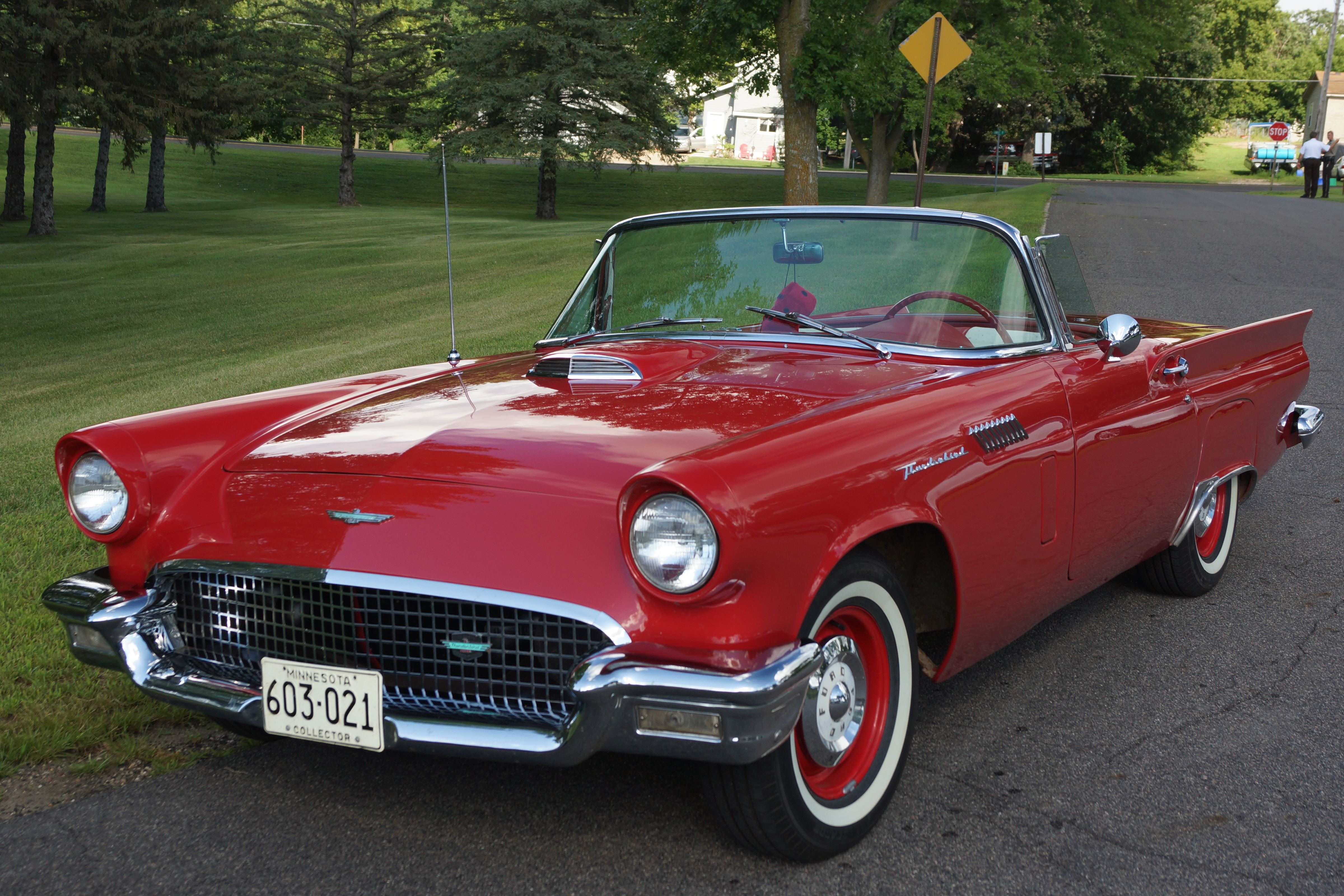
The Ford Thunderbird is a classic car that Ford made starting in 1955. The 1957 version is famous for its stylish design and good performance, making it a sought-after collector's item.
The radiator helps keep the engine cool by removing heat. If a car gets damaged, the radiator might need fixing or replacing to keep the engine from overheating.
Hoosier tires are special tires made for racing cars. They help the cars grip the road better, which is important for going fast and making sharp turns.
Brake bias is how the braking power is split between the front and back wheels of a car. Changing this balance can help the car stop better and handle differently when braking.
The Maserati Ghibli is a fancy car that is known for being fast and stylish. It's made in Italy and is popular among people who like luxury sports cars.
The Chevrolet 3100 is an old pickup truck that many people admire for its strong build and unique look. It's a popular choice for those who love classic vehicles and enjoy restoring them.
The Pontiac GTO is a classic car that became famous in the 1960s for being fast and powerful. Many people love it for its cool design and strong performance.
The Chevrolet Chevelle is a classic car that was popular in the 1960s and 70s. It's known for being powerful and stylish, making it a favorite among car lovers.
The Chevrolet C10 is an old pickup truck that many people love for its strong build and simple look. It's often restored or customized by enthusiasts who appreciate classic vehicles.
The Ford F-100 is an old pickup truck that many people love for its strength and usefulness. Some owners like to upgrade it with newer engines to make it even more powerful.
The Ford Bronco is a tough-looking SUV that can handle rough terrains and off-road adventures. It's been popular for many years and has recently come back with a new design that many people love.
The Chevrolet Camaro is a sporty car that has been around since the late 1960s. It's known for being fast and stylish, and many people consider it one of the best muscle cars ever made.
The Lancia Beta is a small car that was made in Italy during the 1970s and 80s. While it has some interesting features, it had some problems with reliability that made it less popular than other cars.
Restoration costs are how much money you need to spend to fix up an old car and make it look and run like new again. This can include buying parts and paying for work to be done on the car.
LIVE
The Muscle Car Plays online podcast, episode number 639.
This week, a very fascinating interview with Jason Knoll from Fat Fender Garage.
Fat Fender is a company that does not play in the muscle car space, well, yet, until
the end of the interview, you'll find that out.
They're in the truck space, and not just the old Fat Fender Ford truck space, they make
cool custom, yet, to a sort productionized Ford trucks from 48 to 97, Broncos 66 to 69,
and Chevy's 47 to 87.
Big wide range there, but of the popular Ford's and Chevy's.
Today, they are a full-blown, full-build restoration shop, and parts manufacturer as well.
There's a huge push in the truck world right now that's right alongside cars.
Fat Fender used to, but does not anymore, take on smaller projects for customers.
You'll hear why that is here, now it's just full-builds.
They didn't make their own chassis before, but now they do, competing with the biggest
name in the industry on purpose, and you're going to hear why here, and this amazing overnight
success story is just 20 years in the making, and you'll hear why here.
Even if we didn't have customers, I surely didn't want to start making a bunch of payments
on equipment, and the food on the table, and take care of employees, and pay for rent.
So we had to be very cautious what we did, but also very aggressive with our marketing,
and so that we had enough work to sustain what we were trying to accomplish.
This is the Muscle Car Place online podcast, brought to you by National Parts Depot.
This is the weekly show dedicated to people worldwide who love American muscle cars.
If you're buying, selling, restoring, even racing them, this is the place for you.
Now, here's your host, Rob Kibbey.
Yes, indeed, I am Rob Kibbey, and welcome to the Muscle Car Place podcast.
Well, here we are, over halfway through February.
March is just around the corner, and we have a very fun interview here with Jason Nol
from Fat Fender Garage.
Now, Fat Fender is a place that makes pretty killer Ford and Chevy trucks,
classics only. I'll have to admit up front, I like trucks. I've owned many trucks.
I've driven a truck daily over half my life, but I am not a truck guy.
Jason is, though, and old trucks and muscle cars have a lot in common,
especially when it comes to the build and restoration industry right now.
And there's this thing going on, and in our classic car,
automotive aftermarket world of builds and production car,
there's something growing here.
It's expensive, but there's something growing in the classic vehicle custom space.
We have numerous companies building small production line run vehicles.
We had Velocity on early this month. We've had Ravology on before.
There was a company at SEMA.
What is it? They make the Cobras. Superformance, maybe?
They have the sister company that's making the Shelby Mustang.
That's not really what Fat Fender is doing, but maybe they are.
I think they're hard to compare to anybody,
but I would say they're most in line to compare to either Roadster Shop or Detroit Speed
because Fat Fender is in the lane of building full custom vehicles for customers.
They are not making a production vehicle.
They are making production parts that they've had to engineer
for their custom builds over the years.
And those production parts are at this point starting to get pretty numerous chassis
and all sorts of chassis. You want a four by four?
You want something slammed? You want someone on air ride?
You want something with variable ride control?
It's all the versions are there now.
They make really nice interior kits.
They make swap kits for standard chassis for all the, you know,
Godzilla's and Coyotes and LS's.
They're in a lane that is growing slowly but steadily.
And when you hear Jason's interview and you understand
what happened to him prior to 2008, you're going to figure it out.
He's a carpenter.
He wasn't a car builder before.
He's a carpenter, but he's a person who understands
that when you're a general contractor, you control all the pieces
and quality is the key as is marketing, as is not outspending your capacity.
You'll figure this all now. It's really, it's very fascinating to me, very fascinating.
I know a lot of you are into trucks, especially classic trucks.
I think you'll really dig it.
All right. As you heard on the Keeping Friends show this week,
a lot has happened this month.
The Super Bowl is done.
They don't have 500 done.
They don't have to stay done.
My son Dallas had his first National Legends Racing event.
He took third overall.
I'll share that in a minute and Robert Duvall has died.
Now, I loved Robert Duvall probably in every movie I saw him
because he always kind of was Robert Duvall in the movie.
But I specifically loved him in the movie Days of Thunder.
I know you did too.
So we featured him a lot in this show and the Keeping Friends show over the year.
Here's one more montage of Robert Duvall's Harry Hogg,
the legendary crew chief in Days of Thunder.
And there's a lot of love about this movie, but his character decides to become
a mentor to a young, angry, highly talented person.
And Robert Duvall's character decides to put his own ego aside
and make something cool.
And that's my favorite part of all.
What do you want to know?
Well, hell, you're the driver.
You think she's running loose or tight?
Tell us we give a turn here. Take some wedge out there.
We'll win some races. That's all there is to it.
I can't do that.
Well, why the hell not?
Because I don't know what the hell you're talking about.
How do you mean that?
Because I don't know much about cars, OK?
Hey, Cole, that don't make a damn big difference
from any driver I ever met.
No, I mean, I really don't know.
I don't know what you just said about the turn here and wedge there.
I don't know. I don't know.
How did that big?
What's the difference?
Hey, they told me to get in the car and drive, and I could drive.
The point is, I'd like to help out, but I can't.
I mean, idiot, I don't have the vocabulary.
Well, well, then we're just going to have to figure one out.
Aren't we?
Don't worry about it.
All right.
How's she feel?
Oh, her ass is all over the place.
When the rear-ends loose, cars fast.
Loosest, fast, and on the edge, out of control.
See, that clip that we used for Dallas, you know, the cars loose and fast.
That was Robert Duvall's character teaching cold trickle race knowledge.
Because cold trickle, all the cold trickle to do was point and steer and gas and braille
and it just was always working, but he couldn't go further.
He couldn't go further without being developed.
And that's what Duvall did.
He chose to put his own ego aside and develop the kid.
Then it worked, which I dig.
OK, somewhat in a parallel line here.
Burn, cue the Dallas KB Legends car racing update.
When the rear-ends loose, cars fast.
Loosest, fast, and on the edge, out of control.
Again, if you've heard the KB and French show this week, this is a bit of a repeat.
But the Muscle Car Place Network is a proud sponsor of local grassroots
legends car racers, specifically Dallas KB.
This pays for that.
What we did, it's kind of hard to describe.
But at the same track in Winterhaven, Florida, they had two events back to back.
They're kind of tournaments.
The reason for two events back to back, well, A, it's probably to make more money.
But B, one of them is a national event and one of them isn't.
The first week, half the week is just practice days.
And then you get three races.
And I suppose it's meant to be somewhat of a more entry level.
But most teams that come to compete in national events the second week
use the first week as their warm up for the big thing.
We had gone down the first weekend of January and tested at that track.
It's really already got that done.
I don't have the ability to be gone for two weeks in a row right now.
I don't know that I ever will.
But really, I want to Dallas to get the prep he needed.
And he's a student.
He needs to focus on school and student stuff.
And he'll have the rest of his life to work.
But I realized that there's a lot of people out there that will
disagree with me on that.
Pull your kid and have them concentrate on the thing they love.
And, you know, that's it.
I hear you and you might be right.
But, man, you got your whole life to only work.
You do not have your whole life to be a kid.
So I just wanted to do the one week.
And what I kind of compromised on is the week prior had races.
Thursday, Friday, Saturday.
We showed up and raced Saturday.
And that Saturday was kind of a warm up race, you know, get your feet wet.
And we had to skip a basketball tournament here with our homeschool
league to do it and, you know, everything's a compromise.
He ran the race and he got wrecked.
So bummer got that out of the way, though.
I will say that there's always two sides to every wreck.
In this particular case, I can say that I can't see how he could have caused it.
I think he was just caught up in it.
But he learned a lesson.
There's one particular guy on the track that's a checkers or
wreckers kind of guy on lap four, halfway through the back of the bag.
So that was kind of a waste.
The good news was the cars pretty easily put back together, you know,
radiator, offender and a couple bumpers and off you go.
Sunday was practice day.
You get six tires.
I thought you got three sets of tires for the week.
You do not.
You get six tires.
These are a Hoosier tire.
They're a real race tire, but they're a very, very hard tire.
And if you were to look at them, you'd say, man, that looks like a trailer tire.
It's so hard.
But it isn't, but that's kind of the lane that it's in.
After a week of racing, you'll start to see the tires give out a little bit.
But Monday he qualified 12.
So he's in the semi pro class.
That's usually the biggest class at any track.
That's kind of the most catch all class there is.
There are classes for younger drivers.
There are classes for totally inexperienced drivers.
There are classes above that for pro level drivers and over that for older master
level drivers and such semi pro is where you go once you've turned 16 and you're
not yet a pro and that's always the big class.
So that's where Dallas was racing was the semi pro class.
They take 24 cars in the feature race.
And I think there were 35 cars competing every day for those 24 spots.
Did everybody go up in practice?
Lay down a qualifying lap.
After qualifying, they take the top 20 cars based on time.
Everybody else goes to the B mains to race their way in four cars out of the
remaining 15 transfer into the A off you go.
And we did that same thing every day for five days in a row, Monday through Friday.
On Monday, he qualified 12th so solidly in the main finish 15th during the race.
He lost his brakes, totally lost his brakes.
We'll break line out and this car has two brake biases.
One on the front that controls only the front left brake and then the rear is
for both rear brakes and I actually remember which brake bias was the problem.
But actually, I think it was the rear one was the one the lines to a break
bias blue and he lost it, but he lost all the brakes.
So no bueno there.
He left the race.
He got credit for finishing 15th, but he did not finish the race.
Tuesday he qualified 7th and he finished 6th.
So qualifying 7th is a big deal.
The reason he qualified 7th is because he's one of his teammates finally told
him something that clicked and I won't tell you what it is because he likes
me to keep that stuff secret, but he figured something out.
And after that, he was always going to be at the fast guy or a very fast guy.
He qualified 7th, finished 6th on Wednesday.
There was a rule change in the semi pro class.
It's quite common for cars to hit bash, wreck, move each other.
And the rule change came in that said, if you hit somebody, you wreck somebody
and spin them out.
If you're the person that hit them and spun them out, you are ejected from the race.
If you're the person that got hit and you spun out, but did not save your car
and keep going, you don't have to get ejected, but you are the back of the pack.
That was the rule that came in that was enforced for the rest of the week.
So on Wednesday, Dallas qualified 4th.
He finished 6th.
During the race, he did not hit or spin anybody out, but he got hit numerous
times and he saved it every time to the point where he was told that if he saved
it again, he'd go at the back of the pack.
So there's a bad thing about saving the car.
You eventually can slow up a daisy chain of cars behind you.
Now, I don't think he ever did.
I think the race director had had it that day and he was just, his rule wasn't working.
It was, it torqued him off.
His rule eventually did work the rest of the week.
Thursday, Dallas qualified 2nd.
He had the starting position for like one second, but he was out running qualifying
laps and one of his teammates, it's her home track.
And she just always get the pole.
She, I think she got three quick times in qualifying that whole week.
So he started 2nd outside of her.
He finished 9th.
In that race, he got spun out.
And as a result, he got sent to the back of the field.
So he went from 2nd to 24th and then got his way all the way back up tonight.
These are 25 lap races, by the way.
It's 25 laps or 25 minutes, not counting red flags, whichever comes first.
One of the races earlier in the week in a different class went an hour.
25 minutes of racing plus 35 minutes of red flag.
Friday qualified 6th, finished 6th.
At one point on Friday's race, he actually got up to fourth.
That was the best position he had all week.
He just kind of ran out of his ability to get faster.
And the car wasn't going to be there.
There's always something you as a driver can do to get better and faster.
But at that point, he hadn't put it all completely together.
Well, actually, I think he had, I think the car was just finally cooked.
And that result is because he had four races in the top 10, he got third overall for the week.
And that's great.
He got a podium finish for the week.
More importantly, he finished a national race until Tuesday.
He had been in several national events.
He'd never finished one ever.
The only race he'd finished was a heat race, but he had never, ever finished a national race.
Now he's finished four.
So I'm really proud of him.
Great momentum here.
I don't think he would have won the event anyway, even with the brake failure.
The person who won it straight up won it.
So kudos to I should have the name here, but I don't.
The next national event is in April.
That's in Nashville.
We'll run a couple of things between now and then during the event.
I did have to get him a new suit, his old suit blew out a very key component
on both sides, no longer usable.
We're going to send it in to see if it can be fixed.
It'd be a shame if it's totally ruined, but it's not good.
I can tell you that a large portion of it is pretty ripped up.
Also, revealing this here for the first time publicly,
I've scheduled him to test out a late model.
And I'll tell you later with who, but it's coming soon.
I'll also walk you through the art of partnering and sponsorship, because as you
might guess, racing is not a business model that anybody can compete in without
some crazy money.
I don't even have slightly wacko money.
The next level of this is completely beyond me financially.
I can't do it, but I also know that it has to happen.
I'm not willing to tap all of our life savings or go a good triple mortgage or
something.
So I'm working on door number three, and that's OPM, other people's money.
But that's for a later time.
I just wanted you to know that he's going to go test out that late model.
Now we're not dropping legends cars and going to late models.
This is an and also year.
He needs to get great at legends cars.
But as soon as he's great, move on.
There's no value in sticking around a win in every trophy.
I don't even care if he runs for points this year.
That's not what I care about.
I only care about the growth and development.
That's it.
So that concludes the Dallas Ghibli Legends Car Racing Update.
Excellent outro burn, even with one arm, he's still the best in the business.
All right, don't forget once per month, we do have Mr.
Rick Schmidt from NPD on to talk all things National Parts Depot.
And you can send in your question for March and ask him anything you like.
You can email me, Robert, at themusclecarplace.com on, of course, visit
nationalpartsdepot.com to prove for all your muscle car parts needs
because they find they sports, they expect the best.
There is a difference and they've got the goods.
Already up next here is Jason Knoll from Fat Fender Garage.
So like I said before, there is a world out there growing that will
trickle down everywhere, I'm sure.
But Fat Fender is taking the class of truck world that they love to the moon.
And 20 years in, they're having the success that comes from a commitment
to hard work and being aggressive and reinventing yourself.
Stick around to the end of the interview because they are going to get into cars.
Enjoy.
The Muscle Car Place Weekly podcast interview is brought to you by our
good friends at National Parts Depot.
See them through the link at themusclecarplace.com.
Today, our guest is Jason Knoll.
He is the founder and face of Fat Fender Garage in Gilbert, Arizona.
Fat Fender specializes in classic Ford and Chevy truck restorations
and truck components, including their own in-house design and built chassis.
They're doing the whole popular game, but they take something old.
They modernize it. They keep the classic looks.
Everything is new, fresh, safer and better.
But I have done more homework since Jason and I last talked.
I still don't know if they're a restoration shop or a parts
manufacturer or a distributor or if they're planning world domination.
It's somewhere in the between.
Jason, let's figure it out together.
Welcome to the show.
All right, I'm glad to be here.
Glad to be a guest for the second time.
Two days in a row, yeah.
Technical difficulties, right?
We are old friends.
It was great to meet you yesterday, but it's great to meet you again.
Jason, can you give the primer to those listening?
Who are you and where are you from?
Sure. So Jason Knoll, I'll often say no.
Well, if you want to know how to spell my name and Gilbert, Arizona,
born in Arizona, lives here most of my life now.
I did take a little break and went to St.
George, Utah for about 15 to 18 years.
I have eight kids.
Her's mine and ours.
Holy smokes.
Yeah, so that keeps us busy.
What age?
14 to 28.
That's remarkable.
That's yeah.
Wow, OK.
Yeah, it's crazy.
But anyways, for the most part, we just love building old things.
And it's kind of been something that I've always loved,
but has been new to me in the last dozen years.
And so we're just kind of trying to figure it out, just like everybody else.
No one near background a little bit.
Personally, I don't think you're an automotive engineer by trade.
I don't know that you even grew up doing this.
I think you're a woodworker, right?
Or a trim carpenter or something like that.
That is a true story.
The love of my life always growing up was around woodworking.
And so when I was in Utah, I was working on a business that was in construction.
We did custom doors, moldings, I mean, you name it, we did all the finish work.
I've installed miles of crown molding, hung thousands of doors myself.
And I'm very familiar with that process and very comfortable with it.
Comes very second nature for me.
But at the end of the day, you know, I went through that housing crisis in 2008,
nine, and that did me and wiped me out of business.
It wiped me out of a marriage.
You know, just kind of like everything just can crashing in.
And so, you know, I had to rebuild.
And so as I was rebuilding my life and kind of come to terms with a new business model,
a new something restoration, if you will, hot rods seem to fit.
Why have your own thing?
Why be self employed?
I don't know how to do it any other way.
So I've actually, since I've been 22, I've owned my own business.
And I've never worked for anyone since then.
I've worked for customers, but not had somebody bossing me around,
telling me what to do, which I think I would make a, and I know I was.
I was always just an exceptional employee.
I just rose to the highest level I possibly could at anything that I did.
And so it worked out well for me.
But I also struggled with wanting to do more, offering more and filling
handicaps because that company wasn't in a position to do those things or
didn't see the same vision that I had.
So then I found myself just always thinking, well, I can do this better.
And that isn't always the very best advice to give yourself.
But I did give it to myself a few too many times and has got me in trouble.
But for the most part, has also kind of guided me to be the best I can.
Well, let's walk through this journey.
So for what it's worth, one of my best friends from high school,
he was my first car friend in high school.
Today, he owns his own business.
He is the most sought after trim carpenter in Cedar Rapids, Iowa.
They come to him, probably you can relate.
There's no advertising needed.
It just happens.
And when we do car work together, he measures stuff in fat sixteenths.
Like that's a fat sixteenth.
That's a thin sixteenth.
And it's not an eighth here, an eighth there.
It's always used to give my guys, there's a phrase we have at work.
And I learned it from finished carpentry days.
And that is perfect is close enough, right?
Everything has to be perfect.
There's no other option.
And then on the flip side of that coin is close enough is perfect.
And you had to learn how to bridge the gap in there and know when it needed
to be perfect and when it didn't so that you could actually make the money.
And so it's that same principle that we have to have here balancing
the scales of perfection.
When does it matter and when doesn't it?
Did you grow up tinkering with cars?
Did you have cool stuff?
Or I mean, I drove a 1966 Volkswagen bug in high school and just like everybody else,
you know, always working on it, always fixing the engine.
I had a lot of confidence in that thing.
I look back today and I think of all the places that I drove all over Utah,
just jumped in it, drove to Arizona, back to visit friends.
And I had all the confidence in the world in that car.
That was my car.
So we went everywhere together and I'm like, I would not do that today.
There's not a chance I would jump into that Volkswagen takeoff and go anywhere.
But as a 18 year old kid, you're just like, it runs.
So therefore it'll go anywhere.
Why not?
There is ignorance is bliss.
And when you're 18, you're bulletproof, too.
You know, so I'm 73 carmen to get convertible, by the way.
I can relate to the air cooled VW.
So you became a trim carpenter.
You became a self employed trim carpenter.
2008 has happened.
Where does the first truck come in?
So I'm assuming there's a first truck in this story.
There is a first truck and it wasn't even my truck.
That was a first truck to be honest with you.
My father-in-law, he had somebody that owed him a little bit of money, not a lot.
And the way the person paid my father-in-law back was in an old truck in kind for a close value.
So he took this back and I think the truck's value may have been worth, you know, five to six grand.
At the end of the day, he asked me, he goes, hey, do you want to help me fix this up a little bit?
And I'm thinking, sure.
He's like, let's put a new wood bed in it.
I'm like, I'm your guy.
I can do this.
I mean, this would be piece of cake.
It was actually harder than I thought, but we got the wood bed done.
We cleaned it all up.
We fixed a few little things on it and he's like, oh, that was kind of fun.
Let's sell it.
OK, great.
My father-in-law, he doesn't hold on and keep anything.
If it's nailed down, he's looking a way to peel it back and sell it and see if he can make some money.
He's like, hey, let's sell this thing.
And if we make any money, you can have it.
And so we did, we made some money on it.
He says, let's buy something else.
And so we took the proceeds from there and we bought another truck.
He liked the trucks.
I kind of liked the trucks and did this for about five or six trucks, just purely for fun.
Nothing that was for purpose other than we kind of got into trucks and stayed there.
Was the first one a fat fender Ford?
Well, it was a 1953 Chevy advanced design, 3100.
So it all started off in Chevy's.
Now, we did buy actually a T-bird, the 1957 T-bird.
We had a 1967 Pontiac GTO, which was super cool.
Great Arizona car, had it, loved it.
I think I bought it for like seven or eight grand and running, driving.
We sold it and made some money on it.
I think of all these like little vehicles we had and 58, you know, Impala.
First year of the Impala and just this big old boat of a vehicle.
And so we kind of cycled through some stuff, even as much as a Chevelle, you know,
67 Chevelle and also an El Camino played around with stuff, but always kept coming
back to the trucks and I felt most comfortable and it felt like I resonated
with those a lot better than I did all these others.
And I obviously, I learned quickly, it was too hard for me to go from all these
different year makes and models and find any expertise that I could offer it.
And so I said, I think we're done with all that stuff.
I think the truck I like the most is a 1956 Ford pickup truck.
And I think that's where I'm going to play.
And so I bought 53 to 56 pickup trucks, Fords.
I've probably owned 50.
You personally like them or you saw there's a window here of these are popular.
Personally. Personally.
And I personally love them and I then saw a small window.
It wasn't big.
It was a small window of people that were interested in those things.
And that's great.
I've got some people out here interested in them, a little community
that developed with me and some of these guys.
And it wasn't like this big, crazy Chevy market, C 10 craziness.
You know, I didn't know that even existed.
I'm just like in La La Land over here, just bumping around with some old four
pickup trucks and nobody really cared about those.
So we just kind of hung out and I did that and, you know, I'd fix them, flip
them and made a little money.
And then I finally had a customer say, Hey, would you put mine together for me?
And that's kind of where it is.
Repeat customer.
No, just a brand new guy been following us on some of the Facebook groups.
And I said, Yeah, sure.
How hard can it possibly be?
We do this all the time.
Well, turns out working for someone rather than working for yourself, like
adding a customer to the equation and all of his wants and desires.
And I didn't know how to say no to him.
And so we did everything he asked us to do.
And it was literally like making chocolate chip cookies with all the wrong ingredients.
And then he's unhappy.
I'm unhappy and it didn't go well.
Did you choose to exit the truck or did it get done?
We got it done.
We both lost more money than we had planned.
And it wasn't even done well, because it's like, who puts dual
four barrel carburetors on a four 60 motor with mono leaf spring on the front
of a 56 and wonder why this isn't running and riding very well.
All to an old tired out day in a 44 rear end.
That's just dying it back there.
And just wondering why this isn't like working very well.
OK, so you learned.
Did you consider like maybe woodworking sounds good now?
I or what?
What was the next thing you said clearly?
You personally enter the second customer.
Now, this guy shows up and has this really nice 56 for steak bed truck,
you know, flat bed, all original short bed, steak bed.
I was like, hey, this is probably more at my speed.
You know, I can do the wood steak bed on it.
You know, we can get all that done.
Then I told him, I said, but let's get like a suspension kit for this one.
We need to make sure that we have good suspension underneath it.
So it performs a little better.
So he agreed to all that stuff and we were looking for a motor.
And then he said, hey, what do you think about like an LS motor?
And I said, oh, yeah, let's do that.
I said, but maybe let's take a look at the Coyote motor and keep in mind,
I had never seen a Coyote motor working in a vehicle.
I've never installed a fuel injection, anything.
I'd never done an LS.
Coyotes are so brand new, you know, I'm thinking, yeah, let's do this.
And he's like, can you do it?
And of course, I'm like lying to him, just literally lying to him.
And I'm like, yeah, we'll figure it out.
We got this.
And then I'm like, ah, let's see what we can do to figure it out.
And we did.
We figured it out.
That happened a couple more times.
And we started to become known as the shop of F 100s of putting Coyotes in them
like really early on.
And so now we've shared so much knowledge and information with so many people
that now there's tons of people that are doing it now and got it figured out.
But we were one of the first ones to do it.
And through the course of that, we started realizing there's no products
to support any of this.
It's all one off stuff we're creating.
Yeah, I said, hey, if we're going to keep doing this, I'm tired of making
the same thing five times in a row now.
But every time we do it, we know what we need, but we always start from scratch.
Why don't we just see if we just get somebody to make 10 of these for us?
So we don't have to keep coming up with a and so we started working
it from that angle and mostly for us and then ended up starting to
turn into a little bit of a parts business.
So are you manufacturing then and now in house?
So we were doing some, I was outsourcing parts that we would design
very crudely and then outsource the parts to some companies that could
make stuff for us.
And we still do a fair amount of that.
We've never intended to be a manufacturing company.
But as we've gone down this path, I've learned that I also
am really obsessed with getting things done and when I need them done,
not when someone else like a paint company or an upholstery company
or you fill in a blank, anything I'm outsourcing, I would struggle
with their timetables, my customers having to wait.
I'm kind of like the general contractor, if you will,
subbing some stuff out to people and nobody's showing up to do the work.
And it started to make us look bad.
And so we slowly would take on like, okay, we're doing body and paint in house.
That's it.
We're going to have to do that.
The next thing would be, all right, well, we're going to have to make
some of these parts because we can't get anyone else to do it.
We're going to have to do upholstery in house because we can't get the
upholstery done in a reasonable timeframe and certainly aren't getting
the quality or the attention to it that we would like to put into it.
So this vertical integration has slowly began over time.
So we have a lot of shops that listen to this show and some are one man bands
and some are maybe have 10 or 20 people that work there.
It's always a chicken and the egg scenario.
Typically, there's a fear of investing in making your own stuff
because of the high upfront cost, money in time.
And you never really know, am I going to have enough customers to support this?
And then the flip side is sometimes you're playing it so safe
that you're not even attracting customers.
The phone isn't ringing.
So so somehow you have done this successfully.
You're 100 percent right.
It's scary.
And from my perspective, I had already lost everything once.
And so I'm thinking to myself, man, I can't throw caution to the wind.
I'm 40 years old now.
I got eight kids, you know, I'm I got to be really careful.
I have no retirement set up for myself.
Like I was in like, and so for me, we reinvested and paid cash all along the way.
So we got just old, tired, junky stuff, made it work and then upgraded
and slowly upgraded and slowly upgraded.
Like I was very careful that even if we didn't have customers,
I surely didn't want to start making a bunch of payments on equipment
and put food on the table and take care of the employees and pay for rent.
So we had to be very cautious what we did, but also very aggressive
with our marketing and so that we had enough work to sustain what we were trying to accomplish.
What's been the best marketing that you've done?
I know how your marketing now in one way, because Con Media recommended you.
And when they recommend, you always say yes, because that's a quality client.
We didn't hire them until about six months ago.
So we did all this just with our own marketing and our own dollars.
So it definitely can be done.
But what I got into and I had a friend, he kind of helped me out.
But basically, everybody has a story, Rob, like everyone's got a story
and what they're doing and what they're wanting to accomplish
and the expertise of what they have and what they're doing.
And you got to tell your story.
He's got to tell your story, good, bad, ugly, whatever it is.
You just have to tell your story.
So people can kind of get to know who you are, the type of person you are,
the type of product you're producing, like you're marketing yourself
and you're just telling your story to people and people will resonate with that.
They'll resonate with integrity and honesty.
I mean, we've had things go bad that we've told stories where the hood latch broke
and I'm driving a customer down the road at 50 miles an hour and up comes the hood, you know?
And she's sitting right next to me.
And they're taking to the Bear Jackson Cup tomorrow kind of a thing.
And it did not go well and $30,000 of repairs to the vehicle
that we had to eat. I mean, that's the bad.
That's about as bad as it's gotten for us.
But that's a real story.
You have a plethora of content out on YouTube.
I do everything you do when you prepare for an interview.
You cyber stock people, right?
You kind of figure out if you like them before you have talked to them.
You know, I like you.
I like the content.
I can see the lane you're going from.
Somebody called you from the blue.
Have they seen you on YouTube?
Did they see you on Instagram?
Was it a TikTok?
Do you ever know?
I would say mostly YouTube.
Yeah.
We get 60 percent of our leads probably come from YouTube
that are organic, that are not like paid advertising.
And we saw it all these people out, but just like all the real organic stuff.
And a lot of it is just because we're trying to help people
with their problems, educational, like a solution.
And so YouTube is the second largest search engine
aside from Google and Google owns YouTube.
And so you're really right there to where your video is
how to put a coyote in an F 100.
And then a guy goes online and is like, ah, how do I put a coyote in an F 100?
And then Google recommends this video.
Hey, there's this guy Jason in Fat Fender Garage in Arizona.
He's done this and here's all the content videos.
And so that became information that people would stumble into.
And then they would reach out to us and like, hey, I watch your videos.
And now it's like I see people at shows and they're like, I feel like I know you.
Sure.
I'm just like, well, fair enough.
I've watched all your videos.
And I'm like, there's too many to watch all the videos.
I promise you haven't watched them all.
So you talk about the vertical integration, but there's one biggie.
Yeah, I believe you're making your own chassis.
We are just starting that now in fairness, we own all the intellectual property,
design, work and engineering of all of our four chassis.
And so we had a company, a good friend of mine, making them for us called
Porterbilt Fabrication.
Together we kind of started this process.
We have gotten so busy selling chassis.
We've been through that design process and things that we have now done
and decided his shop is only so big.
He can only handle so much.
And so in all fairness, we were putting pressure on him in a way that he wasn't
ready to expand into.
Sure.
So the problem existed and we worked it as long as we could.
And then we decided that we were going to have to just invest into
manufacturing in our own chassis.
And so we are currently in that process.
We should be firing up the machines on Monday.
Like we're that close.
OK, way to go, congrats.
That's a big deal.
And I kind of like the Dave Ramsey model here.
You know, that's what you've described of working my way up.
But as you will know, there are lots of great aftermarket chassis options out there.
And you chose to go your own route.
Why is that?
Yeah, that's a great question.
So all right, the one company we all know Roadster Shop, right?
Sure.
These guys, they're really good at what they do and they build a great product.
So what are you going to say?
These guys have done great at marketing.
They're aggressive.
They're focused on chassis.
They're cranking them out.
And I even got a Bronco.
We're building here for a guy that is on our Roadster Shop chassis, one of our
really, really good customers.
And he just said, will you finish this for us?
And so we are.
So then there's after that, then it disseminates down to a bunch of chassis
companies doing OK.
OK.
You've got a lot of variations of why it exists like that, but nothing real.
Like it's like the same chassis they've been building for 15 or 20 years.
Sure.
And all honesty here, Roadster Shop would be the only company I know that has
truck offerings. Everything I know is in the car world.
I can list you all the wonderful options, versions, variants and suspension systems
thereof. But when it comes to trucks, there's so many flavors.
Some people want them slim.
Some people want a ride height.
Some people want a legit four by four.
I mean, it could go a lot of ways.
Right.
Why not just buy everything from Roadster Shop or somebody of that caliber?
The reason why is this.
I am so obsessed with quality and options and fitment and finish and all that
type of stuff that a spec chassis does not push any of my buttons at all.
And again, not that I'm talking down on it.
It's just it's not the quality and the baseline that works for me, just me.
And I think we build a very, very good chassis.
The design is good.
And then I also want to offer options.
So, for instance, we'll be selling chassis here probably second quarter this year.
You'll be able to get ABS as an option.
You'll be able to get traction control as an option.
And all of our suspension will have active suspension options, whether it's
two-wheel drive or four-wheel drive.
And so you can get performance and handling through the active in the
cornering and the pushing back if you need that.
We're working towards building the very best product that we can.
And in order to do that, I have to have the controller be able to say,
this is what we're doing, not begging for somebody else to consider it.
And so our designs and the construction of our product is just a little bit
more rigid than the spec chassis, more comparable to their fast track chassis.
And honestly, and lastly, why does Roaster Shop have to run away with it?
Why can't somebody else give them some competition?
Sure.
And somebody should.
And I've raised my hand and said, I'll give it a shot because apparently nobody else is.
They are on a different level.
That's for sure.
So I, okay, I can see that.
Yeah.
Let's talk about the trucks you support from just this conversation.
It sounds like people reach out to you for your number thing.
Some are for parts, some are for like partial work, some are for full builds.
Yeah.
Just off your website, I see Ford 48 to 97 plus Bronco in there, 66, 69.
And Chevy 47 to 87, which gets you through the end of the square bodies.
OBS must be later.
Yeah.
Do you have a chassis option for all of those years and offerings of Ford?
We do.
Okay.
So you got all that covered.
Is the bulk of your work for customers partial work or full builds?
Full builds.
So all the partial work stuff that people need help, we either refer to other shops
or we, their DIY guy, he just needs parts to figure it out.
At some point, you'd have to say no, we could do twice the work we're doing now,
but at some point you have to say no and you have to define what you're going to
do and what you're not going to do.
And sometimes saying no is what's going to make you the most money.
And I have to be really careful how I say this, because I say, you can't be
everything to everybody, but yet at the same time, we're offering everything to
everybody to a degree, but, you know, just trying to elevate it.
And honestly, if I was like Roadster shop and I only focus on chassis and
that's all I did in some ways, that would actually be easier than what we've taken
on. We have these different revenue streams that we're building and creating
for us. And yet at the same time, we self build and sell for truck interior
kits a week shipped out to people.
And that has nothing to do with anything that's happening here in our shop.
And so there's this momentum that's been building and growing.
And so, I mean, just something we started just very recently is already
be probably close to a couple of million in revenue, just in that one little
aspect this year.
That's amazing.
Multiple streams of income is how any successful business works.
You mentioned saying no to some of the partial work, and that sounds like
someone who has previously said yes to some partial work.
Yeah, there's what happens.
Here's what happens.
Here's what happens.
A guy comes in, he just wants some air conditioning installed in his truck.
That's all he wants.
You know, Ben and Jared kit, whatever it is, put it on and you go to start that.
And then you discover there's some other things that are wrong.
And so something that's supposed to take you maybe four or five days,
this little project now is turned into probably 30 to 60 days
because of all this other little stuff.
So now I've got this little space tied up.
I'm waiting for parts to show up.
And so it's mostly sitting, waiting for stuff.
Now I have no revenue that's being occupied in that spot for probably
three quarters of the time that vehicle is here.
And so I'm just waiting and waiting and waiting.
And so for me, if I can't work on something every single day
and it's a revenue stream every single day, then I have to consider
why I'm letting such valuable space in my shop be occupied with storage.
And I'm just storing this guy's vehicle, why parts are coming in.
And now I'm not moving the needle very fast.
And so that's what we realized quickly is like we either are just
a small repair shop, little doodads.
And that's what we do, but I don't think we can do both.
We just need to pick where we're headed and what we want to do.
And so those little repairs that people want done,
we find more of a hassle than anything else.
I get it. There's a lot of ways to slice it.
This is the way you've chosen to slice it.
Yeah, I actually wish I could say yes to all those guys
because they're really great guys and they really do deserve to be helped.
But we just try to refer other shops that we know can take care of.
What's the most popular you're doing?
So a few years ago, I would have said the 67 to 72 Chevy is probably the big thing.
I don't even know if that's still the big thing.
It's a real problem.
Learning how much square bodies have come on.
I will admit I'm far more familiar with Chevy than I am Ford.
What is the most popular thing you're selling right now?
So let's go 85 percent Ford, 15 percent Chevy.
No kidding. Wow.
And we're very well known in the Ford world.
And then we built some really nice square bodies
and we've built some really nice 67, 72s, you know,
and always tease the Chevy guys, Ford guys build the best Chevy's.
And they love when I say that.
But we love both.
It was just happened to be more of an expert in the world of Ford's.
And so that's where more of our stuff comes together a little bit easier for us.
But as far as like year make model, I'll tell you, on the Ford side,
the 67, 72 is extremely popular right now.
They call it the bump side.
And then the dent side, which is right after that's popular.
But Ford has a truck called the OBS, too.
They do. Yeah, just like Chevy.
And it goes up to the 1996 year
and they've got their OBS version of it.
And those are starting to become popular, just like the Chevrolets are.
Just like Chevy, you got the ugly years.
Ford has the ugly years.
And but they're even starting to become popular
because every mother loves this ugly child.
And so people love them and they have money.
And the ones that are starting to fade a little bit, the forties,
Chevy, Ford, those are starting to fade out.
The demographics are changing, the people with money,
the things that people want to do with them are changing.
So you're seeing that change.
It's like, you know, the old thirty two Ford Roadster, right?
Like they're just not as cool.
They're just not as common as they once were.
Yeah, the old forties and the old Mercury's led sleds and all that stuff.
They're still cool, but like that customer base is shrinking now.
The people at Detroit Speed once told me the sixty nine Camaro
is to muscle cars, what the thirty two Ford was to hot rods.
I mean, it's just the car of that era.
And I don't know what it would be for truck.
I would still do the sixty seven seventy two Chevy, but that's just what I know.
No dodges on here.
And I assume that that's on purpose. Is the Dodge market too little?
We definitely have some of our employees here that are Dodge fans
and a little bit angry with us.
We do have some little Dodge things that we've been tinkering with.
It is a very, very small market and it's not a no market.
It's just we have so many things on the plate that it just doesn't make sense
to do that stuff until we've completed all of our other tasks.
I was guessing that would be the answer.
And then there's a not even a parallel lane, but a different county,
Japanese drugs, because I dig them all, especially all the 80s.
Toyotas, Nissan, Mazda, I had a Toyota stout in 1967.
Toyota stout, beautiful.
It was just a baby blue.
I got it and I was like, man, this thing's mint condition, no rust at all.
Like I love this thing and I'm going to do something with it.
And then it sat there for a couple of years and I was like,
I don't think I'm going to get to this anytime soon.
I might as well just make somebody else happy and I sold it.
And it was a non running truck and I got seven grand out of the deal.
And the guy was just super ecstatic to have it.
He's doing a build with it.
And I'm super happy for him.
And I'll have to find another one one day in the muscle car world right now.
You're probably familiar with the low volume production act.
There are a lot of people that are making a car and the holy grail end result will
be when they can stamp it with their own VIN.
It has to have the modern emissions compliant drive line that at the moment,
blueprint has a cert on for a Ford drive line.
Some of them are restorations.
So there's still title as the original thing.
But there's like a market out there for a $400,000 Mustang.
All day long there are three or four.
Yeah, you've got there's a lot of companies making those right now.
That genuine Mustang.
Yeah. Are you going that route?
Are you planning to make your production fat fender vehicle?
That is a great, great question.
And it has crossed my mind.
We have a car that we're going to do that with a car or not.
Yep. Not a truck.
Yep. OK.
And only because it's very low volume,
but we're going to play around with the Fox body Mustang.
No fooling. Yeah.
I can see that.
Fox bodies and third gen F bodies.
I mean, it's here.
It's here. Yeah.
We have a different approach that we're going to take.
I have an NDA on so I can't really say on how that's going to look
and how it's going to be licensed and what that'll look like.
We're in some design work right now on it.
Dude, how about that?
Look at you. Yeah, it'll be fun.
Well, how big is your team?
How many people work there at Fafn?
We currently have 75 people in our shop.
That is amazing.
We started off with it literally was just me and my father-in-law
who showed up about 30 minutes every day to see what I was doing.
But that's how it started.
It was just me and a tiny little space.
And we've probably added 25 people just this last year.
Has Gilbert native Brock Purdy showed up to buy something yet?
I wish he would.
He was a great quarterback here in Arizona.
But just the opportunity he had in so quickly to play for the 49ers
is just amazing.
I'm coming to you from Ames, Iowa, home of Iowa State University.
I mean, Brock, he's like our son.
We will love him till we die.
And wherever he goes is our favorite team.
So that's awesome.
But Gilbert, Arizona, you know, everybody knows where Brock Purdy is from.
He's from Gilbert, Arizona.
I have a son-in-law.
He set it out to the Ohio State going to school out there.
No kidding about that.
Last basic question is you can become a fat fender dealer.
And I assume that's a dealer of parts.
Is that of parts and chess?
What does that get you?
This is kind of a new thing.
We're kind of beta testing right now.
And that is shops that work on old vehicles, old four trucks,
whatever. And like, for instance, if you know Casey, the painter,
he was on Gas Monkey Garage, a good friend of mine.
And so he's building a truck for his dad and he bought a bunch of parts from us.
And honestly, we gave him some discounts to help him with the shop and stuff.
And so we're kind of beta testing some stuff and wanting to be and by the end
of this year, we'll have a full fledged program where you'll be able to purchase,
you know, depend upon your volume anywhere from 10 to 20% off on all of our products.
And then we'll try to come up with ways to help them be successful.
One thing I've learned in this industry is we're all on the same team,
even though we might feel like we compete against each other.
But at the end of the day, we're all in the same team, the same industry.
And that is to enjoy our love and passion of automobiles,
classics, trucks, cars, whatever it is.
We really are.
And so that's not always the case.
Some shops feel like they've got an axe to grind against another shop.
I think that's just a really poor way to look at your industry.
And I think you can be competitive all day long, but it's based on what you do
for yourself, not what you do to other people or say about other people.
It's how you live and function and build your business.
You don't worry about what everybody else is doing.
You just need to worry about what you are doing to be successful.
Honestly, people talk to me about stuff all the time.
I'm like, I don't even know what who, what, who are those guys?
I'm like, yeah, there are these guys that I'm like, I don't know who they are.
You know, I'm just doing my own thing here and that's all I can worry about.
I can't worry about anyone else.
But we do get projects that come from other shops, good shops, reputable shops.
Like I'm friends with these guys and the goal is to help them.
The goal is to not ever say anything disparaging.
The goal is to just be kind and help the customer get through the position he's in.
If we take that other path of trying to elevate who we are by stepping on everyone else,
that actually hurts our industry in such a way to where customers hear it, they feel it.
It creates a bad reputation and all that kind of stuff.
And so I feel strongly that if our industry is to get good at and being better what we're doing,
we all have a job to one way or another, kind of support each other and help each other.
Do you have designers in house who puts the artistic touch on all these things?
Just curious.
There's a lot of us.
So we have 10 actual like design engineers.
No kidding.
That use solid works and these guys, I don't want them to hear me talking about it.
But things get really tight in the market.
Designers are the first ones to go, right?
Because they're super expensive.
But it helps us with my ideas.
That's the struggle is I got an idea and I need to figure out how to get it working.
It used to be, I would just go find a designer and, hey, here's a little pet project,
get to work on it and he would.
And then I would just disrupt the flow.
But now we have a procedure.
We have somebody that's over all this stuff so that it can go from concept to on a website
in a really quick time frame.
But then when it comes to designing the vehicles, we have two designers we work with.
If you heard of Sean Smith, Sean Smith designs.
Yep.
Everybody's heard of Sean Smith.
We always tease him.
He's the next chip foos.
And then there's pinstripe Chris, if you've ever heard of him.
He's an artist, a little bit more of an artist, a little less designer, automotive designer
than Sean.
But he has an artistic design that I actually like as well.
And so I work with those two guys and we'll collaborate with them and come up with ideas
that help us get some of these higher end builds through the shop.
Do you use a OEM-like production process?
Is there a start, a middle, and an end to these things?
Mostly just persevere and get it through.
I try not to over design because I try to leave some interpretation to the guys that
are actually doing the work just because you can draw.
It doesn't mean you can make it all the time.
So we try to be careful.
Jason, we could probably talk for a lot longer.
I thoroughly enjoyed this.
But last question is, what does it cost to restore a car?
Is it $400,000 or a truck?
Is it $400,000?
That's always the number.
Yeah, everybody wants to know how much it costs.
And for a revival series, which is a new chassis, new drivetrain, probably not going to paint it,
maybe the firewall under the hood, you're going to start at about $200,000 right there.
Okay.
Rewired and brand new wiring harnesses and everything's brand new where it needs it,
not everything.
The designer stuff, that starts right about $450,000 starts.
You can get over a million dollars if you just have no restraint and everything has to be
customized.
And those are really difficult and challenging because once you get up into that, it better be
perfect, like for sure.
Yeah. So that adds a whole new element of intensity.
So as far as bills go, those are the ranges.
Our interior kits started about $8,000 and go up.
Chassis started about $26,000 for a chassis.
They start there and then we do two-wheel drive, four-wheel drives.
And you can get 12, 13, 14, 16-inch brakes on them, a lot of options.
And so rough numbers there.
All right.
How would you like people to reach out to you or Fat Fender, just the website?
Well, yeah.
Believe it or not, I used to give out my cell phone number because I thought,
that's the best way to get a hold of me.
Still float around out there somewhere because I still, I would get a phone call.
I'm like, where'd you get that phone number from?
And then I'll go try to chase that down, see if I can change it.
But the best thing to do is just go to the website, fatfender.com.
You're going to find resources.
You can fill stuff out.
We'll reach out.
We'll contact you.
You want an interior kit, whatever.
That's easy.
Social media is great.
You want to go find us on Instagram or Facebook.
We reside there.
Obviously the YouTube channels are where you can watch a lot of content.
And then I heard we have a TikTok channel.
I've never been on it or seen it.
But the young kids, they like to throw stuff up there.
Those are the best places and reach out to us.
I mean, I try to talk to as many people as I possibly can that have real hard questions.
And so we try to be as available as we can.
Cool.
Nice talking to you.
I look forward to following along with the FoxBuddy, too.
Not that I wasn't interested for it, but I'm very now.
So talk to you soon, man.
Take care.
Thanks.
See you.
There we go.
Thank you, Jason.
That was awesome.
Very enlightening, especially for me.
Let me all know what you think about that.
I know most of you out there love trucks.
I like trucks, but I would not say I'm a truck guy really at all.
I definitely am 100% cars.
That's what I like.
That's what I love.
Even though I've spent more of my life daily driving a truck than anything else.
I love that.
Well, I will be back now in two weeks.
I realize it was two weeks since the last one,
but that's just kind of how February is.
I'll be back the first Friday of March.
Between now and then hit me up on Facebook or Instagram anytime.
Be sure to subscribe to us on Apple Podcasts, Spotify and YouTube.
And the interview you heard with Jason is on YouTube.
You can see what he looks like in everything.
And you can always find every show,
plus all of our merch on the homepage of themusclecarplace.com website.
As always, don't forget to keep chasing your dreams.
Like you've let me chase mine.
Get well, Bernie.
By next month, you might be back to one and a half functioning hands.
See you again.
Bye-bye.
Sponsored by National Parts Depot.
Visit themusclecarplace.com to get the show weekly through Apple Podcasts
and wherever you get your content.
Don't forget to leave some feedback about the show
and keep up with us on Facebook and Instagram.
Visit our sponsors often.
They make it all possible.
See you soon at the Muscle Car Place.
About this episode
Jason Noel from Fat Fender Garage shares his journey from carpenter to successful truck restoration shop owner. Specializing in custom builds for classic Ford and Chevy trucks, Noel discusses the evolution of his business and the growing demand in the classic vehicle market. He explains how Fat Fender has transitioned to full builds, the challenges of marketing, and the importance of quality control. The episode also touches on the unique aspects of their production parts and chassis, positioning them as competitors in the industry.
Jason Noel, founder of Fat Fender Garage in Gilbert, Arizona, joins us this week with a story that’s less about horsepower at the beginning — and more about perseverance. Jason didn’t grow up chasing race cars. He was a finish carpenter by trade, building doors and crown molding before the 2008 housing collapse wiped out his business and forced a complete reset. What came next wasn’t a hobby gone wild — it was a deliberate rebuild. One old truck led to another, then to customer builds, then to something much bigger than he ever planned.
Today, Fat Fender Garage is a full-scale restoration shop specializing in classic Ford and Chevy trucks, known especially for early Ford F-100s and modern Coyote swaps. Along the way, Jason learned that if he wanted the quality and timelines his customers expected, he’d have to take control of the process. That meant bringing paint, upholstery, parts manufacturing, and now even chassis production in-house. What started as flipping a few trucks for fun has grown into a 75-person operation building high-end custom vehicles and engineered components designed to compete at the top of the industry.
In this episode, Jason shares the hard lessons from early customer builds, the philosophy behind vertical integration, why he chose to compete directly with established chassis manufacturers, and how telling the real story — wins and failures alike — became the backbone of Fat Fender’s marketing success. If you’re into classic trucks, modern restomods, or the realities of scaling a business in the automotive aftermarket, this is a conversation you won’t want to miss.