The “24 Hours of Daytona” is a race where cars run for an entire day. It’s less about one fast lap and more about staying reliable and managing stops and driving for hours.
Off-roading a Porsche means taking it onto dirt trails and rough terrain. It’s harder than normal driving, so you typically need the right tires and setup to handle traction and bumps.
“Lamborghini Super Trefeo” is a racing series where most teams run very similar Lamborghini cars. Because the cars are so alike, it’s more about driving and team work than buying a “faster” car.
Spec racing means everyone races with cars that are very similar. That makes the race depend more on driving and team setup than on having a totally different (and faster) car.
IMSA is the organization that runs a lot of sports car racing in North America. If a series is “in IMSA,” it usually means it races on IMSA event weekends.
Suspension setup means how the car’s suspension is adjusted for the track. Small changes can make the car feel more stable in turns and easier to drive fast.
A crew chief is basically the team’s lead for race-day. They coordinate the crew, work with engineers, and make sure the car is set up and ready to go.
They talk about what racing costs, including the car price and the extra money needed to keep the car running. They also mention that testing and preparation can drive the budget up.
GTD is one of the categories in IMSA racing. It’s for cars that are based on production models, but set up for racing. The speaker is saying their team doesn’t race every single event in that category.
A World Final is the big end-of-season event where teams travel to race internationally. Here, they’re saying they do some races in the U.S. and then also go to the final event in Italy. That adds travel and expense on top of the normal season.
Endurance racing is long-duration racing where you have to keep the car working and the drivers consistent. It’s not just about one quick burst of speed.
Part
bar change
A sway bar helps keep the car from leaning too much when you turn. Changing it can make the car feel like it turns more easily or feels more planted, depending on how it’s set up.
Dampers are shock absorbers that control how the suspension moves. If you change them, the car can feel more stable or more comfortable over bumps and in corners, which helps the driver understand what’s happening.
“Setup” means tuning the car so it handles the way the driver needs. They listen to what the driver feels, make changes, and then try again on the next lap to go faster and be more consistent.
That means fixing the car quickly during the event when something breaks. The goal is to get the car back running safely so the driver can keep going.
Concept
limping around the track
“Limping” means the car can’t drive normally, so the driver has to go slower or with limited ability. What the driver reports while it’s limping helps the team figure out what broke.
A roll cage is a strong metal frame inside the car that helps protect you if the car flips or crashes hard. Race cars use them to make the cabin safer.
Coil springs are the suspension parts that absorb bumps and help control how the car leans. Swapping spring rates changes how the car feels and grips in turns and over rough track sections.
Rake is how much higher or lower the car sits at the front compared to the rear. Changing it can change how the car sticks to the road and how it behaves in turns.
Adjustable sway bars help control how much the car leans in corners. By changing them, the team can make the car turn more predictably and balance grip front to rear.
Downforce is the “suction” effect from aero parts that makes the tires grip harder. It helps the car corner faster, but it can come with tradeoffs like more drag.
Camber is how tilted the tire is when you look at it from the front or back. Changing it helps the tire stay in the best grip position during cornering.
Alignment settings are adjustments to the tire angles so the car tracks correctly. Race teams change them to make the car turn the way they want and keep the tires working well.
Ride height is how high the car sits off the ground. If there’s a minimum ride height rule, teams can’t lower the car too much, so they have to tune within those limits.
Tires don’t just wear—they also change behavior with heat and with what’s on the track. If other tires left different rubber behind, your tires may grip differently.
“Sticker tires” just means brand-new tires that still have the new-tire labels on them. Racers use them early because they usually have the best grip when they’re fresh.
A “match set” means all the tires are chosen to be as similar as possible. The idea is that the car feels more consistent because the tires behave more the same way.
“Air-cooled” means the engine is cooled mostly by air flowing over it, not by coolant in a radiator. Porsche 911s are known for having air-cooled versions, and that’s what the speaker is talking about.
Ground clearance is how much space there is between the bottom of the car and the ground. More clearance helps the car avoid hitting rocks and bumps on trails.
Approach angle is how steep a hill or obstacle you can hit with the front of the car before it scrapes. Better approach angles mean fewer hang-ups on rocks and ledges.
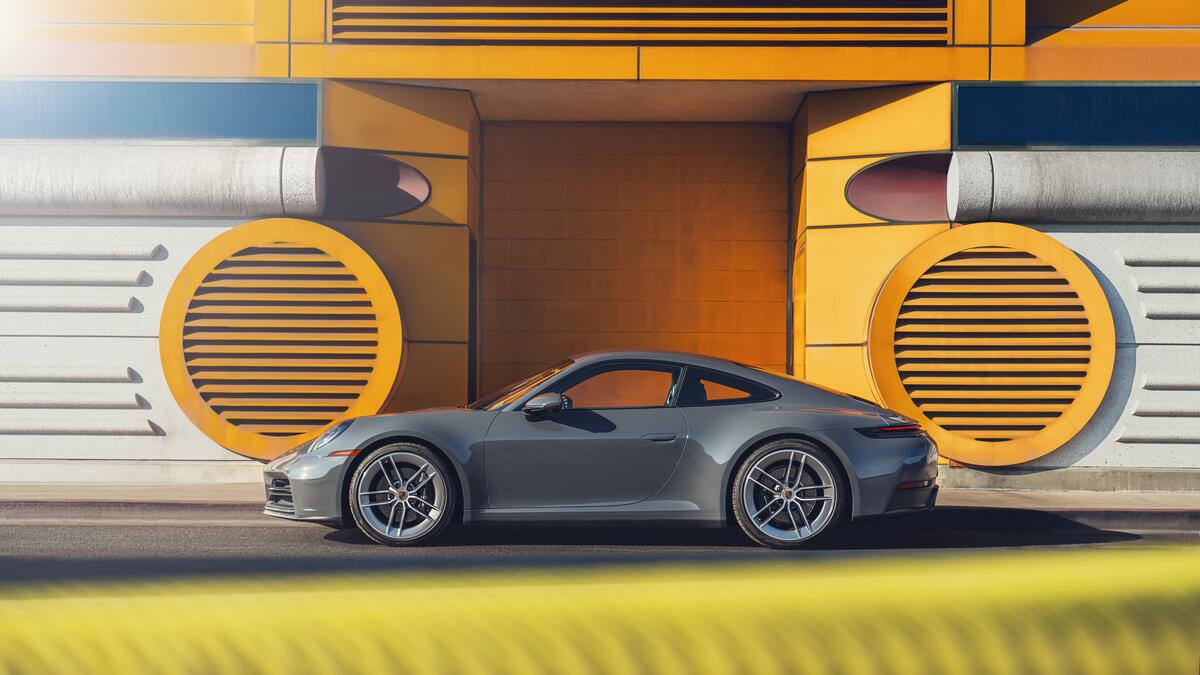
A Porsche 911 is a famous sports car. Here, they’re talking about classic (air-cooled) 911s that have been modified so they can actually drive hard on trails at Moab, not just sit in a garage.
Water crossings are when you drive through water on a trail. It can be risky because it changes traction and can get water where it shouldn’t, so the car needs to be prepared.
A rally is a type of race where cars drive hard over changing road and dirt conditions. They’re saying their trail driving feels like that—fast, aggressive, and constantly changing traction.
Concept
Dakar 911s
“Dakar 911s” is a comparison to Porsche 911s that are built for very extreme rally-raid racing. They’re saying their Moab setups are inspired by that kind of tough, off-road preparation.
Control arms are parts that connect the suspension to the wheels and help control how the wheels move. Custom ones are often stronger and shaped to work better for off-road driving.
Coilover shocks are suspension parts that combine the spring and shock together. Using King coilovers usually means the car’s suspension is tuned for rough terrain so it can absorb bumps better.
Electronically controlled suspension uses electronics to adjust how the suspension behaves. The goal here is better stability—less body sway—when driving hard on rough terrain.
Motorsport ABS is a braking system that helps prevent the wheels from locking up. It’s designed to work better when traction is inconsistent—like on rough or mixed surfaces.
Bosch Motorsport is Bosch’s performance-focused parts line. Here it’s mentioned because the host thinks a motorsport ABS setup would be better than the usual factory street version.
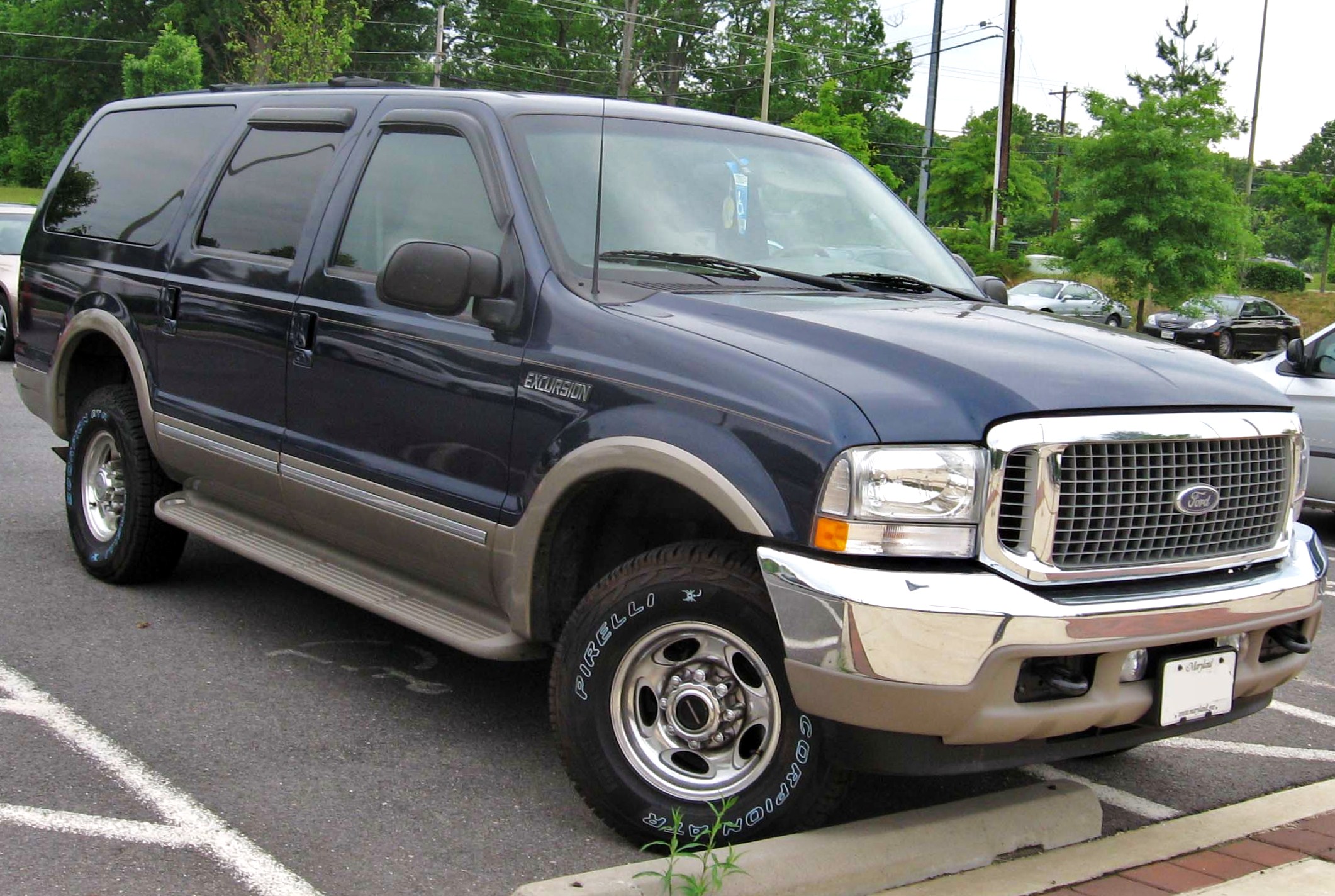
The Ford Excursion is a very large SUV designed for carrying people and towing. The podcast mentions it as part of the setup for trips and adventure driving. Because it’s big and built for work, it can be useful for hauling gear and getting around on longer outings.
Vintage racing is racing older cars in organized events. It’s about driving classics hard, not just keeping them in a collection.
Concept
road dirt
They’re talking about the dirt and mess you get when you actually drive the car on rough roads or trails. It’s treated like proof the car is being used for real adventures, not just parked.
Concept
rock chips and scratches
Rock chips and scratches are the little dents and marks you get when debris hits the car. Here, they’re saying it’s normal when you drive hard off-road.
The SEMA show is an annual automotive trade show focused on aftermarket parts, custom builds, and specialty vehicles. Mentioning it signals that the cars being discussed are likely modified or showcased for enthusiasts and industry buyers.
Drag racing is when cars race in a straight line over a short distance to see which one is quickest. It usually starts from a stop, like at the drag strip.
The Chevrolet Chevelle is a well-known American muscle car. The 1966 version is a classic that many enthusiasts still talk about and modify, and that’s the car that inspired the host to get interested in cars.
A hot rod magazine is a car magazine that talks about modifying and enjoying cars. The host is saying he read an article in one and it sparked his interest in cars.
and executive producer, Bob Eckert. Guys, don't forget to check out our website,
twoguysgarage.com and our social everywhere at twoguysgarage and the twoguysgarage podcast.
It's copyright 2026, Britain Productions Incorporated, all rights reserved.
Travis, final question for you. You got a motorcycle, bro.
Man, I used to have a motorcycle and I sold it when I was going to school. I just broke his
broke gets. Even though that was, it was good because I could put gas in it to get to working
back for like 35 cents or whatever, but I had to sell it and, but I come from a family of bikers.
I was waiting for you to tell me, I was about to do a GP race in two weeks.
Yeah. I would be all about that, but my, my wife, her, before my wife and I got together,
and we were young when we got together, but her boyfriend that she was seeing before me
died on a bike. And so she's like, she's like, no, you can do whatever you want, but no bikes.
And so I was like, all right, as long as you don't give me nothing about boats and racecars
and trucks and everything else, then I'm good with it. So I gave that up.
Don't blame you. Right on, man. Awesome catch up. And I'll talk to you soon for sure, man.
Sounds good. Yeah, man. Thanks for joining us. Guys, hope you enjoyed the adventures that
our man here, Travis Smith is enjoying himself. We'll catch you on the next twoguysgarage podcast.
Twoguysgarage podcast is a production of Britain Productions. For more episodes,
visit iHeartRadio, Apple podcast, Spotify, or wherever you listen to your favorite shows.
About this episode
Travis Smith’s path from Lamborghini Super Trefeo to endurance at Daytona sets the stage for a conversation that links trackside engineering to trailside chaos. The crew chief breaks down how suspension tuning, driver feedback, and quick pit-lane diagnosis help teams deliver cars to the green flag. We also get real numbers for IMSA budgets, then pivot to safari-style air-cooled 911s heading for Moab—built to be driven hard, with sticker tires, rally-inspired hardware, and even motorsport ABS ideas.
After a chance meeting at an airport bar with Willie, Pinnacle Motorsports owner Travis Smith joins the podcast to map out a truly enviable automotive career. He has done it all - from managing the massive pressure and $600k budgets of crew-chiefing in the Lamborghini Super Trofeo series, to collaborating on custom, air-cooled Safari Porsche 911s for 1,000-mile off-road excursions in Moab. Travis also shares his philosophy on choosing real-world moments over social media, his shared muscle car roots with the guys, and his drive to just get out there and live the dream.