Truck Yeah! Slate Announces PricingKilowatt: A Podcast about Electric Vehicles · Jun 27, 2026
Annotations will appear as you listen
0:00
29:13
Car
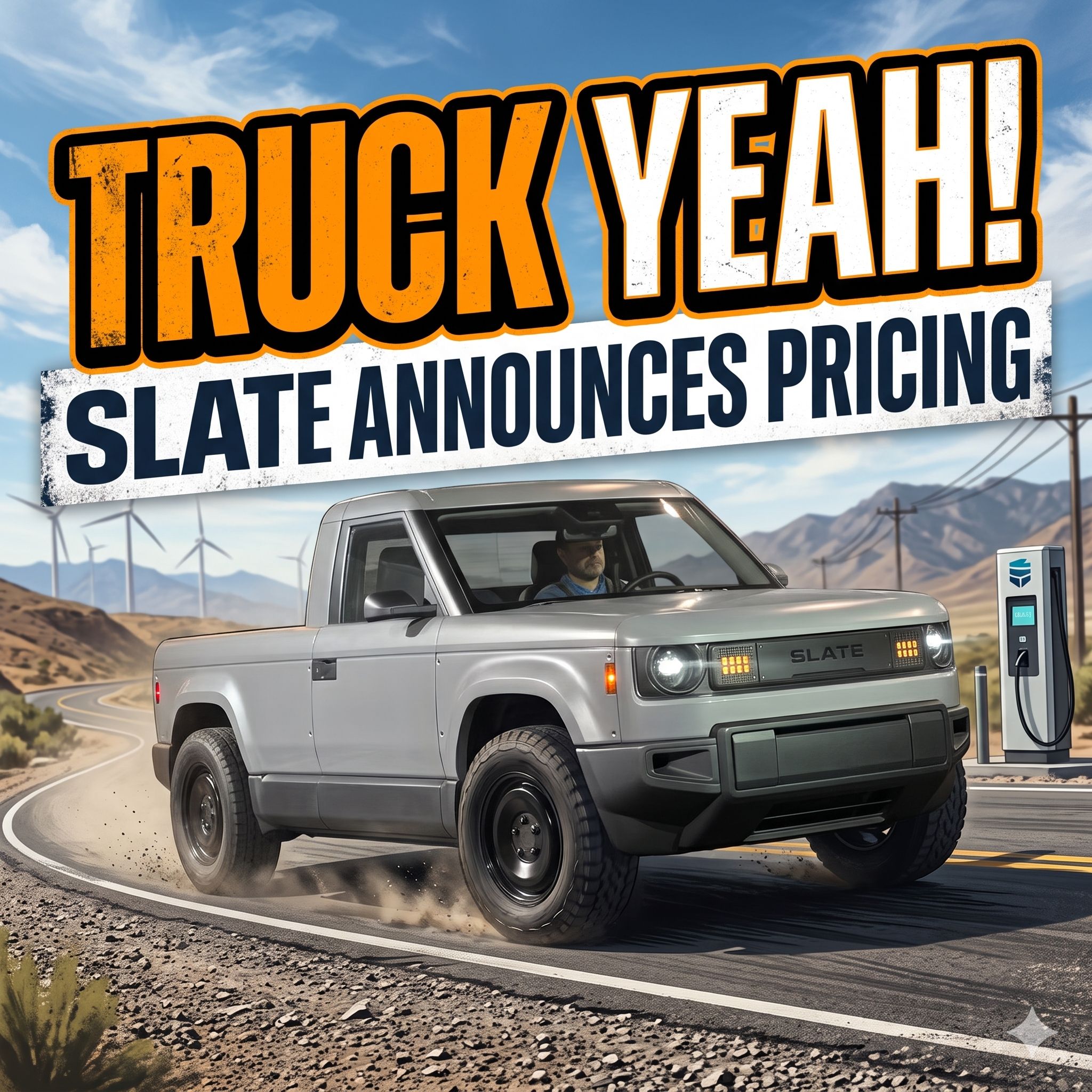
Slate Auto's electric pickup truck
This is Slate Auto’s electric pickup truck, and the big takeaway is the price and the battery/range numbers. The host says it’s about $25,000 and uses a 65 kWh battery, with a stated range of about 205 miles.
LFP is a type of EV battery. The host is saying it tends to handle frequent charging better and doesn’t wear out as quickly as some other battery types.
Rear-wheel drive (RWD) means the electric motors send power to the rear axle. In EVs, RWD can simplify packaging and sometimes improve efficiency, but it also affects traction and handling compared with all-wheel drive.
Kilowatt-hour (kWh) is how we measure how much energy is stored in the battery. More kWh usually means more potential range, but the truck’s efficiency also matters.
Battery degradation means the battery slowly loses its ability to hold as much charge as it used to. The host is saying LFP batteries tend to degrade less, so the range may last longer.
Over-the-air updates are software updates that get sent to the car wirelessly. Instead of going to a shop, the car can update itself, and the host suggests it could also be used to fine-tune the truck.
A federal tax credit is a government discount that comes through your taxes. If it’s available for the EV you buy, it can lower what you pay; if it’s not available anymore, the price may be higher.
In this context, incentives are government or program-based discounts that reduce the effective price of an EV. They can come from state programs and may have eligibility rules like income limits or other conditions.
Many EV incentive programs are income-based, meaning eligibility depends on household income rather than just where you live. That’s why the host says not everyone would qualify for the same level of discount, even if they’re in the same state.
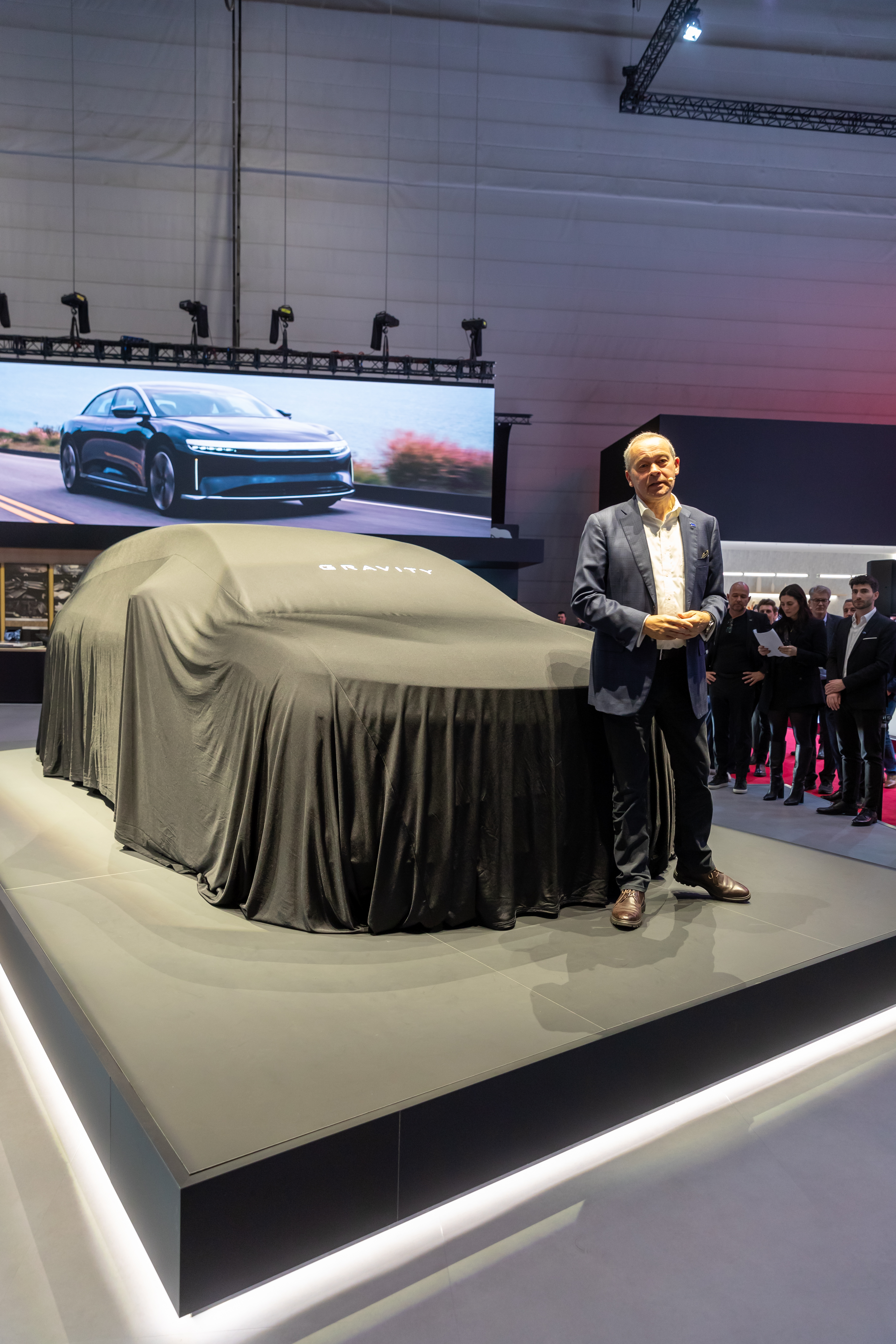
The Lucid Cosmos is a new electric crossover that Lucid is aiming to price under $50,000. The host says Lucid already filed the design paperwork in Europe, and the sketches look like a smaller version of another Lucid SUV called the Gravity. They expect it to be revealed soon and start production later this year.
An intellectual property office is where companies file paperwork to legally protect things they create, like designs. The host says Lucid filed the Cosmos design in Europe, which suggests the car is real and being prepared. It doesn’t mean the car is on sale yet, but it’s an early sign of what’s coming.
Lucid Gravity is another Lucid electric SUV. In this segment, the host uses it as a comparison to explain what the new Cosmos might look like—basically a smaller version of the Gravity’s design. It’s a quick way to picture the Cosmos’s size and shape.
Casa Grande is a city in Arizona where Lucid has a factory. The host says Lucid is laying off workers there because they aren’t selling enough cars, so they have to slow down production. It’s a sign the company is adjusting to demand.
A RoboTaxi service is like Uber or Lyft, but the cars drive themselves. The host says Lucid supplies the vehicles, Uber helps with the ride-hailing system, and Neuro provides the software/technology that lets the car drive itself. They’re aiming to expand this kind of service to Houston.
Houston is the city the host says Lucid wants to start RoboTaxi service in. RoboTaxi programs usually begin in a limited number of places, so naming a city is a sign the rollout is moving toward real operations. It’s not just a theory anymore.
Responsible sourcing is a supply-chain approach where companies try to ensure raw materials are obtained in ways that meet environmental and ethical standards. In the EV context, it often shows up as claims about lower-impact materials and improved transparency.
Green aluminum is aluminum made with less pollution than regular aluminum. Since aluminum production can be very energy-heavy, cleaner aluminum can help reduce a car’s manufacturing impact.
A “clean supply chain” is about how the car’s materials and parts are made and sourced. The idea is to reduce pollution and waste before the car is even built.
“Range” is how far an EV can drive before it needs charging. The host is saying that if lots of cars can do around 300 miles, companies need other reasons to stand out.
“Low carbon steel” is steel manufactured with a reduced carbon footprint compared with typical steelmaking. The host’s point is that scaling up suppliers can lower costs over time, and that these cleaner materials could eventually spread beyond EVs into other vehicles.
“Green steel” is steel made with less pollution than regular steel. It’s usually more expensive at first, but can get cheaper as more factories make it.
Tesla is a company that makes electric cars. The host is using Tesla as an example of an early EV maker that had to modify existing technology to work well in electric vehicles.
“Purpose built parts” are parts made for EVs from the start, not modified from something else. The idea is that dedicated EV parts can work better and get cheaper over time.
The Ford Escape is a compact SUV that people buy for everyday driving. The podcast mentions it because the speaker’s wife’s Escape had safety features, including a driver-side airbag. That’s the main reason it comes up—talking about what was included in the car.
When EV batteries wear out, companies can either recycle them to pull out useful materials or reuse them for a second job. This helps reduce waste and the need to mine new materials.
Responsible mining means extracting the materials for batteries in a way that’s safer and less damaging to people and the environment. The host is saying automakers are pushing their suppliers to do better.
A pollution footprint is a way of talking about how much pollution a product or company creates. Here, it’s used to describe claims that certain cars help reduce environmental impact.
Mercedes CLA is a small luxury car from Mercedes-Benz. Here, the host brings it up to show how Mercedes talks about reducing pollution and improving environmental impact.
The ES90 is a Volvo electric vehicle mentioned in the podcast. The speaker brings it up mainly because they think it looks good. The discussion is about the car’s design and how it stands out.
It means the pollution created to make the battery in the first place, from raw materials all the way to the final battery. The host is saying Tesla published information about these emissions.
The host is referring to European rules that require automakers to document and manage their supply chains for battery minerals. The key idea here is supply-chain mapping and accountability—companies must show where materials come from and how they reduce harms.
Mapping the supply chain means figuring out and documenting where materials come from and who makes what along the way. Here, it’s used to explain how regulations push companies to be more transparent and responsible.
This means building the battery so it can be taken apart and recycled more effectively later. The goal is to recover more of the valuable materials instead of wasting them.
The Tesla Model Y is an electric SUV, meaning it runs on electricity instead of gasoline. In the podcast, it’s used to compare against a gas SUV to show how emissions differ. The goal is to highlight how an EV changes the driving footprint.
The Honda CR-V is a gasoline-powered SUV that people use for daily driving and family trips. In the podcast, it’s used as a comparison point to show how emissions from a gas car stack up against an electric SUV. The idea is to compare what comes out of the tailpipe versus an EV.
EVs are electric cars that use electricity stored in a battery to move. The host is explaining why they can pollute less than gas cars, especially in cities.
This means busy city areas where you stop and go a lot. EVs tend to do better there because they don’t waste energy idling at lights like many gas cars do.
Idling means the car is stopped but the engine is still running. The host says EVs don’t do that at lights, which helps reduce pollution and wasted energy.
A stoplight is the traffic light where you have to stop. The host is saying some newer gas cars automatically turn the engine off while you wait, so the EV advantage can be smaller than in older comparisons.
An “apples to apples” comparison means you’re comparing things in a fair, similar way. The host is saying the EV vs gas-car difference can be less clear because some newer gas cars also shut the engine off at stops.
LIVE
Hello everyone and welcome to Kelowata podcast about electric vehicles, renewable energy,
autonomous driving and much much more. My name is Vody and I am your host and today we're going
to do something a little bit different. I am going to, I'm going to split the show up into
two different shows. Today's episode is going to be a little bit longer. So what I thought I would
do is do a little experiment. I will do the EV segment as one episode and I will do the Tesla
segment as one episode. Now this isn't necessarily going to happen all the time. I'm just trying it
out to see how people like it. So in general, you know, if the show is 30 minutes or less,
I don't feel a huge need to like split this stuff out. Or maybe the show is 40 minutes, but
only three of those minutes are the EV segment or the Tesla segment. I don't really feel the need
to split that out. But if it's pretty even and they're both long, both segments are long,
I was thinking that it might be better to split it out. So looking forward to hearing your thoughts
on this and we'll see what everybody thinks. If you'd rather just have one long episode,
it's actually less work for me. But all in all, I do get that when you
typically listen to a podcast that's under 30 minutes and all of a sudden it's over an hour,
which I don't think today's will be over an hour. But even when you combine the two segments,
it can feel intimidating. And maybe you don't want to listen because you don't feel like you have
the time or whatever. So by breaking it up, I'm trying to help kind of make it easier for people
to listen when they have the time. Okay, starting off with our EV news. We now know the cost of
Slate Auto's electric pickup truck. It's going to cost $24,950. That gets you a 65 kilowatt hour LFP
battery pack rear wheel drive and a range of 205 miles, which is not a lot when it comes to range,
but it's also a $25,000 pickup truck. The good news is with LFP batteries, you can charge to
100% more often and you get less battery degradation. So that's good. Also, there may be some room for
over the air updates and some fine tuning because a 65 kilowatt hour battery pack on a truck so
small should get more than 205 miles of range. I mean, it is a pickup truck, so it's not exact and
it's square. So it's not exactly the epitome of aerodynamic. But also, it's just, it seems like
for 65 kilowatt hours, you should be getting more than 205 miles of range. Seems like.
Now, having said all that, I do think that this would be a very compelling vehicle for somebody
who didn't need to drive for long distances. Maybe your commute is 50 miles back and forth to work
each day or maybe you're buying this for your kid who's in high school or college and they don't need
that much range. I think that this would be a good vehicle for that, especially at that
price. Initially, when Slate announced there was still the US federal tax credit and it looked
like with that tax credit, the truck would sell for under $20,000 while that federal tax credit
has gone away. So the federal, the sub $20,000 truck isn't necessarily the case unless you live
in certain states because depending on which state you live in, they do have incentives
that might make this truck even more affordable. Now, I'm going to go through each state where you
could get some money off of this truck in terms of incentives, but I'm not going to go over all
the terms and conditions. A lot of the terms and conditions are based off of income. So not
everybody would qualify for this. For instance, I wouldn't qualify in a lot of cases for these
state incentives, but I can afford to buy a $25,000 truck if I need to. The whole point
in these incentives is to help people buy a newer or new reliable EV and a lot of that's
income based just the way it is. But there are terms and conditions that you would need to
investigate if you live in one of these states. That's all I'm trying to get at. I'm not going
to go through every single one because I don't really have time for that. So starting off with
California, if you live in California, you could get up to $12,000 off. It's not guaranteed,
but up to $12,000. That would make this truck $13,000, which is ridiculously cheap.
If you live in Maine, you can get up to $8,000 off. If you live in Oregon, where I don't know if a
lot of people know this, but you're not allowed to pump your own gas in Oregon. Don't worry about
why I said that. You're just not allowed to pump your own gas in Oregon. One person knows why I
said that. Anyway, you can get $7,500 off. Massachusetts and Vermont, you can get up to $5,000
off. Rhode Island, up to $4,500 off. Connecticut, up to $4,250. New Jersey and Illinois, up to $4,000.
Colorado, up to $3,250. Pennsylvania, New Mexico and Maryland, up to $3,000 off. Minnesota,
$2,500 off. And New York, up to $2,000 off. Again, this all comes with caveats, so do your own
research. But I mean, that's pretty good. If you bought the base model vehicle and you were able to
get $5,000 off, that's a huge amount of the vehicle that you don't pay for, so huge benefit.
Now, the starting price is $25,000. That's true. But there are so many ways to customize this
truck. And when I say so many ways, I mean, I'm talking a ton of different ways to customize
this truck. And I tried to build something that was just ridiculously expensive, right? So I went
into the configurator, and I just added a bunch of stuff that I thought would be expensive. I got
it to $36,000. You could probably get it more than that. But I tried to customize it in a way
that I would be like, happy to own this truck. I didn't try to customize it in a way to
bring up the price as high as possible. But I didn't skimp. If I thought it would be really cool to
have the SUV version, which I did, I put that in there and I put the bench seats in and blah,
blah, blah. And I customized the paint, or paint the wraps that you can put on there. And it all
came to $36,000. It was just a little bit over $36,000. So that's not too bad, honestly.
I'm looking forward to seeing these trucks on the road. But more than that, I'm looking forward
to seeing what people do to customize them. I mean, straight out the gate, these are very basic
vehicles. You have manual windows and manual door locks. And there's not a stereo in it.
You have to put your own stereo in. But it's also built for a aftermarket, whether you buy
those parts from Slate or you buy them off of Etsy from independent sellers. There's just going to
be a ton of different ways. Again, I've used a ton of different ways a ton of times now.
But there's just going to be a bunch of different ways that people will be able to
make this their own vehicle. And I'm really excited about this. In a world where companies
are paring down and not offering as much in each trim, which I do think is important because it
can be very expensive if you're, if you offer too much and nobody buys it, then you have all
that inventory sitting there. But on the other side of things, if you open this up and make it
very easy for third parties to create a business that might not be profitable for a company like
Slate, but would be profitable for a person like me, you know, I'm just 100% all over this truck.
I love it so much. So anyway, I'll stop talking about that. And let's move over
into our next story. We have a sneak peek at Lucid's sub $50,000 crossover vehicle,
the Cosmos, not the earth, but Lucid registered the design of the Cosmos with the EU's or
European Union's intellectual property property office. And based on the drawings, it looks like
a squinched down smaller Lucid gravity, which honestly is not a bad thing because I think
the gravity looks fantastic. But we'll keep an eye on this as we get closer to an official reveal
because we don't have an official reveal just yet. Production should start later this year.
So I would imagine we're going to see a reveal soon. I mean, it may not be this summer, but at
least in the fall, we should see a reveal. And then in addition to that, the other vehicle
right around $50,000 vehicle that Lucid is looking at producing is called the earth,
and we should see that sometime in late 2027. And I have some other Lucid news,
which is kind of sad news. Lucid is laying off 18% of its workforce in Casa Grande
at their plant in Casa Grande, that's in Arizona, if you're not familiar.
This is about 1500 workers. And the reason why is they're just not selling enough cars and they're
going to have to shut some production down. I think the third shift is being shut down.
So yeah, not a great time to shut production down. And hopefully all those people will be able
to land on their feet at other companies. They do get a severance. There is a severance package
that's going to be handed out. So at least they'll get a little bit of runway to try to find their
next job. And we have one more bit of news for Lucid and it pertains to their RoboTaxi service.
You know, Lucid is in a partnership with Uber and Neuro to build RoboTaxi. Lucid's providing
the cars, Uber's providing the network to, you know, put the RoboTaxi on. And Neuro is providing
the technology and software that allows the vehicles to drive themselves. Well, they are
looking to bring their RoboTaxi service to Houston. So that's exciting. Right now, they have plans to
operate in San Francisco. And then that will happen sometime this year. I don't think it's
happening quite yet, or at least they're probably testing. I don't think they're taking on passengers
quite yet. But then sometime after that, we'll be Houston. So let me know if you live in San
Francisco or Houston and you see these RoboTaxi's running around, shoot me an email bodipodeie
at 918digital.com. Okey doke, we got two more stories. But before we get to that, I just want
to encourage you, if you'd like to support the show, to go to supportkilowatt.com. And you can
choose to support the show on Supercast or Patreon. And for as little as a dollar a month,
like I don't know any other places that are offering a dollar a month to start with. And
really what I want to be able to do is pay for the show with the Patreon. But I also want to make
sure that it's accessible to people who want to contribute. So for $1, you get rid of all of the
ads. If you want to donate more, that's great. If you don't, that's also great. It doesn't bother me
one little bit if somebody only donates a dollar. So supportkilowatt.com if you would like to support
the show. Okay, so earlier this week, I think it was on Thursday, I had a meeting with folks
at the Sunrise Project. And they do a bunch of things, but they're also working with the folks
who put together the lead the charge leader board. And we were talking about a bunch of different,
you know, future interviews and different partnerships, none of it paid by the way,
it's just, these are people that I have for the last two years, this will be the third year,
had them on the show to talk about the lead the charge and what they're doing. But also,
there's other stuff that they're doing as well. And we were just talking about different things
that they're doing that would make sense for them to be on this show. Not everything obviously
makes sense to be on the show. But, you know, we're just, it was a good meeting. But one of the
things that we were talking about is how automakers are now including information on how clean
their supply chains are. And they're doing this by being transparent about their responsible
sourcing like low carbon steel and aluminum, you might hear it called green steel or green
aluminum. But the point is, is this is, this is something that they're calling out as a way to
sell more cars as a way to stand out from other automakers. Because there are certainly automakers
who are better at having a clean supply chain than others for sure. And, you know, as a general,
it sounds like all the automakers are trying to make improvements. But in general, you know,
if you offer a car that's, you know, a spaceship on wheels and has a range of about 300 miles,
how do you differentiate yourself from other companies that offer or offering something
similar. And one of the ways to do that is to say, Hey, we are look how clean our, our supply chain is.
And again, all of this transparency is good. It's good, not only for EVs, but it's good for
the automobile industry as a whole. So as you know, these initial partnerships with EV makers
are, are being made, let's just say for, we'll use green steel or low carbon steel as an example.
Initially, it stands to reason, it's going to be more expensive. And then as these suppliers are
able to hit economies of scale, it'll actually end up reducing costs on these cleaner materials,
like low carbon steel. And then initially, hopefully that would find its way into other
vehicles, like ice cars. So just kind of taking it back when Tesla and companies like BBID,
early, early EV automakers, when they first started, a lot of the critical materials and
components that they were using for batteries or, or the motors, the magnets and the motors,
that kind of thing, some of that stuff was quite expensive. And it wasn't purpose built for EVs,
it might have been built for something else. And they kind of had to modify it and repurpose
it to work in EVs. Just in the 10 years that I've been doing this show, there have been
huge improvements in this regard. And whereas before maybe Tesla or other companies had to
kind of clude something together to make it work. Now there, there are companies that were just built
up around making purpose built parts for EVs, that kind of thing. So it got more, you know,
we reached economies of scale and things got more efficient and started to cost less and
brought the costs down and, you know, improvements were made. So the point is, is that as these EV
makers are using materials like low carbon steel or low carbon aluminum, hopefully that makes its
way into the hybrid and ice world. And we, we start cleaning up that side of the auto industry
as well. So that was a little bit of a digression. The point for this whole thing is
that automakers are using the supply chain to, as a way to market and sell their products.
To me, this feels like the late nineties, early 2000s, where when you would go to buy a car during
that time period, they were talking about all the different safety features as a selling point.
Not to say that safety wasn't a selling point before that, but I remember buying a Saturn in
like 96 or 97, and it had, it had a driver side airbag. It didn't have a passenger side airbag
at that time. But one of the big things that the driver or what the salesman was, was hyping up was
that it had a driver side airbag. And not very long after that, we bought my wife a Ford Escape,
and it had not only a driver side airbag, but it had a passenger side airbag. And it might have,
I can't remember, had a curtain airbag. I mean, there's just all of these things that are,
you know, we take for granted today, but back then that was a huge selling point. And I would
imagine that eventually at some point in time, people just assume the supply chain is very clean,
and that will stop being as big of a selling point, just like, you know, almost nobody mentioned
when we bought our van recently, that it had airbags. If they mentioned it, I don't remember it.
So, when somebody chooses to buy an EV, they may, you know, buy it because they want to reduce their
carbon footprint, or they may buy it because they just want to save money on gas. But if you
want to, if you're in the reduce the carbon footprint camp, it stands the reason that you
want to ensure that the materials and components and, and everything that went into that car was
mined and processed responsibly. It would make me feel better that the company that built my car
really took extra steps to make sure that, you know, human rights were violated,
labor rights were violated, or labor laws were violated, or if there is a labor law,
people weren't taken advantage of. I think you, I think you get the point here without me, you know,
beating a dead horse. But in, in general, that kind of stuff is important to me because I don't
want to contribute to somebody else's harm. So, I want to make sure that everybody is treated
fairly. I want to make sure that things are mined and processed responsibly. Now, having said that,
the lead the charge leader board evaluated 18 companies and more than half of those companies
improved in different areas. And one of the areas that they improved in is battery recycling and
repurposing. Companies like Mercedes Ford and Volkswagen are holding suppliers to higher
standards when it comes to responsible mining. Mercedes and Volvo are making big deals about
how they are able to reduce their pollution footprint with the Mercedes CLA, which is a
great looking car, and the Volvo ES90. So, this is, this is fantastic. And, you know, Tesla gets a
lot of shade and in the next episode, I'm going to talk about some things that don't put Tesla
maybe in the best light. Tesla gets a lot of shade, but they should also get their flowers when
they deserve flowers. So, according to the leaderboard, Tesla has set the industry benchmark,
not the industry, a new industry benchmark by publishing information on emissions from their
battery supply chain and what they're doing to make improvements. And obviously, that is all
fantastic, but we shouldn't ignore the other side of this, where some of these improvements are
coming from and that is from pressure from governments. So, governmental regulations are
also responsible for holding automakers feet to the fire. For example, there are European
regulations that require automakers to map out their supply chains and that requires them to
be more responsible when mining their battery minerals and to design their batteries to be
more recyclable. And honestly, if you're, if you are building a car, an EV and you're marketing it
as it's being good for the environment, but behind the scenes, your company's just laying waste to
all the places that you source your materials from, you're, that's not a good look. And it's
going, eventually people are going to figure it out. And it's, it's just easier to do the right thing.
It's not more profitable to always do the right thing, but it's just easier to do the right things.
Obviously, there's still a lot to improve on, but we're trending in the right direction. And if
you're looking to buy an EV and this type of stuff, like how clean the supply chain is, if that's
important to you, you can more easily make your purchasing decision, not only just by comparing
specs, which is great, but you can also look back at their supply chain and make a real determination
of how responsible are these automakers when it comes to sourcing, mining and, and producing
these materials. Producing is not the right word. What am I looking for?
Processing. Man, my brain is moving slow this morning.
Anyway, if all this stuff is important to you, you now have a better look into something that
used to just kind of be a black box. And we didn't know what, how these companies were processing
things, unless you were in the industry, just the average person, it was just not easy to look up.
But now it is. It's not great. I mean, we can still make improvements on this, but it's getting
better. So I think that's super important. Now to piggyback off of that, and a different article,
an MIT led study shows that EVs beat ICE vehicles on emissions, which this is something that we
always kind of knew. But the argument is always, well, EVs are dirtier to produce. EVs are powered
by coal, even though that's both of those things. Obviously, you're not true. We just talked about
they're not necessarily dirtier to produce just a second ago, and they're powered by coal only in
some areas. So to add a little bit more context to this, how clean EVs are obviously depends on
how everything sourced, but we're not going to talk about that now because we just talked about
but also where you live and what your driving habits are. So when it comes to emissions,
if someone is just powering their vehicle solely off of their solar grid on their house or solar
array on their house, then your emissions are really close to zero, probably not zero, but
close to zero. But if you are in one of those states where you are you're getting your power from
coal or even other dirty energy sources, which would be like
EVs at their worst, it would be their least efficient version of themselves.
It's still producing 18% less emissions than an ICE car. So just keep that in mind. So if you're
driving your, let's say Honda CR-V around and you have a Tesla Model Y and the model you're in
the same place and you are getting your power from coal, your Model Y is still roughly producing 18%
less emissions than your CR-V provided that's not a hybrid and all that stuff. But anyway,
I just use that as two cars that are roughly the same size. Anyway, location does matter,
but EVs typically can save between 40 to 80% when it comes to emissions compared to their ICE
counterparts. If you live in the following locations, then you're going to get the best
emissions savings according to this MIT study. And this was in North America, it was not throughout
the world. So you'll have to forgive me. But places like California, Oregon, Washington, Idaho,
Idaho has a lot of hydro and British Columbia, you get the best emissions savings in those places.
And this is especially true if you live in those places and you live in dense urban
So being able to work your way through city driving in those places, you are even improving
your efficiency even more because you're just not letting the car run. Now in a lot of cases,
newer vehicles, if you pull up to a stoplight, the engine will turn off and then it will start
again and turn off and start again. So maybe not an apples to apples comparison, but just in general,
EVs are better in that regard. So all right, that is all I had for this particular episode,
but that's not all I had necessarily for today. Just a reminder, there is a Tesla episode.
I split these two segments into two different episodes just as an experiment to see if,
one, if I liked doing it as two different episodes, and two, to see what everybody else thinks.
Again, if I have a normal 20 to 30 minute episode, I will not be, I'm not going to
split them into two 10 minute episodes. Maybe when I retire, I can do something like that.
But this is more like those longer 25 to 30 minutes for each segment. And that's what we
have today. So that way, this episode stays under 30 minutes. Right now we're at 28 minutes
in 20 seconds, according to my recording. So yeah, if you would like to email me, you can do so.
It's Bodi B O D I E at 918digital.com. You can follow me on LinkedIn at 918digital.
And yeah, I'm on X at 918digital, but I'm not, I don't post very often, if at all. So you can
follow me there if you want, but I'm not a very fun follow over there. All right, everybody,
thank you so much for listening. And hopefully you go check out the Tesla episode and I will talk to you soon.
If you liked the show, please take a moment to rate, review, and subscribe. It really does help the
show to grow. Thank you for listening.
About this episode
Slate Auto’s electric pickup pricing anchors the episode at $24,950, with a 65 kWh LFP pack, rear-wheel drive, and a stated 205-mile range. The host connects LFP chemistry to more frequent 100% charging with less degradation, plus potential over-the-air tuning. Incentives complicate the “under $20,000” idea, since eligibility can hinge on income and location (California up to $12,000). The discussion then broadens to Lucid’s Cosmos/“earth,” RoboTaxi plans, and how supply-chain transparency and grid electricity affect EV emissions.
This episode of Kilowatt delivers a packed legal and technical update on the state of autonomous driving and electric vehicle innovations. We open with a deep dive into the tragic and heavily scrutinized Tesla crash in Texas, tracing how the story evolved from early media reports to a federal NHTSA probe and Tesla’s recent legal settlement. Next, we check in on the global EV landscape, following the latest design leaks for the upcoming Lucid Cosmos and details on Lucid's robotaxi partnership expanding to Houston. We also break down the engineering limits of Tesla’s highly anticipated Cybercab and examine a radical new safety update that allows vehicle cameras to pre-deploy airbags. Finally, we look at how specialized electric trucks are dropping below the $20,000 threshold thanks to a clever mix of localized state incentives.