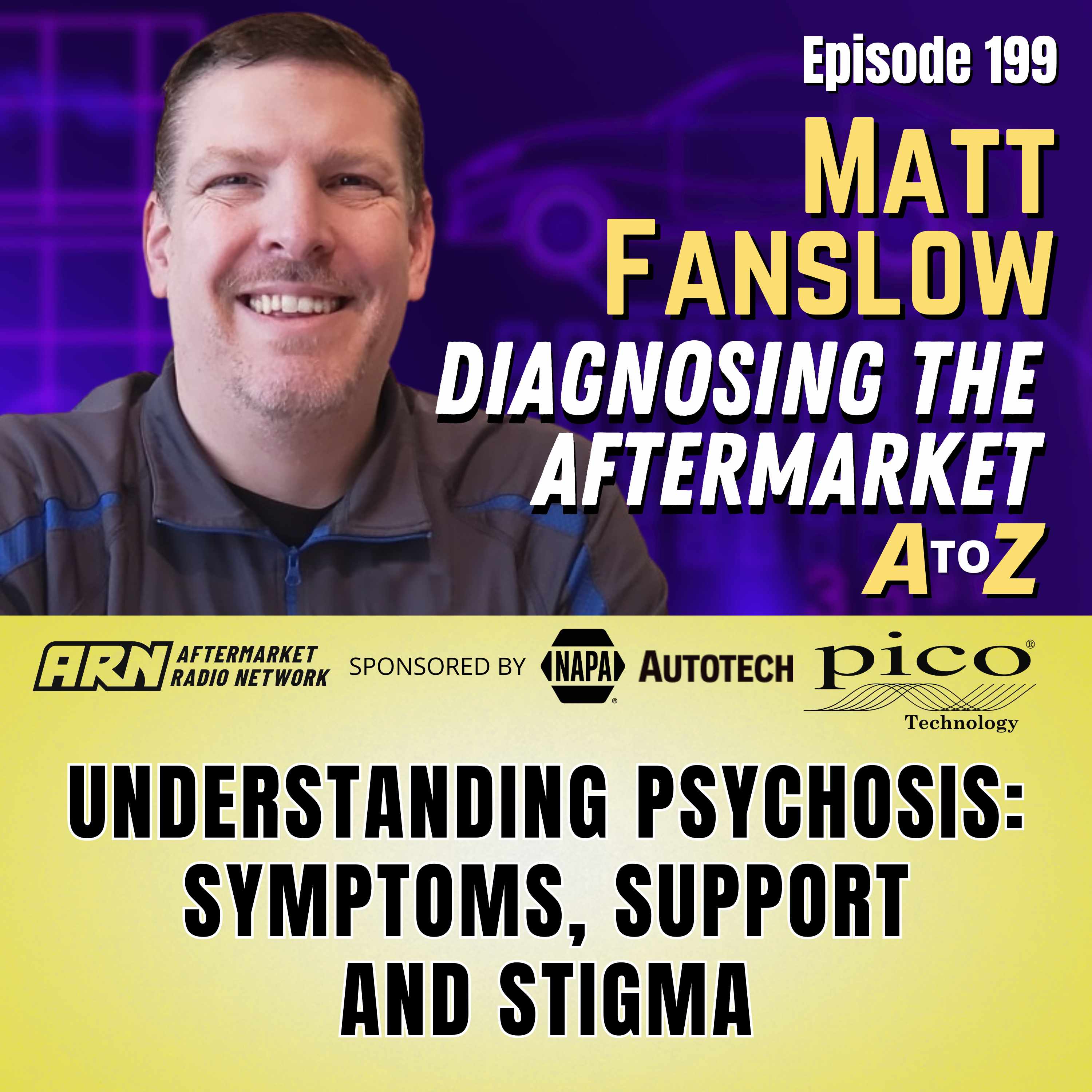
Margaret Light, a licensed marriage and family therapist, joins Matt Fonslow to discuss the complexities of psychosis, including its symptoms, misconceptions, and the stigma surrounding mental health issues. They clarify the differences between psychosis and psychopathy, explore the various disorders that can exhibit psychotic symptoms, and emphasize the importance of understanding and compassion when interacting with those affected. The conversation also touches on how to support individuals experiencing these symptoms, the role of mental health in the workplace, and the need for better resources and awareness.
Topics:psychosis symptomsstigma and misconceptionssupporting individualsmental health in the workplacedelusions and hallucinationsempathy and validationmental health resourcesemployee assistance programs
Matt Fanslow and guest Margaret Light, a licensed marriage and family therapist, unpack common misconceptions around psychosis and psychopathy.
The conversation also tackles the stigma surrounding mental health and stresses the importance of validation and empathy when supporting someone experiencing psychotic symptoms, rather than trying to argue or prove them wrong.
NAPA Autotech’s team of ASE Master Certified Instructors are conducting over 1,200 classes covering 28 automotive topics. To see a selection, go to napaautotech.com for more details.
Thanks to our Partner, Pico Technology
Are you chasing elusive automotive problems? Pico Technology empowers you to see what's really happening. Their PicoScope oscilloscopes transform your diagnostic capabilities. Pinpoint faults in sensors, wiring, and components with unmatched accuracy. Visit PicoAuto.com and revolutionize your diagnostics today!
"So I used to work in an emergency department, right? Where when 9-1-1 was called or crisis was called, folks were brought to me and then I did the assessment."
Select text to request an explanation
This is the Aftermarket Radio Network.
Welcome everyone to yet another episode of Diagnosing the Aftermarket A to Z. I'm Matt
Fonslow and I should do a movie quote, but I'm not.
I'm going to introduce my guest, Margaret Light.
You've maybe heard of her before.
She's been on the podcast once, maybe twice.
Okay, like half a dozen times.
She is a licensed marriage and family therapist.
She is also the president.
Okay, according to her, the owner of Equilibrium Therapy Services.
Welcome to the podcast.
Thank you for being on.
And before we get rolling too quickly here, I'd like to thank our sponsors, Napa
Autotech Training and Pico Technology.
Let Napa Autotech's Buildatech program.
You know, like Build-A-Bear, help you turn your general technician into a money maker
for your shop.
Make them a profitable member of your team.
Go to napautotech.com for more details.
Are you chasing elusive automotive problems?
Pico Technology empowers you to see what's really happening.
Pinpoint faults and sensors, wiring, and components with unmatched accuracy.
PicoScope oscilloscopes transform your diagnostic capabilities.
That's PicoAuto.com.
That's P-I-C-O-Auto.com and revolutionize your diagnostics today.
Thank you for having me back.
Thank you again for being on and putting up with a lot of my BS, would be putting it
kindly.
Shortcomings.
Which I have many.
If I were to quote Rhett Butler, yeah, that is a character from Gone with the Wind.
For those of you that don't know, Gone with the Wind is a old movie.
Everyone should watch but just keep in mind slavery wasn't as good as they depicted it.
True.
Thank you for that disclaimer.
Will you be watching the disclaimer on before you get to watch it?
So it's hard to forget.
Anyways, you pitched a really, really good idea for an episode.
When you sent it, my initial reaction was to make a joke which showed a misunderstanding
that I think, and then I don't mean this in defense of myself.
I just think in general too, in general populace that we have a big misunderstanding about
psychosis and psychopathy.
And I had made a joke about psychosis, almost like serial killers, sociopaths, stuff like
that.
But that's not what you were talking about at all.
That's true.
I mean, for the sake of the audience, could you please explain where I went awry with
that knee-jerk response of mine to try to be funny and fail?
So it's either a loss of contact with reality or it's when a person struggles to differentiate
between what's real and what's not.
Psychopathy or sociopathy or antisocial personality disorder, while some of those terms sound
similar, what that refers to is this ongoing pattern of behavior where somebody violates
the rights of others and displays a lack of empathy.
So they're actually completely different.
Yeah.
I'm thinking just like off the cuff, an example might have been for what you're talking
about, the break from reality was a somewhat public struggle of a movie director named
Kevin Smith, where he had to go, I think he went to inpatient to try to get back
because he did have a very major break from reality.
I think his and I don't want to steer this at all.
Like I really want the ball to be in your court and kind of go in the direction you
would like.
But I feel like my understanding of his break was driven very, very hard by a big, big
or an extreme level of imposter syndrome, where Kevin Smith, the person, wasn't
the Kevin Smith that he was acting like and being thought of as by the general populace.
And that was my understanding of it.
That was the drive that sent him and I don't even want to say like a dark way, just with
that break.
I guess I can't comment on that just because I'm not familiar with sort of that event.
When I talk about psychosis and loss of contact with reality, our hallmark is one
or more of the following five symptoms.
And so I think that probably paint a better picture of what is psychosis in a clinical sense.
So it's a combination, one or more of the following of delusions, which I'll define
in a minute, hallucinations, disorganized thinking, grossly disorganized or abnormal
behavior, and what we call negative symptoms.
And so that's a lot of clinical language that we should probably break down one
by one.
And not to push this again or accelerate it at all.
But my guess is the first thing popping into the listener's head or for sure mine jumping
up and down is schizophrenia.
Yes.
So you're exactly right there.
So the way we kind of think about it is there's these class of disorders, schizophrenia
spectrum and other psychotic disorders is sort of the general class.
And then there's a whole bunch of disorders that fit into that class of which schizophrenia
is one, but not the only one.
So those tend to be the disorders people are most familiar with when we think about
psychotic symptoms.
But the reality of psychotic symptoms can actually show up in a variety of places.
So OCD can look like psychotic symptoms, but it isn't bipolar disorder can include
psychosis, depression, drug use can look like psychosis or even induce it.
Normally prescribed certain types of medication can trigger psychosis.
It can be related to medical conditions or postpartum.
So after somebody gives birth and then also neurodevelopmental disorders.
So that's like autism, developmental delays, things like that.
So it isn't unique to this family of psychotic disorders, but that tends to be what we
think about most when we think about it.
Again, with a little bit of fear of derailing this or going off on a tangent,
but you've used the word psychotic now multiple times.
And I think just as kids, as adults, online, watching exchanges, people refer
to someone as being your psychotic, using it in such a way that's not
accurate whatsoever as to what they're pointing out, whatever behavior or
whatever somebody typed, something like that.
Yeah. I mean, very much so.
I've seen that too.
And I think that's actually part of why I pitched the idea is because I
saw some things playing out where clearly there's just like this massive
lack of information and understanding about what is this language clinically?
What does it actually mean?
And then what are the realities associated with this phenomenon?
Because yes, right?
When we're sort of calling one another psychotic just out in the
general populace, it is never used in an accurate way.
I probably should have researched this.
I don't know where it stems from.
You know, I suppose the knee jerk reaction would be the movies kind of
series psycho, but that's just the very beginning.
It never went to psychotic.
I would argue part of it comes probably from stigma in terms of these
class of disorders and this kind of symptomology is really feared.
And then there's also a lot of stigma around what does it mean to
struggle with this?
Who struggles with this?
How common is it?
And then when we continue to use language like that, it really
perpetuates some of these myths about what does this mean?
How do people think when they're experiencing this?
And then there's this level of shame when we're using it in this way,
which just actually makes the shame associated with the actual
clinical disorders even worse.
Yeah, we got to get shame in whenever we can.
Is that a US thing or is the pretty much the entire planet
kind of got that covered?
I mean, probably the entire planet.
And it's also a function, I think, of misinformation too.
There's a few generations, I think, shame worked, meaning like
for a few generations of it, it worked for controlling behavior
and disciplining and that.
And then now we're feeling the repercussions.
I don't know if I agree with that.
I'm going to go super literal for a minute.
If we think about the way shame is used to control behavior,
this is what a lot of families will do if, let's say, an
adolescent starts displaying some of these symptoms.
Is there can be a lot of shaming around it and a lot of fear?
And actually, it does nothing to control that behavior.
It just creates all this inner turmoil for people who maybe
are dealing with things they have control over.
Shame can be a way to control behavior.
But if it's something you don't functionally have control over,
it's actually massively ineffective.
Yeah, and I think that's where I was aiming to comment
that it was more of a I hate the word normal.
Normal is not.
But if I mean normal by maybe the masses and certain just
for the sake of conversation criteria, that those of you
not watching the video quote on quote works, worked.
And then after a multiple generations of it, it's
starting to backfire.
It's not so that's such a strong ploy, it may be easy.
Again, I don't want to go off on a tangent here, but just
without having a child with ADHD or symptoms of ADHD,
shame won't work.
It doesn't work.
It will make things worse.
So I would say Alba, he is not perfectly well adjusted yet.
I think he's on the way and maybe won't be perfect.
But on his way to being more in control, the environment
that we have them in has been the biggest benefit to it.
But now to get back on track for another three minutes
until I get us back off track.
And then all right, so let's talk about delusions.
And I'm going to define it clinically for a minute
because this is another term we hear a lot.
That's delusional.
So let's talk about it.
So delusions are I'm going to just quote clinical
language, fixed beliefs that are not amenable
to change in light of conflicting evidence.
And so then we classify them into either bizarre or non-bizarre.
Lots of people aren't going to like this language,
but I'm pulling this directly out of the DSM.
So here we are.
Bizarre delusions are not possible.
So for example, if somebody believes aliens came down
and removed all my organs and put somebody else's organs
inside of me, that would be considered a bizarre delusion.
That is not possible.
A non-bizarre delusion is something that's possible,
but there's no evidence for.
So I'm being monitored by the government.
If there's no evidence for that, right, technically possible,
but there's no evidence.
Delusions can be even clinically kind of difficult
to sort out from what's a delusion
versus what's a strongly held belief.
And that's where I think we see this conversation
culturally is people will have difference of opinion
or belief and say, that's delusional.
Well, is it strongly held belief or delusion, right?
Like there's a whole discussion there.
Part of what how we differentiate between the two is
what is the degree of conviction somebody holds
that this belief is accurate, despite kind of clear
or reasonable evidence to the contrary accounting for culture
and does it impair their life?
And some of this is a little gray
because sometimes what we would consider delusional
in one culture wouldn't be delusional in another.
So right, there's a lot of gray there,
but broadly that's how we think about delusion.
So that's one of our symptoms of psychosis.
Our second are hallucinations.
These are a lot more clear and I think easy to grasp
because they're these perception like experiences
that occur without an external stimulus.
So any of your senses, right?
Seeing, hearing, tasting, feeling, smelling,
things that are not there.
Hallucinations can operate on a spectrum though.
So sometimes they're very, very mild,
which is maybe seeing shadows that don't exist,
which is actually really, really common.
All the way to I see people, places, things,
people are grabbing me, which isn't really happening.
Right, like that's the farther side of that spectrum.
So our third one is disorganized thinking,
which is evidenced in speech.
So that would be speech that's either incomprehensible
or sometimes what people will call word salad,
where people are saying actual words,
but they're not in any sort of order that makes sense.
It just sounds random.
Yes, right.
Houses, it has some good kind of demonstrations
of this actually.
And again, right, this is another thing
that occurs on a spectrum of sometimes it's just
sprinkled in there occasionally,
and so you can still kind of understand them.
Sometimes it's, oh, it's this really tangential stuff
that doesn't actually make sense.
So, you know, the stop light turned red
and then my grandma died
and that happened because the stop light turned red.
Right, like it's just like, that's not tracking.
Our fourth one is this, what we call this
grossly disorganized or abnormal behavior.
And broadly we consider this problems
in any form of goal directed behavior.
And so that could be unpredictable agitation.
It could be kind of childlike behavior
coming from an adult.
It could include what we call stereotype to movements.
So repetitive movements, echoing of speech,
and then the far end of that spectrum
would be what we call catatonia,
which again is a spectrum in and of itself,
but it's essentially this delayed
or decreased reactivity to the environment.
And on the far end of that, we're talking about someone,
we've maybe seen it in movies depicting schizophrenia.
Right, where someone is right catatonic,
they're just literally unresponsive
to the world around them.
And again, this is another symptom
that doesn't just occur in schizophrenia.
And then our final one are negative symptoms,
which is essentially diminished emotional expression.
So maybe they're not expressive in the face,
maybe there's not non-verbals that convey emotion,
diminished speech, diminished ability
to experience pleasure, lack of interest
in social interactions, right,
there's all types of stuff with air.
And so broadly it's those five things
that make up this idea of what is psychosis
or a psychotic disorder.
Napa Autotech training sessions
are being conducted day and night
in a town near you.
This training caters to every level
within your organization,
be it a mechanical assistant,
a mechanical specialist,
a technology specialist,
or a driver safety calibration specialist.
Imagine a one stop shop training partner
in Napa Autotech
that will lead your team to a path to greatness.
Autotech's entry level build the tech classes,
convert the untapped potential of your new hires
into money making mechanical specialists.
Autotech's higher level tech update classes
introduce specialists to the world
of ever changing technologies,
which prevents your shop from getting
technologically stagnant.
Remember, if you're not moving forward,
you're falling behind.
And turning to the front of the store,
the Autotech service advisor class
is an awesome way to hone your client
advocate skillset,
ultimately benefiting the customer
through an improved vehicle repair experience.
But it doesn't stop there.
Imagine an electric vehicle class
that takes your specialist well past the mundane,
yet necessary safety topics.
Well, it's here.
Autotech's EV ready training
is a week long curriculum
that takes participants through a hands-on experience
involving hybrids and electric vehicles.
The session kicks off with the use of PPE
and proper tooling,
while touching on required OSHA regulations.
Then the students dive into the lab vehicles
to gain knowledge of the common high-voltage components
on EV and hybrid vehicles and their function.
Attendees will be taken on a path exposing them
to different electric vehicle manufacturers
to compare component form and location.
Additionally, information about level one
and level two charging systems will be included,
along with a quick look at DC to DC charging.
The operation and maintenance of subsystems are explored,
including the different modes of Tesla operations
and so much more.
So what are you waiting for?
Commit to taking your business to the next level.
With Napa Autotech training.
Electric and hybrid vehicles are here,
and with them, a new era of diagnostics.
Don't get left behind.
Pico Technology's EV diagnostic kits
are your all-in-one solution to safely
and efficiently service any electric or hybrid vehicle.
From comprehensive high-voltage system analysis
and insulation testing
to guided step-by-step procedures
Pico puts the power of confident repairs
right at your fingertips.
Future-proof your shop.
Boost your efficiency
and become the go-to expert
for the next generation of cars.
Visit picoauto.com today.
That's picoauto.com.
If you're laying in bed
and you have a chair that has some shirts
or clothes laying over it
and then it kind of looks like a monster,
that may not technically be hallucinating
because it is dark.
There is something there.
You're just reconstructing something
that probably really isn't there.
Right, correct.
There is a difference there, yeah.
And it's important to know
some people experience hallucinations
as they fall asleep.
There's actually a different name for that.
Those are not considered hallucinations
in the form of psychosis.
That's an entirely different sleep-related thing.
So where do we go from here?
Do we start taking that
and looking at ourselves
to be able to pick up on
if we're starting to have these symptoms
or, alternatively, other people?
Let's talk about
how it actually just shows up
in people in general,
maybe to start with.
Like I said earlier,
most of these symptoms can occur on a spectrum.
And the reality is
lots and lots and lots of people
with these type of symptoms
on a regular basis
and you don't know about it.
So a lot of what's depicted in media
are absolute worst-case scenarios
or they're majorly dramatized.
And so when I was kind of prepping for this,
I did a little research
to try and figure out
like what are some cultural beliefs
around this or what's not.
And I think one of the beliefs
I keep running into
is there's this belief
that people experiencing these symptoms
are at an increased risk
for harming you, right?
They're dangerous.
And even when I hear folks
kind of talk about this,
a lot of times the advice I see
is people saying,
well, protect yourself,
carry a gun,
this, that, or the other thing.
But here's the actual numbers on it.
Out of all the serious mental illnesses,
which, right,
these psychotic disorders
would be considered part of that
but not the only one,
only three to five percent
of violent acts
can be attributed to those illnesses.
And within that,
or sort of of people
who experience severe mental illness,
the reality is they're actually
more than 10 times more likely
to be a victim of a violent crime
than the general populace is.
And so that's why I say
lots of people live with this
and we never know about it.
Now, if you're experiencing this
or you know someone who is,
there can be a variety of insight
into these symptoms.
So again, right,
best case scenario
is somebody notices
these things are happening
and they're distressed by it
or they're worried about it
and then they want to seek help, right?
They want to be evaluated by a doctor
or a mental health professional.
But there is a phenomenon
where somebody who's experiencing these symptoms
or maybe on the farther end of this spectrum
is not aware that these symptoms
aren't reality
and they believe it's truly happening
and then they don't seek help
or are resistant to help
and that's where things
for families and individuals
get a lot more complicated.
To be sympathetic
or try to really understand it,
that's the reality.
That's if you're telling me
the sky is blue
and I'm telling you,
no, you're delusional.
It's some other color.
Even if I am technically right,
which obviously I'm not,
but that's about the level
of trying to convince someone
what they're seeing,
hearing, thinking
is not reality.
Correct.
And I think that brings us to maybe like
the first tip I give people, right?
If you're confronted with someone
who is saying or doing
or believing something
that fundamentally isn't true,
it is not in your
or their best interest
to try and convince them
that they're wrong.
That is not the answer.
If you're confronted
with somebody who's struggling with this,
the answer is to slow down,
listen and validate.
And you can validate
something without saying,
yes, this is true, right?
So if somebody comes up in my office
and says, hey,
the cable guy is part of a government
conspiracy to track my whereabouts,
my answer is not going to be,
no, he's not.
My answer is, oh my gosh,
that sounds really scary.
And that goes back to like the
relationship episode.
And I should say episodes that we've done
that that comes up often.
Validation isn't necessarily agreeing.
It's kind of like leading with,
it's easier said than done, darn it.
I'm working on it.
I'm working on it,
but leading with curiosity and validation
rather than, you know,
firing a look at them like, no.
Well, right.
And it requires us to kind of have
the impulse control to recognize,
hey, this is not a moment
where I need to just say what I think.
Right.
This is maybe a moment to stop.
Or what I tell my clients, pause.
Just pause.
Don't do anything.
Yeah.
It's probably a good practice anyways.
Not that this would ever happen,
but that's a tactic by people.
If they want to manipulate you,
that they lead with statements,
they don't ask questions.
They lead a statement.
So like a,
not that this is for anyone to really
go do,
but just as a thought experiment,
challenge yourself to learn how much
somebody earns at a store.
Go to target.
Go to target and just challenge yourself
to find out what one of the employees
there makes per hour
without asking a single question
and see if you can do it in under
five, 10 minutes.
Well, you end up making statements
and it's playing on exactly
what you're talking about.
And I've kind of steered us off track again.
So I guess, yeah, I don't know
where you're going with that.
But the need to state your position,
your perspective or correct something,
that's playing on that need.
So, hey, you know, I read this article
where marriage counselors,
they make like 250 grand a year
and you might be like,
tell me where,
right.
You might be a horrible candidate for this,
but a lot of others would be like,
yeah, right.
That's what I read.
So you're telling me
the way I'm hearing this is,
this is not true.
And then you might let slip like,
yeah, I make half of that or whatever,
but it's playing on that need.
And so I guess the reason I brought it up
is that everybody fights that desire
or a lot of us, everybody that's blanket statements,
lots of us struggle with that desire to correct.
So do you see those three people over there?
They're looking at me.
What three people?
There's no three people over there.
What's wrong with you?
There's not three people over there.
So the need to correct.
Yeah.
And I think especially for folks who are in a like,
or being correct matters a lot,
right.
That instinct is reinforced.
And so again,
if you're confronted with someone struggling with this,
right, your best response is,
oh, oh my gosh,
tell me about that.
Or I'm so glad you told me or,
oh, that sounds terrible.
Like some type of empathy.
Yeah.
And more than just that situation,
but yeah, absolutely.
To have that awareness, to respond like that,
that's really good advice.
Just that could be a blanket statement
or a blanket advice to kind of lead with that.
And I think the other thing I sort of think about is,
and this is true in a lot of scenarios,
but it is definitely true in this scenario, right?
If we're talking about someone who's experiencing
psychotic symptoms,
there can be a lot of anxiety
and a lot of pressure for the person
who's interacting with them
in this sense of like,
we need to fix this and resolve this now.
And that may not be true or even possible, right?
And so I think there's a piece there about
we need to be able to tolerate our own feelings
long enough to be effective, right?
And obviously there's going to be a very big difference
between someone who discloses,
hey, you know, I was diagnosed with schizophrenia
in my early 20s.
I take medication for it.
I have a psychiatrist.
I want you to know this is just a thing
that happens for me sometimes, right?
Like that is not a crisis.
Versus, I mean, right, we're in Minnesota.
If it's 20 below and somebody walks into
QuickTrip in nothing but shorts
and is talking about the aliens coming to abduct them,
okay, we're probably in a crisis scenario now.
And so we need to be able to modulate our response
to that a little.
Is that one where we're not going to help them?
But somebody could call for help.
I don't know if it's always the best situation
for the law enforcement to show up.
But that's who's probably going to show up
because who else is going to show up
other than maybe law enforcement with some EMTs?
But is that where you engage them in conversation?
And again, I'm not trying to imply like reason with them
or anything like that,
but give them the time of day, validate.
And is that a situation for that?
Assuming, and I don't want to push the stereotype
because like you said, they're much more apt
to have violence performed on them
rather than them being violent with someone else
unless you're cornering them,
of which now it has nothing to do with the mental health
specifically, it's an actual human response.
Is this an opportunity to do something like that?
First things first, when we sort of think
about these symptoms, it can be context dependent
what flags for us.
So here's what I mean by that.
Because we're in Minnesota,
this is a really easy example, right?
If somebody walks into Quick Trip
and it's 90 degrees out and they're in shorts,
it's probably not going to flag for us, right?
We're like, eh, it's hot.
They probably want you to wear a shirt,
but like really no one cares.
That person totally be experiencing these symptoms
and it would never flag for us.
That's different is if it's 20 below
and somebody walks in with nothing but shorts,
that looks very different.
Now, if this is happening randomly with a stranger,
it is very appropriate to either check on them
or call for help, whatever you're comfortable with.
And so in most places, that's either going to be 9-1-1
or some type of crisis line.
The reality is though, we're pretty unlikely
to be confronted with a stranger experiencing these symptoms.
We're more likely to be confronted with a friend
or a family member or a coworker or someone like that.
And that's the place where I think we can really lean
into the relationship of, right, I'm so glad you told me.
That sounds really scary.
I really want to help you with this,
but you can leave help broad, right?
The piece I'll say is like a mental health professional.
So I used to work in an emergency department, right?
Where when 9-1-1 was called or crisis was called,
folks were brought to me and then I did the assessment.
What do we do now?
And so the laws vary state to state,
but as a general statement, at least in Minnesota,
and I know a lot most other states are like this,
the criteria for being able to involuntarily treat someone
for a mental health issue is pretty stringent.
And so I think there's a lot of misconceptions out there
about, hey, if someone is displaying these symptoms,
it means they have to have mental health treatment
and that they would qualify for involuntary treatment
if they didn't sign up for it.
And that's actually not the reality.
So usually our criteria for involuntary treatment
is harm to sell for others
where they've lost the ability to care for themselves.
So if somebody has some delusional beliefs
but is still able to go to work, buy groceries,
care for themselves,
they're not going to meet criteria for involuntary treatment.
So that's a very different process
than if somebody is having so many of these symptoms,
they're not eating, they're going out inappropriately dressed
in a way that would be dangerous for them.
That would be evidence of, okay, actually,
truly you cannot care for yourself now.
So when we think about like, how do we intervene on this?
The kind of advice I give people is,
you're always allowed to call for help
and people can get discouraged because they believe
if I call for help once and the person isn't forced to stay,
it means the system either doesn't work
or will never force them to stay.
But that's not reality.
Sometimes the system has to be alerted multiple times,
hey, there's a problem or hey, the problem has gotten worse.
I've totally worked cases where
the first time I see someone,
they can still care for themselves
and three days later, they've deteriorated
to the point where they can't send them back.
Like you're saying that the terms I would be familiar with,
I think, in this situation is creating a paper trail
and kind of like when we're talking about the domestic violence,
creating a paper trail, this is a similar situation.
Yeah, very much so.
And to some degree, if we slow it down and think about it,
it probably should be.
You should probably have to have a fair amount of evidence
to take away somebody's ability to make their own decisions
and to literally force them to stay in a hospital.
We shouldn't do that lightly.
And so sometimes, if that requires multiple ED visits
or multiple contacts with multiple people, that's valid.
Yep, I agree.
And so I think the question then can become for folks
if you're living in this kind of in-between territory.
Where somebody is having these symptoms,
but they don't meet the criteria to be forced
to receive treatment, what do we do?
And I think that's the place where the relationship
can really come into play of, I really care about you,
how can I support you through this?
Can I bring you to your appointments?
What if we went together?
If it's a family member,
sometimes family members will have release of information
that are kept on file with medical providers,
so they can just call a psychiatrist and say,
hey, I'm worried.
And NAMI has some really great resources
related to this, too, of how do I support someone
in seeking treatment who doesn't want to
or isn't aware that they need it?
I think sometimes there's a misconception of
people have to want treatment,
but what if one of the symptoms of the disorder
is the fact that you are not aware you need treatment?
When she says NAMI, she means N-A-M-I,
so November, Alpha, Mike, Indigo as an organization.
And if you go to their website, I think it is NAMI.org.
It's chock full of lots of information,
good information, resources.
They have really phenomenal stuff,
and they have a little handout,
or it's an excerpt from a book called I'm Not Sick, I Don't Need Help,
specifically covering how do I help a friend or family member
who's in this situation.
As a manager or owner of a business,
that may have somebody that's struggling with,
I'll just say, reality.
I guess what would be your advice?
Because if you want to be supportive,
you still have to run a business.
I think it's very reasonable to be very torn about what to do.
And are there resources that the business and or employee have
that they don't even know they have,
or oftentimes don't know they have as part of work comp type?
And it may not actually be work comp,
but it seems to me like there are certain riders on insurance
that are there without you hardly even knowing
that provide resources or money available
to go seek help.
I'll say help.
I don't want to jump right to treatment, but help.
I think the first question I would ask any manager
in that scenario is,
is the symptom negatively impacting their work performance?
If someone just has a belief, but it doesn't impact work,
it's an interesting moment.
Do I intervene on this or not?
If it's starting to show up in a way
where you can see it's impacting work
or it's impacting their ability to care for themselves
or their family life,
I would argue it's super reasonable
to call an emergency contact or a family member
and say, hey, I'm concerned.
I just want to make sure you're aware.
So that would be an option.
Sometimes EAPs are available employee assistance programs,
which is totally free help.
So you can definitely refer people there.
You can always contact county crisis lines,
state crisis lines, local crisis lines
if you have questions, right?
Or even if the person,
if you feel like they're having some type of episode at work
and truly like maybe cannot function anymore
or you're questioning if they can.
I framed it this way for people before of
would you be open to being assessed
in the emergency room
so we can sort out what's going on?
So I don't immediately jump to,
hey, this is a mental health issue.
It could be a medication reaction.
It could be a medical condition.
It could have something to do with pregnancy
or post birth.
Like I'm not going to jump straight to mental health.
It's, hey, would you be open to like getting assessed
to see if we could get answers?
Yeah, you beat me to it to look frightfully so
that it just seems like that's the knee-jerk reaction
is a mental health issue.
That we got to get this person some kind of meds
to straighten them out.
When it turns out, it's a medical issue,
like a physical medical issue.
Right. So I think that would be a reasonable sort of safe way
to frame it.
We're in a bit of a complicated time
if we're talking about resources
because A, people are losing health care
and good luck selling someone
on getting any type of health care
if it's going to cost them an arm and a leg.
Some of our crisis resources are being defunded
or underfunded.
And so there's some risk there.
And then there's talk about, or I know this has happened,
there's been some defunding of the organizations
that would enforce mental health parity
with health insurance companies.
And so it's a little sticky right now
sorting through some of those resources.
And so I think as a manager or as an owner,
if you're having someone who's trying to navigate this,
you might have to circle back to it a few times
or maybe even get a little creative about
is there a free clinic somewhere?
Is there a family member who could talk to them?
Is there a crisis line?
Sometimes there's mobile crisis units
that can check in with someone
if they get a referral, right?
There might have to be some digging
to even see what's still available.
Yeah, that's good advice.
And then I also think, I guess the other thing
I might throw out there is
if someone is managing this
or is seeking treatment
or some type of intervention for it,
it's probably useful to just support the time off
or whatever they need to take for that appointment
and maybe not enforce a like,
you have to request time off a week in advance.
Like no, you should probably just go see your doctor now.
Like if they're willing,
maybe just like take one for the team
and be okay with it.
I guess I don't understand the thought process
behind not taking one for the team.
But where's the big picture?
I mean, come on.
I mean, I think that's a valid question.
The thing I might throw out there
that I think is so interesting is
we're operating on the assumption
that within this conversation,
if somebody said,
hey, I have an appointment at 10 a.m.,
I have to go,
that the manager would know
or that the person would tell them,
oh, by the way, it's because I'm hallucinating.
But a lot of people aren't going to just close that.
And so then it's this interesting moment of,
so an employee has an appointment at 10 a.m.,
what if they don't want to tell you what it's about?
How are you reacting now?
I am aware of a tech that does work at a shop.
They do struggle.
And they do have the ability to just go up to somebody,
an advisor or the manager or shop foreman
and just say like, I got to go in now.
And away they go.
And that's a really nice arrangement.
Extremely.
Because now they're loyal.
I mean, they're so loyal to that facility
and the people there.
And I think maybe the first couple of times
they kind of went like,
I'm really going to go golfing, going fishing.
But then they see in a day or two or longer,
I don't want to make it sound like the changes
or alterations or whatever bounce back.
However you want to phrase that is so immediate.
But they notice the benefits of it.
And then it's just not questioned anymore.
I'm really glad you brought that up.
Because with some of these disorders,
there can be this thing where these symptoms kind of wax and wane.
So for some people it's seasonal.
For some people it has to do with anniversaries or stress.
For some people it has to do hormones.
And so it can be very variable.
And so having the ability to have an arrangement like that
and be given the benefit of the doubt
is actually really important.
And it's even a reasonable accommodation
which is a whole other discussion
because that's a legal term.
But allowing someone to access medical care
is a reasonable accommodation.
If we just twist this the littlest of bit
and not make it medical,
they have atrial fibrillation.
And such that it is very disruptive.
Like it affects them in a way that they can no longer safely function.
Be it do the job of whatever on the vehicle
or they really shouldn't be driving.
You would probably grant them that time
to just drop everything and get their butt up to ER
or urgent care or find out from their medical practitioner
what to do.
When it comes to the mental health stuff,
all of a sudden that starts to go a little sideways sometimes.
It's probably nowadays better than it's ever been in history
but we still have a ways to go.
Well, we do and you're right.
So I've been kind of digging into the numbers
on this a little bit.
And so it's interesting because we were on an upward trend
in terms of people who reporting,
yes, I could tell my manager
if I was having a mental health issue.
Yes, this could be discussed at work.
No, I'm not afraid of retaliation.
And then since I think the number I saw was since 2020,
those numbers have actually been declining.
Oh man, figures.
So we were headed there and now we're dropping again.
I think it's still better than it was years and years ago
and the other piece I throw out there is we actually know
that having access to employment where
it's more or less a positive experience
like for the most part is actually really helpful for recovery.
And so it's this massive protective factor
if we can make this work somehow
that actually supports people in maintaining their well-being.
It's asking a lot for the individual experiencing these
to be able to recognize they're experiencing them
to seek out help.
The chances of that seem really low, the probability.
So going through that,
I mean the solution is the crisis hotlines,
calling for help, it's all of the things.
You're probably not going to know until you're formally diagnosed
and maybe in some sort of like you said recovery program
or treatment program where now you can kind of
or have a better chance of knowing
when things are going off the rails a little bit.
I don't know if that's a reasonable question.
Is that a reasonable question?
I understand what you're asking.
I think it's both.
So the thing I've noticed even as a therapist
is that there is a level of shame and secrecy
around this type of symptom
that seems to extend beyond other things, right?
So when we think about what are the mental health conditions
that are being discussed really openly anymore,
we're hearing about things like anxiety, depression,
ADHD, autism, stuff like that.
Even as a therapist, I have had clients
who have been experiencing hallucinations for months,
who it takes them months to trust me enough to say,
hey, this is happening.
It's not that they don't know it's happening
and it's not that they don't know it's a problem,
is that there's so much shame and fear around it
that they're afraid to ask for help
even when they know it's an issue.
So I would say, right, to anyone experiencing this
or who's maybe having some beliefs or thoughts
where they're like, oh, maybe that's true, maybe it's not,
I don't know, or people react weird when I say it,
it is totally valid to ask for help with that.
And if for some reason the first person you ask for help from
isn't helpful or is shaming about it,
then ask someone else.
Like keep asking until someone provides
a meaningful level of support.
So there's that piece of it.
And then even asking early, so the first time it happens
and not waiting for months, right?
Or I think about postpartum,
that's a particularly dangerous time
if this type of symptomology is happening,
which is rare to be clear, like it's very rare.
And when it does happen, it can get bad
and get worse really fast.
If you're postpartum and this is just starting,
seek help right away.
And there's a lot more support out there now
around that time period
and the mental health stuff that can happen there.
So it is reasonable to say like,
hey, if you're aware of this,
ask for help early and keep asking until you get it.
We know this profession is overwhelmingly male.
And not that it's so important,
but I guess overwhelmingly by sheer statistics,
heterosexual male,
meaning they probably have a significant other
and have families.
So now their significant other,
whoever they're having a child with,
seems to be displaying these symptoms.
How would one go about A,
verifying that that's indeed the case
and you're not jumping the conclusions
because you listened to a podcast
or watched a documentary or a TV show or something.
And also then if need be to get help
without burning down the relationship
or causing a major rift,
although depending on the situation,
that might be what needs to be done anyways,
or at least risk.
Again, I think it has to do with how you frame it.
So the first step isn't,
hey, are you hallucinating?
Don't do that.
Hallucinating or what?
Yeah, do not do that.
Okay, here's what you do.
Hey, I really love you.
The baby's been up all night.
What if I stayed home with you today?
Can I help you?
Do you want to take a bath?
How about a nap?
Do you want someone to come stay?
I know this is a lot.
That's your first step.
And then maybe introduce the conversation of,
hey, how do you feel like you're adjusting?
How are you feeling?
Am I showing up for you in a way that's helpful?
You can even ask, right?
When is your next appointment with your doctor?
Is there anything you're hoping to discuss with them?
Would you like me to come with you?
If they're sharing things with you
and it sounds like something is happening,
maybe say, hey, what do you think about trying to get in sooner?
And I came with you.
I could help with the baby.
And so it becomes this collaborative thing
and not a you need to get it figured out.
The first one you mentioned, that's really good.
I hate to use the word subtle,
but really kind of subtle way to ensure safety
and without accusing anything like,
I don't think you're right in the head.
I don't know if I trust you at home with the kid
or the baby while I'm at work.
That's a much better way.
And then more observation time or, I guess,
trust building to leading to, like you're saying,
the next and the next and the next.
So that's really smart.
Well, and it builds the relationship, right?
The reality is, even for women who are experiencing
some type of postpartum symptomology,
they don't want to harm their baby.
And if they're having thoughts of that,
they are terrified by it.
It is so, so rare for that to actually progress into harm
or for it to be something that that parent wants.
And so again, right, we're not shaming,
we're not blaming, we're not criticizing.
It's very much, how do I support you?
And how would I take the pressure off?
Margaret, you are a presenter
and have been a presenter now for some classes
to the automotive industry, one rather recently.
And then I think you're going to be down at ASTA
in next month.
Yes.
What are the topics you're teaching there
or presenting about?
Yes.
So next month I'm at ASTA talking about mental health.
It's a four-hour course.
We're going to go over business impacts.
We're going to talk about different mental health disorders
and how those show up.
We're going to talk about recognizing them
and yourselves and other people.
And then we're going to kind of answer those business
questions about as a manager or owner,
how do you support an employee who is struggling
with some type of mental health concern?
And then we're going to go through all the seeking
out stuff.
So that's next month.
And then in November, I am at Super Saturday
and a Paxima.
Wow.
Same subject or do you have another subject?
So Super Saturday, it's a shortened mental health class
two hours and then there's like a round table thing
for owner managers I'll be a part of.
And then a Paxima, again, a two-hour mental health thing
and then a two-hour working with different generations
course.
So bridging that gap.
You said something that piqued my interest
about it builds the relationship.
And I think that would be a very, very interesting topic
for anyone in a business, but especially somebody
that's face-to-face at that point of contact
most of the time that can learn means of communicating
that builds rather than tears down or pulls it apart
or weakens the relationship between the client
and either that person or the facility.
So that's a very intriguing idea to me.
That would be fun.
If I ever built that course, if anyone ever sees it,
we're also going to talk about how to give feedback
in a way that builds a relationship too
because I love that.
I need that.
That's what I need.
So somebody needs to book me for that course
so Matt can take it.
Yeah, I'm going to be in front row
center right next to the aisle.
Okay, good.
I'm going to count on it.
Yes, I'm going to probably ask if I could record it
so I can play it back over and over.
But yes, I need that.
Don't we all?
I really, really want to thank you again for being on.
I mean, every time I think we could just talk
for two, three hours, no problem.
This is fascinating subjects.
I have other subjects or topic ideas
that constantly pop into my head
that would be very interesting to talk about.
And I mean, I don't know.
You've probably heard the room
or sometimes scheduling can be rough with me.
I'd probably be on your podcast more.
Probably.
If scheduling was easier.
Now the emails are flying in and like
Matt, get your act together, which they're right.
I need to get my act together.
If he has problems, they can call me.
But yeah, this has been Margaret Light.
She's a licensed marriage and family therapist.
She is also the, I guess, president or owner,
ruler of the Equilibrium Therapy Services,
namely in Minnesota, right?
Minnesota and Wisconsin now.
Nice.
Excellent.
So Minnesota, Wisconsin, if you're seeking,
I mean, I'm just on the level.
Somebody to talk to and help point out your blind spots
is invaluable to have somebody that is looking out for you,
but not necessarily like friends or biased,
if that makes sense.
And yeah, it's invaluable.
Thank you for having me back.
This was good.
Anytime, absolutely anytime.
And I would just like to thank our sponsors,
NAP Autotech Training and Pico Technology.
I'd also like to thank the Aftermarket Radio Network
and even Tracy for helping get this up and go on
so that Margaret and I could record this.
Until next time, take care.
Request an explanation for:
1 cars
1 cars featured
Request an Explanation
Heard something you'd like explained? We'll add it to this episode.
Sign in to request explanations for terms you heard.
Want to learn more?
Browse our glossary for plain-English explanations of automotive terms, jargon, and concepts.
See something that's not quite right? Our annotations are AI-generated and can sometimes miss the mark.
Click the flag icon on any annotation to suggest a correction.